
Planning applications in Sutton rarely fail because the architecture is poor. More often, they stall because transport questions arrive late, evidence is too thin, or a perfectly workable scheme hasn’t been translated into the language highways officers need to see. That’s where a Traffic Engineer in Sutton becomes genuinely useful.
We work with architects, planners, developers, solicitors and local authorities to turn development ideas into clear, defensible transport evidence. In practical terms, that means assessing likely traffic effects, reviewing access, checking parking and servicing, testing junction performance, and making sure a proposal responds to Sutton’s local planning and highway context rather than relying on generic wording.
In 2026, that local angle matters more, not less. Boroughs are under pressure to support growth while managing constrained road space, active travel priorities, servicing demands and road safety obligations. So even relatively modest schemes can trigger transport questions if access is tight, parking is sensitive, or trip generation changes materially.
This guide explains what a traffic engineer does in Sutton, which developments usually need transport input, how Transport Statements, Transport Assessments and Travel Plans fit into the process, and why early advice can save weeks of redesign and negotiation later on. For teams trying to keep applications moving, that’s often the difference between a straightforward determination and a long, expensive back-and-forth.
Key Takeaways
- A Traffic Engineer in Sutton is essential for providing site-specific transport evidence that addresses local road conditions, access, parking, and safety, thereby supporting successful planning applications.
- Early involvement of a traffic engineer helps identify and resolve transport issues before finalising designs, reducing costly delays and redesign in the planning process.
- Transport Statements, Assessments, and Travel Plans must be proportionate and focused, correctly scoped to the development’s scale and impact for efficient planning approval.
- Common developments needing transport input include residential, commercial, mixed-use, and change-of-use projects, where trip generation, access, or parking may materially change.
- Good traffic engineering in Sutton emphasises practical, local solutions—such as junction testing, vehicle tracking, and realistic parking and servicing strategies—that align with borough priorities.
- Choosing a traffic engineer familiar with Sutton’s planning context ensures clear, concise, and timely reports that can challenge and improve designs for smoother application approvals.
What A Traffic Engineer In Sutton Does For Planning And Development

A Traffic Engineer in Sutton helps planning teams demonstrate that a proposal is acceptable in transport terms before the application is determined. That sounds simple. In practice, it covers quite a lot of ground.
We typically review how a development affects the surrounding highway network, what traffic it is likely to generate, whether the site can be accessed safely, and whether parking, servicing and refuse movements work in the real world rather than just on a drawing. We also translate those findings into reports, technical notes and drawing comments that planners, case officers and highways officers can assess efficiently.
For some projects, the task is strategic: establishing whether a scheme needs a full Transport Assessment or a shorter statement, and setting out a proportionate evidence base. For others, it is highly detailed: junction modelling, swept path analysis, visibility checks, access geometry, or a review of whether delivery vehicles can enter and leave in forward gear.
That’s why development teams often bring us in alongside architects and planning consultants rather than after the design is fixed. Wider Traffic Engineering and Transportation principles matter, but local application is what gets schemes over the line. A useful transport engineer doesn’t just produce a report: we identify issues early, suggest workable mitigation, and present the case in a way that supports planning success.
Why Sutton Developments Need Local Transport Evidence
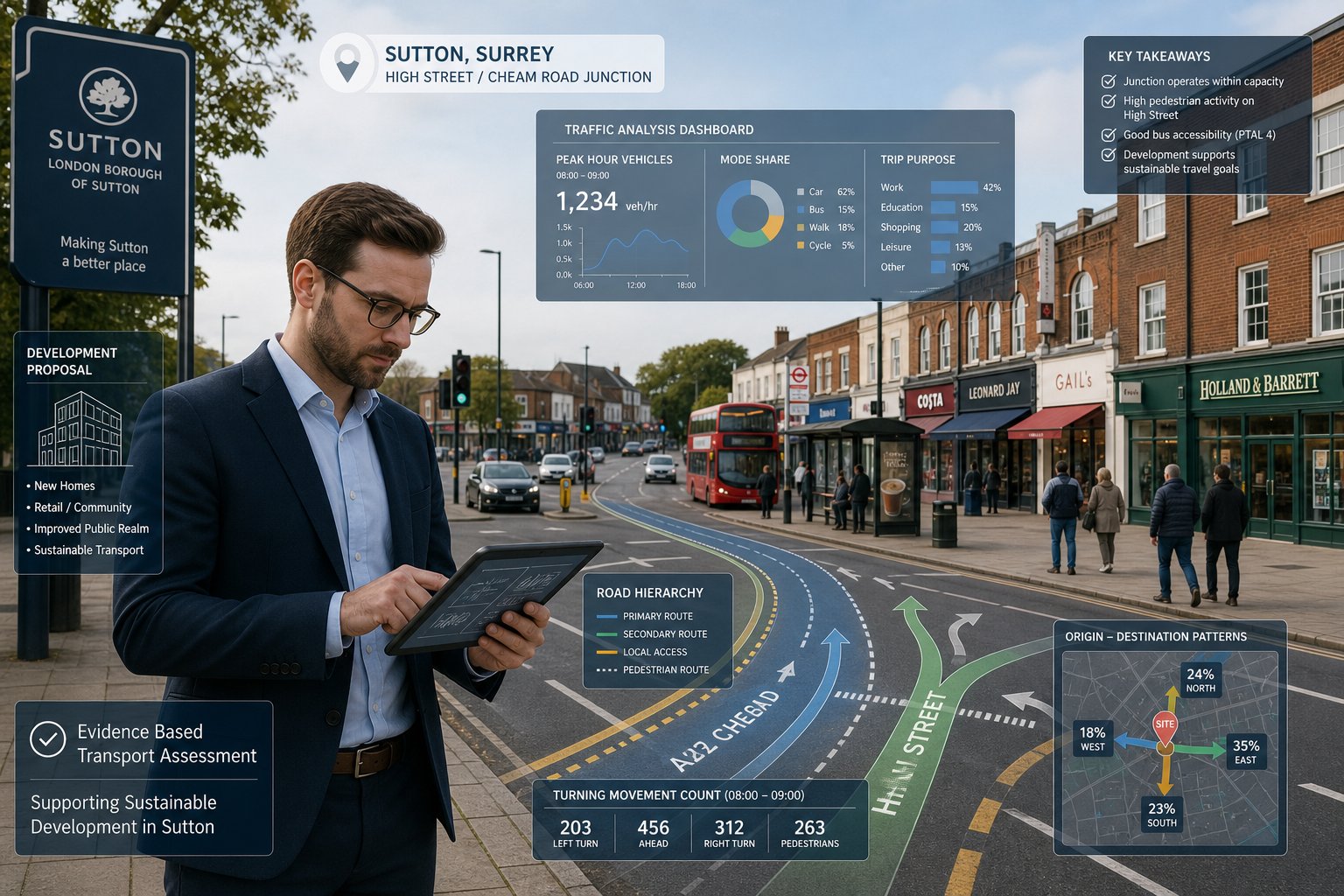
Planning authorities do not usually accept broad claims such as “the impact will be negligible” unless the statement is backed by site-specific evidence. In Sutton, as elsewhere, officers want to know what happens on the roads and footways around the development in question, at the access point proposed, with the type of trips the scheme is likely to generate.
That local evidence matters because transport effects are rarely abstract. A scheme may sit on a corridor that already experiences peak-time stress. Another may front a relatively quiet road but create awkward turning movements near a school, bus stop, parade of shops or signal junction. A third may look minor on paper yet create parking overspill in a street where kerbside pressure is already obvious. Generic text misses all of that.
We hence build the transport case around the actual site, local road hierarchy, nearby junctions, sustainable travel options, and the character of surrounding movement. For clients working across borough boundaries, the difference is important. A methodology that suits one authority may need adjusting in another, which is why comparative experience from a wider Traffic Engineer In London: context can help, but Sutton-specific judgement still carries the day.
In short, local transport evidence shows that a proposal has been tested properly. It gives officers something concrete to assess, reduces ambiguity, and makes it easier to answer objections before they harden into delays.
Sutton Planning Context And Highway Considerations
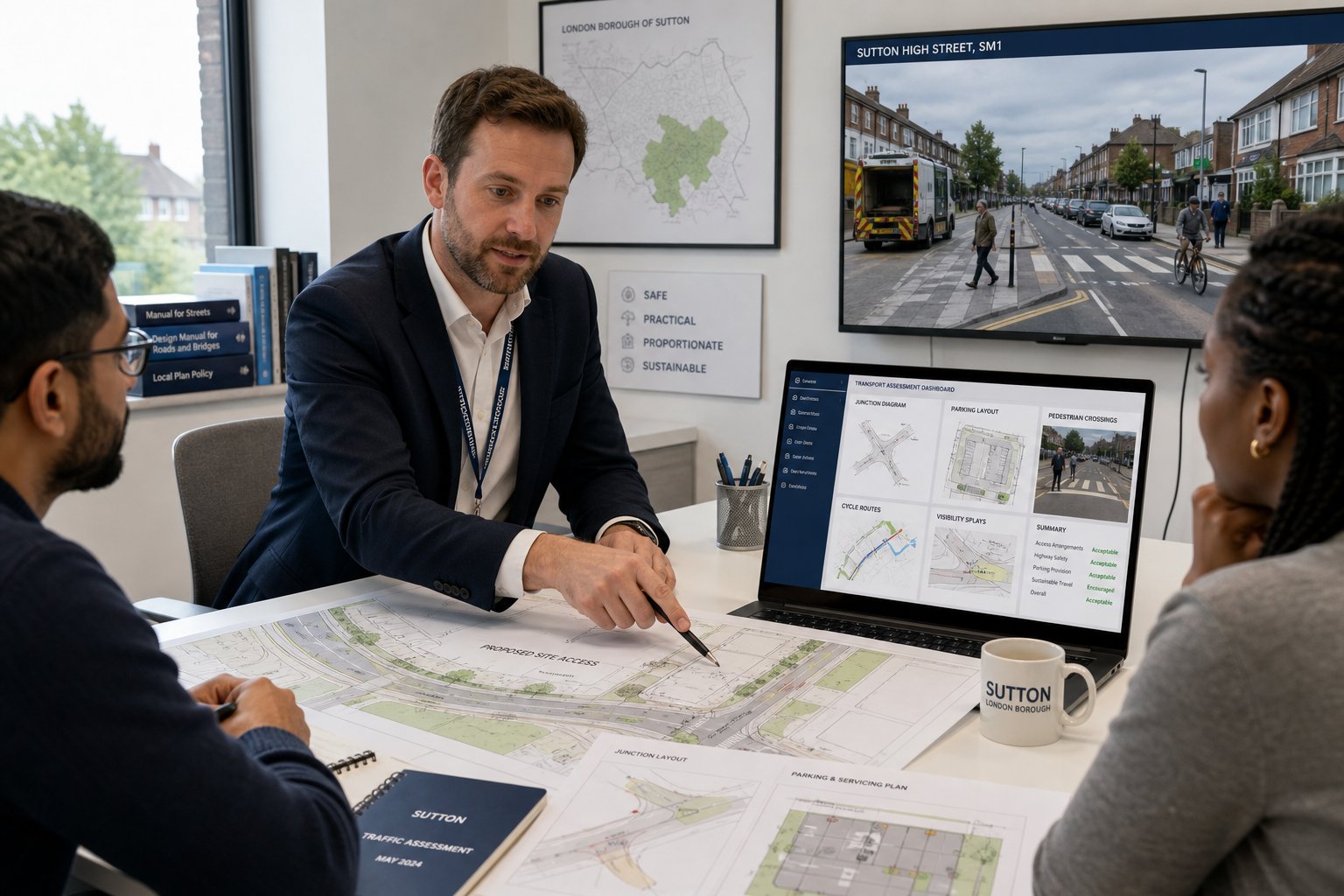
Sutton’s planning context sits within the familiar London tension: accommodating growth while protecting safety, network function and place quality. That means transport submissions need to do more than count cars. They need to explain how a proposal sits within a broader movement picture.
The main highway considerations are usually road capacity, access suitability, visibility, pedestrian and cyclist safety, parking stress, servicing practicality and the effect of development traffic on nearby junctions. Depending on location, public transport accessibility, school travel patterns, town centre conditions and controlled parking arrangements can also become central issues.
Local officers are often less interested in theoretical perfection than in whether a proposal is realistic, safe and proportionate. Can vehicles turn without conflict? Is the access arrangement obvious and operable? Will refuse collection work without blocking the street? Are vulnerable road users protected? Those are the kinds of questions that shape decisions.
This is where concise, accurate reporting matters. At ML Traffic, our work is built around local authority thresholds, proportionate scope and fast turnaround, because planning teams usually need answers before the wider design programme slips. Good Highway And Traffic Engineering advice supports both the technical case and the submission strategy.
And yes, sometimes the right answer is that a layout needs changing. Catching that before submission is far cheaper than defending a weak access arrangement once consultees have raised concerns.
Common Schemes That Require Transport Input In Sutton
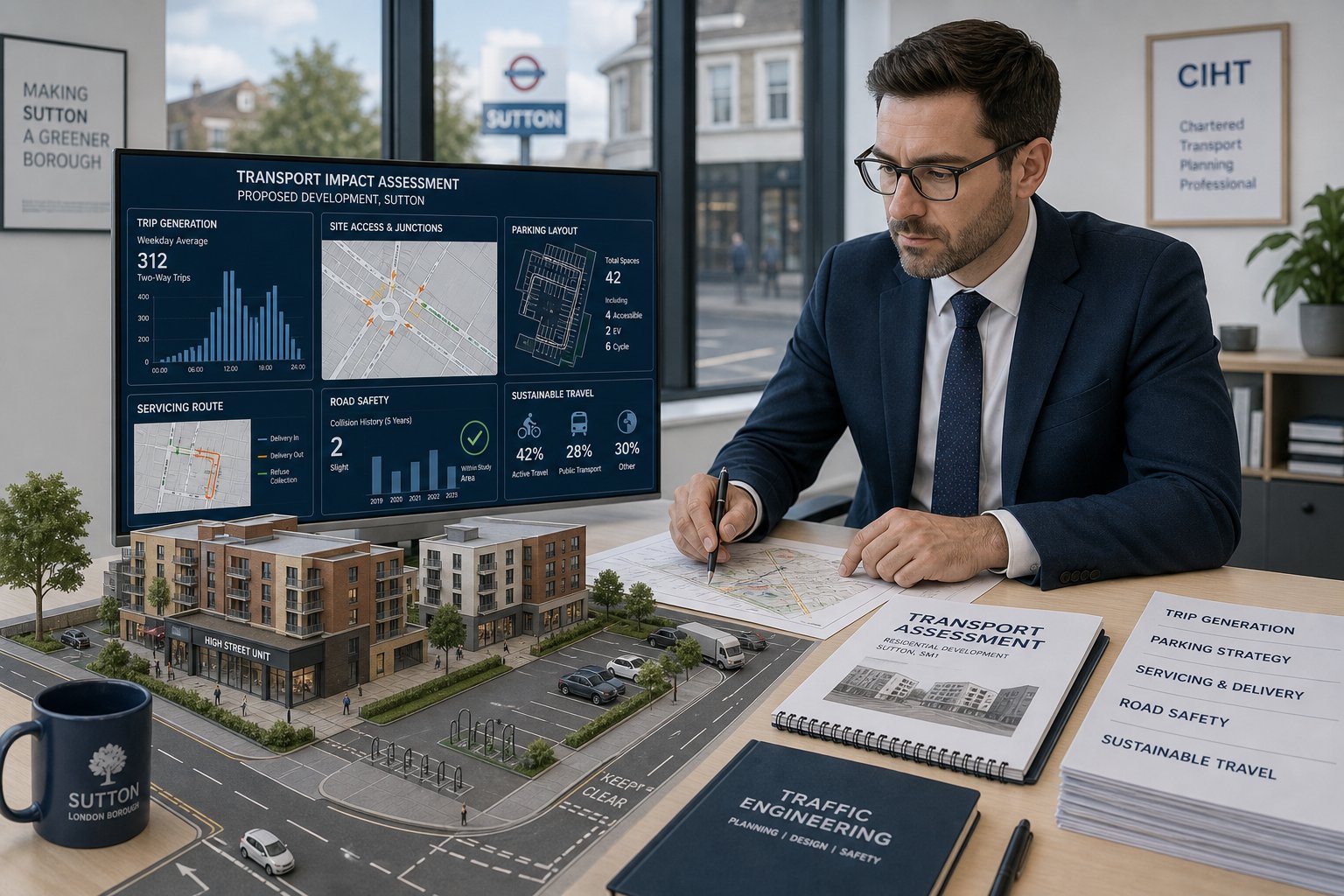
Not every application needs a lengthy transport report. But many more schemes need some level of traffic engineering input than applicants first assume. In Sutton, the trigger is usually whether the proposal changes trip generation, site access, servicing arrangements, parking demand or road safety conditions in a way that could be material to determination.
Residential Developments
Residential schemes are among the most common projects requiring transport input. That includes new-build houses and flats, backland development, infill schemes, estate renewal, and larger apartment-led sites. Even a modest proposal can raise transport questions if it introduces a new vehicular access, reduces manoeuvring space, relies on constrained parking, or affects a sensitive junction nearby.
For housing projects, we usually consider likely trip rates, access visibility, internal layout, parking provision, cycle parking, refuse collection, delivery activity and the relationship with walking routes and public transport. In denser parts of the borough, the issue is not always traffic growth in absolute terms. Sometimes it is whether the access works safely on a narrow frontage, or whether the parking strategy is credible enough to avoid overspill.
Commercial, Mixed-Use, And Change-Of-Use Projects
Commercial and mixed-use schemes often bring a different transport profile: staff arrivals, customer turnover, timed deliveries, servicing peaks and more varied vehicle types. Change-of-use applications can be especially sensitive because a seemingly simple switch in planning terms may alter trip patterns significantly.
A café replacing a retail unit, a gym occupying former office space, or an industrial unit intensifying operations can all prompt questions about parking, loading, junction effects and neighbour amenity. That is why many applicants benefit from early Commercial Traffic Engineering input. We can compare extant and proposed uses, test whether the access and servicing strategy still works, and frame the evidence in a way that directly addresses likely highway concerns.
Transport Assessments And Transport Statements Explained
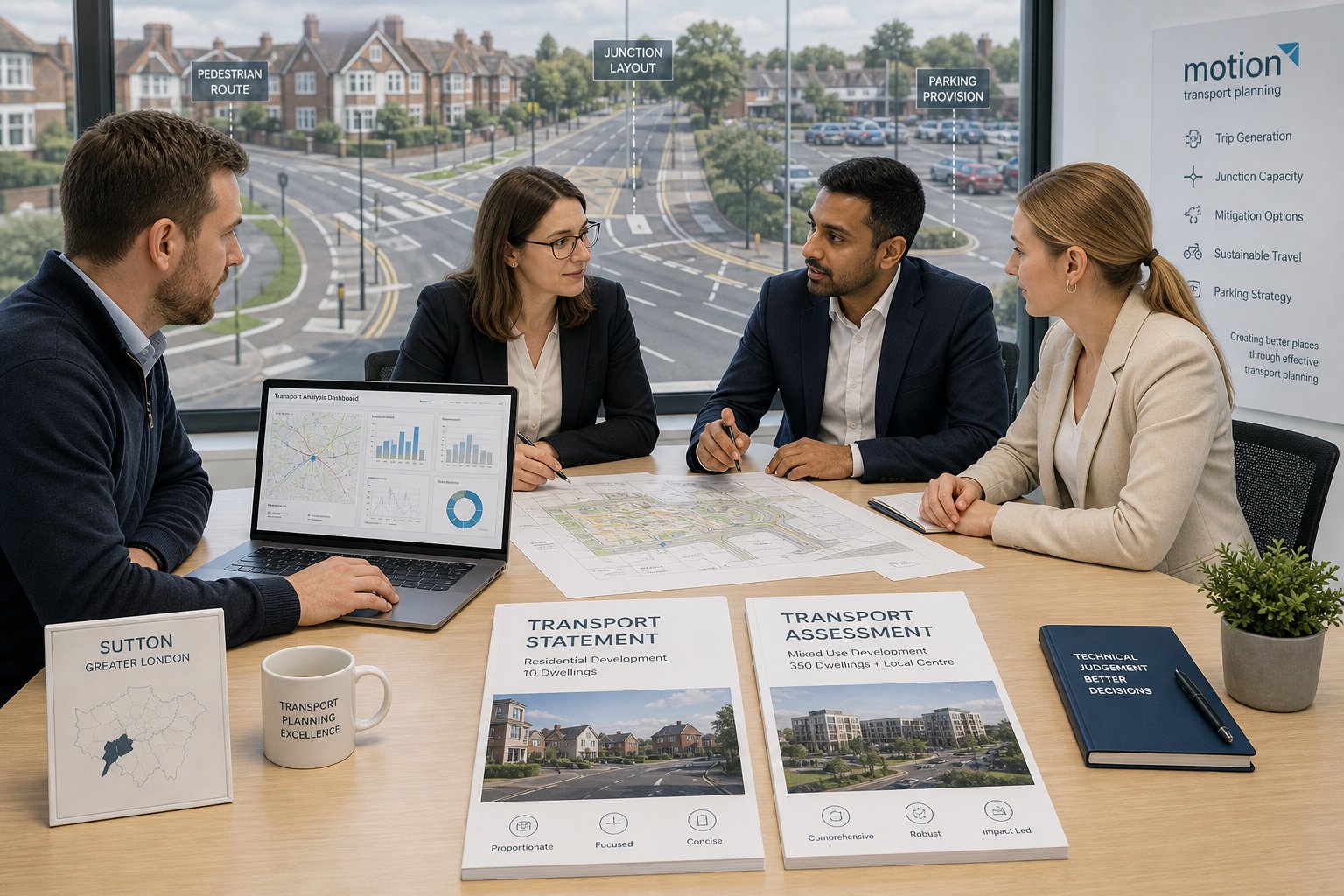
Transport Assessments and Transport Statements are formal planning documents, but they are not interchangeable labels for the same thing. The difference is mainly one of scale, complexity and likely impact.
A Transport Statement is typically used for smaller or less intensive developments where the transport implications can be explained clearly without extensive modelling. It usually describes the site context, accessibility by different modes, expected trip generation, existing highway conditions, access arrangements, parking and servicing, and whether any mitigation is needed.
A Transport Assessment is usually required where impacts are more significant or more heavily scrutinised. It goes further, often including a wider study area, more detailed trip generation analysis, distribution and assignment assumptions, capacity assessments at nearby junctions, accident review, and a clearer mitigation strategy.
The key point is proportionality. Submitting an overblown report can waste time and cost. Submitting an under-scoped one can trigger consultee objections and requests for more information. A capable team of Traffic Engineering Consultants: will usually advise on the likely scope before the application is lodged.
We approach both documents as decision-making tools, not box-ticking exercises. Officers need a report that answers the right questions: what the development does, what it changes, whether the network can accommodate it, and what measures make the proposal acceptable. When that is done well, the report feels straightforward. Which, oddly enough, is often a sign that quite a lot of thought has gone into it.
When A Travel Plan Is Needed And What It Should Cover
A Travel Plan is typically requested when a development is large enough, or operationally significant enough, that the authority wants a structured strategy for managing how people travel to and from the site. In Sutton, that can apply to residential, employment, education, healthcare and mixed-use schemes, depending on scale and context.
The purpose is not to pretend nobody will use a car. It is to show that the applicant has thought seriously about reducing unnecessary car dependence and supporting sustainable travel choices. A good Travel Plan explains likely travel patterns, identifies barriers to walking, cycling and public transport use, and sets out practical measures to influence behaviour over time.
That might include welcome packs for residents, cycle parking and shower facilities, public transport information, car club promotion, monitoring arrangements, targets, a Travel Plan coordinator and review mechanisms. For residential schemes, the emphasis is often on information, infrastructure and long-term management. For employment-led sites, it may involve staff surveys, mode-share targets and operational measures.
We always try to keep the document grounded in the site. Vague aspirations do not carry much weight. Specific actions do. And where a proposal already sits in a relatively sustainable location, the Travel Plan should make intelligent use of that fact rather than padding the document with generic promises.
Handled properly, a Travel Plan can help resolve concerns that might otherwise become conditions, committee questions or post-submission negotiation points.
Junction Capacity, Access Design, And Highway Safety Reviews
This is often the section of transport work that decides whether a scheme feels robust or fragile.
Junction capacity testing examines whether nearby junctions can accommodate development traffic without severe operational problems. Depending on the site and network, that may involve priority junction assessment, signal modelling, roundabout analysis or a more qualitative review where impacts are demonstrably low. The goal is not to produce numbers for their own sake. It is to understand whether queues, delay and driver behaviour are likely to worsen materially.
Access design focuses on how vehicles, pedestrians and cyclists enter and leave the site. Geometry, visibility, gradients, tracking, proximity to junctions, kerbside activity and interaction with footways all matter. A small adjustment to gate position or carriageway width can sometimes resolve an issue that would otherwise attract an objection. Thoughtful access design highway work is often one of the most cost-effective interventions in the whole planning process.
Highway safety reviews then pull the picture together. We look at collision history where relevant, likely conflict points, vulnerable road user movement, reversing risk, servicing interactions and whether the design encourages predictable behaviour. Broader Traffic Engineering: Your principles are useful here, but local judgement matters just as much.
Because a technically compliant layout can still be operationally awkward. And officers are usually quite good at spotting that.
Parking, Servicing, And Refuse Vehicle Tracking
Parking and servicing issues cause a surprising number of planning delays, especially on constrained urban sites where every metre of frontage is doing too much at once.
For parking, the task is not only to count spaces. We need to consider likely demand, usability, disabled provision, electric charging expectations, cycle parking, turning space and whether vehicles can enter and leave safely. In Sutton, parking stress in surrounding streets can quickly become a live issue, particularly where neighbours believe a scheme underprovides or displaces demand.
That is why a clear parking strategy matters. It should explain why the proposed level is suitable for the location and use, how it will operate, and whether management measures are needed. In more complex cases, a structured parking strategy traffic approach helps demonstrate that provision is not arbitrary.
Servicing is equally important. Delivery vans, moving vehicles and maintenance activity all need somewhere realistic to stop or manoeuvre. Refuse collection often becomes the make-or-break detail. If bins cannot be presented sensibly, or if a refuse vehicle cannot access and exit safely, officers will notice.
Swept path analysis is commonly used to test that larger vehicles can move through the site without overrunning kerbs, striking obstacles or relying on unsafe reversing. Those drawings may look technical, but they answer a very ordinary planning question: can the place actually function day to day?
How Early Traffic Engineering Input Can Reduce Planning Delays
Early transport input saves time because it catches avoidable problems before they harden into design assumptions. That may sound obvious, but plenty of projects still bring in a traffic engineer only after layouts are largely fixed and the planning statement is being drafted. By then, any significant access or servicing issue becomes expensive to unwind.
We prefer to review schemes at concept or pre-application stage, when changes to access position, internal circulation, parking layout or servicing arrangements are still manageable. At that point, even a short note can identify whether the site is likely to need a Transport Statement, fuller assessment, Travel Plan, vehicle tracking or junction testing. That lets the wider consultant team programme surveys and drawings sensibly.
Early advice also improves the quality of conversations with officers. If likely transport concerns have already been recognised and addressed, pre-app feedback is usually more focused and more constructive. The application then arrives with fewer surprises.
For multi-disciplinary teams, this is where experienced Highway And Traffic support earns its keep. Instead of reacting to objections, we help design them out where possible. That can reduce redesign cycles, additional information requests, planning conditions and committee risk.
Not every delay is preventable, of course. But many of the most frustrating ones are entirely predictable if transport is reviewed too late.
What To Look For When Choosing A Traffic Engineer In Sutton
If you are appointing a Traffic Engineer in Sutton, technical competence is the baseline, not the differentiator. What usually makes the difference is whether the consultant can apply that competence quickly, proportionately and with a real understanding of local planning dynamics.
First, look for local authority awareness. The consultant should understand how borough transport concerns are typically framed, what level of evidence is proportionate for the scheme, and when a short, sharp technical note will do more good than a bloated report.
Second, check practical capability. Can they prepare Transport Statements and Assessments, review access geometry, undertake vehicle tracking, comment on parking and servicing, and advise on junction impact where needed? In many cases, broad Traffic Engineering Consultants: What experience is useful because real projects rarely fit neatly into one discipline.
Third, value clarity. Planning officers and legal teams do not want grandstanding: they want defensible reasoning, clean plans and concise conclusions. Turnaround time matters too. A brilliant report delivered after the submission window has closed is not much help.
Finally, choose someone who is willing to challenge the design when necessary. The best consultant is not the one who says yes to everything. It is the one who spots the weak point early, fixes it if possible, and then presents the transport case with confidence. That is usually what stronger applications are built on.
Conclusion
For planning applications in Sutton, transport evidence is rarely an optional extra once access, traffic impact, parking, servicing or highway safety become material considerations. The job of a Traffic Engineer in Sutton is to turn those issues into a clear, proportionate and credible case that officers can assess with confidence.
When the work is done early and done properly, it reduces uncertainty across the whole consultant team. Architects can refine layouts with fewer late changes. Planners can submit with a stronger technical footing. Developers gain a clearer view of risk before time and money are committed too far.
In our experience, the strongest applications are not always the largest or most heavily modelled. They are the ones where the transport story is coherent: the access works, the parking and servicing are realistic, the likely impacts are evidenced, and the reporting is tailored to Sutton rather than copied from somewhere else. That is what helps applications move faster and stand up better in 2026.
Frequently Asked Questions About Traffic Engineering in Sutton
What role does a Traffic Engineer in Sutton play in planning applications?
A Traffic Engineer in Sutton assesses how developments affect local roads, junctions, parking, access, and highway safety. They produce transport evidence tailored to Sutton’s context, helping planning teams present a clear, credible case to support application approval.
Why is local transport evidence important for developments in Sutton?
Local transport evidence demonstrates the real impact of a proposal on Sutton’s specific road network, access points, parking, and safety conditions. Planning authorities require site-specific data rather than generic claims to ensure development fits local priorities and constraints.
Which types of projects in Sutton usually require traffic engineering input?
Residential developments, commercial and mixed-use projects, and change-of-use applications in Sutton often need traffic engineering input, especially if they alter trip generation, access arrangements, parking demand, or road safety conditions materially.
What is the difference between a Transport Statement and a Transport Assessment in Sutton planning?
A Transport Statement is a concise report for smaller developments with limited transport impact, outlining site access and trip generation. A Transport Assessment is more detailed, required for significant schemes, including junction capacity analyses and wider transport effects.
How can early involvement of a Traffic Engineer reduce planning delays in Sutton?
Early traffic engineer input identifies potential access, parking, or servicing issues before design finalisation. This proactive approach reduces redesign cycles, lessens objections, and streamlines communications with officers, speeding up planning decisions.
What factors should be considered in parking and servicing strategies for Sutton developments?
Parking strategies must address demand, usability, disabled and electric parking, cycle spaces, and local parking stress. Servicing needs secure delivery and refuse vehicle access, often verified by swept path analysis to ensure safe manoeuvres without road obstruction.