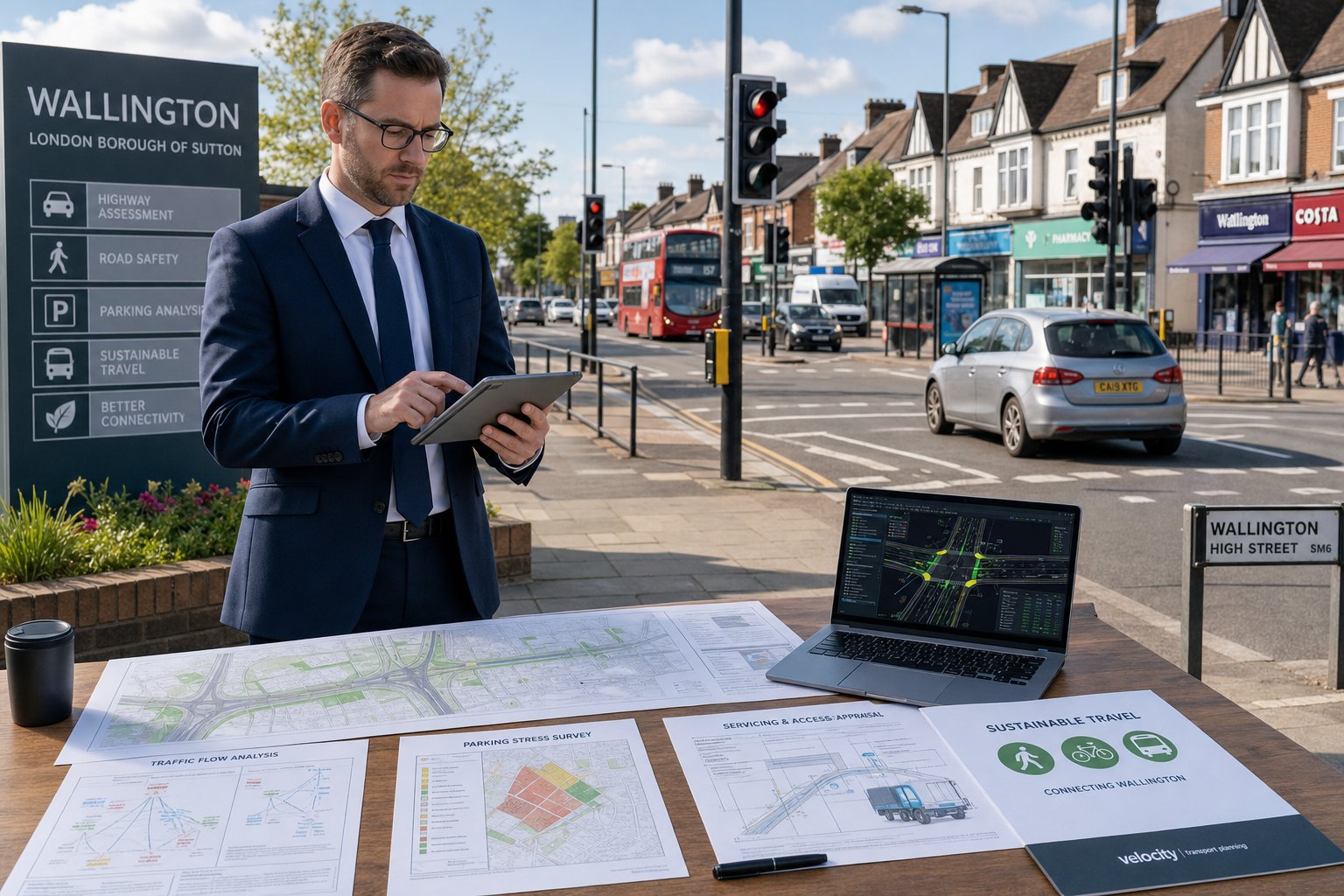
Planning applications in Wallington rarely fail because the architecture is weak. More often, they run into trouble because transport questions are left too late, answered too broadly, or supported by evidence that doesn’t quite fit the local network. A modest infill scheme can trigger neighbour concerns about parking stress. A school extension can raise questions about drop-off peaks. A mixed-use site near a bus corridor can quickly become a debate about servicing, safety, and whether the surrounding streets can realistically absorb more trips.
That is where a traffic engineer in Wallington becomes central to the planning process. We help turn transport risk into clear, structured evidence: how people will arrive, where vehicles will access the site, whether a junction can cope, what parking demand is likely to be, and what mitigation is sensible if impacts appear material. In the London Borough of Sutton, that work needs to align not only with national policy but with local conditions on roads, junctions, schools, stations, high streets, and residential streets that already operate under pressure.
For architects, planners, surveyors, lawyers, developers, and public sector teams, the aim is usually straightforward: submit the right report, at the right level, with enough local detail to avoid unnecessary planning friction. In this guide, we explain what a traffic engineer does in Wallington, when transport reports are typically required, and how well-prepared evidence can help support smoother decisions in 2026.
Key Takeaways
- A traffic engineer in Wallington plays a crucial role in providing localised transport evidence that supports smoother planning applications and avoids unnecessary delays.
- Transport Assessments or Transport Statements are required based on the scale and impact of development, with early scope agreement recommended to match local authority expectations.
- Residential, commercial, and mixed-use developments often require traffic engineering input due to issues like parking demand, servicing, and peak-time congestion specific to Wallington’s urban context.
- Detailed baseline surveys, trip generation forecasting, and junction capacity testing ensure transport impacts are accurately assessed against both national policy and local conditions.
- Supporting documents such as Travel Plans, Construction Logistics Plans, and Servicing Reviews are vital for urban sites to manage sustainable travel and minimise disruptions during and after development.
- Choosing a traffic engineer with strong UK planning experience and local knowledge of Sutton ensures transport advice is precise, proportionate, and aligned with planning strategy, improving the likelihood of consent.
What A Traffic Engineer Does In Wallington Planning Projects
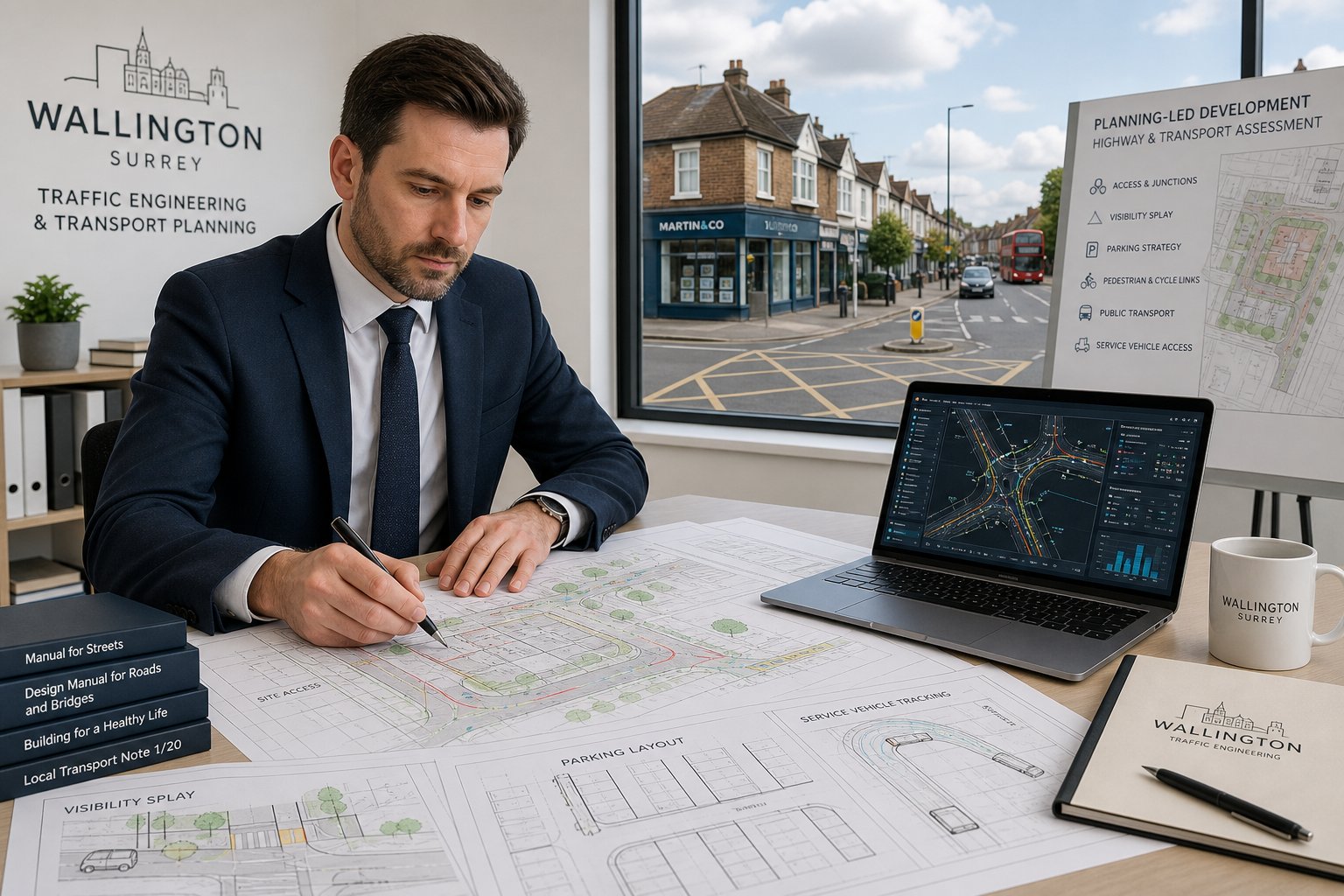
A traffic engineer in Wallington assesses how a development interacts with the surrounding highway and transport network, then translates that into evidence a planning officer, highway officer, committee member, or inspector can actually use. In practice, that means much more than counting vehicles.
We typically begin with baseline conditions: traffic flows, turning movements, speeds, collision history, parking demand, walking and cycling connections, bus accessibility, and nearby constraints such as schools or loading activity. From there, we review the site layout itself. Is the access point safe? Are visibility splays achievable? Can service vehicles enter, turn, and leave in a forward gear? Does the parking layout work in reality, not just on paper?
For many schemes, we also forecast likely trip generation and test whether nearby junctions can accommodate those trips. If not, we advise on proportionate mitigation, which might include revised access geometry, junction alterations, pedestrian crossings, signal timing changes, travel planning measures, or servicing controls. That broader role is covered in work carried out by Traffic Engineering Consultants: supporting planning-led development.
Just as importantly, we prepare formal reports. These can support a full application, discharge conditions, answer objections, or provide technical material for appeal. In Wallington, where local street conditions can vary sharply from one block to the next, that combination of technical rigour and local interpretation often makes the difference between a transport issue being manageable and becoming a reason for delay.
Why Local Transport Evidence Matters For Wallington Developments
Planning policy does not assess development in the abstract. It assesses a proposal in its actual setting. That is why local transport evidence matters so much in Wallington.
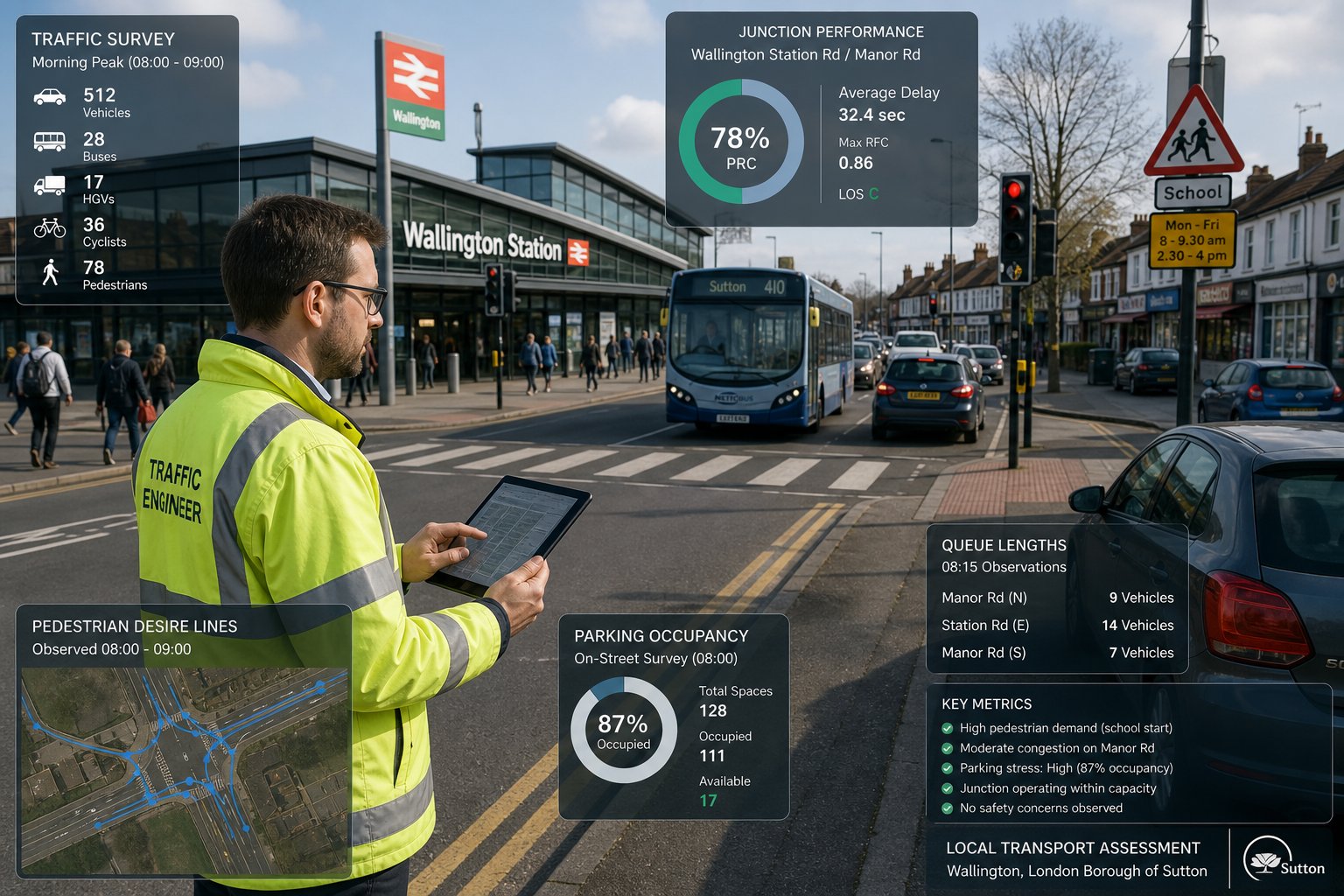
Under the National Planning Policy Framework, development should only be prevented or refused on highways grounds if there would be an unacceptable impact on highway safety, or if the residual cumulative impacts on the road network would be severe. Those tests sound simple. They aren’t. The answer depends on specific evidence: peak-hour counts, queue observations, pedestrian desire lines, parking stress, bus accessibility, and the performance of nearby junctions.
In Sutton, local context is often decisive. A scheme close to Wallington station may justify lower parking provision if public transport access is good and walk connections are credible. The same parking ratio on a more constrained residential street may be far harder to defend. Likewise, a development near a primary school may need a sharper look at drop-off periods than a comparable scheme elsewhere.
That is why we avoid generic assumptions wherever possible. We build evidence from local surveys, collision records, site visits, policy review, and practical design testing. On wider projects across the capital, the same principle applies, as reflected in Traffic Engineer In London: planning support work where borough-specific standards shape the final advice.
Good local evidence does two things. It helps identify genuine risks early, and it gives decision-makers confidence that transport impacts have been considered properly rather than brushed aside with standard wording.
When A Transport Assessment Or Transport Statement Is Required
The question clients ask most often is blunt and fair: do we need a Transport Assessment, a Transport Statement, or neither?
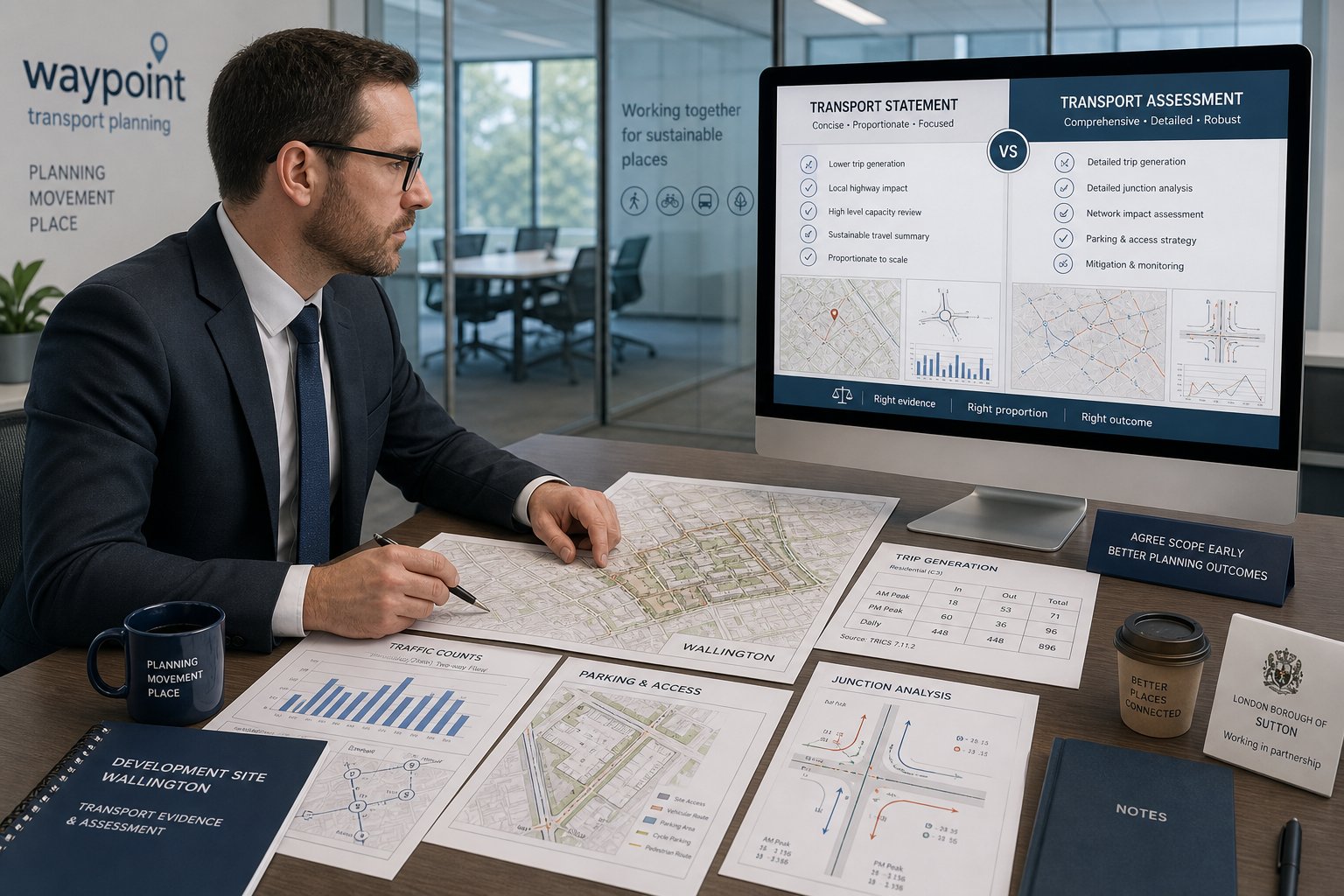
In broad terms, larger or more complex schemes usually require a Transport Assessment, while smaller proposals with a more limited impact often proceed with a Transport Statement. The distinction follows the Department for Transport’s guidance, but there is no single national threshold that works neatly for every site. The right document depends on land use, scale, likely trip generation, location, existing network conditions, and the expectations of the local planning and highway authority.
A Transport Statement is typically appropriate where impacts are expected to be modest and can be explained through concise evidence. It may still include traffic counts, parking review, access analysis, trip estimates, and sustainable travel commentary. A Transport Assessment goes further. It usually includes fuller baseline analysis, future-year forecasting, junction capacity testing, mitigation appraisal, and a more detailed review of all travel modes.
Pre-application engagement is often the smart move, especially for Wallington sites with known sensitivities. A proposal might look small by floorspace but still create concentrated impacts because of servicing patterns, school-time travel, shift changes, or constrained access. Equally, a relatively substantial scheme in a highly accessible location may support a more targeted scope than expected.
We usually advise clients to agree scope early. That avoids the all-too-common problem of submitting a report that is technically competent but pitched at the wrong level for the authority’s concerns.
Common Development Types That Need Traffic Engineering Input
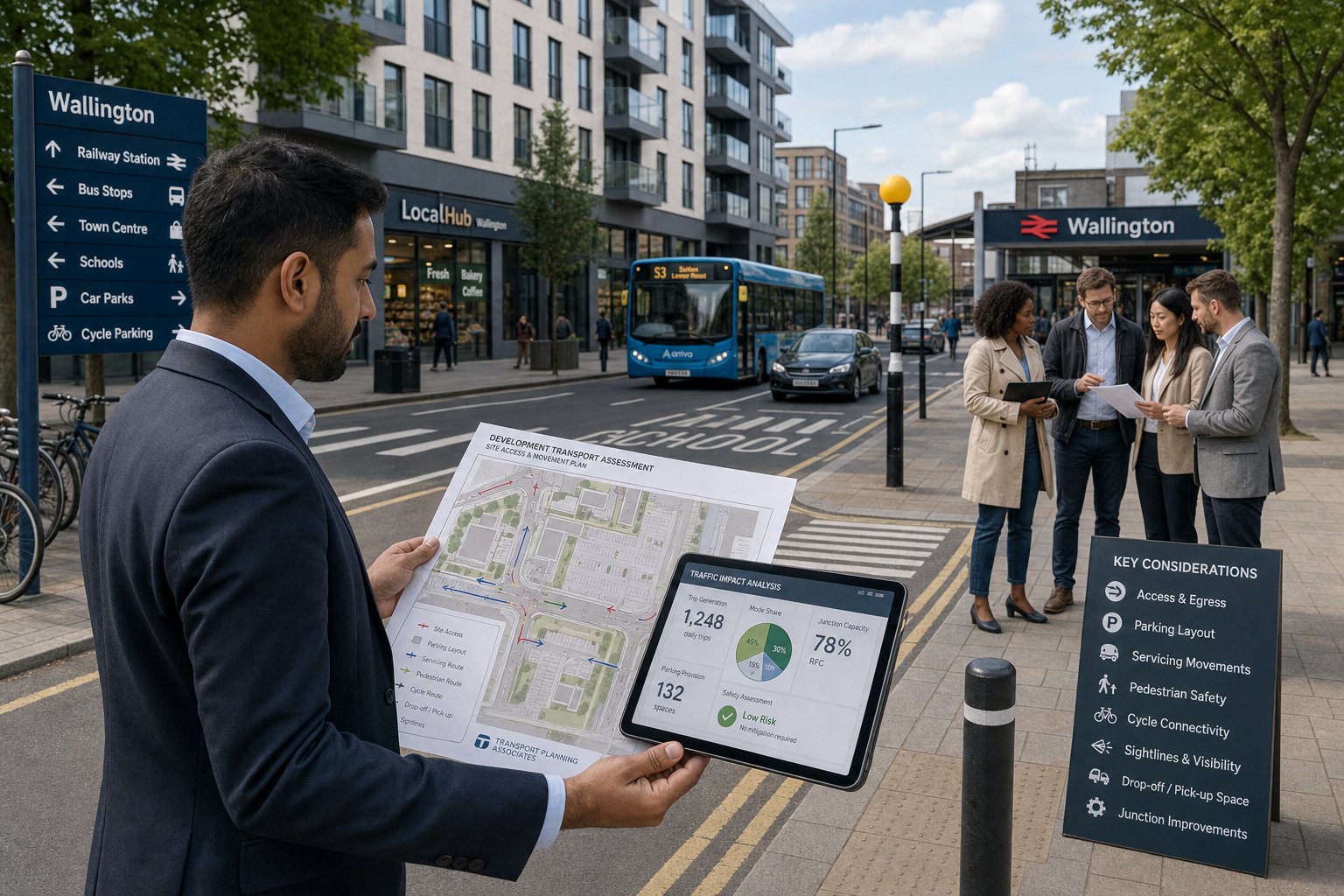
Not every planning application needs a detailed transport package, but many more schemes need traffic engineering input than applicants first assume. The trigger is not only size. It is the likelihood that access, trip generation, servicing, parking, or safety could become material planning issues.
Wallington is a good example because development often sits within an already busy urban fabric. High streets, bus corridors, rail access, school routes, and narrower residential streets can all amplify transport concerns. Even where no formal TA is required, early traffic input can still help shape a better application.
Residential Schemes
Residential development is one of the most frequent sources of transport work. That includes new-build flats, housing estates, backland plots, conversions, care homes, supported living, and retirement accommodation. The issues vary. For a small infill block, the focus may be parking accumulation, refuse collection, cycle parking, and visibility at the access. For a larger scheme, we are more likely to assess trip generation, distribution, junction impact, internal road geometry, emergency access, and sustainable mode opportunities.
Residential projects also tend to attract neighbour objections about overspill parking and local congestion. Those concerns can’t just be dismissed: they need evidence. Parking beat surveys, census travel data, accessibility review, and comparative trip rates are often central here. Broader Highway And Traffic Engineering expertise is especially useful when layout and highway design issues overlap.
Commercial, Mixed-Use, And Community Developments
Commercial and community schemes can be even more transport-sensitive because their peaks are less predictable and servicing demands are often heavier. Supermarkets, retail units, gyms, schools, health centres, places of worship, offices, nurseries, and mixed-use developments all raise different questions.
A small foodstore may generate concentrated short-stay parking turnover and regular deliveries. A school extension may have limited daily traffic growth overall but a pronounced AM peak and road safety concerns at crossing points. A health facility can produce taxi activity, blue badge demand, and pick-up/drop-off movements that standard parking ratios do not capture particularly well.
Mixed-use development adds another layer because different land uses interact. Shared access points, overlapping peaks, servicing windows, and cumulative effects need careful assessment. In those cases, it is often helpful to benchmark assumptions against work undertaken on comparable urban schemes, including examples such as Traffic Engineering: Your Complete guide material where safety and planning performance are considered together.
Key Traffic Engineering Reports For Planning Applications
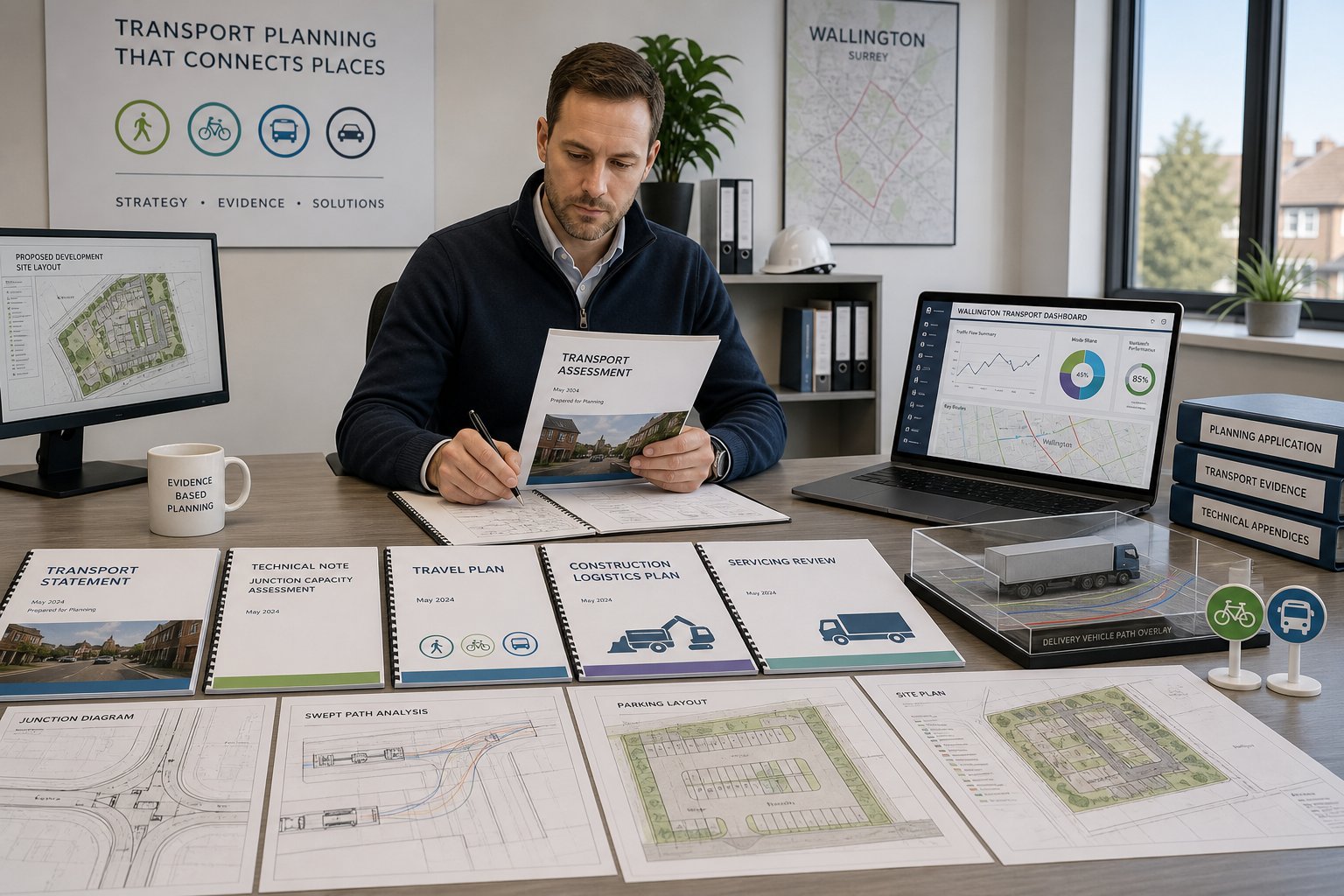
Traffic engineering support for planning is rarely a one-document exercise. Different schemes need different reports, and the quality of that package often shapes how efficiently transport issues are reviewed by the authority.
Transport Assessments, Transport Statements, And Technical Notes
The core documents are usually the Transport Assessment (TA), Transport Statement (TS), and, in some cases, a Technical Note. A TA is the fuller document, generally used for larger or more complex proposals where multi-modal impact, junction capacity, future-year testing, and mitigation need proper depth. A TS is usually more concise, but it still needs to be evidence-based and site-specific.
Technical Notes are useful where the issue is narrower. We might prepare one to respond to consultee comments, update trip assumptions, address a revised layout, or examine a single topic such as parking stress or servicing manoeuvres. For applications moving quickly, a well-targeted note can sometimes resolve an objection without reopening the whole transport case.
Across different cities, the report names stay familiar even when local expectations differ, which is why examples like Traffic Engineer In Leeds: planning-led support are useful reminders that scope always needs to match the authority and the site.
Travel Plans, Construction Logistics, And Servicing Reviews
Many Wallington developments also need supporting management documents. A Travel Plan sets out how the development will encourage sustainable travel, whether through cycle facilities, travel information packs, public transport incentives, car club membership, monitoring, or appointment of a Travel Plan coordinator. Residential, workplace, and school Travel Plans each have different emphases.
A Construction Logistics Plan can be critical where build-out activity may affect constrained streets, neighbours, schools, or bus routes. It deals with routing, vehicle sizes, timing restrictions, contractor parking, loading arrangements, and site management. If construction traffic is not handled properly, a technically acceptable development can still draw strong resistance.
Servicing and Delivery Plans, sometimes combined with waste management reviews, examine how goods, refuse, and maintenance vehicles will reach and operate within the site. Swept path analysis, loading duration, frequency, and conflict with pedestrians all matter. These documents can feel secondary, but in urban locations they are often what unlock practical planning agreement.
How Traffic Impact Is Measured And Presented To Local Authorities
Authorities do not approve or reject transport arguments based on instinct. They look for a clear chain from evidence to conclusion. So how is traffic impact actually measured?
We start with baseline conditions. That usually includes classified turning counts, queue surveys, parking occupancy, personal injury collision data, speed information where relevant, and a review of walking, cycling, and public transport accessibility. We then estimate development trips. In UK planning work, TRICS is commonly used to derive person-trip and vehicle-trip rates from comparable sites, adjusted where necessary for local context.
Those trips are assigned onto the network and tested against future-year scenarios. Depending on the scale of the scheme, we may undertake priority junction modelling, signal junction modelling, or more strategic network review. The outputs usually focus on capacity ratios, queue lengths, delays, reserve capacity, and whether the changes are material in planning terms.
Numbers alone are not enough, though. Presentation matters. Plans, figures, tables, swept path drawings, access visibility diagrams, and concise commentary all help officers follow the logic. The best reports do not drown readers in software outputs: they explain what the results mean and whether mitigation is proportionate.
That approach is common to local planning work far beyond Sutton, including city-specific assessments such as Traffic Engineer In Bristol: support where local thresholds influence the level of analysis.
And sometimes the most persuasive point is not a dramatic model result but a practical one: for example, that a revised service bay removes reversing onto the highway, or that cycle access now works for the actual route people will use.
Local Constraints That Can Affect Development In And Around Wallington
Wallington is not assessed in a vacuum. Its local constraints shape what is likely to be acceptable, what will attract scrutiny, and which mitigation measures are realistic.
One recurring issue is the contrast between strategic accessibility and local street pressure. A site may sit within reasonable reach of rail and bus services, supporting a lower-car approach in principle. But if the immediate residential streets already experience heavy overnight parking or awkward turning conditions, the design still needs to show that day-to-day operation will be workable. That is especially important for flatted schemes, HMOs, and uses with visitors or carers.
Another constraint is proximity to schools and community uses. Term-time peaks, informal drop-off activity, and crossing demand can materially affect the interpretation of traffic impact. A development that appears minor when viewed as daily totals may be more sensitive when examined over a 30-minute school peak.
High street frontage, servicing demand, bus stop interaction, and access near A-road corridors can also complicate matters. Sometimes the issue is not sheer traffic growth but conflict: delivery vans blocking lanes, refuse vehicles waiting in the carriageway, or poor visibility where pedestrians are crossing in practice rather than where the drawings suggest they should.
Experience across comparable urban authorities helps here too. Work on schemes similar to Traffic Engineer In Liverpool: planning reports shows how local insight often matters as much as the modelling itself.
In short, Wallington projects succeed when transport evidence respects the ordinary realities of the surrounding streets, not just policy wording and standard trip rates.
Choosing The Right Traffic Engineer For A Wallington Project
Choosing the right consultant is not simply about finding someone who can produce a report. It is about finding a team that understands planning strategy, local authority expectations, and how transport evidence should be framed to support a viable scheme.
For Wallington projects, we would look for several things. First, strong UK development-planning experience. A consultant may be technically capable in highways design yet less effective at preparing planning-led reports that answer exactly what officers need. Second, familiarity with London and Sutton contexts: parking restraint, active travel expectations, public transport accessibility, and the practical way urban sites operate.
Third, technical depth matters. That includes competent use of TRICS, access design standards, swept path analysis, parking surveys, and junction modelling where required. But equally important is judgement. Not every scheme needs a heavyweight model, and over-scoping can waste time and budget just as surely as under-scoping can create objections.
Track record is another useful test. Has the engineer supported successful planning consents on constrained urban sites? Can they respond quickly to consultee comments? Can they coordinate well with architects, planning consultants, and legal teams? At our end, the value of more than 30 years’ experience is often speed with precision: knowing what level of evidence is enough, what is likely to be challenged, and how to keep the reporting concise without leaving gaps.
That balance tends to be what clients remember. Not pages for the sake of pages, but transport advice that moves the application forward.
Conclusion
A traffic engineer in Wallington plays a practical, planning-critical role: identifying transport risks early, measuring likely impacts properly, and presenting evidence in a form Sutton Council and other stakeholders can assess with confidence. For some schemes, that means a focused Transport Statement and a parking review. For others, it means a full Transport Assessment, junction testing, travel planning, servicing analysis, and construction logistics.
The constant is this: local evidence matters. Wallington developments are judged against real streets, real travel patterns, and real policy tests around safety, accessibility, and cumulative impact. When transport input is brought in early, applications are usually stronger, objections are easier to manage, and design changes happen before they become expensive.
For architects, planners, developers, lawyers, and public bodies working in Sutton, the best outcomes typically come from proportionate, site-specific advice rather than generic reporting. Done well, traffic engineering does not just answer questions from the authority. It helps shape a scheme that is more robust from the start.
Frequently Asked Questions About Traffic Engineers in Wallington
What role does a traffic engineer play in Wallington planning projects?
A traffic engineer in Wallington analyses existing traffic conditions, assesses site access and parking, forecasts trip generation, tests junction capacity, and recommends mitigation to support planning applications with clear, localised transport evidence.
When is a Transport Assessment or Transport Statement needed for Wallington developments?
Larger or complex developments usually require a full Transport Assessment, while smaller schemes often need a Transport Statement. The choice depends on scale, trip generation, location, and local authority expectations in Sutton.
Why is local transport evidence crucial for developments in Wallington?
Local evidence is vital because planning decisions consider the actual impact on nearby roads, junctions, and public transport. It helps demonstrate whether traffic or parking effects are acceptable under the National Planning Policy Framework and local policies.
What common types of developments in Wallington need traffic engineering input?
Residential schemes like flats and care homes, as well as commercial, mixed-use, and community developments such as schools, supermarkets, and offices, often require traffic engineering input to address access, parking, and safety concerns.
How do traffic engineers measure and present traffic impact for planning authorities?
Traffic impact is assessed through baseline traffic surveys, trip generation modelling with tools like TRICS, and junction capacity tests. Findings are presented with clear plans, tables, and commentary to demonstrate effects and necessary mitigation.
How can I choose the right traffic engineer for a Wallington project?
Look for a chartered civil or transport engineer with UK development planning experience, knowledge of London and Sutton standards, strong skills in TRICS and junction modelling, and a proven record of successful local planning approvals.