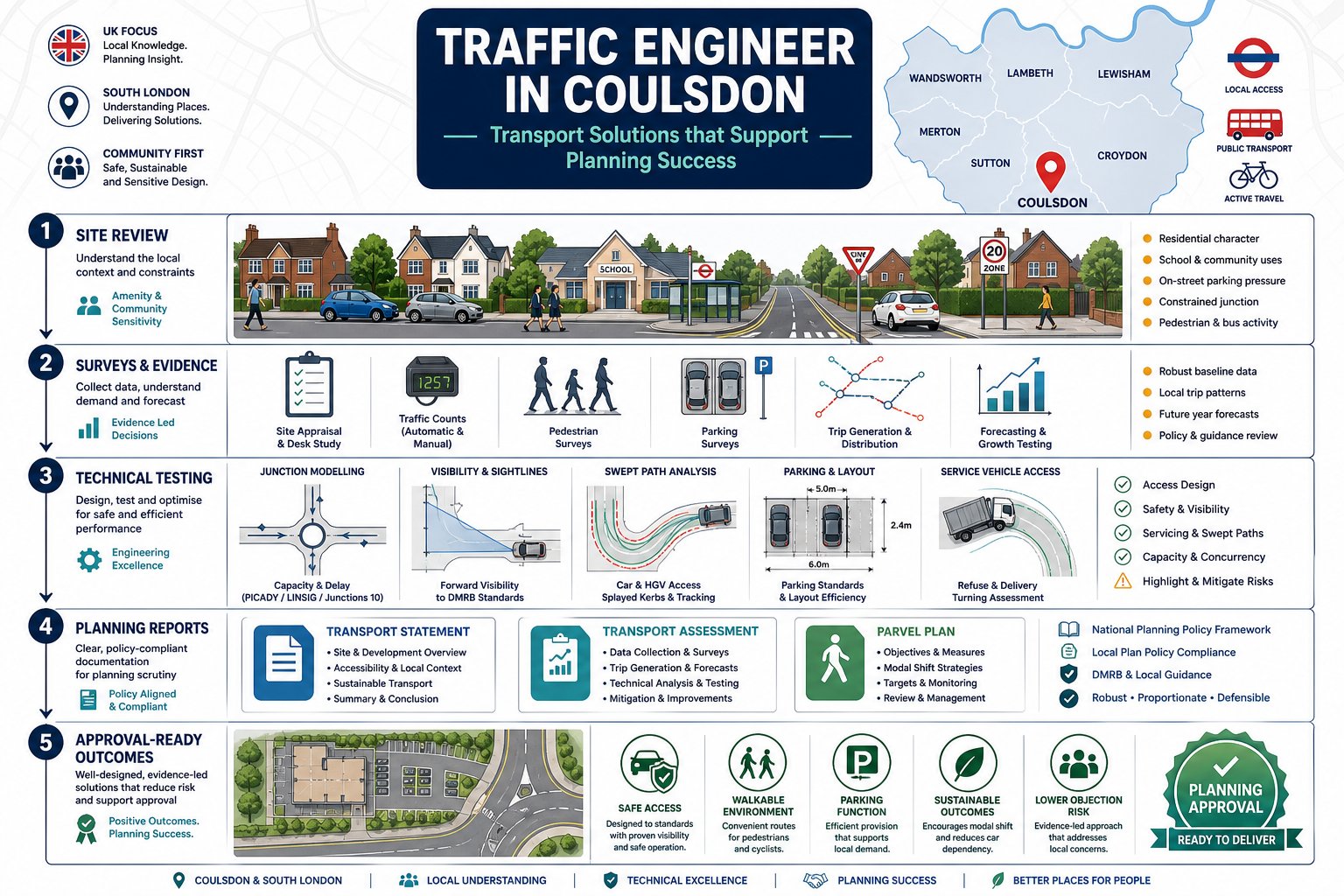
Coulsdon is one of those places where transport issues rarely stay “technical” for long. A modest access change can raise neighbour concerns about rat-running. A small residential scheme can create questions about parking stress, refuse access, pedestrian visibility, or whether the nearby junction is already close to capacity at school-run peak times. And once those questions appear in pre-app or validation comments, they tend to shape the whole planning conversation.
That’s why the role of a Traffic Engineer in Coulsdon matters so much for 2026 projects. For architects, planners, surveyors, developers and local authorities, transport input is often the difference between a scheme that feels under-evidenced and one that reads as credible, policy-aware and deliverable. We’ve seen it repeatedly: when transport advice is brought in early, site layouts improve, access points become easier to justify, and the planning narrative gets stronger.
In practice, good traffic engineering is not just about counting vehicles. It’s about understanding how a site works in its local context: highway constraints, walking routes, servicing, parking demand, safety history, public transport links and the standards that decision-makers will apply. In this guide, we explain when a traffic engineer is needed, what reports are typically required in Coulsdon, what gets reviewed on site, and how to choose support that is fast, proportionate and robust enough for planning scrutiny.
Key Takeaways
- A Traffic Engineer in Coulsdon is essential for delivering credible, locally informed transport input that strengthens planning applications for 2026 developments.
- Early involvement of a traffic engineer helps refine site layouts, access points, and parking arrangements, reducing risk of objections and costly revisions.
- Transport reports, such as Transport Assessments or Statements, are tailored to development scale and local impact, addressing safety, servicing, parking, and policy compliance.
- Thorough site reviews and traffic surveys ensure transport advice aligns with actual local conditions, including road safety history, pedestrian routes, and parking behaviour in Coulsdon.
- Choosing a traffic engineer with local knowledge and planning experience ensures proportionate, clear, and robust support that anticipates officer concerns and speeds approvals.
- Good traffic engineering not only justifies but improves development proposals by balancing transport demands with community amenity and policy expectations.
Why Traffic Engineering Matters For Development In Coulsdon
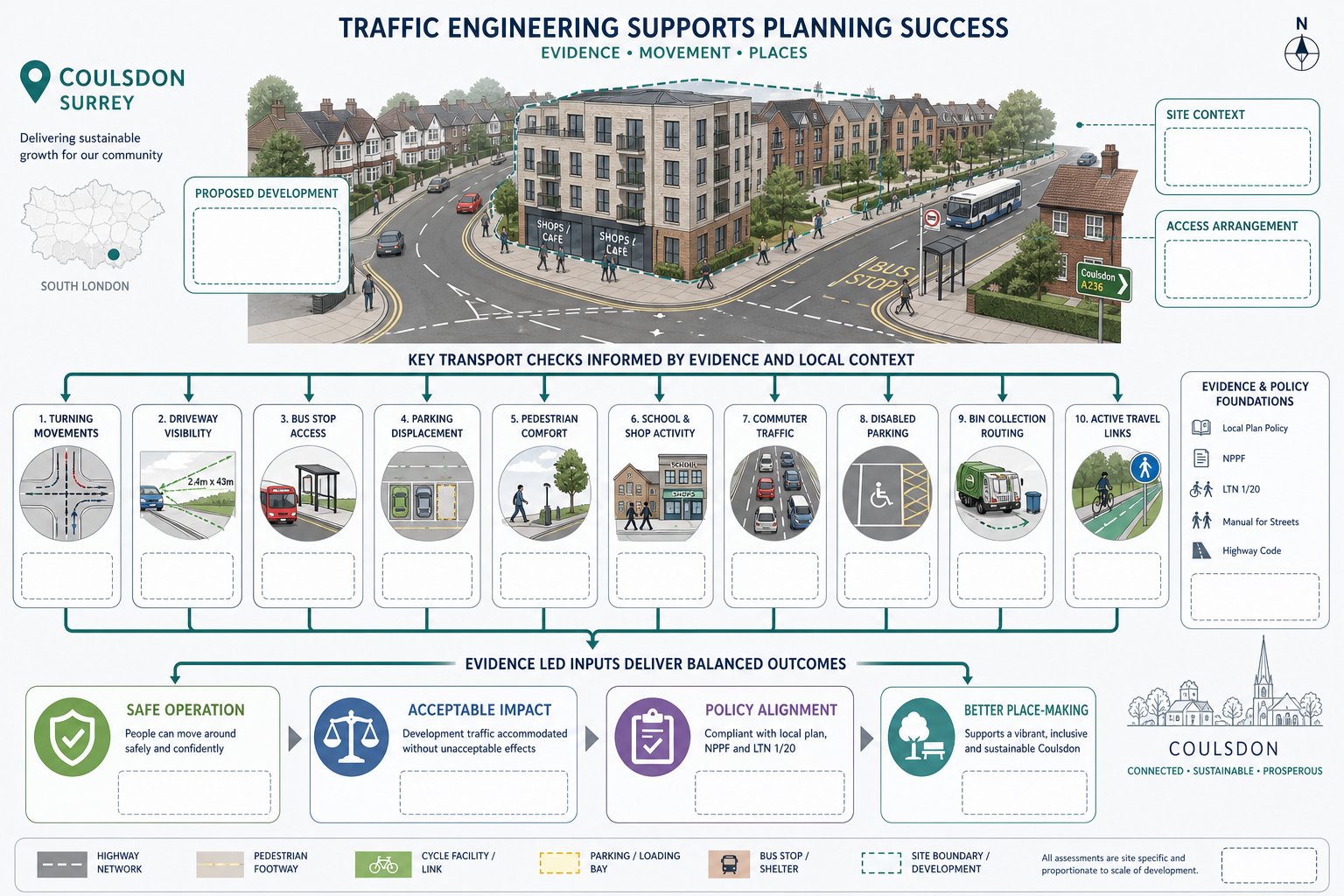
Coulsdon sits in a suburban South London setting where development pressure meets an already sensitive transport environment. That combination makes traffic engineering central to planning success. Even schemes that look straightforward on paper can affect turning movements, driveway safety, bus stop access, parking displacement, or pedestrian comfort on roads that already serve schools, shops and commuter traffic.
From a planning perspective, transport evidence helps answer three questions early: will the proposal operate safely, will its impact be acceptable, and does it align with local and national policy? Those are not abstract tests. They influence officer recommendations, highway comments, committee debates and, in some cases, appeal outcomes.
For development teams, the value is practical as well as regulatory. Proper traffic input can reshape a site plan before costly assumptions become fixed. We often find that access geometry, bin collection strategy, visibility constraints or disabled parking arrangements need refinement long before the application is submitted. That is far easier to solve early than after objections land.
There is also a wider place-making issue. Coulsdon needs growth, but growth that respects local amenity, supports active travel and avoids storing avoidable problems on the public highway. Sound transport advice helps balance those priorities. Broader Traffic Engineering: Your Complete principles still apply, but local context is what turns generic compliance into a persuasive planning case.
When You Need A Traffic Engineer For A Planning Application
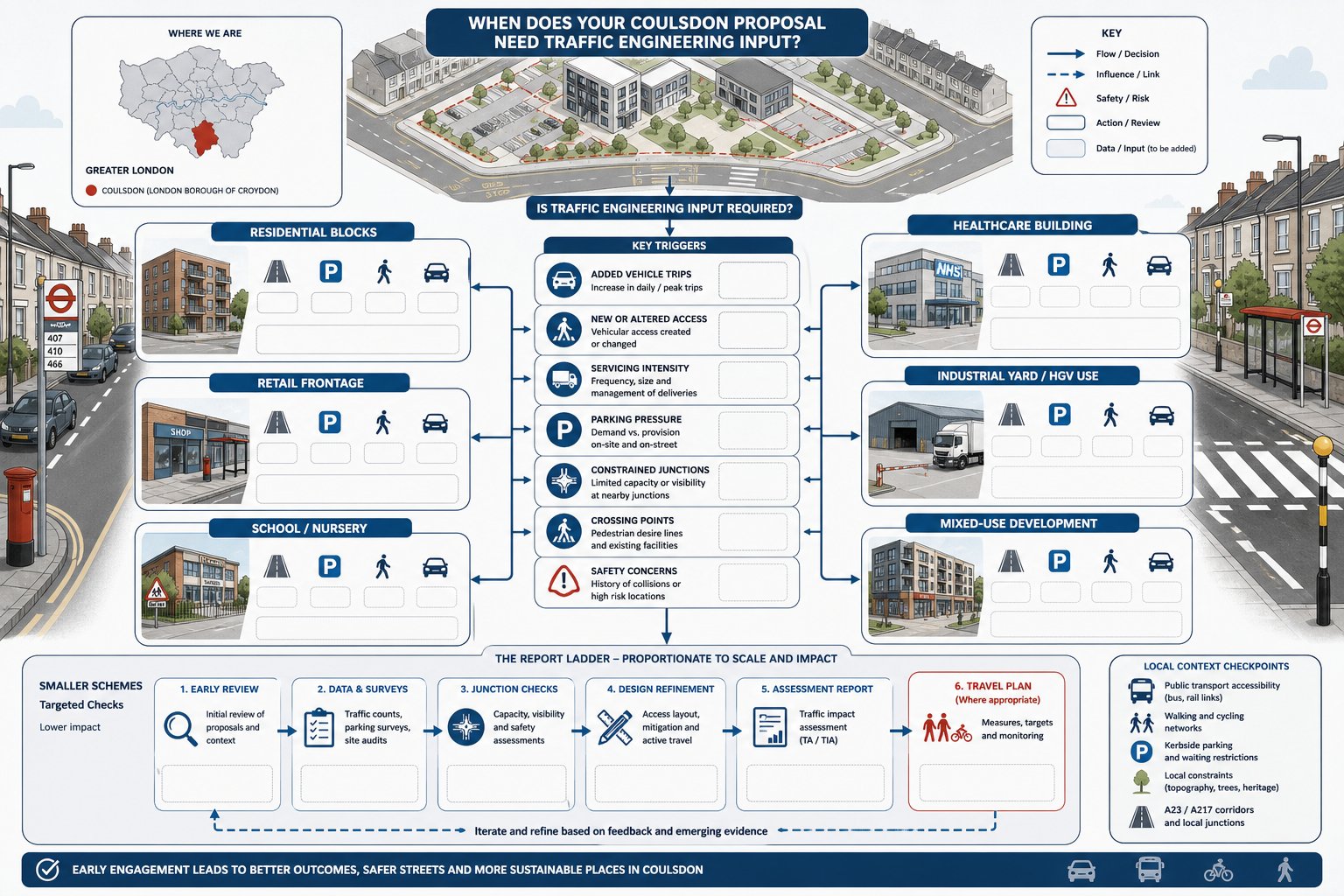
Not every planning application in Coulsdon needs a full transport package, but many need more than applicants first expect. The trigger is usually not the size of the building alone. What matters is whether the development could materially affect movement on or around the highway network.
We’re typically brought in where a proposal is likely to generate noticeable additional trips, introduce or alter a vehicular access, intensify servicing, change parking demand, or interact with a constrained junction, crossing point or frontage. Local authorities and highway officers will also want evidence where there are known road safety concerns, sensitive nearby land uses, or objections linked to congestion and overspill parking.
In practical terms, that means transport support is often needed for schemes well before they reach the “major development” category. A modest infill site may still need a Transport Statement. A nursery extension may need parking and pickup analysis. A commercial unit may need servicing sweeps and access checks. A larger mixed-use site may require a full Transport Assessment and Travel Plan.
Early involvement also helps with pre-application strategy. We can identify whether surveys are needed, whether a junction review is sensible, and whether design revisions could avoid avoidable conflict with highway officers. That kind of front-loading saves time. It also aligns with the planning-led approach discussed in Traffic Engineering Consultants: What, where the report is only one part of a broader approval strategy.
Common Project Types That Trigger Transport Reports In Coulsdon
In Coulsdon, several project types repeatedly trigger the need for transport evidence. Residential development is the most common, especially flats, backland schemes, estate regeneration, and proposals with constrained parking or access. Even when trip generation is modest, the local concern is often cumulative impact: another access, another refuse movement, another pressure point at peak time.
Retail and leisure schemes also tend to need review because traffic patterns are less evenly spread and parking turnover can be intense. Schools, nurseries and healthcare uses are particularly sensitive because drop-off activity can create sharp peaks, unsafe stopping, and pedestrian conflict in a short window. Industrial, storage and distribution sites raise a different issue: HGV routing, yard circulation and whether larger vehicles can enter and leave in forward gear.
We also see transport reports requested for change-of-use applications, care settings, student or supported housing, and developments near busy classified roads. In those cases, the question is often less about raw trip totals and more about access suitability, servicing practicality and local network fit.
For teams handling comparable schemes elsewhere, the pattern is similar to the thresholds discussed in Highway And Traffic Engineering: if movement, safety or parking could become a planning issue, proportionate traffic engineering support is usually worth commissioning.
Key Traffic Engineering Services For Coulsdon Sites
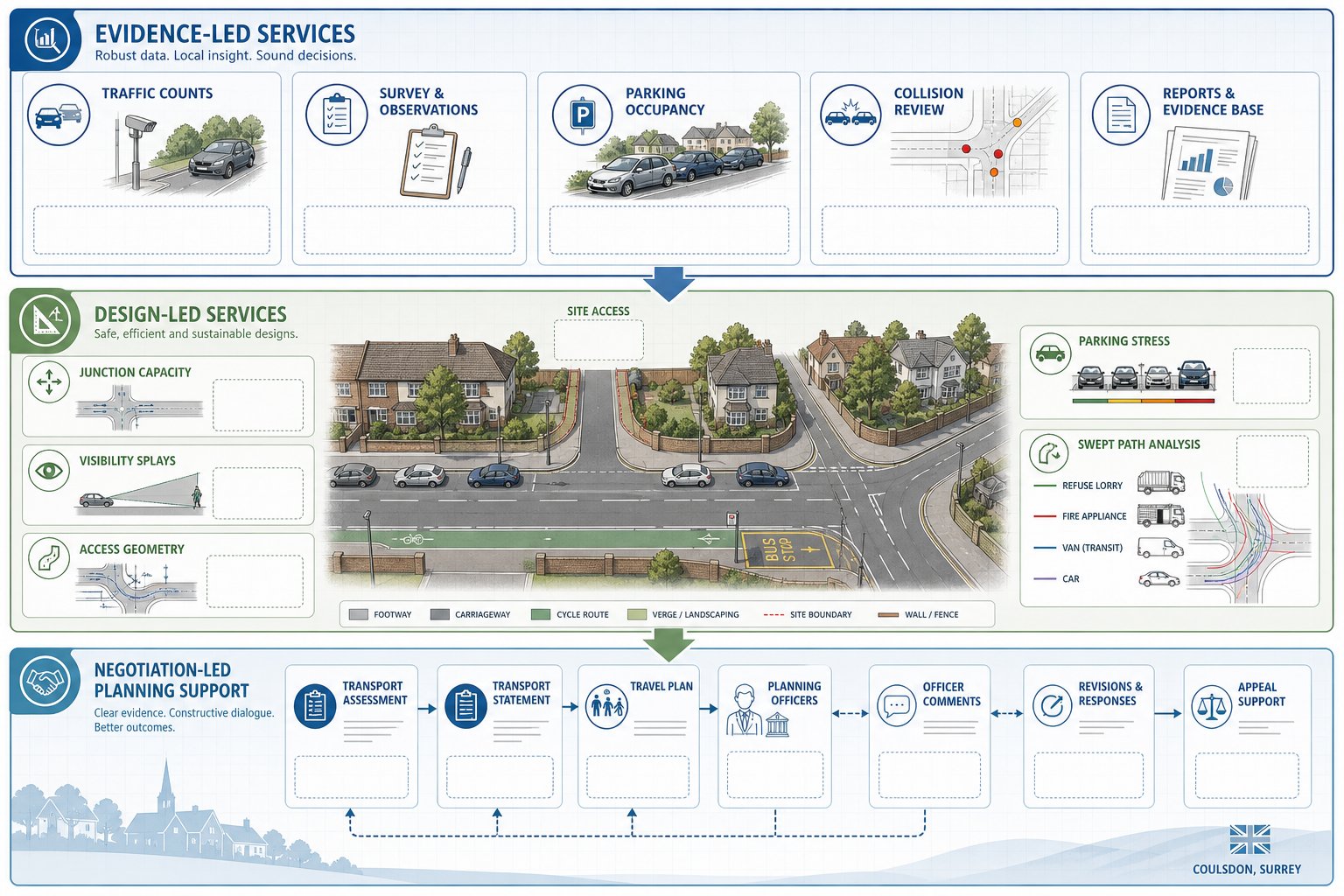
The right service depends on the site, the scale of development and the planning risk attached to transport issues. In Coulsdon, the most common requirements include traffic impact studies, survey coordination, parking stress reviews, access design, servicing analysis, collision review and support through planning queries or appeal statements.
A useful way to think about it is this: some commissions are evidence-led, some are design-led, and some are negotiation-led. Evidence-led work proves what is happening now and what is likely to happen after development. Design-led work tests whether vehicles, pedestrians and cyclists can move safely within and around the site. Negotiation-led work responds to officer comments, local objections and committee concerns.
For applicants, speed matters, but so does proportionality. An overblown report can irritate decision-makers just as much as a thin one. The strongest submissions are tailored to the local authority threshold, the exact proposal and the live planning questions. That is especially important in suburban locations where the difference between acceptance and objection may rest on one issue such as visibility, parking accumulation or servicing manoeuvres.
Our approach is usually to define the likely transport ask early: what the council will expect, what survey season is suitable, whether a TA or TS is enough, and where the site layout may need adjustment before the report starts locking assumptions in.
Transport Assessments, Transport Statements, And Travel Plans Explained
A Transport Assessment is the fuller option. It is normally used for larger or more transport-sensitive developments and examines how a scheme affects all travel modes, not just car traffic. That can include existing conditions, trip generation, distribution and assignment, junction impact, sustainable accessibility, parking, servicing and mitigation. In Coulsdon, a TA is often appropriate where the scale of change is obvious or where local constraints mean even moderate growth needs careful modelling.
A Transport Statement is shorter and more proportionate. It is commonly used for smaller schemes where the traffic effect is limited but still needs formal explanation. A good TS is not a cut-down TA for the sake of it: it is a focused report that addresses the actual planning issues without excess padding.
A Travel Plan is different again. It sets out practical measures to encourage walking, cycling, public transport use, car sharing and lower single-occupancy car demand. Depending on the use class and scale, it may be framework-based at application stage and developed later through condition discharge.
For developers with employment, retail or mixed-use schemes, the reporting logic often overlaps with the points covered in Commercial Traffic Engineering: the best document is the one proportionate to impact and credible to the reviewing highway officer.
Junction Capacity, Access Design, And Swept Path Analysis
This is where transport work becomes very visual, and often very decisive. Junction capacity analysis tests whether nearby priority junctions, mini-roundabouts or signalised nodes can accommodate forecast traffic with acceptable delay and queueing. Depending on the site, we may use industry-standard modelling to compare baseline and development scenarios and assess whether mitigation is needed.
Access design is more immediate. Can drivers enter and leave safely? Are visibility splays available and protectable? Is the gradient workable? Is there enough width for two-way movement or does the proposal need a different operating arrangement? In Coulsdon, frontage constraints, boundary walls, on-street parking and street trees can all become real design factors.
Swept path analysis then checks the vehicle movements that often decide whether a scheme is genuinely workable: refuse wagons, fire appliances, delivery vans, articulated vehicles where relevant, and ordinary cars in tighter courtyards. It is surprising how often a layout looks acceptable until the turning path is tested properly.
These services are not isolated technical extras. They are the bridge between concept drawings and a defensible planning submission. If the geometry does not work, the report cannot rescue the scheme. That is why access and manoeuvring should be tested early, not left as a late-stage drawing note.
How Local Planning And Highway Considerations Shape Transport Advice
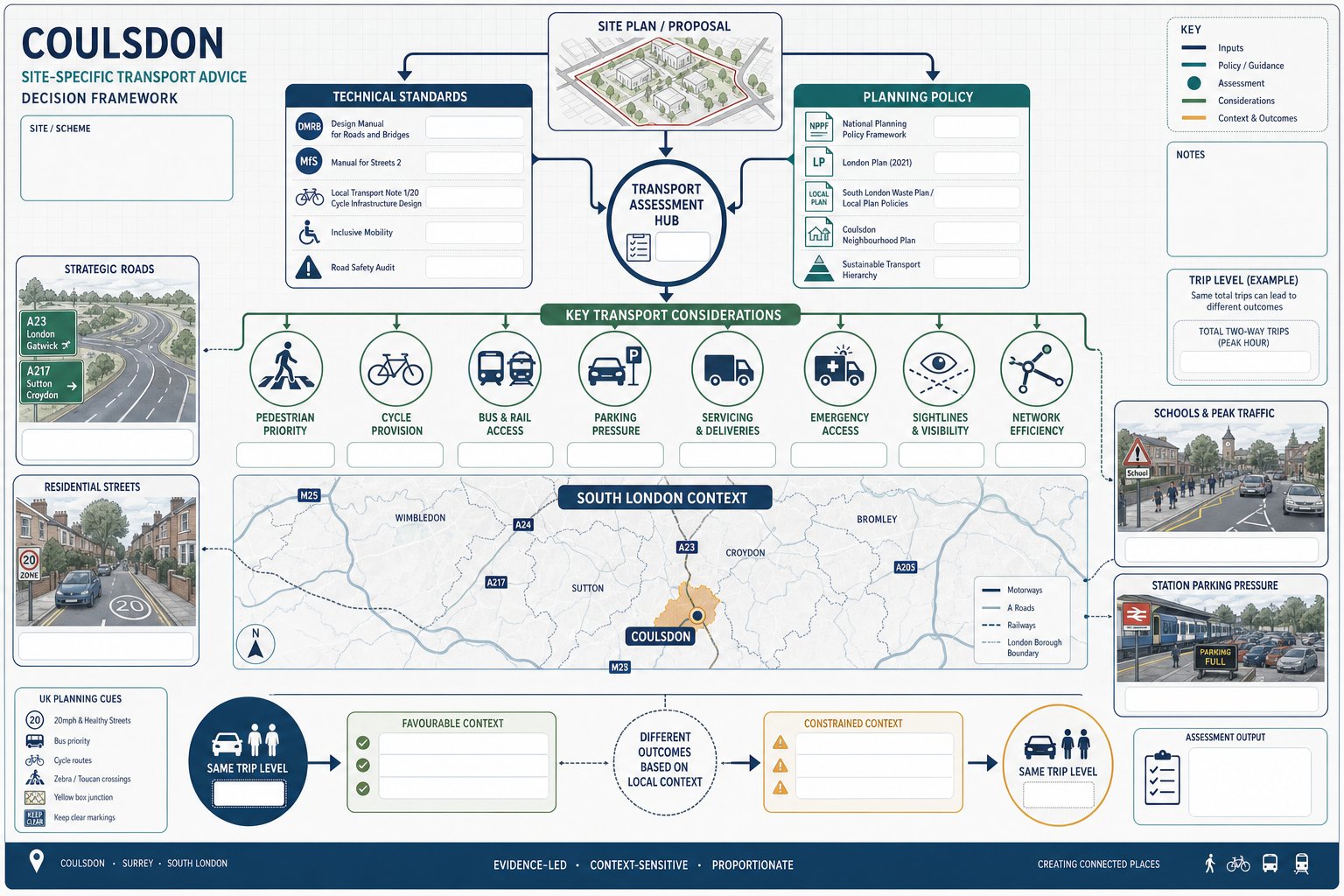
Transport advice in Coulsdon has to do two things at once: satisfy technical standards and fit the planning policy context. One without the other is usually weak. A drawing may work geometrically, but if it ignores parking policy, active travel expectations or local highway concerns, it may still struggle. Equally, a policy-heavy statement without robust site evidence tends not to carry much weight.
In practice, we shape advice around national guidance, the local development plan, London-wide transport expectations, and the review habits of the determining authority and highway team. That includes thinking about pedestrian priority, cycle provision, public transport accessibility, servicing practicality, emergency access, visibility, and whether the proposal protects the safe and efficient operation of the network.
Local character matters too. In Coulsdon, some sites sit near strategic routes, while others are affected more by residential street patterns, school-run peaks or station-related parking pressure. The same trip generation can be acceptable in one location and problematic in another because the receiving environment is different.
This is one reason experience across multiple authorities is useful. Lessons from wider work, such as the borough-facing approach set out in Traffic Engineer In London:, help us anticipate what officers are likely to focus on. But the final advice must still be site-specific. Generic transport text is easy to spot, and planning officers spot it quickly.
What A Traffic Engineer Will Review At Your Site
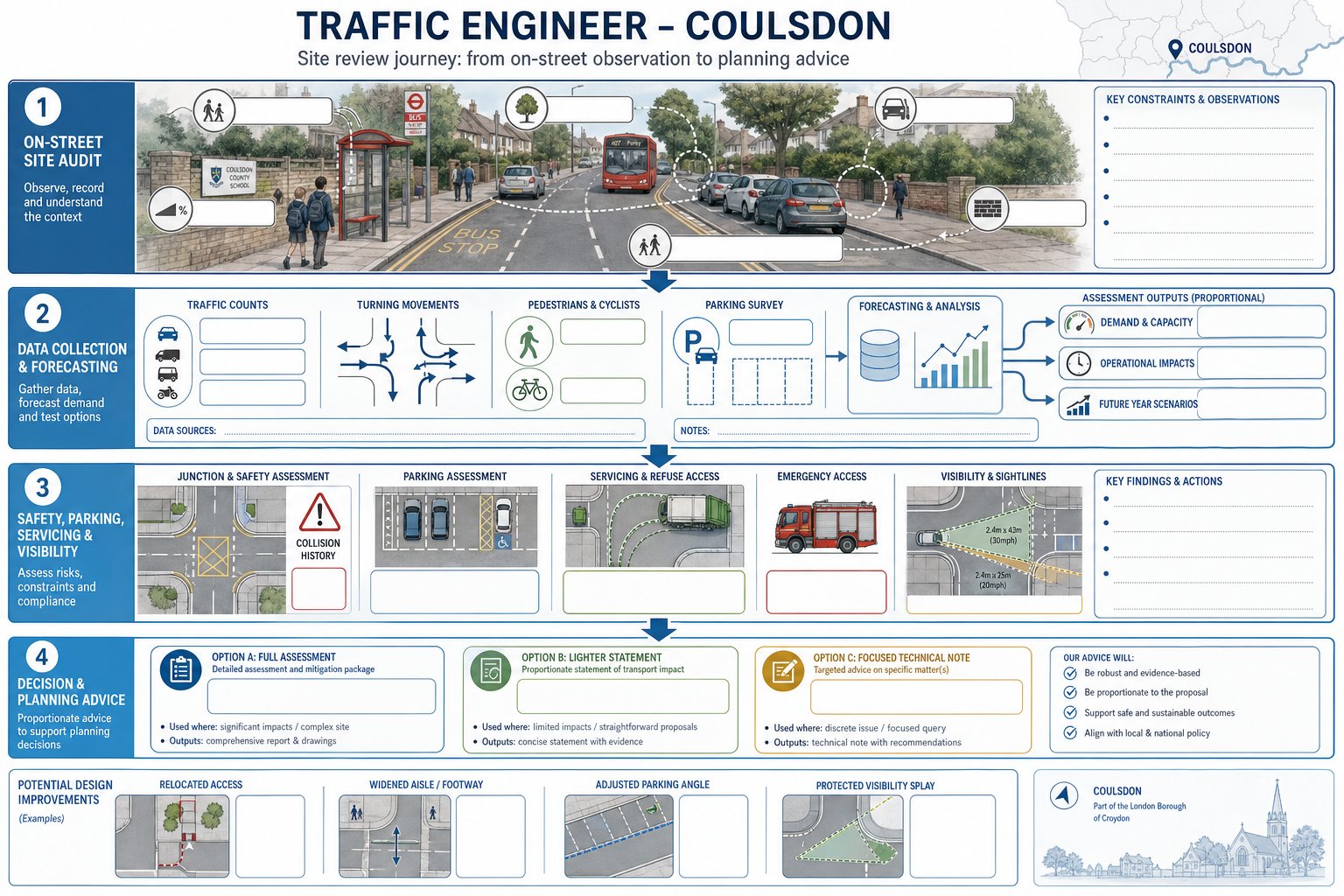
A site review is where assumptions are tested against reality. Before we write conclusions, we need to understand how the street actually works: traffic flow patterns, frontage activity, school or commuter peaks, parking behaviour, pedestrian desire lines, bus stop interactions and the physical constraints that do not always show clearly on topographical plans.
At most Coulsdon sites, we start with the basics and go from there. What are the surrounding road classifications? Are there existing access points nearby? Is there a collision pattern worth investigating? How easy is it to walk to local services or public transport? Are there gradients, retaining walls, mature vegetation, or boundary features that affect visibility and access design? And just as important: how are people using the kerbside now?
That site intelligence informs both the report scope and the design advice. It can change whether a proposal needs a full TA, a lighter TS, or a more focused technical note on access, servicing or parking. It can also reveal simple improvements, such as relocating an access, adjusting parking angles, widening an aisle or protecting a visibility splay, that materially strengthen the planning case.
Traffic Surveys, Trip Generation, And Forecasting Inputs
Transport reports are only as reliable as the evidence behind them. That is why traffic surveys matter. Depending on the scheme, we may commission junction turning counts, automatic traffic counts, queue observations, pedestrian and cycle counts, or parking beat surveys. Timing is important: surveys should reflect typical conditions and the local authority’s expectations, not a random quiet week that looks convenient in hindsight.
Trip generation then estimates how many movements the proposed use is likely to create. We generally use recognised comparable databases, census and travel mode context, site-specific realism and professional judgement. A suburban care facility, for example, behaves differently from town-centre flats: a trade counter behaves differently from a small office, even if the floorspace is similar.
Forecasting brings the analysis forward. We consider background growth, committed development where relevant, distribution of trips across the local network, and whether the resulting flows are material in planning terms. Sometimes the answer is that impact is limited and easily accommodated. Sometimes a nearby junction needs testing. Sometimes the site design itself is the real issue rather than wider network capacity.
For multidisciplinary teams, this analytical stage often benefits from the same comparative discipline used by a Traffic Engineer In Leeds: or other city-based planning-led commission: use evidence, but keep the conclusions proportionate to the actual development effects.
Road Safety, Parking, Servicing, And Visibility Checks
These checks are often where planning debates become very specific. Road safety review looks at recorded collision history, site geometry, likely conflict points and whether the proposal changes risk for pedestrians, cyclists, drivers or service vehicles. A short collision record does not automatically mean no issue: equally, a concern raised locally does not always translate into a technical safety objection. The evidence needs careful reading.
Parking analysis examines both quantity and function. Are the proposed spaces suitable in size and layout? Is disabled parking properly integrated? Will vehicles be able to enter and leave without awkward manoeuvres? Could overspill parking affect neighbouring streets? On constrained Coulsdon sites, it is common for the parking question to be less about pure numbers and more about day-to-day usability.
Servicing checks cover refuse collection, deliveries and emergency access. A site that cannot be serviced safely is usually carrying a planning risk, but attractive the architecture. Visibility checks then confirm whether drivers and pedestrians can see and react in time, using the relevant standards for speed environment and road type.
Across UK planning work, whether in South London or on schemes benchmarked against a Traffic Engineer In Bristol: style local-threshold review, these fundamentals remain the same: if safety, servicing and visibility are weak, the application is exposed.
How To Choose The Right Traffic Engineer In Coulsdon
Choosing the right consultant is not just about who can produce a report fastest, though speed certainly matters when programmes are tight. The real question is whether the traffic engineer can produce work that is proportionate, locally aware and credible under scrutiny.
We’d start with experience. Has the consultant handled UK planning applications of a similar type and scale? Do they understand the difference between a report that fills pages and one that answers the actual planning issue? Coulsdon schemes often need judgement as much as technical competence, particularly where suburban streets, parking pressure and sensitive frontages are involved.
Professional standing matters too. Chartered or equivalent credentials are useful signals, but they should be matched by practical planning experience. A strong consultant should be comfortable speaking with architects, planning consultants, solicitors, transport officers and, where needed, committee members or appeal teams.
Local and regional awareness is another advantage. Someone who understands London and borough-level expectations is more likely to scope work correctly, avoid unnecessary overreach and anticipate likely officer concerns. That does not mean relying on boilerplate text. It means knowing how standards are typically interpreted in real planning cases.
Finally, look at responsiveness and clarity. Can they explain whether you need a TA, TS, Travel Plan, swept path, parking survey or junction model without turning the answer into a lecture? Can they work quickly with evolving site layouts? At ML Traffic, that combination of concise reporting, planning focus and more than 30 years of experience is exactly what many project teams need when deadlines are moving and refusal risk needs reducing.
Conclusion
For 2026 projects in Coulsdon, transport evidence is rarely a side issue. It shapes access, layout, parking, servicing, safety and, eventually, planning confidence. A capable Traffic Engineer in Coulsdon helps turn those moving parts into a coherent case: one that is proportionate to the scheme, grounded in survey evidence and aligned with policy expectations.
The earlier that work starts, the more useful it becomes. Early traffic input can reveal design problems before they harden into objections, identify the right level of reporting, and support a smoother conversation with highway officers and planning teams. For architects, developers, lawyers, surveyors and local authorities alike, that means fewer surprises and stronger submissions.
In short, good traffic engineering does not simply justify development. It improves it.
Frequently Asked Questions about Traffic Engineering in Coulsdon
Why is traffic engineering important for development projects in Coulsdon?
Traffic engineering in Coulsdon ensures safe site access, assesses traffic impact, and aligns with local and national policies, helping developments avoid objections and gain planning approval.
When should I hire a traffic engineer for my Coulsdon planning application?
You typically need a traffic engineer if your scheme affects trip generation, access points, parking demand, or impacts nearby junctions and crossings, especially for residential, retail, or sensitive uses.
What types of transport reports are commonly required for developments in Coulsdon?
Common reports include Transport Assessments for larger or sensitive schemes, Transport Statements for smaller projects, and Travel Plans promoting sustainable travel, tailored to the development’s scale and impact.
How do traffic engineers assess junction capacity and access design in Coulsdon?
They use modelling to evaluate junction capacity under new traffic flows, design safe vehicle access with proper visibility, and conduct swept path analysis to ensure manoeuvres by cars and service vehicles are feasible.
What key considerations shape traffic engineering advice in a London suburban context like Coulsdon?
Advice balances technical standards with policies on parking, active travel, and local highway safety, taking into account surrounding road classifications, school runs, parking pressure, and public transport accessibility.
How do traffic surveys and trip generation forecasts influence planning decisions in Coulsdon?
Traffic engineers use surveys and land-use data to estimate future trips and model traffic flows, helping predict scheme impact on the road network and informing design and mitigation proposals for planning approval.