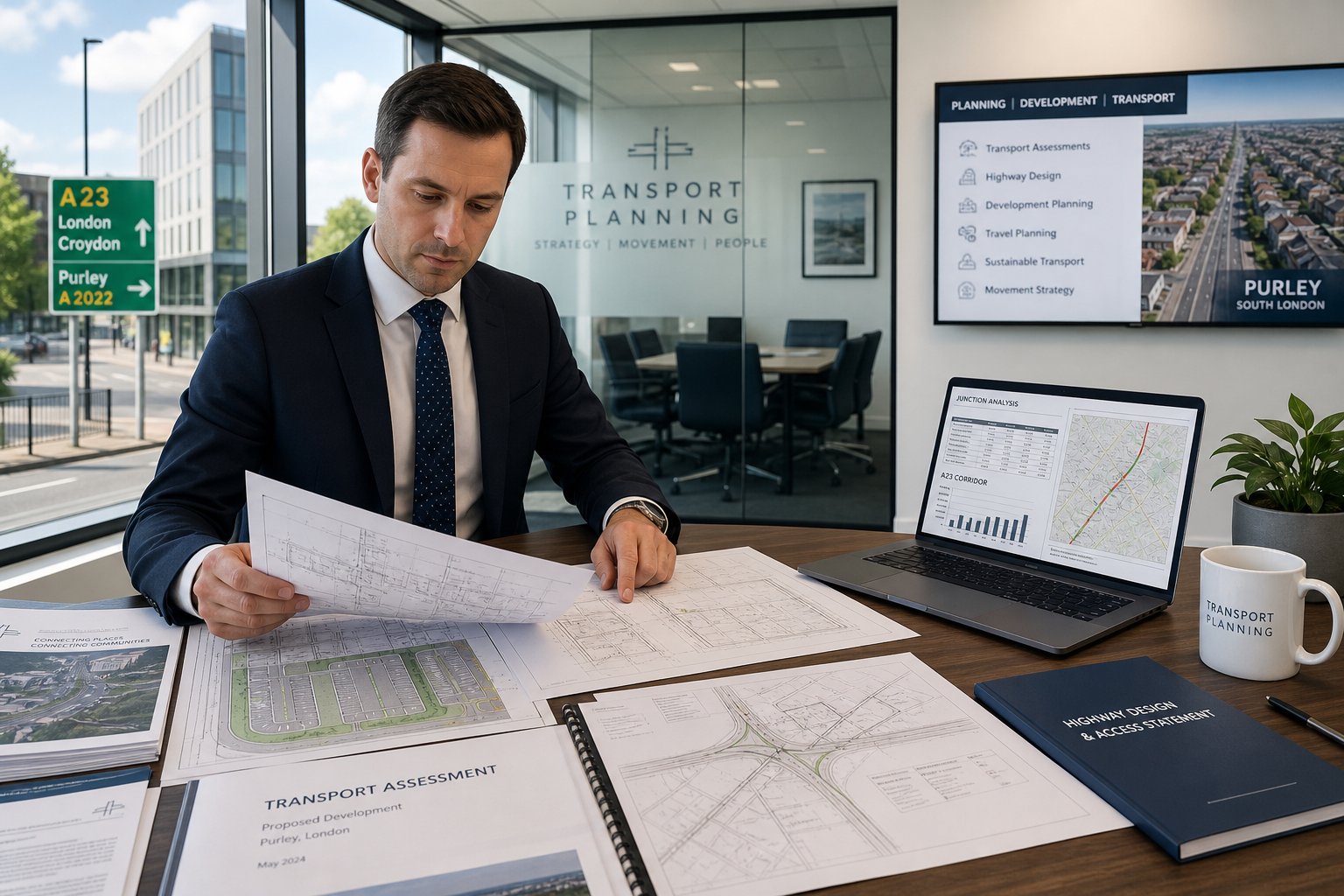
Purley looks straightforward on a map. In planning terms, it rarely is.
A site can appear modest, the access can seem workable, and the parking layout may fit neatly on a drawing. Then highways comments arrive. Questions are raised about trip generation, turning space, refuse access, visibility, overspill parking, or whether the local network can absorb another development on already sensitive corridors. That is usually the point where transport evidence stops being a supporting document and starts becoming central to the planning outcome.
For architects, planners, developers, lawyers and surveyors working in South London, a traffic engineer in Purley is often the difference between a scheme that feels plausible and one that is properly evidenced. We use transport analysis to show how development will function in the real world: how people arrive, where they park, how deliveries are handled, whether junctions remain safe, and what mitigation is reasonable if impacts do arise.
In Purley, that work needs to reflect Croydon’s planning framework, London-wide policy, and the practical realities of a place shaped by town-centre activity, residential streets, bus routes and strategic links such as the A23. Done early, traffic engineering can de-risk a scheme, sharpen the design, and reduce the chances of avoidable highways objections later in the application process.
Key Takeaways
- A traffic engineer in Purley plays a crucial role in ensuring development proposals meet Croydon’s specific transport policies and local conditions.
- Early involvement of a traffic engineer helps identify and mitigate issues related to access, parking, servicing, and safety before planning submission, reducing risk and delays.
- Transport evidence in Purley must be site-specific, addressing local street hierarchy, travel patterns, and sustainable transport to satisfy Croydon and TfL expectations.
- Transport assessments vary by project but often include trip generation analysis, access design, safety reviews, and parking provision compared against local standards.
- Engaging experienced traffic engineers familiar with Purley’s planning context leads to credible, proportionate reports that streamline the approval process.
- Providing complete design and planning information upfront expedites the traffic engineering process and prevents costly revisions later.
Why A Traffic Engineer Matters For Development In Purley
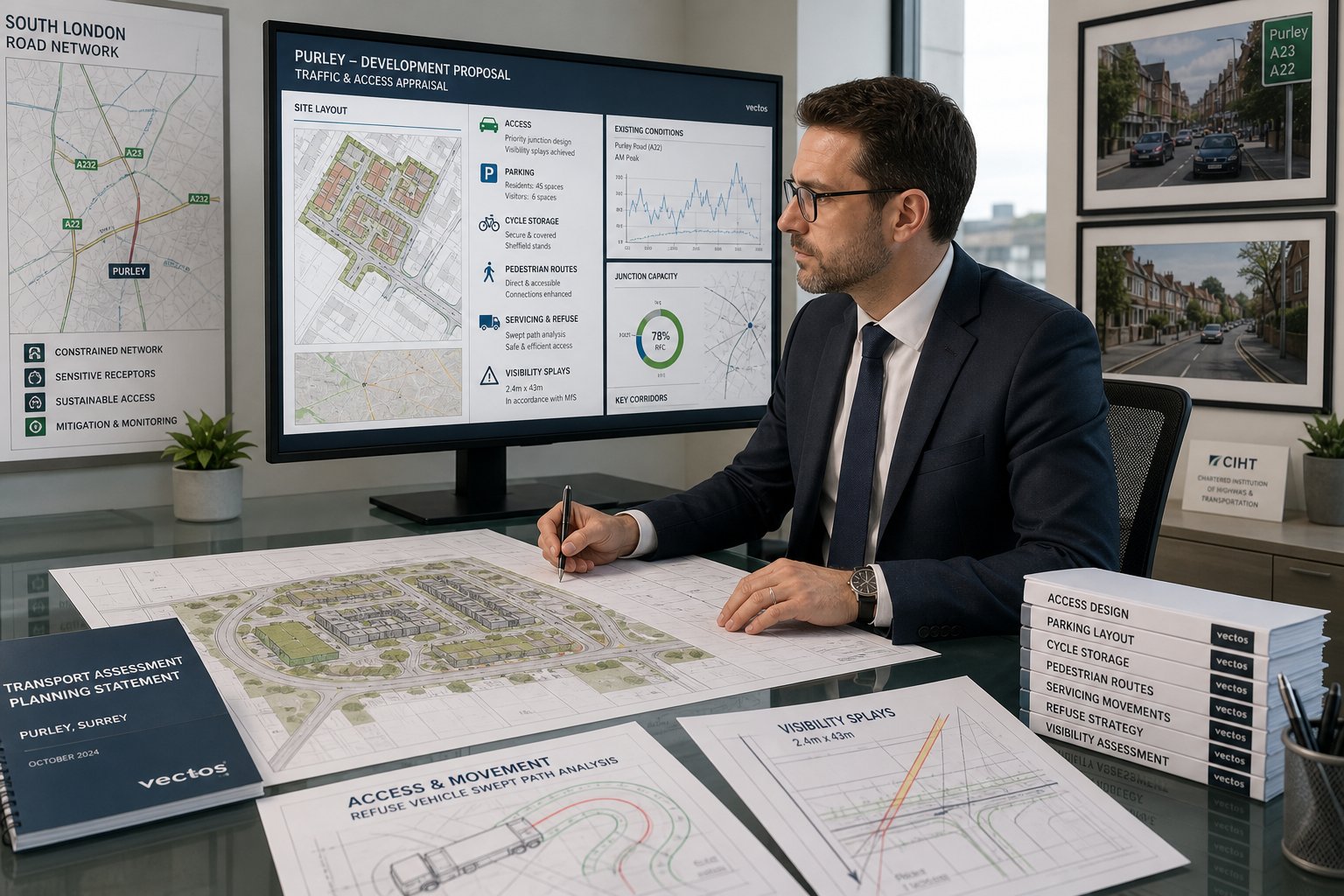
A traffic engineer in Purley does more than produce a report for a planning portal. We help translate a design proposal into transport terms that Croydon’s highways officers, planning case officers and, where relevant, TfL can assess with confidence.
That matters because Purley sits within a transport context that is more constrained than many applicants first assume. Main corridors carry substantial through-movement, local streets can be sensitive to additional parking pressure, and even relatively small developments can trigger concerns about servicing, safety or cumulative impact. A scheme does not need to be a major application to attract detailed scrutiny.
Our role is to establish whether the development can be safely and efficiently accommodated on the network, and to present that case using accepted methodology. That usually means reviewing access arrangements, parking provision, cycle storage, walking routes, servicing, refuse collection, visibility, and the likely number and timing of vehicle trips. Where issues arise, we identify proportionate mitigation rather than waiting for objections to define the problem.
In practical terms, early input often saves time. We can flag if an access is too tight for a refuse vehicle, if disabled parking is missing, if a turning head is unlikely to work, or if a proposed land use will need a fuller assessment than the team expects. That sort of advice overlaps with broader Traffic Engineering Consultants: support, but in Purley the local application of policy is what really shapes outcomes.
And there is a strategic point here. A good transport submission does not merely defend a scheme: it helps make the scheme look planned, coherent and deliverable. That is exactly what decision-makers want to see.
Purley Planning And Transport Context Developers Need To Understand
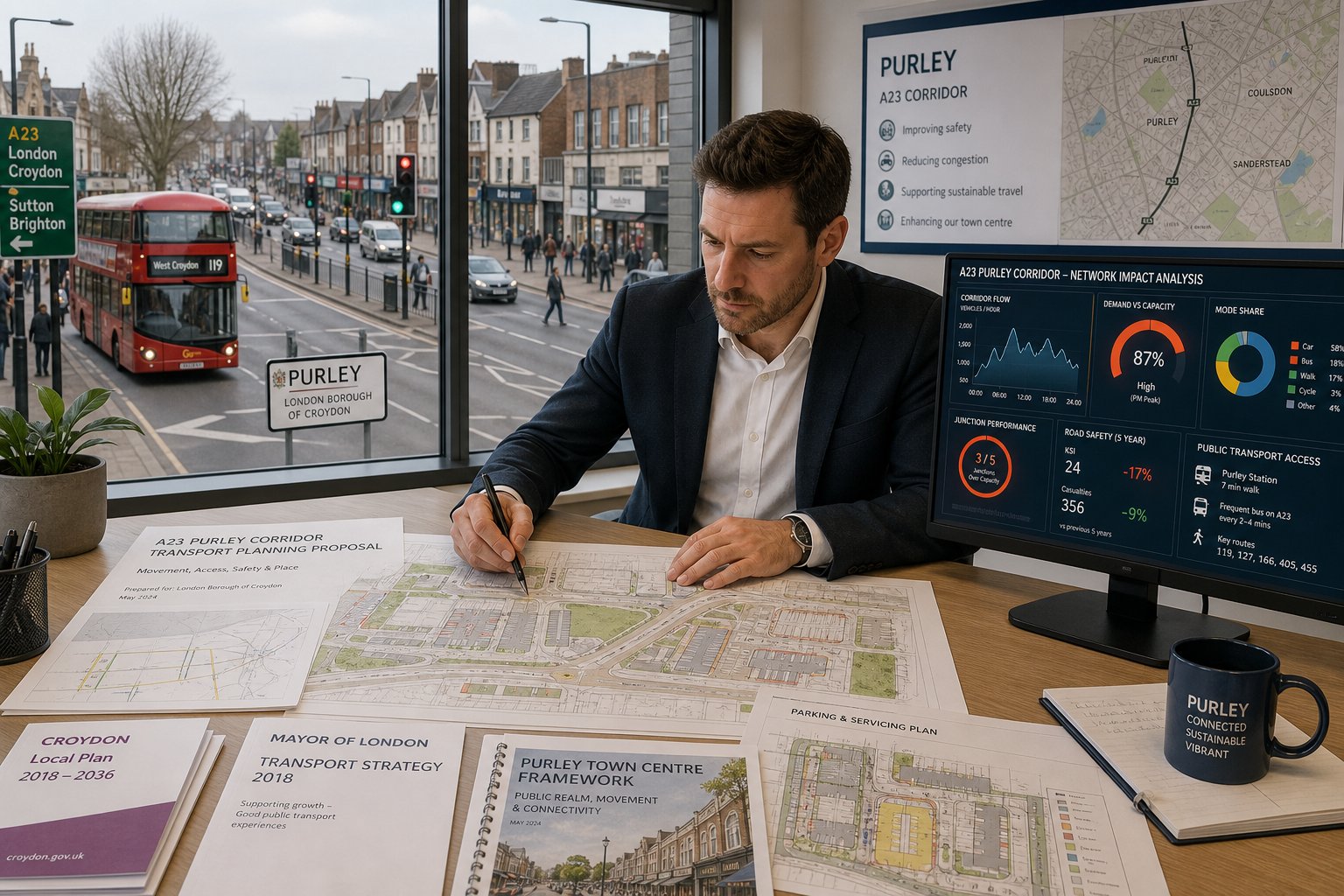
Purley falls within the London Borough of Croydon, so transport work for planning applications is typically framed by the Croydon Local Plan, the London Plan, the National Planning Policy Framework, and technical guidance used across London development management. That policy stack sounds familiar, but the local detail is where many schemes either strengthen or weaken.
Purley’s transport conditions are shaped by radial movement toward and through South London, pressure on corridor capacity, a town-centre environment with active frontages and bus activity, and surrounding residential streets where amenity concerns can carry weight. On the A23 Brighton Road and nearby routes, decision-makers are alert to congestion, road safety and network resilience. On smaller side roads, the focus often shifts to overspill parking, manoeuvring, servicing and whether traffic associated with a proposal feels out of character.
For developers, the practical implication is simple: generic transport text is not enough. Reports need to explain the local street hierarchy, likely travel patterns, nearby public transport opportunities, and whether the design supports sustainable travel in a credible way. A car-free or low-parking proposal, for example, needs to be justified against accessibility, parking stress and site-specific constraints, not just asserted.
We also need to consider who may be consulted. Croydon’s highways team will often review access, parking and safety matters, while TfL may become involved where strategic roads, bus operations or wider network impacts are relevant. That means evidence should be robust, proportionate and policy-literate from the outset.
For teams working across the capital, the same principles often apply in neighbouring boroughs, which is why wider Traffic Engineer In London: experience can be useful. But Purley still needs a site-by-site response, grounded in local conditions rather than a London template.
Common Projects That Require Traffic Engineering Input
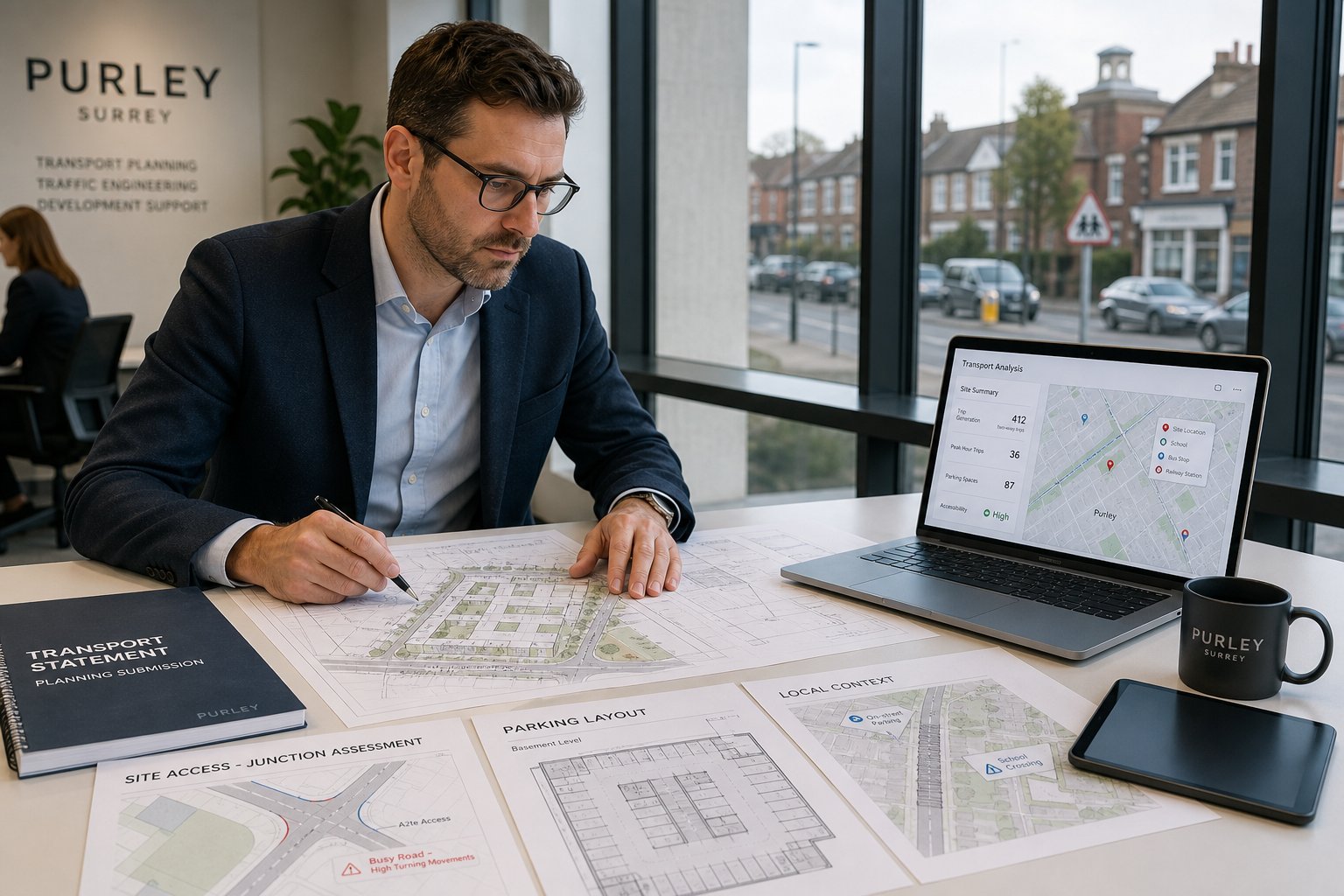
Not every scheme in Purley needs a full Transport Assessment, but a surprisingly wide range of applications benefit from traffic engineering input. The trigger is not only development size. Sensitivity of access, parking pressure, proximity to schools or busy roads, and likely concern from highways officers can all make transport evidence worthwhile.
We are often brought in when a project team wants to reduce planning risk before submission, respond to pre-application feedback, or address known site constraints that could become reasons for refusal.
Core Transport Reports Typically Needed For Planning Applications
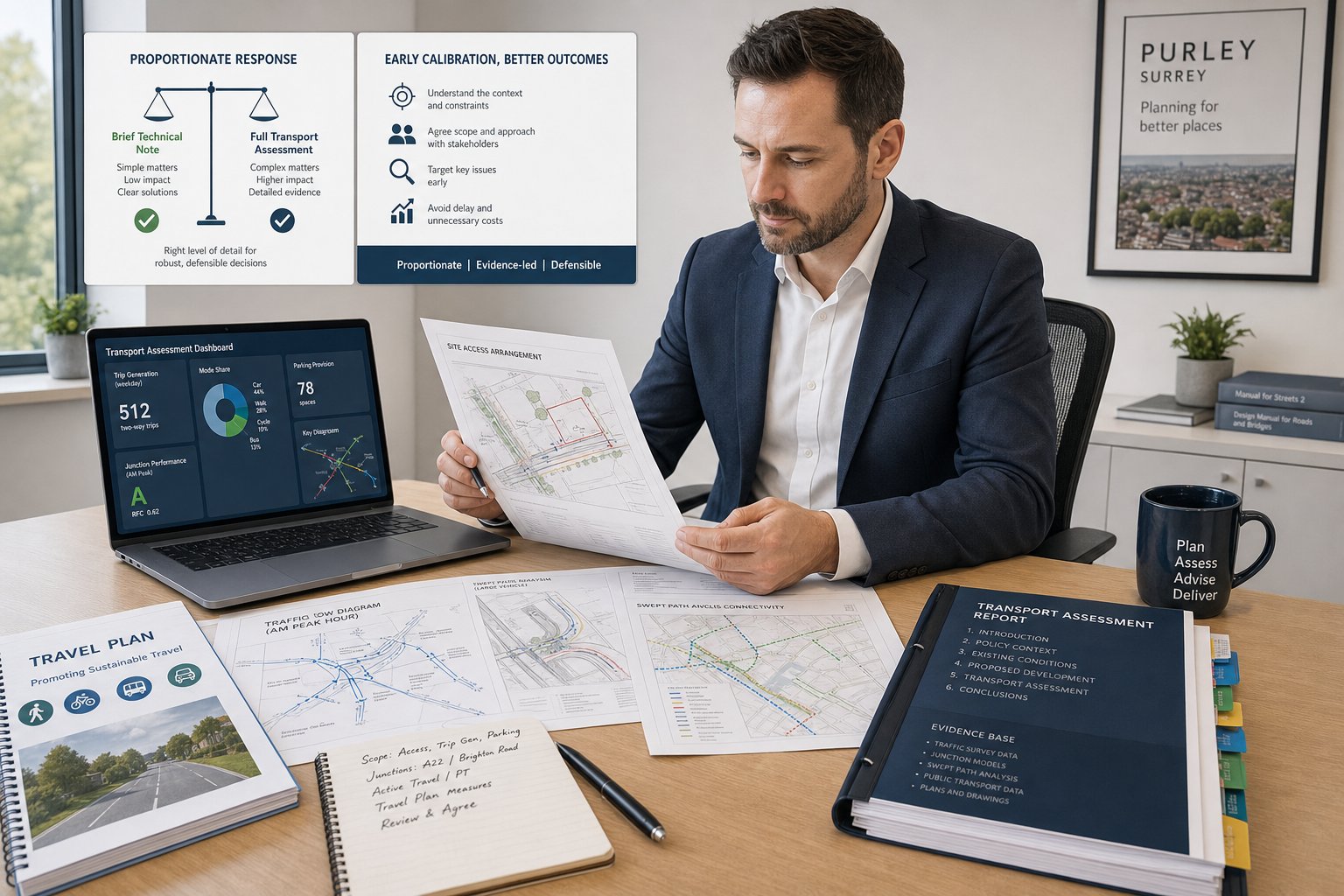
The right report depends on scale, land use, location and local authority expectations. One of the most common mistakes we see is preparing either too little or too much. A brief technical note may be enough for one site, while another will plainly need a full package with survey evidence and a travel plan.
Our job is to calibrate that requirement early so the planning submission is proportionate, credible and defensible.
How Traffic Engineers Assess Access, Safety, And Highway Impact
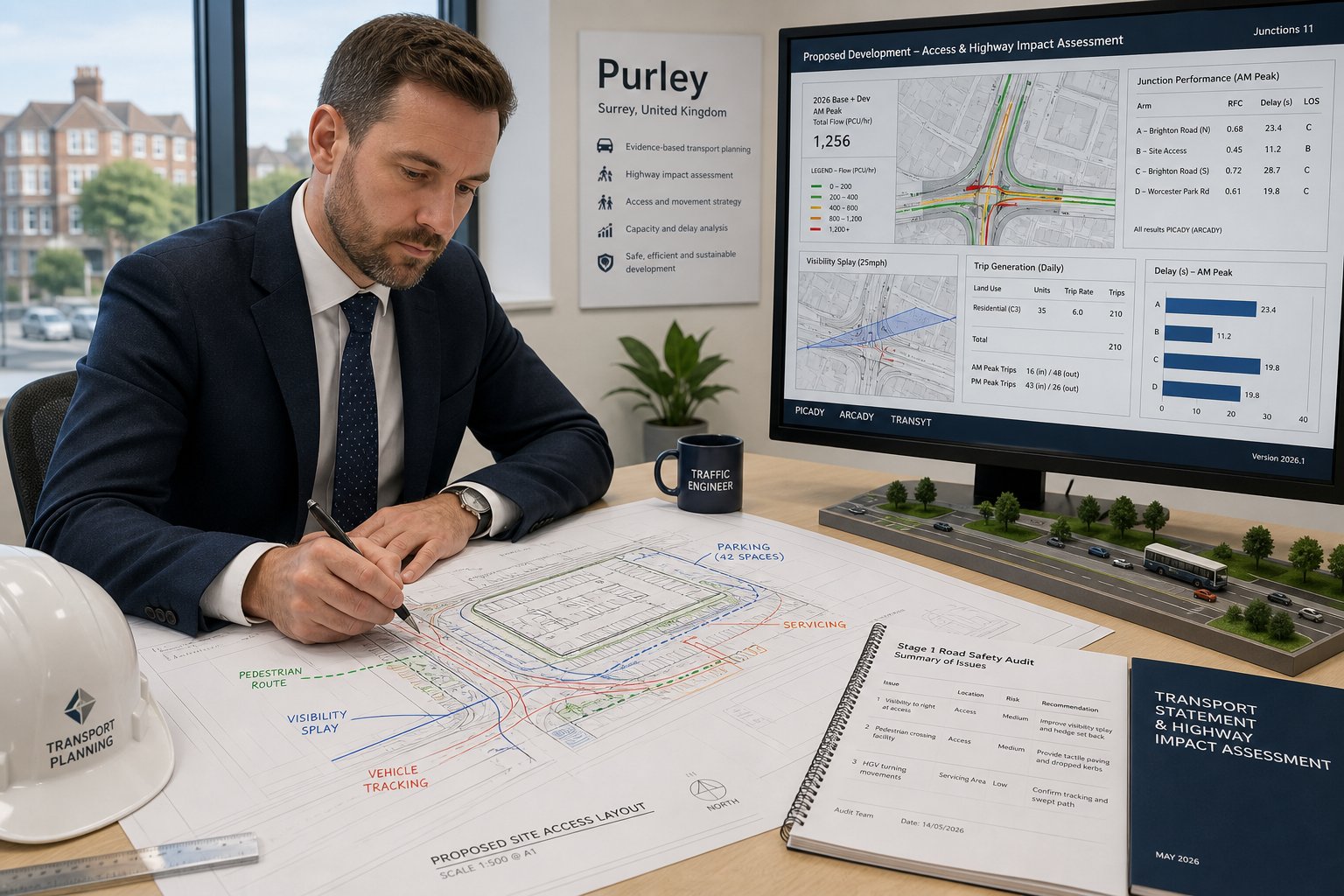
At the heart of the process is evidence. We assess whether the proposed development works on the ground, whether it introduces material highway issues, and whether any effect can be reduced through design changes or mitigation.
Trip generation is often the starting point. We use recognised data sources such as TRICS to estimate likely vehicle, pedestrian and cycle movements associated with the proposed use. Those trips are then considered in context: when do they occur, where are they likely to route, and are they materially different from the lawful existing use or fallback position?
Access design comes next. We review geometry, widths, gradients, intervisibility, tracking and the interaction between vehicles and pedestrians at the site entrance. Small design choices matter here. A gate set too close to the highway, a ramp that is too steep, or a bin collection point that interrupts manoeuvring can all prompt objections. Good access design highway thinking resolves these details before they become planning problems.
Safety assessment usually includes a review of collision data, visibility splays, pedestrian crossing desire lines, and the likely effect of additional turning movements on the surrounding network. For larger or more sensitive schemes, we may test junction operation using tools such as PICADY, ARCADY or LINSIG to understand reserve capacity and delay.
Parking and servicing are assessed in a similarly grounded way. We compare proposed provision against policy, local constraints and realistic demand, often supported by beat surveys where overspill is a concern. Construction traffic may also need attention, particularly on constrained urban sites.
This is the practical core of Traffic Engineering and Transportation: turning a site layout into a transport case that is both technically sound and planning-ready.
Working With Croydon Planning Requirements And Local Authority Expectations
Croydon is not unusual in wanting robust highways evidence, but it can be exacting on detail. In Purley, applications are commonly reviewed for more than just broad traffic impact. Officers often look closely at the mechanics of how a site will operate day to day: can vehicles enter and exit in forward gear where needed, can refuse be collected safely, is there proper disabled access, are cycle spaces usable, and does the proposal create pressure on already stressed kerbside parking?
That is why reports should engage directly with policy and officer concerns rather than rely on generic development wording. If the site fronts a busy route, we should explain access visibility and turning movements clearly. If parking provision is restrained, we should justify demand assumptions and, where appropriate, support them with survey evidence. If a school, clinic or commercial use is proposed, drop-off behaviour, delivery patterns and peak-hour overlap deserve explicit treatment.
Where strategic impacts may arise, TfL expectations can also shape the submission. Bus route reliability, impacts on red routes or nearby signals, and consistency with London-wide sustainable transport objectives may all become relevant.
For applicants, the benefit of experienced input is partly speed and partly judgement. We know when a concise technical response is likely to satisfy a query and when a more substantial package is necessary. That is the value of working with teams grounded in Highway And Traffic matters as well as planning strategy.
Above all, Croydon tends to respond better when transport evidence is specific, measured and realistic. Over-claiming can be just as damaging as under-evidencing.
What To Prepare Before Instructing A Traffic Engineer In Purley
The fastest way to keep a planning programme moving is to brief the traffic engineer properly from day one. Too many transport appointments start after the layout is effectively fixed, which limits what can be improved without rework. Earlier involvement usually means fewer iterations and fewer surprises.
At minimum, we need a red-line boundary, a draft site plan, proposed access arrangements and a schedule of accommodation. For residential schemes that might mean unit mix, tenure assumptions and cycle parking numbers. For commercial or education schemes, floor areas, staffing, opening hours, delivery patterns and expected peak activity are essential.
Any pre-application feedback from Croydon or TfL should be shared immediately. So should previous appeal decisions, historic highway comments, and local objections if they are already known. Residents often raise recurring issues such as rat-running, school gate congestion or evening parking stress: whether or not those concerns are fully borne out by evidence, they should inform the scope of assessment.
Design information matters too. If the architect has developed a servicing strategy, refuse approach, basement access, or internal turning arrangement, we can test it quickly through tracking and operational review. If parking is likely to be contentious, an early parking strategy traffic review is often more useful than trying to defend numbers after submission.
It also helps to be clear about the planning route. Full application, prior approval, change of use, appeal, condition discharge and pre-app submissions all call for slightly different levels of transport evidence.
When briefs are complete, reporting tends to be quicker, leaner and more persuasive. That is one reason firms with established Commercial Traffic Engineering processes can often add value beyond the report itself: they help the wider team avoid preventable transport issues before those issues harden into objections.
Conclusion
In Purley, transport evidence is rarely a box-ticking exercise. It is often a decisive part of the planning case, especially where access, parking, servicing or highway impact sit close to policy thresholds or local concern.
A well-briefed traffic engineer in Purley helps us do three things early: understand risk, shape a more workable design, and produce reports that align with Croydon and London expectations. That may involve a concise Transport Statement, a fuller assessment with modelling, a Travel Plan, swept path work, parking surveys, or simply a sharp technical response to a highways query.
The key is timing. When traffic engineering starts before a scheme is locked in, it tends to save time rather than add it. And in a planning environment where avoidable objections can cost months, that is not a minor advantage: it is often the difference between momentum and delay.
Frequently Asked Questions About Traffic Engineering in Purley
What does a traffic engineer in Purley do for new developments?
A traffic engineer in Purley assesses whether a new development can be safely and efficiently integrated into the local and strategic road network. They provide key transport evidence on trip generation, access, parking, and servicing, often proposing necessary mitigation to support planning permission.
Why is early involvement of a traffic engineer important in Purley planning?
Early involvement allows traffic engineers to identify and resolve access or parking issues before designs are finalised, reducing planning risks, avoiding delays, and ensuring reports comply with Croydon and London transport policies, ultimately supporting smoother planning approvals.
Which transport reports are commonly required for planning applications in Purley?
Typical reports include a Transport Statement for smaller impacts, a detailed Transport Assessment for larger or sensitive sites, Travel Plans promoting sustainable travel, Technical Notes addressing specific queries, Swept Path Analysis for vehicle manoeuvres, and Parking Reviews evaluating demand and policy compliance.
How do traffic engineers assess safety and highway impact in Purley?
They analyse trip generation using databases like TRICS, review collision data, check visibility and pedestrian routes, and may use modelling tools such as PICADY and ARCADY to assess junction capacity and delays, ensuring the development maintains safety and network efficiency.
What transport policies shape traffic engineering work in Purley?
Traffic engineering in Purley is guided by the Croydon Local Plan, the London Plan, TfL guidance, and national frameworks like the NPPF, covering aspects such as parking standards, cycle facilities, highway safety, and sustainable transport, tailored to Purley’s unique town centre and residential environment.
What information should developers provide before instructing a traffic engineer in Purley?
Developers should supply the red-line site boundary, draft layouts, accommodation schedules (units, staff, pupils), any pre-application feedback, architect’s access and parking strategies, and knowledge of local concerns like parking pressure or school traffic to enable effective and timely traffic assessments.