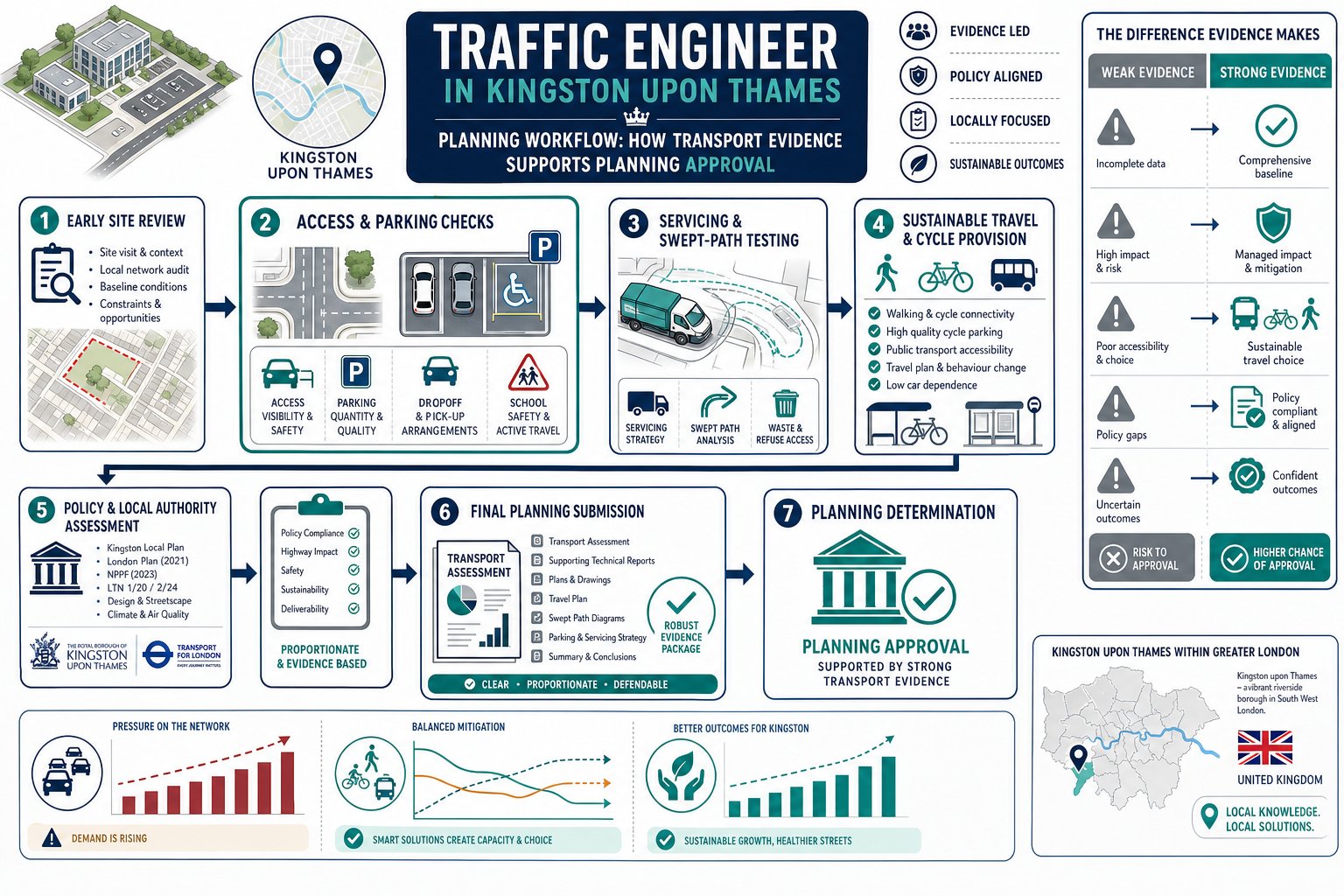
Planning in Kingston upon Thames is rarely just about the building. Access, parking, servicing, cycle provision, school-run pressure, bus reliability, and the effect on already busy local roads can all become decisive planning issues surprisingly early in the process. For architects, planners, developers, solicitors and project teams, that means transport evidence isn’t a late-stage add-on: it’s often one of the pieces that determines whether an application moves smoothly or stalls under highways objections.
A good traffic engineer in Kingston upon Thames helps translate a development proposal into clear, policy-led transport evidence that a case officer, highways officer, and sometimes Transport for London can properly assess. We’re not simply counting cars. We’re showing that access is safe, parking is realistic, servicing works in practice, and the proposal aligns with national policy, London expectations, and the Royal Borough of Kingston upon Thames’ own local context.
In 2026, that local context matters more than ever. Car-lite expectations, Controlled Parking Zones, pressure around district centres, and sensitivity around sustainable travel all shape what a robust submission looks like. In this guide, we’ll break down what transport engineers actually do for planning applications in Kingston, which reports are usually needed, where projects most often go wrong, and what to look for when appointing the right consultant.
Key Takeaways
- A traffic engineer in Kingston upon Thames provides essential, policy-led transport evidence that ensures planning applications address access, parking, servicing, and local highway constraints effectively.
- Early involvement of a traffic engineer helps align proposals with Kingston’s specific transport context, including Controlled Parking Zones and sustainable travel expectations, reducing the risk of planning delays or refusals.
- Transport reports in Kingston should be proportionate and site-specific, ranging from concise Transport Statements for small schemes to full Transport Assessments and Travel Plans for larger developments.
- Parking pressures, servicing logistics, and peak activity impacts such as school runs are critical local issues that strong transport evidence must address to satisfy borough officers and local residents.
- Choosing the right traffic engineer involves assessing their local experience, report clarity, responsiveness, and ability to produce concise, targeted evidence rather than voluminous generic documents.
- Integrating traffic engineering input early in the design process improves planning outcomes by resolving operational concerns before submission, making applications easier to defend and quicker to determine.
What A Traffic Engineer In Kingston Upon Thames Does For Planning Applications
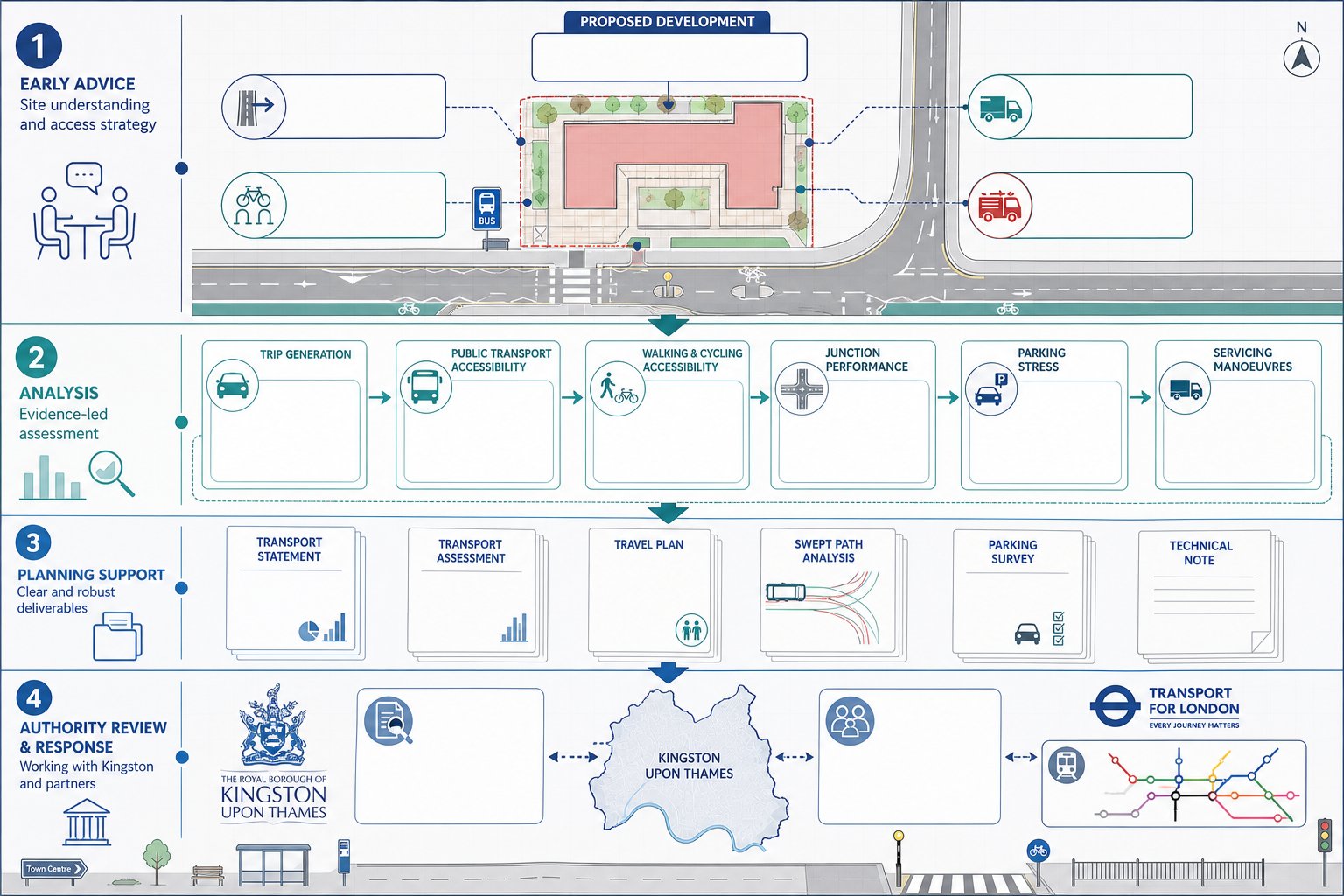
A traffic engineer in Kingston upon Thames provides the technical transport case behind a planning application. In practical terms, that means we assess how people, vehicles, deliveries and emergency access will interact with the proposed development and with the surrounding highway network.
For some schemes, the task is straightforward: confirm that an infill development has safe access, sensible cycle parking, and no meaningful transport impact. For others, particularly larger residential, education, healthcare or commercial proposals, the work becomes more detailed. We may need to review trip generation, compare multi-modal accessibility, assess junction performance, test parking stress, and demonstrate that servicing can occur without creating conflict on the highway.
That support often starts well before submission. We advise on whether a proposal is likely to need a Transport Statement, a full Transport Assessment, a Travel Plan, swept path analysis, a parking survey, or a short technical note. Early advice can stop avoidable redesign later.
We also help project teams respond to authority comments. In Kingston, the transport conversation may involve the borough’s highways officers, transport planning officers, and in some cases TfL. That is where concise reporting matters. Broad theory rarely wins planning arguments: site-specific evidence does. Broader context from Traffic Engineering Consultants: and practical development advice in Traffic Engineering and Transportation both point to the same thing: planning success usually comes from clear technical justification, not volume for its own sake.
At our best, we make the transport side of the application easier to understand, easier to defend, and harder to object to.
Why Transport Evidence Matters In The Royal Borough Of Kingston Upon Thames
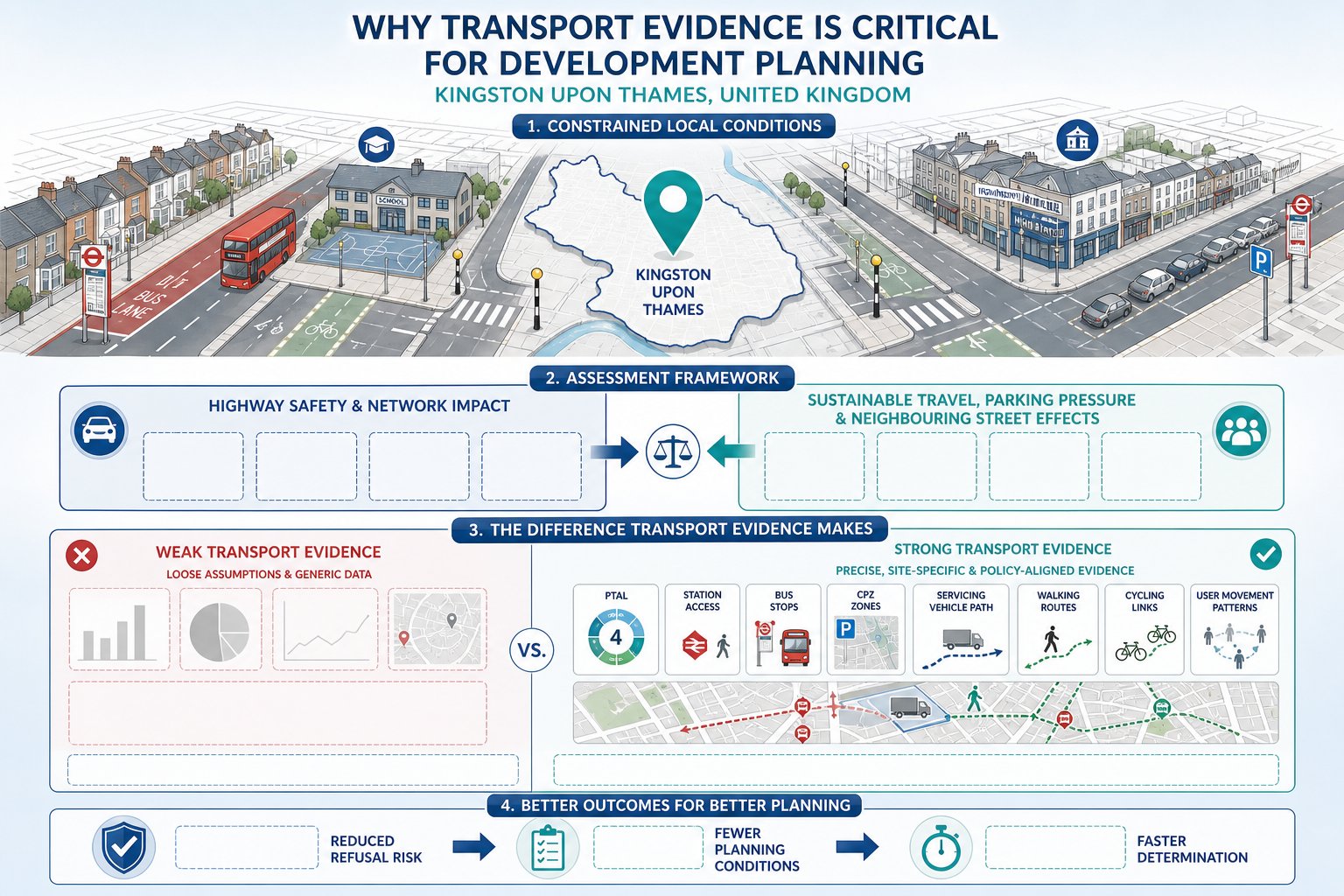
Kingston is an Outer London borough, but that label can be misleading if it makes a team assume highway conditions are loose or forgiving. They often aren’t. Many sites sit within constrained urban streets, near town centres, on bus corridors, around schools, or in areas where kerbside space is already under pressure. So the planning question isn’t simply whether a scheme adds traffic: it’s whether the impact is acceptable in policy and operational terms.
Nationally, the familiar test is whether a development would have an unacceptable impact on highway safety or cause a severe residual cumulative impact on the road network. Locally, RBKT will also expect proposals to support sustainable travel, reflect parking realities, and avoid shifting existing problems onto neighbouring streets.
That’s why transport evidence matters so much. Weak reports tend to rely on assumptions, generic trip rates, or broad statements about good public transport without really dealing with on-street conditions. Strong reports show the authority that the team understands local context: the site’s PTAL, nearby station and bus accessibility, CPZ controls, pedestrian routes, cycle infrastructure, servicing constraints and likely user behaviour.
And there’s another point. Good evidence doesn’t just reduce refusal risk: it can narrow planning conditions and speed up determination. A well-scoped report from a Highway And Traffic specialist can often answer the objection before it is raised. That is particularly valuable where programmes are tight and redesign costs are real.
Common Developments That Need Traffic And Transport Input
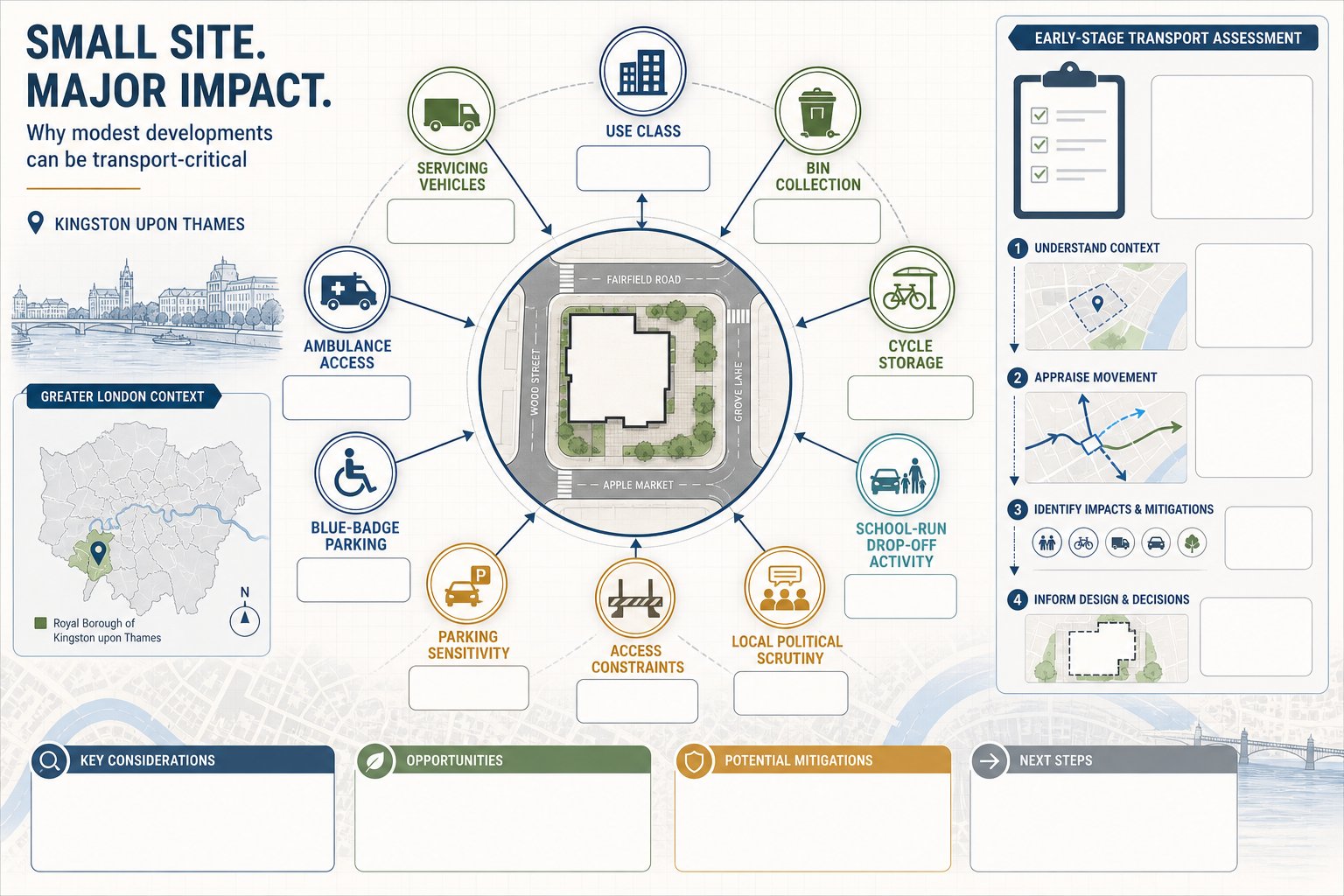
Not every project in Kingston needs a full transport package, but a surprisingly wide range of developments benefit from traffic engineering input. The trigger is not only size. Use class, operational characteristics, parking sensitivity, access constraints, and local politics can all push transport into the foreground.
Schemes on apparently modest plots often become transport-heavy once servicing, bin collection, ambulance access, blue-badge parking, cycle stores or school-run activity are examined properly. That’s why we usually advise teams to scope transport requirements early rather than guess.
Residential Schemes, HMOs, And Mixed-Use Proposals
Residential work is one of the most common reasons clients instruct a traffic engineer in Kingston upon Thames. New-build houses, apartment schemes, small backland development, conversions, PRS blocks, and changes to HMOs can all raise transport questions.
For housing, the authority will typically want comfort on access design, visibility, parking provision, cycle parking, refuse collection, delivery activity and expected trip impacts. The detail varies by location. A town-centre site near strong public transport may support a car-lite or lower-parking strategy. A suburban site with weaker alternatives may need a more cautious parking position and stronger justification.
HMOs and conversions are particularly interesting because the traffic impact may look modest on paper but parking stress can become contentious with neighbours. In those cases, parking accumulation logic, census-based car ownership evidence, local survey data and CPZ context matter more than generic assumptions.
Mixed-use proposals add another layer. Residential above retail, office or food premises can create overlapping demand across deliveries, staff arrivals, visitor activity and resident parking. The right approach is to separate the land uses, test peak periods sensibly, and show how the site will operate through a normal day rather than a single spreadsheet moment.
For teams dealing with schemes beyond pure residential, Commercial Traffic Engineering often overlaps with the same core questions we answer in Kingston: who arrives, when they arrive, where they stop, and whether the surrounding highway can cope.
Schools, Healthcare, Commercial, And Community Uses
Education and community uses can be some of the most sensitive projects in the borough because the transport issue is often less about average daily traffic and more about short, intense peak activity. A nursery may generate a concentrated drop-off period. A school expansion may affect crossing points, parking pressure and bus stop operation. A place of worship or community hall might create highly variable weekend peaks. A GP surgery can trigger concerns about patient parking, blue-badge access and ambulance servicing even where floor area appears modest.
Commercial schemes also vary widely. Offices may be assessed through mode share, PTAL, cycle provision and servicing needs. Light industrial or warehouse uses may need more attention on delivery vehicle routing, turning, loading and conflict with neighbouring uses. Leisure and food-led developments can create evening peaks that don’t align neatly with commuter assumptions.
In all of these cases, transport input is most effective when it is operational, not theoretical. We ask simple but decisive questions: where do people get dropped off, where does the refuse wagon turn, what happens if a van arrives early, can a fire appliance enter and leave in forward gear, and will neighbours start objecting because parking overspill has been ignored?
Those are the issues that planning committees and local residents tend to understand immediately, so they need good answers.
Core Reports A Traffic Engineer May Prepare
The right report depends on the scale, sensitivity and likely transport effects of the proposal. In Kingston, as elsewhere, over-reporting can be wasteful, but under-reporting is often what creates avoidable planning friction.
Our job is to recommend the lightest report that still provides a robust evidence base. Sometimes that is a concise note focused on parking and access. Sometimes it needs a full package with data collection, drawings and a Travel Plan. The key is proportionality backed by local judgement.
Transport Statements, Transport Assessments, And Travel Plans
A Transport Statement is usually appropriate for smaller schemes with limited and manageable transport effects. It explains the site context, accessibility, parking, servicing and likely movement patterns, and it demonstrates that impacts are not significant. For many modest residential or change-of-use proposals in Kingston, a well-prepared TS is enough.
A Transport Assessment goes further. We would usually prepare a TA for larger developments, more sensitive land uses, or sites where access, capacity or safety concerns need fuller testing. That can include trip generation analysis, distribution and assignment, junction assessment, collision review, sustainable travel appraisal and mitigation proposals. The aim is not to drown the reader in technical appendices. It is to answer the authority’s likely questions before they ask them.
A Travel Plan complements either document where sustainable mode choice needs to be actively managed. In Kingston, this can be particularly important on schemes with good public transport accessibility or where car use restraint is part of the planning strategy. A credible Travel Plan includes targets, measures, management responsibility and monitoring, not just a generic promise to encourage cycling.
For a wider London perspective, Traffic Engineer In London: highlights how borough-specific judgement sits on top of the same national framework. That mix of consistency and local nuance is exactly what good planning reports need.
Parking Surveys, Swept Path Analysis, And Highway Technical Notes
Some of the most valuable work a traffic engineer does never becomes a lengthy standalone report. A parking survey, for example, may decide whether a proposal is acceptable in an area with strong resident concern about overspill. In Kingston, CPZ restrictions, event patterns, proximity to shops and the time of day all affect what survey data really means. The survey itself matters, but the interpretation matters more.
Swept path analysis is another frequent requirement. Refuse vehicles, delivery vans, fire appliances and moving vans all need to enter, manoeuvre and exit safely. A scheme can look fine on a basic layout drawing and still fail once a realistic tracking exercise is overlaid. That is especially true on tight urban plots and mews-style access arrangements.
Then there are highway technical notes, brief, targeted responses to comments from RBKT, TfL or third parties. These can be crucial. A concise rebuttal on trip rates, visibility, parking demand or delivery assumptions can rescue an application more effectively than a bloated reissue of the full transport report.
This is where experience shows. General guidance in Traffic Engineering: Your is useful, but planning support in practice often comes down to whether the engineer can isolate the precise technical point that is worrying the authority and deal with it directly.
Key Local Transport And Highways Issues In Kingston Upon Thames
Kingston has a transport profile that can catch non-local teams out. The borough contains attractive residential areas and major trip attractors, but road space is finite and many corridors are already sensitive to peak-hour congestion. Add schools, district centres, rail stations, bus movements, cycle routes and parking controls, and even a relatively small development can become locally contentious.
One recurring issue is parking pressure. On-street spaces are often treated by neighbours as a fixed, scarce resource, so applications that underplay parking are vulnerable to objection. That doesn’t mean every scheme needs high parking provision. In fact, some locations can justify car-free or car-lite approaches, particularly where PTAL is stronger and daily needs are close by. But the case must be evidenced properly and reflect permit eligibility, CPZ controls and realistic ownership patterns.
Another issue is servicing and access geometry. Tight frontages, established trees, narrow carriageways and existing crossing activity can constrain what is possible. We often find that a scheme’s planning risk sits not in traffic generation but in whether a delivery van can stop without blocking movement or whether visibility is compromised at a busy local junction.
School-run activity, pedestrian safety and cycling provision also matter. Near schools and centres, the authority will look closely at conflict points, crossing demand and kerbside friction. That’s why local insight helps: generic transport reporting may tick boxes, but Kingston schemes are often won or lost in the operational detail visible on site.
How A Traffic Engineer Supports Architects, Planners, And Developers
The most useful transport input usually happens before the planning statement is drafted. When we work alongside architects, planners, surveyors and developers early, we can influence the layout while changes are still easy. Shift an access point by a few metres, revise a turning head, adjust cycle storage, reduce parking conflict, or rethink servicing, and the application becomes much easier to defend.
For architects, that means transport advice that is practical rather than obstructive. We’re there to help the design work on a real highway network, not just to say no. For planning consultants and solicitors, we provide policy-backed evidence that supports the planning balance and addresses technical consultation risk. For developers, we help avoid costly redesign and determination delays.
There is also a coordination role that gets underestimated. Transport issues often overlap with drainage, refuse strategy, fire access, public realm and viability. A good traffic engineer joins those dots early. On commercial-led schemes, the same joined-up thinking appears in Commercial Traffic Engineering In. On wider project teams, the value is consistency: one transport narrative running through access drawings, planning text, servicing logic and eventual responses to comments.
And when objections do arrive, we help the team stay calm. Highways concerns often look bigger at first glance than they really are. Once broken down into access, demand, safety, servicing or parking, they usually become solvable technical questions.
The Process From Initial Brief To Planning Submission
Most successful transport work follows a fairly disciplined process, even when the final output is concise.
First comes the initial brief. We review the proposed use, scale, access arrangement, likely planning route, and whether the site may need early engagement with RBKT or TfL. We’ll usually flag the likely transport deliverables at this stage and identify obvious design risks.
Next is the site visit and baseline review. This is where drawings meet reality. We look at junction spacing, footway width, crossing activity, parking controls, neighbouring access points, loading patterns and the general feel of how the street actually works. That last part sounds informal, but it matters. A technically compliant layout can still be operationally awkward.
Then comes data collection where needed: traffic counts, parking beat surveys, accessibility review, trip-rate evidence, collision data and servicing observations. After that we carry out the relevant analysis, parking demand, access review, swept path checks, junction capacity work, or policy assessment.
We then prepare the draft report package: TS, TA, Travel Plan, technical note, drawings or tracking plans. This draft is usually coordinated with the architect and planning consultant so the transport story aligns with the wider submission.
Finally, we finalise for submission and support post-submission queries. Comparative articles such as Traffic Engineer In Bristol: and Traffic Engineer In Birmingham: show the same broad workflow, but the important thing in Kingston is tailoring the evidence to local highways expectations rather than relying on a generic template.
What To Look For When Choosing A Traffic Engineer In Kingston Upon Thames
If you’re appointing a traffic engineer in Kingston upon Thames, credentials matter, but so does judgement. We’d start with the basics: relevant UK development planning experience, strong report writing, familiarity with local authority consultation, and ideally professional standing such as CEng, MICE or MCIHT. Those signals matter because planning transport work is not just design: it is evidence, negotiation and risk management.
But we’d look beyond CV lines. Has the consultant worked on London schemes with constrained urban streets, CPZ issues, sustainable transport expectations and active local scrutiny? Can they produce a concise note for a modest application, or do they only know how to generate a 100-page assessment? Do they understand when a survey is essential and when it is overkill?
Software capability is important too. Swept path tools, CAD literacy, parking analysis and junction modelling all have their place. Still, tools don’t win arguments on their own. The real differentiator is whether the engineer can explain the findings clearly to planners, clients and, when needed, committee members.
We’d also test responsiveness. In planning, speed matters. A delayed transport note can hold up an otherwise ready submission. That’s one reason many clients value specialist teams with a focused reporting model and long experience across local authority environments. The best appointment usually isn’t the firm that promises the thickest report. It’s the one most likely to produce the right evidence, in the right format, at the right time.
Conclusion
In Kingston upon Thames, transport evidence has a habit of becoming central to planning applications because the borough’s streets, parking conditions and policy expectations leave little room for vague assumptions. A well-prepared report can show that a proposal has safe access, workable servicing, realistic parking, and an acceptable effect on the wider network. Just as importantly, it can show that the development supports the sustainable travel direction expected in London planning.
For architects, planners, developers and legal teams, the practical lesson is simple: bring transport input in early. The sooner access, servicing, parking and policy issues are tested, the easier they are to solve. By the time an application is submitted, the transport story should feel settled, coherent and defensible, not hurried.
That’s eventually what a strong traffic engineer brings to a Kingston project: local understanding, proportionate evidence, and a better chance of keeping the planning process moving.
Frequently Asked Questions about Traffic Engineers in Kingston upon Thames
What role does a traffic engineer play in planning applications in Kingston upon Thames?
A traffic engineer assesses traffic, access, parking, and highway safety impacts of a development, preparing policy-led transport evidence to ensure planning applications comply with local and national requirements in Kingston upon Thames.
Why is transport evidence crucial for developments in the Royal Borough of Kingston upon Thames?
Transport evidence is vital because Kingston’s constrained roads, bus corridors, and parking controls require schemes to show no severe impact on highways and support sustainable travel, reducing refusal risks and planning conditions.
Which types of developments typically require a traffic engineer’s input in Kingston?
Common projects needing input include new housing, HMOs, mixed-use schemes, schools, healthcare facilities, retail, offices, leisure, industrial uses, and community buildings, where traffic and parking implications must be assessed.
What types of reports can a traffic engineer prepare to support planning submissions in Kingston?
They may prepare Transport Statements for smaller developments, full Transport Assessments for larger or sensitive proposals, Travel Plans promoting sustainable travel, as well as parking surveys, swept path analyses, and technical rebuttals.
How does local context influence traffic engineering evaluations in Kingston upon Thames?
Local factors such as Controlled Parking Zones, school-run congestion, cycle routes, bus reliability, and car-lite policy expectations shape assessments to ensure developments fit within Kingston’s urban environment and transport policies.
What should I consider when choosing a traffic engineer for a Kingston upon Thames project?
Select a chartered professional with UK planning experience, strong local knowledge of RBKT policies, skills in technical tools, clear reporting ability, and responsiveness to ensure efficient handling of transport assessments and authority negotiations.