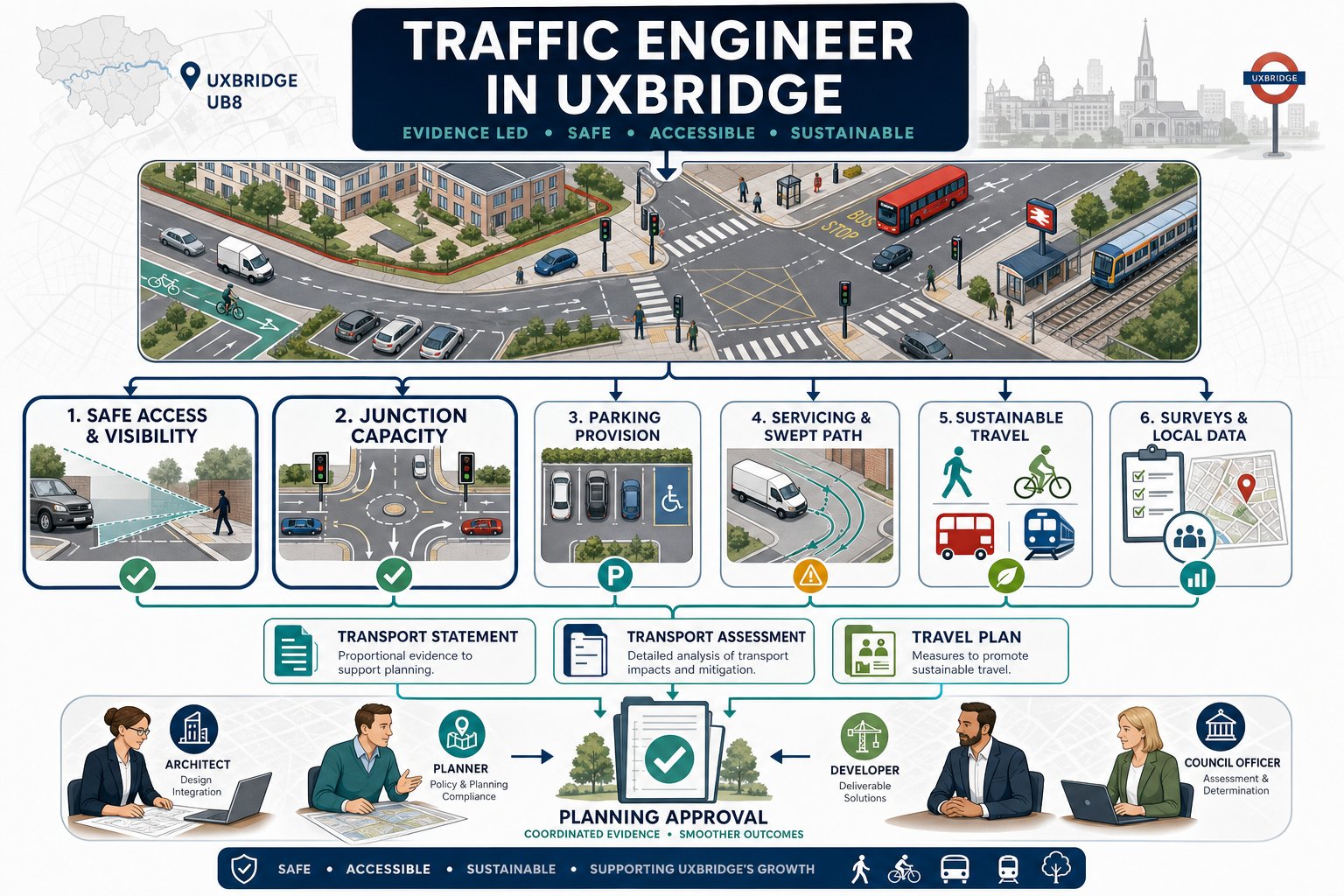
A planning application can look perfectly sound on paper and still run into trouble once transport issues are tested properly. In Uxbridge, that happens more often than many teams expect. A scheme may have the right land use, the right massing, even local policy support, but if access is awkward, parking is undercooked, servicing is impractical, or nearby junctions are already strained, objections quickly follow.
That is why transport evidence matters early, not just at validation stage. For architects, planners, developers, surveyors, solicitors, and council teams, the question is rarely whether movement matters. It is whether the proposal can show, with credible data and clear reasoning, that people and vehicles will reach the site safely and that the surrounding network will continue to operate acceptably.
As a traffic engineer in Uxbridge, we look at the practical side of development: how trips are generated, how vehicles turn, where deliveries go, whether visibility works, how pedestrians connect to local routes, and whether the scale of impact needs a Transport Statement, a full Transport Assessment, or a Travel Plan. In a place like Uxbridge, with town centre activity, strategic roads, rail and bus connections, schools, mixed-use sites, and established residential areas, those questions need local judgement as much as technical method.
This guide explains where traffic engineering fits into the planning process, what tends to trigger transport work, and what decision-makers usually expect to see in 2026.
Key Takeaways
- A traffic engineer in Uxbridge ensures transport evidence is credible, showing safe access and manageable impact on local roads to support successful planning applications.
- Early involvement of traffic engineering helps shape designs by addressing access, parking, servicing, and multimodal movement before layouts are finalised.
- Transport reports in Uxbridge must balance practical local conditions, assessing junction capacity, parking demand, and sustainable travel options like walking, cycling, and public transport.
- Accurate traffic surveys and local data are essential to build robust transport assessments that satisfy planning officers and councillors.
- Effective collaboration between traffic engineers, architects, planners, developers, and councils streamlines planning by aligning technical evidence with local policies and site specifics.
- Choosing a traffic engineer with local knowledge, technical expertise, clear reporting, project coordination, and realistic advice improves planning outcomes and reduces delays.
Why Traffic Engineering Matters For Development In Uxbridge
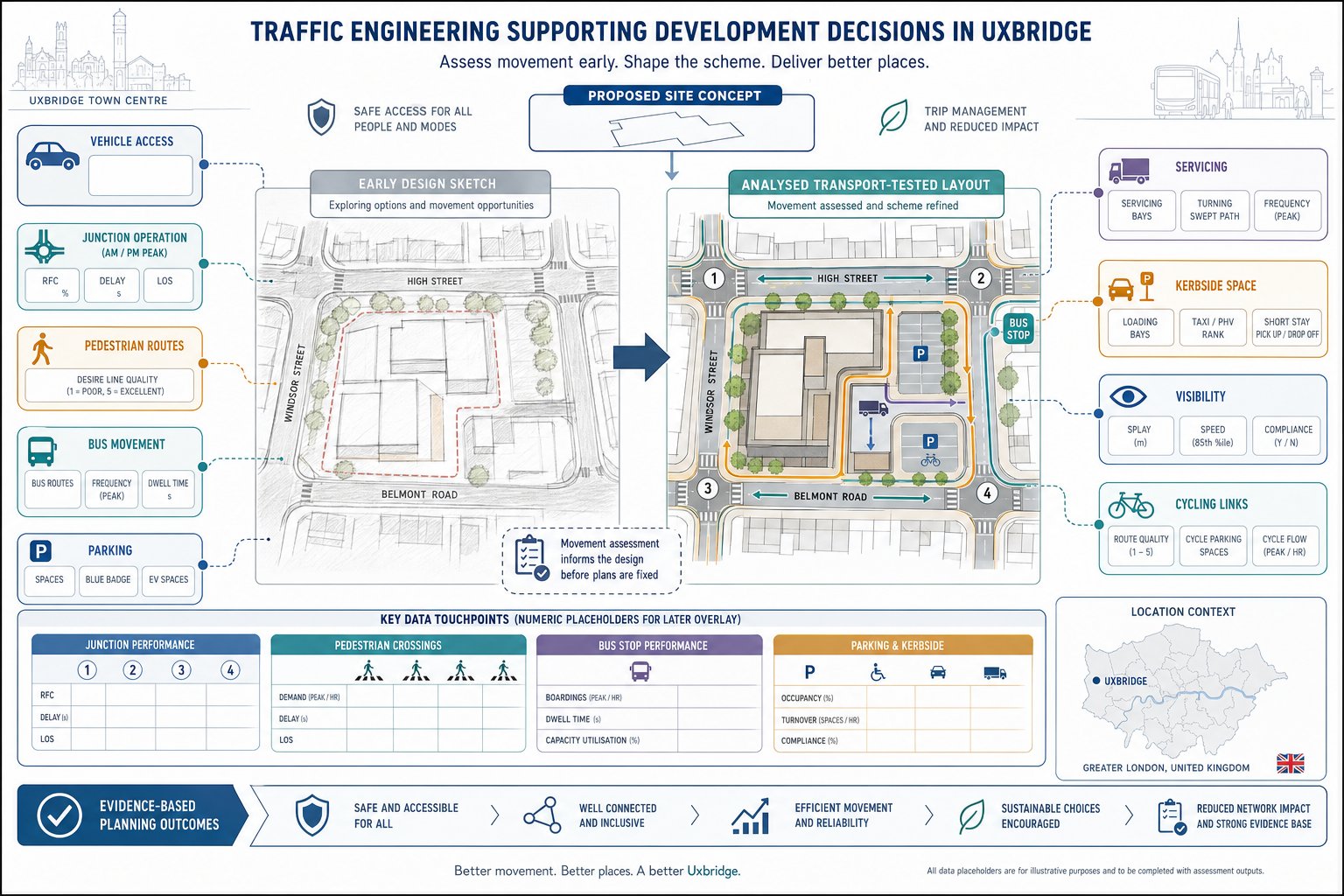
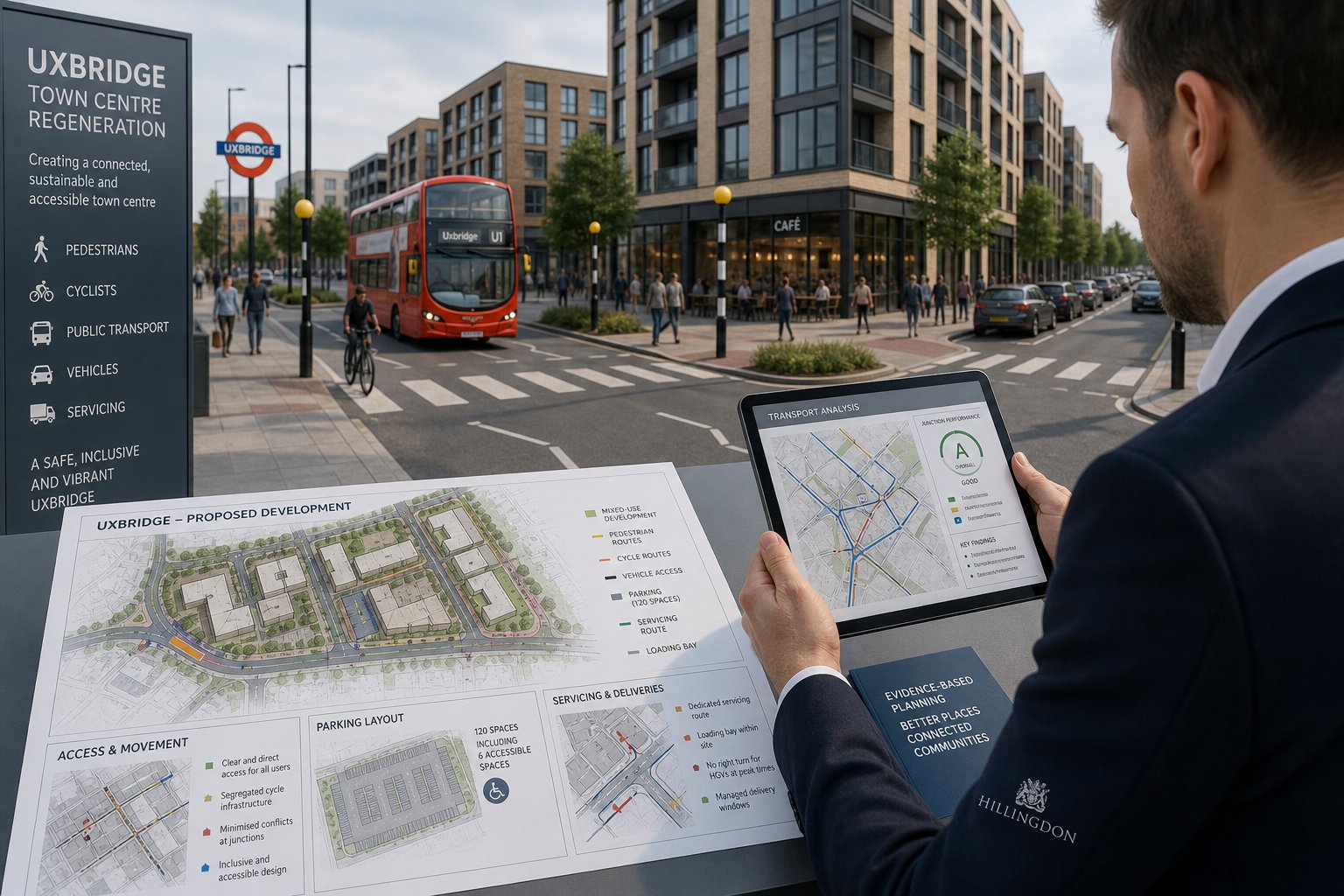
Traffic engineering sits at the point where development ambition meets day-to-day movement on the ground. In Uxbridge, that matters because planning decisions are not made in the abstract. They are made against real roads, real junctions, real pedestrian routes, and existing pressures on kerbside space, parking, bus operations, and local safety.
A development proposal must do more than show buildings on a site plan. It needs to demonstrate that access will work safely, that additional trips can be understood and managed, and that the proposal will not create unacceptable effects on the local highway network. That applies to housing, commercial schemes, education uses, care facilities, industrial sites, and mixed-use redevelopment alike.
The transport case also helps shape design quality. Early input from Traffic Engineering Consultants: often prevents the common problem of a layout being drawn first and tested later. In practice, the better approach is the reverse: test likely access, servicing, parking, and multimodal movement early enough to influence the design before positions harden.
For Uxbridge projects, we usually find that traffic engineering is most valuable when it turns broad concerns into evidence. A neighbour may worry about overspill parking. A highways officer may ask about visibility or turning. A planning case officer may need comfort on sustainable travel. Good transport work answers those points with measured, site-specific analysis rather than vague assurance.
The Main Planning And Transport Challenges In Uxbridge
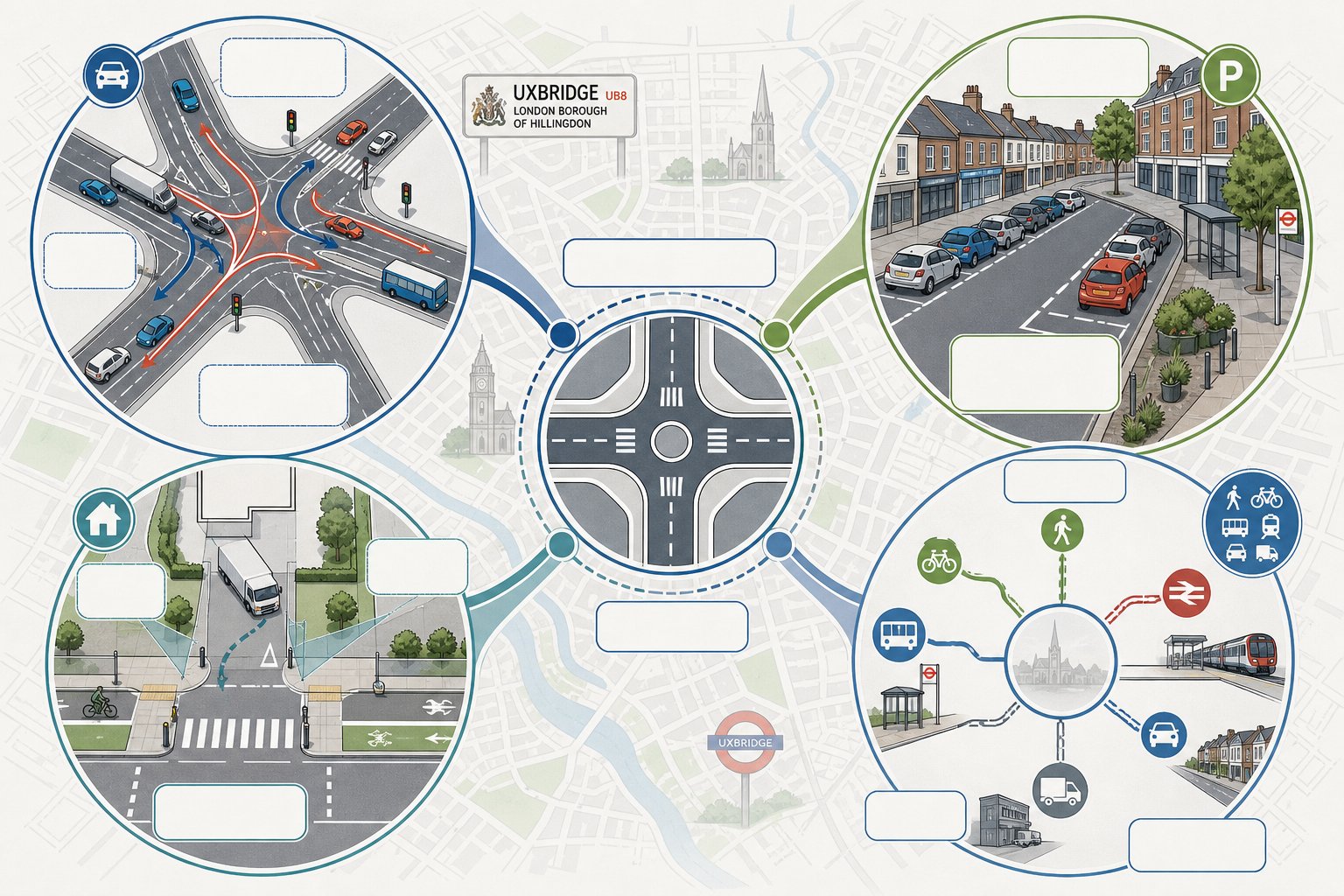
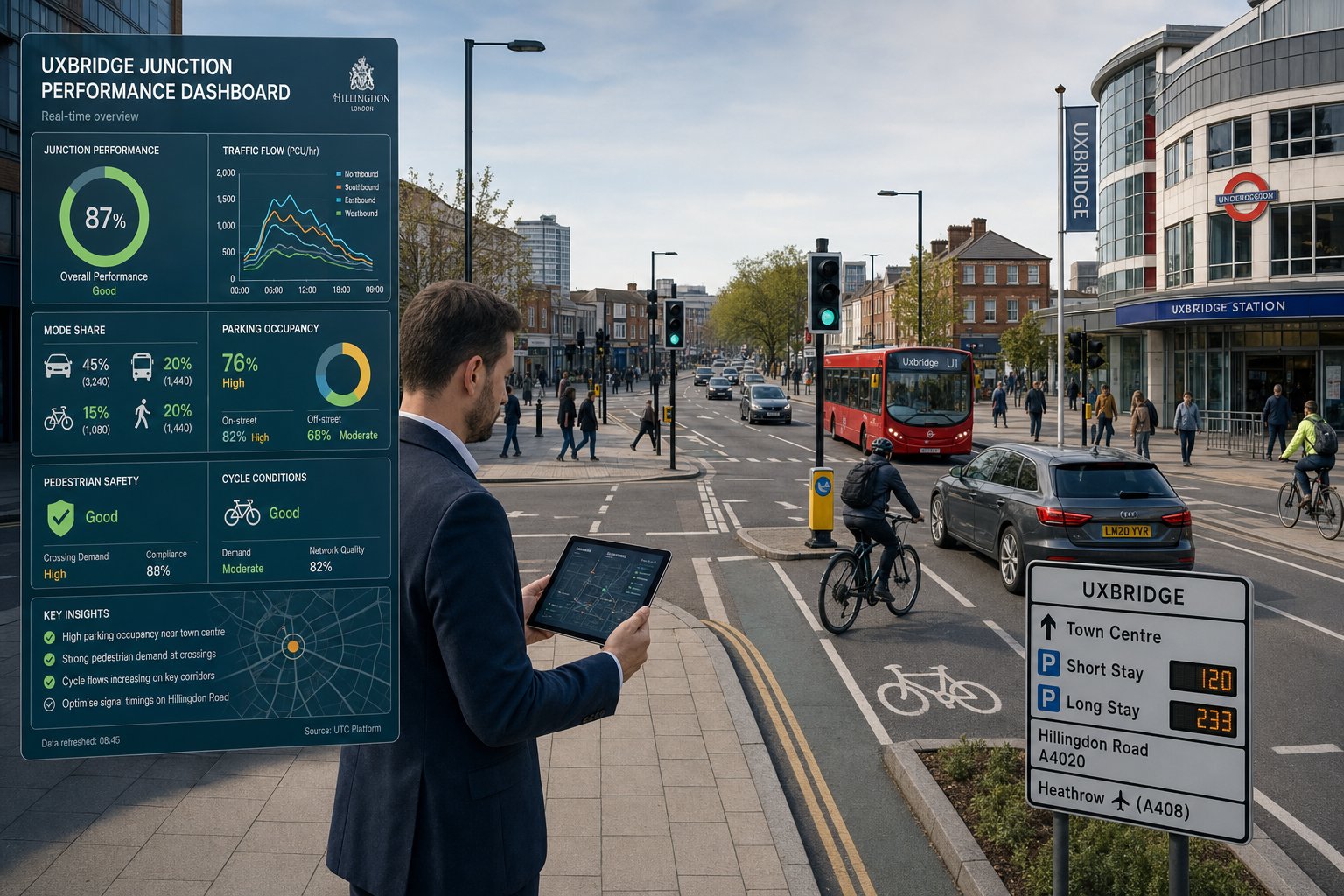
Uxbridge brings together conditions that make transport planning nuanced rather than routine. There are town centre streets with competing demands, established suburban roads with strong resident sensitivity, strategic links carrying through traffic, and sites influenced by public transport accessibility. That mix means one-size-fits-all reporting rarely survives scrutiny.
A recurring challenge is junction performance. Even modest development can become contentious if it adds turning movements onto a corridor that already experiences peak-time delay. In those cases, the question is not simply how many trips are added, but where they load onto the network, when they occur, and whether local junctions have operational resilience.
Parking is another frequent pressure point. Existing streets may already be busy, and planning teams often need a balanced position between policy aspirations for reduced car dependence and the reality of user demand. Underestimating parking demand can trigger objections: overproviding it can conflict with design and sustainability goals.
Safe access arrangements are equally important. We regularly review whether the geometry, visibility, pedestrian interaction, and servicing arrangements are appropriate for the proposed use. That is particularly relevant where sites are tight, front onto active streets, or rely on shared spaces.
The final challenge is balance. Modern transport evidence must consider not only cars and vans, but also walking, cycling, buses, rail access, and inclusive movement. Wider guidance in Traffic Engineering and Transportation reflects that shift: successful planning support now depends on showing how a site functions for all users, not just motor traffic.
When A Traffic Engineer Is Needed For A Planning Application
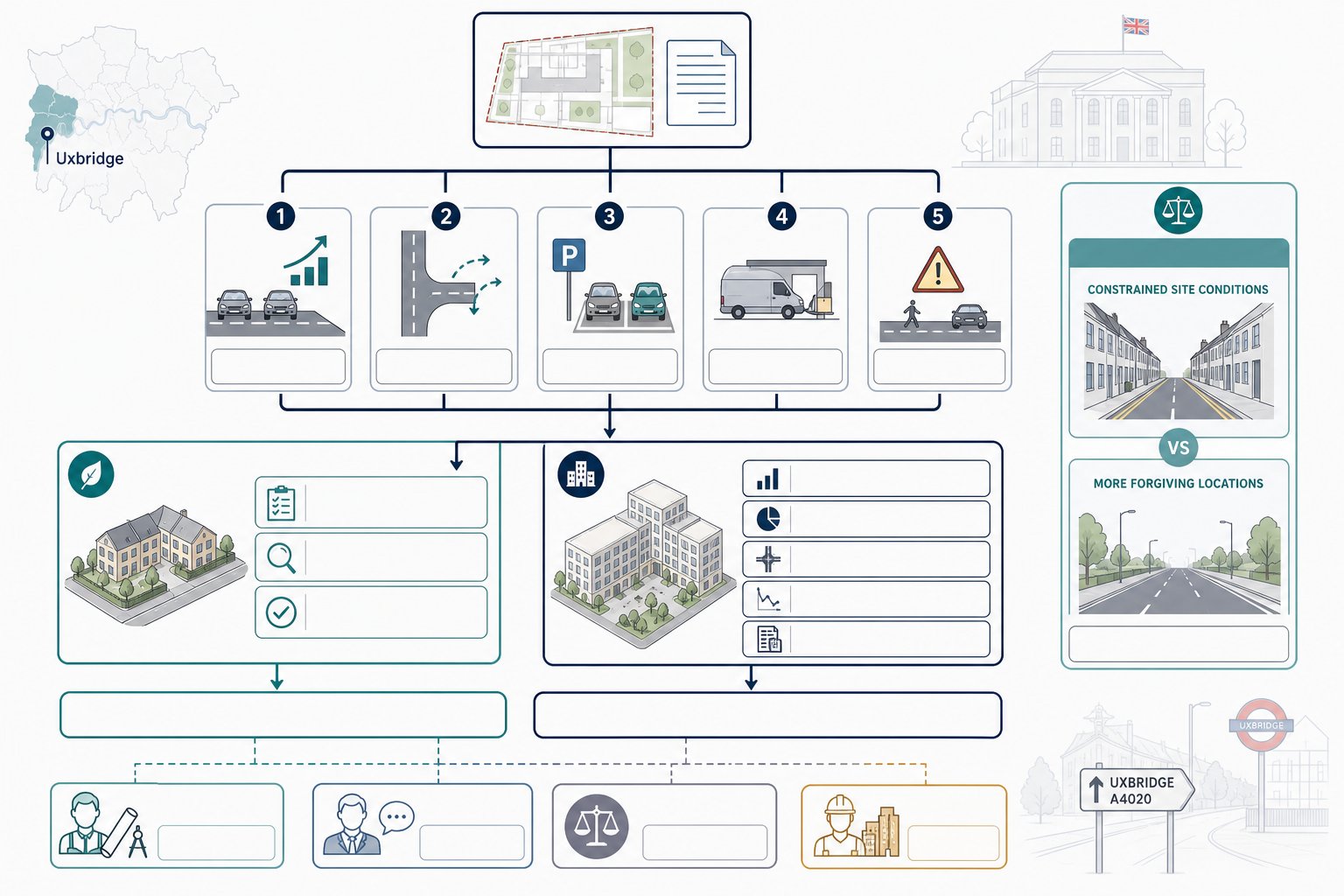
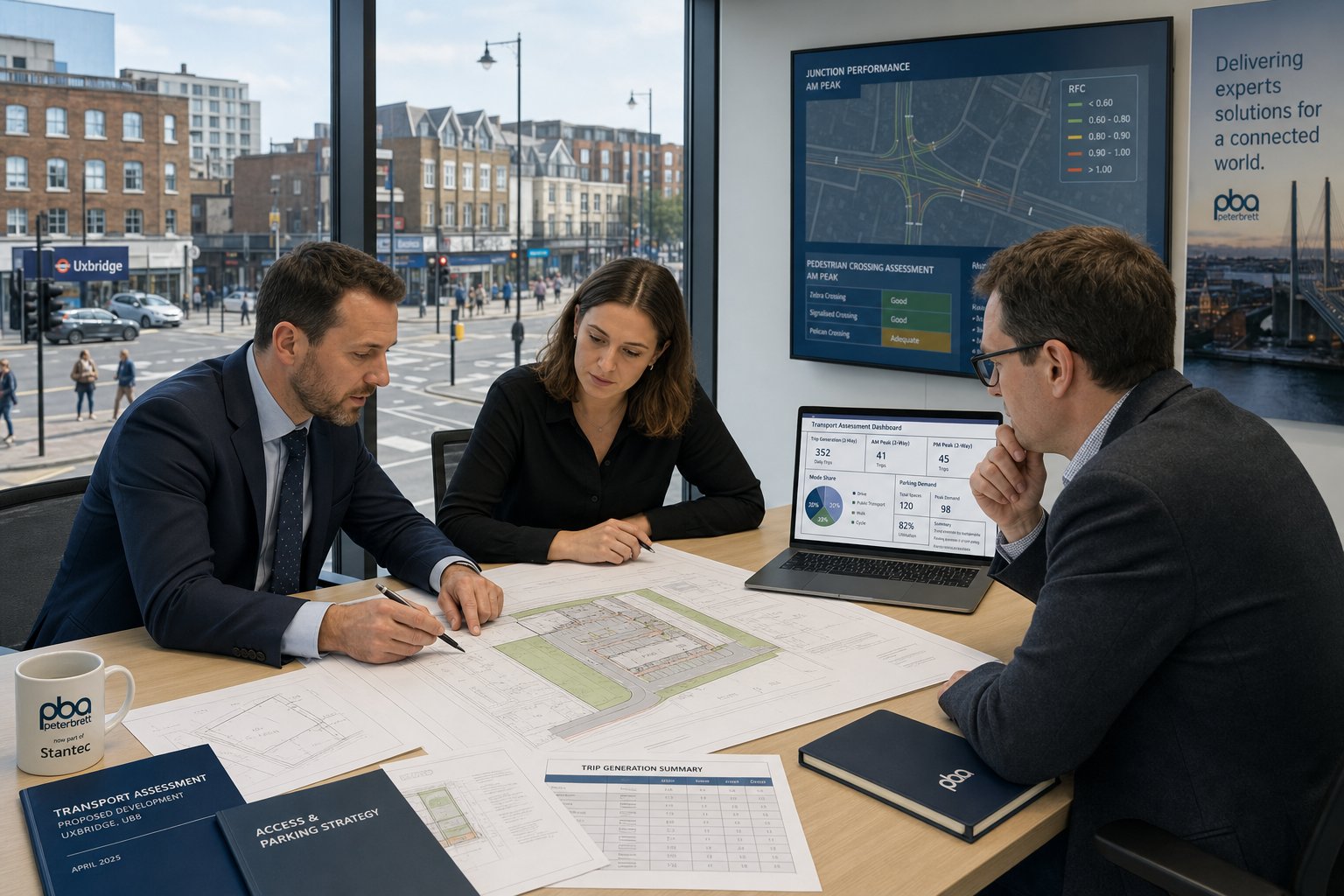
Not every planning application needs a full transport submission, but many more schemes need traffic engineering input than applicants first assume. The trigger is usually practical impact. If a proposal changes trip generation, alters access, affects parking demand, introduces servicing activity, or raises a highway safety question, transport evidence is often necessary.
For smaller schemes, that might mean a concise review of access, parking, and local travel options. For larger or more sensitive proposals, it may involve a formal Transport Assessment supported by surveys, trip analysis, capacity testing, and a Travel Plan. Local authority thresholds matter, but they are not the only factor. A relatively small development on a constrained site can generate more concern than a larger one in a forgiving location.
We are commonly instructed where an architect has developed an initial layout and wants confidence that it will stand up in planning: where a planning consultant anticipates transport queries from the council: where a solicitor needs technical backing in support of an appeal or application strategy: or where a developer has already received pre-application feedback flagging highways concerns.
A Traffic Engineer In London: context often overlaps with Uxbridge too, because outer-London planning expectations can combine strategic policy with very local operational detail. The earlier we are brought in, the more chance there is to solve issues through design rather than defend them later through mitigation.
Transport Assessments, Transport Statements, And Travel Plans Explained
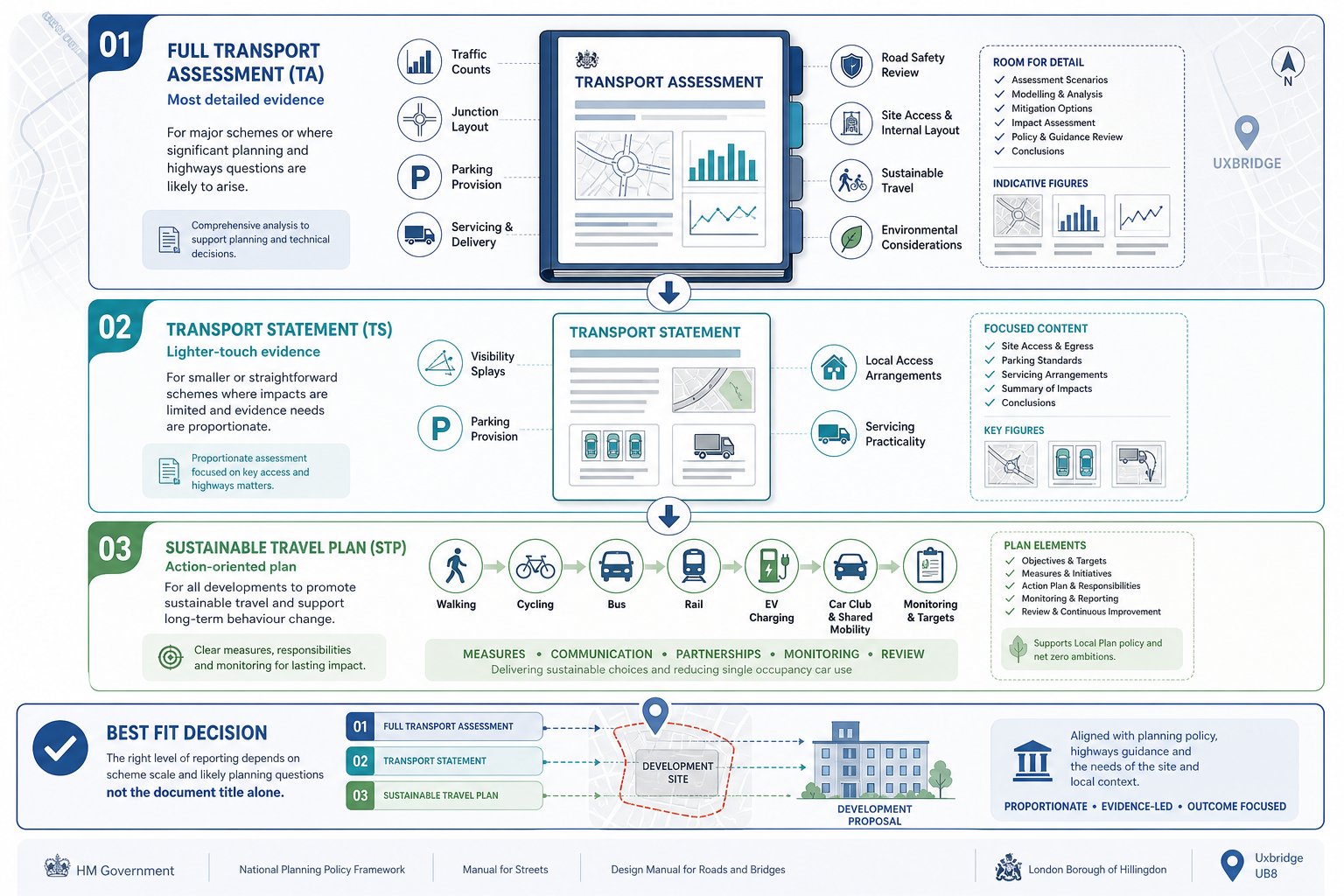
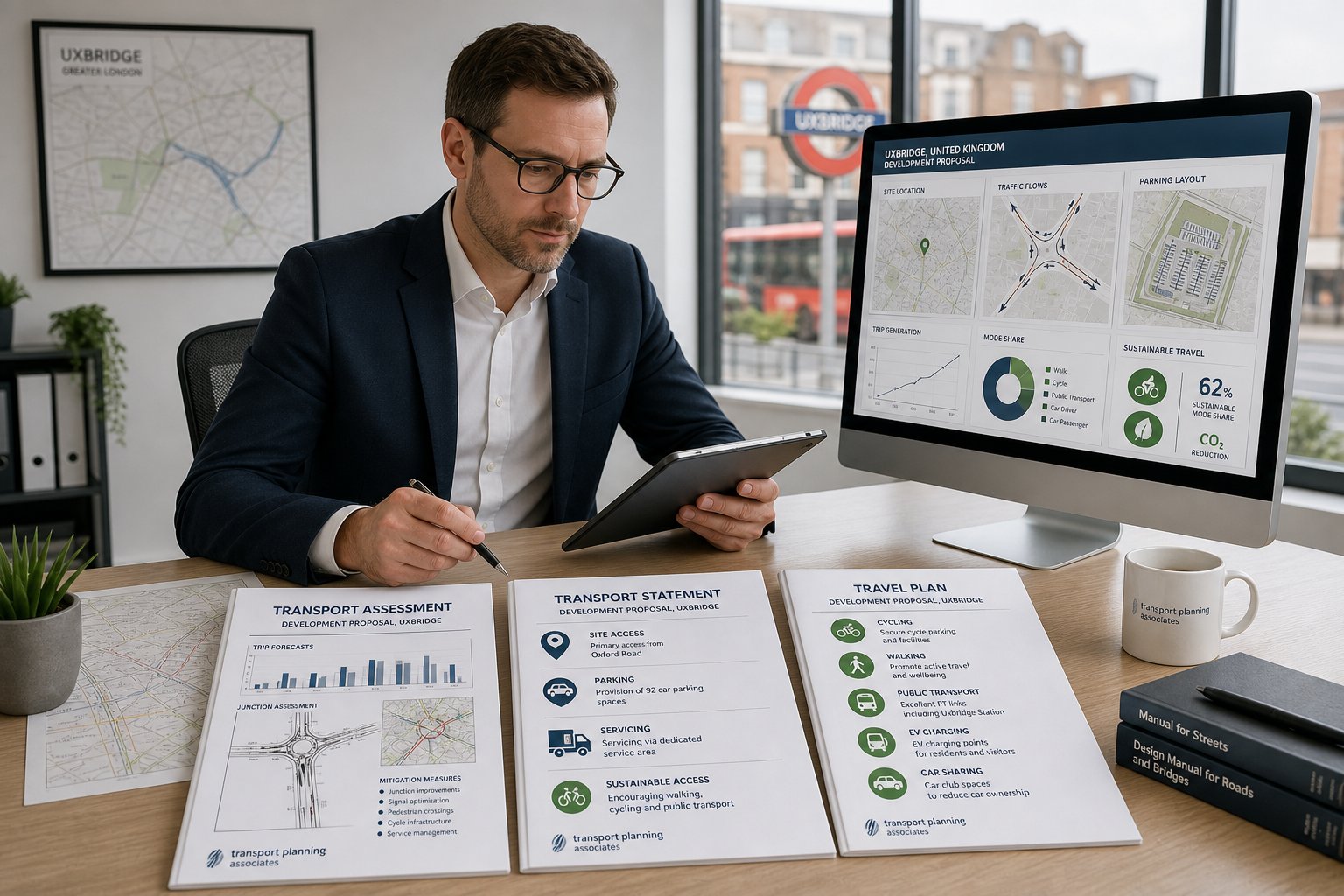
These documents are often mentioned together, but they do different jobs.
A Transport Assessment is the most detailed form of transport evidence. It is generally used for schemes with a more material transport effect, or where the site context is sensitive enough that officers need a robust understanding of forecast trips, assignment, operational impact, access design, parking, servicing, road safety, and sustainable travel opportunities. A good Transport Assessment is analytical but readable. It explains the baseline, the proposal, the evidence, the likely impact, and any mitigation in a clear chain.
A Transport Statement is lighter touch. It is usually suitable for smaller development or proposals where transport impacts are limited and can be demonstrated without extensive modelling. That does not mean it is casual. A weak Transport Statement can still cause delay if it skips key matters such as visibility, parking stress, or servicing practicality.
A Travel Plan is different again. It sets out measures to encourage sustainable travel and reduce reliance on single-occupancy car trips. Depending on the scheme, that might include cycle parking, pedestrian improvements, public transport information, car club measures, EV infrastructure, staff travel policies, monitoring, and targets.
We often explain to clients that the document title matters less than the fit between the evidence and the development. Material published under Commercial Traffic Engineering makes the same point: the right level of reporting is the one that answers likely planning questions fully, without overcomplicating a straightforward scheme.
What A Traffic Engineer In Uxbridge Will Typically Review
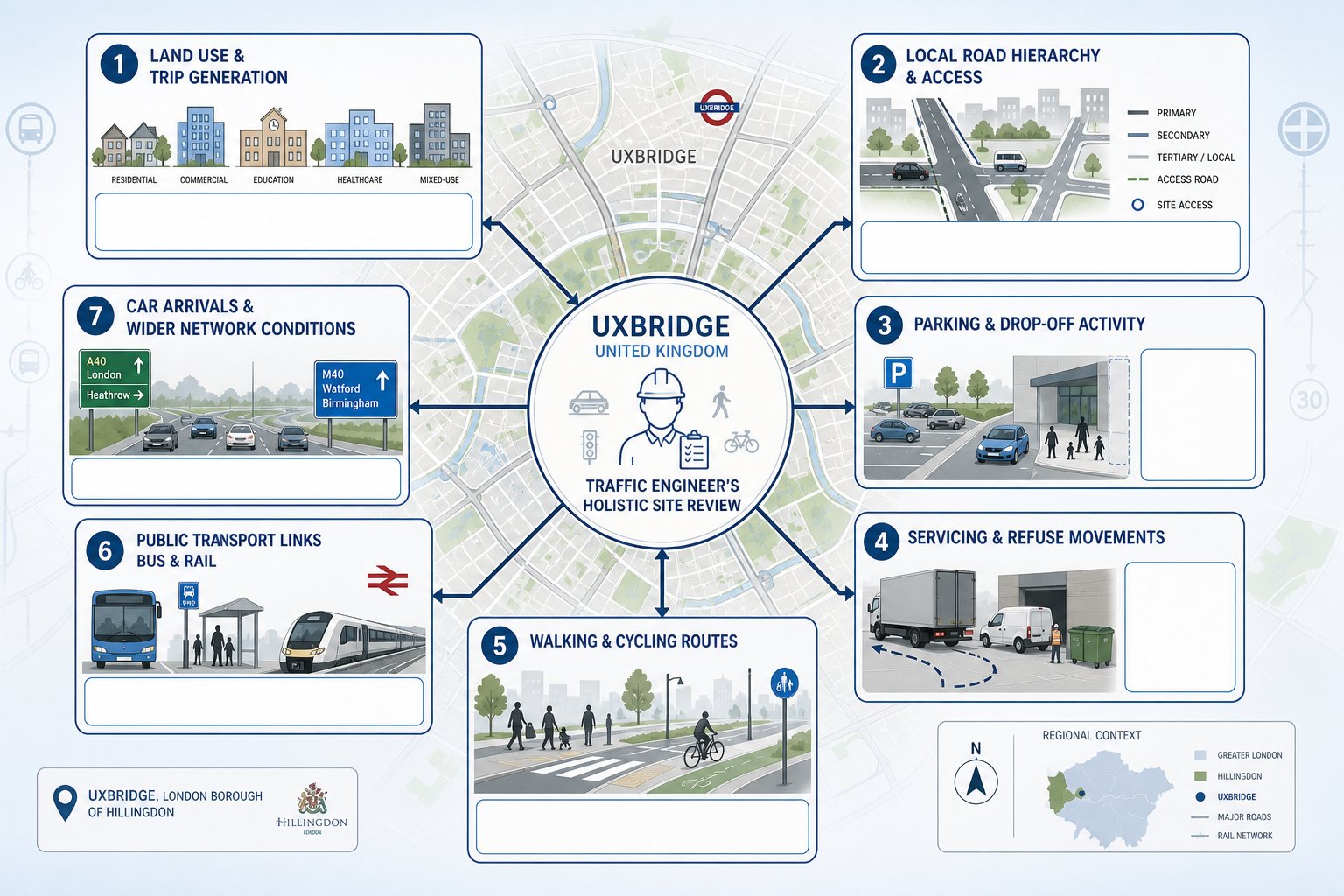
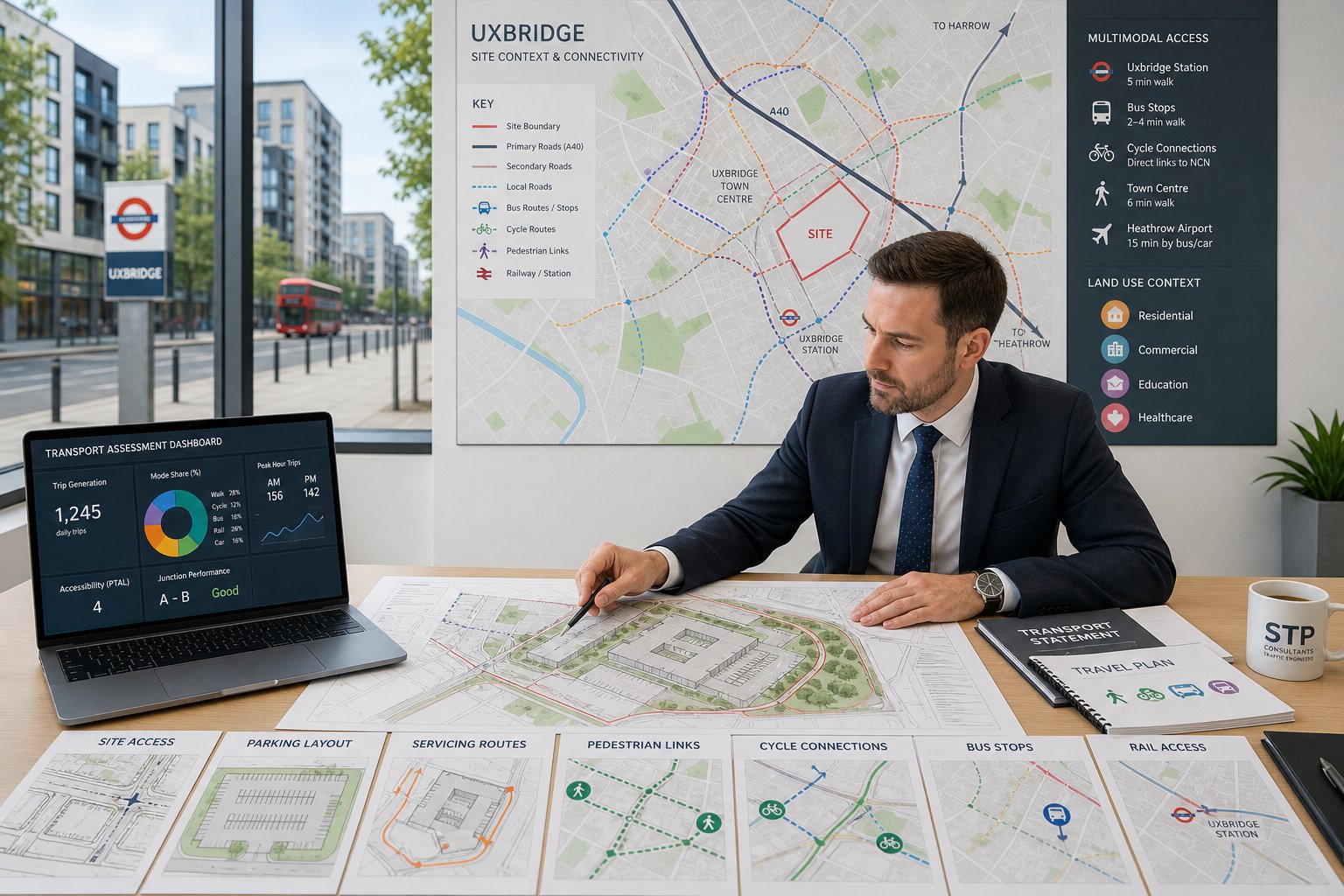
A traffic engineer in Uxbridge will usually review the site in the round, not as a single highway issue. That means understanding the proposed land use, likely trip profile, local road hierarchy, access conditions, servicing needs, parking demand, and how people are expected to arrive on foot, by cycle, by bus, by rail, or by car.
The detail varies by scheme type. Residential development raises questions around parking accumulation, drop-off activity, refuse collection, and local walkability. Commercial schemes may put more emphasis on delivery patterns, servicing yards, and employee travel demand. Education, healthcare, and mixed-use sites often require even closer attention because peak activity can overlap with already busy network conditions.
Our role is partly technical and partly interpretive. We collect and analyse evidence, but we also translate that evidence into planning language that officers, consultees, and project teams can act on. That is where experience matters. With more than three decades of transport work behind many of the methods we apply, we aim to keep reporting concise, accurate, and tailored to local authority expectations rather than padded with unnecessary analysis.
Below are the areas most commonly tested in Uxbridge planning work.
Highway Access, Visibility, And Junction Capacity
Access is often the first point of challenge because it is easy for consultees to visualise and easy for poor design to undermine an otherwise sound scheme. We examine whether vehicles can enter and exit the site safely, whether the access width and alignment are suitable, whether pedestrian crossing movements are protected, and whether the arrangement fits the character and function of the road.
Visibility splays are a core part of that review. If a driver cannot see sufficiently in either direction, or if obstructions such as boundary treatments, parked vehicles, or street furniture reduce sight lines, the access may be unacceptable or require redesign. This is one reason early access design highway input is so valuable.
Junction capacity is the next step. Where a development adds traffic to nearby junctions, we assess whether that extra demand is likely to create severe delay, queue growth, or operational instability. Importantly, capacity assessment is not just about software output. We interpret local conditions, lane discipline, blocking back risk, signal staging, and peak spreading. Sometimes a junction appears technically workable but performs poorly in reality because of nearby friction points. And sometimes the opposite is true.
In planning terms, the goal is to demonstrate that the development will not compromise safety or create an unacceptable impact on network operation.
Parking Provision, Servicing, And Swept Path Analysis
Parking can become the most politically sensitive element of a planning application, especially on infill and town-edge sites. We hence review parking not just against standards, but against likely user behaviour, nearby controls, public transport accessibility, site constraints, and the operational pattern of the use.
The key question is whether the proposed provision is credible. Too few spaces can increase overspill risk. Poorly arranged spaces can be technically compliant but practically awkward. And some schemes focus so heavily on car parking numbers that they neglect cycle parking quality, visitor provision, disabled bays, or EV charging expectations.
Servicing is equally important. Delivery vans, refuse vehicles, and occasional larger vehicles need to reach the site, manoeuvre safely, and leave without causing avoidable conflict. We test whether loading can happen on site or kerbside, whether turning heads work, and whether operational assumptions are realistic.
Swept path analysis provides visual proof. It shows whether a vehicle of the right size can navigate the route without overrunning footways, colliding with obstacles, or forcing unsafe reversals. Guidance discussed by Highway And Traffic Engineering aligns with what we see on live projects: many report delays come from underestimating how much servicing practicality influences planning confidence.
Sustainable Travel, Public Transport, Walking, And Cycling
Transport planning in 2026 is not limited to vehicles entering and leaving a site. Decision-makers increasingly expect evidence on how people will travel more sustainably and whether the proposal supports that in a practical way.
In Uxbridge, this means examining walking routes to nearby services, bus stop access, rail or Underground connectivity where relevant, cycling links, crossing facilities, and the quality of the public realm immediately around the site. We look at distance, directness, safety, gradient, surveillance, and convenience, because a route that is technically available but unattractive may not influence travel behaviour much at all.
We also consider what the development itself provides. Secure and well-located cycle parking, showers for staff in employment schemes, travel information packs, wayfinding, car club provision, and carefully designed pedestrian access points can all strengthen the planning case.
This is an area where generic wording stands out in a bad way. A credible report should reflect the local network, not paste in stock text about sustainability. Broader references such as Traffic Engineering: Your Complete are useful background, but site-specific assessment is what persuades officers that sustainable travel has been considered seriously rather than added as an afterthought.
How Traffic Surveys And Local Data Inform A Robust Report
Good transport reporting starts with evidence. Traffic surveys, parking beat surveys, queue observations, turning counts, speed data, collision history, servicing observations, and site visits all help establish what is happening now before we forecast what may happen after development.
That baseline matters because planning officers and highways teams are rarely convinced by assumptions alone. If a report claims a junction operates comfortably, there should be counts and observations behind that conclusion. If it says parking stress is limited, the survey scope and timing need to support it. If it states that sustainable travel is realistic, local route quality should be demonstrated rather than asserted.
Local data also improves judgement. Uxbridge sites can behave very differently depending on whether they are near the town centre, on a bus corridor, close to schools, influenced by commuter parking, or adjacent to constrained residential streets. The technical method may be standard, but the interpretation must be local.
We use survey and context data to build trip forecasts, assign likely routing, test junctions where needed, and identify whether mitigation is necessary. We also sense-check the outputs. Data can be technically correct yet misleading if collected on an unusual day or interpreted without local knowledge. That is why robust transport work combines measured surveys with experienced review, not just spreadsheet processing.
Working With Architects, Planners, Developers, And Local Councils
Transport reporting works best when it is part of the design conversation, not a document added at the end. We usually work alongside architects, planning consultants, developers, solicitors, surveyors, and sometimes directly with council officers through pre-application engagement.
With architects, the key is coordination. A slight shift in bin store position, parking layout, access width, or tracking envelope can make the difference between a straightforward submission and a long series of amendments. With planning consultants, we align the transport narrative with policy strategy and likely consultee concerns. With developers, we focus on risk, programme, and what evidence is proportionate for the scheme.
Local councils, of course, need clarity and confidence. They are assessing whether a proposal is safe, policy-compliant, and workable in operation. Reports that answer likely questions directly tend to progress better than documents that bury the important points under pages of generic material.
We also find value in drawing on wider comparable experience. A Traffic Engineer In Bristol: scheme will not be assessed exactly like one in Uxbridge, but cross-authority experience helps us understand how thresholds, expectations, and report structure can vary, and what level of justification tends to satisfy reviewers without producing unnecessary bulk.
Common Reasons Transport Reports Are Delayed Or Challenged
Most transport report problems are avoidable. The commonest issue is incomplete baseline work: surveys taken at the wrong time, too little parking data, no servicing review, or limited appreciation of how the surrounding network really functions. Once those gaps are exposed in consultation, the programme slips.
Another frequent problem is mismatch between the drawings and the report. The text may assume a refuse vehicle can turn on site, while the latest layout shows it cannot. Or the access geometry tested in swept path work no longer matches the architect’s revision. These discrepancies are more common than they should be.
Reports are also challenged when conclusions overreach the evidence. If junction impact has not been properly tested, saying there is no operational concern will not carry much weight. If a Travel Plan is generic, officers may doubt whether sustainable mode share assumptions are realistic. And where parking provision is contentious, weak reasoning can invite neighbour objection and further highways queries.
In our experience, speed comes from precision rather than haste. Concise reporting is effective only when the underlying analysis is complete. That principle runs through much of our approach at ML Traffic: focus on the issues that matter, tailor the evidence to the authority and site, and remove loose ends before submission rather than arguing about them after.
Choosing The Right Traffic Engineer For Uxbridge Projects
Choosing the right consultant is partly about qualifications, but mostly about judgement. You need a team that understands transport evidence, can communicate with planners and highways officers clearly, and knows when a scheme needs detailed modelling and when it simply needs a well-reasoned, locally grounded report.
For Uxbridge projects, we would look for five things.
First, local planning awareness. The engineer should understand how outer-London and borough-level transport expectations shape submissions.
Second, technical range. That includes access reviews, trip generation, junction assessment, parking analysis, servicing strategy, swept path testing, and sustainable travel planning.
Third, reporting discipline. A 70-page report is not automatically stronger than a 20-page one. What matters is whether it answers the relevant questions convincingly.
Fourth, project coordination. The best transport advice fits around architects, planning consultants, and programme deadlines instead of operating in a silo.
Fifth, commercial realism. Clients need clear scope, sensible timescales, and advice that reflects planning risk.
The wider role of Traffic Engineer in Uxbridge support is eventually simple: reduce uncertainty. A good consultant helps the design team identify transport issues early, prepare proportionate evidence, and improve the chance of a smoother planning determination.
Conclusion
In Uxbridge, transport evidence can be the difference between a planning application that moves forward cleanly and one that stalls over avoidable technical issues. Access, visibility, junction impact, parking, servicing, walking routes, cycle provision, and public transport links all feed into the same planning question: will this development function safely and credibly in its real setting?
That is where a traffic engineer adds value. We do not just produce a report. We help shape a proposal so that transport assumptions, site layout, and planning strategy line up from the start. For architects, planners, developers, lawyers, surveyors, and local authorities, that usually means fewer surprises, clearer evidence, and better quality decision-making.
If the transport case is proportionate, locally informed, and technically sound, the planning process becomes far easier for everyone involved.
Frequently Asked Questions about Traffic Engineering in Uxbridge
What does a traffic engineer in Uxbridge do for planning applications?
A traffic engineer in Uxbridge reviews site access, vehicle trips, parking, servicing, and sustainable travel arrangements to ensure developments operate safely and efficiently on local roads, helping produce credible transport evidence for planning approvals.
When is traffic engineering input required for a Uxbridge planning proposal?
Traffic engineering is typically needed when developments alter trip generation, access, parking, servicing, or raise highway safety concerns, or when the local council requests detailed transport evidence to assess impact and compliance.
How do traffic engineers assess parking and servicing requirements in Uxbridge developments?
They analyse parking demand, local controls, public transport access, and site constraints to propose credible parking provision. Swept path analysis verifies if delivery and refuse vehicles can manoeuvre safely on site without causing operational issues.
Why is sustainable travel consideration important in Uxbridge traffic engineering?
Sustainable travel assessment ensures developments promote walking, cycling, and public transport use, supporting planning policies aimed at reducing car dependency and improving inclusive, safe movement for all users on the local network.
What challenges does traffic engineering address in Uxbridge’s planning process?
Common challenges include junction capacity under peak conditions, parking pressures, safe access design, and balancing vehicle movements with pedestrian and cyclist needs in a complex urban and suburban environment.
How do traffic engineers use local data and surveys to support development planning in Uxbridge?
They collect traffic counts, parking surveys, collision history, and site observations to build accurate trip forecasts, assess junction capacity, and understand existing conditions, ensuring transport assessments reflect real-world impacts.