
Wembley is one of those places where transport issues stop being a background technical matter and become central to whether a scheme is workable at all. Between Wembley Stadium, major regeneration areas, busy town centre streets, rail and Underground stations, and strategic routes such as the A406 North Circular and A404 Harrow Road, even relatively straightforward development proposals can raise detailed questions about access, traffic impact, servicing and road safety.
That is why appointing a traffic engineer in Wembley early usually pays off. We are often asked to step into projects where the design is already moving, the planning timetable is tight, and Brent Council or Transport for London will expect clear, policy-led evidence rather than broad assurances. In practice, good transport input does more than produce a report. It shapes layouts, reduces avoidable planning risk, and helps teams demonstrate that a proposal can operate safely on normal days as well as in a more complex event-day environment.
For architects, planners, lawyers, surveyors, developers and local authorities, the real issue is not whether transport matters. It is what level of evidence is likely to be needed, how local planning context affects that evidence, and how to assemble a robust package that supports permission rather than delays it. That is what we cover here.
Key Takeaways
- Appointing a traffic engineer in Wembley early in the planning process helps address complex transport challenges unique to the area, including event-day impacts and strategic route interactions.
- Traffic engineering input is crucial for meeting Brent Council and TfL requirements by providing clear, policy-led transport evidence that supports planning permission and reduces risks.
- A traffic engineer shapes development layouts by advising on access, parking, servicing, and pedestrian connectivity, ensuring proposals operate safely during normal and event days.
- Transport assessments and statements in Wembley must be concise, focused, and proportionate to the scheme’s size and location, often including junction capacity and safety analyses.
- Travel plans are essential for larger Wembley developments to promote sustainable travel and comply with policy-led parking restrictions, especially in high-PTAL locations.
- Choosing a traffic engineer familiar with Wembley’s local context, policy environment, and event-related pressures is key to producing credible, robust transport evidence and facilitating smooth planning approvals.
Why Traffic Engineering Matters For Development In Wembley
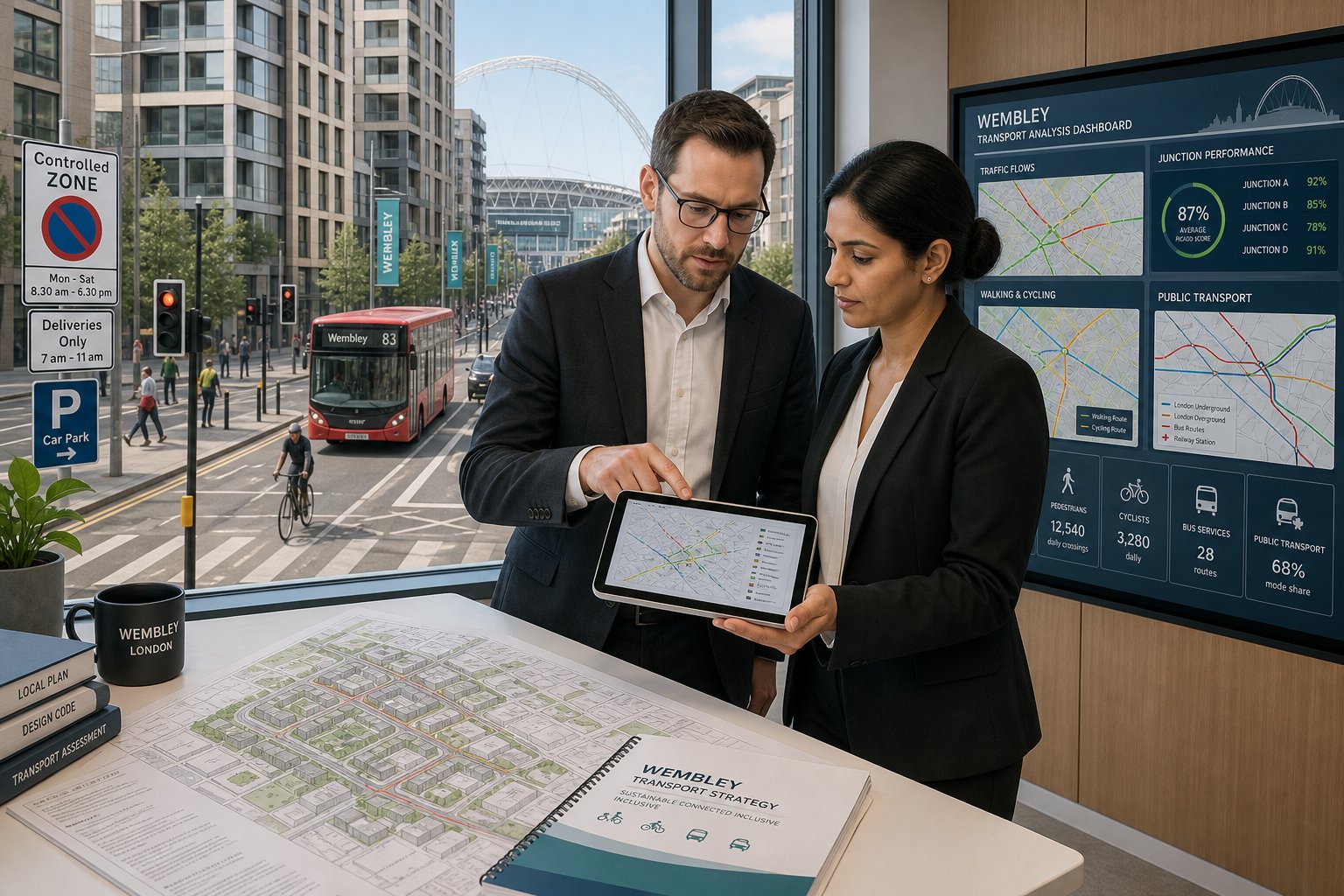
Wembley is a transport-sensitive location by any measure. It combines high-density housing growth, town centre activity, strategic highway movements, strong public transport accessibility in many areas, and the unusual operational reality of major stadium events. That mix means transport evidence is rarely a tick-box exercise.
From a planning perspective, traffic engineering matters because applicants must show that development will not create an unacceptable impact on highway safety and will not result in severe residual cumulative impacts on the road network, reflecting the National Planning Policy Framework. In Wembley, that often means looking beyond a site boundary. We may need to consider nearby junctions, bus activity, pedestrian routes to stations, controlled parking zones, delivery patterns and how the network behaves at different times.
It also matters because policy in London pushes projects toward sustainable movement. Lower car dependency, stronger walking and cycling links, and realistic public transport use are not just good ideas: they are often central to making an application policy-compliant. That is especially true in higher PTAL locations around Wembley Park and nearby stations.
For some schemes, the transport challenge is obvious. For others, it is more subtle: a tight access, a servicing conflict, a poor visibility line, or an understated parking pressure issue. We find that early technical review usually exposes these issues while they are still fixable, rather than after submission when redesign becomes slower and more expensive.
The Role Of A Traffic Engineer In The Planning Process

A traffic engineer supports a planning application from far earlier than many teams expect. In the best-case scenario, we are involved while the site layout is still flexible. That lets us advise on access position, internal circulation, parking provision, servicing space, pedestrian connections and whether junction or capacity analysis is likely to be needed.
As the proposal develops, we prepare the technical evidence that planning officers and highway consultees will rely on. That may include a Transport Statement, a full Transport Assessment, a Travel Plan, swept path analysis, a junction capacity assessment, a preliminary access design review or road safety input. On schemes with a broader urban movement focus, the work may also sit alongside Traffic Engineering Consultants: support covering strategy, standards and stakeholder coordination.
In Wembley, consultation is a big part of the role. Brent Council may lead on local highway matters, but Transport for London can become important where the strategic road network, bus operations or wider movement impacts are relevant. Schools, healthcare sites, mixed-use schemes and stadium-influenced uses can all trigger wider transport conversations.
A good traffic engineer is not there simply to defend a scheme. We help shape one that can actually be defended. With over 30 years of experience, our approach is to keep reports concise, technically sound and aligned to local thresholds and planning context, because that is what tends to move applications forward.
Common Projects That Need Traffic Engineering Input In Wembley
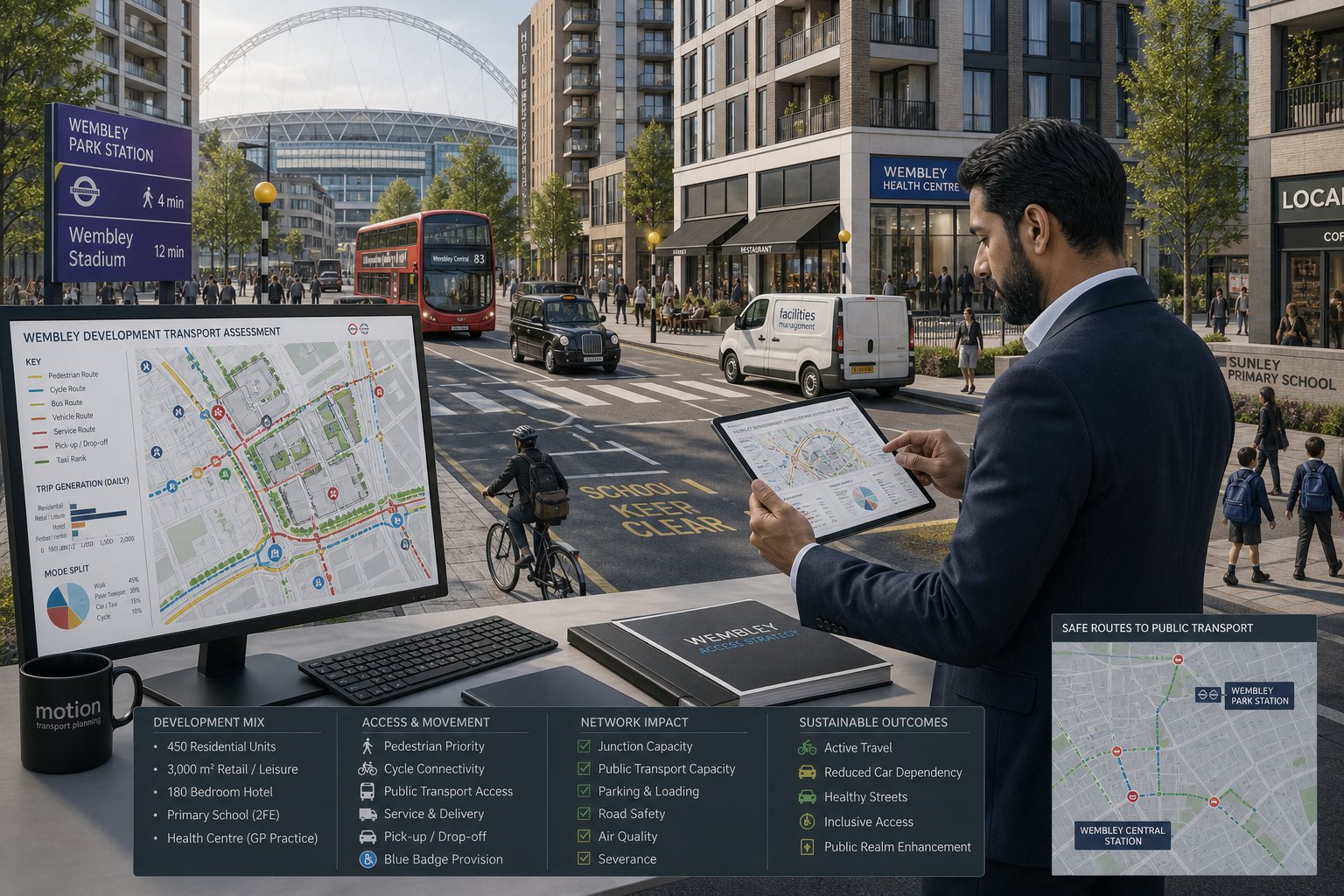
In Wembley, traffic input is commonly required across a wide range of development types, not just large headline schemes.
Residential developments are the most obvious example, especially flats in areas with constrained access or limited on-street capacity. Even where car parking is relatively low, Brent will still expect evidence on trip generation, servicing, refuse collection, cycle parking and pedestrian access.
Mixed-use schemes also frequently need transport review because combining homes with retail, food and beverage, workspace or leisure uses can create very different daily movement patterns. Arrival peaks, delivery activity and short-stay turnover often need closer attention than applicants first assume.
Hotels, leisure venues and stadium-related uses are particularly sensitive in Wembley. The issue is not only standard weekday impact but also event-day interaction, coach or taxi activity, pick-up and drop-off pressure, and whether visitors will move safely between the site and nearby stations or destinations.
Education, health and community uses are another common category. Schools, colleges, health centres and places of worship can create concentrated peaks, informal parking behaviour and site access pressure. For commercial-led schemes, the principles discussed in Commercial Traffic Engineering In wider planning contexts apply strongly here too.
In short, the trigger is not just size. It is whether the development changes how people, vehicles and servicing activity interact with a constrained local network.
Transport Assessments And Transport Statements: What Is Usually Required

The level of transport reporting normally depends on the scale of the proposal, the type of land use, and the sensitivity of the surrounding network. In Wembley, scope should ideally be agreed early with Brent Council and, where relevant, TfL.
A Transport Statement is generally used for smaller schemes with more limited transport effects. A Transport Assessment is more detailed and is usually expected where trip generation is higher, where the local network is already under pressure, or where the proposal raises strategic access questions.
Either way, the report typically covers:
- existing site and highway conditions
- relevant planning and transport policy
- accessibility by walking, cycling and public transport
- baseline traffic and parking conditions
- trip generation and distribution
- impact on local roads and junctions
- servicing and refuse strategy
- access proposals and road safety considerations
- mitigation, where needed
The best reports are not bloated. They are targeted, evidence-led and proportionate to risk. We often find that planning teams benefit when transport reporting is prepared in the same practical spirit as broader Highway And Traffic Engineering support: answer the authority’s likely questions before they have to ask them.
Data sources may include traffic counts, parking beat surveys, delivery observations, collision records, accessibility mapping and junction modelling. In more complex parts of Wembley, event-day conditions may also need to be addressed explicitly rather than treated as an afterthought.
When A Travel Plan May Be Needed
A Travel Plan is commonly requested for larger or more trip-intensive developments, especially major residential, education, employment, leisure or stadium-related proposals. Its purpose is simple: show how the site will encourage sustainable travel and manage demand realistically.
That can include measures such as cycle facilities, resident or staff travel information, car club membership, visitor travel advice, monitoring targets, welcome packs, appointment scheduling, delivery management or incentives linked to public transport and active travel.
In Wembley, Travel Plans matter because parking restraint is often policy-led. If a scheme provides low car parking in a high-accessibility location, the supporting strategy for walking, cycling and public transport needs to be credible, not just aspirational.
Junction Capacity And Traffic Modelling For Local Roads

Junction capacity work is often where transport evidence becomes more technical and, frankly, more contested. If a development is likely to add material traffic to nearby roads, Brent or TfL may expect modelling of the relevant junctions and links.
The right tool depends on the junction type and the issue under review. We may use ARCADY for roundabouts, PICADY for priority junctions, LINSIG for traffic signals, TRANSYT for coordinated signal corridors, or more detailed microsimulation where network interaction is complex. Wembley can justify that deeper review because local roads do not operate in isolation: queueing, pedestrian crossings, bus movements and event management can all influence performance.
But modelling is only as good as its assumptions. Trip rates, distribution patterns, committed development, future year scenarios and sensitivity testing all matter. A weak model with optimistic inputs rarely survives scrutiny for long.
For Wembley applications, we usually focus on whether the scheme would materially worsen delay, queue lengths or reserve capacity at local pinch points, and whether any mitigation is feasible within the available highway envelope. Sometimes the outcome supports the design as submitted. Sometimes it points to a revised access arrangement, altered servicing timing, or a stronger sustainable transport package.
Broader practice set out in Traffic Engineering: Your planning work still applies here: model only what is necessary, but model it properly.
Parking, Servicing, And Vehicle Swept Path Analysis
Parking in Wembley is rarely just a numbers exercise. The starting point is usually the London Plan and local Brent standards, but the planning discussion quickly broadens into how parking will function, who will use it, how disabled bays are provided, whether cycle parking is practical, and how overspill risk will be controlled.
For high-PTAL sites, lower car parking levels may be appropriate and often expected. That does not remove the need for evidence. Authorities still want to understand likely car ownership, visitor demand, blue badge provision, electric vehicle charging, and the relationship with any local controlled parking zone.
Servicing can be even more important. Deliveries, refuse collection, moving vans, taxis and occasional larger vehicles need a workable strategy that does not create unsafe reversing, obstruct the highway or undermine pedestrian movement. On tight urban sites, this is often where apparently elegant layouts start to struggle.
Swept path analysis helps resolve those questions. Using software such as AutoTrack, we test whether vehicles can enter, manoeuvre and exit safely within the site or from the highway. Basement ramps, loading bays, refuse stores and shared courtyards all need careful testing. Similar operational issues arise across dense urban schemes, including those discussed in Traffic Engineer In London: broader planning support.
If the manoeuvre only works perfectly on a drawing but not in reality, it is usually better to find that out before submission.
Road Safety, Visibility, And Access Design Considerations
Planning authorities are understandably cautious about access safety, and Wembley sites often present constraints: busy frontages, high pedestrian flows, bus activity, narrow margins, existing street furniture, and varied vehicle speeds depending on the road type.
A robust traffic engineering review will usually consider whether the proposed access aligns with standards in the Design Manual for Roads and Bridges, Manual for Streets and relevant local guidance. That includes visibility splays, turning geometry, pedestrian crossing desire lines, footway continuity, gradient, boundary treatments and the interaction between vehicles and cyclists.
Road safety is not just about whether a car can get in and out. It is about conflict points. Can drivers emerging from the site see clearly? Will refuse vehicles overrun footways? Is there enough waiting space so vehicles do not block the road? Are pedestrians forced into awkward crossings because the access has been positioned for convenience rather than safety?
On some projects, a Road Safety Audit may be expected, often at Stage 1/2 during planning or pre-delivery design development. Even where it is not formally required, thinking like an auditor is useful. It exposes hidden risks early.
In Wembley, this matters especially around schools, town centre frontages, and event-influenced routes where pedestrian volumes can spike. A safe access that works only in quiet periods is not really a safe access.
How Wembley Planning Context Influences Transport Evidence
Transport evidence in Wembley has to respond to local context, not just generic planning standards. That sounds obvious, but it is where many weak submissions fall down.
For sites near Wembley Park, Wembley Central or other well-connected locations, high PTAL can support lower car parking and a stronger emphasis on walking, cycling and public transport. That can be a major planning advantage. At the same time, authorities may expect a more robust explanation of travel behaviour, cycle provision and pedestrian connectivity because the case for reduced parking rests on those alternatives actually being credible.
Event-day conditions are another local factor that can change the analysis. Around the stadium and associated routes, traffic, parking controls, crowd movement and temporary management arrangements may all affect how a development operates. Even if the site itself is not event-related, cumulative pressure can still be relevant.
Brent’s regeneration objectives also shape expectations. Growth is welcomed, but not at the expense of safety or network resilience. So transport reports need to show not just compliance, but understanding. We sometimes point clients to examples from Traffic Engineer In Manchester: or Traffic Engineer In Leeds: work to illustrate how local authority context changes the evidence base from city to city.
In Wembley, local knowledge is not a nice extra. It often determines whether a report feels relevant or generic.
Working With Architects, Planners, And Developers To Support An Application
The strongest planning applications usually come from coordinated teams rather than isolated technical inputs. Traffic engineering works best when it feeds into design early and stays involved as the scheme evolves.
With architects, we typically review access location, vehicle tracking, servicing yards, basement entries, refuse strategy, cycle stores and pedestrian routes. Small layout moves can make a big difference. A gate moved a few metres, a ramp gradient softened, a bin store repositioned, or a corner chamfer widened can remove a transport objection that would otherwise linger.
With planners, the focus is often on proportionality and strategy: what level of reporting is likely to be needed, which policy tests matter most, how to frame mitigation, and whether pre-application engagement with Brent or TfL is sensible.
Developers and project managers usually need something more practical: clear advice, quick turnarounds and realistic risk assessment. That is where our own site approach at ML Traffic is simple, concise, accurate transport reports delivered quickly, with local-authority awareness built in rather than added at the end.
Lawyers and surveyors also have a role, especially where rights, highway status, servicing constraints or planning conditions need to be understood precisely. Transport evidence tends to be stronger when the whole team shares information early instead of passing issues downstream.
What To Prepare Before Instructing A Traffic Engineer
A traffic engineer can start with limited information, but the process is smoother and faster when the basics are ready.
At minimum, we would usually want:
- a red-line boundary plan
- an emerging site layout
- proposed land uses and floorspace or unit schedule
- access points under consideration
- any known servicing assumptions
- planning history or earlier transport advice
- pre-application feedback, if available
- details of local concerns already raised
- existing survey information or topographical data
If the scheme is in Wembley, it also helps to flag nearby junction concerns, event-day sensitivity, controlled parking zone issues, adjacent bus stops, or any previous refusal reasons linked to transport. Those details can materially affect scope.
The point is not to create a perfect package before appointment. It is to avoid wasting time. If we know, for example, that a basement car park is being considered, or that Brent has already raised visibility concerns, we can target work from day one.
This is especially useful on live planning programmes where architecture, drainage, servicing and fire strategy are all moving at once. Good transport advice depends on current information: outdated layouts are one of the fastest ways to generate avoidable revisions.
Choosing A Traffic Engineer For Wembley Projects
Not every consultant is the right fit for a Wembley scheme. Technical competence is essential, of course, but local planning awareness matters just as much.
We would generally suggest looking for Chartered Engineers or similarly experienced transport professionals with clear evidence of work in London boroughs and, ideally, with TfL-facing projects. Wembley is not the easiest place to learn on the job. High-density design, event-day pressures, parking restraint, and close policy scrutiny reward consultants who understand urban transport trade-offs.
It also helps to ask practical questions. Will they scope proportionately, or default to over-reporting? Can they coordinate with architects and planners rather than work in isolation? Do they explain risks clearly? Are their reports concise enough to be read, but robust enough to stand up in planning?
Past experience with stadium-area, mixed-use or similarly constrained urban schemes is valuable. So is responsiveness. Planning timetables do not usually wait for perfect conditions.
For many applicants, the right choice is the consultant who can combine solid modelling and standards knowledge with real planning judgement. That blend tends to matter more than flashy presentation. In transport planning, credibility still wins.
Conclusion
A specialist traffic engineer in Wembley can make the difference between a scheme that merely looks acceptable on paper and one that is genuinely ready for planning scrutiny. In a location shaped by regeneration, public transport accessibility, constrained local roads and the added complexity of stadium-related movement, transport evidence has to be specific, proportionate and locally aware.
The strongest applications usually come from early engagement, realistic assumptions and careful coordination between design, planning and transport teams. Whether the issue is a Transport Assessment, a Travel Plan, junction modelling, servicing, parking or access safety, the aim is the same: demonstrate that the development will function safely and efficiently, and that any impacts can be managed in line with policy.
For Wembley projects, robust transport support is not an optional extra. It is often one of the foundations of planning success.
Frequently Asked Questions about Traffic Engineering in Wembley
Why is hiring a traffic engineer important for developments in Wembley?
Hiring a traffic engineer early helps ensure developments will have safe access, minimise severe traffic impacts, and comply with Brent Council and TfL policies, especially near Wembley Stadium and major roads, improving chances of planning approval.
What types of projects in Wembley typically require traffic engineering input?
Projects needing traffic engineering include residential, mixed-use, stadium-related venues, hotels, schools, health centres and community buildings, where vehicle and pedestrian interactions affect local roads and transport networks.
What reports does a traffic engineer prepare for Wembley planning applications?
Traffic engineers prepare Transport Statements for smaller schemes and detailed Transport Assessments for larger or sensitive sites, covering trip generation, highway impact, access, servicing, and mitigation measures as agreed with Brent and TfL.
How do event-day conditions near Wembley Stadium affect traffic engineering considerations?
Event days create additional traffic, parking pressure and pedestrian flows around Wembley, requiring traffic engineers to assess cumulative impacts and design mitigations ensuring developments operate safely during these peak conditions.
What factors influence parking and servicing strategies in Wembley developments?
Parking aligns with London Plan and Brent standards, with special attention to disabled bays, cycle parking, and controlled parking zone risks. Servicing must accommodate deliveries and refuse vehicles safely, often tested through vehicle swept path analysis.
How should one choose the right traffic engineer for a Wembley project?
Select Chartered Engineers with proven experience in London and TfL projects, ideally with stadium-area or urban scheme expertise and a practical approach to balancing design and transport compliance for efficient planning approval.