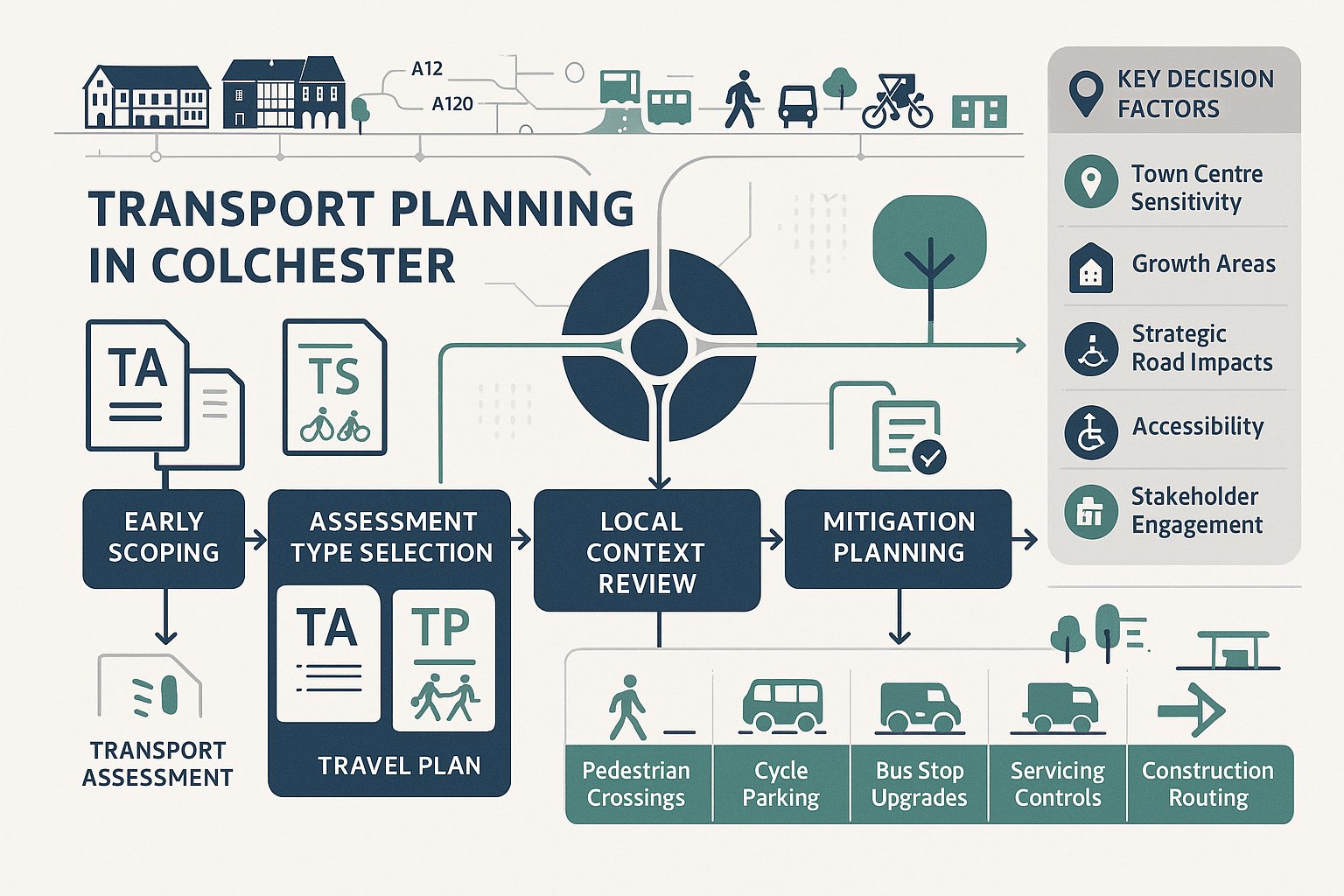
Colchester is growing, and that growth puts pressure on every part of the transport network: historic streets in the centre, strategic routes such as the A12 and A120, local junctions, bus corridors, walking links, cycle routes, and access to major development areas. For developers, architects, planners and legal teams, that means transport planning in Colchester is no longer a box-ticking exercise. It often sits right at the centre of whether an application moves smoothly through the system or stalls in consultation.
In practice, local decisions are shaped by a mix of national planning policy, Essex County Council’s highway role, Colchester’s own growth ambitions, and a clear policy push toward active travel and public transport. The result is fairly consistent: proposals need to show not just that vehicles can get in and out, but that sites are genuinely accessible, safe, and aligned with the area’s long-term transport strategy.
In this guide, we set out what usually matters most in transport planning in Colchester in 2026: when a Transport Assessment or Transport Statement may be required, how local context affects technical expectations, what evidence tends to strengthen an application, and where schemes commonly run into trouble. We also explain how the process typically works from scoping through to decision, so project teams can plan ahead rather than react late. That early clarity usually saves time, cost and a fair bit of frustration.
Why Transport Planning Matters For Development In Colchester
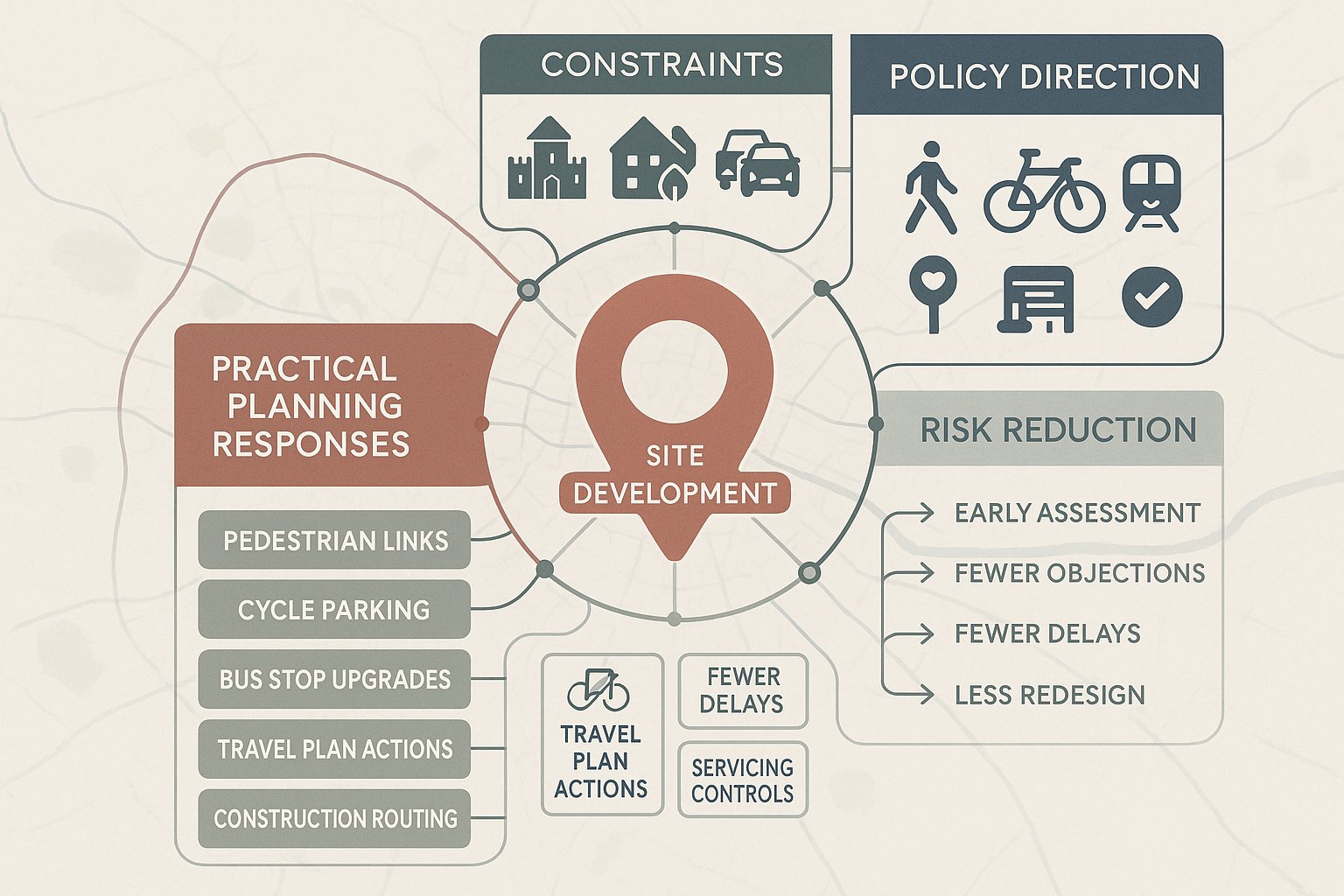
Colchester’s development context makes transport a material planning issue on almost every sizeable site. It is a major employment, retail, leisure and residential centre, but it is also a place with obvious constraints: a historic core, established neighbourhoods, pressure on key corridors, and growth planned at the edge of the urban area. When those elements collide, transport evidence becomes one of the main ways an applicant shows that development can be accommodated responsibly.
The direction of travel is clear in the Colchester Future Transport Strategy: active and safe sustainable travel is meant to sit at the heart of how the network evolves. That matters because transport planning is no longer judged purely on junction capacity or parking numbers. Decision-makers increasingly expect us to explain how a proposal supports walking, cycling, bus use, accessibility and safer street design alongside the more traditional traffic questions.
For planning applications, that has two practical consequences. First, transport reports need to be proportionate but genuinely policy-led. Secondly, mitigation packages often need to do more than tweak an access bellmouth or refresh white lining. In Colchester, a robust submission may need to show better pedestrian links, cycle parking, bus stop improvements, Travel Plan measures, servicing controls, or carefully designed construction routing.
From our perspective, early transport planning reduces risk because it identifies whether a site is constrained by local streets, strategic roads, sustainable access gaps, or all three. If those issues are left until submission stage, they tend to become objections, holding responses or expensive redesigns.
When A Transport Assessment, Transport Statement, Or Travel Plan May Be Needed
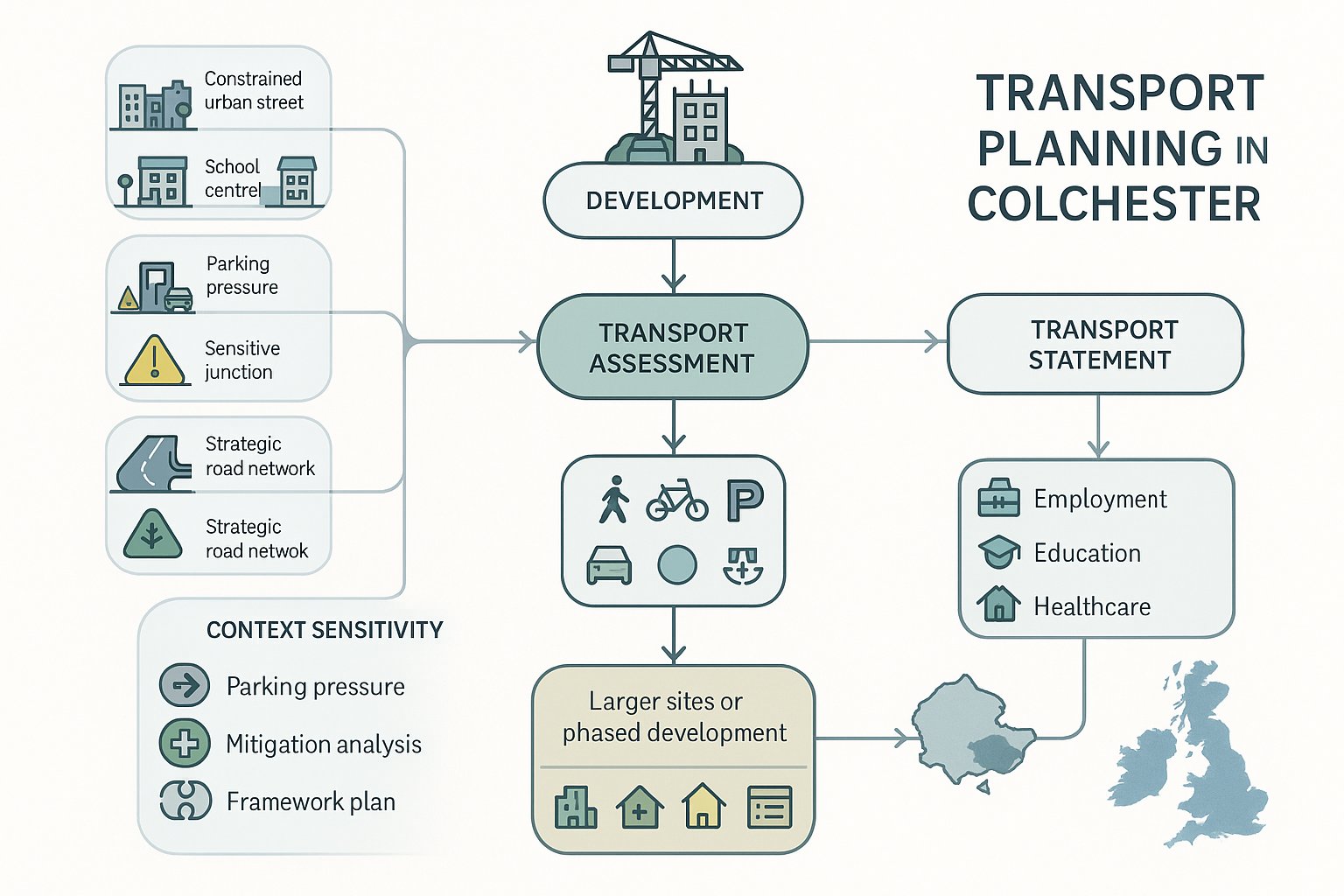
Whether a development needs a Transport Assessment (TA), Transport Statement (TS) or Travel Plan depends on scale, use, location and likely trip generation. There is no sensible one-size-fits-all answer. In Colchester, Essex County Council, acting as Highway Authority, will usually expect the scope to be agreed through pre-application discussions, especially where impacts may affect sensitive junctions, town-centre streets, school travel patterns, or the strategic road network.
As a rule, a Transport Assessment is used for developments expected to generate significant movement. It is the fuller document, typically covering baseline conditions, multi-modal accessibility, trip generation, distribution and assignment, junction impact, parking, safety, and mitigation. A Transport Statement is the lighter-touch version, used where impacts are limited and a proportionate assessment is enough.
A Travel Plan is often requested for larger or more trip-intensive schemes, particularly employment, education, healthcare, mixed-use and major residential development. For phased or strategic sites, that is often a Framework Travel Plan rather than a final site-operator document at application stage.
The most important point is this: thresholds are not just about floor area or unit numbers on paper. Context matters. A relatively modest scheme on a constrained urban street, close to a school, or in an area with known parking stress can attract more scrutiny than a larger scheme in a less sensitive location. We usually advise clients not to guess. Scoping the requirement early with Essex Highways is far cheaper than arguing later about why evidence is missing.
How Colchester’s Local Context Shapes Transport Planning Decisions
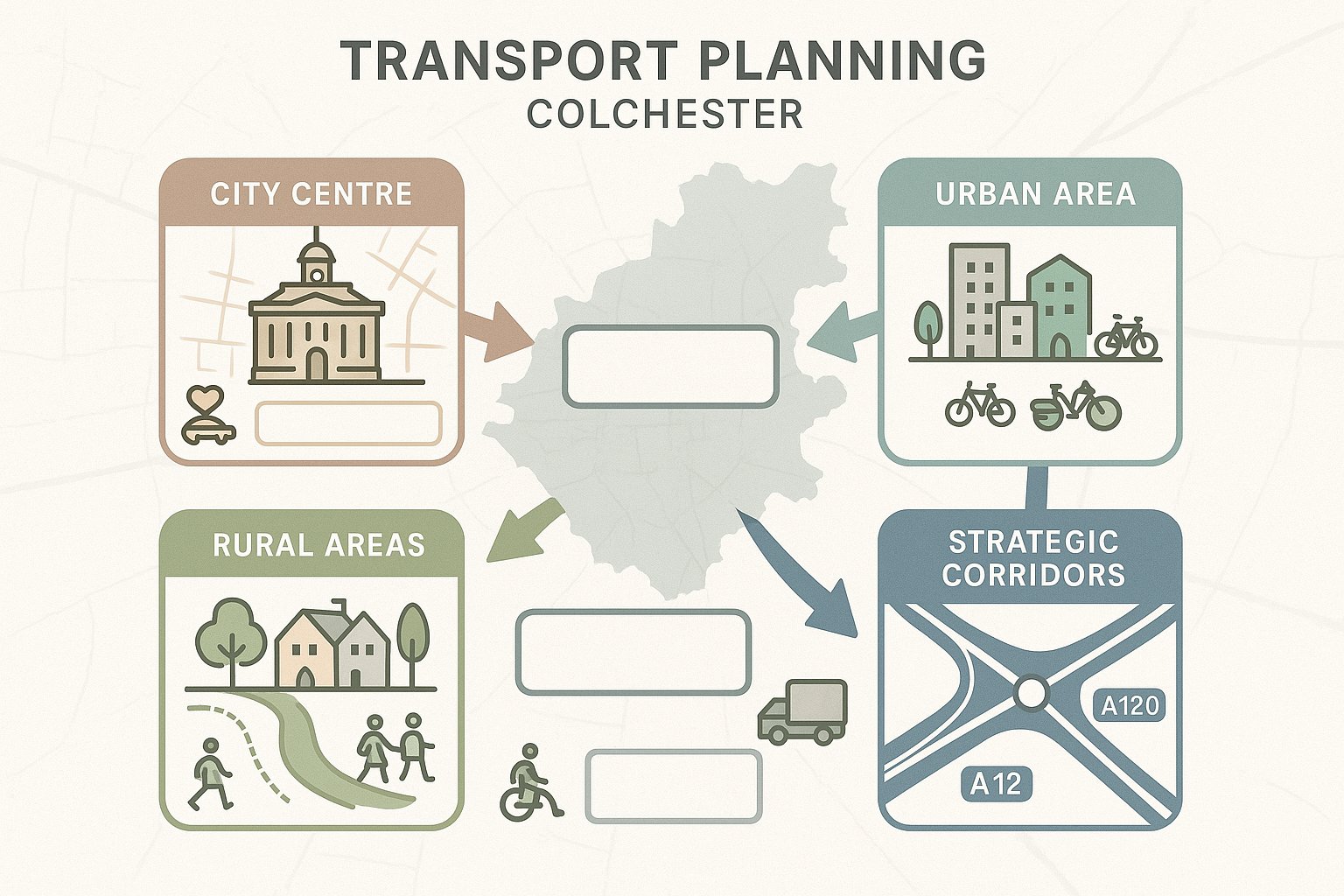
Transport planning in Colchester is strongly shaped by place rather than formula. The same development quantum can be viewed very differently depending on whether it sits in the city centre, an urban extension, a village edge location, or near a strategic road junction. Local policy and highway advice are hence highly context-driven.
That approach reflects the way Colchester functions. The city centre has heritage value, constrained streets and competing demands for movement and place. Wider urban areas include established residential districts and local centres where mode shift is possible but not automatic. Edge and rural locations raise different questions about car dependency, bus viability and safe walking and cycling connections. Then there are the strategic links, where impacts on the A12, A120 and associated junctions can quickly become central to the planning debate.
For applicants, this means the local story cannot be generic. Reports need to explain how a proposal responds to the character of its immediate surroundings and the role of the site within the wider network. That might involve public realm sensitivities, freight routing, school travel patterns, access for disabled users, or cumulative impact from nearby allocations.
A good submission shows that we understand not only traffic impact, but also how local transport policy is meant to shape future travel behaviour in Colchester.
Town Centre, Growth Areas, And Strategic Road Considerations
The city centre is usually the most sensitive transport planning environment in Colchester. Capacity is limited, streets can be narrow, pedestrian activity is high, and policy generally leans toward reducing unnecessary car use while improving the experience for shoppers, visitors and residents. So, for town-centre proposals, the question is rarely just “can cars access the site?” It is often “does the scheme support a better balance between movement and place?”
By contrast, the main growth areas bring a different set of issues. Strategic allocations, including the Tendring Colchester Borders Garden Community and related large-scale development areas, are supported by their own evidence base, masterplanning and infrastructure expectations. Since the Garden Community Development Plan Document was adopted in 2025, proposals in and around that geography are expected to respond to a more structured transport framework, not simply standalone junction fixes.
Then there is the strategic road network. Sites with reliance on the A12, A120 or key distributor routes often trigger closer scrutiny of trip assignment, peak-hour impact and cumulative development traffic. Depending on the location, National Highways may need to be consulted alongside Essex Highways. That can affect programmes significantly.
In practical terms, we usually see three recurring priorities here:
- realistic assessment of town-centre and corridor constraints:
- clear alignment with strategic growth and infrastructure planning:
- early engagement where trunk road or major junction impacts may arise.
Miss one of those, and even an otherwise well-designed application can slow down.
Walking, Cycling, Public Transport, And Accessibility Expectations
One of the biggest shifts in recent years is that sustainable access is no longer treated as a soft add-on. In Colchester, it is central. The local transport strategy places clear emphasis on walking, cycling, bus connectivity and inclusive access, and that expectation filters directly into planning responses.
So a robust submission needs to test more than highway capacity. We should usually demonstrate how people can reach the site on foot, by cycle and by public transport, and whether those options are realistic for day-to-day use. That includes route quality, crossing opportunities, gradients, lighting, surveillance, bus frequency, stop quality, step-free access, and links to schools, employment areas, services and the centre.
Accessibility for disabled people also needs to be embedded from the outset. That means thinking about dropped kerbs, tactile paving, crossing design, pavement widths, accessible parking, gradients, mobility scooter use, bus stop access and legible routes, not just nominal compliance on a plan.
Where sites are weakly connected, we need to confront that honestly. Sometimes the answer is a package of off-site improvements, cycle storage, showers and lockers, bus contribution measures, car club provision, or stronger Travel Plan commitments. Sometimes it means the site is simply more car-dependent than the applicant hoped, and the evidence needs to deal with that openly.
In Colchester, sustainable transport claims that are unsupported by on-the-ground reality tend not to survive detailed review. The better approach is specific, measurable and local.
Key Transport Planning Documents Used To Support Applications
Most planning applications with meaningful transport implications in Colchester are supported by a suite of documents rather than a single report. The exact mix depends on the scheme, but the principle is straightforward: the evidence should be proportionate, technically sound and matched to the authority’s concerns.
For smaller proposals, that might mean a concise Transport Statement with access drawings and a parking review. For larger or phased schemes, the package can expand quickly to include a Transport Assessment, Framework Travel Plan, Delivery and Servicing Plan, Construction Logistics Plan, swept path drawings, junction modelling outputs, road safety review material and supporting correspondence from pre-application discussions.
The strongest submissions usually tell one coherent story across all of those documents. If the TA says sustainable travel is realistic, the Travel Plan should contain measures that make that credible. If servicing is sensitive, the delivery strategy should align with the access drawings and site management arrangements. If construction traffic is a concern, the logistics plan should clearly route vehicles away from the most constrained streets where possible.
This is also where local knowledge matters. At ML Traffic, for example, we tailor reports to authority-specific expectations rather than relying on generic templates. That sounds obvious, but in practice it is often the difference between a smooth consultation and several rounds of avoidable clarification.
Transport Assessment And Transport Statement
A Transport Assessment and a Transport Statement do similar jobs, but at different levels of depth.
A Transport Assessment is the fuller technical document. For Colchester schemes, it will commonly include:
- a planning and policy review:
- existing site and highway conditions:
- walking, cycling and public transport accessibility:
- traffic count data and baseline analysis:
- trip generation using appropriate databases and local sensitivity:
- trip distribution and assignment:
- junction capacity modelling where required:
- parking, servicing and road safety review:
- mitigation and residual impact assessment.
A Transport Statement is more proportionate. It is suited to development with limited transport effects, where a detailed modelling exercise may not be justified. But “shorter” should not mean thin. A good TS still needs a reasoned explanation of access, parking, likely trip impact and sustainable travel opportunities.
The choice between the two matters because under-scoping can damage credibility. If a scheme plainly has wider network implications, a brief statement often just delays matters until the authority asks for a TA anyway. Over-scoping, on the other hand, can waste budget and time.
We generally approach this by asking a simple question early: what are the likely transport concerns of Essex Highways, the local planning authority and, if relevant, National Highways? The document should answer those concerns directly rather than merely satisfy a label.
Framework Travel Plans, Delivery And Servicing, And Construction Logistics
For larger sites, especially phased or multi-occupier development, a Framework Travel Plan is often essential. It sets the strategy for reducing single-occupancy car trips over time, usually through targets, management arrangements, monitoring and a menu of measures that future occupiers or phases can refine. In Colchester, that may include cycle parking, end-of-trip facilities, personalised travel information, bus incentives, welcome packs, car sharing tools and appointment of a Travel Plan coordinator.
Delivery and Servicing Plans are increasingly important where freight activity could affect congestion, residential amenity or safety. Town-centre and constrained urban locations are the obvious examples, but employment schemes, care uses, schools and mixed-use sites can all benefit from a clear servicing strategy. Authorities want to know when deliveries will happen, what vehicles are expected, where they will wait, whether they can turn safely, and how conflict with pedestrians and cyclists will be minimised.
Construction Logistics Plans serve a similar purpose during the build phase. They manage contractor traffic, routing, hours, wheel washing, staff parking, material delivery timing and vulnerable road user safety. On constrained streets, this document can become a major part of the acceptability case.
These supporting documents are sometimes treated as afterthoughts. That is a mistake. When prepared properly, they often resolve the practical concerns that sit behind highway objections, even where the main TA or TS already shows acceptable network impact.
The Core Evidence Needed For A Robust Colchester Submission
A strong transport submission in Colchester usually combines policy alignment, reliable baseline evidence, clear forecasting and a mitigation package that feels realistic rather than aspirational.
At minimum, we would expect the core evidence to cover five areas.
1. Policy and guidance review. The report should reference relevant national policy, Essex transport and highway guidance, and local strategy, including the Colchester Future Transport Strategy where applicable.
2. Baseline conditions. That means up-to-date traffic counts where necessary, site observations, collision data, parking stress if relevant, and an honest appraisal of walking, cycling and public transport accessibility. Old counts or desk-based assumptions can weaken the whole document.
3. Trip generation and impact testing. Forecasts should be based on suitable comparators, local context and transparent assumptions. Where junctions are sensitive, capacity modelling may be needed. For some sites, cumulative development traffic also matters.
4. Access, servicing and safety. Drawings should show that the access works, large vehicles can manoeuvre safely, visibility is acceptable, and the design responds to all users rather than motorists alone.
5. Mitigation and management. If there is impact, the solution should be specific: junction changes, crossing upgrades, pedestrian links, cycle facilities, bus support, Travel Plan measures, servicing restrictions, construction controls, or contributions secured through planning obligations.
In short, robust evidence is not about producing a longer report. It is about giving consultees confidence that we have understood the site, the network and the likely real-world effects of the proposal.
Common Transport Issues That Delay Or Weaken Planning Applications
The same transport problems come up again and again in Colchester applications, and most are preventable.
The first is missing or inadequate scoping. If the authority expected a TA and only receives a TS, or if the study area omits a junction everyone knows is sensitive, progress slows immediately. The second is poor baseline evidence: outdated counts, no parking survey where overspill is likely, weak accessibility review, or unsupported statements about bus and cycle use.
Another common issue is underestimating trip generation. Applicants are sometimes tempted to present the lowest plausible case, but if the numbers feel optimistic, consultees tend to interrogate everything else more closely. Credibility matters.
We also regularly see over-reliance on car access with too little thought given to walking, cycling and bus connectivity. In Colchester, especially near the centre or on strategic growth sites, that can be a serious weakness because it cuts across local policy direction.
Then there is insufficient engagement with highway stakeholders. Essex Highways may be the key highway consultee, but some sites also need dialogue with National Highways or bus operators. Leaving that until after submission can create entirely avoidable delays.
Finally, mitigation is often too vague. Phrases like “encourage sustainable travel” or “deliver improvements if required” do not carry much weight. Authorities usually want defined measures, delivery mechanisms and, where relevant, monitoring.
Most delays are not caused by transport complexity alone. They happen because the evidence package does not answer the obvious questions early enough.
How The Transport Planning Process Typically Works From Scoping To Decision
Although every site differs, the transport planning process in Colchester usually follows a recognisable sequence.
1. Pre-application and scoping. We begin by identifying likely transport issues and seeking agreement on the study scope with Colchester City Council and Essex Highways. For strategic-road sites, National Highways may also need to be involved. This stage often covers survey requirements, study area, modelling expectations and whether a TA, TS or Travel Plan is needed.
2. Evidence collection and analysis. That can include traffic counts, queue observations, parking stress surveys, accessibility audits, collision review and site visits. We then prepare trip generation, distribution and any required modelling or capacity checks.
3. Drafting the technical package. The TA or TS is prepared alongside access drawings and supporting documents such as Framework Travel Plans, Delivery and Servicing Plans or Construction Logistics Plans. If the design team is still evolving the layout, this stage usually involves some iteration.
4. Submission and consultation. Once submitted, the local planning authority consults the relevant transport bodies. Questions often focus on methodology, mitigation, sustainable access and deliverability. A clear, well-structured report tends to shorten this stage.
5. Negotiation and resolution. If impacts need mitigation, we may agree highway works, planning conditions, Section 106 contributions, Travel Plan monitoring or phasing triggers. Sometimes revisions are minor: sometimes they require meaningful redesign.
6. Decision and post-permission discharge. Even after permission, transport work often continues through condition discharge, detailed design approvals, Travel Plan monitoring and construction management.
The key lesson is simple: successful transport planning starts early. The later transport is considered, the more expensive and adversarial it usually becomes.
Conclusion
Transport planning in Colchester sits at the intersection of growth, heritage, network constraint and a clear policy push toward sustainable travel. That combination means planning applications need more than a standard traffic note. They need evidence that is proportionate, locally aware and aligned with how Colchester wants development to work in practice.
For project teams, the essentials are fairly consistent: scope early, understand whether a TA, TS or Travel Plan is likely to be needed, test the real accessibility of the site, and engage properly with Essex Highways and any other relevant consultees. Then build a mitigation package that is specific enough to be trusted.
Done well, transport planning in Colchester helps unlock development rather than delay it. And done early, it usually saves everyone time. If a scheme needs concise, authority-focused reporting, our experience at ML Traffic is that clear local scoping and robust technical evidence remain the fastest route to a defensible planning submission in 2026.
Frequently Asked Questions about Transport Planning in Colchester
What is the importance of transport planning for development in Colchester?
Transport planning in Colchester is crucial due to growth pressures and historic constraints. It manages congestion, protects the city centre, and ensures developments support sustainable travel, aligning with the Colchester Future Transport Strategy’s focus on active and safe travel modes.
When is a Transport Assessment or Transport Statement required in Colchester?
A Transport Assessment (TA) is needed for developments generating significant travel movements, providing detailed analysis. A Transport Statement (TS) suits smaller proposals with limited impact. Essex County Council guides the scope through pre-application discussions based on location, scale, and trip generation.
How does Colchester’s local context influence transport planning decisions?
Transport planning varies by zone: city centre, urban areas, rural edges, and strategic roads. Historic street patterns and environmental limits increase emphasis on walking, cycling, public transport, and sensitive design tailored to each location’s unique transport challenges.
What sustainable transport considerations are key in Colchester’s development proposals?
Developments must demonstrate realistic access by walking, cycling, and public transport, including route quality, accessibility for disabled users, and integration with bus services. Supporting infrastructure like cycle parking and bus stop improvements are often required to align with local sustainable travel goals.
What documents support a transport planning application in Colchester?
Common documents include Transport Assessments or Statements, Framework Travel Plans for larger sites, Delivery and Servicing Plans, Construction Logistics Plans, and technical drawings. These should be coherent, proportionate, and reference local policies such as the Colchester Future Transport Strategy.
How can early transport planning benefit a development application in Colchester?
Early engagement with Essex Highways and pre-application scoping helps tailor studies to local concerns, reduces objections, and identifies constraints. This proactive approach saves time, costs, and prevents delays caused by missing evidence or misaligned mitigation measures, facilitating smoother application approval.