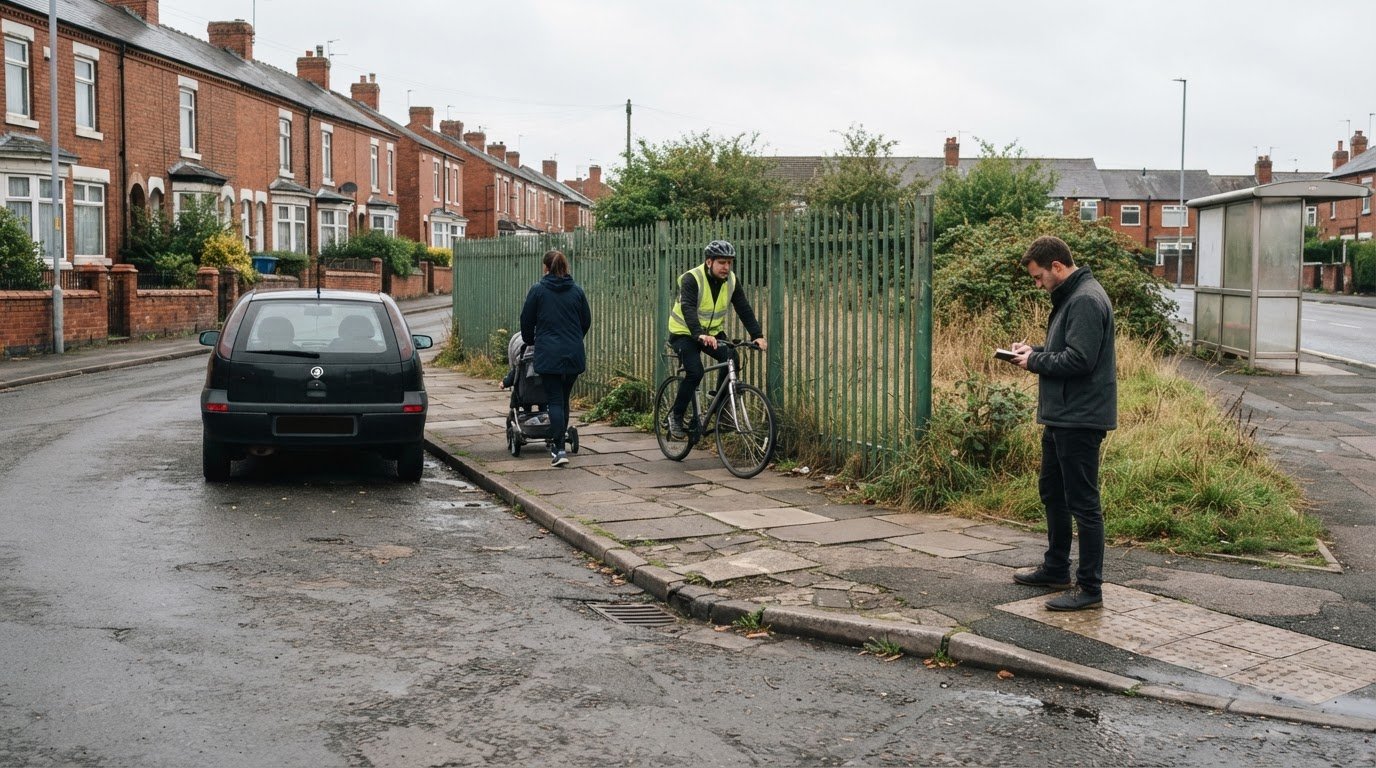
A development can have a sound design and still face transport questions that affect its planning application. Transportation consultants answer those questions by assessing travel demand, site access, highways and the likely transport effects of a proposal.
Their work often goes beyond preparing a report. Consultants analyse traffic and movement, consider whether nearby junctions can accommodate additional trips, and liaise with planning officers and highway authorities about assessment requirements and potential mitigation. They may also assess vehicle, walking, cycling and public transport access, as well as public engagement when it forms part of the project.
This guide explains what transport consultants do at each stage of a development and how their work supports planning decisions. It covers Transport Statements and Transport Assessments, authority liaison, highways and site access, and local transport strategy. It also explains how surveys and swept path analysis can inform a project, what shapes the scope of consultancy work, and when specialist transport planning support can help progress a proposal.
Key Takeaways
- Understand how inclusive transport planning considers community needs and the way people travel to and from a development.
- See how public consultation and stakeholder engagement can surface local concerns that shape transport proposals.
- Learn how access assessments consider vehicle movements and connections to walking, cycling and public transport.
- Find out how structured liaison with authorities and other stakeholders can help clarify assessment requirements and potential mitigation.
- According to the UK legislation register, the Bus Services Act 2025 strengthens the role of local authorities in shaping bus networks and protecting services in the United Kingdom.
What Do Transport Consultants Actually Do?
Transport consultants assess how a development may affect movement, access and nearby transport networks. Their analysis can inform planning decisions, design and discussions with relevant authorities.
Transport Planning and Urban Design
Transport planning and urban design need to work together from the early layout stage. The position of entrances, streets and public spaces affects how people reach homes, workplaces and services. For example, a site designed around walking needs routes that connect destinations, not just paths within its boundary. A consultant examines these connections and explains how the layout supports practical, inclusive travel.
Consultant Experience and Service Fit
When comparing transportation consultants, look for experience with similar projects and a clear explanation of the proposed analysis. Client reviews can show how clearly a consultant communicates, manages revisions and responds to project needs. Check that the services match the planning task, such as assessing development traffic or vehicle access. In the UK, local authority and highway knowledge is particularly relevant to the site.
Inclusive planning considers who will use a development and how they travel. A consultant may examine public transport access, walking routes and cycling connections alongside vehicle movements. For example, a proposal near homes, shops and a bus stop raises different questions from an employment site with few nearby services. The community and site context help determine which travel patterns and access issues need closer analysis.
For development planning, consultants can use established data and traffic modelling software to forecast trips generated by a proposal. They assess whether nearby junctions could accommodate additional movements and report on traffic impact, access by sustainable modes and relevant planning policy. A Transport Statement or Transport Assessment presents evidence for the planning application. The document and analysis required depend on the project’s scale and likely transport effects.
Planning risks can affect programme decisions. Consultants can identify potential planning conditions, infrastructure contributions and timescales, helping project teams plan with better information. In complex cases, they may also provide evidence for a planning appeal or public inquiry. Their analysis can explain how transport effects were assessed and how proposed mitigation relates to identified impacts.
There is no single qualification or accreditation that applies to every transport planning task. Compare relevant qualifications and accreditations with the work required, then consider the consultant’s project experience and client feedback. Consultants advise on transport assessment, planning policy and application requirements, with the site and proposal determining the issues to address. Commissioning usually begins with the site, development proposal and planning requirement, followed by an agreed scope. For local expertise, look for familiarity with the site’s local authority and highway context.
Stakeholder engagement and public consultation
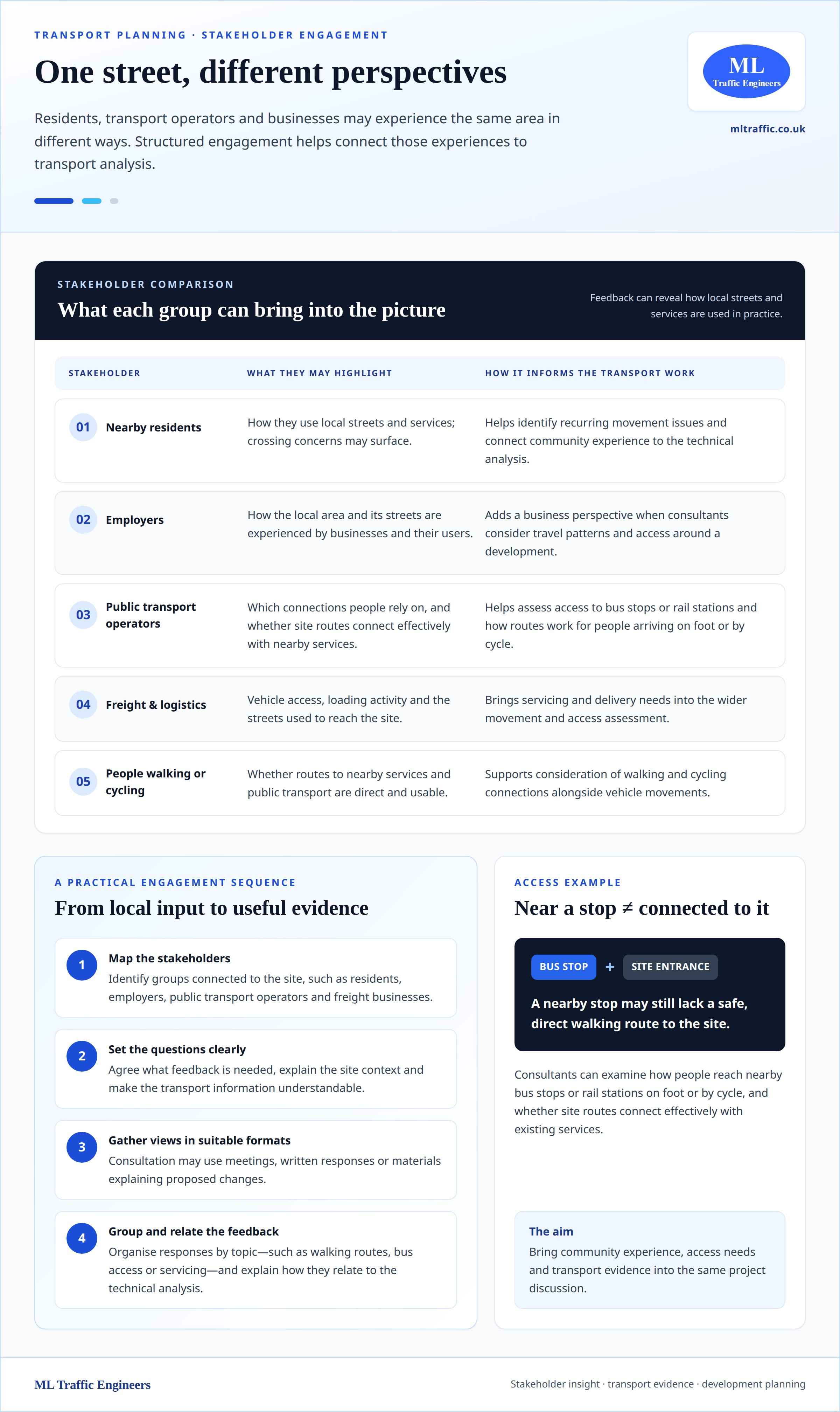
Transport proposals affect residents, businesses and people travelling through an area. Structured engagement can identify how different groups use local streets and services before the development’s transport approach is finalised.
Consultants can map stakeholders, agree what feedback is needed and explain technical information in clear language. For a mixed-use development, this could involve gathering views from nearby residents, employers, public transport operators and freight businesses. Each group may experience the same street differently: residents might raise crossing concerns, while delivery operators identify access constraints. Recording these themes helps distinguish individual comments from recurring movement issues.
Public consultation can involve meetings, written responses or materials explaining proposed changes. A useful process sets out the site context, the transport questions under consideration and how feedback will inform the work. Consultants can group responses by topic, such as walking routes, bus access or servicing, and explain how they relate to the technical analysis. This connects community experience to project decisions without treating every comment as a design instruction.
Engagement can also test connections between a development site and existing public transport. Consultants may examine access to nearby bus stops or rail stations and whether routes work for people arriving on foot or by cycle. For example, an entrance may be close to a bus stop but still lack a safe, direct walking route. Freight and logistics stakeholders can identify other needs, including vehicle access, loading activity and the streets used to reach the site.
Bus access needs close attention when a proposal may change travel demand or movement patterns. Discussions with operators and local stakeholders can clarify which connections people rely on and where the site layout creates barriers. The findings can inform transport planning, including whether access routes connect effectively with existing services. Consultants can present these matters alongside other transport evidence, rather than treating public transport as a separate design issue.
Public realm strategies connect movement with the quality and use of streets and shared spaces. A town-centre scheme, for example, may need to accommodate walking, cycling, buses, servicing and public activity in the same area. Engagement can reveal where these uses compete or complement one another. Consultants can bring that evidence into the transport assessment, identifying practical design considerations for project teams and decision-makers.
For development projects, a transport planning assessment can help organise movement evidence alongside stakeholder concerns. The result gives planning discussions a clearer account of how proposals relate to existing streets, services and community needs.
Highways, access and infrastructure delivery
Access planning connects a development to the surrounding highway network and people’s journeys. Consultants assess site entrances, nearby junctions, vehicle movements and links to sustainable travel. They identify transport requirements and explain how a proposal relates to existing infrastructure. Their role is to provide analysis for planning decisions, not to construct roads or other infrastructure.
For a new site entrance, an assessment considers how vehicles enter and leave and how those movements relate to the adjacent road. Consultants review the proposed layout alongside traffic conditions and the development’s likely trip generation. Junction analysis helps establish whether the surrounding network can accommodate additional movements or whether changes need consideration. The site’s location, use and connection to existing roads determine the scope of the work.
Servicing needs a practical review of its own. Delivery and refuse vehicles need to reach suitable stopping or loading areas and manoeuvre within the site. Consultants can assess vehicle paths against the proposed layout and identify where turning movements may conflict with parking, buildings or pedestrian routes. For example, a tight service yard may require internal layout changes before the access arrangement is settled. This analysis helps project teams understand operational needs early.
Access should also work for people arriving without a car. Consultants can assess connections to nearby bus stops and rail stations and identify potential improvements to those links. A site entrance may connect to a highway but still provide poor access to a station, undermining the development’s wider travel aims. Walking and cycling routes, public transport access and vehicle servicing should therefore be considered together, not as isolated site features.
Infrastructure planning depends on how a proposal fits its local setting and wider movement network. For a town-centre development in Birmingham, for example, project teams may need to consider how site access connects with existing walking, cycling and bus routes. Coordinated design can address several travel modes at once. Transport consultants assess how proposed access relates to the surrounding network and identify the evidence needed for planning discussions.
A clear assessment links each access issue to a design response or planning consideration. Consultants can set out assumptions, describe the movements assessed and explain how junction or servicing constraints affect the proposal. This gives decision-makers a structured basis for considering access arrangements. It also helps project teams identify details to resolve as the layout develops, such as entrance position, internal circulation or connections to existing sustainable routes.
Engagement with authorities and stakeholders
Development proposals can involve planning officers, local highway authorities and, where relevant, National Highways. Transport consultants liaise with these bodies to agree assessment scopes and discuss potential mitigation. Early coordination clarifies which transport questions need analysis, what information is relevant and how findings should be presented. The organisations involved depend on the site, road network and proposal’s likely effects.
A practical first step is to identify the decision-makers and organisations connected to the project. A site beside a strategic road may require discussion with the relevant highway authority and National Highways. A proposal affecting local streets may involve the local highway authority and planning officers. Public transport operators may also contribute if a development could affect service access or connections. Mapping these interests gives project teams a clearer basis for planning discussions.
Scope discussions align technical work with the questions authorities need answered. Officers may, for example, seek analysis of development-generated traffic, nearby junctions or access arrangements. Consultants can clarify the assessment area, assumptions and evidence required, then reflect the agreed scope in the transport work. Recording the approach also helps keep later revisions focused on the planning issues under consideration.
Mitigation discussions connect identified transport effects with possible responses. If analysis indicates pressure at a junction, the consultant can explain the evidence and discuss potential measures with the relevant highway authority. The authority’s feedback can help refine the proposal or clarify what further work is needed. This is a technical process: proposed changes need to relate to the assessed impact, the site layout and the surrounding network.
Some projects also need coordination across disciplines. Transport consultants may work with environmental specialists so that access roads, drainage features and movement corridors support wider sustainability objectives. For instance, a proposed access route could affect both vehicle movement and the placement of drainage features. Early discussion between transport, environmental and engineering teams helps identify design interfaces before they become programme issues. Project teams and private landowners may also need to coordinate site information and design decisions.
Engagement continues as project details develop. A revised layout can change access positions, servicing arrangements or the traffic assumptions used in analysis. Consultants can explain those changes to planning officers and highway authorities, identify whether the agreed scope still fits and update the transport evidence. This keeps decisions tied to the current proposal rather than an earlier design.
Effective liaison does not replace the authority’s decision-making role. It gives planning and highway stakeholders a structured account of the proposal, its assessed effects and the reasoning behind mitigation options. For developers, this helps keep discussions focused on defined transport issues, with technical evidence available to support the next planning steps.
Transport strategy and local plans
Local transport strategies set movement priorities across an area, while development proposals must respond to their specific context. Consultants examine how a site relates to planned growth, existing services and active travel connections. For example, a housing proposal near a town centre may need to support links between homes, shops and public transport. This strategic view places the project in the context of wider local objectives.
Transport planning draws on local knowledge as well as technical analysis. Consultants consider the roads, bus services, walking routes and cycling connections around a site, then assess how the proposal fits those networks. An integrated approach can reveal where different objectives overlap. A direct walking route to a bus stop, for instance, can improve public transport access and support active travel.
Bus networks are part of that planning context. According to the UK legislation register, the Bus Services Act 2025 strengthens the role of local authorities in shaping bus networks and protecting services in the United Kingdom. For development projects, this makes local bus planning relevant when considering access, service connections and the relationship between proposed growth and existing provision.
Consultants can use local plans and strategy documents to understand the policy context for a site. They identify relevant movement objectives, such as improving public transport connections or supporting walking and cycling, and relate them to the proposed development. A Transport Assessment explains how a project’s transport effects have been considered. A Travel Plan sets out measures intended to support travel choices associated with a development.
These documents serve different purposes. A local strategy addresses area-wide priorities, while project-level assessments focus on the effects and access needs of a specific proposal. Consultants connect the two by considering the site’s location, expected travel patterns and available networks. This helps decision-makers understand how the project relates to local priorities without treating a broad strategy as a substitute for site-specific evidence.
Coordination across the transport sector matters too. A development may involve planning officers, highway authorities and public transport operators, each with local network knowledge. Consultants can use that input to shape the analysis and identify assumptions that need closer attention. For example, a change to site access may affect how people reach nearby bus services, making an integrated review more useful than considering each issue separately.
If a development needs transport evidence aligned with local priorities, discuss your project’s transport planning requirements.
ML Traffic Engineers UK
ML Traffic Engineers UK supports development projects that need transport planning evidence for a planning application. The team prepares Transport Statements and Transport Assessments to explain a proposal’s transport considerations. Swept Path Analysis assesses vehicle manoeuvring, while Parking Surveys provide information about parking conditions relevant to a project.
The right work depends on the development, its access arrangements and the questions raised by planning. Sharing the site location, proposal details and relevant planning requirements helps establish what transport information is needed. This gives the project a focused starting point for preparing its evidence.
Contact ML Traffic Engineers UK to discuss transport planning support for your development project.
Set your development up for its next decision
Transport work is most useful when it reflects the development’s current design and the planning questions it needs to answer. Involving transportation consultants at the right stage helps align technical evidence with access, parking and vehicle movement as plans develop.
ML Traffic Engineers UK provides Transport Statements, Swept Path Analysis and Parking Surveys for development projects. The appropriate work depends on the site and the transport evidence required. Clear details about the proposal and its planning context provide a focused starting point.
As your plans progress, keep transport requirements connected to design decisions and the evidence needed for the planning process. Contact ML Traffic Engineers UK to discuss transport planning support for your development. With the right project information in hand, you can take the next step with a clearer view of the transport work involved.
Frequently Asked Questions
What services do transportation consultants provide in the UK?
Transportation consultants prepare planning evidence and analyse traffic and access for development projects. Services can include Transport Statements, Transport Assessments, Travel Plans, traffic or parking surveys, and Swept Path Analysis. The right combination depends on the proposal and the transport questions it raises. For projects in Greater London, Manchester, Birmingham, Liverpool and other covered areas, ML Traffic Engineers UK provides transport planning documents and traffic data analysis.
Which UK transport consultancies specialise in freight, logistics, public transport or infrastructure?
Specialisms vary, so match the consultancy’s work to the project’s specific needs. Freight or logistics planning focuses on goods movement and operational requirements, while public transport strategy addresses services and passenger connections. Development planning consultancies prepare transport evidence for planning applications. ML Traffic Engineers UK focuses on development-related transport planning and documentation across Greater London, Manchester, Birmingham, the West Midlands, Liverpool, Surrey, East Sussex, West Sussex, Hampshire, Berkshire and Buckinghamshire.
How can a transport consultant help with a transport assessment or travel plan for planning permission?
A consultant can assess a proposal’s transport implications and prepare documents for its planning submission. For example, a mixed-use scheme may require travel-demand analysis and a Travel Plan suited to its intended uses. The consultant can tailor the work to the development and local planning context, then present the findings clearly for decision-makers. These documents inform the application but do not determine its outcome.
What is the difference between a transport consultant, logistics consultant and traffic engineer?
A transport consultant typically addresses how development proposals relate to travel, access and transport planning. A logistics consultant generally focuses on moving, storing or distributing goods within business operations. A traffic engineer concentrates on traffic operations and engineering analysis, such as vehicle movement and network performance. Since these roles can overlap, define the project’s core need: planning evidence, goods distribution or traffic engineering analysis.
What risks should businesses consider when hiring a transport consultant?
Key risks include an unclear scope, assumptions that no longer match the design, or work that does not answer the planning question. Set out the proposal, intended submission and required deliverables at the start. Keep the consultant informed of design changes, since access or land-use revisions can affect the analysis. Also agree how findings, assumptions and necessary revisions will be documented, without assuming that planning approval is assured.
Where can I find transport consultants near me in the UK?
For a local search, focus on transportation consultants familiar with the site’s local authority and highway context.

Disclaimer
The content on mltraffic.co.uk, including all technical articles, guides, and resources, is provided for general informational and educational purposes only. It is not intended to constitute professional advice in traffic engineering, transportation planning, development approvals, or any other technical or legal field.
While ML Traffic Engineers makes every reasonable effort to ensure the accuracy, completeness, and timeliness of the information published, we do not provide any warranties or representations (express or implied) regarding its reliability, suitability, or availability for any particular purpose. Any reliance you place on the content is strictly at your own risk.
In no event shall ML Traffic Engineers, its directors, employees, authors, or affiliates be liable for any direct, indirect, incidental, special, consequential, or punitive damages (including, without limitation, loss of profits, data, or business opportunities) arising out of or in connection with the use of, or inability to use, any information provided on this website.
The articles and guides on this site are not a substitute for engaging a qualified, professional traffic engineer to assess your specific project requirements. For tailored advice, compliance assessments, or traffic engineering services, please contact a competent professional.
This disclaimer may be updated from time to time without notice. By accessing or using this website, you agree to be bound by the most current version of this disclaimer.