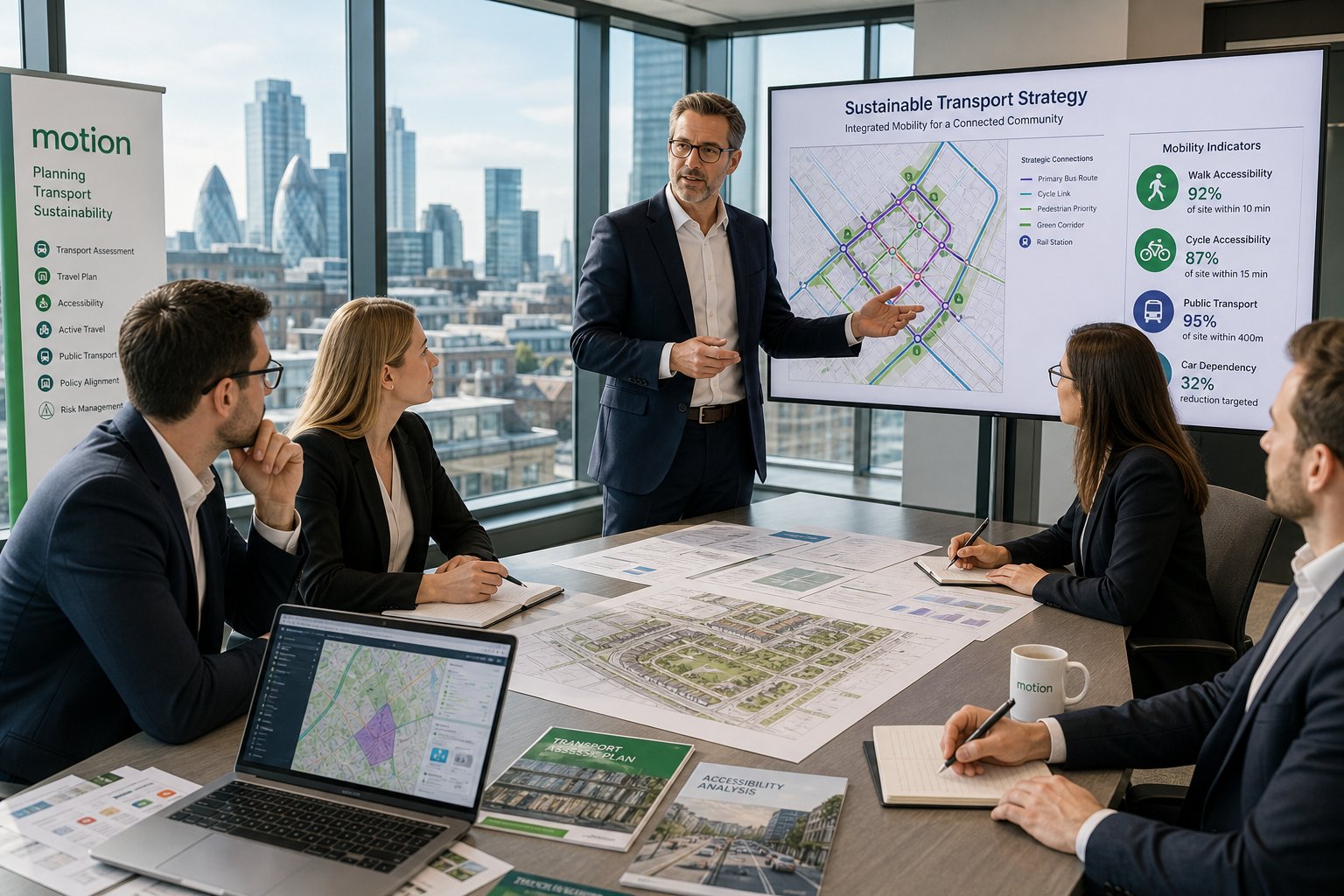
Planning risk rarely announces itself politely. More often, it appears halfway through a scheme as a late highways objection, a weak accessibility case, an awkward parking dispute, or a Travel Plan that says all the right words but convinces nobody. By that point, redesigns are expensive, programme dates start slipping, and what looked straightforward on a site plan becomes much harder to justify in policy terms.
That is exactly where sustainable transport consultants add value. We help development teams show not only that a proposal can function on the network, but that it is genuinely accessible by walking, cycling and public transport, aligned with current planning policy, and realistic about how people will actually travel. In 2026, that matters more than ever. Local authorities are under pressure to support growth while meeting net-zero commitments, reducing car dependence where appropriate, and improving air quality, safety and place quality.
For architects, planners, developers, surveyors, legal teams and councils, the strongest transport advice now goes well beyond traffic counts and junction capacity. It shapes layouts, informs site selection, supports negotiation, and reduces the chance of transport becoming the reason a promising application stalls. In this guide, we set out what sustainable transport consultants do, when to involve them, the services that matter most, and what to look for if you want evidence that stands up under scrutiny.
What Sustainable Transport Consultants Do In The Planning Process
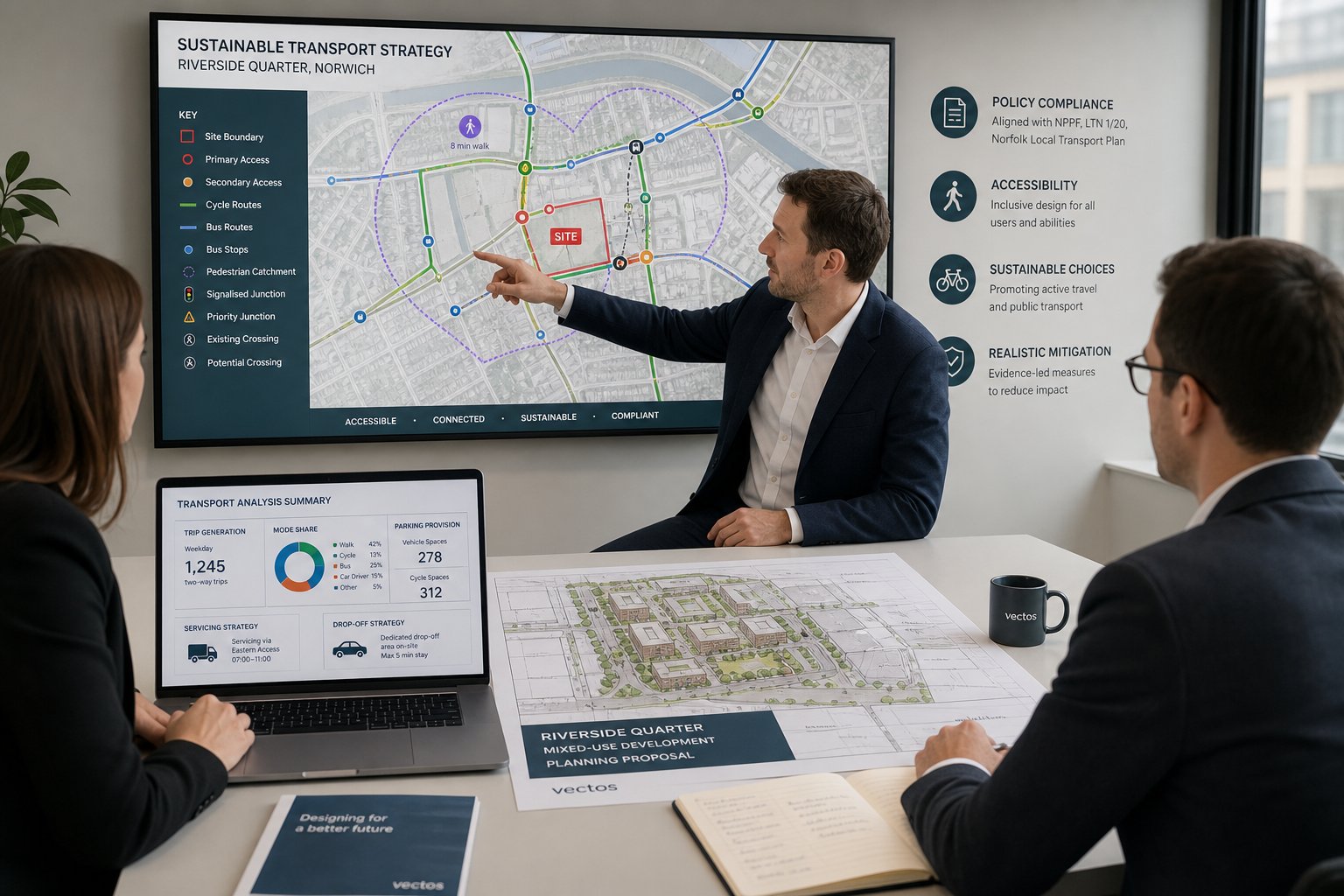
Sustainable transport consultants sit at the point where design ambition meets planning reality. Our job is to test whether a development is accessible, policy-compliant and operationally credible, then turn that analysis into evidence a planning authority can rely on.
In practice, that means estimating trip generation, understanding likely mode share, reviewing the surrounding street and movement network, and identifying whether a scheme can support more journeys on foot, by cycle and by public transport. We also look at the basics that frequently become contentious: site access, servicing, parking levels, drop-off arrangements, and the relationship between the proposal and nearby junctions or routes.
Just as importantly, we help explain why the scheme is acceptable. A good planning submission does more than append transport documents: it presents a coherent story. If the site is in a town-centre location with strong bus links and walkable catchments, that should shape the strategy from the start. If constraints exist, they need to be acknowledged early and addressed with realistic mitigation.
This is why many teams treat transport input as part of a wider planning narrative rather than a stand-alone technical exercise. On complex schemes, the role overlaps with broader Transport Planning Consultants: work, especially where masterplanning, phasing and authority negotiation all interact. For applicants, the real value is simple: fewer assumptions, better evidence, and a stronger basis for approval.
How Sustainable Transport Supports Planning Policy And Development Goals

Transport is no longer a side note in planning policy. It is central to how authorities judge sustainability, placemaking and long-term resilience. That shift has been building for years, but in 2026 it is much sharper: schemes are expected to reduce unnecessary car dependence, support active travel, respond to climate obligations and make efficient use of existing infrastructure.
Sustainable transport consultants help translate those policy expectations into practical development decisions. We assess how a proposal aligns with national guidance, local plan policies, parking standards, active travel strategies and, where relevant, town-centre regeneration or public health objectives. That policy fit matters because even a modest scheme can struggle if its transport case feels disconnected from the authority’s wider goals.
There is also a commercial dimension. A development that is easier to reach by multiple modes is often more adaptable over time. Residential schemes benefit from wider travel choice: employment and education sites are less exposed to parking pressure: mixed-use places tend to function better when walking routes, cycle links and public transport integration are designed in early.
The strongest advice often combines technical evidence with policy interpretation. That is why policy-led analysis, including work similar to Transport Policy Review, can be so useful where objections are likely. And on larger sites, a vision led transport approach helps teams move beyond “how many cars?” towards “what kind of place are we trying to create?”
When A Development Should Involve A Sustainable Transport Consultant
The short answer? Earlier than most teams think.
If transport is brought in only after the layout is fixed and the planning statement is drafted, options narrow quickly. By contrast, early input can influence site selection, access strategy, density assumptions, frontage design, parking distribution and the case for sustainable mode share. It can also prevent a familiar problem: a scheme that looks acceptable in broad terms but starts to unravel once someone asks how people will actually get there.
We usually advise involving sustainable transport consultants at three points. First, during feasibility, when a site’s strengths and constraints are still being weighed. Second, before or during pre-application discussions, so transport issues are framed properly with the authority. Third, whenever a proposal is likely to generate material traffic effects, raise parking concerns, or rely on a strong sustainability argument to secure support.
This is particularly important where thresholds for a Transport Statement or Assessment may be close, local policy is tight, or the surrounding network is already sensitive. Teams working on phased or multi-party sites also benefit from joined-up, end to end advice rather than isolated report writing.
A useful rule of thumb: if transport could influence viability, programme, design quality or planning risk, bring it in early.
Typical Projects That Benefit From Sustainable Transport Input
The obvious candidates are residential, mixed-use and commercial schemes, but the range is wider than that. Retail parks, roadside foodstores, logistics sites, schools, colleges, healthcare facilities, leisure venues and stadiums all generate transport issues that can make or break an application.
Town-centre regeneration projects often need especially careful handling. They may involve constrained street networks, competing demands for servicing and public realm, reduced parking expectations, and a policy push toward active travel. Strategic land promotion and masterplanning also benefit from transport input because movement assumptions made early tend to shape everything that follows.
Even relatively small schemes can justify expert advice where local sensitivities are high. A few dozen dwellings on a constrained rural edge-of-settlement site may attract more transport scrutiny than a larger urban infill proposal with excellent bus access. Context matters more than headline scale.
In our experience, any project that depends on demonstrating accessibility rather than simply accommodating traffic will benefit from specialist input. That includes schemes where decision-makers are likely to ask hard questions about mode choice, parking restraint, highway safety or cumulative impact.
Core Services Provided By Sustainable Transport Consultants
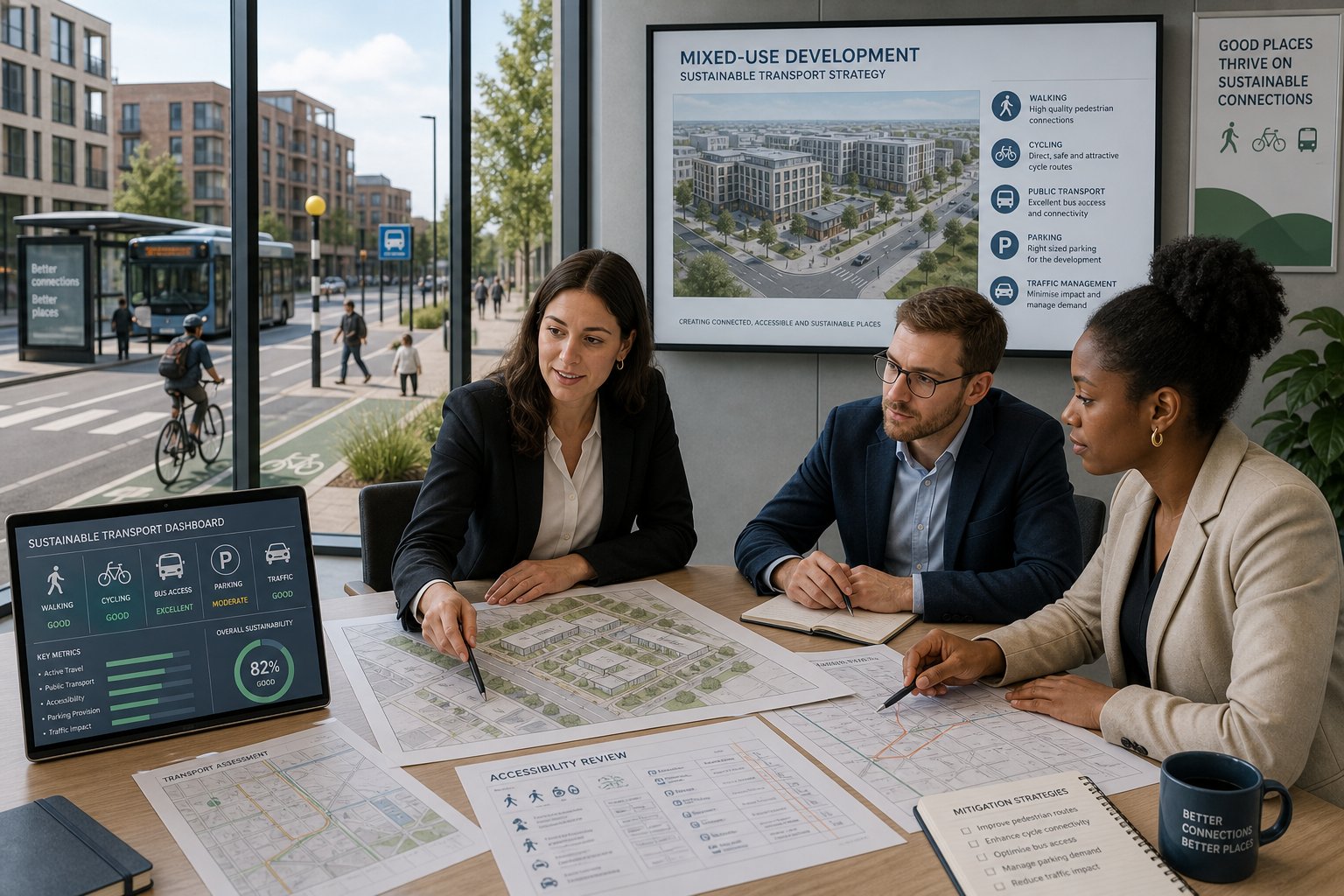
The core offer is broader than many clients expect. Yes, sustainable transport consultants prepare planning documents, but the better work starts earlier and reaches further. We review site opportunities, advise on design responses, test assumptions, develop mitigation, and support discussions with local authorities and highway officers.
For planning teams, that breadth is useful because transport issues rarely arrive in neat silos. A parking question may actually be an accessibility problem. A highways objection may stem from weak trip assumptions. A request for mitigation may point back to a layout that missed a pedestrian desire line or failed to integrate a bus stop properly.
Strong consultants hence combine technical assessment with judgement. They know when a concise statement is enough and when a more detailed evidence base is needed. They can also connect transport with related disciplines, including drainage, environmental effects, townscape and masterplanning.
On schemes with potentially wider impacts, transport work may overlap with environmental impact assessment requirements, especially where cumulative effects, air quality or strategic mitigation need careful framing. The service is not just about compliance: it is about helping a scheme function well, read credibly, and stand up to scrutiny.
Transport Statements, Transport Assessments, And Travel Plans
These are the documents most clients recognise, but each serves a different purpose.
A Transport Statement is usually proportionate to smaller or less complex schemes. It explains the existing context, estimates likely trips, reviews access and parking, and demonstrates that impacts are acceptable without extensive modelling.
A Transport Assessment goes further. It is used where impacts are likely to be more material or more contested. That can involve junction analysis, baseline surveys, distribution and assignment assumptions, committed development review, mitigation testing and a more robust treatment of accessibility and mode share.
A Travel Plan focuses on behaviour. It sets out practical measures to encourage walking, cycling, public transport use, car sharing and sometimes EV support or mobility hubs, with targets, management actions and monitoring. Weak Travel Plans are easy to spot: they promise modal shift without clear ownership or follow-through.
For teams deciding what level of reporting is appropriate, the distinction between statements and assessments is often the key issue, which is why guidance from Transport Statement Consultants and transport assessment for schemes can be so relevant at the outset.
Site Appraisals, Accessibility Reviews, And Mitigation Strategies
The desk-based picture only tells part of the story. Good consultants visit sites, walk routes, review gradients, crossing points, lighting, surveillance, bus stop quality, cycle permeability and the small details that mapping can miss. A route may look short on plan and still feel unusable in reality.
Accessibility reviews test whether key destinations are realistically reachable by sustainable modes, not just theoretically within a catchment buffer. That distinction matters in committee reports and appeals, where credibility often turns on practical, on-the-ground conditions.
Mitigation strategy then bridges evidence and action. Depending on the scheme, that might include new pedestrian crossings, footway links, cycle access improvements, junction upgrades, wayfinding, bus stop enhancements, parking management, servicing controls or phased Travel Plan measures. The best mitigation is proportionate, deliverable and tied clearly to identified issues.
And one point worth stressing: authorities are much more receptive when mitigation is specific. “Encourage cycling” is not a strategy. A funded crossing, secure cycle parking, a direct route to nearby services and a monitored Travel Plan coordinator role, that starts to look real.
How Consultants Assess Accessibility And Travel Behaviour
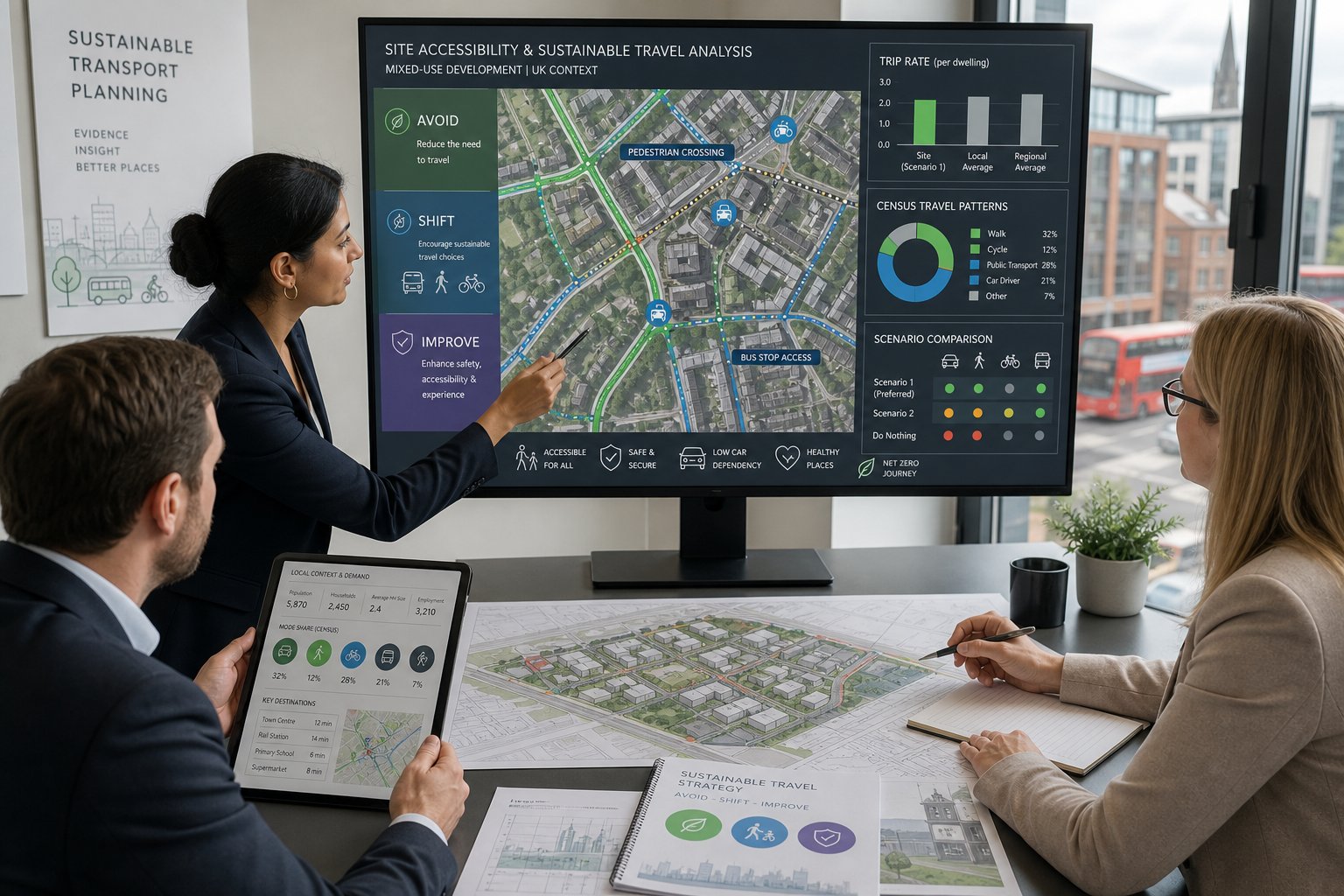
Assessing accessibility is part data exercise, part professional judgement. We typically start with location, land use and network context: where the site sits relative to homes, jobs, schools, centres and transport corridors. Then we test actual travel options, not idealised ones.
The evidence base can include TRICS-style trip-rate benchmarks, traffic counts, junction surveys, census travel-to-work data, local mode share evidence, public transport timetables, National Travel Survey patterns, and origin-destination information where available. On larger or more sensitive schemes, scenario testing helps us understand not only expected demand but also how different design or mitigation choices could affect it.
But numbers alone are not enough. Travel behaviour is influenced by convenience, safety, cost, habit and perception. A five-minute walk to a bus stop sounds positive: less so if the route involves poor crossings, no lighting and an uninviting frontage. Likewise, a cycle connection may exist on paper but fail if it is indirect, hostile or fragmented.
This is where frameworks such as Avoid–Shift–Improve are helpful. First, avoid unnecessary trips through land-use planning and digital access. Then shift trips to cleaner, more space-efficient modes. Finally, improve the performance of the remaining trips. It is a simple lens, but a powerful one. It keeps transport strategy focused on outcomes rather than just vehicle throughput.
Done well, accessibility assessment does something valuable for planning teams: it turns “sustainable location” from a slogan into evidence.
The Role Of Sustainable Transport In Reducing Planning Risk
Transport problems are expensive mainly because they emerge late. A missed access issue can trigger redesign. A weak trip generation case can lead to prolonged highways queries. An over-optimistic Travel Plan can leave conditions that are difficult, or impossible, to discharge. Sustainable transport input reduces those risks by identifying them before they harden into objections.
That risk reduction operates at several levels. Technically, it strengthens the evidence base. Policy-wise, it aligns the proposal with how authorities now assess sustainable development. Strategically, it gives applicants a more realistic sense of what can be supported, what needs mitigation, and what may be hard to defend.
This matters not just at application stage but at appeal, condition discharge and reserved matters too. Reports need to be internally consistent, proportionate and robust enough to withstand scrutiny from planning officers, highway authorities, objectors and sometimes barristers. The better the transport case, the less room there is for avoidable ambiguity.
For many clients, the practical gain is programme certainty. Faster responses, clearer scoping and concise reporting all help. That is also where experienced firms such as ML Traffic position their service: accurate technical work, quickly delivered, with a strong understanding of local authority thresholds and planning context. When transport advice arrives early and is properly integrated, it stops being a reactive fix and becomes a genuine risk-management tool.
Working With Architects, Planners, Developers, And Local Councils
The best outcomes usually come from collaboration, not handovers. Sustainable transport consultants work most effectively when we are part of the design team early enough to influence decisions rather than simply document them afterwards.
With architects, that often means testing street hierarchy, block structure, access geometry, parking placement, servicing strategy and how frontages support walkability. With planners and planning lawyers, it means building a transport narrative that aligns with policy, committee concerns and likely conditions. With developers and land promoters, it often centres on feasibility, phasing, deliverability and negotiation strategy.
Local councils and highway authorities are a crucial part of this picture. Their concerns may range from junction capacity and safety to parking overspill, bus service viability or the realism of active travel claims. Early, constructive engagement can narrow issues before they become formal objections. It also helps define scope: whether a statement will suffice, what survey data is needed, and how mitigation should be framed.
On larger projects, transport operators, education bodies, estate teams and neighbouring land interests may also need to be involved. Coordination matters because transport sits across disciplines and ownership boundaries in a way few other planning topics do.
When this collaboration works, the result is usually obvious. The transport strategy feels native to the scheme, not stapled on at the end.
What To Look For When Choosing A Sustainable Transport Consultant
Not all consultants bring the same mix of planning judgement, technical capability and local authority credibility. If an application is likely to face scrutiny, those differences matter.
Start with relevant experience. Has the consultant handled similar land uses, scales and planning contexts? A town-centre mixed-use site, a suburban care home and a logistics scheme may all require transport input, but the issues are very different. Past work with the relevant authority, or with comparable authorities, can also be valuable because thresholds, expectations and preferred methodologies vary.
Next, look at capability. Can they provide proportionate advice on statements, assessments, Travel Plans, accessibility and mitigation? Do they understand active travel design, not just traffic modelling? Can they engage confidently in pre-apps, committee support or appeal preparation? Broader expertise often leads to cleaner, more consistent advice.
Communication is another differentiator. Good consultants explain risk clearly, scope work sensibly and avoid unnecessary technical theatre. They tell you when an issue is manageable and when it is not.
If you are comparing options, it is worth reviewing how they approach Transport Assessment Consultants: work and whether they can support wider planning strategy rather than only produce a report. In short: choose a consultant who can think, negotiate and write, not just calculate.
Common Mistakes That Delay Sustainable Transport Approval
The most common mistake is timing. Transport is often commissioned after key design decisions are already fixed, which leaves little room to solve problems elegantly. At that point, consultants can still help, but the work becomes more defensive and less strategic.
Another frequent issue is underestimating demand. Trip generation, servicing needs and parking pressure are sometimes presented too optimistically, especially where applicants worry that realistic assumptions may trigger mitigation. In reality, weak assumptions usually create bigger delays because they invite challenge.
Accessibility is another blind spot. Teams may point to nearby bus stops or cycle routes without checking whether they are attractive, safe or useful in practice. Planning officers notice that quickly. So do objectors.
Mitigation can also be vague to the point of being ineffective. If proposals are unfunded, uncosted, dependent on third parties with no delivery route, or disconnected from the actual impact identified, authorities are unlikely to be reassured. The same goes for generic Travel Plans with no targets, monitoring, incentives or named responsibility.
Finally, some applications fail to connect transport evidence with the wider planning case. A technically competent report can still feel weak if it does not support the scheme’s sustainability narrative. The avoidable delay, then, is not just bad analysis. It is bad integration.
Conclusion
In 2026, sustainable transport is not a box to tick near the end of an application. It is a core part of how development is judged: on accessibility, policy fit, placemaking, climate response and everyday practicality.
That is why sustainable transport consultants matter most when they are involved early. We can test assumptions before they become liabilities, shape schemes around real movement patterns, and provide evidence that planning officers and highway authorities can trust. For developers, designers, planners and councils, that usually means fewer surprises, more credible mitigation, and a better chance of securing consent without avoidable delay.
The strongest schemes are not simply the ones that generate acceptable traffic. They are the ones that function well for people, fit the policy direction of travel, and remain resilient as standards and expectations keep moving. Expert transport advice helps get them there.
Frequently Asked Questions About Sustainable Transport Consultants
What role do sustainable transport consultants play in the planning process?
Sustainable transport consultants assess trip generation, mode share, site access, and parking to ensure developments are accessible by walking, cycling, and public transport, providing evidence that meets planning policy and reduces risks in approval.
When should developers involve sustainable transport consultants in their projects?
Engage sustainable transport consultants early during site selection, feasibility, or pre-application stages to influence layout, access, and transport strategy, preventing costly redesigns and addressing planning risks effectively.
How do sustainable transport consultants support planning policy and development goals?
They align proposals with national and local policies on net zero, active travel, and air quality, promoting low-car reliance and sustainable infrastructure investment to meet modern climate and accessibility standards.
What typical projects benefit most from sustainable transport consultancy?
Residential, mixed-use, retail parks, logistics sites, education, healthcare, stadiums, and town-centre regeneration projects commonly require sustainable transport input due to their complex transport and policy implications.
What are the differences between Transport Statements, Transport Assessments, and Travel Plans?
Transport Statements suit smaller schemes with basic trip and impact summaries; Transport Assessments offer detailed junction and traffic modelling for complex sites; Travel Plans focus on behavioural measures to encourage sustainable travel modes through targets and monitoring.
How do sustainable transport consultants reduce planning risk?
They provide robust, policy-compliant evidence early on, identify transport issues before objections arise, and create credible mitigation strategies, helping schemes avoid delays, redesigns, and hard-to-discharge conditions.