
Planning delays often start with something that looks small on paper. A modest residential scheme, a light industrial unit, a school extension, none of them may seem large enough to trigger a heavyweight transport exercise. Yet one awkward access point, a few disputed trip rates, or parking that jars with local standards can slow an application down fast. That is exactly where transport statement consultants earn their keep.
In practice, a good consultant does far more than write a report to tick a validation box. We use transport evidence to explain how a proposed development will work on the ground: how vehicles enter and leave, whether pedestrians can move safely, what parking and servicing look like, and whether the local highway network can accommodate the proposal without material harm. For architects, planners, solicitors, surveyors, developers and council teams, that proportionate evidence can make the difference between a straightforward approval and a long chain of technical queries.
In 2026, expectations are a bit sharper too. Local planning authorities are paying closer attention to active travel, site-specific constraints and whether a report genuinely reflects the scheme submitted. So choosing the right advisor matters. In this guide, we set out what transport statement consultants do, when a Transport Statement is needed, why councils challenge them, and how to choose an expert who helps keep the planning process moving.
What A Transport Statement Consultant Does And When You Need One

A transport statement consultant is a transport planning specialist who assesses the likely movement effects of a development and turns that analysis into a concise planning report. The key word is proportionate. A Transport Statement is usually prepared for schemes where transport impacts are real enough to matter, but not so extensive that they justify a full Transport Assessment with detailed junction modelling.
In practical terms, we review how a site will function day to day. That means forecasting likely vehicle, pedestrian and cycle trips: checking access geometry and visibility: reviewing parking and servicing: and considering whether people can realistically reach the site by walking, cycling or public transport. If there are issues, we identify sensible mitigation early rather than leaving them to become objections later.
You typically need one when a planning application sits in that middle ground: too significant to submit with no transport evidence, but below the threshold for a more detailed assessment. Small housing developments, changes of use, infill sites, nursery or school expansions, local retail units and modest commercial schemes often fall into this category.
The consultant’s role also extends beyond writing. We often help define the scope, advise the design team on access and layout, and respond to comments from the local highway authority. That wider planning input is why many teams value early advice from Transport Planning Consultants: What before a scheme is fixed. And where a proposal starts to edge beyond TS territory, the distinction with transport assessment for larger schemes becomes important.
How A Transport Statement Differs From A Transport Assessment And A Travel Plan
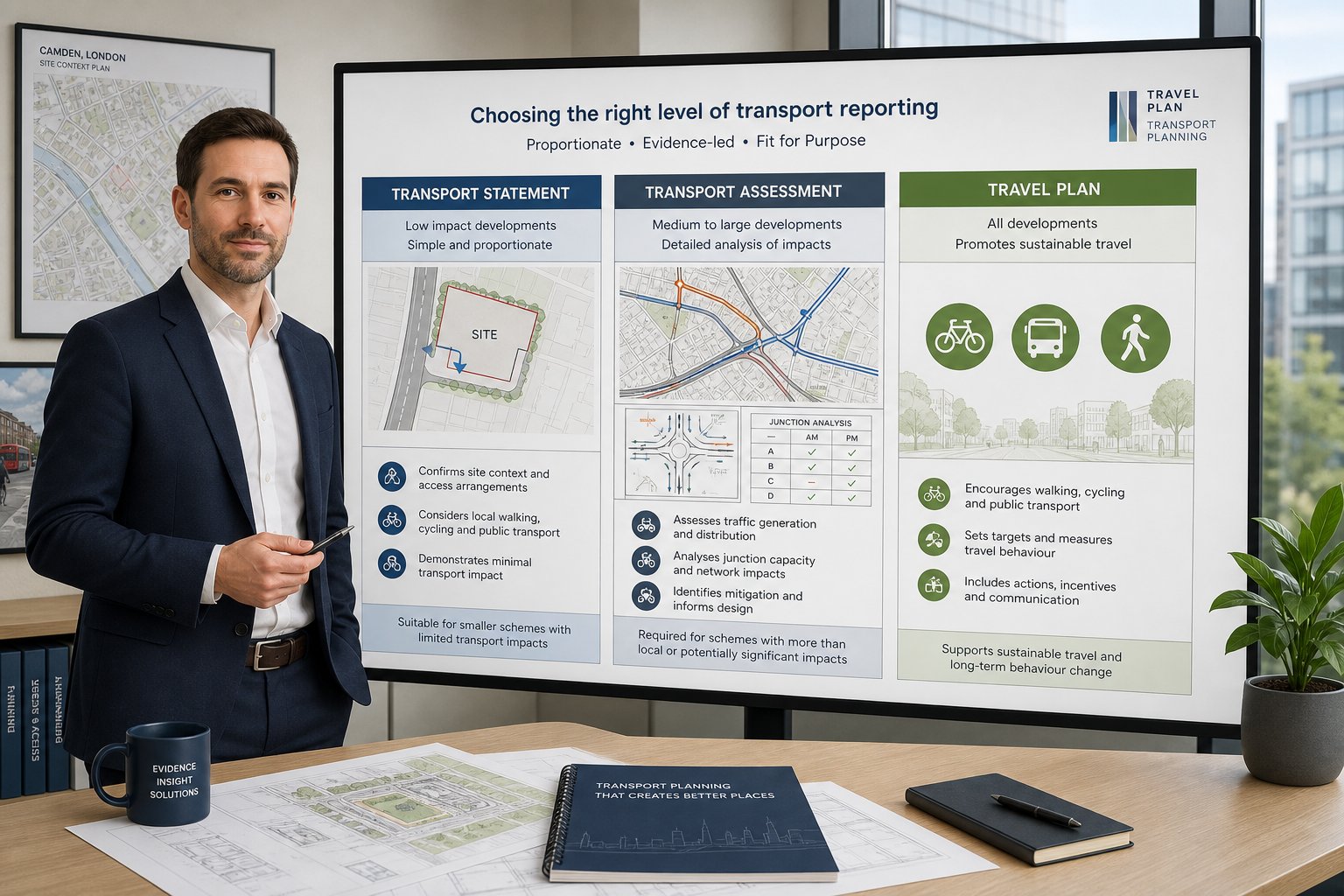
These three documents are related, but they are not interchangeable.
A Transport Statement (TS) is a concise, evidence-based review used where a development is expected to generate relatively low levels of movement and no complex network modelling is needed. It explains existing conditions, likely trips, access arrangements, parking, servicing and sustainable travel options. The emphasis is on proportionality.
A Transport Assessment (TA) goes further. It is normally required for larger, more traffic-intensive or more sensitive developments. A TA may include traffic surveys, junction capacity assessments, distribution and assignment work, accident analysis in more depth, and a fuller package of mitigation. If a scheme could materially affect the operation of nearby junctions or strategic routes, a TA is often the right tool rather than a TS. That broader comparison is covered well in discussions around Transport Assessment Consultants: for more complex planning applications.
A Travel Plan, by contrast, is a management strategy rather than an impact report. It sets out how a site will encourage sustainable travel over time, for example through cycle parking, staff travel information, public transport incentives or monitoring commitments. A Travel Plan may accompany either a TS or a TA.
The mistake we still see is treating the smallest document as the safest option. It isn’t. If a scheme really needs a TA, a thin TS can create delay because the council will simply ask for more. The right approach is to match the reporting level to the scale, context and sensitivity of the development.
Which Developments Commonly Require A Transport Statement

Many schemes that need transport input are not headline-grabbing developments. They are ordinary projects in constrained places.
Common examples include small residential developments, infill plots, apartment conversions, mixed-use refurbishments, modest office or retail units, care uses, community buildings, medical facilities, school extensions and light industrial proposals. In each case, the likely movement impact may be limited in absolute terms, but still important enough for the planning authority to want clear evidence.
Location often matters as much as size. A ten-unit housing scheme on a quiet road with good visibility may need only brief transport input. The same scheme near a school, on-street parking pressure or a difficult junction can trigger more detailed scrutiny. Likewise, a small commercial unit may still need a TS if servicing is awkward or local parking standards are already stretched.
From a development management perspective, the TS acts as the bridge between concept drawings and real-world operation. It explains how deliveries occur, where cars turn, whether emergency access is practical, and whether the surrounding road environment is suitable.
For applicants handling several moving parts at once, that wider coordination is often part of an end to end planning strategy rather than a stand-alone report.
Typical Local Authority Triggers And Validation Expectations
There is no single national trigger that works for every authority. Councils usually rely on local validation checklists, local plan policies and county or unitary highway guidance to decide whether a TS or TA is required.
Typical triggers include developments below TA thresholds but above a level where transport effects are considered material: proposals in sensitive locations: sites with constrained access: schemes that exceed parking standards: and developments near schools, town centres or busy junctions. A change in use can trigger a TS even where no new building is proposed, simply because trip patterns or peak demand are expected to change.
Validation expectations are fairly consistent. Most authorities expect the TS to address existing site context, access arrangements, visibility, walking and cycling links, public transport availability, trip generation, parking provision, servicing and refuse collection. If there is a safety concern, they may also expect collision data or a road safety review.
What catches applicants out is assuming that a national threshold is enough. It rarely is. Local nuance matters, and so does policy wording. That is why an early Transport Policy Review can be useful when a site sits near the boundary between a simple TS and something more involved.
What A Consultant Reviews Before Preparing The Report

Before drafting starts, a competent consultant should test the site and scheme from several angles. Writing first and checking later is how weak reports happen.
We normally begin with planning policy, local highway guidance and the council’s validation requirements. Then we look at the development itself: floor area, land use, unit mix, parking quantum, servicing needs, access proposals and likely build-out assumptions. Even a small mismatch between the architect’s drawings and the transport description can trigger unnecessary questions.
Existing site context comes next. That includes nearby roads, junctions, speed environment, pedestrian routes, cycle links, public transport accessibility and any physical constraints such as narrow frontages, retaining walls or poor inter-visibility. We also review available traffic data, road safety records and whether surveys are needed.
The purpose of this early review is simple: identify the issues that matter and ignore the noise. A concise report should still be technically robust.
Site Access, Highway Conditions And Visibility
Access is usually the first thing a highway officer looks at, and for good reason. If vehicles cannot enter and leave safely, the rest of the report becomes academic.
A consultant should assess access position, width, geometry, gradient and relationship to neighbouring junctions or crossings. Visibility splays need to be checked against the prevailing speed environment and the relevant design standards. On constrained urban sites, that can involve some judgement, especially where existing front boundaries, parked vehicles or street furniture affect sightlines.
We also review the condition of the adjacent highway. Are footways continuous? Are there safe crossing opportunities? Does the proposal rely on reversing manoeuvres onto the public road? Can refuse, delivery and emergency vehicles enter, turn and exit in a practical way? Sometimes a swept path exercise is enough to resolve what would otherwise become a planning objection.
Where access is marginal, honest advice early on is invaluable. Moving a gate, widening a bellmouth or altering internal layout at concept stage is usually much cheaper than defending a poor arrangement after submission.
Trip Generation, Parking, Servicing And Sustainable Travel
Trip generation is where proportion matters most. A TS does not usually require highly complex modelling, but it still needs credible evidence. Consultants often use recognised databases, survey data, census information, local observations and comparable sites to forecast likely arrivals and departures by mode and by peak period.
Parking is not just a numbers exercise either. We assess whether provision aligns with local standards, whether disabled spaces and cycle parking are properly integrated, and whether overspill risk is likely. Too little parking can concern neighbours and officers. Too much can also be problematic, especially in accessible urban areas where policy encourages restraint.
Servicing deserves more attention than it sometimes gets. A small café with awkward delivery patterns, for instance, may create more operational concern than a slightly larger office. Turning space, loading position and refuse collection arrangements need to work in reality, not just on paper.
And then there is sustainable travel. Even modest schemes should explain nearby bus services, walkable destinations, cycle links and any measures that support non-car trips. For some developments, early community-facing work through public consultation transport can also help identify practical access concerns before they harden into objections.
How Transport Statement Consultants Support The Planning Process
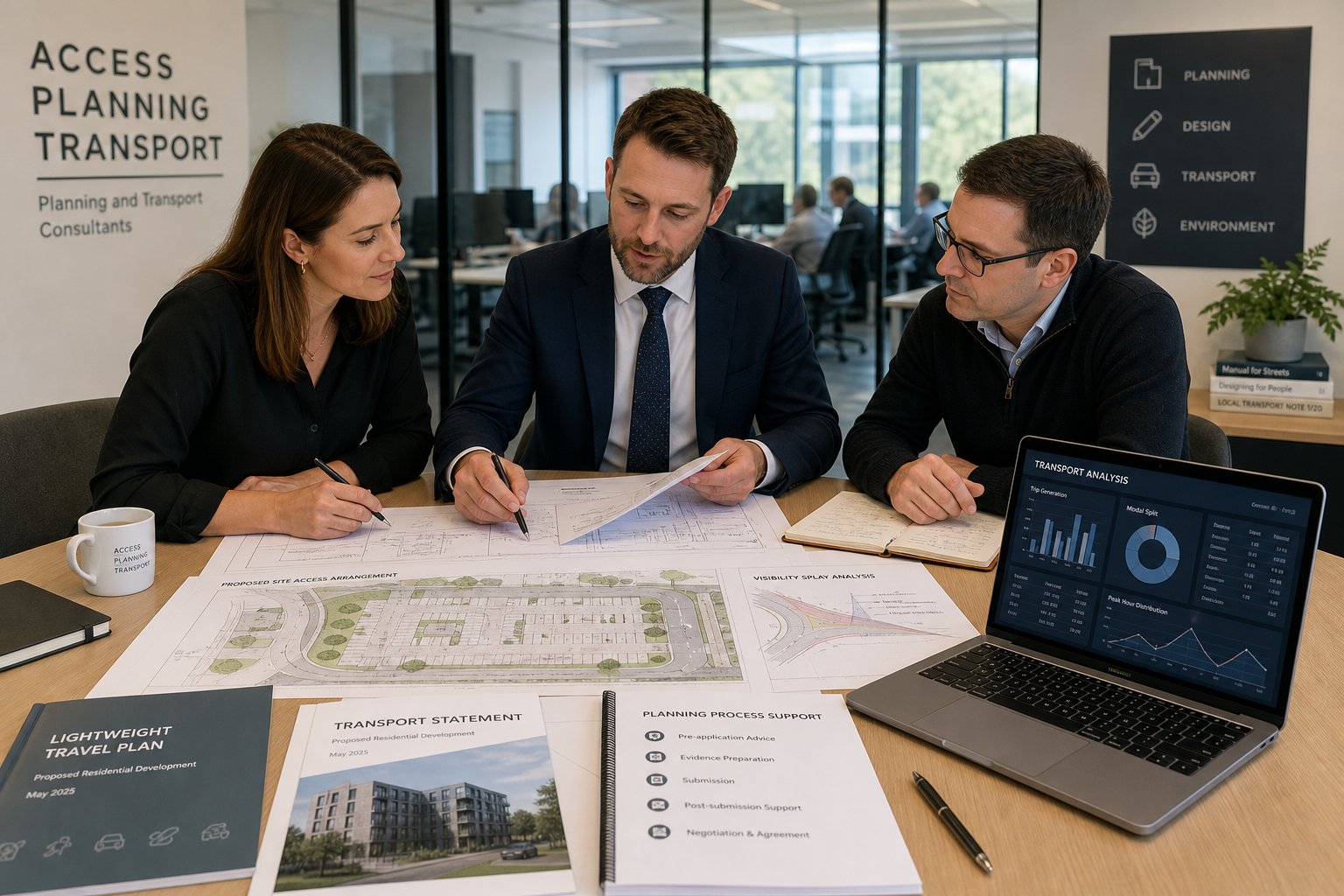
The report itself is only one part of the consultant’s value. Good transport statement consultants support the planning process from early feasibility to post-submission negotiation.
At pre-application stage, we help teams understand whether a TS is likely to be required, what scope is sensible, and which design issues should be resolved before plans are fixed. That can be especially useful for architects and planning consultants working to tight programmes. A short technical note at the right moment can prevent a much longer delay later.
During preparation, we coordinate with the wider design team so the transport evidence matches the submitted scheme. That sounds obvious, but inconsistencies between site layout, access drawings, parking schedules and planning forms are a surprisingly common source of technical queries.
After submission, the consultant often becomes the point of contact for highways comments. We answer officer questions, clarify assumptions, provide supplementary analysis where justified and help negotiate conditions or minor mitigation measures. In some cases, that may mean refining a visibility drawing: in others, it may involve additional parking justification, servicing detail or a lightweight Travel Plan.
For developers and planning teams managing broader technical packages, the input often overlaps with the work of Developer Transport Consultants: who support planning strategy more generally. And where local junction sensitivity is part of the discussion, experience in Traffic Flow Management can strengthen the response.
Key Inputs That Improve Accuracy And Reduce Delays
Most transport delays are not caused by exotic technical problems. They are caused by missing basics.
The quality of a Transport Statement depends heavily on the information the consultant receives at the right time. Accurate floor areas, unit numbers, land-use descriptions and dwelling mix are essential because they affect trip rates, parking demand and servicing assumptions. If those numbers change late in the process, the report may need rewriting.
Access drawings matter just as much. We need a confirmed or near-confirmed layout showing junction geometry, visibility, internal turning, parking spaces, cycle parking and refuse strategy. A TS based on a sketch that later changes materially can undermine confidence in the whole application.
Survey data is another common pinch point. Not every TS needs fresh traffic counts, but where local conditions are sensitive, observed turning patterns, parking stress or speed data may be necessary. Using old or irrelevant evidence is rarely worth the risk.
Early engagement with the highway authority can save weeks. If officers agree the scope up front, there is less room for procedural dispute later. That is particularly helpful where the site sits close to TS/TA thresholds or has unusual operational characteristics.
The best outcomes usually come from concise collaboration: planner, architect, transport consultant and client making sure the scheme description, drawings and technical evidence all tell the same story.
Common Reasons Transport Statements Are Challenged By Councils
Councils do not usually challenge a Transport Statement because it is too short. They challenge it because it feels incomplete, optimistic or disconnected from the scheme.
One frequent issue is underestimated trip generation. If peak periods are chosen selectively, if comparable sites are weak, or if local characteristics are ignored, the highway officer may conclude the report understates impact. That does not always mean the development is unacceptable, only that the evidence is not persuasive enough.
Access problems are another obvious trigger. Sub-standard visibility, awkward manoeuvring, reliance on reversing movements, conflict with pedestrians or insufficient space for service vehicles can all lead to objections. On constrained sites, trying to explain away a poor arrangement without redesign is rarely convincing.
Parking often causes friction too. Some reports simply state compliance with standards without addressing actual demand or local context. Others underprovide or overprovide spaces without policy justification. Either way, councils tend to ask for more explanation.
We also see challenges where the TS ignores collision history, nearby school activity, bus stop accessibility, or the quality of walking and cycling routes. In 2026, sustainable travel is no longer a token paragraph. Authorities expect a realistic appraisal of non-car access, even for modest schemes.
Finally, reports are vulnerable when they are generic. A recycled template may mention the right headings, but if it does not reflect the local street network, policy wording and operational reality of the proposal, officers spot that quickly.
How To Choose A Transport Statement Consultant
Choosing the right consultant is partly about credentials and partly about judgement.
Start with relevant experience. You want a transport planner who regularly works on planning applications of similar scale and complexity, not someone who only really focuses on major infrastructure or, at the other end, produces generic reports with little strategic thought behind them. Chartered status or equivalent professional standing can be a useful signal, but recent comparable work matters more.
Local authority familiarity is another big factor. A consultant who understands how a particular council or county highway team interprets thresholds, parking standards and access expectations can often scope the work more efficiently and avoid predictable pitfalls. That is especially valuable on edge cases where the question is not just what guidance says, but how it is applied in practice.
We would also look at communication style. Can they explain transport issues clearly to non-specialists? Will they challenge a weak access arrangement before submission? Are they responsive when planners, solicitors or architects need quick answers? Technical ability is vital, but planning work is collaborative, and a consultant who cannot communicate tends to create drag.
For many clients, speed matters as well. Fast turnaround is helpful only if the report is still accurate, concise and tailored to the authority. That combination of pace and technical rigour is one reason firms with long practical experience, such as ML Traffic’s planning-focused approach, are often preferred for smaller schemes.
Finally, ask what happens after submission. Some consultants disappear once the PDF is issued. Better ones stay involved, answer queries and help close out conditions or amendments. That support can be the difference between a smooth determination and weeks of avoidable back-and-forth.
Conclusion
A strong Transport Statement does not try to make a scheme look bigger than it is, or smaller than it is. It gives the planning authority a proportionate, credible account of how the development will function and whether any transport concerns can be managed.
That is why choosing the right consultant matters. The best transport statement consultants combine technical accuracy with planning judgement: they understand thresholds, local expectations, access design, trip generation, parking, servicing and sustainable travel, and they know how to present that evidence clearly enough to keep an application moving.
For architects, planners, developers, solicitors and council teams, the real benefit is not just a report. It is fewer surprises, faster responses and a lower risk of avoidable delay on transport grounds. In a planning system that rarely rewards vagueness, proportionate expertise still goes a long way.
Frequently Asked Questions About Transport Statement Consultants
What is the role of a transport statement consultant in planning applications?
A transport statement consultant assesses how a modest-scale development affects local transport, including vehicle, pedestrian, and cycle movements. They prepare a concise Transport Statement to support planning applications, ensuring access, parking, and sustainable travel measures are appropriate.
When is a Transport Statement needed instead of a Transport Assessment?
A Transport Statement is required for small to medium developments with material but lower traffic impacts that do not justify detailed junction modelling. Larger or more traffic-intensive projects typically need a full Transport Assessment with extensive analysis.
How do transport statement consultants help reduce planning delays?
By providing accurate, proportionate transport evidence early, consultants identify potential access, parking, or trip generation issues, advise on mitigation, and coordinate with local authorities to avoid objections or technical queries that can delay approvals.
What key factors do consultants assess before preparing a Transport Statement?
Consultants review local planning policies, existing traffic and safety data, site layout and access options, nearby public transport, walking and cycling links, and parking and servicing arrangements to produce a robust and tailored report.
Why do councils often challenge Transport Statements and how can these issues be avoided?
Challenges usually arise from underestimated trip rates, inadequate access or visibility, non-compliant parking, ignoring road safety, or insufficient sustainable travel considerations. Early engagement with authorities and thorough site-specific analysis help prevent these problems.
What should be considered when choosing a transport statement consultant?
Select experienced, chartered transport planners familiar with local authority practices who can communicate clearly, provide evidence-based advice, manage engagements efficiently, and support the planning process from pre-application to post-submission.