
Planning risk rarely begins on committee day. More often, it starts months earlier, when a site is promoted without testing access properly, when parking is sketched before policy is reviewed, or when a development team assumes transport can be “sorted later”. In our experience, that’s where costs creep in and avoidable objections take shape.
Private sector transport planning sits right in the middle of that risk picture. For developers, landowners and project teams, it is the practical process of proving that a scheme can work on the ground: safely, efficiently and in line with national and local policy. Done well, it can sharpen site layout, improve negotiations with councils and highways officers, and give planning applications a much stronger footing. Done badly, it can delay validation, trigger redesign, or undermine an otherwise good proposal.
In 2026, the bar is not necessarily about producing more paperwork. It is about producing the right level of evidence, at the right time, in a form that local planning authorities can actually rely on. That means proportionate reporting, credible survey data, realistic modelling, and transport strategies tied closely to design, sustainability and deliverability.
Below, we set out what private sector transport planning covers, how schemes are assessed, the reports and evidence that matter most, and how developers can scope a transport strategy that strengthens an application rather than simply reacting to problems late in the process.
What Private Sector Transport Planning Covers

Private sector transport planning is broader than writing a Transport Assessment shortly before submission. At its best, it supports the full development lifecycle: early feasibility, planning strategy, negotiation, detailed design and, sometimes, appeal evidence.
For developers and landowners, the core question is simple: can the proposed development be accessed safely and sustainably without creating unacceptable effects on the surrounding network? Answering that properly involves several technical strands.
Typical work includes site access reviews, visibility assessments, trip generation, junction capacity testing, active travel audits, parking analysis, servicing strategy, refuse and emergency access checks, and construction traffic planning. On larger or more sensitive sites, we may also need network modelling, signal junction review or phased mitigation advice. This is why many teams bring in Developer Transport Consultants: What early, rather than treating transport as a late planning add-on.
There is also a commercial layer. Good transport advice is not just about satisfying policy: it is about protecting site value and avoiding design choices that become expensive to reverse. In practice, private sector transport planning often sits between architecture, planning, civil engineering and viability, translating technical constraints into workable decisions.
Why Transport Planning Matters Early In The Development Process

Early transport input changes outcomes. That sounds obvious, but it is surprising how often transport is still commissioned after the layout is largely fixed. By then, options narrow quickly.
At concept stage, transport planning helps test whether a site can support the proposed quantum and mix of development. A simple access constraint, substandard visibility, a nearby congested junction or a local parking restriction can alter what is realistically deliverable. If we identify those issues early, the team can adapt the layout, adjust unit numbers, rework servicing or phase mitigation before the application hardens.
This is also where proportionate advice matters. Developers do not need every site to be burdened with elaborate modelling. They do need enough analysis to spot show-stoppers and shape a sensible submission route. That balance sits at the heart of Property Development Transport: enough evidence to de-risk the scheme, without wasting time or budget on unnecessary work.
Early involvement also improves coordination. Architects can protect pedestrian routes and vehicle tracking space from the start. Planning consultants can align statements with transport policy. Lawyers can anticipate likely conditions or Section 106 and Section 278 obligations. Put bluntly, early transport planning is usually cheaper than late redesign.
How Private Sector Schemes Are Assessed By Local Planning Authorities
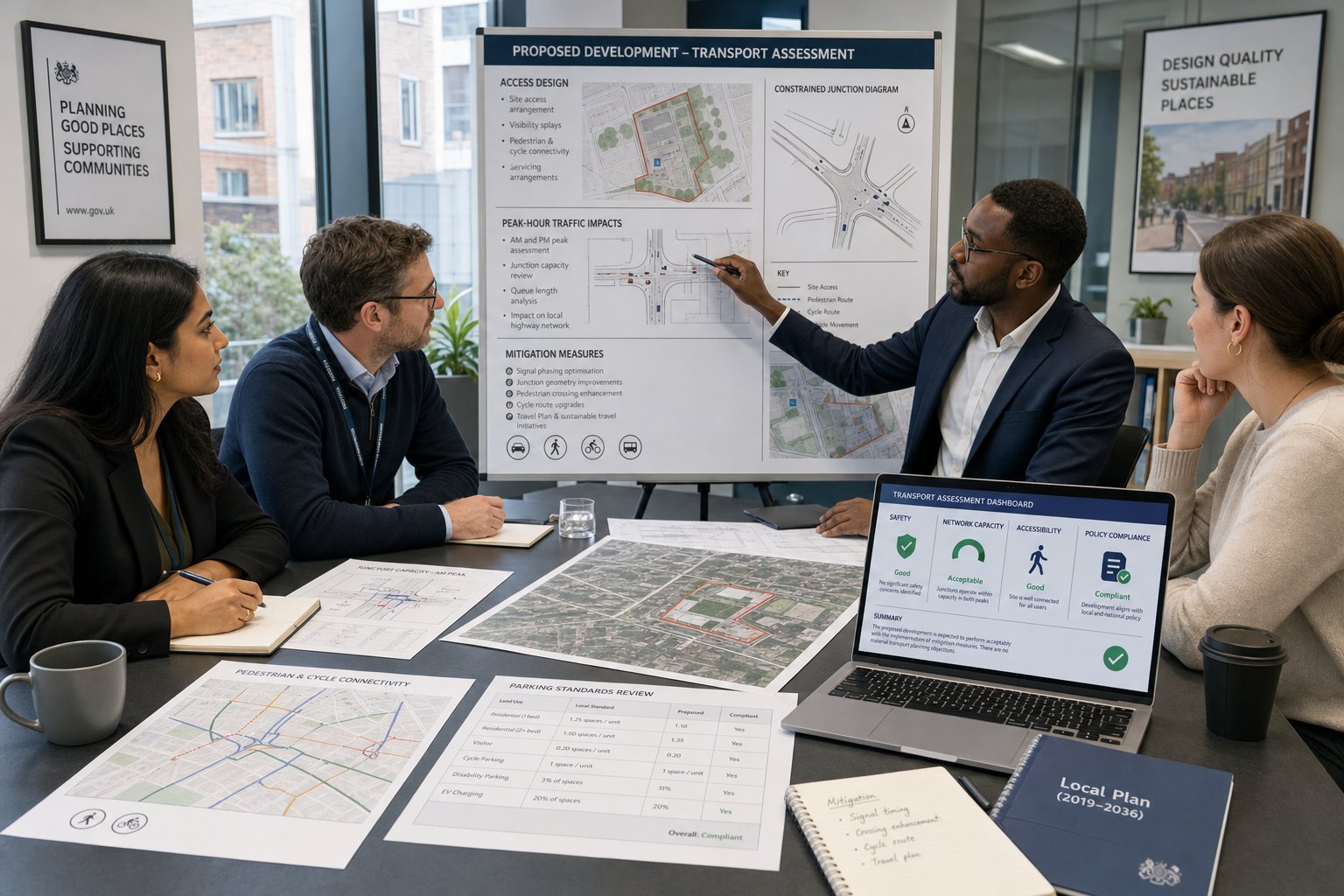
Local planning authorities and highway authorities do not assess transport documents in a vacuum. They are looking at whether the proposal would have a severe residual cumulative impact, whether access is safe, whether the transport strategy aligns with policy, and whether any mitigation is realistic and enforceable.
In practical terms, officers usually focus on four themes.
First, highway safety. That includes access geometry, visibility splays, pedestrian crossings, cycle conflict points, servicing movements and collision history. Second, network operation. They will consider traffic generation, peak-hour effects, junction capacity and whether committed development has been taken into account. Third, accessibility. A scheme that relies entirely on private car use, even though being in a location with realistic walking, cycling or public transport opportunities, may struggle. Fourth, policy compliance: local parking standards, design guides, Local Plan policies, and national guidance all matter.
The level of scrutiny varies by authority and site context. A modest infill residential scheme in a low-sensitivity location may only need a concise statement. A mixed-use or roadside commercial proposal near constrained junctions will face more detailed review. When local context matters, location-specific insight can make a difference, especially in places with distinct authority expectations such as Traffic Engineer In Leeds: or comparable metropolitan areas.
The key point is that authorities expect transport evidence to be proportionate, but also credible. Thin analysis is rarely persuasive.
Core Transport Reports Used In Planning Applications

Most private sector planning submissions rely on one or more core transport reports. The right choice depends on scheme scale, local thresholds, likely impact and policy context. Getting this wrong can create delay before the application is even fully considered.
Transport Assessment
A Transport Assessment, or TA, is the more detailed option. It is normally required for larger developments or sites likely to create material transport effects. A TA looks at existing conditions, forecast trips, trip distribution, junction performance, sustainable travel opportunities, access design and mitigation.
A good TA does more than present numbers. It tells a coherent story about how people and vehicles will reach the site, what the likely impacts are, and why those impacts are acceptable or can be mitigated. That often includes sensitivity testing, committed development review and a clear explanation of assumptions.
Transport Statement
A Transport Statement, or TS, is a lighter-touch report for smaller or lower-impact proposals. But “lighter-touch” should not mean superficial. A TS still needs to explain the site context, access arrangements, likely trip effects and policy position clearly enough for officers to make a sound judgement.
In many cases, the real skill lies in showing why a TS is proportionate and sufficient. Over-assessing can waste cost: under-assessing can invite requests for more work and slow determination.
Travel Plan
A Travel Plan sets out how a development will encourage more sustainable travel and manage reliance on the private car. Depending on the scheme, that can include cycle parking, public transport information, welcome packs, car club provision, EV charging, monitoring arrangements, targets and named responsibility for implementation.
Authorities often scrutinise Travel Plans more closely than applicants expect. Vague promises are not enough. Measures need to be realistic, measurable and tied to the site’s actual location and occupier profile. On some schemes, stronger sustainable measures linked with Net Zero Transport Planning can materially improve the planning case.
The Main Evidence Base Behind A Robust Submission

Robust transport planning stands on evidence, not assumption. If the evidence base is weak, even a well-written report can unravel under review.
Observed traffic surveys are usually the starting point: junction turning counts, queue observations, pedestrian and cycle movements, parking beat surveys, and sometimes automatic traffic counts. Those surveys establish how the network actually operates, not how we think it operates. Timings matter too. Surveying during school holidays, abnormal roadworks or atypical weather can distort the picture.
Trip generation often relies on TRICS or comparable databases, but selecting suitable sites is critical. A suburban warehouse is not a fair comparator for a town-centre mixed-use scheme. Distribution and assignment assumptions also need to be defensible, ideally drawing on local census patterns, existing network logic and observed movements.
Then comes technical testing: junction modelling, safety review, swept path analysis, accessibility audit and policy review. National policy, Local Plans, parking standards, design guides and active travel guidance such as LTN 1/20 should all feed into the assessment. Where cost and deliverability are sensitive, a Commercially Viable Transport approach helps ensure mitigation is not only technically acceptable but realistic to carry out.
In short, a robust submission combines data, engineering judgement and policy awareness. Remove any one of those, and objections become more likely.
Key Development Types And Their Transport Planning Challenges
Different development types create different transport risks, and authorities know it. A report that ignores those distinctions usually feels generic straight away.
Residential schemes often turn on parking pressure, internal layout, refuse tracking, school-run effects and the quality of walking and cycling links. Even relatively small housing sites can draw local concern if on-street parking is already stressed or nearby junctions are sensitive at peak times.
Retail and leisure development brings a different profile: sharper peaks, higher turnover of short-stay trips, parking accumulation, servicing activity and, in some cases, weekend pressure that standard weekday surveys can miss. For drive-throughs, roadside retail or food-led uses, queueing and internal circulation can become central issues.
Employment, industrial and logistics schemes raise questions around HGV routing, delivery windows, staff shift patterns, amenity impact and suitability of the strategic road connection. Councils will often want reassurance that large vehicles can access the site without harming safety or neighbouring residential streets.
Student, healthcare, education and mixed-use schemes each add their own complications, from term-time peaks to ambulance access or multi-peak trip patterns. That is why a one-size-fits-all report rarely works. The strategy must respond to how the site will actually operate, not just what land-use label appears on the application form.
Common Risks That Delay Approval Or Trigger Objections
Most transport objections are not surprises. They usually arise from a short list of recurring problems.
One of the biggest is underestimating trips. If trip rates are obviously optimistic, or if committed development nearby has been ignored, officers and objectors will question the whole assessment. Another common issue is incomplete modelling: testing only one junction, using outdated baseline data, or omitting sensitivity scenarios where congestion is already a live concern.
Access design is another flashpoint. Substandard visibility, awkward turning movements, poor pedestrian priority and unresolved servicing can all prompt highways objections. Parking is similar. Too little parking can trigger overspill concerns: too much can conflict with sustainability policy, especially in accessible urban areas.
Travel Plans also fail more often than they should. If targets are generic, measures are weak, or monitoring responsibility is vague, authorities may treat the plan as window dressing rather than meaningful mitigation.
And then there is timing. Late engagement with the highway authority can undo months of progress. We often find that an agreed Access Strategy Transport framework early on prevents exactly the kind of last-minute redesign that frustrates applicants, consultants and councils alike.
In reality, delay risk comes less from complexity than from unresolved basics.
Design, Access, Parking And Servicing Considerations
Transport planning is not only about external traffic impact. A great deal of planning risk sits within the red line boundary.
Access design needs to work for all users, not just the design vehicle. That means visibility, gradients, junction spacing, pedestrian crossing points, cycle continuity and clear hierarchy between public and private movement. A technically possible access is not always a planning-ready access.
Parking design goes beyond counting spaces. Authorities will look at layout efficiency, disabled provision, EV charging, cycle parking quality, visitor arrangements, turning space and whether parking is likely to function as intended. Poorly designed parking courts or awkward basement ramps can create operational issues long after consent is granted.
Servicing is equally important. Delivery vans, refuse vehicles, fire appliances and, on some schemes, articulated HGVs all need to enter, manoeuvre and leave safely. Swept path analysis often becomes decisive here. A layout that looks tidy on plan can fail once real vehicle movements are tested.
Construction access should not be overlooked either, especially on constrained urban sites. Temporary traffic management, routing, delivery timing and neighbour impact can influence both planning conditions and stakeholder confidence.
This is where transport planning has to mesh closely with architecture and civil design. Small geometric changes early on can remove major objections later.
Working With Highways Authorities, Councils And Project Teams
Transport planning is partly technical and partly diplomatic. The strongest schemes usually have both.
Highways officers want clear evidence, but they also want confidence that the applicant understands local issues and is responding constructively. Early pre-application discussions can help define scope, flag likely concerns and avoid producing a report package that misses the authority’s real priorities. In larger or more complex cases, those discussions may also shape the path towards planning conditions, Section 278 highway works or Section 106 obligations.
Within the project team, coordination matters just as much. Transport advice needs to feed into architectural layouts, drainage constraints, level changes, landscape strategy, refuse arrangements and planning narrative. If those strands drift apart, contradictions appear fast. A Transport Statement that assumes one access point while the drawings show another is the sort of inconsistency that creates unnecessary scrutiny.
For regionally sensitive schemes, teams often benefit from practitioners who understand local authority behaviour as well as technical standards, whether that means insight comparable to a Traffic Engineer In London: context or another authority with exacting review processes.
Our experience is that steady, well-documented engagement tends to outperform last-minute argument. Councils rarely object because a report is concise: they object because it leaves too many unanswered questions.
How To Scope A Proportionate Transport Planning Strategy
A proportionate strategy is the sweet spot: enough technical work to satisfy the authority and de-risk the application, but not so much that the project becomes slow, bloated or commercially unbalanced.
We normally start with five questions. What is the scale and land use of the proposal? How sensitive is the surrounding network? What do local policy and validation requirements say? Are there obvious access, parking or servicing constraints? And which transport issues are most likely to drive officer comments or third-party objection?
From there, scope can be tailored. Some sites need only a concise Transport Statement and a focused Travel Plan. Others need multi-junction modelling, road safety review, parking stress surveys, construction management input and extensive design iteration. The point is not to produce the biggest package: it is to produce the right one.
Pre-application engagement is often worth the effort because it helps agree assumptions on survey extent, assessment years, junctions to model and report type. That reduces the risk of abortive work. For many clients, this is where effective private sector transport planning delivers the biggest value: not merely writing reports, but setting a strategy that aligns planning success, cost control and deliverability.
In 2026, proportionate does not mean minimal. It means targeted, evidence-led and genuinely useful.
Frequently Asked Questions about Private Sector Transport Planning
What is private sector transport planning and why is it important for developers?
Private sector transport planning helps developers demonstrate that a development can be accessed safely, sustainably, and efficiently in line with policies. Early planning reduces risks, improves site layout, and strengthens planning applications, avoiding costly redesigns or objections later.
How does early transport planning influence a development project?
Early transport planning identifies access constraints, potential trip generation, and mitigation needs while designs are flexible. This proactive approach prevents costly late-stage changes, improves coordination with architects and planners, and aligns development with local policy, ultimately saving time and budget.
What key reports are typically required in private sector transport planning?
Developments often need a Transport Assessment for larger sites, a lighter Transport Statement for smaller schemes, and a Travel Plan to promote sustainable travel. These documents provide evidence on trip impacts, access arrangements, and strategies to manage car use consistent with planning authority requirements.
What do local planning authorities assess in transport planning submissions?
Authorities focus on highway safety, traffic impact including junction capacity, accessibility by walking and public transport, and compliance with parking and transport policies. They expect credible, proportionate evidence demonstrating that the development will not cause severe residual impacts.
How can developers avoid common risks that delay transport-related planning approval?
To avoid delays, developers should provide realistic trip estimates including committed developments, carry out thorough junction modelling, design safe access and parking, prepare enforceable Travel Plans, and engage early with highway authorities, preventing last-minute objections and redesigns.
What role do Developer Transport Consultants play in private sector transport planning?
Developer Transport Consultants provide specialist advice throughout development stages, managing transport assessments, negotiations with authorities, and aligning technical constraints with design and viability. Their involvement ensures transport strategies are robust, efficient, and supportive of planning success in 2026.