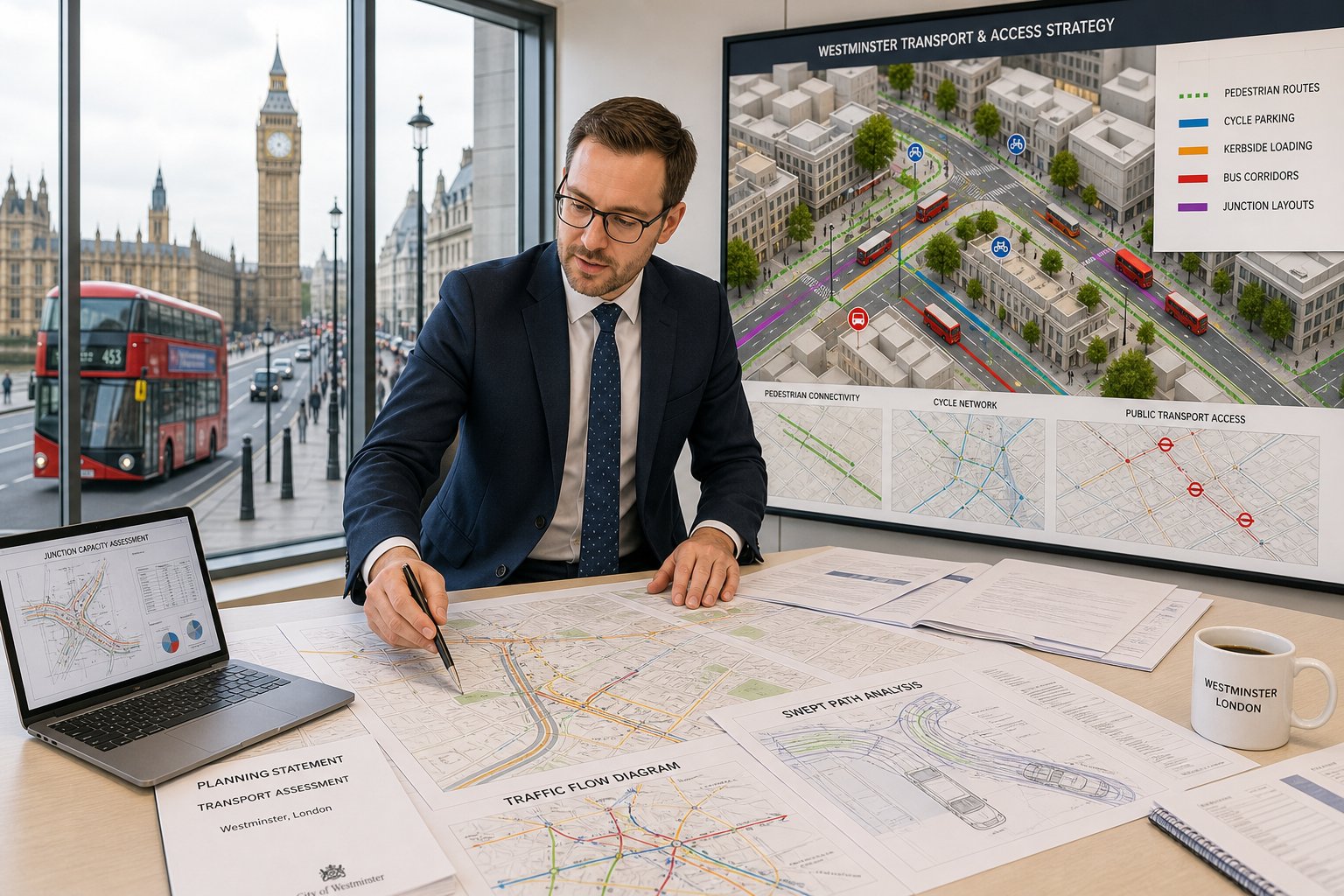
Westminster is one of those boroughs where transport issues can decide the tone of a planning application very early. A scheme might look straightforward on a drawing set, but once questions about servicing, kerbside activity, pedestrian comfort, cycle parking, taxi access, bus operations or junction impact start landing, the room changes. Fast. In central London, and especially in Westminster, there’s rarely much tolerance for generic transport wording or borrowed assumptions from another site.
That’s where a traffic engineer in Westminster becomes central to the planning team rather than an add-on brought in at the end. We help translate development proposals into clear, technical evidence that Westminster City Council, Transport for London and other consultees can actually test. That includes the practical basics, vehicle access, trip generation, delivery activity, visibility, swept paths and highway safety, but also the harder local questions around constrained streets, heritage settings and competing demands on very limited road space.
For architects, planners, lawyers, surveyors and developers, the real value is not just producing a report. It’s producing the right report, at the right depth, with evidence that reflects the site as it really operates. In Westminster, that often makes the difference between a smooth review and a long series of avoidable objections. The sections below set out what a traffic engineer in Westminster does, when input is needed, which reports are usually required, and how robust local evidence helps secure better, faster planning outcomes.
Key Takeaways
- A traffic engineer in Westminster is essential for transforming development proposals into detailed transport evidence, aligning with local policies and addressing specific site challenges.
- Westminster’s unique transport conditions require a site-specific transport strategy that considers local street functions, heritage constraints, and competing demands on limited road space.
- Transport reports in Westminster range from concise Transport Statements for smaller projects to comprehensive Transport Assessments for larger developments, often including Travel Plans, Delivery and Servicing Plans, and Construction Logistics Plans.
- Early involvement of a traffic engineer can identify and manage complex issues such as servicing, pedestrian movement, cycling access, and kerbside pressures before they impact planning outcomes.
- Successful Westminster traffic engineers combine technical skill, local knowledge, clear communication, and practical solutions to ensure planning submissions meet the stringent demands of local authorities and Transport for London.
What A Traffic Engineer In Westminster Does For Planning Applications

A traffic engineer in Westminster provides the transport evidence that allows a planning proposal to be understood in operational terms, not just architectural ones. We assess how people, goods and vehicles will reach, use and move around a site, and whether that pattern of movement is acceptable in policy, safety and capacity terms.
In practice, that means reviewing access arrangements, parking provision, cycle parking, servicing strategy, refuse collection, taxi activity, blue badge needs, pedestrian routes and likely trip demand. We then explain how the proposal aligns with Westminster City Council policy, the London Plan and, where relevant, TfL expectations on the Transport for London Road Network or other sensitive corridors.
For smaller schemes, the work may be concise and targeted. For larger or more sensitive sites, it can involve traffic surveys, junction modelling, swept path analysis, collision review and negotiation with multiple stakeholders. Either way, the role is part technical author, part problem-solver. We are there to identify issues before the local authority does, and to show how those issues can be managed credibly.
That broader advisory role is why planning teams often involve Traffic Engineering Consultants: What early rather than waiting for validation comments. And on schemes that sit within wider London movement patterns, lessons from Traffic Engineer In London: work are often directly relevant to Westminster’s demands.
Good transport input does more than answer objections. It shapes the scheme so that the application starts from a position of realism.
Why Westminster Requires A Site-Specific Transport Strategy
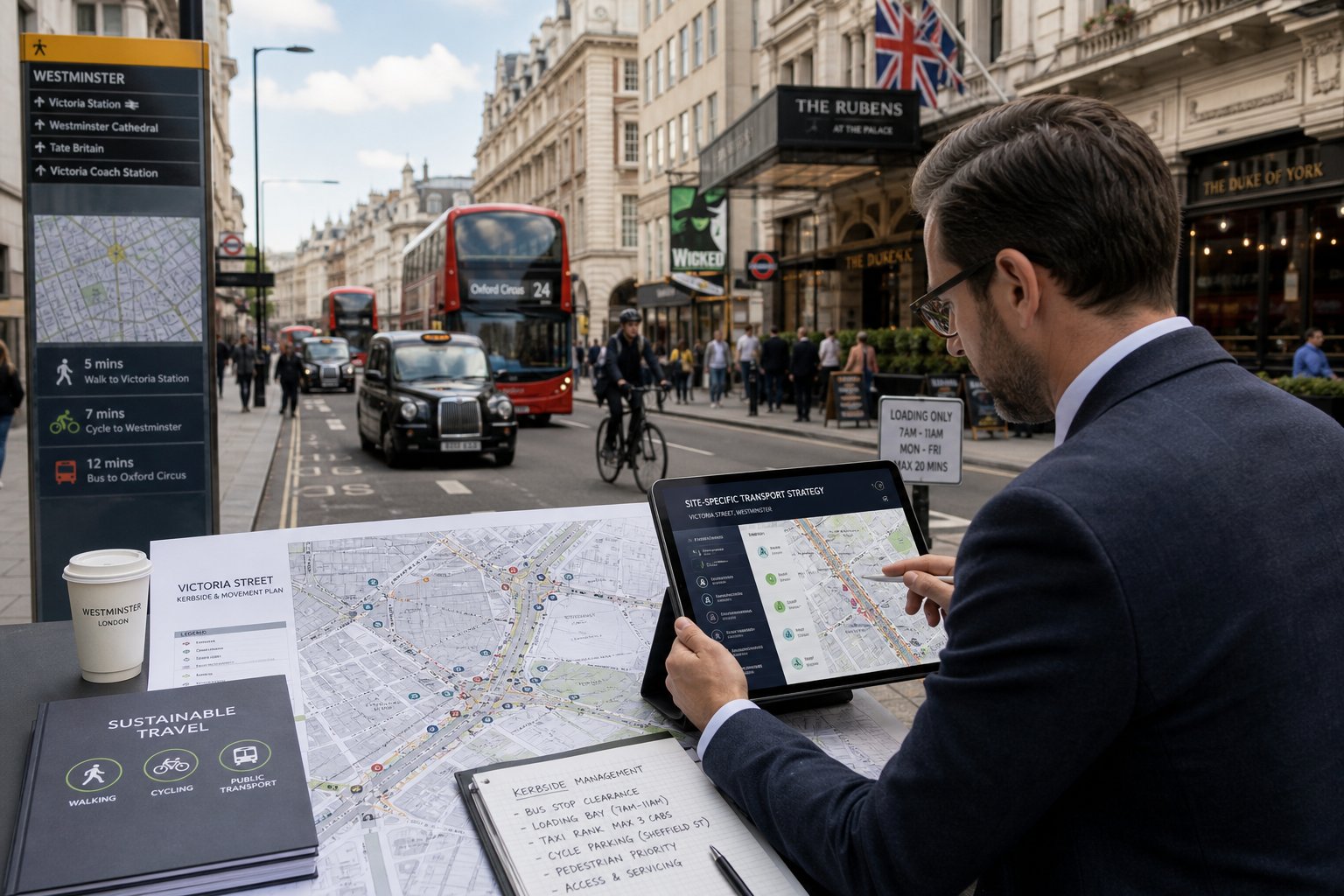
Westminster is not a borough where a standard transport chapter can be dropped into a planning statement and expected to do the job. Conditions change block by block. A site near Oxford Street, Victoria, Paddington, Soho, Marylebone or Pimlico may sit within the same authority, but the transport constraints can be completely different.
Public Transport Accessibility Levels are often high, which usually supports lower car parking provision and stronger sustainable travel assumptions. But high PTAL does not automatically solve servicing, taxi demand, pedestrian crowding or construction routing. In fact, dense public transport networks often sit alongside severe kerbside pressure and heavily contested footway space. That tension is one reason Westminster expects proposals to be tailored to actual local conditions.
Heritage and townscape constraints matter too. Many streets cannot simply absorb geometric changes, widened access points or visible highway interventions without wider design consequences. Add residents, hotels, theatres, offices, restaurants, embassies and tourist activity into the same street network and you get an environment where transport strategy has to be precise.
A site-specific approach typically addresses existing street function, neighbouring land uses, delivery patterns, restrictions on waiting and loading, nearby crossings, cycle routes, bus stops, station access and relationships with adjoining boroughs. It also has to show that any residual impact would not be severe.
That’s why broader principles from Traffic Engineering and Transportation are useful, but Westminster applications need local calibration. The strategy has to fit the street outside the door, not an abstract model of urban development.
Key Planning And Highway Reports Often Needed In Westminster

The right report depends on scale, use, sensitivity and highway context. Westminster schemes often need more transport justification than applicants first expect, especially where access, servicing or cumulative movement impacts are under scrutiny.
Transport Statement
A Transport Statement is usually suitable for smaller developments or proposals with relatively limited transport effects. That does not mean it is lightweight. In Westminster, even modest schemes can trigger detailed questions if they alter servicing patterns, remove parking, intensify use or sit on constrained streets.
A strong Transport Statement summarises existing conditions, reviews local policy, sets out trip generation, explains access and servicing arrangements, and identifies mitigation where needed. It should also show that the applicant understands how the street currently functions. If loading activity already saturates the kerb, saying impacts are “minimal” without evidence rarely goes down well.
For many change-of-use, infill, retrofit or smaller commercial schemes, a concise but well-argued statement is enough to de-risk the application. That is particularly true when the transport team has checked likely consultee concerns before drafting begins.
Transport Assessment
A Transport Assessment is normally required for larger, more complex or more sensitive proposals. In Westminster that can include substantial office intensification, hotels, student accommodation, build-to-rent, mixed-use redevelopment, or schemes affecting strategic routes, bus corridors or important junctions.
The Assessment goes beyond summary-level reporting. We would usually examine person trips, vehicle trips, servicing demand, mode share, accessibility, road safety, local network operation and cumulative effects. Depending on the site, junction modelling using tools such as ARCADY, PICADY, LinSig, Synchro or VISSIM may be needed to test whether nearby nodes can accommodate forecast movements.
This is also where professional judgement matters. The biggest report is not always the best one. The aim is to provide enough evidence to answer the planning question properly, without burying the authority under unnecessary material.
On more commercially driven schemes, the issues often overlap with Commercial Traffic Engineering, particularly where loading profiles and occupancy assumptions drive the transport outcome.
Travel Plan, Delivery And Servicing, And Construction Logistics
In Westminster, supporting documents are often just as important as the main TS or TA. A Travel Plan explains how the development will reduce reliance on private car travel and support walking, cycling and public transport. For office, residential, education and hotel schemes, it helps convert broad sustainability claims into measures, monitoring and accountability.
A Delivery and Servicing Plan is frequently critical. Many Westminster streets simply do not have spare kerb capacity for unmanaged deliveries. A DSP sets out vehicle types, booking systems, loading locations, frequency, hours of operation and management responsibilities. If a site depends on on-street activity, this document can make or break confidence in the proposal.
A Construction Logistics Plan is also common in central London, especially where TfL is involved or where nearby streets are already under pressure. The CLP deals with routing, timing, vehicle management, contractor controls and impacts on vulnerable road users.
Where access geometry is tight, principles from access design highway work become particularly relevant, because the credibility of servicing strategy often depends on whether vehicles can actually enter, turn and leave safely.
When A Westminster Development Is Likely To Need Traffic Input

Some Westminster applications obviously need transport input from day one. Others look simple until one design move creates a highway issue. In our experience, early traffic input is usually warranted where the proposal changes access, increases intensity, affects servicing, relies on car-free credentials, or sits on a street with existing operational stress.
Major development is the clearest case. Larger residential, office, hotel, student and mixed-use schemes nearly always need a TS or TA, and often a Travel Plan plus servicing and construction documents. But smaller schemes can also need support where they alter basement servicing, create a new crossover, remove a loading opportunity, intensify a hospitality use, or introduce a land use with peaky arrival patterns.
Sites on A-roads, bus corridors, one-way systems or constrained side streets are especially sensitive. So are proposals near schools, rail stations, major attractions or hospitals, where pedestrian and kerbside interactions can dominate the planning discussion. Westminster’s dense network means even a relatively modest uplift in delivery activity or pick-up/drop-off demand can have a disproportionate effect.
We also advise transport input where neighbouring borough interfaces matter. A site close to Camden, Kensington and Chelsea, Brent or the City can trigger cross-boundary movement concerns, particularly for construction routes and displaced servicing.
If there is any doubt, early scoping is usually cheaper than late redesign. That is a consistent lesson across both Westminster and other cities, although the local thresholds and pressure points differ from places covered in Traffic Engineer In Manchester:. Westminster is simply less forgiving of assumptions left untested.
How Traffic Surveys And Local Highway Data Inform The Evidence Base

Transport reports are only as persuasive as the evidence underneath them. In Westminster, baseline conditions are too variable to rely on generic trip assumptions alone. We need to understand what is happening on the street, when it is happening, and how the proposed development interacts with that pattern.
Typical survey work may include classified turning counts, automatic traffic counts, queue and delay surveys, pedestrian and cycle counts, parking beat surveys, loading beat surveys and servicing observations. For some sites, we also collect taxi activity, ride-hailing pick-up/drop-off patterns, refuse operations and hotel coach movements. Timing matters. A weekday interpeak survey can tell a very different story from an AM peak, evening economy period or Saturday trading window.
Collision data adds another dimension. It helps test whether existing access arrangements already present safety concerns and whether a new movement pattern could worsen them. Equally, local highway records, traffic orders, waiting and loading restrictions, bus stop clearways and signal data often reveal constraints that are not obvious on a site visit.
This evidence base then feeds the technical narrative: trip generation, accessibility analysis, servicing strategy, swept paths, modelling assumptions and mitigation design. It allows us to defend conclusions with specifics rather than broad claims.
That discipline sits at the heart of good Highway And Traffic Engineering practice. It is also one reason concise reports can still be robust, provided the local data is properly targeted and interpreted.
Common Transport And Access Issues In Westminster
Westminster applications tend to revolve around a familiar set of transport pressure points, but each site combines them differently. The challenge is rarely just traffic volume. More often, it is competition for finite street space, mixed travel demands, operational timing and the need to protect safety and movement quality in a very constrained environment.
Servicing, Kerbside Pressure, And Loading Constraints
Kerbside management is one of the biggest recurring issues in Westminster. Offices need courier activity, hotels need linen and food deliveries, restaurants need frequent servicing, residential schemes need removals and online shopping, and all of them need refuse collection. The kerb, meanwhile, is also serving residents, blue badge users, taxis, buses, cyclists, utility works and general traffic regulation.
That is why servicing strategy has to be practical. We test whether deliveries can occur on-street within available restrictions, whether a shared bay is realistic, whether off-street servicing is physically achievable, and whether timed booking systems or consolidation measures are needed. Swept path analysis, dwell time assumptions and visibility checks all matter here.
Sometimes the answer is not to create more infrastructure but to manage demand better: fewer larger deliveries, stricter servicing windows, dedicated on-site staff control, or refuse arrangements outside peak pedestrian periods. What councils and consultees want is confidence that the proposal will function in real life, not just in a drawing note.
Pedestrian Movement, Cycling, And Public Transport Accessibility
Westminster is fundamentally a people-movement environment. On many sites, the key question is less about extra vehicles and more about whether the scheme protects walking routes, crossings, footway comfort, cycle access and public transport integration.
We typically assess footway width, desire lines, station access, step-free routes, crossing opportunities, cycle parking quality and links to nearby cycle infrastructure. Public Transport Accessibility Level is relevant, but it should not be treated as the whole story. A station may be close, yet the walking route may be congested, indirect or difficult for people with impaired mobility.
Cycle parking also attracts close attention. Quantity matters, but so do location, security, access gradients and whether users can reach the highway safely. For larger schemes, we may need to consider interactions with bus stops, bus lanes or strategic cycle corridors.
These are not secondary issues. In Westminster, a scheme that gets active travel and public realm movement wrong can struggle just as much as one with poor vehicle access. Sound Traffic Engineering: Your advice looks at the whole movement picture, not only the carriageway.
Choosing The Right Traffic Engineer For Westminster Projects
Not every transport consultant is the right fit for a Westminster application. The technical basics matter, of course, but so does local judgement. We would always look for a team that understands how Westminster officers, TfL reviewers and multidisciplinary design teams actually work in practice.
First, experience in central London is valuable because policy compliance on paper is only one part of the job. The consultant also needs to recognise recurring local issues early: constrained servicing, resident sensitivity to access changes, bus corridor protection, heritage context, blue badge expectations, cycle parking scrutiny and the politics of kerbside reallocation.
Second, the engineer should be capable across both strategy and detail. That means writing a clear TS or TA, but also being comfortable with surveys, tracking, junction modelling, access geometry and mitigation testing. If a proposal needs ARCADY, PICADY, Synchro or VISSIM inputs, the consultant should be able to explain the findings in plain language rather than dropping software outputs into an appendix and hoping for the best.
Third, communication is underrated. A strong transport consultant can speak credibly with planners, architects, lawyers, project managers and highway officers without turning every issue into a technical standoff. That often shortens the path to agreement.
For many applicants, speed matters as well. A responsive team with established workflows can produce concise, accurate reports quickly, which is one reason practice-based experience from firms such as ML Traffic is useful on time-sensitive submissions. The broader perspective covered in Traffic Engineer In London work and in Traffic Engineering and planning support is helpful, but Westminster still rewards consultants who know the local street realities, not just the theory.
A good test is simple: can the engineer tell you, early and plainly, what the authority is most likely to challenge, and how to deal with it before submission?
Conclusion
In Westminster, transport input is rarely a box-ticking exercise. It is part of how a planning team proves that a development can operate safely, efficiently and in line with policy on one of the most constrained street networks in the country.
A capable traffic engineer in Westminster brings together local evidence, practical design judgement and clear reporting to address the issues that authorities actually care about: access, servicing, pedestrian movement, cycling, public transport, safety and cumulative impact. That may involve a focused Transport Statement, a detailed Transport Assessment, or supporting plans for travel, deliveries and construction.
The common thread is site specificity. When the transport case reflects the real conditions on the ground, not a generic template, planning discussions tend to become more productive, and approvals far less uncertain. For architects, developers, planners and legal teams, that is usually the difference between a report that merely exists and one that genuinely moves the application forward.
Frequently Asked Questions About Traffic Engineering in Westminster
What role does a traffic engineer in Westminster play in planning applications?
A traffic engineer in Westminster provides detailed transport evidence addressing access, trip generation, servicing, parking, and safety to ensure proposals comply with Westminster City Council and Transport for London policies, facilitating smoother planning approvals.
Why is a site-specific transport strategy essential for developments in Westminster?
Westminster’s unique challenges like high public transport accessibility, heritage constraints, kerbside pressure, and varying local conditions mean that generic transport approaches are insufficient. Every scheme must reflect actual street operations to minimize severe traffic or safety impacts.
When is traffic engineering input typically required for developments in Westminster?
Traffic input is usually needed for major developments, changes in vehicle access or servicing, intensifications of use, car-free proposals, or sites located on busy A-roads, bus corridors, or constrained streets to address potential operational and safety concerns early on.
What are the common transport and access issues faced in Westminster?
Key issues include limited kerbside space for servicing, resident parking controls, blue badge and taxi access, narrow street servicing challenges, protecting cycle routes, maintaining bus operations, and managing impacts on signalised junctions in a dense urban environment.
How do traffic surveys contribute to effective transport planning in Westminster?
Surveys like turning counts, parking and loading beats, pedestrian flows, and collision data provide essential local evidence about street use and safety, enabling traffic engineers to produce robust transport statements or assessments adapted to Westminster’s specific conditions.
What should I consider when choosing a traffic engineer for a Westminster project?
Select engineers with proven Westminster or central London experience, familiarity with local policies, proficiency in junction modelling software (e.g. Synchro, ARCADY), excellent report writing and stakeholder communication skills to navigate local authority requirements efficiently.