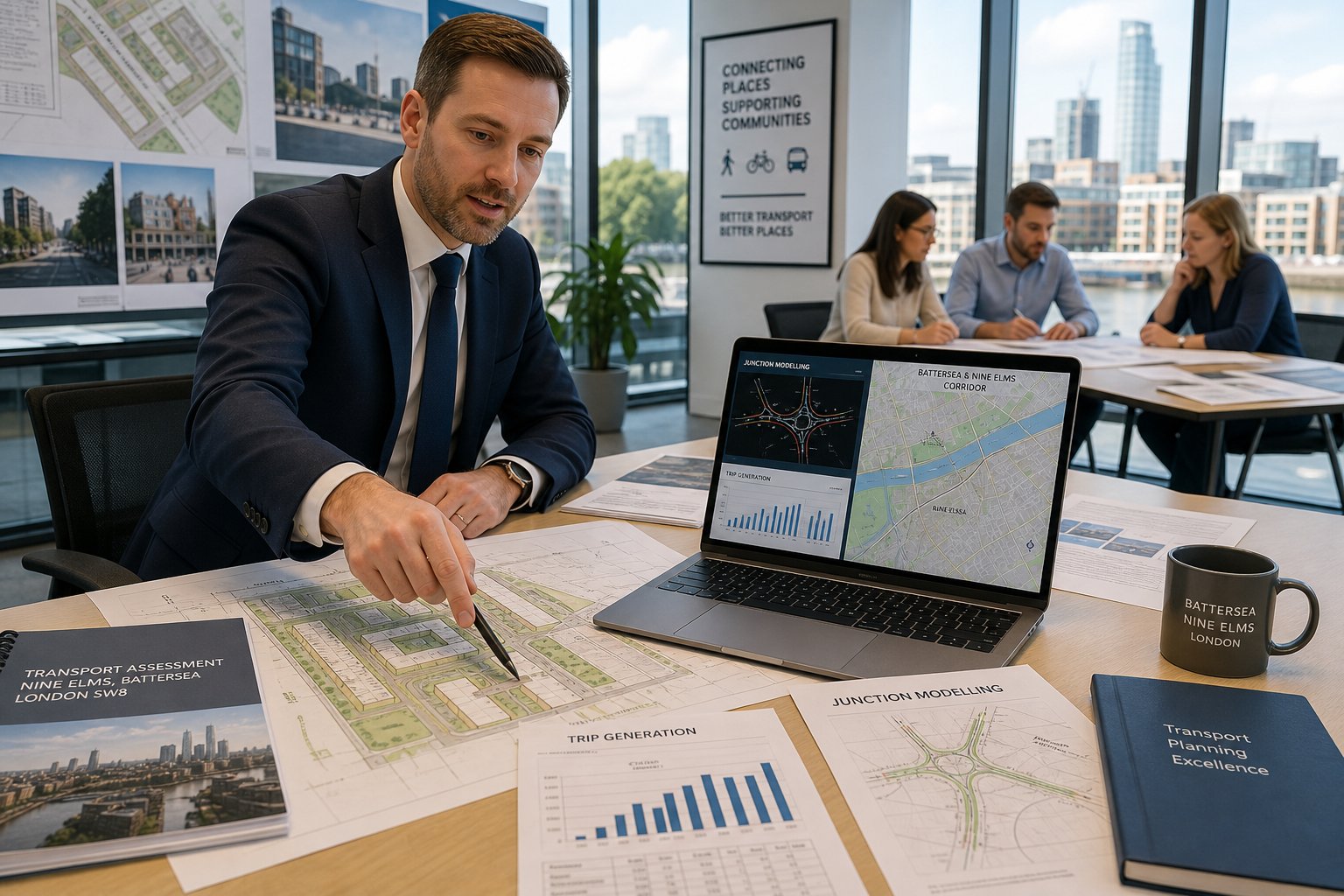
Battersea looks straightforward on a location plan. Then the transport questions start. A scheme may sit close to strong public transport, but that rarely means transport can be left to the end. In this part of London, a small change in access, servicing or parking can trigger bigger planning issues than many project teams expect.
That is why a Traffic Engineer in Battersea often becomes central to the planning process early on, not just when a report is needed for submission. For architects, planners, developers, lawyers and surveyors, the transport case has to do more than fill a validation requirement. It has to show that a proposal can operate safely, fit local policy, and avoid unacceptable impacts on nearby junctions, bus movement, walking routes, cycle access and servicing arrangements.
Battersea is also unusually sensitive because it sits within a fast-changing corridor shaped by Nine Elms growth, strategic movement patterns, dense residential development and high policy expectations around sustainable travel. Wandsworth Council and Transport for London will usually want clear evidence, not assumptions.
In our experience, the schemes that move more smoothly are the ones where transport advice starts while layouts are still flexible. That gives the design team room to solve issues properly rather than defend weak positions later. The sections below explain where traffic engineering fits, what reports are typically needed, and how to approach a Battersea application with fewer surprises.
Key Takeaways
- Engaging a Traffic Engineer in Battersea early in the design process helps address complex local transport challenges and avoids costly planning delays.
- Traffic engineering in Battersea must consider local policy priorities like sustainable travel, Healthy Streets principles, and junction capacity to ensure proposals operate safely and efficiently.
- Transport reports such as Transport Statements, Transport Assessments, and Travel Plans are tailored based on scheme scale, location, and network sensitivity, not just size.
- Effective traffic engineering involves evaluating practical operation aspects including access geometry, servicing, parking, and cycle provision to create realistic, submission-ready evidence.
- Close collaboration with Wandsworth Council, TfL, and other stakeholders is critical for navigating local transport requirements and securing planning approval.
- Selecting a Traffic Engineer with specific Battersea experience ensures transport advice is locally relevant, technically robust, and supports smooth planning outcomes.
Why Traffic Engineering Matters For Battersea Developments
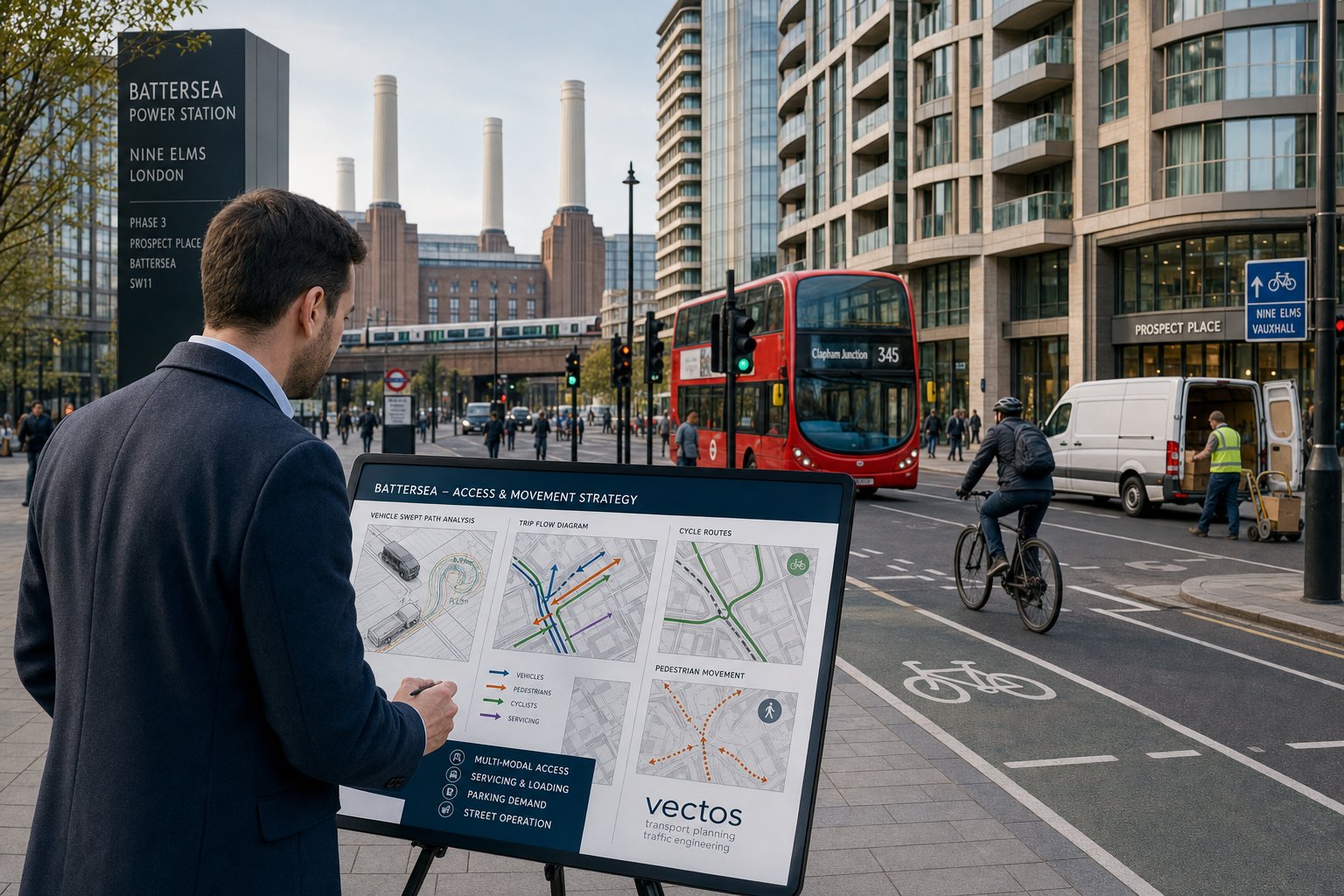
Battersea is not a place where transport can be treated as an afterthought. The area combines dense residential streets, strategic movement routes, rail corridors, bus-heavy roads and major regeneration pressure. Around Battersea Power Station and the wider Nine Elms corridor, development intensity has risen sharply, which means local decisions about access and trip impacts are examined closely.
For planning applications, traffic engineering matters because the margin for error is small. A scheme that underestimates vehicle arrivals, ignores delivery patterns or assumes unrealistic parking demand can quickly run into objections. Those objections may come from highway officers, TfL, neighbours, or sometimes from a planning case officer who simply isn’t convinced the transport story hangs together.
In practice, we use transport input to test whether the development is credible in operational terms. That includes trip generation, trip distribution, access geometry, refuse collection, loading activity, cycle provision and pedestrian movement. It also means asking awkward questions early. Can a van actually turn on site? Will pick-up activity spill onto a bus route? Is the proposed access point too close to a stressed junction? Better to find that out in week two than after submission.
For broader context on how local authority expectations shape transport work, our piece on Traffic Engineer In London: reflects the same principle: the technical case needs to be local, proportionate and defensible.
Done properly, traffic engineering protects design quality as much as planning prospects. It helps the team submit something that can actually function on the street, not just on a drawing.
Battersea Planning And Transport Context At A Glance
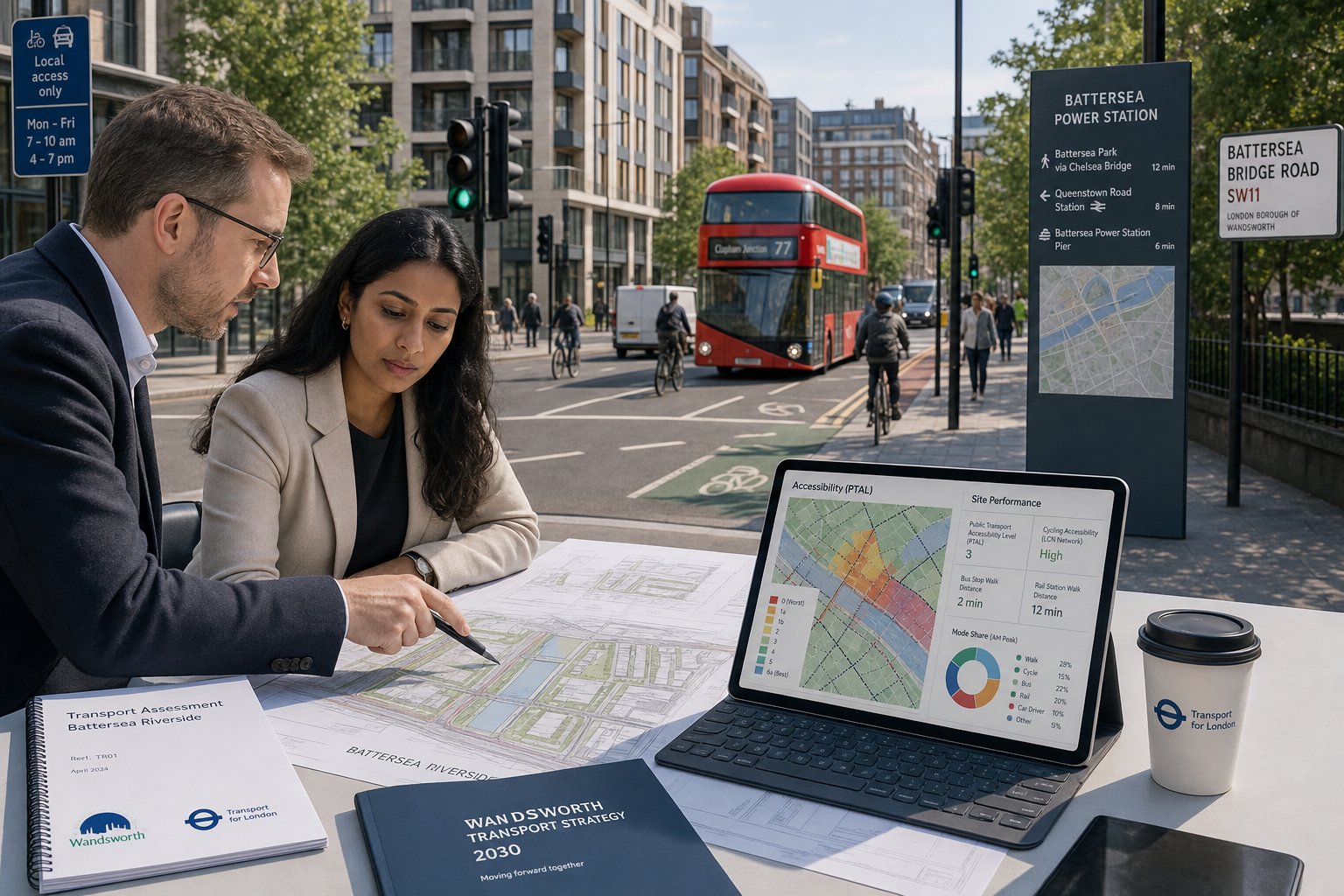
Battersea sits within the London Borough of Wandsworth, but the transport context is layered. Local roads, controlled parking, junction design, public realm priorities and planning policy are shaped by Wandsworth Council. At the same time, TfL has a major role where proposals interact with strategic roads, bus operations, cycle corridors and London-wide transport policy.
That combination matters. A development may be acceptable in pure land-use terms yet still face transport concerns if it conflicts with policy expectations on mode share, servicing or safety. PTAL ratings, the London Plan, the Wandsworth Local Plan and area-specific regeneration frameworks all feed into the assessment. In Battersea, transport policy is not simply about whether a road can carry more traffic. It is also about reducing unnecessary car use, supporting active travel and protecting network performance.
For that reason, our analysis usually starts with policy and place together: what the site is, where it sits in the network, and what the authority is likely to focus on.
Key Constraints That Shape Local Transport Advice
Several recurring constraints shape transport advice in Battersea.
First, highway space is limited. Even where a carriageway looks generous on plan, kerbside demand may already be intense because of parking controls, deliveries, bus stops, crossing points and cycle movement.
Second, congestion and delay at local junctions can become decisive. Nearby impacts often matter more than headline traffic growth.
Third, policy expectations are high. Healthy Streets, Vision Zero, air quality objectives and cycle-friendly design are not optional extras. They influence access design, visibility, servicing, footway treatment and public realm response.
And fourth, there are practical constraints that catch teams out: loading bans, narrow side streets, estate road controls, bus route sensitivity and neighbouring schemes competing for kerb space. Our wider guide to Traffic Engineering and Transportation covers the same principle from a development-planning angle: local context changes the right technical answer.
What A Traffic Engineer In Battersea Actually Does
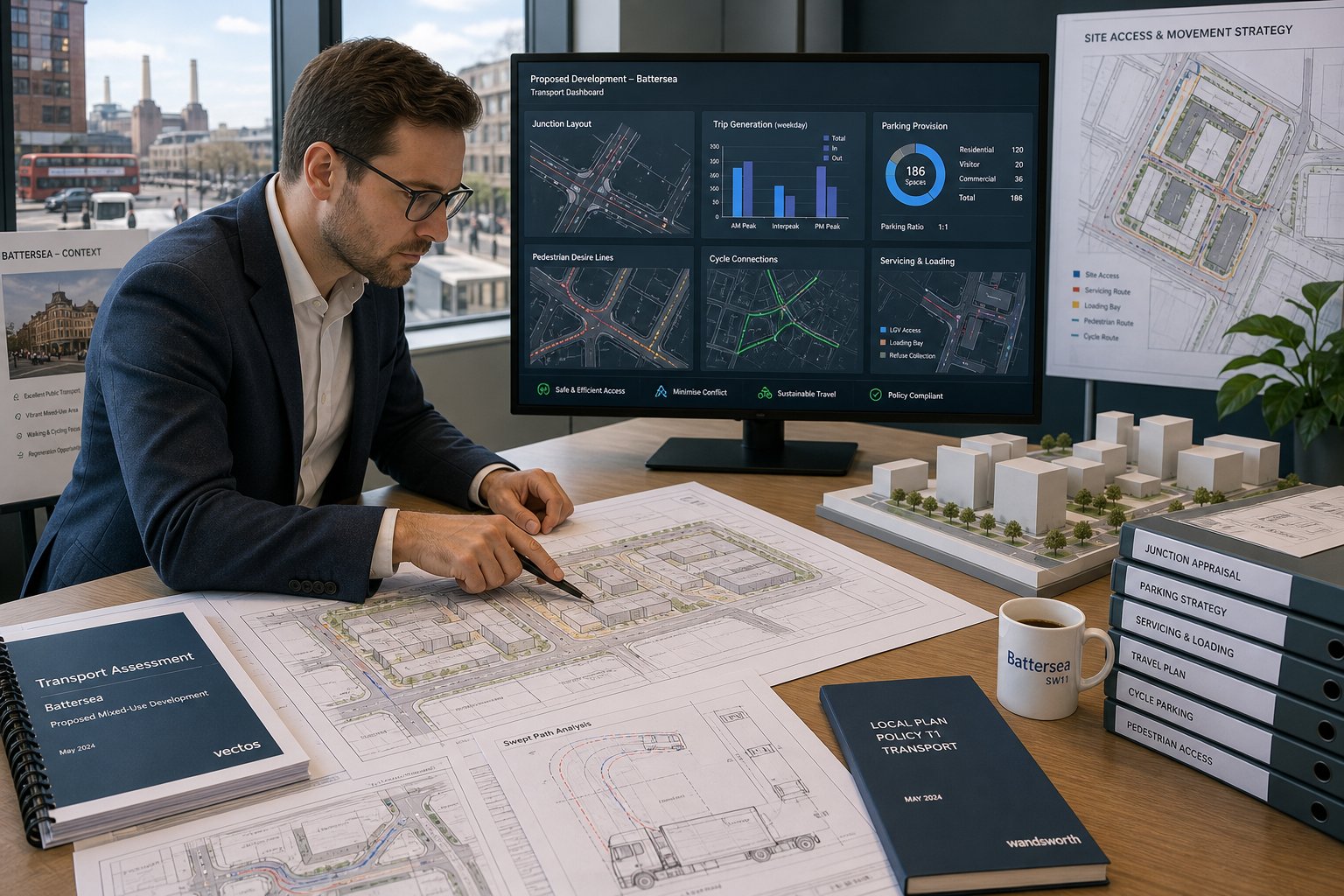
A traffic engineer in Battersea does far more than produce a report at the end of the process. We help shape whether a proposal will stand up technically before it reaches that stage.
At the early design phase, we review the site in transport terms: existing access arrangements, nearby junctions, parking stress, servicing constraints, pedestrian routes, cycle connections and policy sensitivity. That often leads to immediate design advice. A doorway may need to move. A loading space may need to come on site. A basement ramp might work geometrically but create unacceptable vehicle conflict at street level.
We then assess likely demand. That includes forecasting trip generation, identifying how journeys are likely to be distributed across the network, and deciding whether junction modelling is needed. Depending on the site, we may use industry tools and survey data to test likely impacts in a way officers can rely on.
Just as importantly, we look at operation rather than only numbers. Can deliveries be managed without blocking the street? Can refuse vehicles access the site safely? Will car and cycle movements conflict? Are drop-off patterns likely to create informal stopping nearby?
Formal outputs may include a Transport Statement, Transport Assessment, Travel Plan, junction capacity testing, swept-path analysis, construction-related advice, parking review and mitigation proposals. For teams comparing broader support roles, our article on Traffic Engineering Consultants: What explains where strategic advice ends and detailed planning evidence begins.
In short, the job is to translate a design proposal into transport evidence that is practical, policy-aware and submission-ready.
Transport Statements, Transport Assessments, And Travel Plans Explained
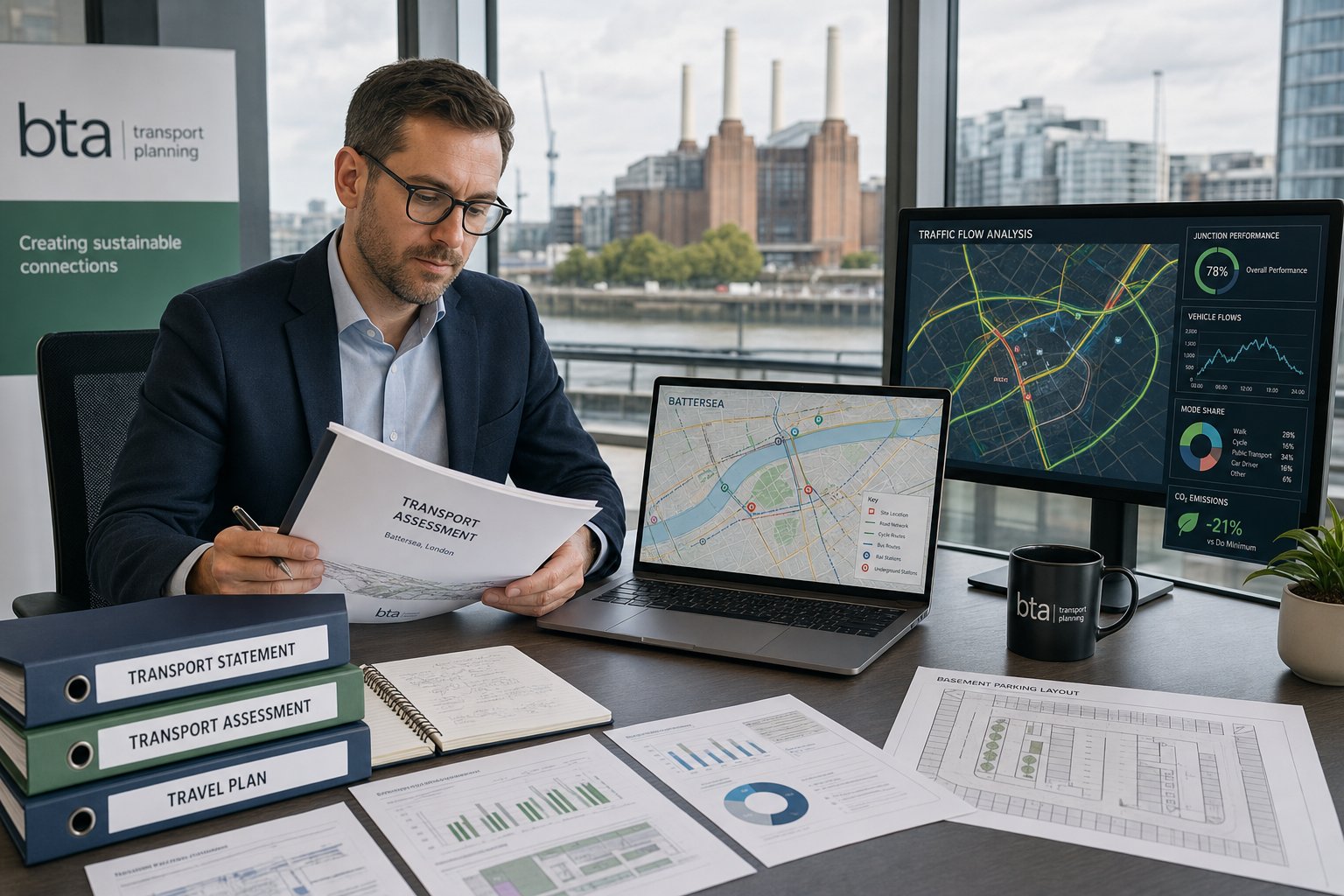
These three documents are often grouped together, but they do different jobs.
A Transport Statement is usually the lighter-touch option. It explains the site context, existing transport conditions, the likely trip impact of the proposal and whether any local transport issues arise. It is typically used for smaller or lower-impact schemes where a concise evidence base is enough.
A Transport Assessment goes further. It is the fuller technical case for schemes with more material transport effects. That may include detailed trip generation analysis, committed development review, distribution and assignment, capacity modelling, collision review, parking analysis, servicing strategy and mitigation. In Battersea, a TA is often needed not only for larger schemes but also for sites in sensitive locations where the network is already under pressure.
A Travel Plan is different again. It focuses on behaviour and management. The purpose is to encourage sustainable travel through measures such as cycle facilities, travel information, welcome packs, monitoring, targets, management responsibilities and review mechanisms.
The right document mix depends on scale, use, location and policy context. For employment, retail and mixed-use proposals, the transport package often needs careful scoping. That is especially true where deliveries, visitors and peak-hour movement interact.
Our overview of Commercial Traffic Engineering explores how this plays out on business-led schemes, where servicing and mode share assumptions can become the critical planning issue.
When Each Report Type Is Usually Required
There is no single national threshold that answers every Battersea case. Wandsworth and TfL will look at scale, use class, local sensitivity and likely network effect.
Broadly, a Transport Statement is commonly suitable for modest residential schemes, smaller commercial changes and lower-impact developments where trip generation is limited and there is no serious concern around access or servicing.
A Transport Assessment is more likely where schemes are larger, mixed-use, close to busy junctions, connected to strategic roads, or expected to generate notable peak-hour trips. Major residential developments, student accommodation, supermarkets, hotels, schools and substantial office proposals often fall into this category.
A Travel Plan is frequently requested alongside a TA for developments where active travel and public transport mode share need to be demonstrated and then managed over time. In London, that is common.
The key point is this: report type should reflect likely planning risk, not just floorspace. An apparently modest scheme can still require detailed transport evidence if the location is constrained or the operation is awkward.
Common Battersea Projects That Need Traffic Input
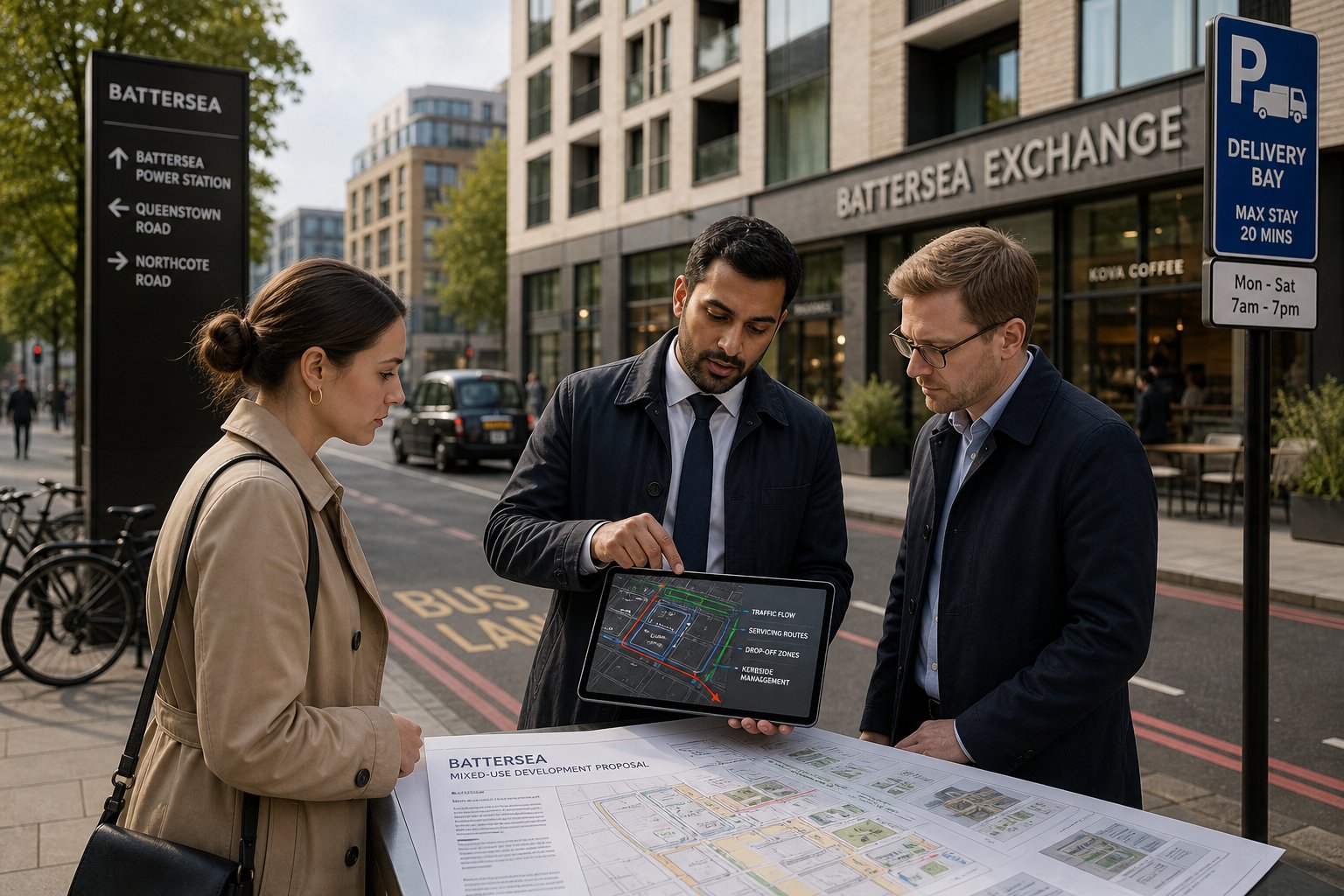
Some project types come up again and again in Battersea, and each brings its own transport pressure points.
Mixed-use blocks are an obvious example. Residential, retail, leisure and workspace uses can be perfectly acceptable together, but only if arrivals, servicing and kerbside demand are thought through properly. A ground-floor café with delivery activity under a residential frontage is manageable on paper: in reality, it may create repeated stopping issues unless the servicing plan is robust.
Build-to-rent and student housing schemes also need careful work. These uses can have lower private car ownership than conventional housing, but they may generate concentrated move-in activity, courier demand and more frequent servicing than a standard apartment block.
Change-of-use applications are another common trigger. Industrial to leisure, office to education, or warehouse to last-mile style operations can all alter traffic patterns significantly even where built form changes very little. That often surprises non-transport teams.
Schools, nurseries and hotels deserve special attention because drop-off, pick-up and taxi activity can dominate local impact. Likewise supermarkets, food-led uses and larger cafés, where delivery windows and refuse storage can make or break a scheme.
Across these project types, transport advice is rarely just about volume. It is about timing, management and street fit. Our broader primer on Traffic Engineering: Your makes the same point from a network perspective: the operational details usually decide whether a proposal feels workable to officers.
How Junction Capacity, Access, And Servicing Are Assessed
When officers ask whether a development will have an unacceptable transport impact, this is usually the section of work they mean.
For junction capacity, we first decide whether modelling is actually necessary. Not every Battersea scheme needs a full technical model. But where a site connects to a busy priority junction, roundabout, signalised junction or network already operating tightly, capacity testing may be essential. Depending on junction type, that can involve tools such as ARCADY, PICADY or LINSIG. The goal is not to produce impressive software outputs. It is to test queueing, delay and reserve capacity in a way that decision-makers can trust.
Access assessment then focuses on safety and function. We review geometry, visibility, pedestrian conflict, turning demand, gradients, gate positions and whether vehicles can enter and leave in a practical manner. An access can be technically compliant yet still poor in operational terms if vehicles block the footway or hesitate in a live lane.
Servicing is often the real battleground in Battersea. We typically test delivery vehicle type, frequency, arrival patterns, loading duration, refuse collection, on-site turning and whether kerbside activity can be managed without harming buses, cyclists or neighbours. Swept-path analysis is a core part of this, particularly for refuse vehicles and larger vans.
And if servicing relies on management, that management has to be believable. A promise that drivers will not stop informally is not enough: the site layout and operational plan must support it.
Parking, Cycle Provision, And Healthy Streets Considerations
In Battersea, parking is never a stand-alone spreadsheet exercise. It sits inside a wider London policy framework that increasingly prioritises sustainable travel, street quality and safety.
Car parking levels are usually tested against London Plan maximum standards, PTAL context, local controlled parking arrangements and the nature of the proposed use. For many schemes, the question is not “how much parking would be convenient?” but “what level is policy-compliant and operationally justified?” Disabled parking, car club provision, electric charging and servicing overlap can all affect that answer.
Cycle provision is equally important. Officers will expect cycle parking that meets quantity and dimensional standards, but good schemes go beyond numbers. We look at access routes, gradients, security, convenience, visitor spaces and whether the route to the store is intuitive. A technically compliant cycle store hidden behind awkward doors does not encourage use.
Healthy Streets principles also influence design quality. Footway width, crossing demand, kerb management, street activation, visibility, traffic calming and the comfort of people walking or wheeling can all become planning issues. In Battersea, where many schemes sit within busy urban streets, the public realm response can be scrutinised almost as closely as vehicle impact.
That is why transport advice has to join up. Parking, cycling and Healthy Streets cannot be assessed in separate silos if the final application is going to feel coherent.
Working With Wandsworth Council And Other Highway Stakeholders
Good transport work in Battersea is not just technical: it is procedural. Knowing who needs to be engaged, and when, can make a noticeable difference to programme risk.
Wandsworth Council is usually the main planning and highway authority voice for local applications, so pre-application discussion can be valuable where a site raises access, servicing, parking or policy questions. Early engagement helps us understand likely officer concerns before the design hardens.
TfL becomes relevant where schemes affect strategic roads, bus reliability, cycle infrastructure, major walking corridors or London-wide policy compliance. In Battersea, that interface comes up more often than some teams expect. A development does not need to front a red route to attract TfL interest if its impacts feed into the wider network.
Other stakeholders can matter too. Network Rail may need to be considered near rail assets. Adjacent landowners or estate managers may influence access rights or servicing routes. Nearby developments can change baseline conditions, especially in regeneration areas.
The key is coordination. We generally find that concise, authority-aware reporting works better than flooding consultees with unnecessary analysis. That has been a consistent lesson across locations, whether a scheme is being handled in Battersea or compared with work such as Traffic Engineer In Birmingham: where local highway process differs but the need for clear evidence does not.
How Early Transport Advice Helps Avoid Planning Delays
Most planning delays linked to transport are avoidable. They usually happen because the transport review started after the core design was effectively fixed.
At that point, the team may discover that the access is in the wrong place, servicing cannot happen on site, cycle parking is underprovided, or parking assumptions conflict with policy. None of those issues is unusual in Battersea. What causes delay is finding them too late.
Early advice gives the design team room to make sensible changes while options still exist. We can test trip assumptions before the planning statement is drafted, challenge whether a junction really needs modelling, and identify whether a Travel Plan will be expected. We can also flag street-level realities that are easy to miss from drawings alone: loading restrictions, awkward corner radii, bus stop interaction, or a frontage that simply will not tolerate regular delivery stopping.
This early-stage role is particularly helpful on constrained urban sites, where every metre matters and one transport decision can reshape the ground floor. It often reduces requests for further information after submission because the likely objections have already been designed out or answered properly.
In practical terms, earlier input usually saves time, cost and consultant rework. It also makes the eventual application more persuasive, because the transport story is integrated rather than bolted on.
What To Prepare Before Instructing A Traffic Engineer
The better the starting information, the faster and cleaner the transport advice tends to be.
At minimum, we would usually want the site red-line boundary, existing access arrangements, nearby parking and servicing conditions, and a basic description of the proposed development. An accommodation schedule is useful, even if still provisional, because trip generation and servicing needs depend heavily on use mix and scale.
Indicative layouts matter too. They do not need to be perfect, but they should show likely access points, vehicle routes, cycle storage, bin stores and any loading arrangements. If the design team already has swept-path concerns, it is worth surfacing those immediately rather than hoping they disappear.
Pre-application feedback, if available, can save a lot of duplication. The same applies to any known local constraints: waiting restrictions, loading bans, nearby junction sensitivity, estate road control, neighbour objections or expected committee interest.
Programme is another one people forget. If a submission date is fixed, we need to know that early because survey timing, modelling scope and authority engagement can all affect what is realistic.
When teams arrive with this material organised, the advice can be sharper from day one. That is one reason firms value experienced Traffic Engineer In Manchester: and London-region support alike: good transport input starts with a disciplined brief, not just technical software.
Choosing The Right Traffic Engineer For A Battersea Scheme
Not every consultant who can write a transport report is the right fit for a Battersea planning application. The local context is too specific for generic, copy-and-paste advice.
We would look first for direct experience in Wandsworth and with TfL-facing work. That does not just mean familiarity with policy names. It means understanding what officers tend to question, how to scope reports proportionately, and when a modest-looking scheme still needs more detailed analysis because of location sensitivity.
Technical capability matters as well. If a project may require junction modelling, swept-path analysis, parking justification, Travel Plan drafting or Healthy Streets commentary, the consultant should be able to deliver all of that coherently. Fragmented advice from multiple sources often creates contradictions.
Reporting style is another differentiator. The best transport reports are concise, evidence-led and easy for planners, lawyers and design teams to use. Long documents with weak logic rarely help. At ML Traffic, that is exactly where our focus sits: fast, accurate reporting shaped around local thresholds and practical planning needs.
Finally, choose someone willing to engage, not just issue PDFs. Battersea schemes often benefit from attendance at meetings, response to officer comments and collaboration with architects and planning consultants as the design evolves.
A strong Traffic Engineer in Battersea should make the project clearer, not more complicated. If the advice sharpens decisions early and reduces friction later, the appointment is doing its job.
When that happens, transport stops being a planning risk to manage and becomes part of the strategy that gets the scheme over the line.
Frequently Asked Questions About Traffic Engineering in Battersea
Why is a traffic engineer important for developments in Battersea?
A traffic engineer ensures that proposals in Battersea operate safely, comply with local policies, and avoid negative impacts on junctions, bus routes, and walking or cycling paths, especially given the area’s dense development and transport complexity.
What kinds of reports might a traffic engineer prepare for a Battersea planning application?
Common reports include a Transport Statement for small schemes, a detailed Transport Assessment for larger or sensitive projects, and a Travel Plan to encourage sustainable travel and manage transport behaviour over time.
How do traffic engineers assess junction capacity and servicing in Battersea?
They use specialised modelling tools like ARCADY or LINSIG to test junction delay and capacity, assess safety and function of access points, and carry out swept-path analysis to ensure safe vehicle movements and servicing without disrupting bus or cycle lanes.
When is a Transport Assessment required instead of a Transport Statement in Battersea?
A Transport Assessment is needed for larger-scale developments, mixed-use sites, or those near busy strategic roads and junctions, where detailed analysis of trip generation, parking, and mitigation is essential to satisfy Wandsworth Council and TfL requirements.
How can early involvement of a traffic engineer benefit a Battersea project?
Early advice helps identify transport issues like access location, servicing, or parking constraints before design is fixed, reducing planning delays, rework, and objections by addressing concerns during the concept phase.
What factors influence parking and cycling provision in Battersea developments?
Parking levels are guided by London Plan maximum standards and local controlled parking zones, while cycle parking must meet London Cycle Design standards; both are integrated with Healthy Streets principles to promote safety, active travel, and improved public realm.