
Planning in Mitcham rarely stalls because of one dramatic issue. More often, it slows down through a series of avoidable transport questions: Is the access safe? Will parking overspill into nearby streets? Can refuse vehicles turn on site? Will the junction cope at peak times? For architects, planners, developers and local authorities, those questions can make the difference between a smooth validation process and months of redesign.
That is where a traffic engineer in Mitcham becomes central to the planning team, not an add-on called in at the last minute. In the London Borough of Merton, transport evidence needs to do more than tick a box. It has to respond to the London Plan, local policy, highway standards, active travel expectations and the character of the surrounding network, from strategic routes to residential side roads and public transport links.
We approach transport input as part of the scheme design itself. Done early and done properly, it helps shape access, servicing, parking, travel behaviour and highway impact before those issues become objections. Whether the project is residential, mixed-use, education, healthcare or commercial, the right report can reduce planning risk and speed up decisions.
In this guide, we break down what a traffic engineer in Mitcham actually does, when transport work is likely to be required, and what planning teams should expect in 2026.
Key Takeaways
- A traffic engineer in Mitcham plays a crucial role in planning applications by ensuring developments align with local transport policies and function safely within the existing network.
- Early involvement of a traffic engineer helps shape access, parking, servicing, and travel behaviour, reducing planning risks and avoiding costly redesigns.
- Transport assessments in Mitcham must consider sustainable travel priorities, including walking, cycling, and public transport, reflecting both London Plan and Merton policies.
- Proportionate transport evidence—ranging from concise Transport Statements to full Assessments—is essential and should be tailored to the scale and sensitivity of each development.
- Detailed vehicle swept path analysis and local knowledge of highway conditions are vital to design workable and safe access and servicing arrangements.
- Collaborating closely with architects, planners, developers, and local authorities from the outset improves planning outcomes and helps transform transport considerations from a risk into an advantage.
What A Traffic Engineer In Mitcham Does For Planning Applications
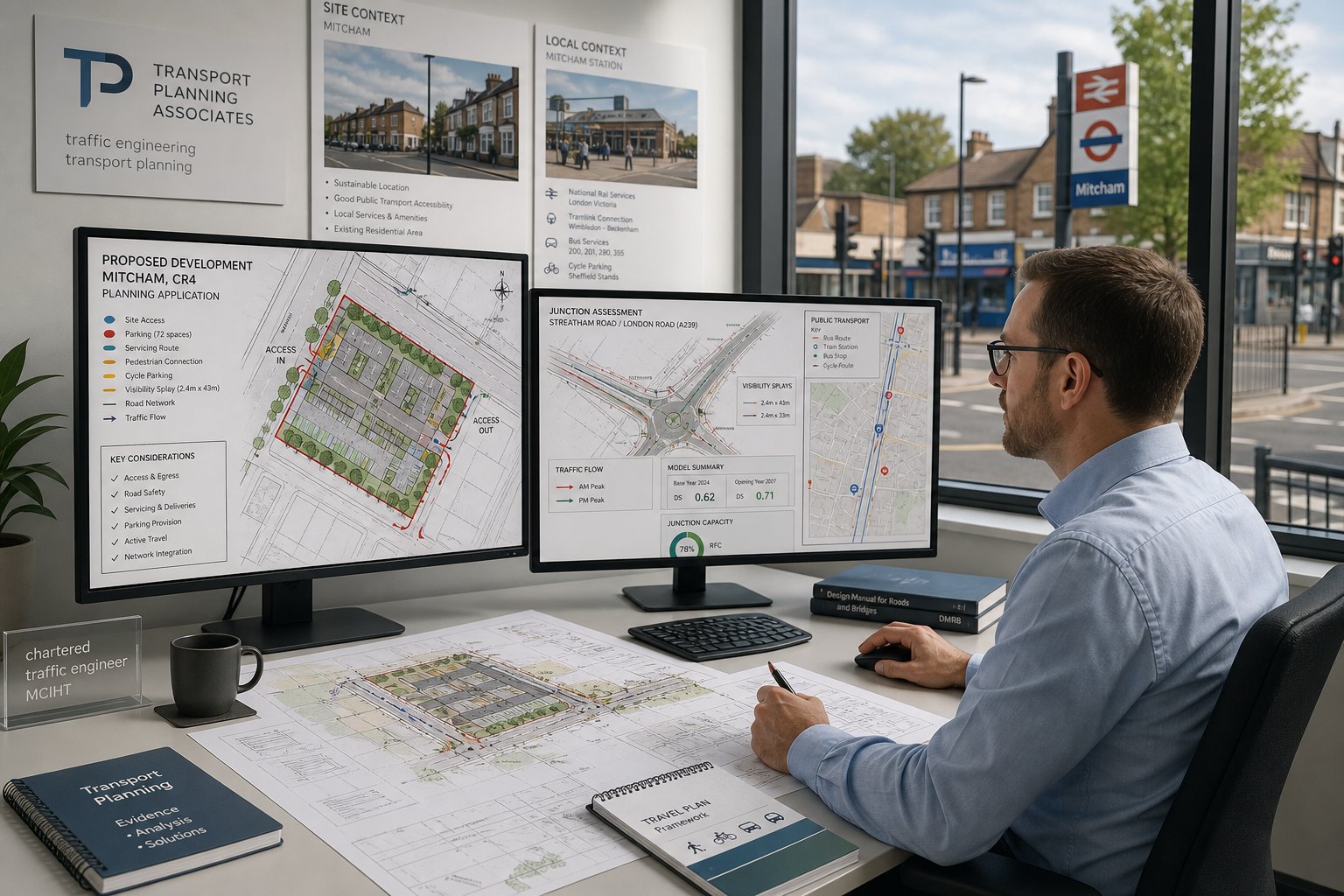
A traffic engineer in Mitcham supports planning applications by assessing how a proposed development interacts with the surrounding transport network and then presenting that evidence in a form local planning authorities can rely on. In practical terms, that means we review access arrangements, trip generation, servicing, parking, visibility, road safety, public transport accessibility and the likely effect on nearby junctions and streets.
For smaller schemes, the work may be concise and proportionate: a Transport Statement, access review or parking note. For larger or more sensitive sites, it can extend to a full Transport Assessment, Travel Plan, junction modelling, swept path analysis and mitigation proposals. The purpose is the same in each case: to show that the development can function safely and acceptably within policy and engineering standards.
In Mitcham, that usually means aligning with national planning guidance, the London Plan, Merton policy expectations and accepted design references such as Manual for Streets. It also means understanding how local conditions influence technical judgement. A site near Mitcham Junction, for example, will raise different issues from one on a quieter residential road.
Our role often begins before an application is submitted. We advise design teams on whether a layout is likely to work, what evidence will be needed and where transport objections are most likely to arise. That early advisory role is often more valuable than the report itself, because it prevents poor assumptions from getting embedded in the scheme.
Broader traffic engineering and transportation input is often what turns a technically acceptable scheme into one that is also easier to approve.
Why Mitcham Developments Need Transport Input Early

Transport input is most effective when it happens at concept stage. Once an architect has fixed the building footprint, bin store, parking arrangement and access position, the room for sensible change starts to disappear. And that is usually when transport problems become expensive.
In Mitcham, early review matters because local policy and London-wide standards can shape the scheme from the outset. Low-car or car-free expectations, cycle parking provision, servicing strategy, disabled parking, EV charging, pedestrian connections and access geometry are not details to tidy up later. They influence site capacity and viability.
We often find the same pattern. A promising layout is drawn quickly, then someone asks whether a refuse vehicle can enter and leave in forward gear. Or whether visibility splays can actually be achieved without affecting frontage design. Or whether the amount of parking proposed is realistic for the site’s PTAL level and local demand. Those are not minor edits. They can trigger redesign across the whole plan.
Early involvement also helps in pre-application discussions with Merton Council and, where relevant, TfL. A transport position that is thought through from the beginning tends to generate more constructive officer feedback. It shows the team has considered the network, not just the red line boundary.
For planning teams working across multiple authorities, the value is similar to using experienced traffic engineering consultants: fewer surprises, more proportionate evidence, and less time spent undoing avoidable layout mistakes.
Local Planning And Highway Considerations In Mitcham
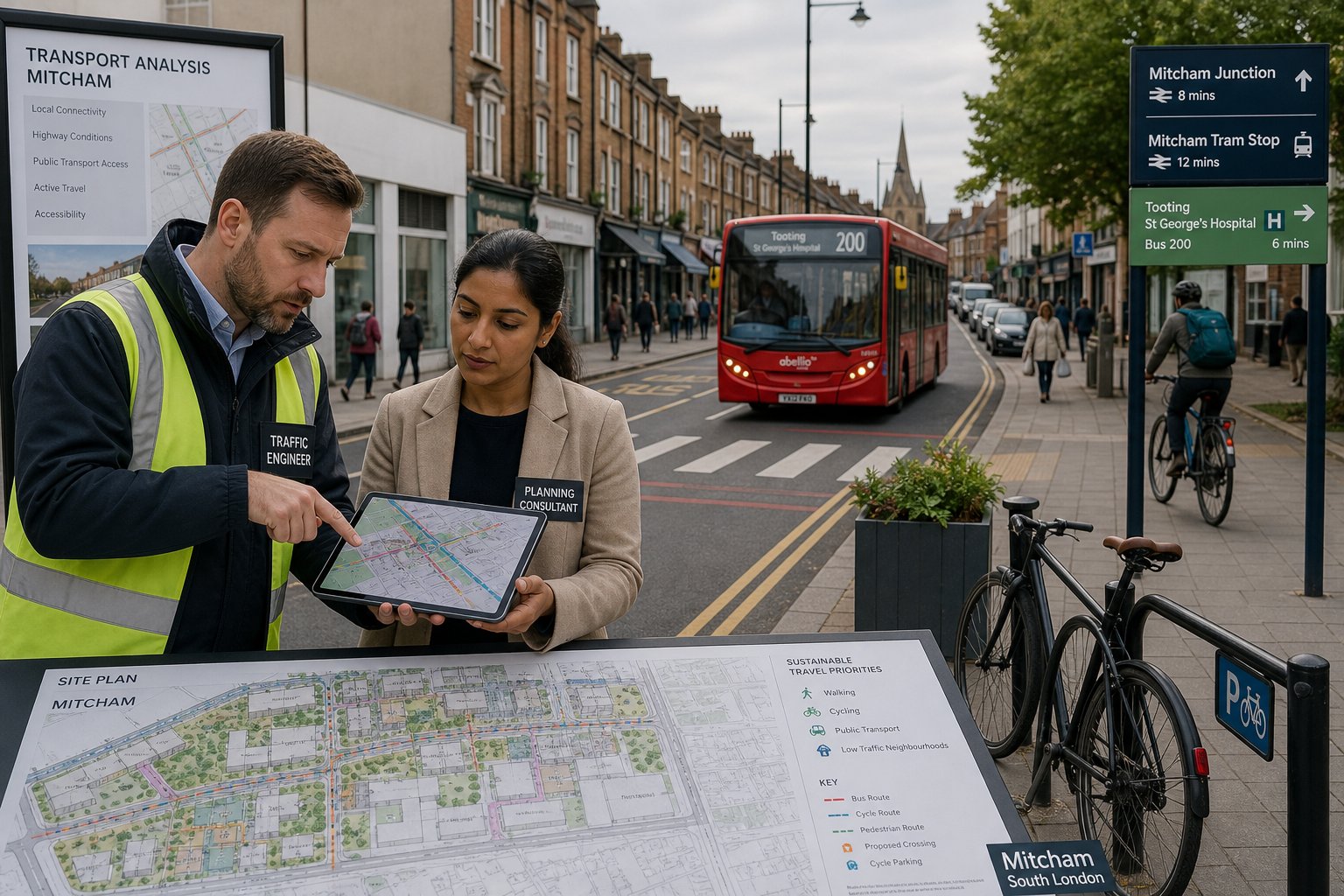
Mitcham sits within a part of south London where transport planning is shaped by both strategic policy and very local street conditions. A scheme may be only a short distance from key routes such as the A217, A236 or A239, but still rely on access via constrained residential roads. That mix matters.
The London Plan pushes hard on sustainable travel, reduced car dependency, cycle parking, Healthy Streets and Vision Zero principles. Merton’s local planning approach reflects those priorities, so applications are not assessed solely on whether vehicles can get in and out. They are also judged on whether the development supports walking, cycling and public transport use in a credible way.
That creates a more nuanced transport brief. A technically workable access is not enough if the pedestrian route to nearby bus stops is poor, if cycle storage is impractical, or if parking provision conflicts with local policy expectations. Sites near tram and rail connections, including Mitcham Junction, may face stronger scrutiny around parking restraint and mode share assumptions.
Highway design considerations are equally local. Existing waiting restrictions, school-related peak activity, frontage parking stress, bus movements and narrow carriageways can all affect how a proposal is received. Even where trip generation is modest, the character of the surrounding streets can make servicing and manoeuvring a major issue.
That is why local knowledge counts. A planning-led report with generic wording rarely carries the same weight as analysis grounded in place. Strong highway and traffic advice reflects the network people actually use, not just a policy summary.
Common Development Types That Trigger Transport Assessment Work

Not every application in Mitcham needs a full transport package, but certain development types routinely trigger transport review. Residential schemes are the obvious example, especially flatted developments, estate intensification, mixed-tenure blocks and medium-to-large housing proposals where parking, access and trip impacts need to be evidenced.
HMOs and student-style accommodation can also require careful analysis, even when the gross floor area is not especially large. The planning questions are often less about pure volume and more about turnover, pick-up and drop-off activity, servicing and likely parking stress.
Commercial schemes are another common trigger. Retail, foodstore, drive-thru, warehouse and industrial proposals tend to raise concerns about delivery activity, peak-hour traffic, queueing and site circulation. Education, healthcare and leisure developments can be just as sensitive because of concentrated arrival patterns and vulnerable users.
Mixed-use sites often generate the most detailed transport discussion. Different land uses may peak at different times, share parking or servicing areas, and produce competing demands on the same access. That complexity usually pushes the application towards a more robust evidence base.
Thresholds matter, but context matters just as much. A modest proposal on a constrained junction, on a bus corridor, or close to a school may need more work than a larger scheme on a forgiving site. We judge the likely requirement by scale, use, local sensitivity and cumulative impact, then recommend proportionate reporting.
For developer teams, that judgement is a core part of commercial traffic engineering support because getting the scope wrong early can delay the entire programme.
Transport Statements, Transport Assessments, And Travel Plans Explained

These three documents are often mentioned together, but they serve different planning purposes.
A Transport Statement is usually prepared for smaller or less intensive developments. It gives a concise, evidence-based overview of existing transport conditions, site accessibility, access proposals, parking, servicing and the likely impact of the development. It should still be rigorous, just proportionate. A good Transport Statement answers the right questions without pretending the scheme is bigger than it is.
A Transport Assessment goes further. It is used where impacts may be material or where the site is more sensitive. A TA can include detailed trip generation, distribution and assignment, junction capacity assessment, accident review, sustainable travel analysis and mitigation design. In short, it is the document used when the planning authority needs a fuller picture of how the development affects the network.
A Travel Plan is different again. It focuses on how travel behaviour will be managed over time. That may include mode share targets, cycle incentives, public transport information, car club measures, monitoring and a named coordinator. In London, Travel Plans are often expected for schemes where policy seeks to reduce private car use.
The key is not producing the thickest report. It is producing the right one. We find that concise, authority-aware reporting usually performs better than a generic document padded with unnecessary data.
When A Delivery Needs A Full Assessment Or A Proportionate Report
The line between a proportionate statement and a full assessment depends on scale, land use, local highway sensitivity and cumulative effects. There is no universal magic number. National guidance encourages proportionate evidence, but local authority expectations and network conditions shape the real answer.
As a rule, smaller infill schemes or low-impact changes of use may only need a Transport Statement, provided access and parking are straightforward. Once a proposal begins to generate material vehicle trips, relies on a constrained junction, introduces significant servicing demand or sits in an area with known transport pressure, a fuller TA becomes more likely.
Travel Plans are commonly requested where sustainable travel outcomes matter to policy compliance, particularly for larger residential, employment, education and mixed-use schemes.
That is why scoping is so important. A short early note to the planning team can save weeks later, especially where a Traffic Engineer In London: style policy approach meets site-specific borough requirements.
Swept Path Analysis And Vehicle Access Requirements
One of the quickest ways for a planning application to attract concern is to show an access that looks plausible on a drawing but fails when tested by real vehicle movements. Swept path analysis is how we avoid that problem.
Using specialist software such as AutoTrack or Vehicle Tracking, we test whether the vehicles expected to use the site can enter, turn, load and leave safely. Depending on the development, that may include cars, vans, refuse vehicles, fire appliances and larger service vehicles. The outputs help demonstrate whether the geometry works in practice rather than in theory.
In Mitcham, access design often needs careful handling because many sites are constrained by existing buildings, narrow frontages, boundary features or nearby parking activity. Small adjustments in gate set-back, kerb radius, aisle width or turning head shape can make the difference between a workable access and one that invites an objection from highways officers.
Visibility is part of the same conversation. It is not enough for a vehicle to physically fit. Drivers also need acceptable visibility splays, manageable gradients and a layout that does not force awkward manoeuvres over the footway. Where larger vehicles are involved, internal tracking is critical, particularly if the authority expects vehicles to enter and exit in forward gear.
These drawings are often treated as technical appendices, but they influence site design far more than people expect. Access, landscaping, parking, refuse strategy and frontage treatment all tend to move around them.
Parking, Servicing, And Site Layout Issues That Affect Approval
Parking and servicing are where policy, user behaviour and physical design collide. On paper, a site may appear compliant. On the ground, it may still function badly if bays are too tight, disabled spaces are poorly located, cycle stores are awkward to reach, or delivery activity blocks internal circulation.
In Mitcham, parking provision is shaped by London and local policy expectations around restraint, accessibility and sustainable travel. That means the debate is rarely just about how many spaces are proposed. Officers will also look at whether the quantum is justified, whether disabled and EV provision is suitable, and whether cycle parking is genuinely usable rather than tokenistic.
Servicing can be even more sensitive. A scheme that relies on reversing over a footway, stopping on the public highway, or informal refuse collection arrangements is likely to struggle. We test where vehicles stop, how bins move, whether loading conflicts with residents or customers, and whether the internal layout creates pinch points.
There is also the overspill question. Under-providing parking in a high-demand location can create neighbour objections, but over-providing can conflict with policy and undermine mode share assumptions. The answer is usually evidence-led rather than instinctive.
Well-resolved site plans tend to integrate all of this quietly: parking dimensions, turning, servicing, pedestrian routes and cycle access working together. That is the sort of practical coordination often missing when transport advice arrives after the layout has already hardened.
For wider design context, applied traffic engineering principles usually explain why apparently minor layout choices cause major planning friction.
Junction Capacity, Trip Generation, And Traffic Impact Modelling
When a development is large enough, or the surrounding network sensitive enough, planning decisions turn on evidence about how many trips the site is likely to generate and what those trips do to nearby junctions. This is where transport work becomes more analytical.
Trip generation is commonly estimated using TRICS or comparable data sources, selecting survey sites that reflect the proposed use and local context as closely as possible. That sounds straightforward: it rarely is. The quality of the comparison sites, the treatment of mode split, and the assumptions around peak periods all affect how credible the outcome appears.
Once trips are established, we distribute and assign them across the local network based on observed conditions, census patterns, accessibility and engineering judgement. Then, where needed, we model nearby junctions using tools such as PICADY, ARCADY, LINSIG, SYNCHRO or microsimulation platforms. The purpose is not to produce a flashy appendix. It is to answer practical questions: will queues materially worsen, will reserve capacity be exhausted, and does mitigation need to be considered?
Mitigation may be modest, such as lining amendments or access refinement, or more involved, such as signal staging changes, pedestrian crossing provision or turning lane adjustments. The right response depends on the actual scale of impact.
A useful report explains these assumptions clearly. Planning officers and consultees do not just need numbers: they need confidence that the numbers are sensible, proportionate and rooted in the reality of Mitcham’s network.
Road Safety, Visibility, And Active Travel Considerations
Highway impact is only part of the planning picture. Safety and active travel are increasingly central, especially in London boroughs applying Healthy Streets and Vision Zero principles with more seriousness than they did a decade ago.
For a Mitcham scheme, that means we review not just whether vehicles can operate, but whether the proposal creates a safe environment for people walking, wheeling and cycling. Access visibility, pedestrian desire lines, crossing points, cycle connections, lighting, gradients and frontage activity all matter. An access that works for a car but interrupts a heavily used footway in a poor way may still be unacceptable.
Collision analysis can also be relevant. If there is an existing road safety pattern near the site, the planning authority may expect that context to be acknowledged and addressed. On larger or highway-altering schemes, Road Safety Audits may form part of the process.
Active travel provision should be practical, not decorative. We look at whether cycle parking is secure and convenient, whether routes to local bus stops are direct, and whether the layout encourages short local trips without a car. These are often the details that strengthen a planning case because they connect transport evidence to broader policy aims around health, emissions and street quality.
In many cases, sustainable access measures are also the most persuasive form of mitigation. If a scheme can show credible alternatives to private car use, the wider transport case becomes easier to defend.
Working With Architects, Planners, Developers, And Local Councils
Transport work is rarely a standalone exercise. The best results come when the traffic engineer is part of the wider design and planning conversation from the beginning. That means working closely with architects on access geometry and servicing, with planners on policy positioning, with developers on viability and phasing, and with legal teams where obligations or appeal evidence are in play.
In practice, this collaboration is iterative. A first layout may reveal a refuse tracking issue. That leads to a revised parking arrangement, which affects landscaping, which then changes pedestrian routing. It is normal. The value lies in resolving those conflicts before the application reaches formal consultation.
We also liaise with Merton Council, TfL and, in some cases, other highway stakeholders during pre-application and application stages. Clear dialogue matters because many transport issues are not purely yes-or-no questions. They depend on professional judgement, local precedent and whether officers trust the evidence presented.
When comments do come back, the response needs to be technical but readable. Planning teams do not benefit from defensive jargon. They need concise rebuttals, revised drawings where necessary, and a transport narrative that still makes sense after amendment.
That joined-up approach is why many clients look for support from a Traffic Engineer In different city only as a reference point, but appoint locally aware teams when borough-specific judgement is what really decides the outcome.
How To Choose The Right Traffic Engineer In Mitcham
Not all transport consultants are equally suited to planning work in Mitcham. Technical competence is essential, of course, but planning usefulness depends on something more specific: can the consultant produce proportionate evidence, tailored to Merton and London expectations, without creating unnecessary work?
We would start with local and policy experience. A strong consultant should understand how London Plan policy, borough transport priorities, parking restraint, cycle standards and Healthy Streets thinking influence scheme design and report content. Generic national-only advice is rarely enough here.
Next, look at track record. Have they supported similar residential, commercial, education or mixed-use applications? Can they scope reports sensibly at pre-application stage? Do their documents read clearly enough for planners, councillors and applicants, not just other engineers?
Software capability matters too. If a site is likely to need vehicle tracking, capacity modelling or detailed CAD input, the consultant should be comfortable with the relevant tools and know when each one is actually necessary. Over-modelling is not a virtue.
Professional standards still count. Membership or chartership through bodies such as CIHT or ICE, along with appropriate professional indemnity insurance, gives reassurance. So does responsiveness. In live planning programmes, speed and clarity are often as important as technical depth.
For many teams, the best choice is the one that combines concise reporting with broad Traffic Engineer In Bristol: or London-region benchmark experience while still understanding what is uniquely sensitive about Mitcham.
Conclusion
A competent traffic engineer in Mitcham does far more than prepare a report to accompany an application. The real value is in shaping the scheme early, identifying risks before they harden into objections, and presenting transport evidence in a form that planners and highway officers can actually use.
In 2026, that means combining policy awareness with practical design judgement. Access, parking, servicing, trip impact, safety and active travel all need to work together. Some schemes only need a concise statement. Others need modelling, tracking, mitigation and ongoing travel planning. The difference lies in getting the scope right from the start.
For architects, planners, developers and local authorities, the best outcomes usually come from proportionate, locally informed advice delivered early and clearly. In Mitcham, that is often what turns transport from a planning risk into a planning advantage.
Frequently Asked Questions About Traffic Engineering in Mitcham
What does a traffic engineer in Mitcham do for planning applications?
A traffic engineer in Mitcham assesses how proposed developments impact the local transport network, providing planning authorities with evidence on access, parking, servicing, junction performance, and road safety in line with London Plan and Merton policies.
Why is early transport input important for developments in Mitcham?
Early transport input in Mitcham helps avoid costly redesigns by ensuring layouts comply with local and TfL standards, addressing parking, access, servicing, and sustainable travel from the concept stage to reduce planning delays and objections.
Which types of developments in Mitcham typically require transport assessment work?
Medium to large residential schemes, HMOs, student accommodations, commercial, education, healthcare, leisure, and mixed-use developments in Mitcham usually trigger transport assessments due to their potential impact on parking, access, and junction capacity.
How does a Transport Assessment differ from a Transport Statement and a Travel Plan?
A Transport Statement is a concise review for smaller developments. A Transport Assessment provides detailed analysis including junction modelling and mitigation for larger or sensitive schemes. A Travel Plan focuses on managing travel behaviour to reduce car use, often required for policy compliance in London.
What role does swept path analysis play in traffic engineering for Mitcham developments?
Swept path analysis uses simulation software to verify that vehicles, including refuse and emergency vehicles, can safely manoeuvre on site. This ensures access geometry and visibility meet standards, avoiding objections related to impractical vehicle movements.
How can I choose the right traffic engineer for a Mitcham planning project?
Select a traffic engineer familiar with London and Merton policies, experienced in similar developments, proficient in relevant modelling tools, member of professional bodies like CIHT or ICE, and able to provide clear, proportionate reports tailored to Mitcham’s specific requirements.