
Planning a scheme in Sheffield without transport input is a bit like drawing a building before checking the ground levels: you can do it, but you may end up redesigning a lot more than you expected. For architects, planners, developers and legal teams, transport issues often sit quietly in the background until they become the reason a planning application stalls.
That matters even more in Sheffield. The city’s steep topography, constrained urban streets, strategic bus corridors, Supertram interfaces and growing emphasis on active travel all shape what is, and isn’t, likely to be accepted. A traffic engineer in Sheffield helps turn those constraints into a workable planning strategy. We assess how a development will operate, whether the access is safe, how servicing and refuse can be accommodated, and what level of transport reporting is proportionate for the proposal.
In practice, our role is not just to “do the report”. We help clients make better decisions early, align schemes with local policy, and reduce the risk of objections from highways officers or consultees later on. Whether the project is a small infill scheme, a residential block, a logistics site or a mixed-use redevelopment, the right transport advice can be the difference between a smooth submission and a long round of revisions.
Below, we break down what that support usually involves in Sheffield in 2026, where the common risks sit, and how to prepare a strong planning submission from the outset.
Key Takeaways
- A traffic engineer in Sheffield plays a crucial role in ensuring developments are safely accessible and compliant with local transport policies, reducing planning delays.
- Early involvement of a traffic engineer helps shape access, parking, servicing, and sustainable travel strategies, aligning schemes with Sheffield’s unique topography and transport demands.
- Transport Statements, Assessments, and Travel Plans must be proportionate to the development’s impact and address Sheffield’s specific transport context, including tram and bus corridors.
- Swept path analysis and Construction Traffic Management Plans are vital on constrained urban sites to demonstrate safe vehicle manoeuvres and manage construction phase impacts.
- Understanding local authority expectations, transport software tools, and a track record with similar schemes is essential when choosing a traffic engineer in Sheffield.
- Providing comprehensive site details and known constraints upfront allows for accurate scoping, saving time and costs by focusing on relevant transport issues from the start.
What A Traffic Engineer In Sheffield Does For Planning And Development
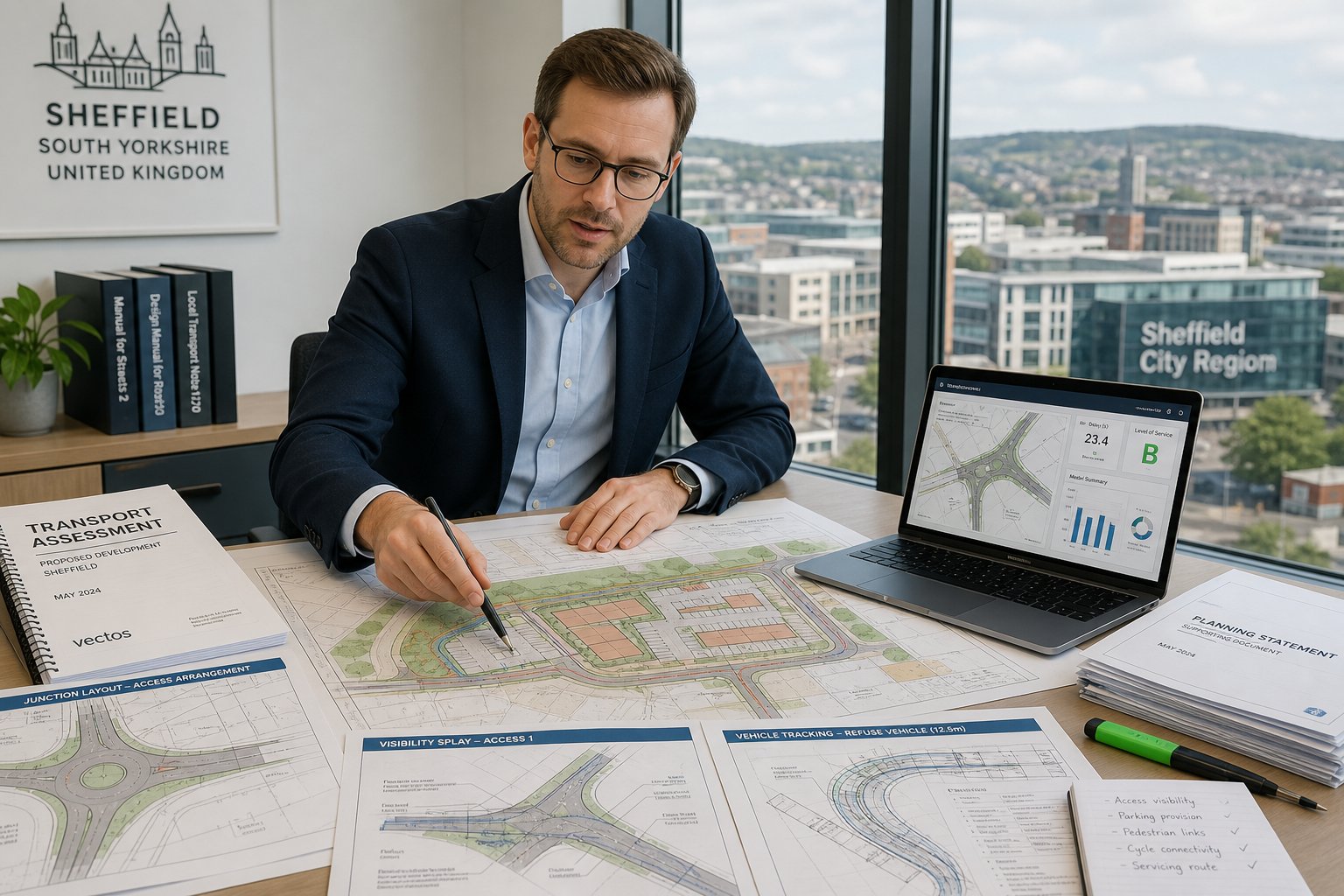
A traffic engineer in Sheffield applies transport engineering principles to one practical question: can a development be accessed, serviced and operated safely and acceptably within the local network?
For planning purposes, that usually means we review trip generation, likely vehicle movements, walking and cycling connections, public transport accessibility, parking demand, servicing arrangements and the effect on nearby junctions. We then translate that analysis into planning-ready outputs: Transport Statements, Transport Assessments, Travel Plans, junction modelling, vehicle tracking, access drawings and technical responses to highways comments.
On many schemes, our involvement starts before the planning pack is assembled. We advise on whether an access is likely to be acceptable, whether visibility splays are achievable, whether bin collection and fire access work, and whether the proposed parking strategy is realistic. That early technical steer often saves a surprising amount of redesign.
We may also input into signs, lining, internal circulation, loading arrangements and mitigation measures if a proposal creates pressure on the surrounding network. For broader context on how this role fits within planning work, Traffic Engineering Consultants: often bridge the gap between site design, transport policy and highway authority expectations.
In short, we help make transport issues legible to the planning system, and make planning proposals more legible to transport officers.
Why Sheffield Developments Need Local Transport And Highways Input Early

Early input matters in any city, but Sheffield has a habit of punishing late transport thinking.
A scheme can look fine on a drawing set and still run into trouble once local realities are tested: a gradient too steep for comfortable pedestrian access, a servicing route that conflicts with parked vehicles on a narrow terraced street, or an access point too close to a busy bus movement or signalised junction. Add in local policy pressures around sustainable travel, air quality and public realm, and it becomes obvious why transport should be considered before the design hardens.
We normally advise clients to bring in highways and transport input at concept or pre-app stage, not after the application has already been drafted. That allows us to shape access strategy, parking provision, cycle storage, servicing and site circulation while there is still flexibility. It also means we can judge whether a Transport Statement is enough or whether a fuller assessment is likely.
Local familiarity helps here. Thresholds, officer expectations and network sensitivities are rarely identical from city to city. Comparing approaches across places such as Traffic Engineer In Leeds: or Traffic Engineer In Manchester: shows how strongly local authority context can shape the same type of development.
Done early, transport advice reduces avoidable objections, cuts redesign time and gives the planning team a clearer route through to submission.
Planning Applications That Commonly Require Traffic Engineering Support
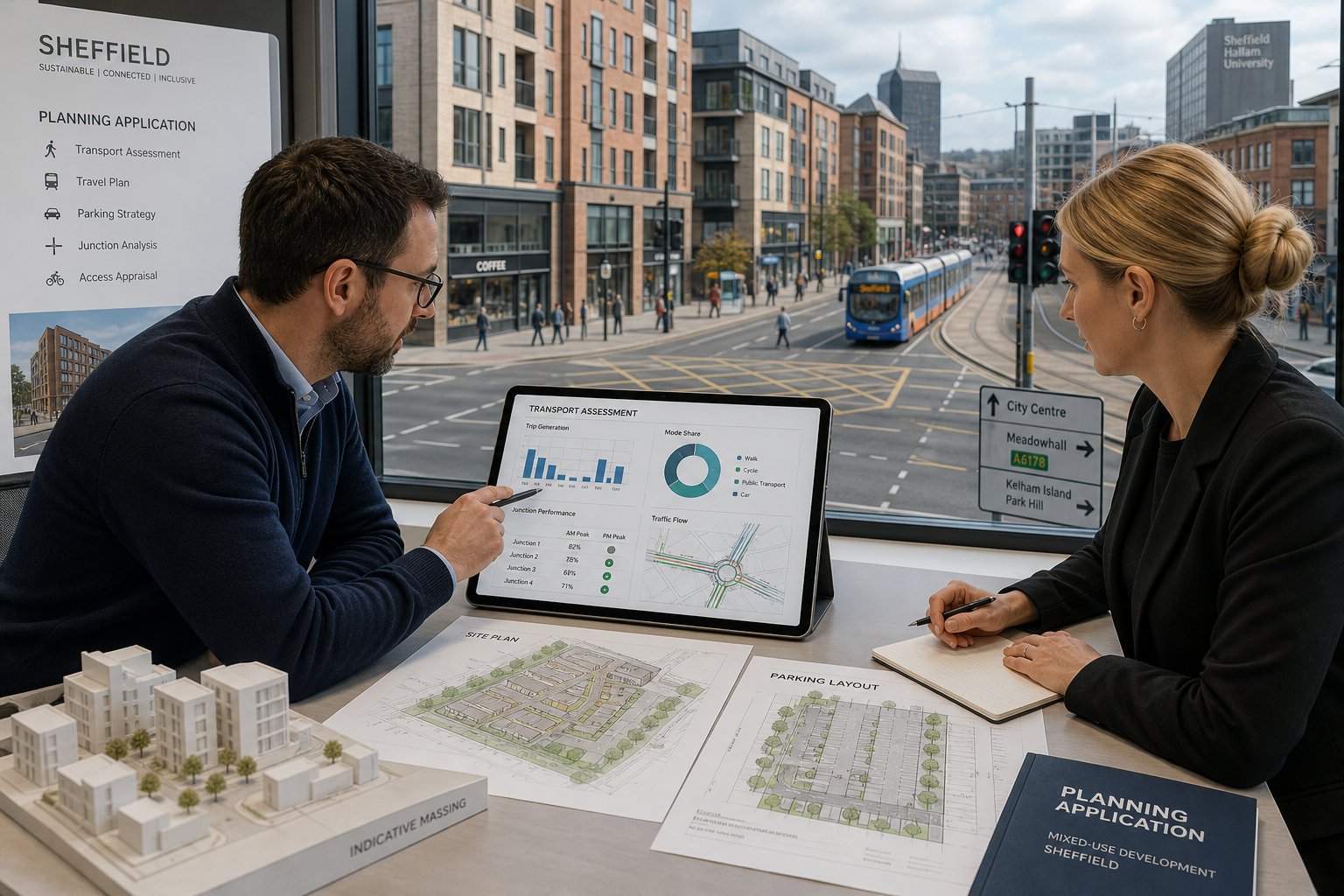
Not every application needs a full transport package, but a lot more schemes need traffic engineering input than applicants first assume.
The obvious examples are larger residential developments, apartment buildings, retail schemes, schools, healthcare uses, employment sites and logistics or warehousing proposals. These often create enough additional trips, servicing demand or parking pressure to justify formal assessment. But smaller projects can also trigger transport concerns if they introduce a new access, intensify an existing use, alter a car park, or sit on a constrained frontage.
In Sheffield, we regularly see traffic engineering support needed for:
- housing schemes on former industrial or infill sites
- student and build-to-rent developments
- foodstores and roadside retail
- care homes and medical uses
- schools and nurseries
- industrial yards, last-mile logistics and trade counters
- mixed-use town and city centre redevelopments
- schemes involving access changes onto classified roads
Materiality is the key test. A modest development can still need analysis if it affects a sensitive junction, bus corridor, tram environment or residential street with limited capacity. Equally, some applications need only proportionate evidence.
For teams working across multiple cities, comparisons with places such as Traffic Engineer In Birmingham: can be useful, but Sheffield-specific site conditions and policy framing still need their own response. That’s why we tailor advice to the proposal rather than forcing every project into the same reporting template.
Transport Statements, Transport Assessments, And Travel Plans Explained
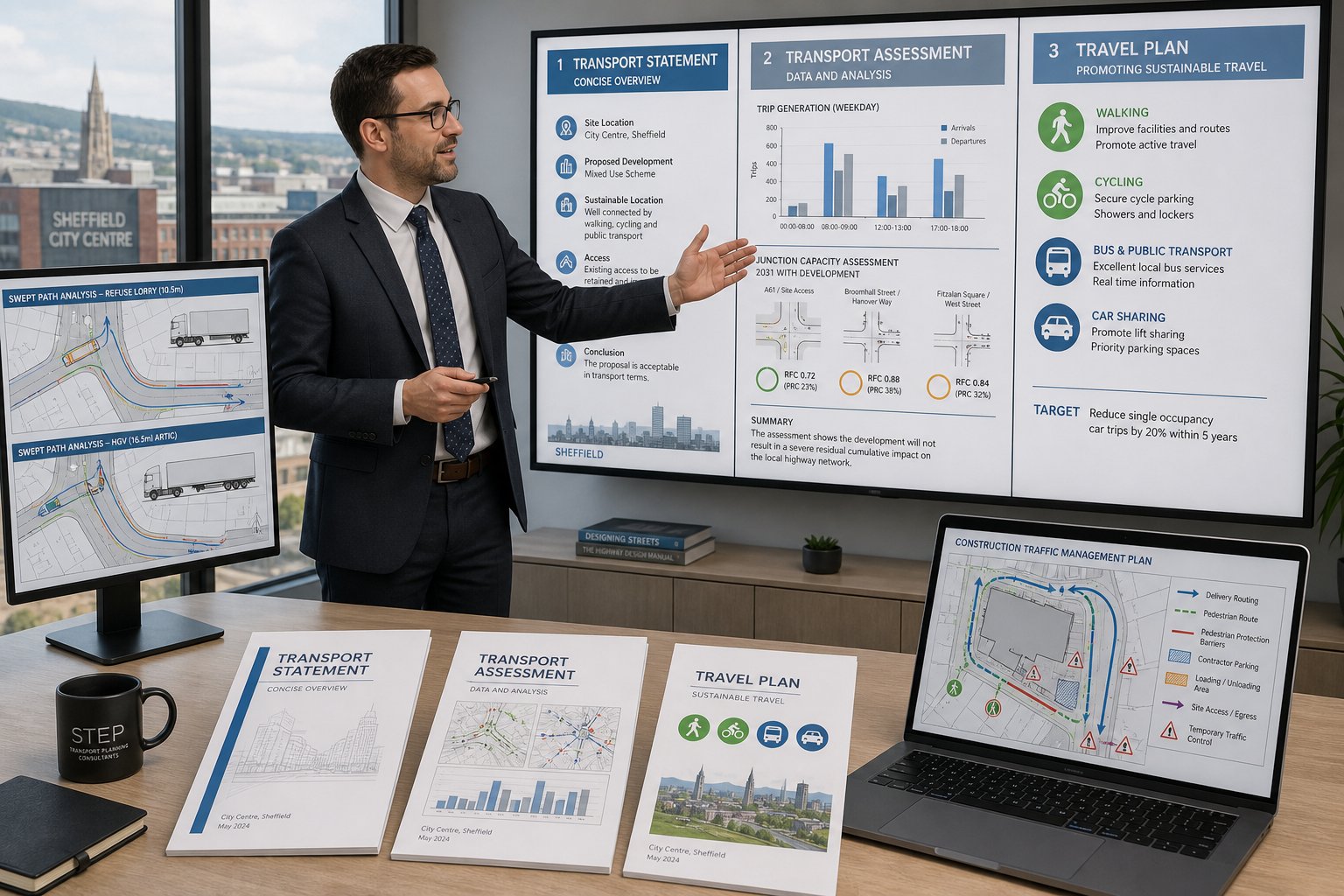
These documents are often mentioned together, but they do different jobs.
A Transport Statement (TS) is usually the proportionate option for smaller schemes with limited transport impact. It explains the site context, access arrangements, parking, sustainable travel opportunities and likely traffic effects in a concise way. A good TS is not just brief: it is targeted. It addresses the actual risks of the site instead of padding out pages with generic commentary.
A Transport Assessment (TA) goes further. It is typically required where a development is likely to generate more significant trips or where the network effect is potentially material. A TA may include trip generation analysis, distribution and assignment, junction capacity testing, sustainable mode review, road safety context and mitigation proposals. If there is likely to be pressure at a nearby roundabout or signal junction, the TA is where that evidence is set out clearly.
A Travel Plan (TP) focuses on behaviour rather than pure capacity. It sets out measures to encourage walking, cycling, public transport, car sharing and responsible travel choices, often with targets, management actions and monitoring commitments. In a city with strong policy emphasis on mode shift, this can carry real weight.
Across England, the principles are broadly familiar, whether we are preparing work akin to Highway And Traffic Engineering support or city-specific reports. The important point is proportionality: the document should fit the development and the authority’s likely concerns.
When A Swept Path Analysis Is Needed
Swept path analysis is used where we need to prove that vehicles can manoeuvre safely and realistically. In planning, that commonly means refuse wagons, fire appliances, articulated vehicles, service vans or rigid HGVs.
If a site layout only works on paper because a large vehicle clips a kerb, mounts a footway or needs impossible reversing, officers will spot it quickly. Vehicle tracking software allows us to demonstrate turn-in, turn-out, internal circulation and servicing in a way that is visual and technically defensible. It is especially useful on tight urban sites, awkward corners and shared yards.
When A Construction Traffic Management Plan Is Required
A Construction Traffic Management Plan, or CTMP, is usually required where the build phase itself could create a material highways or amenity impact. Think constrained city-centre plots, school-adjacent sites, roads with restricted loading opportunities, or developments needing frequent HGV deliveries.
A robust CTMP covers likely construction vehicle numbers, routing, delivery hours, wheel washing if relevant, contractor parking, temporary traffic management, pedestrian protection and communication arrangements. It can also address banksmen, on-site marshals and abnormal load procedures where needed.
This is one of those documents that is easy to underestimate. A technically sound permanent access does not remove construction-stage risk, and officers often want comfort that neighbours, buses, cyclists and school traffic will be protected while the site is being built.
Key Sheffield And South Yorkshire Transport Considerations For New Schemes
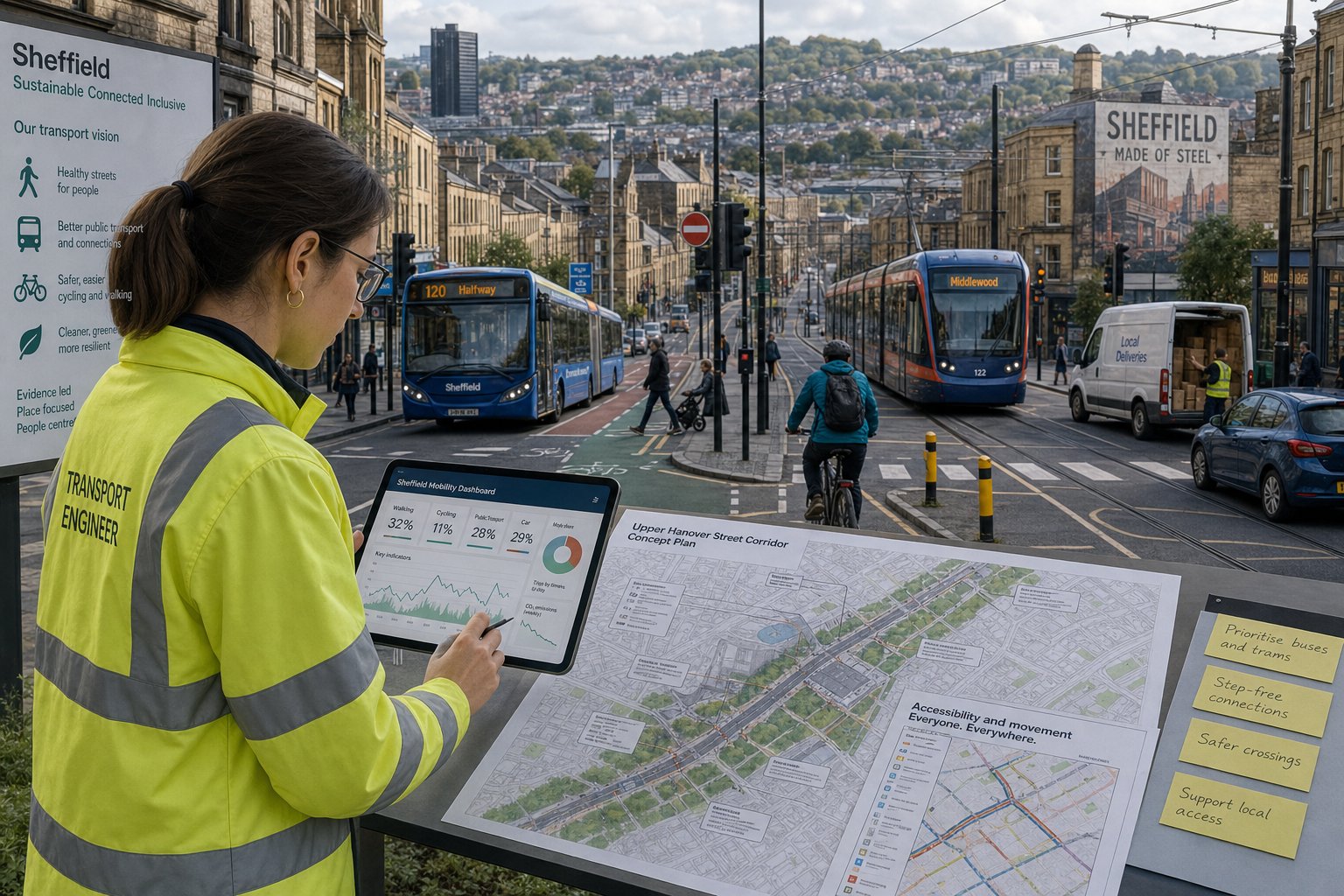
Sheffield has transport characteristics that are easy to list and harder to design around well.
Topography is the first. Steep gradients affect walkability, cycle attractiveness, accessibility for some users and even servicing practicality. A route that looks short on a location plan may feel much less convenient on the ground if it climbs sharply. We hence assess connectivity in a way that reflects real user experience, not just map distance.
Street pattern is another factor. Parts of the city rely on narrow terraced streets, constrained junctions and kerbside activity that leaves little room for error. Parking overspill, delivery stopping and refuse access can become critical issues quickly. Then there are bus corridors, Supertram interfaces and wider South Yorkshire priorities around active travel, decarbonisation and public transport reliability.
In some locations, air quality considerations, city-centre public realm priorities or school street measures will also shape what mitigation is acceptable. A solution based purely on accommodating more car movement may not align with policy direction, even if it appears operationally convenient.
That local policy lens is what distinguishes a generic report from one likely to carry weight. While there are lessons from schemes in Traffic Engineer In Bristol: or Traffic Engineer In London:, Sheffield submissions need to speak directly to Sheffield and South Yorkshire realities. We frame transport evidence around those realities from the start, rather than trying to retrofit them later.
How Traffic Surveys And Data Inform A Robust Planning Submission
Good transport reports are built on evidence, not optimism.
The type of data we collect depends on the site and likely issues. For some schemes, classified turning counts at nearby junctions are essential. For others, queue surveys, automatic traffic counts, speed data, parking beat surveys, pedestrian and cycle counts, or servicing observations provide the clearer picture. We may also review collision history, committed developments and publicly available transport context data.
That information feeds the technical core of the submission. Junction counts support capacity modelling. Speed data informs visibility and access review. Parking surveys test whether displaced demand is likely to be a problem. Pedestrian flows help us understand whether a crossing desire line or footway pinch point could become material.
What matters is not just collecting data, but collecting the right data at the right time. Surveys carried out in an unrepresentative period can weaken confidence. So can counts that miss school activity, peak servicing or network disruption patterns. We usually scope surveys carefully to avoid expensive but irrelevant work.
Done well, data helps move a discussion away from assumption. It gives planning officers and highway officers a shared factual base, which is often what unlocks progress. And when a scheme is challenged, robust evidence is far easier to defend than broad statements about likely minimal impact.
Common Highways And Access Issues That Delay Approval
Some planning delays are complex. Others are painfully predictable.
One of the most common is inadequate visibility at the site access. If splays cannot be achieved because of boundary constraints, parked vehicles, street furniture or gradient, the whole access strategy may need to be revisited. Another frequent issue is poor internal layout: cars overhanging footways, refuse vehicles unable to turn, delivery bays blocking circulation, or disabled parking placed in impractical locations.
We also see applications delayed by an over-reliance on private car trips without enough evidence on sustainable travel alternatives. In Sheffield, that can be particularly problematic where policy supports active travel and public transport use. A weak cycle strategy, poor pedestrian links or unconvincing Travel Plan can make a development feel out of step with local objectives.
Parking and servicing are another flashpoint. Too little parking can create overspill objections: too much can raise policy questions or undermine placemaking. Servicing often causes the real headache, especially on constrained urban sites where delivery vehicles and refuse collection need space the architect would understandably rather use for something else.
Then there is simple underestimation of sensitive network effects. A proposal may not generate huge traffic overall, but if it adds pressure to the wrong junction, near the wrong school, or along the wrong corridor, approval can slow down fast. Most of these issues are manageable, if they are identified early enough.
Working With Architects, Planning Consultants, And Developers On A Scheme
Transport input works best when it is collaborative rather than bolted on at the end.
We usually work iteratively with architects, planning consultants, developers, surveyors and sometimes legal teams from the point where the site strategy is still flexible. That may involve testing alternative access points, marking up internal layouts, reviewing parking ratios, checking service yards, advising on refuse strategy and feeding transport wording into the planning statement or Design and Access Statement.
This process is rarely linear. An architect adjusts the building line, which affects tracking. A planner flags likely policy pressure on car parking, which changes the balance of spaces and cycle provision. A land constraint shifts levels, which then affects pedestrian gradients. Transport engineering sits in the middle of those moving pieces.
Our role is partly technical and partly interpretive. We help the wider team understand what a highways officer is likely to focus on, and we respond when comments come back. That can mean revising drawings, tightening report wording, agreeing planning conditions or preparing evidence for appeal.
With more than 30 years of experience, the approach behind mltraffic.co.uk is built around concise, accurate reporting aligned to local authority thresholds rather than over-produced documents that bury the answer. For project teams, that usually means faster coordination, clearer actions and fewer surprises once the application is live.
How To Choose The Right Traffic Engineer In Sheffield
Not all transport consultants are interchangeable, and the cheapest quote is not always the most economical choice once delays are counted.
We would look for five things.
First, local authority understanding. A consultant should know how Sheffield and the wider South Yorkshire context influence report scope, access design and likely officer concerns.
Second, planning fluency. Technical capability matters, but so does the ability to write clearly for planners, members, applicants and sometimes inspectors. A sound model hidden inside a muddled report is not much use.
Third, relevant software and technical range. Depending on the scheme, that might include PICADY, ARCADY, LINSIG, CAD tools and vehicle tracking packages. Larger or more sensitive proposals may also require microsimulation or more detailed network testing.
Fourth, track record. Ask whether the consultant regularly prepares TS, TA and TP documents for schemes similar to yours, and whether they handle negotiation after submission rather than disappearing once the invoice is paid.
Fifth, professional standards. Membership of bodies such as CIHT or ICE, appropriate PI insurance and a disciplined QA process all matter.
The right adviser should also be pragmatic. We have seen technically correct advice that was almost unusable in planning terms because it ignored programme, budget or design realities. Good traffic engineering solves problems in a way the wider team can actually use.
What To Prepare Before Instructing A Transport Consultant
A better brief produces a better report. It really is that simple.
Before instructing a transport consultant, we recommend assembling the core information that will shape scope and programme:
- site address and red line boundary
- proposed use classes, unit numbers or floorspace
- draft site layout and access drawings
- levels information where gradients may matter
- parking, cycle and servicing assumptions
- proposed phasing, if relevant
- any pre-application advice already received
- previous planning decisions or refusal reasons
- known local concerns, constraints or legal issues
- any existing transport, survey or highway information
If the development team already knows the likely flashpoints, perhaps a difficult junction, neighbour objections, rights over land, or servicing pressure, it helps to say so early. There is no prize for making the consultant guess.
We also advise agreeing practical points upfront: whether the priority is a fast initial review, a full planning package, support for pre-app discussions, or technical backup through determination and condition discharge. That shapes the level of detail we produce from day one.
When the starting information is clear, we can usually scope work more accurately, avoid unnecessary surveys, and focus effort where it will make the biggest difference to the planning outcome. That tends to save both time and money, which clients rarely object to.
Conclusion
In Sheffield, transport is rarely a side issue. It influences access, layout, policy fit, servicing, sustainability and, eventually, whether a scheme feels credible to the decision-maker. Appointing a locally aware traffic engineer in Sheffield early gives the wider team a clearer route through those issues before they harden into objections.
We find that the strongest planning submissions are not always the biggest or most technical. They are the ones built on proportionate evidence, realistic design assumptions and a clear understanding of local transport context. If the access works, the servicing works, the sustainable travel case is credible and the report answers the authority’s real concerns, the application stands on much firmer ground.
That is exactly where focused transport support adds value in 2026: not as paperwork for its own sake, but as a practical tool for faster, more robust local approval.
Frequently Asked Questions about Traffic Engineers in Sheffield
What role does a traffic engineer in Sheffield play in the planning process?
A traffic engineer in Sheffield assesses how developments can be accessed and operated safely within the local transport network, preparing Transport Statements, Transport Assessments, and technical reports to support planning submissions aligned with South Yorkshire policies.
Why is early transport input important for Sheffield developments?
Early transport input helps shape access strategies, parking, and servicing before designs are fixed, reducing redesign and objection risks. Sheffield’s steep topography and local policies on sustainable travel make this early consideration critical for smooth planning approval.
When is a swept path analysis necessary in Sheffield planning applications?
Swept path analysis is required to prove that large vehicles like refuse wagons, fire appliances, and HGVs can manoeuvre safely within site layouts or junctions, ensuring practical vehicle access on constrained or complex urban sites in Sheffield.
What are common traffic-related issues that can delay planning approval in Sheffield?
Typical delays arise from inadequate visibility splays at access points, poor internal layouts preventing vehicle manoeuvres, insufficient parking or servicing space, and over-reliance on car trips without strong sustainable travel proposals, all critical in Sheffield’s local context.
Which types of planning applications in Sheffield typically need traffic engineering support?
Applications including residential estates, apartment blocks, schools, retail, healthcare, logistics sites, and any developments altering access or parking commonly require traffic engineering input to assess trip generation, safety, and network impact.
How do Traffic Statements, Assessments, and Travel Plans differ for Sheffield developments?
A Transport Statement suits smaller schemes with limited impact; a Transport Assessment covers larger developments needing detailed trip and junction analysis; a Travel Plan focuses on encouraging sustainable travel behaviour, all tailored to Sheffield’s local transport requirements.