
Cambridge is one of those places where transport can make or break a planning application faster than many teams expect. A scheme might look sound in architectural, commercial, and even policy terms, yet still stall if the highway and movement case is thin. That’s because access, safety, network impact, sustainability, and travel behaviour are not side issues here: they’re central planning considerations.
For architects, planners, developers, lawyers, surveyors, and councils, the practical challenge is rarely just producing a report. It’s producing the right evidence, at the right time, in a form that speaks clearly to local concerns. In Cambridge, that usually means showing more than vehicle capacity. We need to address cycling priority, walkability, bus connectivity, parking restraint, and the realities of working within a constrained historic street network.
As a result, appointing a Traffic Engineer in Cambridge is often less about box-ticking and more about de-risking the application. We use transport evidence to anticipate objections, shape layouts early, and turn potential highways issues into a coordinated mitigation strategy. With more than 30 years of planning-led experience behind the approach used by ML Traffic, concise and locally tailored reporting remains one of the most effective ways to keep applications moving.
Below, we break down where traffic engineering fits into Cambridge planning, when it is typically required, and how to prepare a transport submission that supports smoother approvals in 2026.
Key Takeaways
- Appointing a Traffic Engineer in Cambridge is essential to de-risk planning applications by addressing local transport priorities such as cycling, walkability, and parking restraint.
- Traffic engineering evidence in Cambridge must go beyond vehicle capacity to include sustainable travel behaviour and align with the city’s strict transport policies.
- Early engagement with traffic engineering helps anticipate objections, shape site layouts, and develop targeted mitigation strategies to support smoother planning approvals.
- Transport submissions should integrate trip generation, junction capacity, access design, and travel plans into a coherent narrative tailored for Cambridge’s constrained historic street network.
- Even small developments require careful transport assessment in Cambridge due to limited highway capacity and the city’s emphasis on active travel and public transport.
- Clear, concise, and planning-led transport reports improve decision-making by demonstrating why schemes are acceptable within Cambridge’s unique transport context.
Why Traffic Engineering Matters For Planning Applications In Cambridge

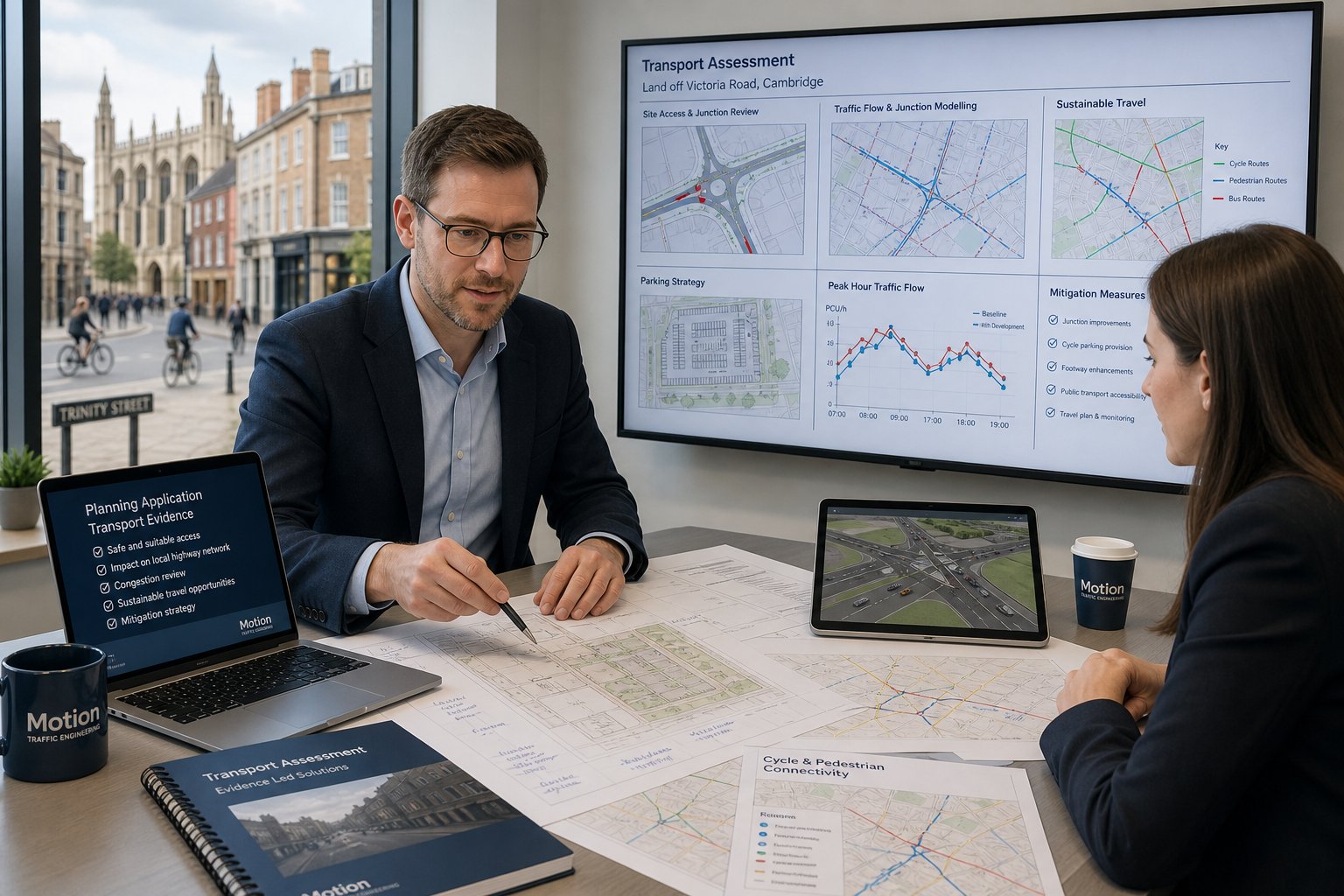
In Cambridge, transport is not a technical appendix that sits quietly at the back of an application. It is often one of the first areas scrutinised by planning officers, highway authorities, and third parties. If a proposal increases trips, changes access arrangements, affects parking demand, or creates conflict with walking and cycling routes, those impacts need to be evidenced properly.
That is where traffic engineering becomes critical. We assess whether a site can be accessed safely, whether nearby junctions can operate acceptably, and whether the wider effects on congestion, road safety, and sustainable travel are reasonable in planning terms. A strong transport case does two jobs at once: it quantifies impact and it explains why the scheme remains acceptable, often with mitigation.
In practice, that might mean baseline traffic surveys, queue observations, swept path analysis, trip generation, junction modelling, and a review of local collision patterns. But numbers alone are never enough. Cambridge decisions are heavily influenced by policy and place. A technically correct document that ignores local movement priorities can still feel tone-deaf.
That’s why planning teams often benefit from advice shaped around both highways evidence and application strategy. Our work tends to align with the broader role described in Highway And Traffic support, where the objective is not just analysis, but planning success. In a city as constrained and transport-sensitive as Cambridge, that distinction matters.
How Cambridge Planning Context Shapes Transport Requirements
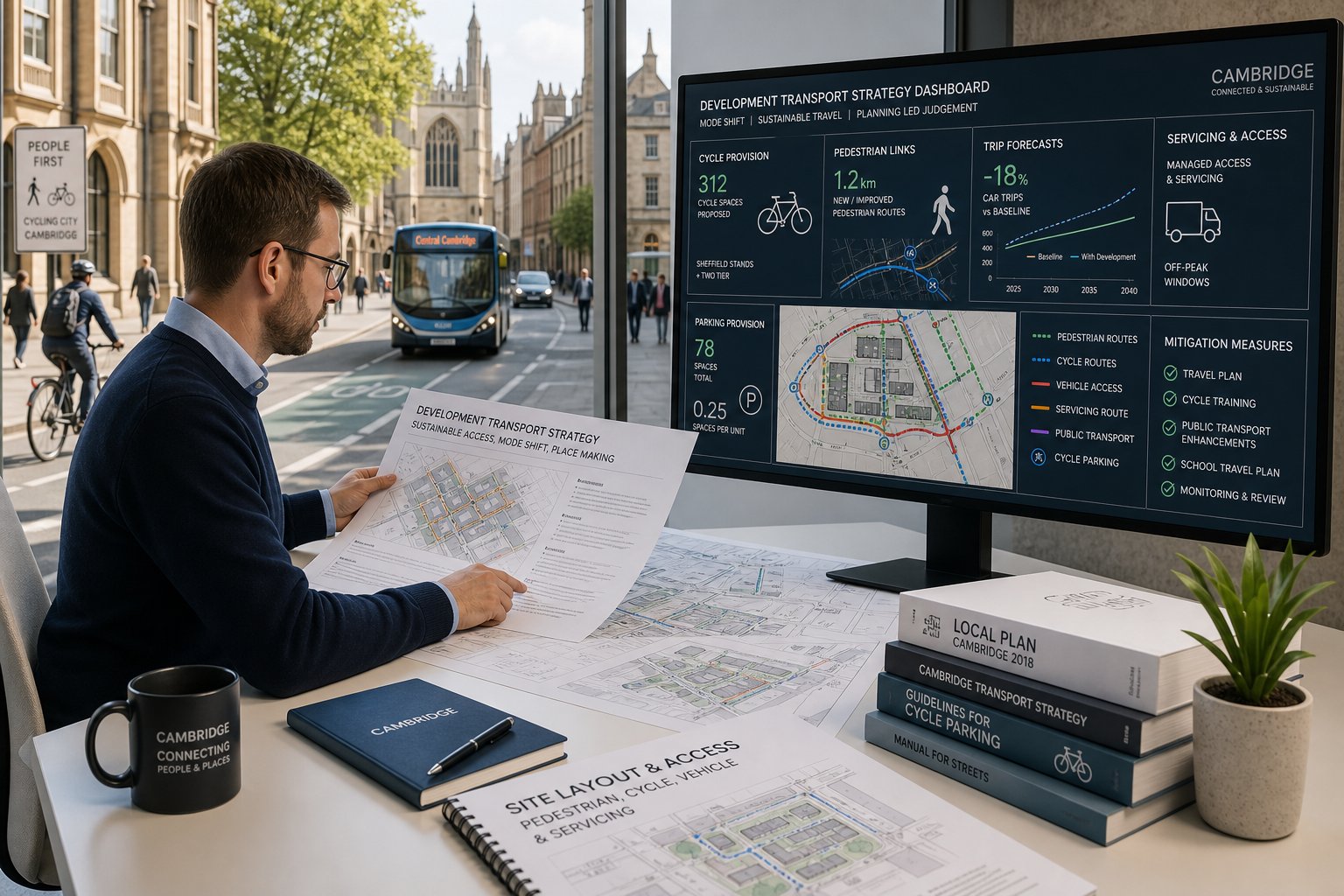
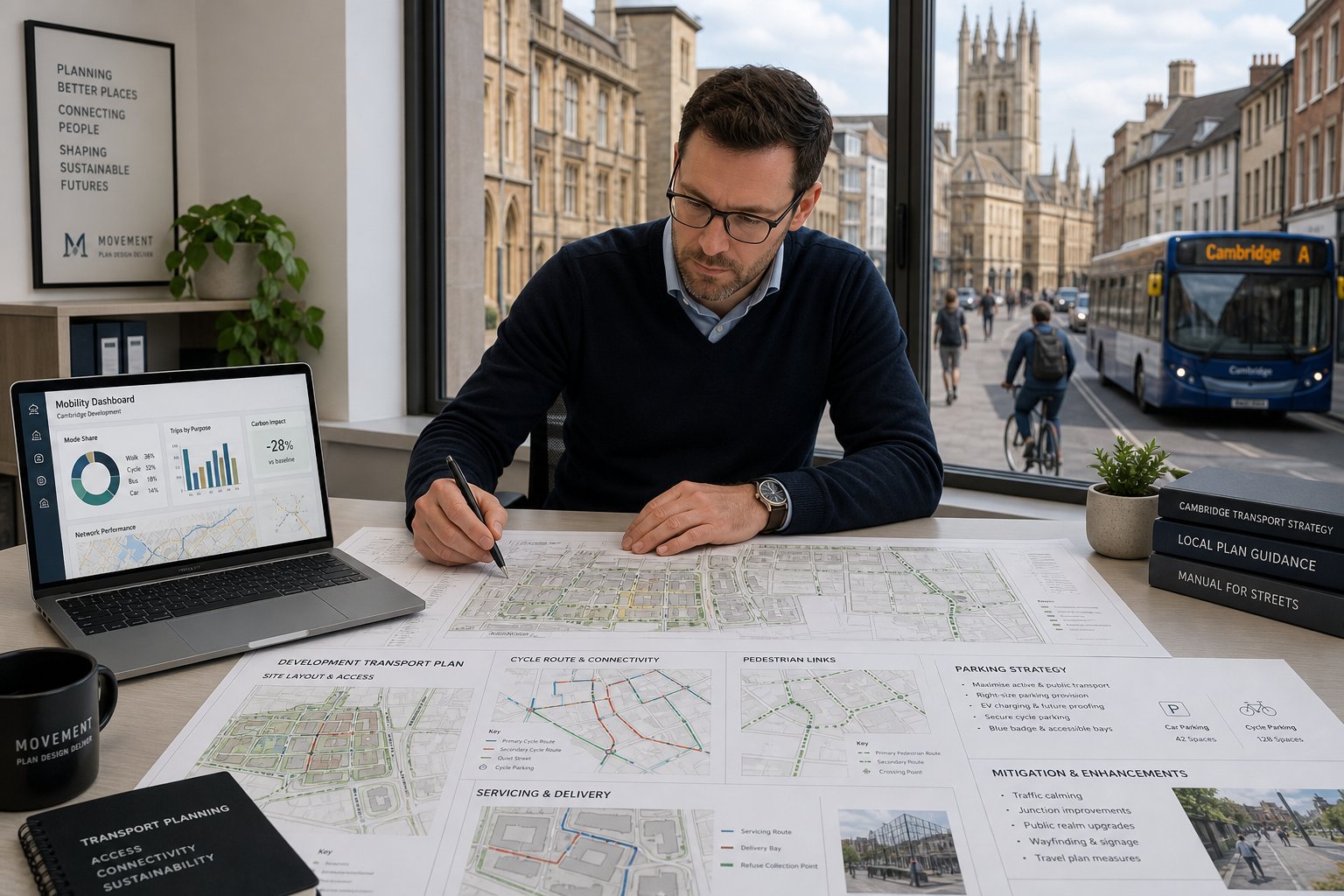
Cambridge has a transport profile that is unusually demanding. High cycling mode share, established walking patterns, bus movement constraints, limited road space, sensitive historic streets, and pressure on parking all shape what the local authority expects from development. In simple terms, schemes are usually expected to support mode shift rather than rely on private car growth.
That affects everything from access design to parking strategy. A proposal that might be acceptable in a more car-oriented location can face much closer examination in Cambridge, especially if it appears to undermine active travel priorities or add pressure to already constrained corridors. Even modest developments can trigger concern if servicing, drop-off activity, or turning movements are poorly handled.
We hence need to frame transport submissions around local policy intent as well as operational evidence. The question is not only, “Can vehicles get in and out?” It is also, “Does the scheme fit Cambridge’s movement hierarchy, and does it reinforce sustainable travel behaviour?”
This is where early, planning-led judgement matters. A generic report template rarely survives first contact with a city that has such a distinctive transport character. Good advice pulls together site layout, access, cycle provision, pedestrian links, trip forecasts, and mitigation into one coherent narrative. That broader mindset is reflected in Traffic Engineering and Transportation, where transport planning is treated as part of development strategy rather than a late-stage compliance exercise.
When A Traffic Engineer Is Typically Needed
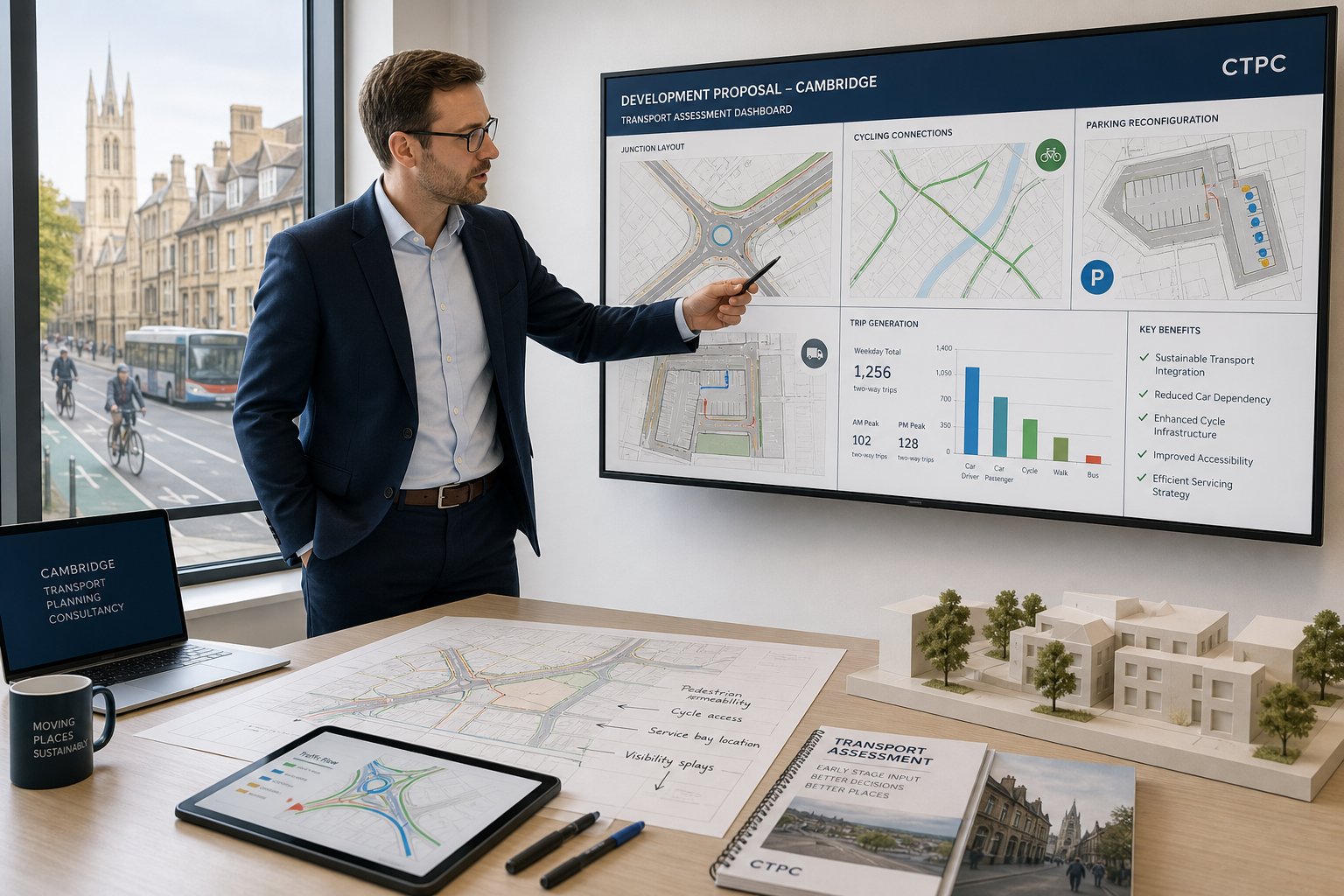
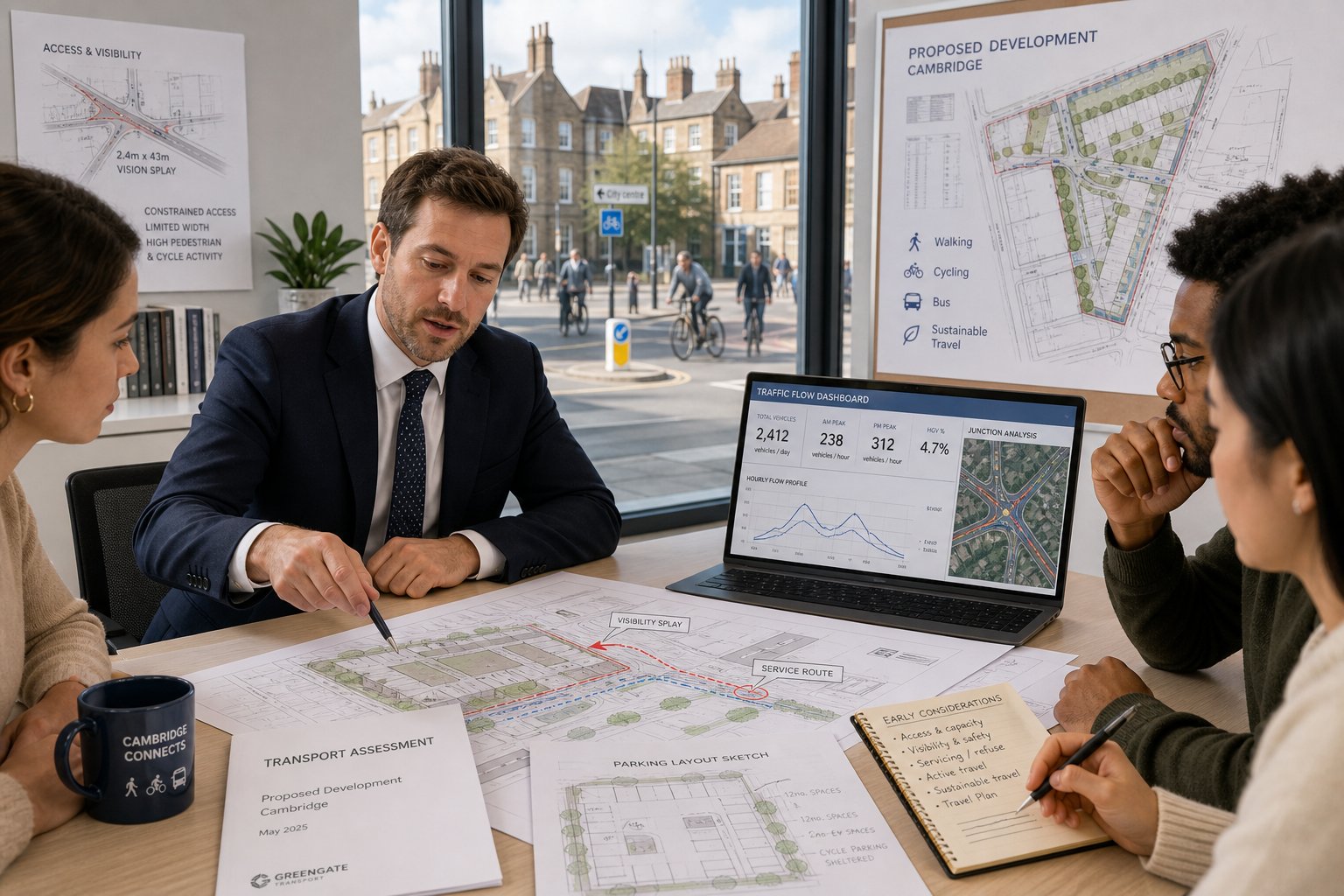
A traffic engineer is usually needed when a development has a realistic prospect of generating material transport effects, or when transport issues are likely to become a planning focus. In Cambridge, that threshold can arrive earlier than some applicants expect because even relatively small changes can have knock-on effects in tightly constrained locations.
Typical triggers include new or altered access points, increased trip generation, parking reconfiguration, servicing changes, highway works, or proposals likely to require a Transport Statement, Transport Assessment, or Travel Plan. We are also commonly brought in where there is likely to be sensitivity around junction operation, cycling safety, school travel, or city-centre servicing.
Just as importantly, there are projects where a formal threshold may look marginal on paper, but the planning risk still justifies early traffic input. That tends to happen with awkward frontage conditions, constrained visibility, neighbouring objections, or sites with a history of access concerns. In those cases, getting transport advice in early can prevent expensive redesign later.
For development teams weighing up timing, the earlier question is often not whether a report will eventually be needed, but whether transport evidence could shape the proposal before it hardens. In our experience, it usually can.
Residential, Commercial, Education, And Mixed-Use Schemes
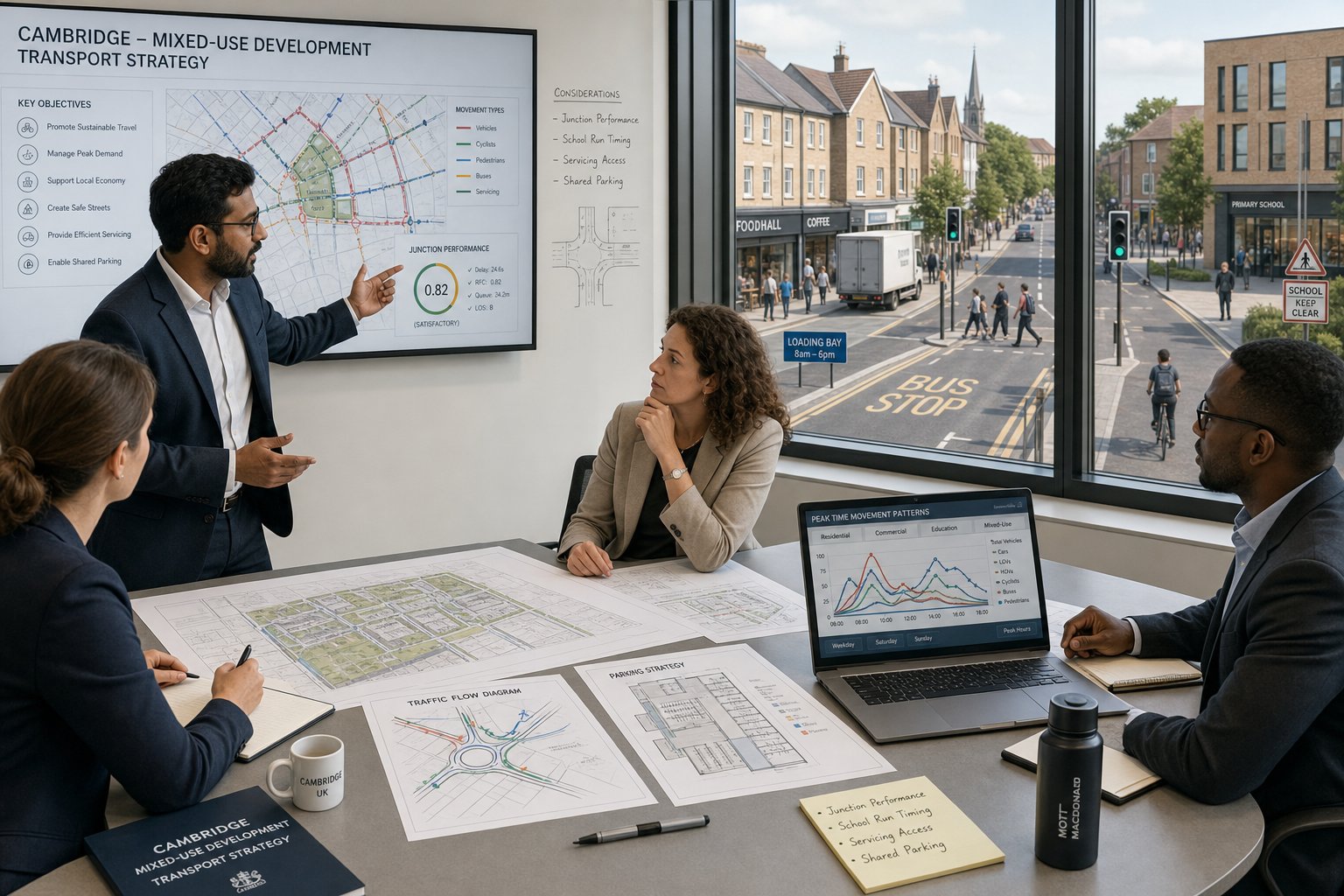

Different land uses generate different transport risks, and Cambridge authorities will usually want those differences addressed directly rather than folded into generic assumptions.
Residential schemes often raise questions around parking restraint, visitor demand, cycle storage, school-run effects, and peak-hour junction performance. Family housing and student accommodation can produce very different travel patterns, so the analysis needs to reflect who will actually use the site.
Commercial schemes bring another layer: deliveries, servicing, staff arrivals, customer access, and the practical operation of loading space. A small urban unit can cause disproportionate friction if vans have nowhere suitable to stop.
Education schemes are particularly sensitive in Cambridge because concentrated arrival and departure peaks can create safety issues around crossing points, bus stops, and frontages. Even where total daily trips are manageable, the timing can be the problem.
Mixed-use schemes are more complex still. They may benefit from internal trip capture and shared parking, but they also create overlapping demand profiles that need careful explanation. We often have to show how different uses interact across the day, not just as separate trip tables. That sort of joined-up analysis is a hallmark of effective Traffic Engineering: Your support on more layered urban sites.
Change Of Use, Redevelopment, And Site Intensification
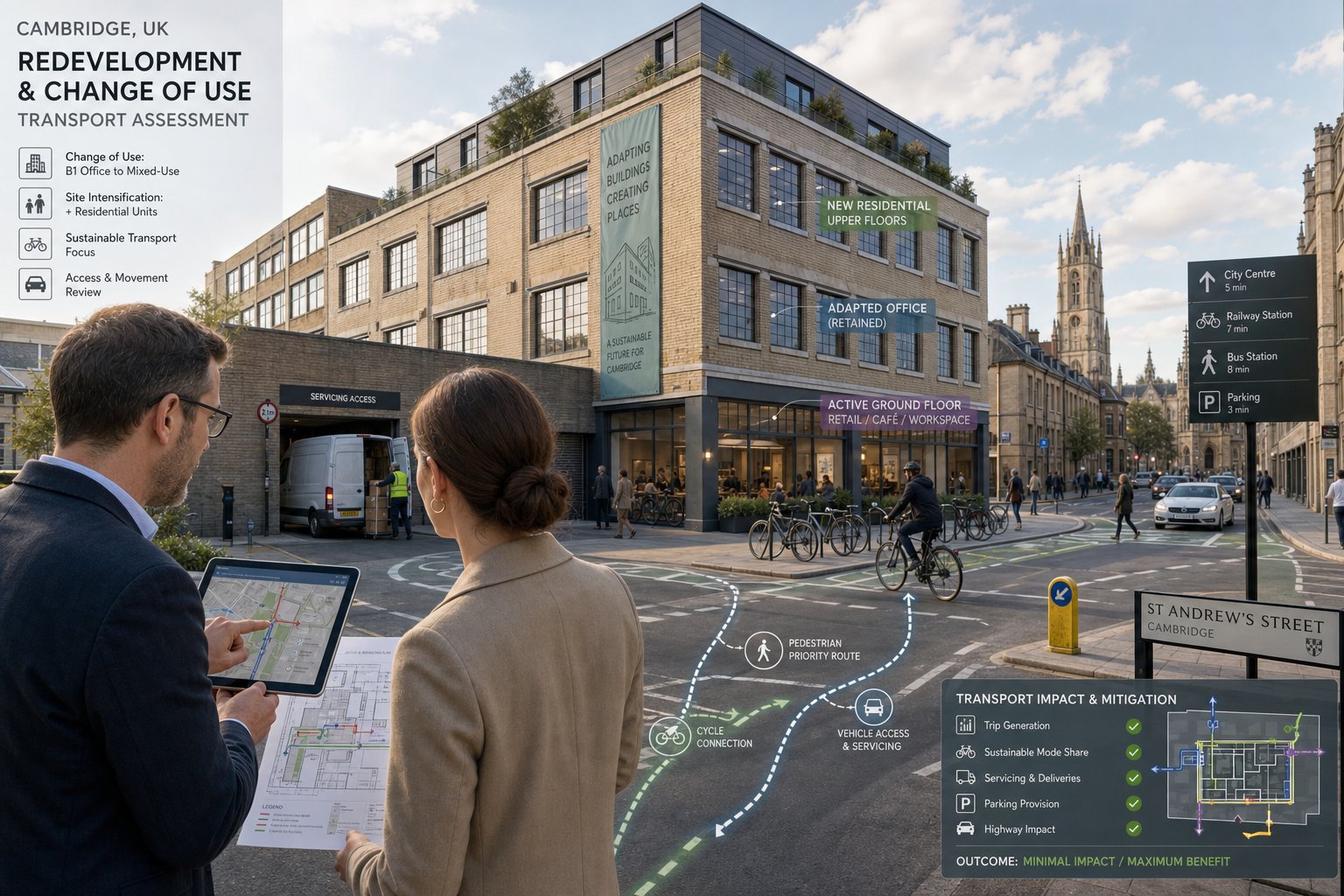
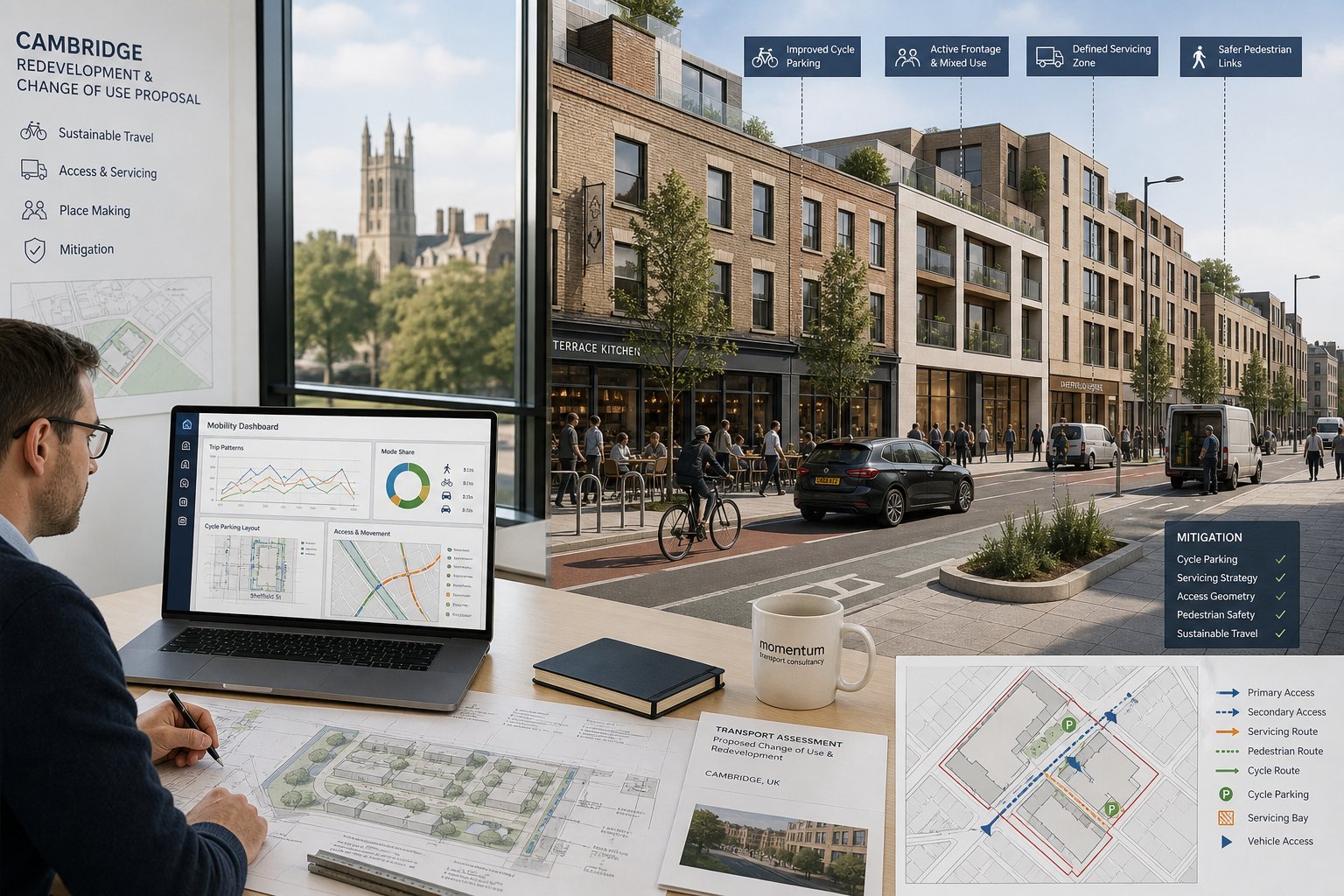
Change-of-use schemes can look deceptively simple. The building may already exist, the access may already be established, and the applicant may assume transport risk is limited. But in Cambridge, the question is often whether the proposed use changes the intensity, timing, or character of movement enough to create a planning issue.
A restaurant replacing an office, a residential conversion with reduced parking, or a redevelopment that increases floorspace can all alter vehicle trips, cycle demand, servicing frequency, and street-level conflict. The local authority will typically want to know whether the new pattern of use remains acceptable for the surrounding network and frontage conditions.
We hence compare existing lawful use assumptions with proposed activity, test whether access arrangements remain suitable, and identify whether mitigation is needed. Sometimes the answer is modest: clearer servicing controls, revised cycle parking, or minor access adjustments. Sometimes it is more substantial, involving junction assessment, swept path review, or a full transport statement.
Redevelopment and intensification also create opportunity. A more efficient site layout, better pedestrian permeability, or a stronger travel plan can offset concerns that raw trip numbers alone might trigger. The key is to present transport as part of the improvement story, not just as a hurdle to be defended.
Core Traffic Engineering Services For Cambridge Developments
For Cambridge developments, traffic engineering services usually need to be both technically robust and tightly focused. Planning teams do not benefit from bloated reporting that says everything and settles nothing. They need evidence targeted to the actual risks of the site.
Core services commonly include baseline traffic and multimodal surveys, trip generation analysis, junction capacity assessment, access design review, parking and servicing appraisal, swept path analysis, and support for Transport Statements, Transport Assessments, and Travel Plans. Depending on the proposal, we may also advise on road safety concerns, mitigation packages, or the likely scope of planning conditions.
What matters most is matching the level of work to the planning issue. An urban infill scheme may need a concise, well-argued statement focused on access and sustainable travel. A larger or more controversial proposal may require a broader evidence base and direct engagement with highway stakeholders.
That is why concise reporting can be an advantage when it is backed by solid analysis. The aim is not to impress with volume: it is to make decision-making easier. The more clearly we identify transport impacts, thresholds, assumptions, and mitigation, the easier it becomes for officers and consultees to follow the logic of the submission.
Transport Statements, Transport Assessments, And Travel Plans
These are the documents most planning teams encounter, but they are often misunderstood.
A Transport Statement is typically used where impacts are material but relatively limited. It explains existing conditions, estimates likely trip effects, and addresses access, parking, servicing, and sustainable travel in a proportionate way. A Transport Assessment goes further, providing a deeper review of network operation, capacity effects, and mitigation where impacts are more significant.
A Travel Plan is different again. It is not simply a policy add-on. In Cambridge, it can be central to demonstrating that a scheme aligns with local expectations around mode shift. Measures might include cycle facilities, welcome packs, public transport information, car club support, monitoring commitments, and low-car management arrangements.
The real skill lies in making these documents speak to one another. A trip forecast in the statement or assessment should align with the behavioural assumptions in the Travel Plan. Parking strategy should support the sustainable transport narrative rather than undermine it. Where useful, broader guidance from Traffic Engineering Consultants: work helps frame what level of reporting is proportionate and what local authorities are typically trying to test.
Junction Capacity, Trip Generation, And Access Appraisals
This is often where transport evidence becomes most scrutinised. If predicted trips are too optimistic, or the wrong junctions are tested, confidence in the whole submission drops quickly.
Trip generation is usually derived from recognised databases and then adjusted using local judgement. In Cambridge, that judgement matters a lot. A suburban benchmark heavy on car use may not reflect a central, cycle-rich, bus-accessible location. Equally, overplaying mode shift without evidence can backfire. We need assumptions that are realistic, defensible, and clearly explained.
Junction capacity work then examines whether nearby priority junctions, signals, roundabouts, or access points can accommodate likely demand. The focus is typically on delay, queueing, reserve capacity, and operational resilience at key times. But capacity is only part of the picture. Access appraisals also consider geometry, visibility, turning movements, servicing practicality, and conflict with pedestrians and cyclists.
Sometimes the best outcome is not a more complicated model but a better-designed access arrangement. Early technical review can save an application from relying on mitigation that is expensive, uncertain, or simply unnecessary. And where wider comparator thinking helps, examples from a Traffic Engineer In Bristol: context can illustrate how local thresholds and urban constraints shape otherwise familiar technical tasks.
Key Local Issues That Affect Cambridge Sites
Cambridge sites tend to be shaped by a handful of recurring transport constraints, and ignoring any one of them can weaken an otherwise strong application.
First, highway capacity is limited. Not everywhere is gridlocked all day, of course, but many corridors and junctions operate with little slack in the peak. Small traffic increases can hence attract disproportionate attention, especially where there is existing delay or bus reliability pressure.
Second, cycling is not a peripheral mode here. It is a core movement reality. That changes how access points, visibility splays, crossing design, kerbside activity, and servicing strategy should be assessed.
Third, parking is rarely a simple numbers exercise. Controlled parking zones, car-free or low-car expectations, displacement concerns, and the operational needs of residents or businesses all need careful treatment.
Fourth, Cambridge’s historic and city-centre environment creates physical limits. Streets can be narrow, frontages active, and scope for conventional highway solutions quite limited. On some sites, the answer is not engineering our way to more vehicle accommodation but reducing conflict through demand management and better site design.
For project teams used to more forgiving highway contexts, this local combination can be surprisingly exacting.
Cycling, Walking, Public Transport, And City Centre Constraints
In Cambridge, active travel and public transport are not background considerations to be dealt with in a final chapter. They are often the organising principle of the transport case.
Cycle access must be direct, legible, and safe. That means more than providing stands or stores. We need to consider route continuity, interaction with vehicles at accesses, crossing points, visibility, gradients, and whether cyclists are being pushed into awkward desire lines. The same is true for walking. Short, clear, overlooked pedestrian routes can be more persuasive in planning terms than a technically compliant but inconvenient arrangement.
Public transport matters too, particularly for larger residential, education, office, and mixed-use schemes. Proximity to bus stops or rail is only the start: the route quality between the site and those services must also work in practice.
City-centre and heritage constraints make this harder. Tight corridors, listed frontages, limited loading space, and competing kerbside functions mean there is often no perfect solution. We have to balance movement, place, and heritage sensitivity with a degree of realism. Comparable urban lessons can be found in a Traffic Engineer In London: setting, where constrained streets demand similarly careful trade-offs.
How To Prepare A Strong Transport Submission
The strongest transport submissions usually start earlier than the first draft of the planning statement. If transport is brought in at pre-application stage, we can influence site layout, parking strategy, access design, servicing arrangements, and document scope before positions become expensive to change.
A good first step is agreeing the likely level of assessment with the local highway authority or through pre-app dialogue. That helps avoid a common problem: either under-scoping the work and inviting objections, or over-scoping it and burying the application in unnecessary technical detail.
After that, the essentials are straightforward, though not always easy. Use current survey data. Tie assumptions to local policy and actual site context. Explain trip generation clearly. Test the right junctions. Make sure drawings, parking numbers, servicing notes, and Travel Plan measures all line up. If mitigation is proposed, show that it is specific, deliverable, and proportionate.
It also helps to write for decision-makers, not just modellers. Officers and consultees need to understand the story the evidence is telling. Why is the scheme acceptable? What are the residual impacts? How are they being managed?
That planning-led discipline is why many teams look for a Traffic Engineer in Cambridge approach that combines quick turnaround with local-authority awareness and concise reporting. When transport submissions are coherent, they tend to move through the system with fewer surprises.
Conclusion
In Cambridge, transport evidence is rarely peripheral. It sits close to the heart of whether a scheme is seen as safe, workable, and aligned with local policy. That is why a Traffic Engineer in Cambridge can add real value long before an application is submitted.
For us, the job is not just to produce a report. It is to identify risk early, shape practical mitigation, and present a clear planning case that responds to Cambridge’s particular transport pressures, cycling priority, constrained streets, parking restraint, and sustainable travel expectations included.
When traffic engineering is handled early and proportionately, it helps turn transport from a likely objection into a reasoned, evidence-backed part of the approval strategy. And in a city where small transport details can carry surprising weight, that can make all the difference.
Frequently Asked Questions about Traffic Engineering in Cambridge
Why is appointing a traffic engineer important for planning applications in Cambridge?
In Cambridge, transport issues are key planning considerations. A traffic engineer provides evidence on access safety, junction capacity, and impacts on congestion, cycling, and parking, helping to reduce risks and support smoother planning approvals.
When is a traffic engineer typically required for a development in Cambridge?
A traffic engineer is usually needed when proposals involve increased trips, new or changed access, parking alterations, servicing changes, or require a Transport Statement, Assessment, or Travel Plan, especially given Cambridge’s constrained transport environment.
How does Cambridge’s local transport context affect traffic engineering requirements?
Cambridge prioritises sustainable travel, with high cycling mode share and limited road space. Schemes must support mode shift, incorporate cycling and pedestrian provisions, and manage parking tightly to meet local authority expectations.
What core traffic engineering services support developments in Cambridge?
Services include baseline and multimodal traffic surveys, junction capacity modelling, access design appraisal, parking and servicing layouts, swept path analysis, road safety audits, and assistance with Transport Statements, Assessments, and Travel Plans.
How can transport assessments in Cambridge address cycling and walking priorities?
Transport assessments must ensure safe, direct, and legible cycle routes and pedestrian links, considering visibility, crossing safety, and route continuity to align with Cambridge’s high active travel mode share and local policies.
What steps help prepare a strong transport submission for planning in Cambridge?
Early engagement with a traffic engineer, agreeing scope with highway authorities, using current local data, aligning with policy, and presenting clear, concise evidence with realistic mitigation measures enhance approval chances.