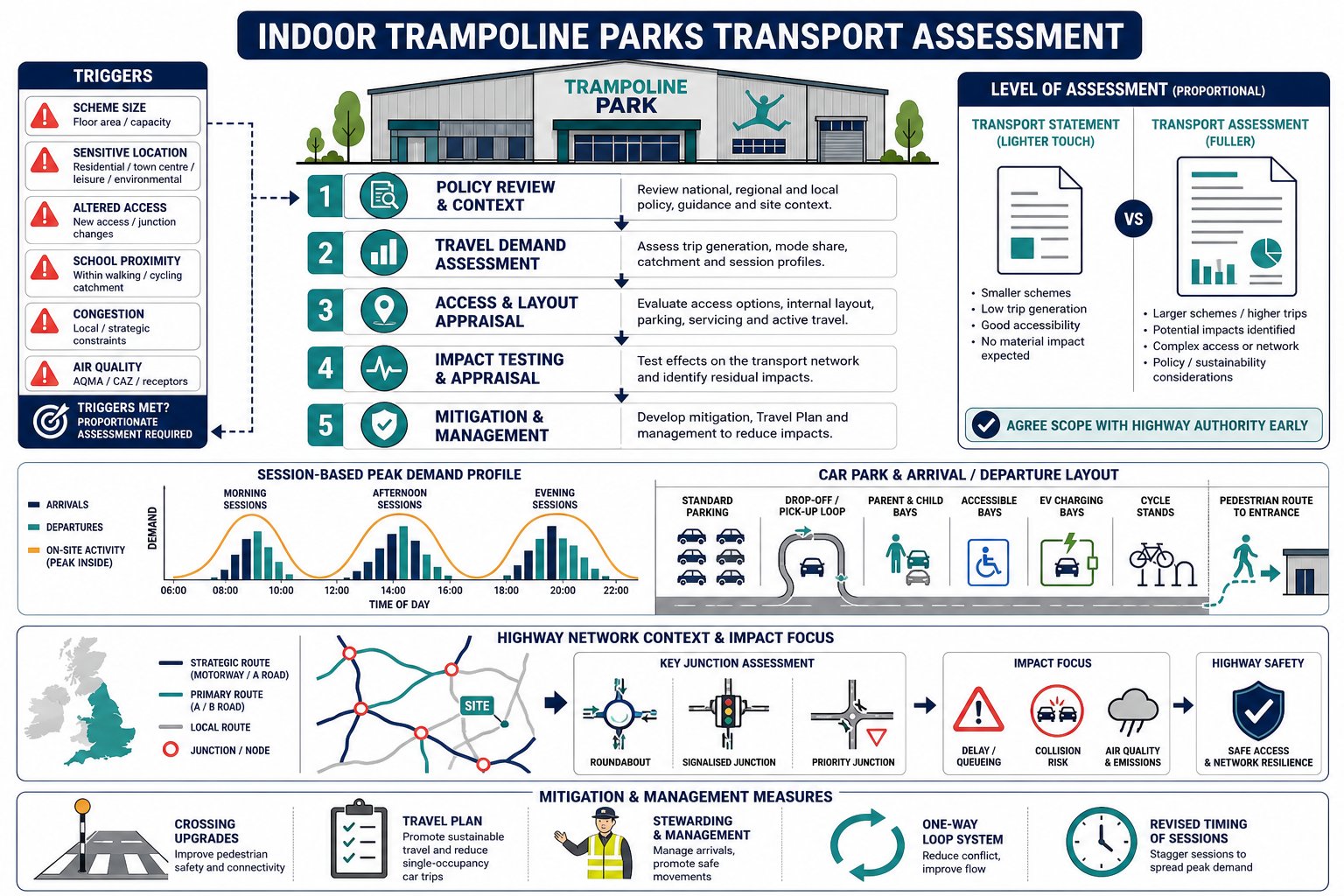
Getting an indoor trampoline park through planning is rarely just about proving there is demand for the use. In practice, the harder questions usually sit outside the building: how people arrive, where they park, whether session changeovers create sudden traffic spikes, and what that means for nearby junctions, neighbours, and highway safety.
That is why an Indoor Trampoline Park Transport Assessment matters. For leisure schemes, especially those involving children, parties, school groups and concentrated weekend demand, transport impacts can look quite different from standard retail or gym assumptions. A site that appears acceptable on paper can quickly become problematic if drop-off activity spills onto the highway, if peak arrivals overlap with school traffic, or if parking demand has been based on the wrong comparator.
From our perspective, a strong assessment does two things at once. First, it gives local planning authorities and highway officers confidence that the likely effects have been properly quantified. Second, it helps the wider consultant team shape a more workable scheme from the start, with better access, more realistic parking, and clearer mitigation.
In 2026, that means going beyond a generic template. We need evidence-led forecasting, local policy awareness, robust survey work and a credible strategy for sustainable travel. Done properly, the transport case becomes part of the reason a proposal moves forward rather than one of the reasons it stalls.
Key Takeaways
- An Indoor Trampoline Park Transport Assessment is crucial to demonstrate safe and efficient access, addressing trip generation, parking, and local highway impacts specific to leisure use patterns.
- The assessment must consider fixed session peaks, drop-off activity, and distinct customer profiles to avoid underestimating transport demand and parking needs.
- Local planning policies and highway thresholds heavily influence the assessment’s scope, requiring early engagement with authorities to define requirements and avoid costly redesigns.
- Robust evidence including multi-period traffic counts and surveys at comparable parks ensures accurate trip forecasts and highlights peak travel times, critical for managing traffic flow and parking accumulation.
- Effective mitigation strategies such as staggered session times, drop-off management, and a credible Travel Plan improve operational functionality and build confidence among planners and highway officers.
- A comprehensive transport assessment integrates parking layout, staff travel, servicing logistics, and junction capacity analysis to support smooth operation and successful planning approval.
What An Indoor Trampoline Park Transport Assessment Covers
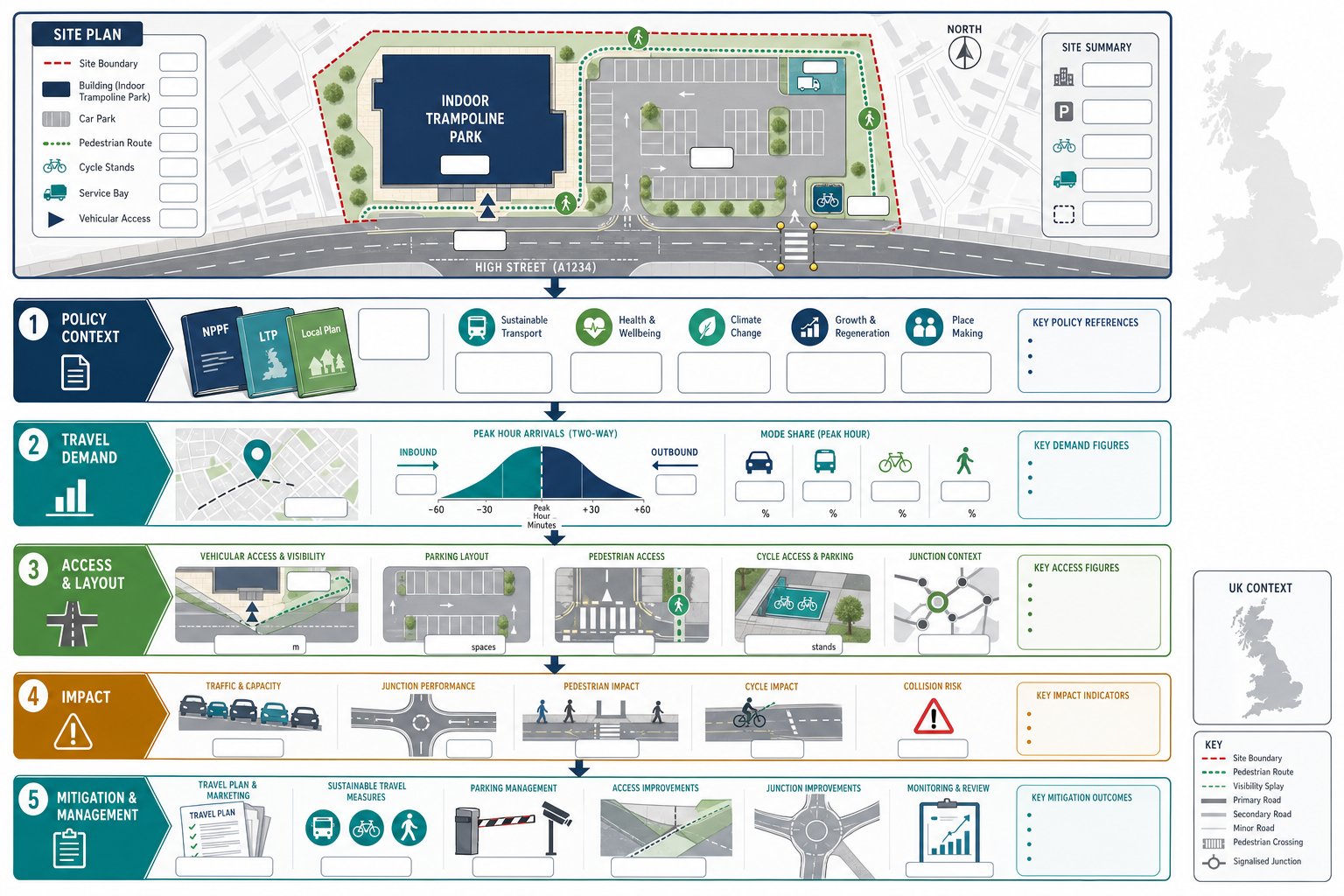
An Indoor Trampoline Park Transport Assessment is the transport planning document that explains how a proposed trampoline park will function in movement terms and whether its effects are acceptable. In the UK planning context, that usually starts with a clear description of the development itself: gross internal area, likely capacity, opening hours, session format, any café or party rooms, staffing levels, and whether the proposal is a new build, subdivision, or change of use.
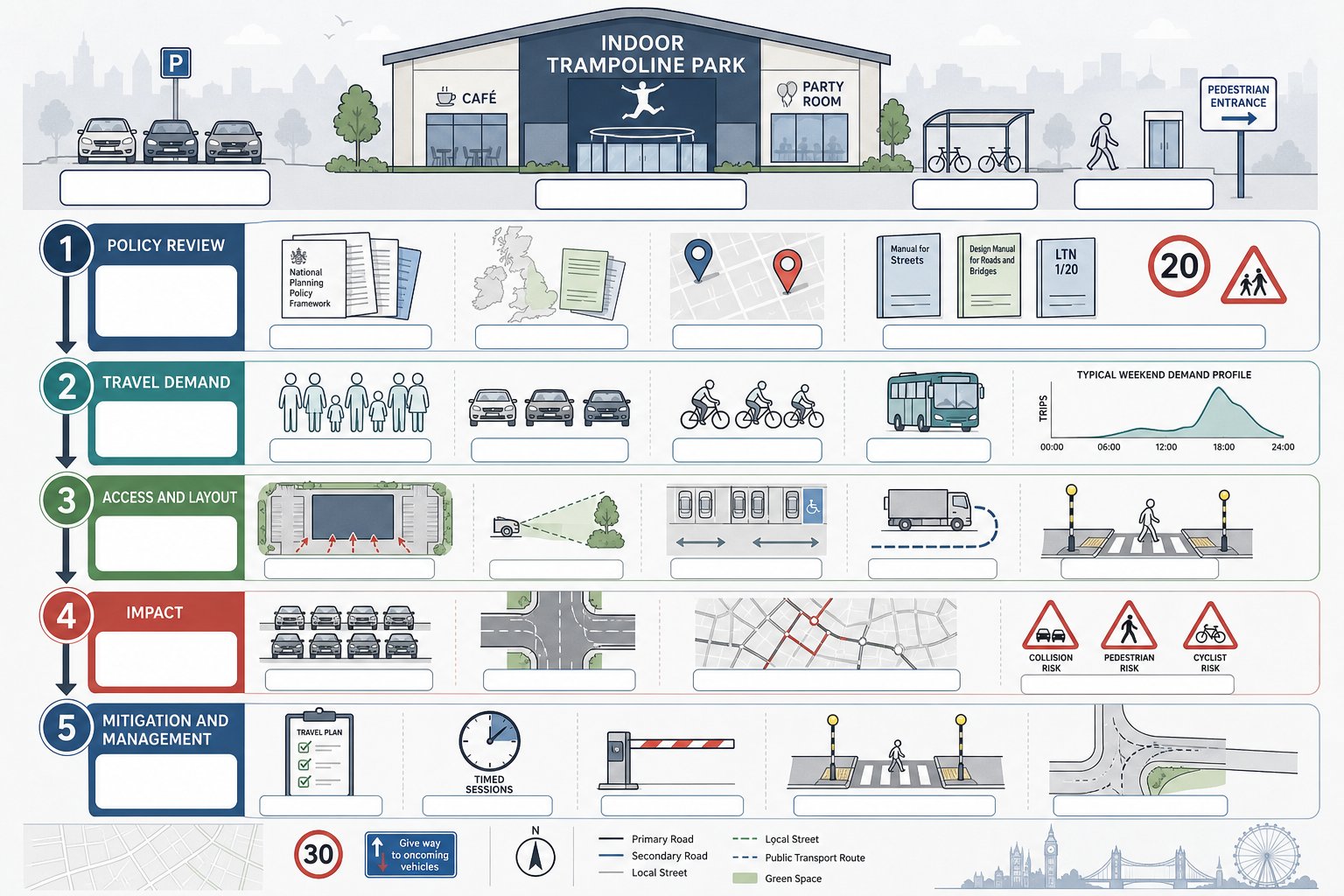
From there, the scope normally expands into five core themes.
First, policy. We review the National Planning Policy Framework, local plan transport policies, adopted parking standards, cycle parking requirements, and any wider local transport strategies. Leisure uses often sit in a policy grey area unless the analyst is careful, so we need to translate broad planning policy into site-specific transport tests.
Second, travel demand. That means trip generation, likely mode share, and the timing of arrivals and departures. For trampoline parks, fixed sessions can create short, sharp peaks that are more important than a standard daily average.
Third, access and layout. We assess site access arrangements, visibility, internal circulation, parking layout, pedestrian routes and whether servicing can operate safely alongside customers.
Fourth, impact. That includes parking accumulation, nearby junction capacity, network effects, and road safety based on collision records.
Finally, mitigation and management. This may include a framework Travel Plan, car park controls, revised session timing, crossing improvements, or access changes. The same disciplined approach applies across sectors, whether we are dealing with a leisure destination or transport assessment for developments: more broadly.
When A Transport Assessment Or Transport Statement Is Likely To Be Required
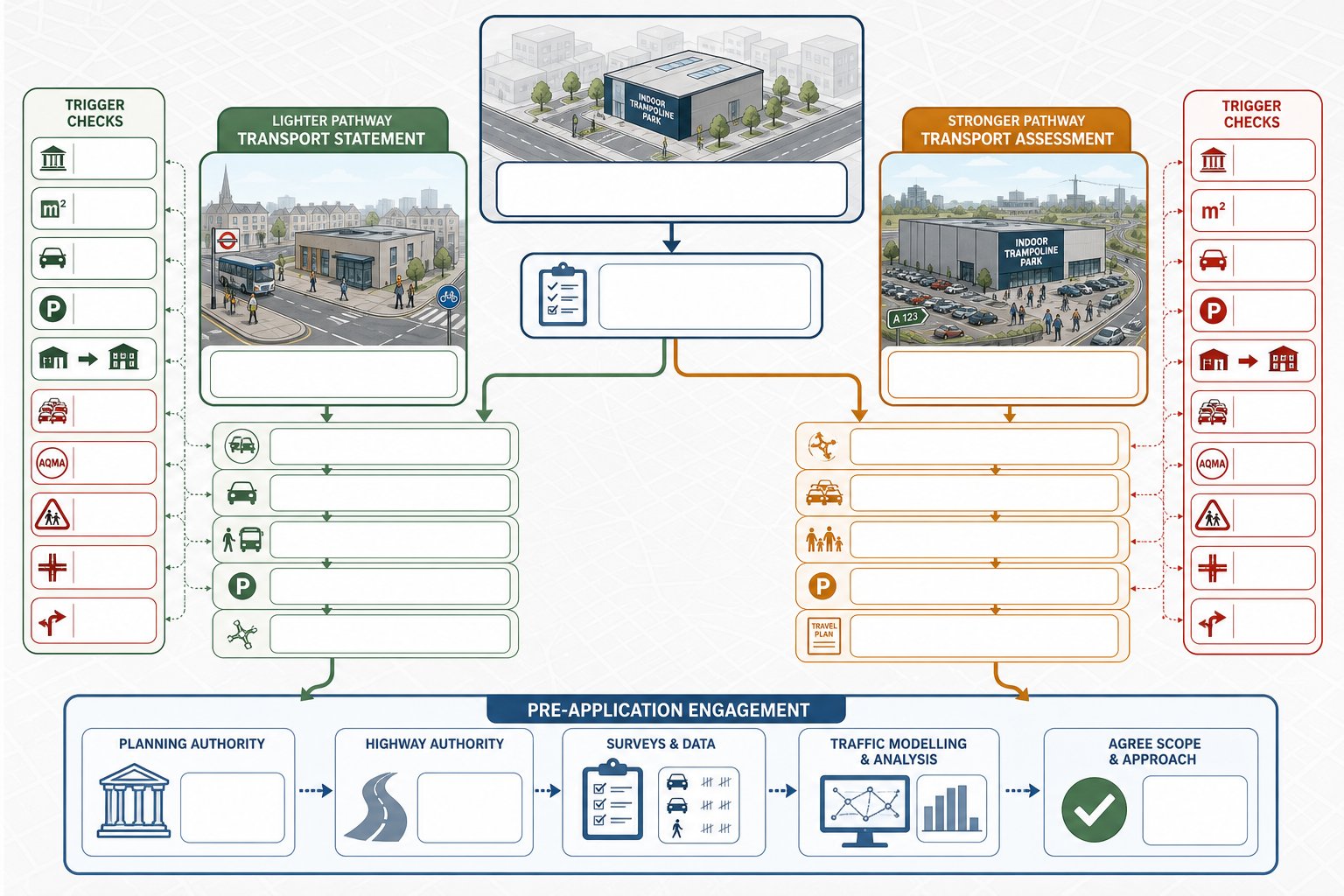
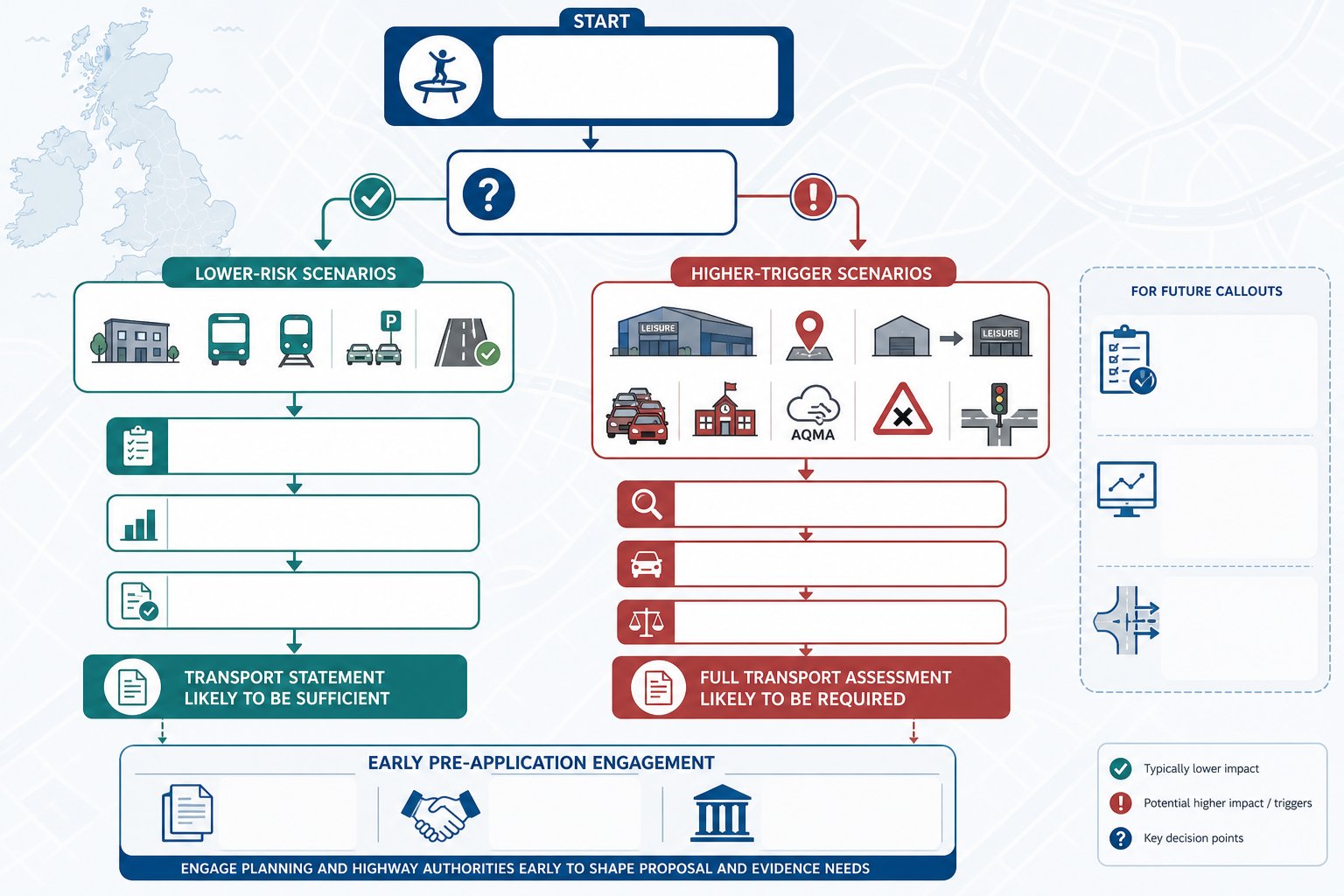
Not every trampoline park proposal needs a full Transport Assessment, but many do. The distinction usually turns on scale, location sensitivity, existing highway conditions, and whether the proposal changes the traffic profile materially.
A smaller scheme in a well-connected urban location, with modest floorspace and no access alterations, may only require a Transport Statement. That lighter document can still address traffic, parking and accessibility, but usually in less depth. A larger site, an edge-of-centre leisure box, or a change of use from relatively low-traffic warehousing to a family leisure use is far more likely to trigger a full assessment and often a Travel Plan as well.
In practice, local authority thresholds matter. Some councils set thresholds by gross floor area, some by expected trips, and others by parking provision or use class context. Highway authorities may also request a full assessment where the site sits near a congested corridor, within an Air Quality Management Area, close to schools, or beside a collision-sensitive junction.
New or altered accesses are another common trigger. Once the proposal requires a fresh priority junction, revised signal access, or material change in turning movements, highway officers will usually want more than a high-level statement.
The safest approach is to confirm scope early with the planning and highway authority through pre-application engagement. That avoids the familiar problem of submitting a lean document, only to be asked later for extra surveys, modelling and redesign.
How Local Planning Policy And Highway Thresholds Shape The Scope
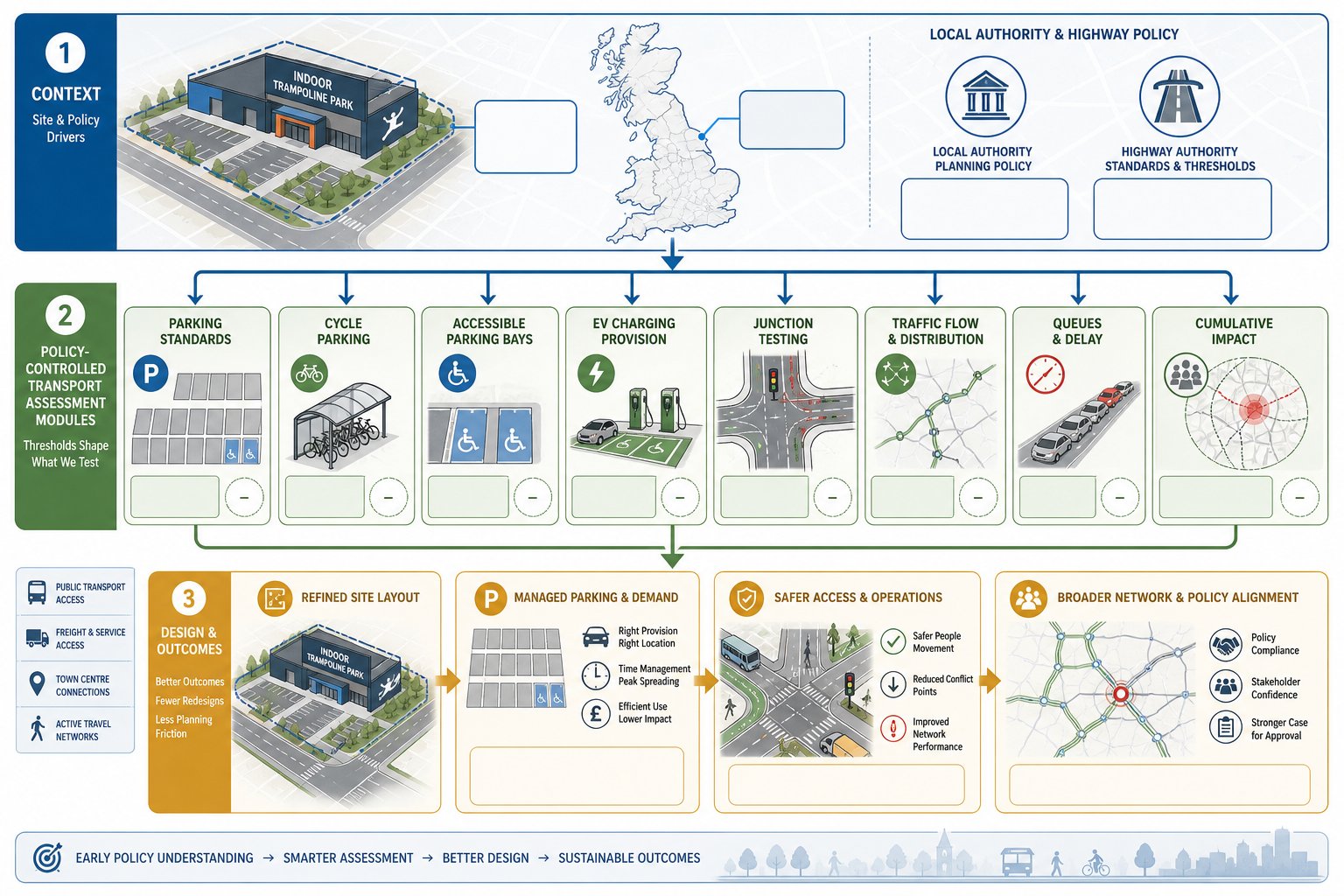
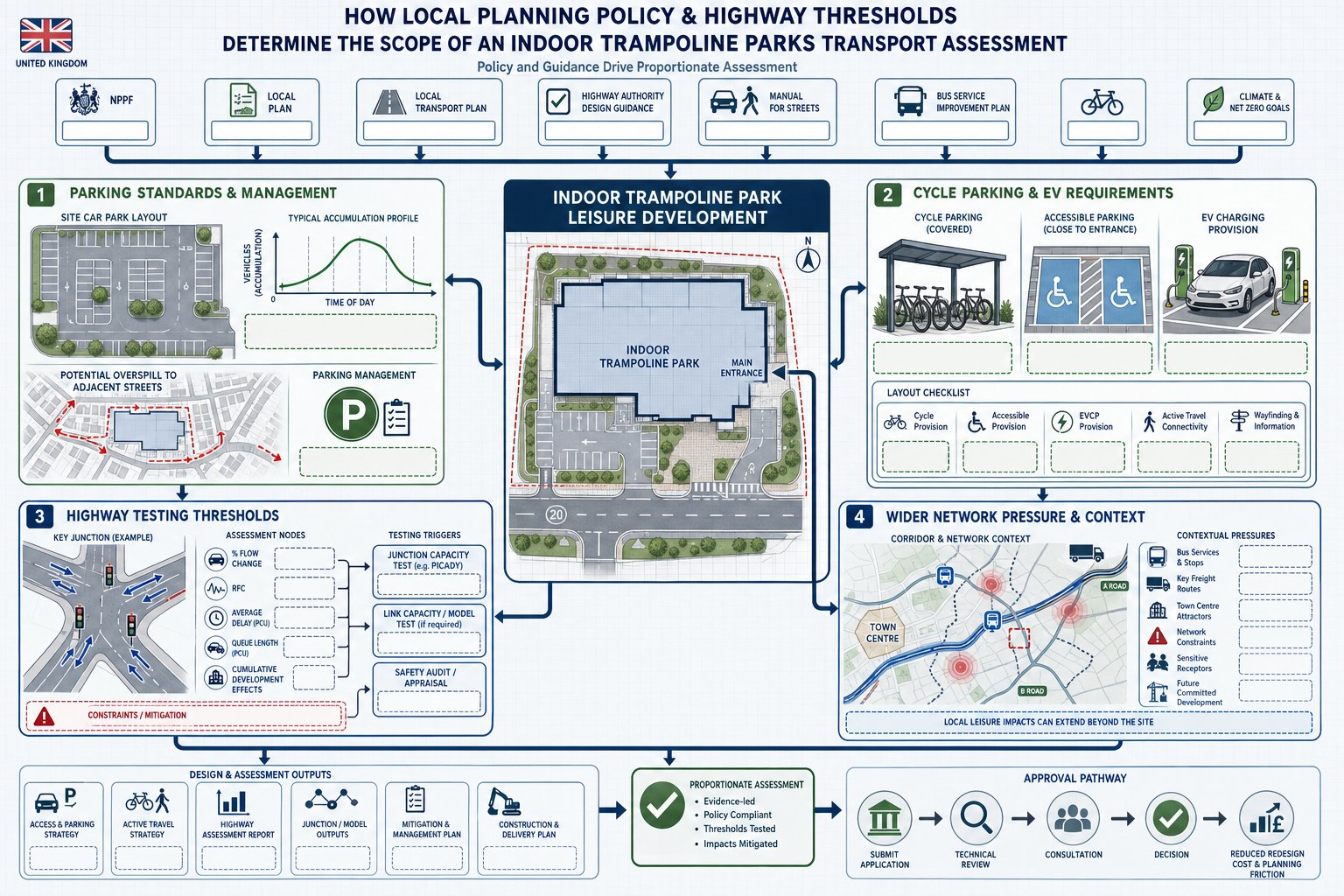
Policy does not just sit in the background: it defines what the assessment must prove. For an indoor trampoline park, local planning policy and highway authority guidance often shape the scope as much as the physical site does.
Parking standards are a good example. Some authorities apply leisure parking standards directly. Others rely on town centre accessibility, maximum parking principles, or case-by-case judgement. That affects not only how many spaces may be acceptable, but whether we need a detailed parking accumulation exercise, a stress test for overspill, or active management measures.
Cycle standards and EV charging requirements also influence layout from the outset. If the authority expects secure, covered cycle parking near the entrance, accessible spaces in specific locations, and a set proportion of EV bays, those requirements need to be reflected in the design package rather than patched in later.
On the highway side, local thresholds often determine which junctions must be tested and what modelling tools are expected. Some authorities focus on percentage increases in flow. Others pay closer attention to RFC, queue growth, delay, or cumulative effects with committed development. Where wider corridors are already under pressure, a seemingly local leisure scheme can end up needing broader analysis, especially if bus routes, freight movements or sensitive town centre links are involved.
The same principle appears on more complex schemes too, particularly in mixed use masterplan work where local policy can change the entire assessment framework. For trampoline parks, understanding those local rules early saves time, redesign cost and avoidable planning friction.
Key Trip Generation Factors For Indoor Trampoline Parks
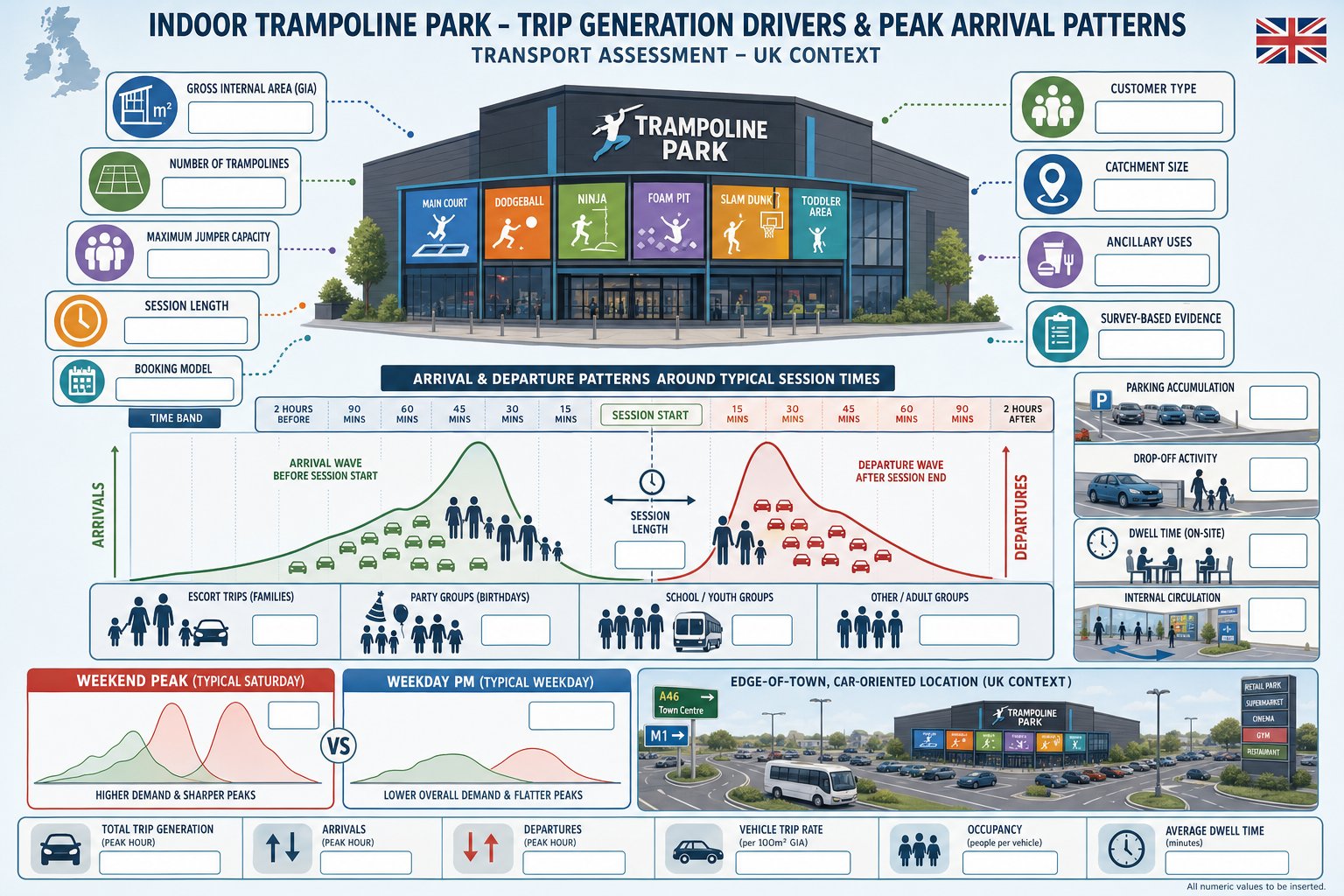
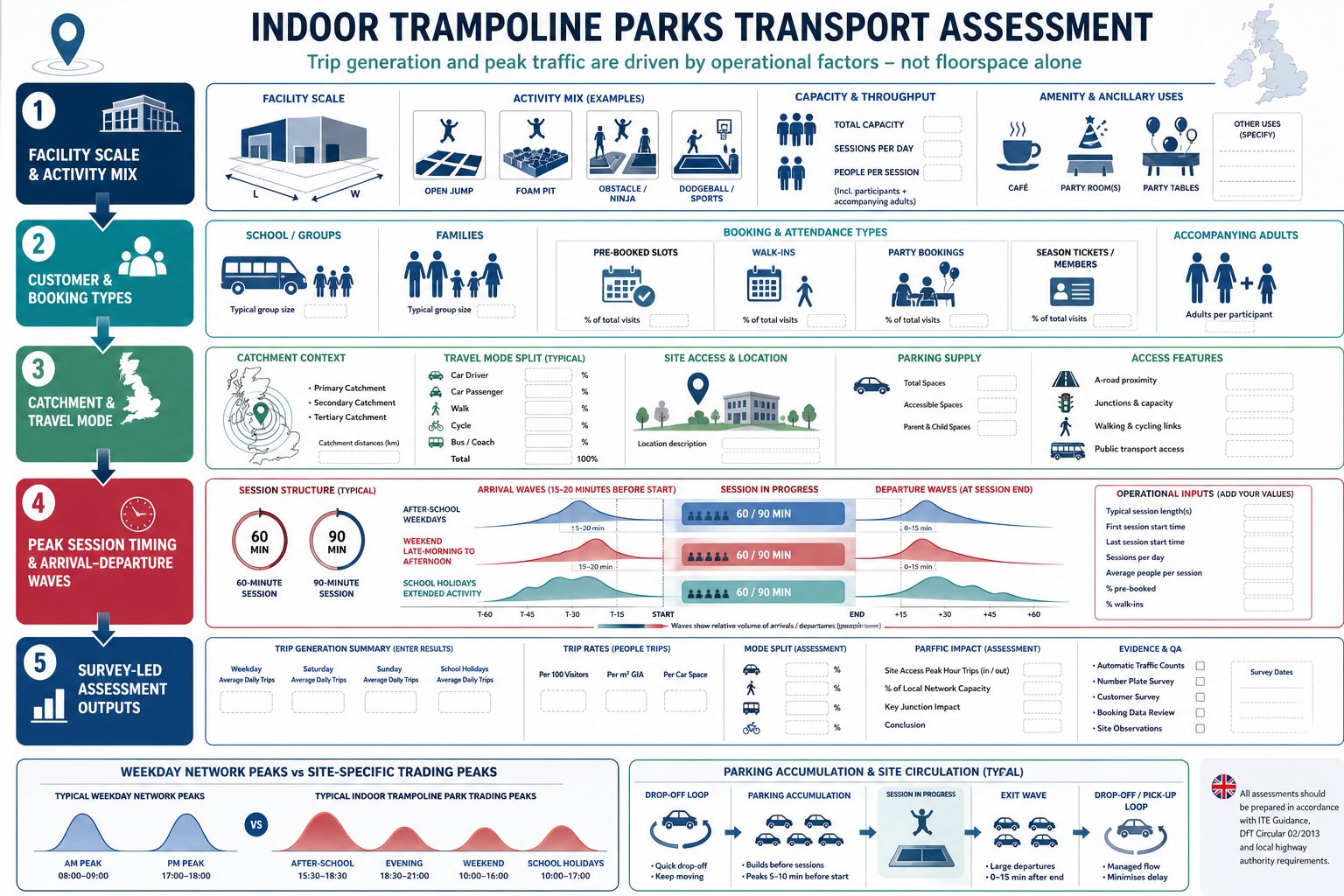
Trip generation for trampoline parks cannot be estimated reliably by floorspace alone. Two schemes with similar areas can operate very differently depending on session management, audience profile and ancillary uses.
The main drivers usually include gross internal area, number of trampolines or activity zones, maximum jumper capacity, session duration, and whether the operator runs fixed pre-booked slots, walk-ins, or a blend of both. Pre-booked hourly sessions tend to create more visible arrival waves. Walk-in leisure can smooth demand a little, but often not enough to ignore peak concentration.
Customer type matters just as much. Children’s sessions usually generate escort trips, and that can mean two adults per booking, siblings, and different parking behaviour depending on whether parents stay on site. Fitness-based evening sessions for adults may have lower occupancy per car but more direct arrival patterns. Party bookings and school groups can distort demand further, often increasing dwell time and producing short bursts of very high arrivals.
Catchment size is another factor. A destination offer with limited local competition may draw from a wider area and achieve higher car mode share, particularly in edge-of-town locations. If the park includes soft play, climbing, café space or party rooms, dwell time often lengthens and turnover slows.
For that reason, robust trip rates normally come from surveys at comparable trampoline parks, supported where needed by proxy leisure uses. We prefer evidence that reflects actual operation rather than generic assumptions borrowed from unrelated uses. That is especially important when the planning debate is likely to centre on peak traffic rather than average daily flow.
Peak Trading Periods, Session Booking Patterns, And Arrival Profiles
The busiest hour for the local highway network is not always the busiest hour for the site, and that distinction matters. Indoor trampoline parks often peak after school on weekdays, typically between about 15:30 and 18:30, while weekends are usually strongest from late morning into the afternoon. School holidays can extend the active peak across much of the day.
The operational pattern is the key complication. Because many parks trade in 60- or 90-minute sessions, arrivals often bunch 15 to 20 minutes before the start time, followed by a matching departure wave at the end. Add a birthday party, a youth group or a minibus arrival and the curve gets even sharper.
That means we usually assess more than one period. The weekday network AM and PM peaks may still require testing because the authority will want consistency with wider traffic conditions. But we also need a site-specific peak trading hour, and for many leisure schemes the weekend peak is actually the critical test. Parking accumulation, drop-off intensity and internal circulation can all look worse on a Saturday than during a weekday PM network peak.
Good analysis tracks not just how many vehicles arrive, but when, with what occupancy, and how long they remain. Without that level of detail, the assessment can understate exactly the moments when objections are most likely to arise.
Assessing Site Location, Catchment, And Accessibility
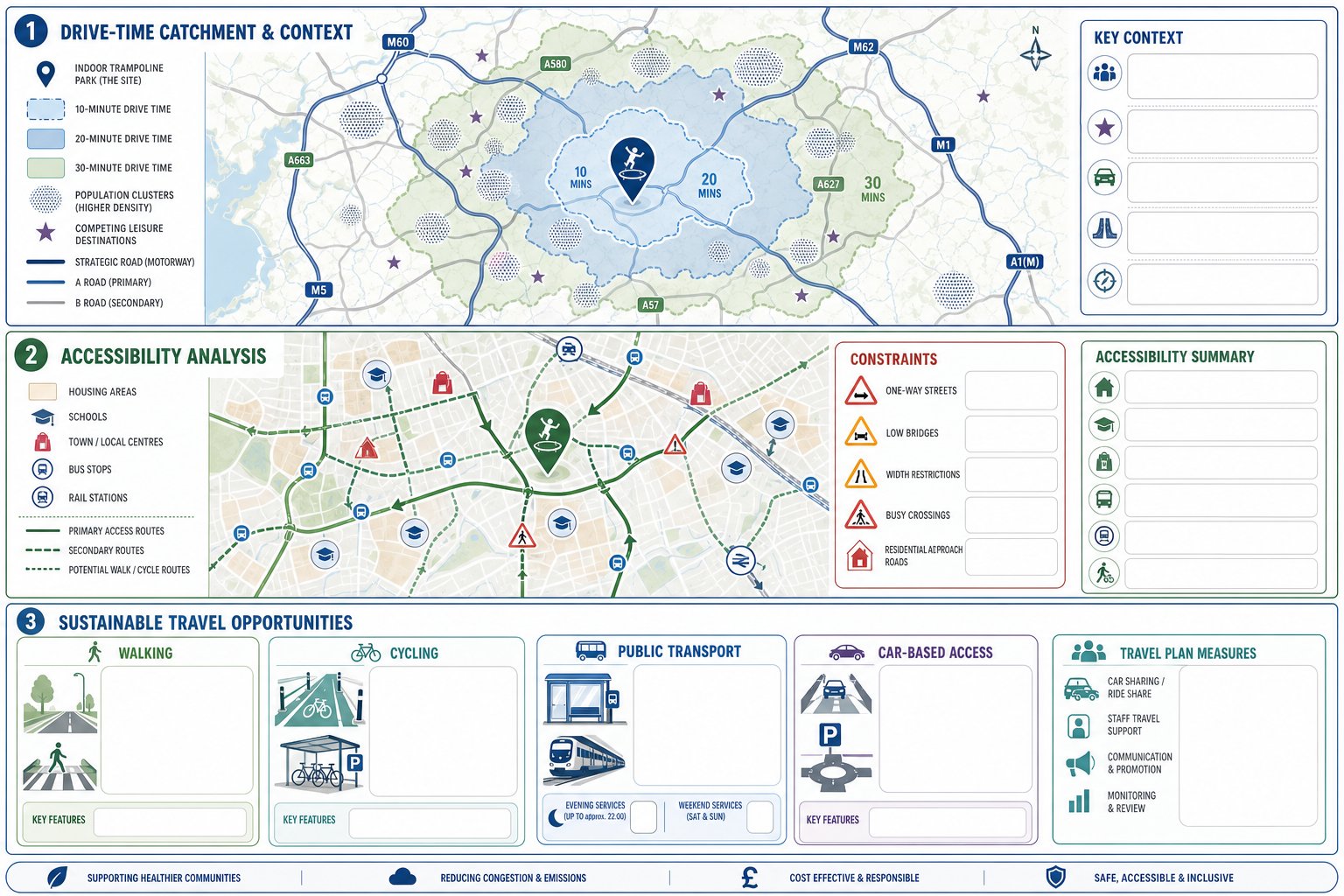
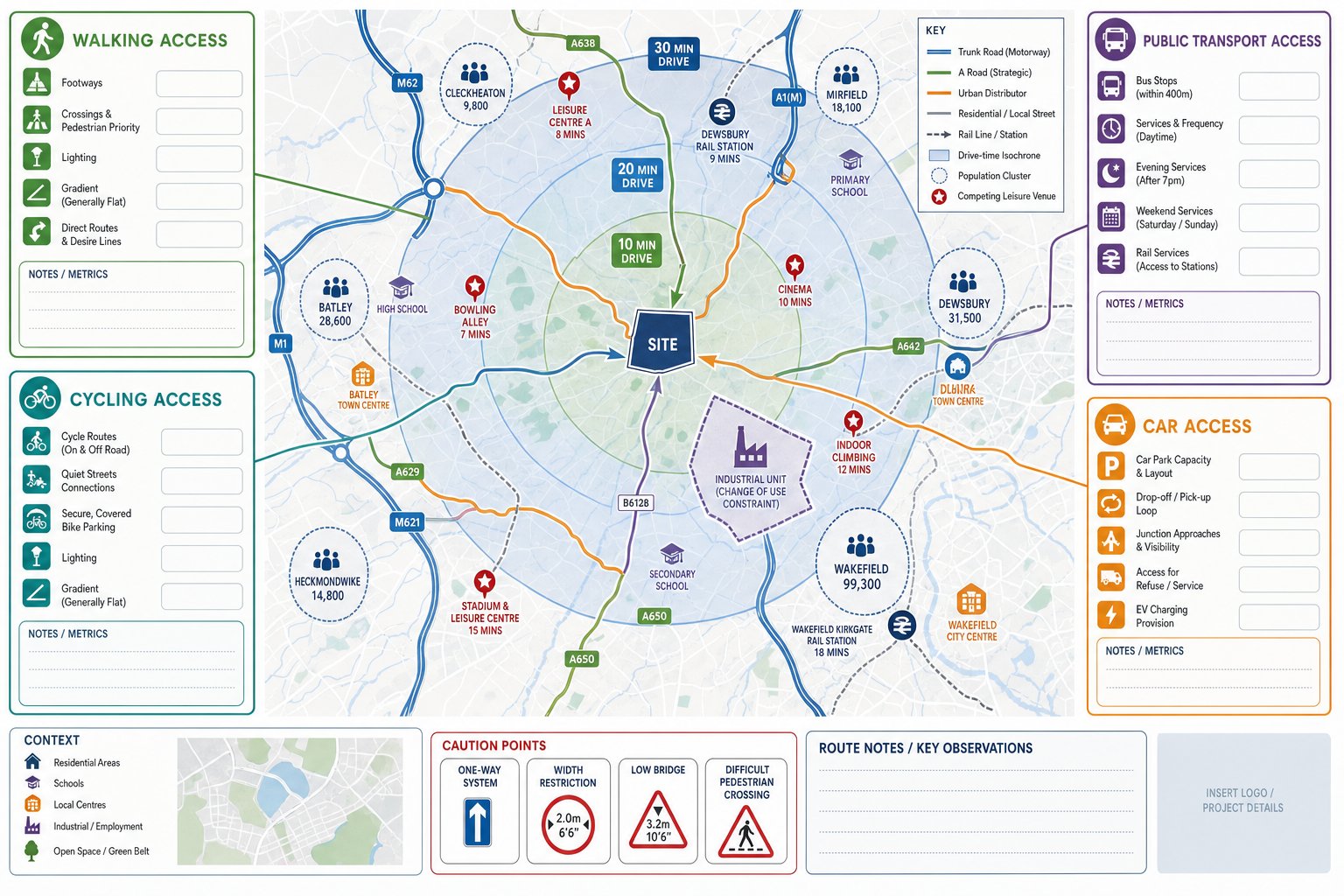
A trampoline park is rarely a pure walk-in neighbourhood use. Most operate as destination leisure, so site location and catchment analysis need to be handled carefully. We normally start by defining realistic drive-time catchments, often using 10-, 20- and 30-minute isochrones, then reviewing population distribution, competing venues and the strategic road context.
That helps answer some practical planning questions. Is the proposal serving a broad sub-regional market? Is it one of several similar venues in the area? Will customers approach mainly from a trunk road, from urban distributor routes, or through residential streets? Those answers influence everything from junction selection to parking assumptions.
The accessibility side is just as important. Local authorities will want to understand how close the site is to residential areas, schools, centres, and public transport nodes, and whether there are obvious physical constraints such as one-way systems, width restrictions, low bridges or difficult pedestrian crossings.
For change-of-use schemes, this is often where issues first appear. A former industrial unit might be perfectly viable in land-use terms, but much less comfortable once family leisure traffic, child drop-off and weekend turnover are factored in. Catchment analysis should hence do more than draw circles on a map: it should explain how the site will actually be reached and whether that pattern is compatible with the surrounding network.
Walking, Cycling, Public Transport, And Sustainable Travel Opportunities
Even when a trampoline park is expected to be predominantly car-based, we still need to show that sustainable travel has been properly assessed and, where possible, improved. Planning policy does not require us to pretend every leisure trip will transfer to bus or bicycle. It does require a realistic appraisal of what opportunities exist.
For walking, that means auditing footways, crossing points, gradients, lighting, wayfinding and personal security on the routes people would genuinely use. If the site sits near housing, schools or a centre, short walking trips may be more significant than first assumed.
For cycling, the audit should consider route quality as well as distance. A nominal cycle catchment is not persuasive if riders must negotiate hostile roundabouts or poor links. Secure, covered cycle parking near the entrance is usually a minimum, with staff facilities considered where relevant.
Public transport assessment should set out bus and rail services, frequencies, walking distances and evening availability. Leisure uses often trade outside office peaks, so the evening and weekend timetable matters more than the weekday interpeak headline.
A sensible sustainable travel package might include staff season-ticket loans, cycle-to-work support, route information, car-sharing measures and Travel Plan monitoring. Where wider effects are relevant, related thinking can overlap with environmental impact assessment, particularly around mode shift and network resilience.
Parking Demand, Drop-Off Activity, And On-Site Circulation
Parking is often the make-or-break issue for indoor trampoline park applications. Not because the total traffic is always exceptional, but because the activity is concentrated, family-oriented and highly sensitive to how the car park actually functions.
A credible parking assessment should distinguish between several user groups: customers who park and stay, parents who remain on site during a session, quick drop-off and collection movements, party guests with variable occupancy, staff parking, and accessible users who need bays close to the entrance. Treating all of that as a single static parking ratio usually leads to weak evidence.
We typically model accumulation from forecast arrivals and departures over the day, using session timing and dwell time assumptions rather than a blunt peak-hour factor. Comparable site surveys are invaluable because they reveal the real split between stay-and-watch users and short-stay turnover. In children’s leisure uses, that split can change dramatically by time of day.
Drop-off design matters too. If there is no safe, convenient short-stay area, drivers tend to improvise on the access road, at the site entrance or on adjacent streets. That is where objections about child safety and congestion usually come from. Good layouts provide segregated drop-off space, clear signing, accessible and parent-and-child bays, EV provision, legible circulation, and pedestrian routes that minimise conflict with moving vehicles.
If the site needs a one-way system, marshalling at peaks, or a formal Car Park Management Plan, we should say so plainly. Highway officers tend to respond better to honest operational management than to optimistic parking arithmetic.
Junction Capacity, Network Impact, And Highway Safety Considerations
Once trip generation is established, the next step is to understand where those trips load onto the network and whether the surrounding junctions can cope. For an indoor trampoline park, that usually means identifying the main access routes, selecting critical junctions, and testing the periods that matter locally and operationally.
Survey evidence is the foundation. Turning counts, queue observations and route choice review help establish which junctions are genuinely sensitive. Depending on the layout, modelling may use priority-junction software, roundabout assessment or signal models. In everyday practice, that often means tools such as PICADY, ARCADY or LINSIG, and for some schemes the workflow sits neatly alongside Junctions 11 Software outputs and highway authority expectations.
The usual comparison is baseline, future year without development, and future year with development, including committed schemes where appropriate. Sensitivity testing can be particularly helpful for leisure uses because objectors often focus on worst-case sessions, parties or holiday periods.
Safety should be assessed separately, not folded casually into the capacity commentary. A review of five-year STATS19 collision data can identify whether there is an existing accident pattern involving turning movements, pedestrians, speed or visibility. If the proposal increases activity near that point, we need to address it directly.
Mitigation may be light-touch or substantial: access geometry improvements, visibility enhancement, lining and signing, waiting restrictions, crossing provision or minor junction upgrades. The key is proportionality. The report should show not only whether a problem exists, but whether it can be solved in a targeted, planning-led way.
Servicing, Deliveries, Staff Travel, And Operational Movements
Customer traffic is only part of the operational picture. A good transport assessment also explains how the site works behind the scenes, because servicing conflicts and unmanaged staff travel can create avoidable planning concerns.
For indoor trampoline parks, servicing is usually moderate rather than heavy, but it is still relevant. Catering supplies, vending stock, cleaning materials, maintenance visits, equipment replacement, waste collection and occasional event-related deliveries all need to be considered. If the scheme includes café space, party facilities or ancillary leisure uses, delivery frequency may be higher than first expected.
The report should identify likely vehicle types and show that the largest realistic vehicle can enter, turn and leave safely. Swept path analysis is often required, particularly on tighter retrofit sites. Reversing should be minimised, and service activity should be separated from customer walking routes wherever possible.
Staff travel also deserves more attention than it often gets. Shift patterns may begin before the first session and end after evening close, when public transport options are weaker. Staff parking demand, cycle provision, secure pedestrian access and Travel Plan measures should reflect those realities.
And then there are occasional group arrivals. Schools, youth clubs and parties may come by minibus or coach, especially for off-peak weekday sessions. Even if those trips are infrequent, the site needs a safe place for standing, turning or controlled drop-off. Ignoring them can leave an operational gap that planning officers spot quickly.
Common Evidence, Surveys, And Technical Inputs Needed
The quality of an Indoor Trampoline Park Transport Assessment depends heavily on the quality of its inputs. When schemes run into trouble, it is often because the evidence base is too generic, too old, or too disconnected from how trampoline parks actually operate.
A robust submission will usually include multi-period traffic counts at the key junctions, often covering weekday peaks, weekend peaks and, where relevant, a site-specific leisure peak. Parking and drop-off surveys at comparable trampoline parks are especially useful because they provide direct evidence on occupancy, dwell time, escort behaviour and party-related surges.
Where walking and cycling effects may be material, pedestrian and cycle counts can support the case for crossings, route improvements or layout refinement. Speed data, queue surveys and delay observations may also be needed if the local network already experiences stress.
Safety evidence typically includes STATS19 collision records over a five-year period, supported by plan-based visibility checks and access review. On the design side, site layout drawings, access geometry, swept-path analysis and car park layouts should align with relevant guidance such as Manual for Streets and local design standards.
Policy extracts matter too. Parking standards, cycle standards and local threshold guidance help explain why the assessment has been scoped the way it has. We often find that concise, accurate reporting built around local authority expectations is far more persuasive than a long appendix-heavy document with weak interpretation. That same discipline underpins our work across sectors, including Residential Development Transport, where evidence quality can make or break the planning outcome.
Frequent Planning Issues And How To Strengthen An Application
Most objections to trampoline park proposals are predictable. Parking overspill into nearby streets. Bursts of traffic around session start times. Child drop-off on a busy frontage. Late-evening vehicle noise near housing. Weak public transport links in an edge-of-town location. None of these issues is unusual, but each needs a practical answer.
The strongest applications are usually those that deal with concerns before they are raised. That starts with locally relevant comparator surveys rather than optimistic averages from unrelated leisure uses. If the likely criticism is parking pressure, the evidence should show real accumulation patterns and include sensitivity testing. If the issue is a congested junction, the modelling should test realistic worst cases, not just central assumptions.
Operational management can be just as important as physical mitigation. Staggered session starts may smooth arrival waves. A Car Park Management Plan can allocate staff parking, control time limits and introduce stewarding at the busiest periods. Clear drop-off arrangements can reduce unsafe manoeuvres and neighbour complaints.
Travel Plans need to be believable. Authorities are increasingly wary of mode-share promises that have no relationship to site location or user profile. Better to propose a modest, credible package with monitoring than a glossy but unrealistic target.
Finally, early dialogue helps. Where access works or off-site mitigation may be needed, agreement in principle with the highway authority can materially strengthen the planning position. In our experience, concise evidence, realistic assumptions and a scheme team that is willing to adapt will outperform a defensive report every time.
Conclusion
A well-prepared Indoor Trampoline Park Transport Assessment is not just a compliance exercise. It is the document that shows, with evidence, that a popular but peaky leisure use can operate safely, efficiently and in line with policy.
For planning teams in 2026, the essentials are clear: define the use properly, base trip rates on credible comparators, understand session-driven peaks, test the right junctions and be honest about parking, drop-off and operational management. Just as importantly, align the scope with local authority thresholds from the beginning rather than after objections land.
When that work is done properly, the assessment becomes more than a technical appendix. It gives planners, architects, developers and councils a clear picture of how the site will function in the real world, and what mitigation is needed to make the proposal acceptable. That is usually the difference between a transport report that merely exists and one that genuinely helps secure permission.
Indoor Trampoline Park Transport Assessment FAQs
What does an Indoor Trampoline Park Transport Assessment typically include?
It covers the development description, policy review, trip generation, peak period analysis, site access, parking and drop-off assessment, junction capacity, road safety review, servicing, staff travel, and a mitigation or Travel Plan package to ensure safe and efficient operation.
When is a full Transport Assessment required instead of a Transport Statement for trampoline parks?
A full Transport Assessment is usually needed for larger sites, sensitive locations, or where changes in traffic profile or new access junctions occur. Smaller urban schemes with modest floorspace and no access changes may only need a lighter Transport Statement.
How do local planning policies and highway thresholds influence transport assessments for trampoline parks?
Local policies set parking, cycle parking, EV charging standards, and junction testing thresholds, which determine assessment scope, parking demand, modelling tools, and mitigation requirements to align proposals with specific local expectations.
What factors influence trip generation for an indoor trampoline park?
Key factors include gross internal area, number of trampolines, session duration and booking system, customer profiles such as children with adults, catchment size, and additional uses like cafés or party rooms, with data drawn from comparable parks to ensure accuracy.
How are peak trading periods and session booking patterns important in assessing indoor trampoline park transport impacts?
Indoor trampoline parks often experience strong peaks after school on weekdays and during weekends, with fixed session timings creating concentrated arrival and departure waves. Assessments model these peaks alongside local highway peaks for robust impact analysis.
What sustainable travel opportunities should be considered in an Indoor Trampoline Park Transport Assessment?
Assess walking routes, cycling conditions and parking, public transport access and frequencies, and propose measures such as staff travel plans, cycle-to-work schemes, and car-sharing to encourage mode shift and compliance with local sustainable travel policies.