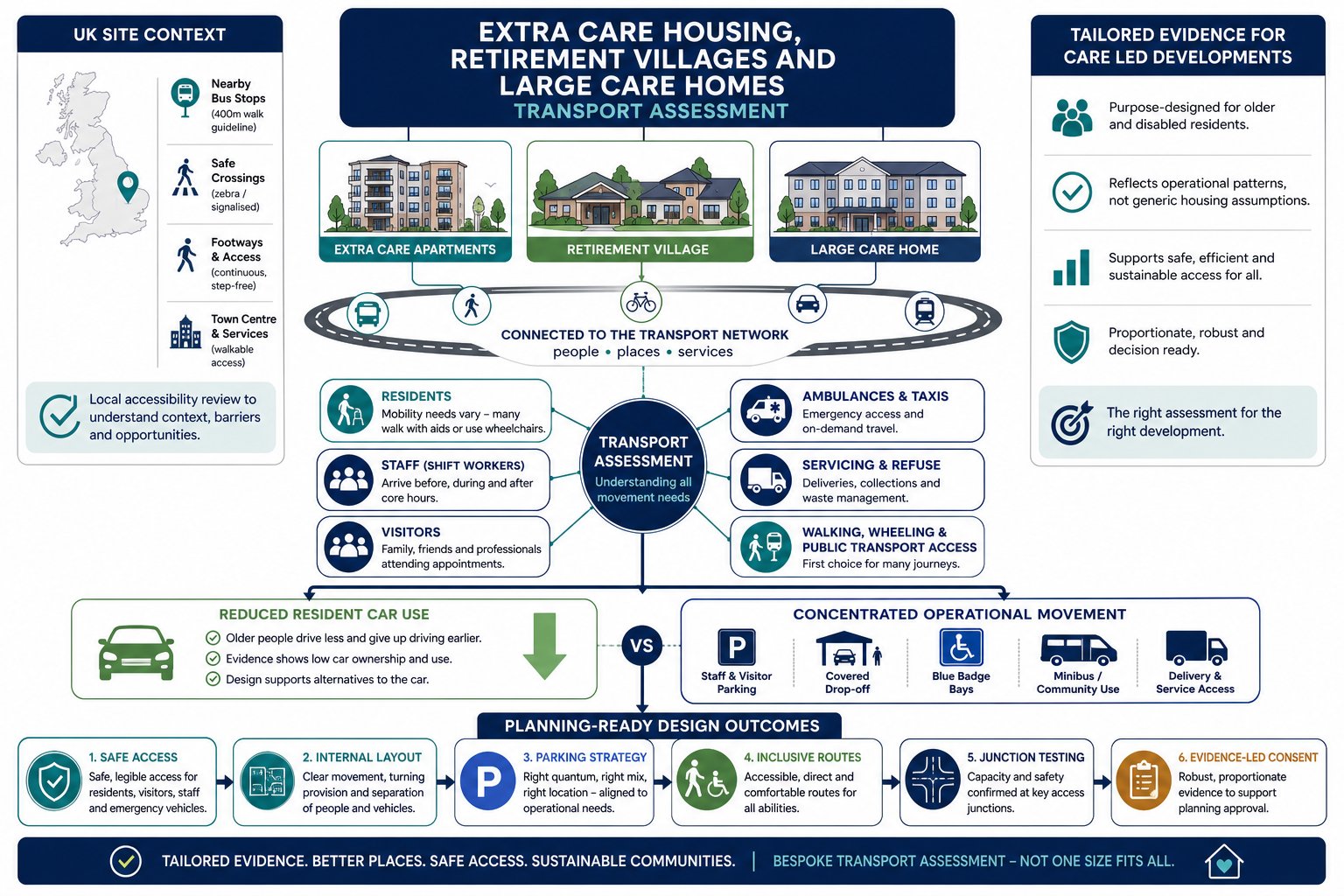
Later-living development rarely behaves like standard housing, and that is exactly why transport work so often gets scrutinised. On paper, an extra care scheme or care home may appear to generate modest resident car use. In practice, the transport picture is more nuanced: staff shift changes, visitors, ambulances, servicing, community transport, blue badge demand, and the everyday realities of reduced mobility can all become decisive planning issues.
For architects, planners, lawyers, developers and local authorities, a robust Extra Care Housing, Retirement Villages and Large Care Homes Transport Assessment is not just a supporting report. It is often the document that shows whether a scheme is genuinely workable, safe and inclusive for the people who will rely on it most. A weak assessment tends to invite familiar objections: parking overspill, poor drop-off design, unsafe pedestrian routes, or generic trip rates that don’t reflect how later-living schemes actually operate.
In 2026, expectations are higher. Councils want clearer evidence, more tailored assumptions and stronger justification around accessibility, equality, and site operation. We also need to show that transport impacts have been understood in the round, not treated as a box-ticking exercise borrowed from conventional residential development.
This article sets out what planners usually need, where the risks lie, and how to shape an assessment that supports consent rather than slowing it down.
Key Takeaways
- A tailored Extra Care Housing, Retirement Villages and Large Care Homes Transport Assessment is essential to reflect the unique transport patterns, including staff shifts, visitor flows, and servicing needs, rather than using generic residential models.
- Transport assessments must demonstrate safe, accessible routes and site layouts that accommodate reduced mobility and support inclusive access for residents using mobility aids or wheelchairs.
- Effective assessments address all user types separately—residents, staff, visitors, and service vehicles—to prevent parking overspill and ensure smooth drop-off and ambulance access.
- Early collaboration with planning and highway authorities on scope and evidence helps avoid delays and ensures the assessment meets local policy requirements and practical realities.
- Incorporating real operator data, observed comparator site surveys, and realistic travel patterns creates credible trip generation forecasts and supports planning consent.
- Investing in inclusive design elements like blue badge bays, covered drop-off zones, and safe pedestrian routes enhances resident independence and reduces planning objections.
Why Transport Assessment Matters For Later Living And Care Development
Later-living and care schemes demand a different kind of transport thinking because the user group is different from the outset. Many residents either do not drive, drive less often, or rely on assistance for everyday journeys. That lowers some forms of vehicle demand, but it does not reduce the need for careful planning. In many cases it increases it.
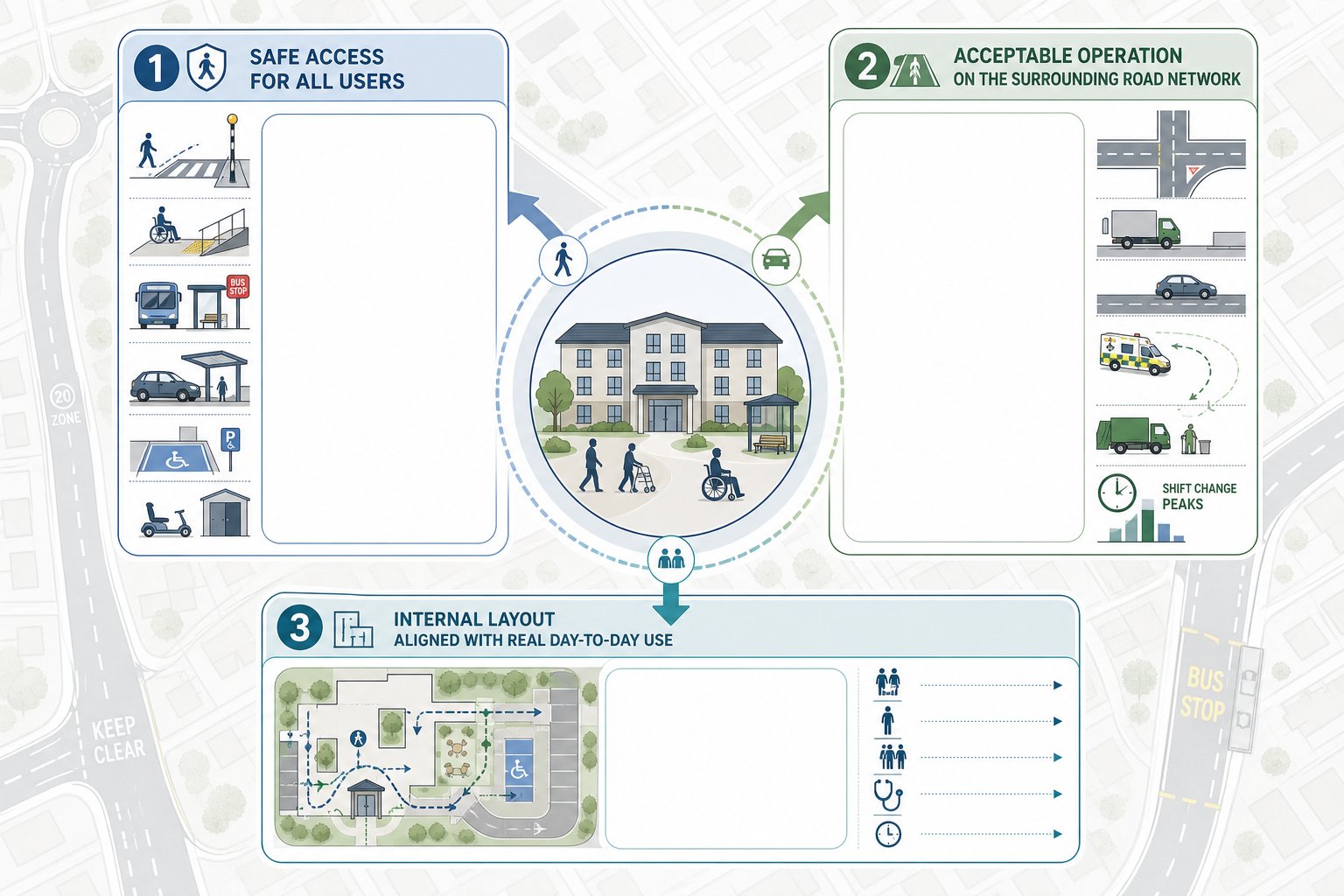
A transport assessment matters because it has to prove three things at once. First, that the site can be reached safely by all users, including people with limited mobility, wheelchair users and those with sensory impairments. Second, that the development will operate acceptably on the surrounding network. Third, that the internal layout, parking and access arrangements match the way the building will actually function day to day.
This is where later-living schemes often get misunderstood. We may be dealing with low resident car ownership, yet quite intense staff parking pressure. We may see limited commuter-style peaks from residents, but sharp arrival patterns around shift changes, visiting times, clinics, deliveries and waste collections. The assessment has to reflect that real operating pattern rather than forcing the site into a standard suburban housing model.
From a planning perspective, the report also helps demonstrate compliance with national and local policy on sustainable transport, highway safety and inclusive access. And for design teams, it gives early clarity on what the scheme will need in practical terms: access geometry, ambulance turning, blue badge parking, shelter at the entrance, mobility scooter storage and safe routes to nearby bus stops. Get that right early, and the whole application tends to move more smoothly.
Which Schemes Usually Require A Transport Assessment Or Transport Statement

There is no single UK-wide threshold that covers every extra care, retirement village or care home proposal in exactly the same way. In practice, whether a scheme needs a Transport Statement or a full Transport Assessment depends on scale, local policy thresholds, highway sensitivity and the characteristics of the surrounding area.
As a rule, larger extra care developments, substantial retirement villages and most larger care homes will need at least a Transport Statement. A full assessment is more likely where the proposal is major development, sits on a constrained or busy network, raises parking concerns, or depends on junction performance and accessibility evidence to support the planning case. Rural sites, edge-of-settlement locations and schemes near schools, hospitals or congested town centres often trigger a deeper level of analysis.
The sensible approach is to agree scope early with the planning authority and highway authority. That avoids producing too little evidence, which leads to delay, but also avoids overcomplicating a scheme that could have been handled proportionately. Our experience is that councils respond best when the scoping note clearly explains the use class context, likely user profile, expected shift patterns and why a tailored methodology is more appropriate than a generic residential template.
That principle runs through any broader transport assessment for developments: the planning team may already be preparing. Later-living sites often overlap with issues familiar from a Residential Development Transport Assessment: but they usually need a more bespoke evidence base around accessibility, staffing and servicing.
How Extra Care Housing, Retirement Villages And Care Homes Differ In Transport Terms
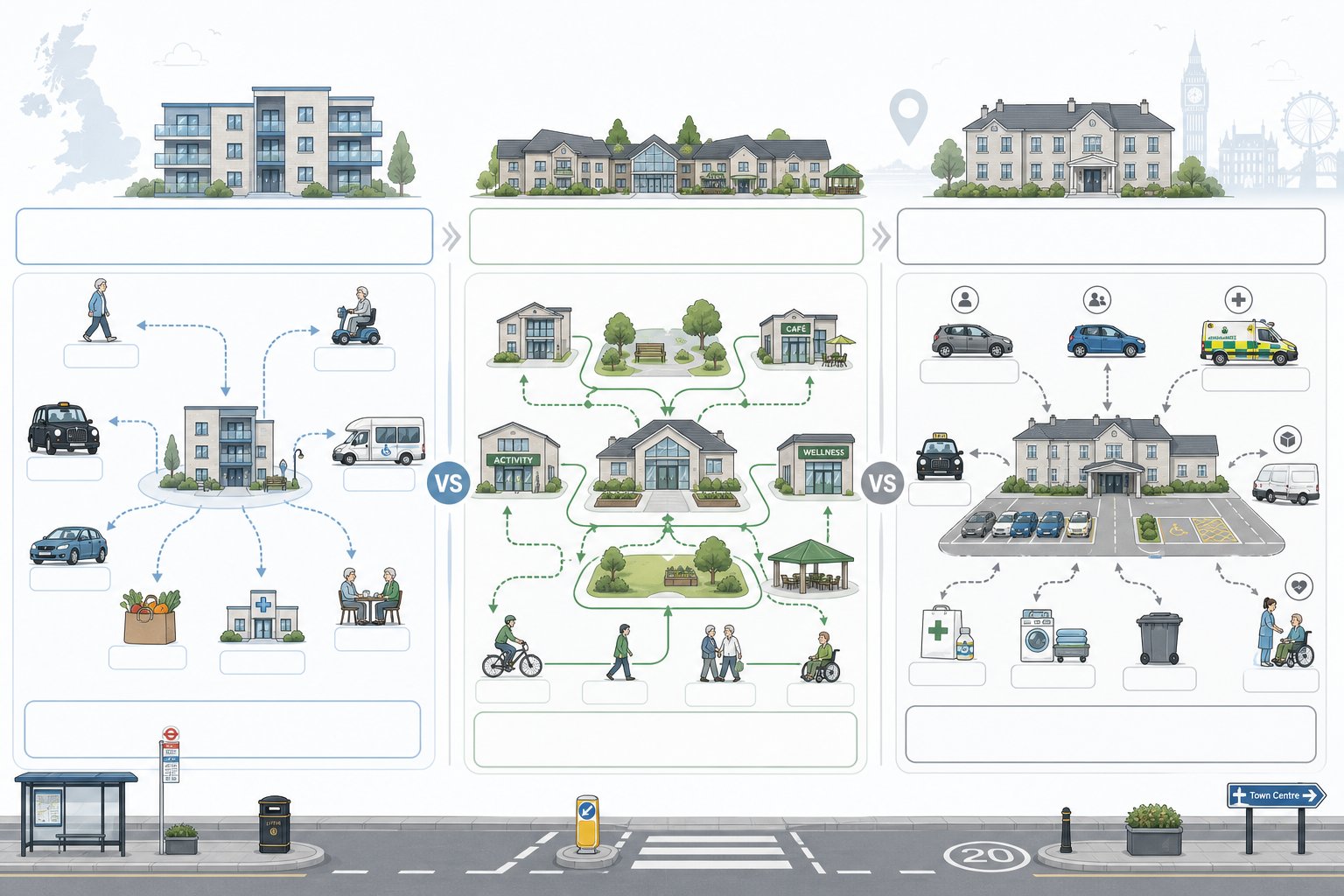
These schemes are often grouped together in planning discussions, but they are not transport-equivalent uses.
Extra care housing usually comprises self-contained apartments with on-site care available around the clock. Residents tend to be more independent than those in a traditional care home, and some still travel alone, whether on foot, by mobility scooter, community transport, taxi or occasionally by private car. That means trip patterns can include shopping, social visits, medical appointments and leisure trips through the day.
Retirement villages are often larger and more mixed in character. They may include communal facilities, healthcare space, cafés, activity rooms or wellness uses. Residents can be relatively active and the site may attract more internal movement, visitors and non-car trips than a standard older persons’ apartment block. Because of that, the assessment may need to look beyond a single building and consider the site almost as a small campus.
Care homes, including nursing and dementia care, are different again. Resident independent travel is usually very limited. Vehicle movements tend to be driven by staff, visitors, district nurses, GPs, pharmacy and food deliveries, laundry, waste, taxis and ambulances. Parking pressure can hence be more operational than residential.
This distinction matters. If we use the wrong comparator sites or assume that all later-living developments behave the same way, the assessment quickly loses credibility. In some cases, a scheme can also overlap with wider movement planning issues seen in mixed use masterplan projects, especially where retirement villages contain multiple facilities and service functions on one site.
The Main Trip Generation And Travel Pattern Issues To Address
Trip generation is usually the point where a later-living application either starts to look robust or starts to unravel. Too many reports rely on broad assumptions, yet these schemes have distinctive travel rhythms that need to be unpacked carefully.
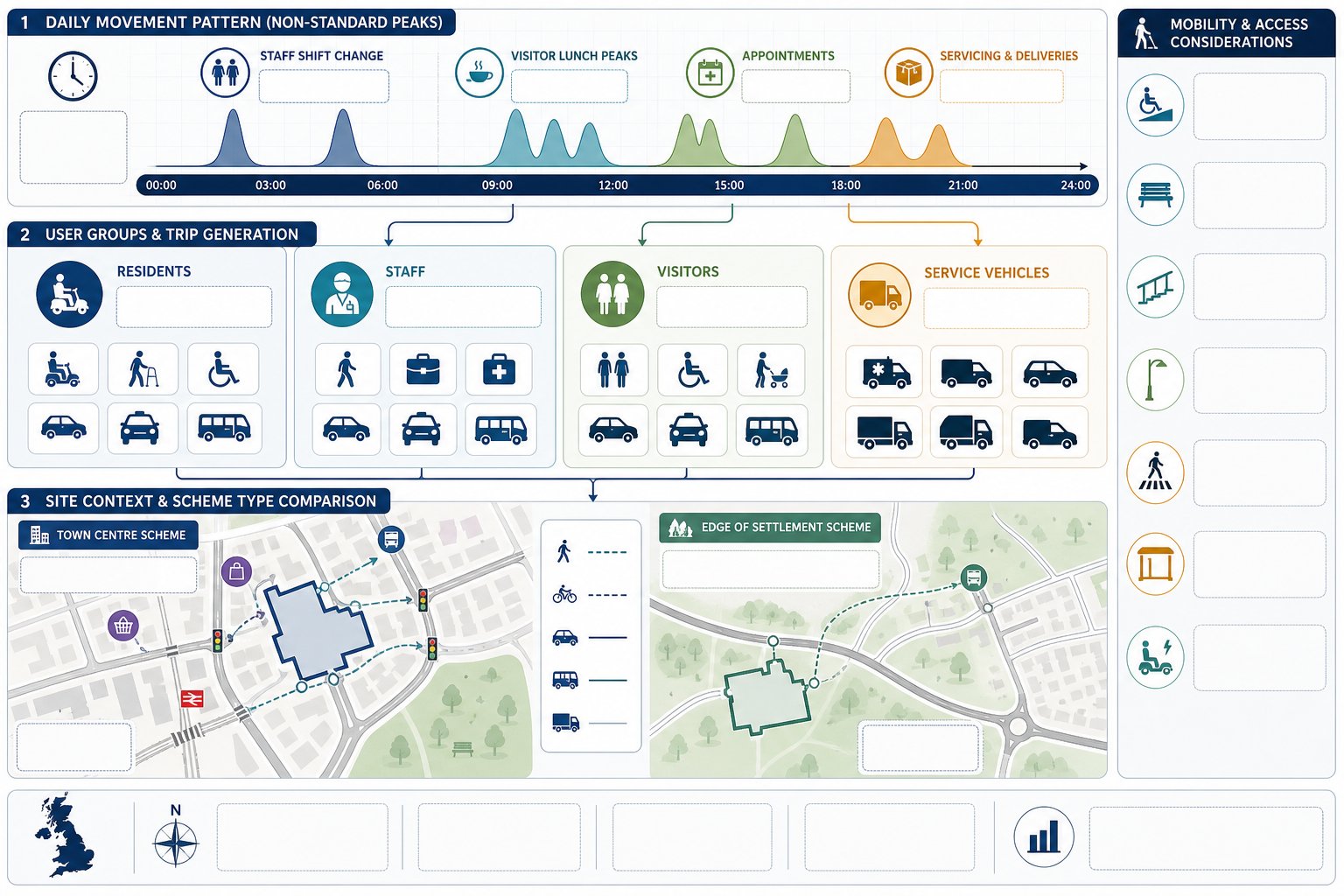
The first issue is timing. Peaks are often less about the classic 08:00 and 17:00 commuter profile and more about staff shift changes, lunchtime visiting, appointment windows, and regular servicing slots. The second issue is user mix. Residents, staff, visitors, clinicians, support workers, taxis, patient transport, deliveries and refuse vehicles all contribute to total movement. The third issue is variation between schemes. A 60-unit extra care development in a town centre will perform differently from a 75-bed care home on a semi-rural edge site.
A credible assessment usually combines observed evidence from comparable sites, operator information and a clear explanation of how the proposed development will function. That means asking practical questions early: How many staff are on each shift? What are visiting hours? Is there a minibus? Are meals prepared on site? How often are clinical visits scheduled? What proportion of residents are expected to own cars?
If junction impact is likely to be debated, modelling should reflect realistic peak periods rather than default network peaks alone. Where necessary, tools such as Junctions 11 Software can help test the operational effect of staff and visitor arrivals with more confidence.
Resident Travel Characteristics And Mobility Considerations
Resident travel in later-living development is shaped less by ownership and more by ability, confidence and support. That sounds obvious, but it changes the entire transport strategy. A resident may not drive, yet still make regular trips by mobility scooter, with family, by accessible taxi, or on a site-run minibus. Another may walk only very short distances and need level surfaces, resting places and weather protection just to reach the main entrance.
So the assessment should not treat low car use as low mobility demand. Instead, we need to map the modes residents are genuinely likely to use and the barriers they face. Key questions include whether routes are step-free, whether gradients are manageable, whether crossing points are safe, and whether nearby bus stops are realistically accessible for older people using sticks, frames or wheelchairs.
For extra care and retirement village schemes in particular, resident independence can remain quite high. That often means more daytime social, shopping and leisure trips than planning teams first assume. In urban areas, proximity to shops, pharmacies, green space and bus routes can materially reduce car dependence. In rural areas, the opposite may be true, and community transport becomes more important.
The practical design implications are specific: short walking distances, good lighting, uncluttered routes, seating, handrails where needed, and secure storage/charging for mobility scooters. These details often carry as much weight as the numerical trip forecast.
Staff, Visitor And Service Vehicle Demand
If one element is underestimated most often, it is this one. Staff numbers are usually the strongest driver of daily vehicle demand, especially on care home sites. Early shifts, night shifts and limited public transport coverage can push car mode share upwards even where resident parking need is modest.
Visitors are the next variable. Their arrivals may be spread across the day, but weekends, lunch periods and special events can create short, sharp spikes. Add clinicians, hairdressers, therapists, pharmacy deliveries, food suppliers, laundry vehicles, waste collection, taxis and ambulances, and the operational picture becomes busy quite quickly.
The assessment should hence distinguish clearly between resident, staff, visitor and servicing demand rather than presenting one blended total. Councils usually want confidence that staff parking will not overspill onto nearby residential streets and that ambulances or minibuses will not conflict with ordinary drop-off activity at the entrance.
We find that operator engagement is critical here. Draft rotas, staffing assumptions, delivery schedules and visitor management arrangements can turn a speculative report into a persuasive one. And where a scheme forms part of a larger planning package, the methodology should align with any wider Development Transport Assessment: so the evidence reads consistently across the application.
Access, Highway Safety And Internal Layout Requirements
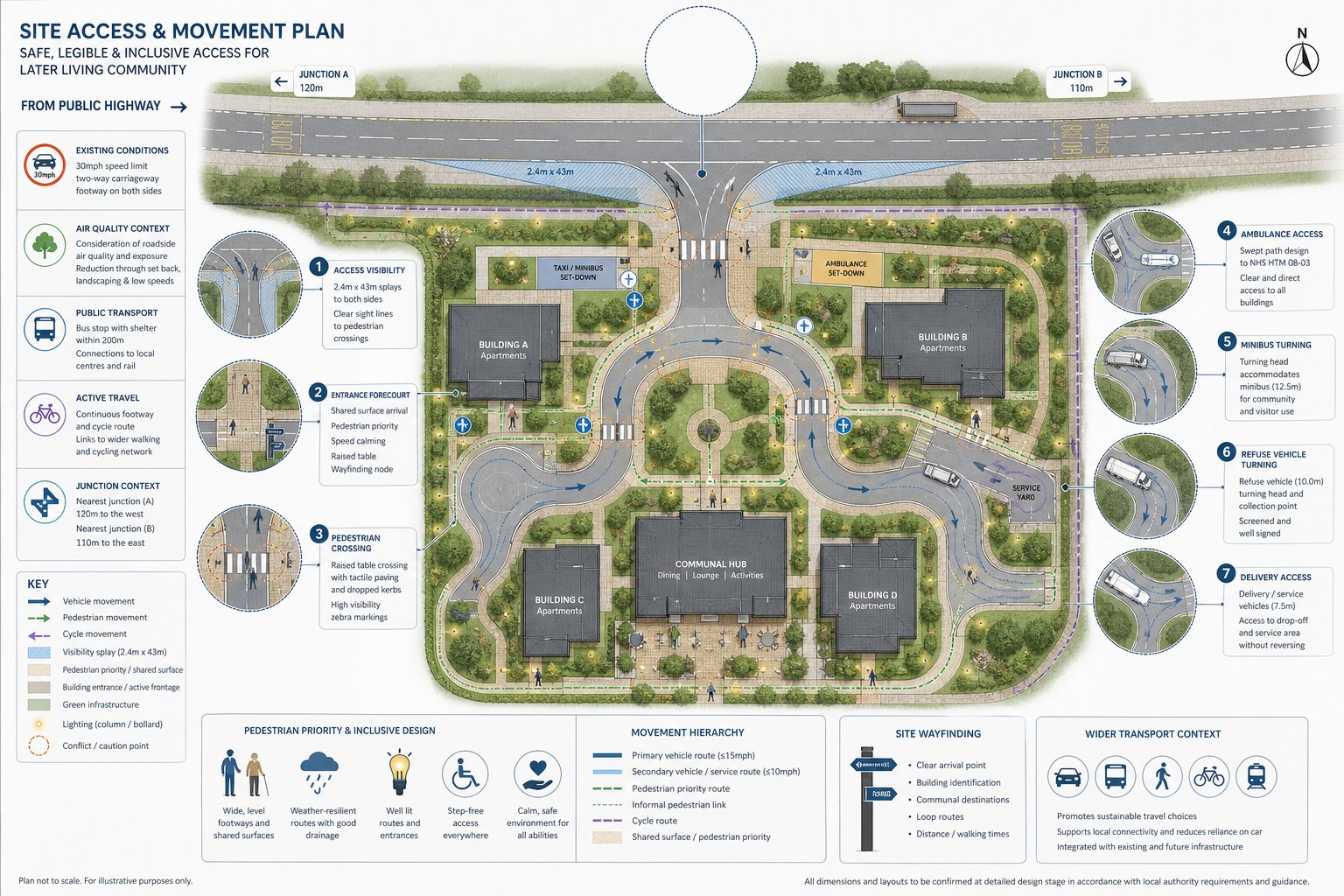
Access design for later-living development has to do more than meet minimum geometry. It needs to work calmly, legibly and safely for vulnerable users and for vehicles with very different operating requirements.
At the site access, authorities will usually expect appropriate visibility, a clear relationship with nearby junctions, and a design that keeps speeds low on entry. That may sound routine, but the detail matters. If vehicles approach too fast, if pedestrian crossing points sit awkwardly, or if taxi and ambulance stopping activity spills back towards the access, objections arrive quickly.
Inside the site, the layout should accommodate ambulances, minibuses, refuse vehicles and delivery vans without forcing awkward reversing or conflict with people walking slowly across the frontage. Pedestrian priority is especially important near the main entrance and communal facilities. Shared surfaces can be contentious unless they are carefully designed and very easy to read.
Good internal design also means intuitive wayfinding, lighting levels that support older users with declining vision, and routes that remain usable in poor weather. Where the proposal includes multiple buildings or a campus-style retirement village, the assessment should explain how movement is organised across the whole site, not just at the highway boundary.
In more complex or sensitive cases, site access work may also connect with wider environmental impact assessment questions, particularly where the local road environment, air quality or cumulative transport effects are part of the planning debate.
Parking, Drop-Off, Blue Badge And Servicing Provision
Parking for later-living schemes is one of those subjects where simplistic assumptions cause avoidable trouble. Yes, resident car ownership is often lower than standard market housing. No, that does not mean overall parking demand is low.
The right approach is to separate demand by user type. Resident parking may be modest, particularly in care homes. Staff parking can be substantial. Visitor demand can be variable but still important, especially at weekends. Then there is blue badge provision, taxi stopping, ambulance access, patient transport, minibus use, and the need for efficient servicing.
Blue badge bays should be plentiful enough for real operational need, located close to accessible entrances and designed with proper transfer space. Covered drop-off areas are highly desirable because people arriving may be frail, unsteady or being assisted from vehicles in bad weather. A good canopy is not a decorative extra: on many schemes it is operationally essential.
Servicing needs equal attention. Food, laundry, waste, medical supplies and maintenance traffic can be frequent, and these vehicles need dedicated space that does not undermine the arrival experience or block pedestrian routes. Time-restricted servicing arrangements can help, but only if they are realistic.
Planning authorities are usually reassured when the report links parking numbers directly to evidence: staffing levels, observed demand at comparator sites, local parking standards and accessibility conditions. Generic standards alone rarely settle the argument.
Walking, Wheeling, Public Transport And Inclusive Access
This section is often where a strong report distinguishes itself from a merely adequate one. For older persons’ development, sustainable transport is not just about reducing car trips. It is about whether people can move with dignity, confidence and reasonable independence.
Walking routes need to be continuous, direct and step-free wherever possible. But for many residents, “walking” in policy terms really means wheeling: wheelchairs, mobility scooters, walking frames and assisted movement. That changes what counts as an acceptable route. Narrow footways, steep gradients, cluttered crossing points and missing dropped kerbs can all render a theoretically nearby facility effectively unusable.
The assessment should review local footways, crossing opportunities, gradients, resting places, street lighting and the quality of links to bus stops, shops, health services and public open space. Bus accessibility should be judged realistically. A stop may be close on a plan but poor in practice if there is no shelter, no seating, limited crossing provision or an uneven approach.
Inclusive access should also run through the site itself: entrance design, internal pedestrian routes, mobility scooter parking, and clear wayfinding. Equality duties are not an afterthought here: they are central to whether the scheme genuinely works.
Where the location is less accessible, we should explain realistic mitigation such as community transport, shuttle services, improved footway links, crossing upgrades or travel planning measures. Authorities generally respond better to candid assessment and practical solutions than to overclaiming sustainability.
What Local Planning Authorities Typically Expect In The Assessment
Most local planning authorities are looking for a report that is proportionate, evidence-led and specific to the development rather than copied from another job with a few labels changed. They usually expect a clear development description, site context, baseline transport conditions, accessibility review, trip generation, trip distribution, parking and servicing analysis, and an explanation of highway safety implications.
For later-living proposals, they also tend to expect more. In particular, they want to understand who the users are, how the scheme will operate daily, and whether the proposed access and layout are genuinely suitable for older and disabled people. If the report says resident car use is low, the authority will often ask what replaces it. If staff parking is reduced, they will ask where overspill goes. If public transport is cited as a benefit, they will look closely at whether the route to the stop is actually usable.
They may also request junction capacity testing where a site sits on a constrained network or where local concern is high. Road safety review, swept path analysis and a framework travel plan are common supporting elements.
Above all, councils expect justification. Trip rates, parking provision and mode assumptions should be rooted in comparable evidence and explained in plain English. A concise, tailored report usually performs better than a long generic one. That is one reason we focus on reports that respond to local thresholds and planning context rather than relying on standard templates.
Survey Data, Evidence Base And Common Methodology Choices
The methodology has to fit the use. That means the evidence base for a later-living assessment should usually combine several sources rather than leaning on one dataset in isolation.
Observed surveys at comparable UK sites are often the most persuasive starting point, especially where they can be matched reasonably closely by scale, type, location and care model. Manual counts, parking beat surveys, staff shift information and servicing observations can all help. Operator input is equally important because staffing structures and visiting policies can materially affect trip patterns.
Database trip rates may still play a role, but they need caution. Imported rates from loosely comparable care uses can be useful as a sense check, not as a substitute for judgement. Where rates are applied, the assessment should explain why the selected sites are relevant and how local conditions may alter the outcome.
For distribution and assignment, we normally look at surrounding population catchments, staff origin assumptions, local route hierarchy and relationships with key services such as hospitals or town centres. For parking, survey evidence should test both daily accumulation and changeover peaks.
And if the proposal sits within a wider strategic or phased development, methodology choices should align with the broader transport package. Consistency across chapters, appendices and modelling outputs can save a surprising amount of planning time later.
Common Planning Risks And How To Avoid Delays Or Objections
Most objections on these schemes are predictable. The trouble is that they are often predictable only after the application has been submitted.
One common risk is underestimating staff and visitor demand. That leads straight to overspill parking concerns, neighbour objections and requests for revised layouts. Another is relying on generic residential assumptions for a use that plainly does not behave like standard housing. Councils spot that quickly.
A third risk is weak inclusive access analysis. If the report talks about sustainable travel but ignores dropped kerbs, crossing safety, gradients, seating, shelter or mobility scooter movement, it opens the door to design and equality concerns. Blue badge shortfall and poor drop-off design create the same problem.
There is also the evidence risk: too little survey data, unclear comparator site selection, or unsupported trip rates. That often results in further information requests rather than outright refusal, but delay can be costly enough. On larger sites, failing to coordinate transport work with drainage, landscape, servicing and architectural design can also create contradictions that undermine the application.
The best way to avoid these issues is straightforward, if not glamorous: scope early, test assumptions with the operator, use relevant comparator evidence, and let the transport strategy influence layout before the design hardens. In practice, the strongest applications are usually the ones where transport has been treated as part of the scheme design, not something bolted on at the end.
Conclusion
A well-prepared Extra Care Housing, Retirement Villages and Large Care Homes Transport Assessment recognises the central truth of later-living development: resident car use may be low, but transport demands are not. They are simply different.
For planning teams in 2026, the winning approach is a tailored one. We need to understand resident mobility, staff operations, visitor behaviour, servicing patterns, inclusive access and on-site safety as one connected system. When those elements are evidenced properly, the assessment does more than answer objections. It helps shape a scheme that is practical, age-friendly and more likely to secure consent.
For architects, developers, councils and advisers, that means fewer generic assumptions and more real-world detail. And in this sector, that extra thought usually shows, both in planning outcomes and in the everyday quality of life the finished development can support.
Transport Assessment FAQs for Extra Care Housing and Retirement Developments
Why is a transport assessment important for extra care housing and retirement villages?
A transport assessment ensures safe access for residents with limited mobility, evaluates the impact on the local highway network, and supports compliance with accessibility and equality duties, all critical to securing planning consent for later-living developments.
What factors differentiate transport assessments for extra care housing, retirement villages, and care homes?
Extra care housing residents are more independent, generating varied trip patterns; retirement villages often have more communal facilities and higher visitor activity; care homes have limited resident travel, with trips mainly by staff and visitors, requiring tailored trip generation assumptions in assessments.
Which later-living schemes usually require a full transport assessment rather than just a transport statement?
Major extra care developments, large retirement villages, or care homes in constrained or busy locations typically need a full transport assessment, especially where parking pressure or junction performance impacts are significant according to local planning thresholds.
How do staff and visitor travel influence transport planning for these developments?
Staff shift changes, visitor arrivals, deliveries, and service vehicles often create peak travel times distinct from typical commuter peaks, leading to significant vehicle demand that must be carefully planned to avoid parking overspill and ensure smooth site operations.
What design features improve accessibility and safety in later-living transport assessments?
Inclusive design incorporates step-free routes, good lighting, seating, weather protection, safe pedestrian crossings, ample blue badge parking near entrances, and covered drop-off points, all essential for supporting residents’ mobility and meeting planning requirements.
How can transport assessments address walking and public transport accessibility for residents with reduced mobility?
Assessments should evaluate continuous step-free footways, safe crossings, accessible bus stops with shelters and seating, and realistic community transport options, ensuring routes are usable for wheelchair and mobility scooter users, not just measured by distance on a plan.