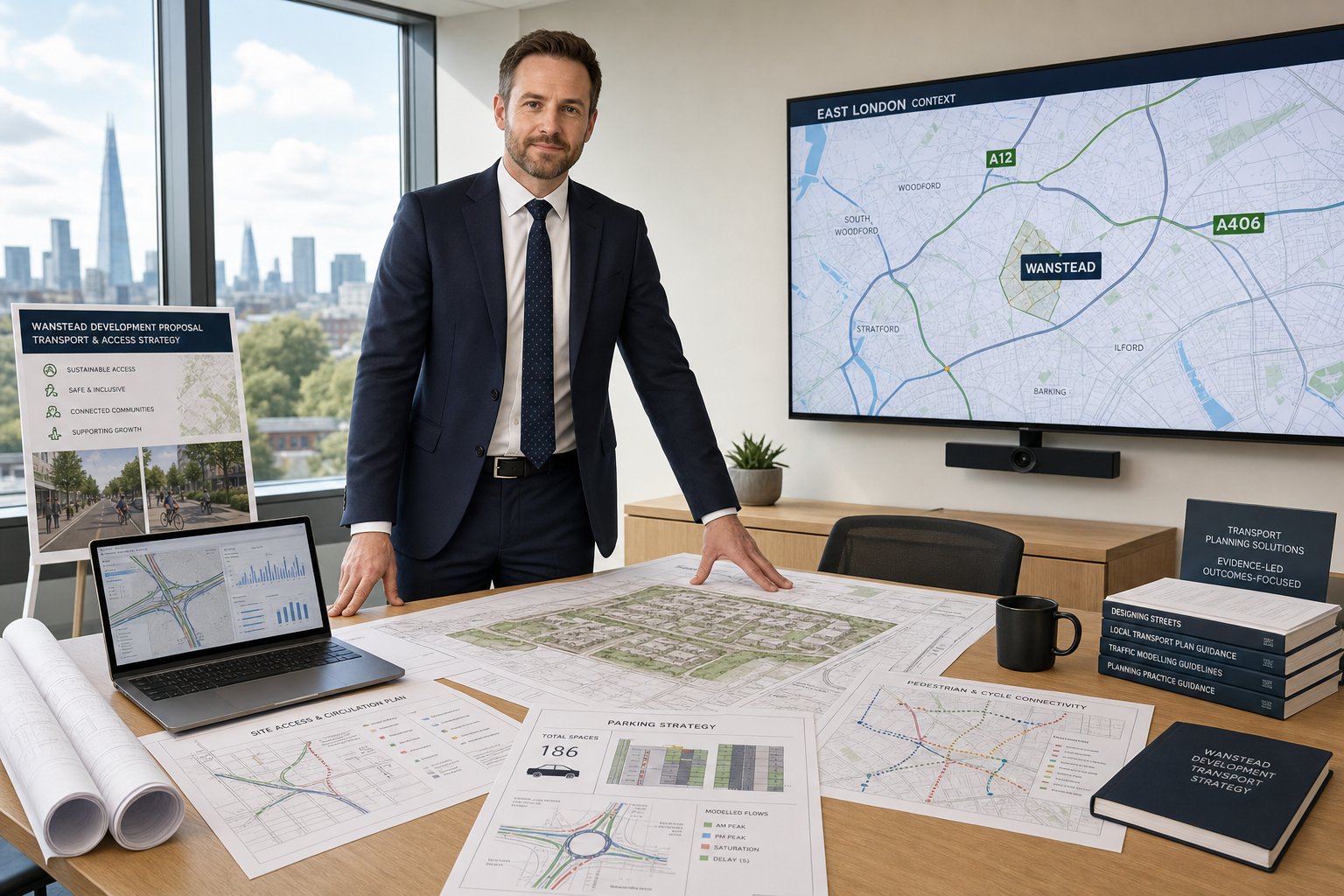
Wanstead schemes rarely fail on ambition alone. More often, they stall because a planning team underestimates what highways officers, transport planners, or TfL will want to see before they’re comfortable with a proposal. A modest change of use can trigger parking concerns. A small infill scheme can raise questions about refuse tracking, visibility, or congestion at a nearby junction. And if a site sits close to the A12, A406, a school route, or a station catchment, the transport conversation gets serious quite quickly.
That’s where a traffic engineer in Wanstead becomes genuinely useful. We don’t just produce reports to fill a planning checklist. We help turn early design ideas into evidence-led submissions that address access, safety, capacity, servicing, and policy fit before those issues become reasons for delay. For architects, planners, surveyors, developers, legal teams, and local authorities, that usually means clearer advice, fewer avoidable objections, and a better chance of keeping a programme on track.
In Wanstead, local knowledge matters. Redbridge policy, London Plan expectations, PTAL context, controlled parking pressure, and the practical behaviour of nearby streets all shape what “acceptable” looks like. In this guide, we explain what transport support typically involves, when it’s needed, which reports are commonly used, and how we assess the details that planning decisions often turn on.
Key Takeaways
- A traffic engineer in Wanstead provides essential, evidence-led transport input that addresses access, safety, capacity, and policy compliance, helping development proposals succeed.
- Early involvement of a traffic engineer can prevent costly delays by ensuring designs meet Redbridge and London Plan expectations and local highway authority requirements.
- Transport reports in Wanstead should be proportionate, ranging from concise technical notes to full Transport Assessments depending on scheme size and impact.
- Local factors such as parking pressure, proximity to strategic roads, school routes, and sustainable travel opportunities significantly influence transport assessments in Wanstead.
- Collaboration between traffic engineers, architects, planners, and councils leads to better schemes and smoother planning approvals by integrating transport expertise early in the design process.
- Choosing an experienced, communicative traffic engineer familiar with Wanstead’s specific policies and practical realities is crucial for timely, tailored, and effective transport advice.
What A Traffic Engineer In Wanstead Does For Planning Applications

A traffic engineer in Wanstead helps demonstrate that a development can function safely and efficiently within the surrounding highway network. In practice, that starts with reviewing the proposal as drawn, not as imagined. We look at access geometry, internal circulation, parking layout, servicing, refuse collection, pedestrian movement, cycle provision, and how the site connects to the local road hierarchy.
For planning applications, our job is partly technical and partly strategic. The technical side involves measurements, standards, surveys, trip forecasting, visibility checks, and sometimes junction modelling. The strategic side is knowing what level of evidence is proportionate for Redbridge, when TfL may need to be involved, and how to present transport issues in a way that addresses officer concerns directly.
A good transport input can also improve the design itself. We often advise on widening or repositioning an access, refining parking arrangements, safeguarding servicing space, or strengthening walking and cycling links so the scheme performs better before submission. That is usually far easier than defending a weak layout after objections arrive.
For teams needing broader context beyond a single borough, our work often aligns with the same principles covered in Traffic Engineering and Transportation across urban planning projects. The difference in Wanstead is that local street character, parking pressure, and strategic route sensitivity can make small details carry unusual weight.
When Transport Input Is Needed For A Wanstead Development

Not every scheme needs a full Transport Assessment, but many developments in Wanstead benefit from transport input much earlier than teams expect. If a proposal could materially affect local roads, parking demand, servicing activity, or pedestrian and cycle conditions, it is sensible to involve a traffic engineer before planning documents are finalised.
We are commonly asked to support residential blocks, HMOs, mixed-use schemes, schools, nurseries, healthcare uses, retail units, leisure proposals, and employment sites. Change-of-use applications are especially easy to underestimate. A building may look unchanged externally while generating very different arrivals, departures, delivery patterns, or on-street parking demand.
Transport support also becomes more important where access is constrained, where vehicles must manoeuvre in tight courtyards, or where the surrounding network is already sensitive. In Wanstead, sites near busy local junctions, bus corridors, or strategic roads often need careful justification even when the proposal itself is not especially large.
That’s why early appraisal matters. On a straightforward scheme, concise Traffic Engineering Consultants: support may be enough to confirm the likely scope. On a more complex site, early transport advice can prevent an architect from investing weeks in a layout that will later be challenged on access or servicing grounds.
Typical Schemes That Often Require Assessment
Certain development types repeatedly trigger transport questions in Wanstead. Medium to large housing schemes are the obvious example, particularly where parking is restrained or the local highway network already experiences pressure. Mixed-use proposals can be even trickier because residential, commercial, and service traffic often peak at different times.
We also regularly see transport evidence requested for change-of-use applications that intensify demand. A former office becoming a healthcare use, or a retail unit becoming a food-led use, can alter trip rates and kerbside activity quite sharply. Sites on or near the A12, A406, or heavily trafficked local routes are another common trigger, especially where turning movements may affect network reliability.
Then there are context-led issues: school-frontage sites, locations near stations, schemes affecting cycle corridors, and developments with awkward servicing needs. Even a modest proposal may need assessment if it interferes with a bus route, compromises pedestrian desire lines, or adds pressure to a controlled parking zone. The size of a site is only part of the story: its surroundings often decide the level of scrutiny.
The Main Transport Reports Used In Wanstead Planning

Transport reporting in Wanstead should be proportionate. Planning officers and highway authorities usually want enough evidence to understand the likely impact of a scheme, but they do not always need a heavyweight document. Choosing the right report matters because an oversized submission can waste time, while an underspecified one can trigger objections or validation delays.
At the simpler end, a short technical note may be enough to address a single point, such as parking stress, visibility, or refuse access. For many minor developments, but, a Transport Statement provides the right level of structure. Larger or more complex schemes usually require a fuller assessment of trips, network effects, mitigation, and policy compliance.
The best approach is usually to define the need based on use class, scale, access conditions, and local sensitivity rather than relying on guesswork. Our reporting style is concise because planning teams rarely benefit from padded analysis. What they need is clear evidence, local policy awareness, and direct answers to the questions officers are likely to ask.
That is also the principle behind our Highway And Traffic Engineering work more broadly: keep reports focused, defensible, and aligned with the decision-making context.
Transport Statements, Transport Assessments, And Travel Plans
A Transport Statement (TS) is normally used for smaller schemes where impacts are expected to be limited. It explains the site context, access arrangements, parking, sustainable travel opportunities, and likely trip effects in a concise format. In Wanstead, a TS often works well for modest residential, community, or commercial proposals where there is a need for evidence but not full-scale modelling.
A Transport Assessment (TA) is more detailed and usually reserved for larger developments or sites likely to have a more significant effect on the network. A TA may include baseline surveys, trip generation, trip distribution, junction capacity work, parking analysis, servicing review, and mitigation proposals. It also tends to engage more directly with borough and London-wide policy requirements.
A Travel Plan (TP) is different. It is less about measuring impact and more about managing travel behaviour. A good Travel Plan sets out realistic measures to encourage walking, cycling, public transport, car sharing, and reduced single-occupancy car trips. In London contexts, this can be particularly important where parking is limited and mode shift is a policy expectation rather than a nice extra.
Technical Notes, Swept Path Analysis, And Highway Advice
Not every planning issue needs a full report. Sometimes the most effective response is a concise technical note dealing with one disputed point. That could be a rebuttal to a highways comment, a short parking stress review, a note on cycle parking standards, or a clarification of servicing frequency. Small, well-targeted notes can unblock applications surprisingly quickly.
Swept path analysis is another common requirement. Using vehicle tracking, we test whether cars, refuse vehicles, delivery vans, and emergency vehicles can enter, turn, load, and leave safely. For constrained Wanstead sites, especially backland or infill developments, this can be one of the most important pieces of evidence in the whole application.
We also provide practical highway advice on visibility splays, kerb radii, access widths, adoption issues, and potential section 278 or section 38 implications. For teams handling commercial or mixed-use proposals, the transport issues often overlap with the concerns discussed in Commercial Traffic Engineering, particularly around servicing, loading, and peak-hour activity.
Key Local Transport And Highway Considerations In Wanstead

Wanstead is not a place where generic transport advice works especially well. A report can be technically competent and still miss the local planning mood if it ignores how Redbridge and London policy apply on the ground. That includes the Redbridge Local Plan, the London Plan, and, where relevant, TfL expectations around strategic roads, sustainable mode share, Healthy Streets, and Vision Zero principles.
One of the first things we consider is whether the site’s location changes the planning balance. Proximity to Underground or rail stations can support lower parking provision, but only if the walking route is realistic and the wider design supports non-car travel. PTAL matters, but it should never be treated as the whole story. A site may have a decent theoretical accessibility level and still present practical concerns if crossings are poor, footways are narrow, or local roads feel hostile.
Parking pressure is another recurring issue. Controlled Parking Zones, school pick-up behaviour, and on-street stress can all influence officer responses. In some parts of Wanstead, neighbours are less worried about extra traffic in the abstract than about where delivery vans, carers, visitors, or second cars will actually go.
Then there are the strategic and semi-strategic corridors nearby. Sites influenced by the A12 or A406, or by busy local junctions feeding them, can attract more scrutiny because small turning or queueing effects may be judged cumulatively rather than in isolation. We also pay close attention to local walking and cycling routes, crossings near schools, and any interaction with bus services. Those details often decide whether a scheme is seen as merely acceptable or genuinely policy-aligned.
For teams working across multiple boroughs, the broader framework set out in Traffic Engineer In London: is useful, but Wanstead-specific judgement remains essential.
How A Traffic Engineer Assesses Access, Safety, And Capacity

Most planning transport work comes back to three questions: can vehicles and people get in and out safely, will the proposal create unacceptable risk, and can the surrounding network cope? A traffic engineer structures the assessment around those fundamentals, then scales the evidence to match the site.
For access, we examine width, gradient, junction spacing, turning provision, gate positions, and whether refuse or emergency vehicles can operate without awkward reversing or conflict. For safety, we review visibility, likely pedestrian and cycle interactions, historic collision patterns where relevant, and whether the design introduces unnecessary points of tension. For capacity, we test the effect of development traffic on the local network, sometimes with simple reasoned assessment and sometimes with formal modelling.
The important point is that these are not separate silos. A tight access can create safety issues. A parking shortfall can become a highway concern if overspill blocks sightlines. A servicing bay that works on plan may fail in operation if it forces vehicles to wait in the carriageway. That is why transport input works best when it is integrated with layout design rather than added after the fact.
Our approach reflects the same practical mindset found in Traffic Engineering: Your Complete discussions, but planning applications demand a more site-specific and policy-aware application of those principles.
Traffic Surveys, Trip Generation, And Junction Analysis
Evidence starts with understanding existing conditions. Depending on the scheme, we may commission traffic counts, queue surveys, speed surveys, parking beat surveys, or pedestrian and cycle observations. Sometimes suitable recent data already exists: sometimes fresh counts are clearly necessary, especially where local conditions fluctuate around schools or peak commuter periods.
Trip generation is then estimated using TRICS, comparable sites, census-informed assumptions, or a combination of sources. In London locations, person-trip analysis can be as important as vehicle-trip analysis because public transport, walking, and cycling mode share may materially affect outcomes. The purpose is not to inflate precision but to arrive at a realistic and defensible estimate.
Where a junction is likely to be sensitive, we assign trips to the network and assess operational effects. That may involve priority junction modelling using PICADY, roundabout review with ARCADY, or signal analysis in other software where appropriate. The headline question is simple: does the development traffic cause a material worsening, and if so, is mitigation available?
Design Review, Visibility, Parking, And Servicing
Design review is where transport theory meets what people will actually do on site. We check whether access visibility splays are appropriate for likely speeds, whether drivers can emerge without creeping into conflict, and whether pedestrians are protected along the desire lines they are most likely to use. A compliant number on a drawing is not enough if the arrangement is awkward in practice.
Parking is assessed against borough and London standards, but standards alone do not settle the issue. We look at local ownership patterns, PTAL, the nature of the use, visitor demand, blue-badge provision, cycle parking quality, and likely on-street consequences. In Wanstead, parking objections are often emotionally charged, so the evidence needs to be calm, specific, and credible.
Servicing is equally important. Refuse, deliveries, and occasional larger vehicles can make or break a site layout. We test tracking, loading positions, waiting space, and whether vehicles can leave in forward gear where expected. On tighter plots, a few metres of poor planning can create years of operational frustration, and a very avoidable planning refusal.
Working With Architects, Planners, Developers, And Councils
The best transport outcomes usually come from collaboration, not heroic report writing at the end. By the time a planning application is assembled, access, level changes, bin strategy, parking layout, and servicing assumptions have already been shaped by other disciplines. If transport input arrives too late, the whole team may be trying to defend avoidable weaknesses.
We hence work closely with architects on site layout, access geometry, tracking, and pedestrian movement. With planners, we align the transport case to policy and anticipated officer concerns. With developers and land teams, we balance technical recommendations against viability, phasing, and programme pressure. And with councils or TfL, we aim to keep the conversation specific, proportionate, and solution-focused.
This matters because transport planning is rarely just about one report. A simple note may prompt a revised drawing. A swept path issue may affect landscaping. A parking strategy may need support from a Travel Plan or permit-free condition. A servicing concern may influence tenancy assumptions on a commercial scheme.
Across wider regional work, we often draw comparisons with lessons seen in Traffic Engineer In Manchester: and other city contexts, but local authority engagement in London tends to be more policy-dense and more sensitive to sustainable transport detail. In Wanstead, concise communication helps. Officers usually respond better to clear evidence and sensible amendments than to long, defensive explanations.
Where needed, we also support design team meetings, pre-application discussions, and responses to highways comments. Occasionally, that extends to planning committee or appeal input. The aim is not to make transport look more complicated than it is. It is to make sure a planning team has a defensible case at the points where scrutiny is highest.
Choosing The Right Traffic Engineer In Wanstead
Choosing the right consultant is not just about finding someone who can produce a Transport Statement. It is about finding a team that understands what evidence is proportionate, how Redbridge and TfL are likely to view the scheme, and how to keep advice practical under programme pressure.
We would start with experience. A strong traffic engineer in Wanstead should be comfortable with London policy, borough parking standards, junction assessment, swept path work, Travel Plans, and written highways responses. Credentials matter too, whether that means chartered or incorporated status, specialist transport planning background, or a long record of development support. But experience on paper is only part of it.
Communication matters just as much. Planning teams need concise advice, quick turnarounds, and reports that answer the actual issue rather than wandering through generic theory. That is particularly important when a highways officer has asked a narrow question and the application cannot afford a month of delay while everyone waits for an over-engineered response.
We would also look for a proven approval record and a willingness to engage early. The right consultant should be able to say, with some confidence, when a full TA is unnecessary, when a technical note will do, and when the layout itself needs fixing first. That practical judgement is often what saves time.
At ML Traffic, our focus is exactly that: concise, accurate transport reports delivered quickly, shaped by more than 30 years of experience and tailored to local authority thresholds. For many planning teams, the value is not simply in producing analysis. It is in producing the right analysis, at the right moment, in a form decision-makers can actually use.
Conclusion
In Wanstead, transport input is rarely a box-ticking exercise. It is the evidence base that shows whether a scheme is safe, workable, and policy-compliant in a location where parking pressure, strategic roads, school movements, and London-wide transport expectations can all influence planning outcomes.
A capable traffic engineer in Wanstead helps teams make proportionate decisions early: whether a site needs a Transport Statement or a fuller assessment, whether access or servicing needs redesign, and whether local conditions require stronger justification on parking, active travel, or junction impact. Done properly, that support reduces uncertainty and strengthens the application before objections harden.
For architects, planners, developers, surveyors, legal teams, and councils, the real benefit is clarity. Better transport advice usually means a better scheme, and, very often, a faster route through planning in 2026.
Frequently Asked Questions About Traffic Engineering in Wanstead
What role does a traffic engineer play in planning applications in Wanstead?
A traffic engineer in Wanstead reviews development proposals for access, layout, parking, and servicing against safety and highway standards. They provide evidence to ensure schemes are safe, efficient, and meet Redbridge and London Plan policies, helping to avoid delays and objections during planning.
When is transport input necessary for a development project in Wanstead?
Transport input is needed when a scheme materially affects local roads, parking, servicing, or active travel routes. This often includes residential blocks, HMOs, schools, healthcare, retail, and sites near busy junctions or strategic roads like the A12 or A406, where access and traffic impact require early expert advice.
What kinds of transport reports are typically required for Wanstead planning applications?
Wanstead developments commonly use a Transport Statement for smaller schemes, a more detailed Transport Assessment for larger or complex projects, and Travel Plans to encourage sustainable travel. Technical notes and swept path analyses address specific points like parking or access safety as needed.
How do traffic engineers assess access and safety for Wanstead developments?
They evaluate factors such as access width, gradient, visibility splays, junction spacing, and vehicle manoeuvrability including refuse and emergency access. Safety reviews include collision history, pedestrian and cycle interactions, ensuring the scheme functions safely within the local highway network.
How does local context in Wanstead influence traffic engineering assessments?
Local conditions including Redbridge policy, controlled parking zones, PTAL ratings, school routes, and strategic roads like the A12 and A406 shape assessment. A traffic engineer considers local walking, cycling, and bus corridors, plus neighbour parking concerns, to provide tailored advice specific to Wanstead’s transport environment.
What should I look for when choosing a traffic engineer in Wanstead?
Choose a consultant with chartered status and expertise in London and Redbridge policies, proven planning approval experience, and the ability to produce proportionate assessments like Transport Statements, modelling, and Travel Plans. Clear communication and responsiveness to local authority processes are equally important.