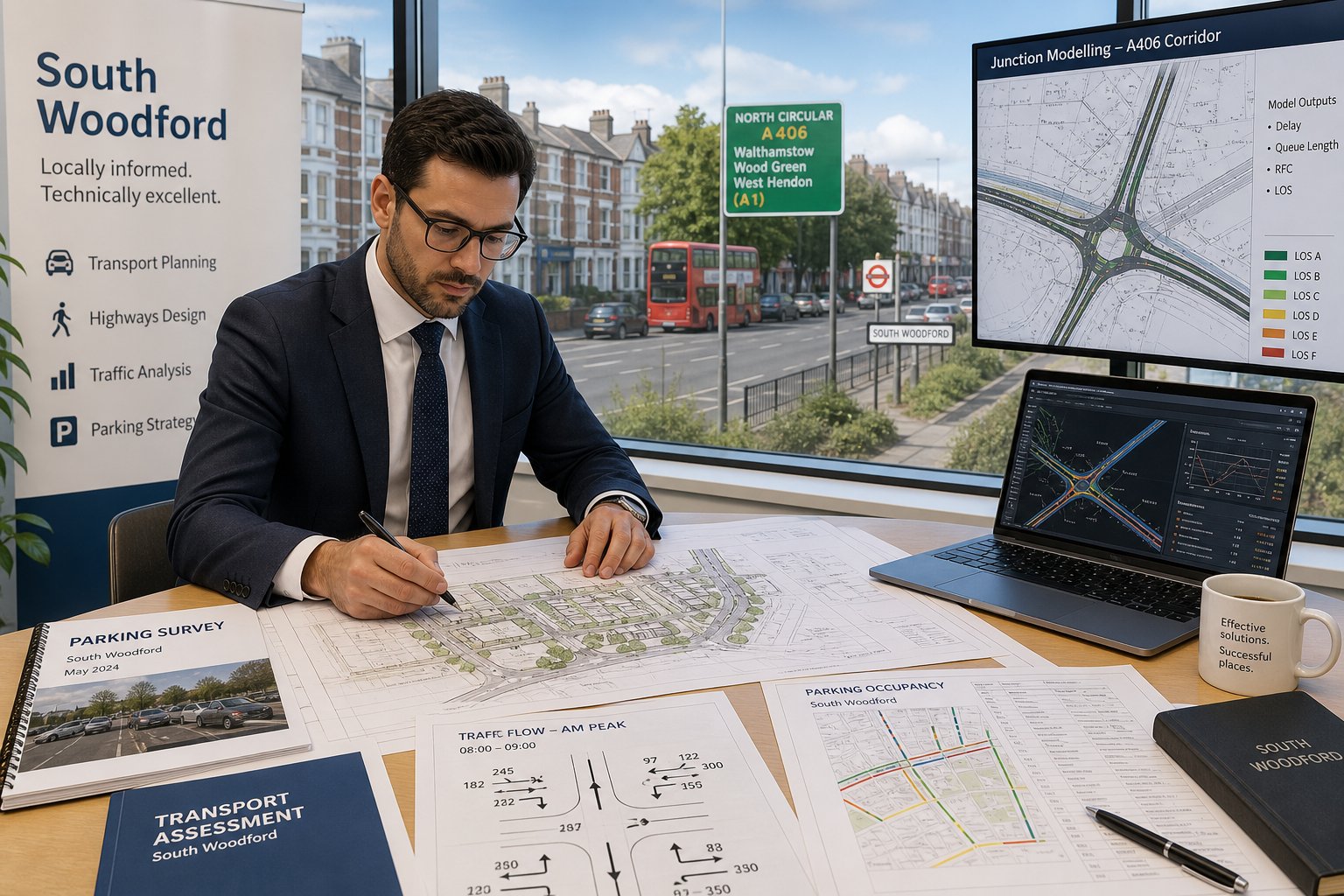
South Woodford is not the kind of place where transport issues stay abstract for long. Put a new access on the wrong corner, underestimate parking stress near a parade, or ignore how school-run traffic interacts with the A406 corridor, and a planning application can run into trouble quickly. For architects, planners, developers and legal teams, that usually means one thing: transport evidence needs to be credible, proportionate and locally aware from the start.
That is where a traffic engineer in South Woodford becomes central to the planning process rather than a late-stage add-on. We use technical highway analysis to show how a proposal will function in the real world: how people arrive, where vehicles turn, whether servicing works, whether parking demand is manageable, and whether any mitigation is needed to satisfy the highway authority. In a London context, that also means aligning with borough policy, TfL expectations, Healthy Streets principles and road safety priorities.
In our experience, the strongest submissions are rarely the ones with the longest reports. They are the ones that answer the right questions clearly, with evidence that fits the site, the scale of development and the concerns likely to be raised by Redbridge officers. Below, we set out why transport input matters in South Woodford, what schemes typically need it, and what good traffic engineering support should look like in 2026.
Key Takeaways
- A traffic engineer in South Woodford plays a crucial role in providing credible, locally tailored transport evidence that supports planning applications effectively.
- Early traffic engineering input helps prevent planning objections by addressing access, parking, servicing, and road safety concerns specific to South Woodford’s urban context.
- Transport assessments and parking surveys must be proportionate and focused, targeting key local issues like the A406 corridor impact and local parking pressures.
- Residential, mixed-use, and change-of-use developments often require bespoke traffic engineering analysis to evaluate trip generation, parking demand, and servicing arrangements accurately.
- Choosing a traffic engineer with local planning knowledge and clear communication skills ensures that transport evidence aligns with Redbridge borough policies and speeds up the planning process.
- Strong transport evidence not only supports planning validation but also improves scheme design and mitigates objections, facilitating a smoother path to approval in South Woodford.
Why A Traffic Engineer Matters For Development In South Woodford
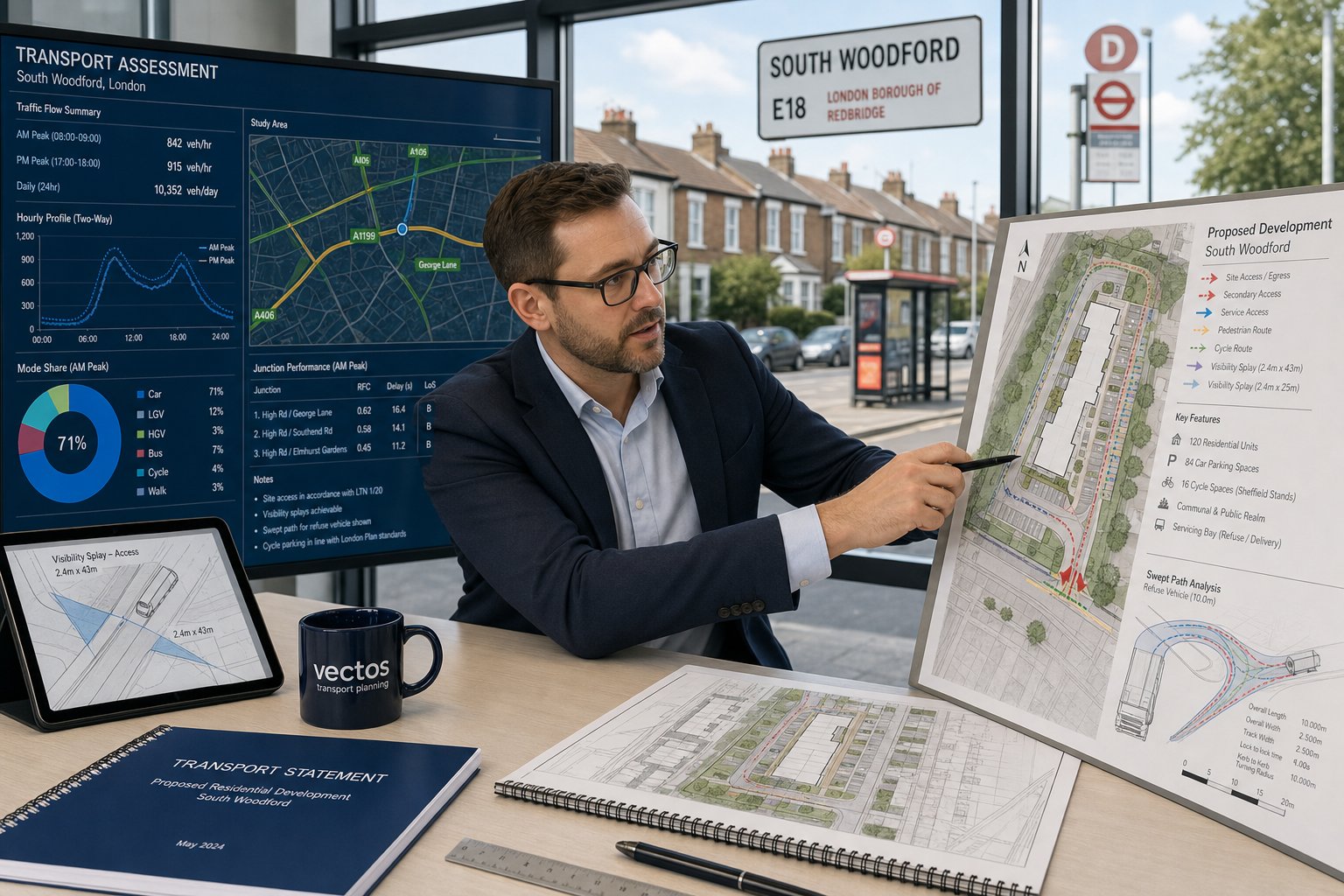
South Woodford presents a very London-style mix of planning pressures: constrained sites, busy distributor roads, established residential streets, public transport accessibility that varies by micro-location, and sensitive local concerns around parking and safety. In that setting, highway and transport issues often become decisive even when the development itself is relatively modest.
A traffic engineer in South Woodford helps translate a design proposal into measurable transport effects. We assess access geometry, likely trip generation, servicing arrangements, visibility, swept paths, parking demand, cycle provision and pedestrian movement. That evidence gives planning officers and highway consultees a structured basis for deciding whether a scheme is acceptable.
This matters because transport objections are often framed in practical terms rather than theory. Residents may raise overspill parking concerns. Officers may question whether a refuse vehicle can enter and leave in forward gear. A case officer may need reassurance that a change of use will not intensify peak-hour traffic beyond what the local network can reasonably accommodate. Those are not issues best answered with assumptions.
In many cases, our role is also preventative. Early transport input can reshape a layout before an application is submitted, avoiding weak access arrangements or underprovided cycle parking that later trigger objections. For teams working across multiple authorities, broader context from Traffic Engineer In London: assignments is useful, but local judgement in South Woodford is what usually makes the difference between a report that merely exists and one that actually helps secure consent.
Local Planning And Highway Context In South Woodford
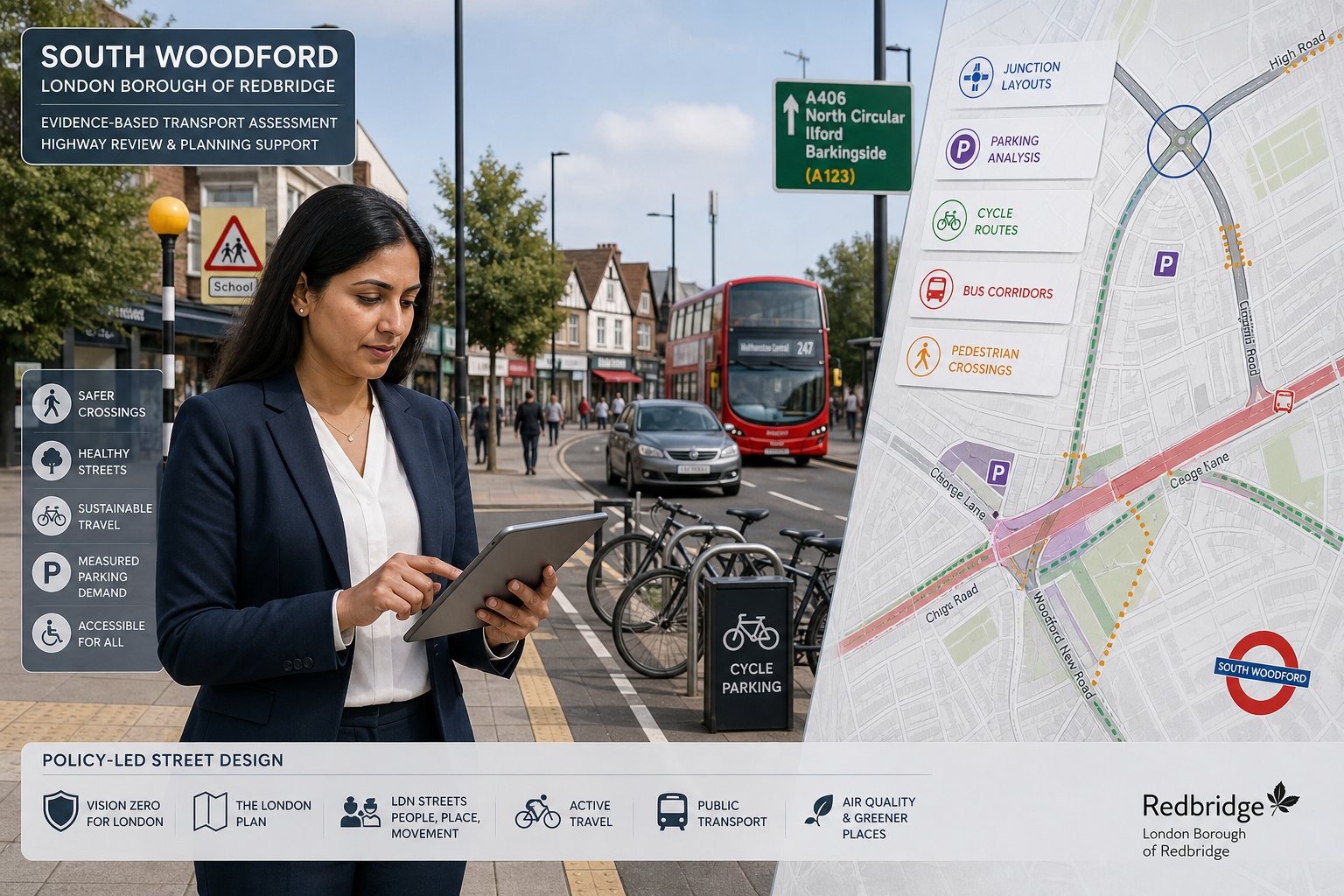
South Woodford sits within the London Borough of Redbridge, where highway matters are considered against a mix of local and London-wide policy. In practice, that means development teams need to think beyond simple traffic flow. Officers may also focus on sustainable travel, road danger reduction, cycle parking quality, accessibility, bus operations and the cumulative impact of parking demand on nearby streets.
The borough’s Highways and Transport function, including its Traffic Engineering Team, plays an important role in reviewing how proposals affect the network. That review is not carried out in a vacuum. It is shaped by the London Plan, Redbridge Local Plan policies, national planning guidance and transport design expectations commonly associated with TfL standards. Vision Zero and Healthy Streets are not just policy phrases: they influence how access, crossings, servicing and street design are judged.
South Woodford’s location near the A406 corridor adds another layer. Some schemes may appear small on paper but sit in a sensitive operational context because of turning movements, congestion patterns or interactions with strategic roads. Nearby bus routes, school travel patterns and established parking stress can all change the level of evidence required.
That is why proportionate reporting matters. A concise note may be enough for one site, while another will need a fuller package of surveys, trip analysis and junction review. The discipline outlined in Traffic Engineering Consultants: work is especially relevant here: understand the authority’s likely concerns, then answer them directly with local evidence rather than generic transport wording.
Common Schemes That Need Transport Input
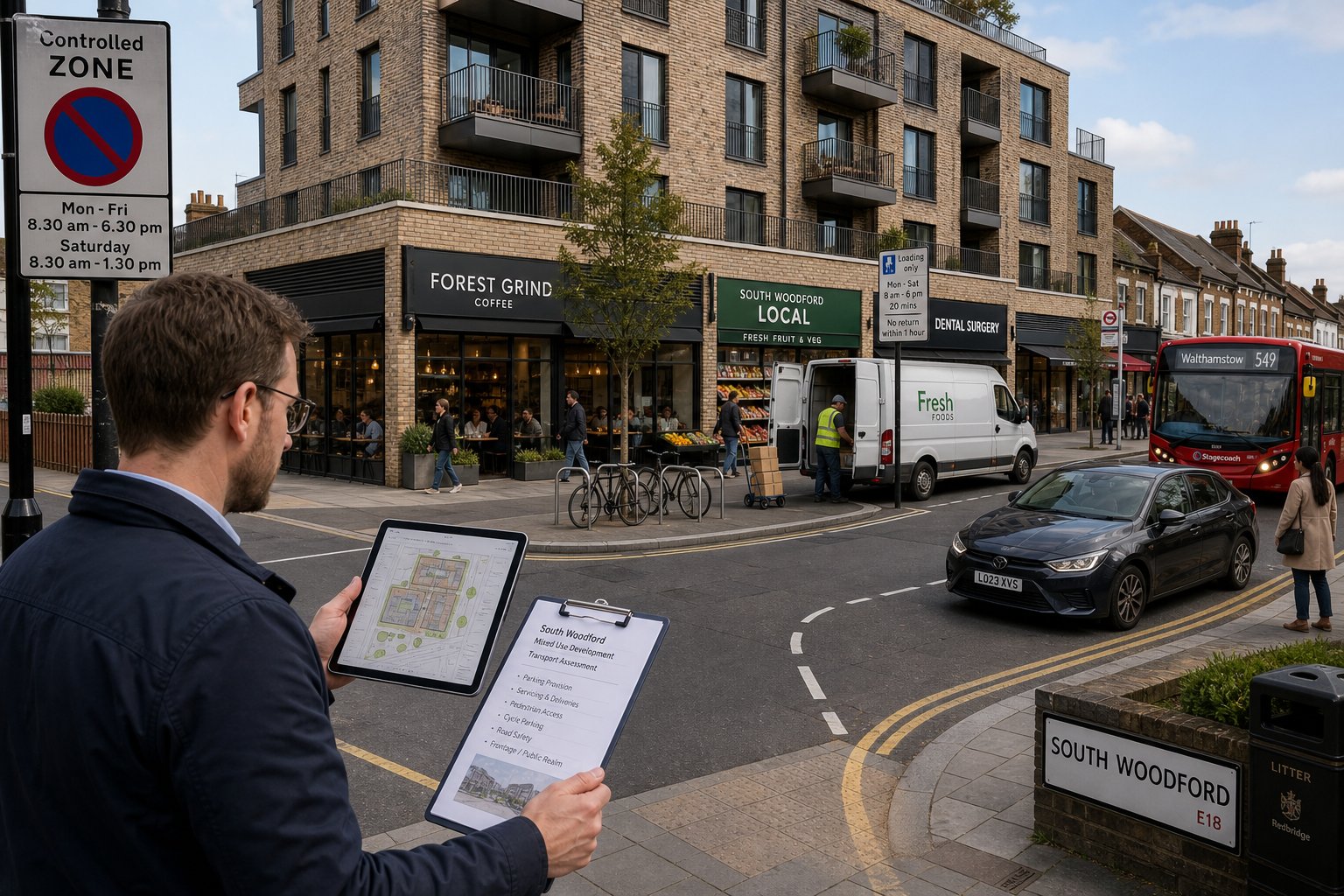
Not every planning proposal in South Woodford needs a lengthy Transport Assessment, but many need some form of transport input. The trigger is usually not just floorspace or unit numbers. It is whether the scheme changes access, increases movements, affects kerbside activity, alters parking demand or raises road safety questions.
Typical instructions include small and medium residential developments, infill plots, apartment schemes over ground-floor commercial space, office-to-residential conversions, HMOs, food and drink uses, schools, places of worship, healthcare uses, community facilities and alterations to existing servicing arrangements. Even when a proposal seems straightforward architecturally, transport can be where the planning risk sits.
We also see frequent demand for support on dropped kerbs, vehicle crossovers, bin collection strategy, cycle parking justification and minor highway works linked to frontage changes. Those tasks may sound technical and narrow, but they often feed directly into whether an application is validated, supported by officers or challenged during determination.
For developer teams, the practical question is simple: will the local authority need evidence to understand how people, goods and vehicles interact with the site? If the answer is yes, transport input is usually sensible.
Residential Developments And Change Of Use Projects
Residential schemes in South Woodford often attract detailed scrutiny because their transport effects are felt immediately by surrounding streets. A new-build block may generate modest vehicle trips in network terms, but if it adds pressure to an already stressed parking area, creates a weak refuse collection arrangement or relies on awkward reversing movements, objections can arrive fast.
Change-of-use projects are especially sensitive. Converting a house to an HMO, an office to flats, or a shop unit to a more intensive use may alter arrival patterns, delivery frequency and on-street parking demand in ways that are not obvious from floor area alone. We typically assess likely trip generation, parking accumulation, cycle storage provision, refuse access, emergency access and whether a car-free or low-car approach is realistic in that exact location.
On constrained urban plots, a short parking survey can be more valuable than pages of generic commentary. It shows whether spare kerbside capacity exists at the times residents and visitors will actually park. For residential-led planning teams, principles from Traffic Engineering: Your practice are helpful, but the real task is applying them to South Woodford’s street pattern, controls and local behaviour.
Commercial, Mixed-Use, And Community-Led Proposals
Commercial and mixed-use schemes bring a different set of transport questions. The authority will often focus less on resident parking and more on servicing, short-stay turnover, staff travel, customer arrival patterns and conflict between deliveries, buses, cyclists and pedestrians.
A café or retail unit, for example, may seem low-impact until delivery timings, collection activity and nearby waiting restrictions are examined properly. A mixed-use scheme can also create overlapping peaks, where residential departures, servicing windows and visitor arrivals all occur within similar periods. Community-led proposals such as schools, healthcare facilities or religious uses need particular care because arrivals can be peaky, highly directional and closely tied to neighbouring amenity concerns.
In these cases, we usually test not just how many trips are generated, but how they are managed. Is there a lawful loading point? Can vehicles turn safely? Will taxis or informal pick-up activity block traffic? Do cycle routes or bus stops alter access design options? Practical guidance developed in Commercial Traffic Engineering work often maps well onto South Woodford schemes, especially where mixed urban frontages and limited kerb space make operations tighter than first impressions suggest.
Core Traffic Engineering Services For Planning Applications
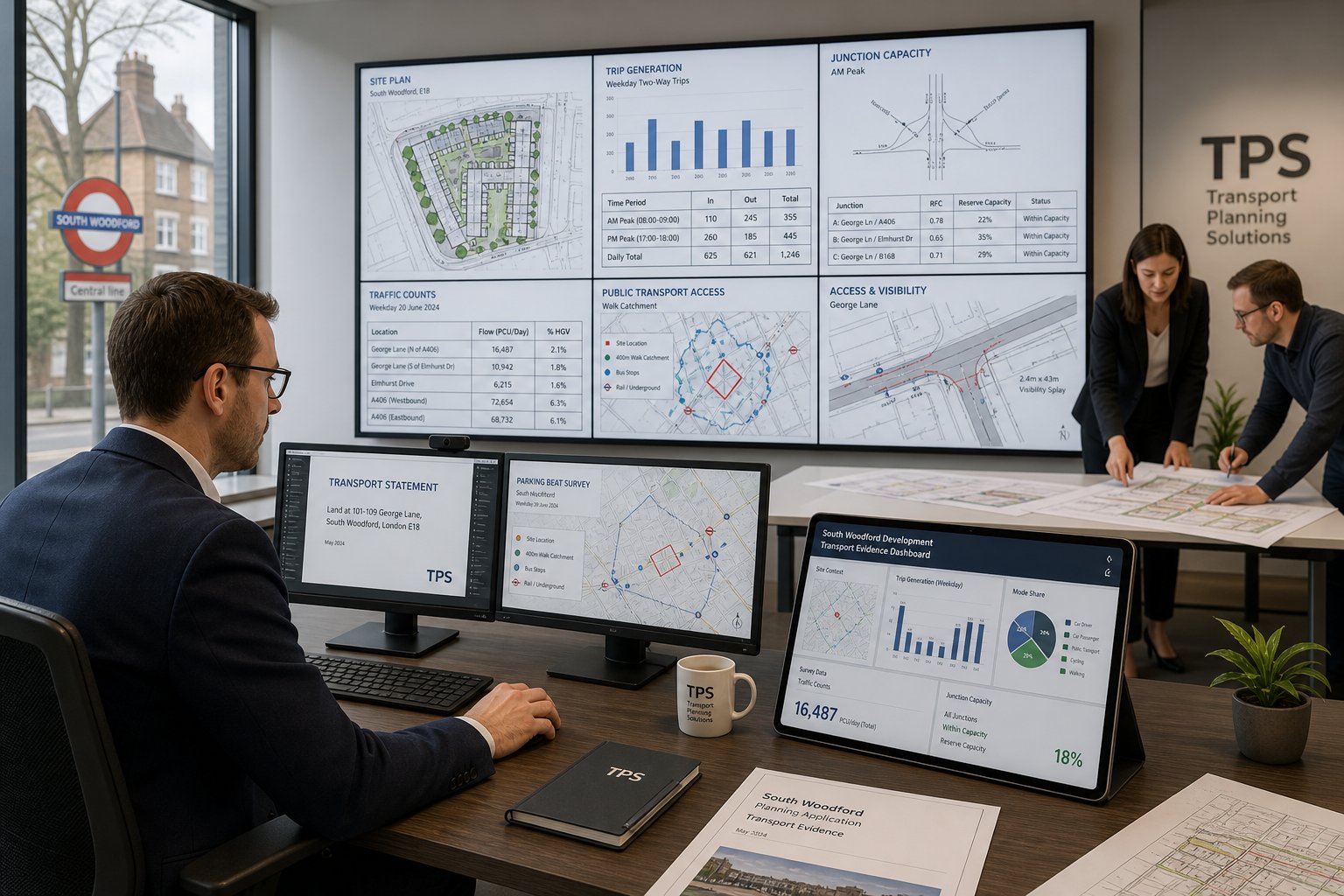
The exact scope of transport work should always match the scale and risk profile of the application. Over-reporting wastes time and budget. Under-reporting, though, is what usually causes delay. For South Woodford projects, the core objective is to produce evidence that is technically sound, proportionate and aligned with what officers and highway reviewers are likely to test.
Our role commonly starts with a review of planning history, site access, local constraints and probable policy triggers. From there, we advise whether the scheme needs a brief technical note, a Transport Statement, a full Transport Assessment, a Travel Plan, parking survey work, traffic counts, junction modelling or access design support. The right package depends on the proposal and the sensitivity of the surrounding network.
Some projects also need coordination with architects and planning consultants on layout revisions before reports are finalised. That can include vehicle tracking, bin lorry access, cycle parking arrangement, visibility splays or frontage changes. It is rarely efficient to treat transport as a separate bolt-on once the site plan has hardened.
Transport Statements, Transport Assessments, And Travel Plans
Transport Statements and Transport Assessments are the backbone of most planning-related traffic engineering work. The difference is usually one of scale, complexity and likely impact. A Transport Statement is normally used where effects are limited and can be explained clearly without extensive modelling. A Transport Assessment is broader and more detailed, often required where trip generation, access arrangements or network effects need deeper scrutiny.
In South Woodford, both documents typically cover existing site conditions, local highway context, sustainable transport accessibility, parking supply, trip generation, distribution, servicing, road safety considerations and any mitigation or design changes proposed. Good reports are not padded. They target the concerns that matter to Redbridge and, where relevant, TfL.
Travel Plans are also increasingly important, especially for schemes expected to support non-car travel. These set out measures to encourage walking, cycling, public transport use, car club membership, delivery management or staff travel management. A Travel Plan is stronger when it reflects the actual site context rather than repeating generic pledges.
Teams comparing regional practice sometimes benefit from examples similar to Traffic Engineer In Leeds: frameworks, but South Woodford applications still need a specifically London-led treatment grounded in local policy and public transport conditions.
Parking Surveys, Trip Generation, And Junction Capacity Reviews
This is often where planning applications are won or lost. If neighbours say parking is impossible, or officers think an access junction will operate poorly, opinion alone is not enough. We need evidence.
Parking surveys establish how much on-street capacity exists around a site at relevant times. The methodology matters: survey extents, beat lengths, restrictions, permit controls and timing must be chosen carefully so the findings are defensible. In urban boroughs, a well-executed parking stress survey can directly answer one of the most common refusal risks.
Trip generation work estimates how many person-trips and vehicle trips a development is likely to create. Depending on the proposal, that may rely on TRICS-based analysis, census-style context, comparable sites, or a combination of professional judgement and empirical data. The point is not to inflate precision: it is to provide a realistic basis for assessment.
Where access or nearby junction performance is in issue, capacity reviews may follow using tools such as ARCADY, PICADY or LINSIG, depending on junction type. We only recommend modelling when it is justified. Still, when a proposal sits near a sensitive junction or strategic corridor, robust technical review is far better than leaving a consultee to assume the worst. Comparable workflows in Traffic Engineer In Bristol: assignments show how local thresholds vary, which is exactly why site-specific advice matters.
How Traffic Evidence Supports A Stronger Planning Submission
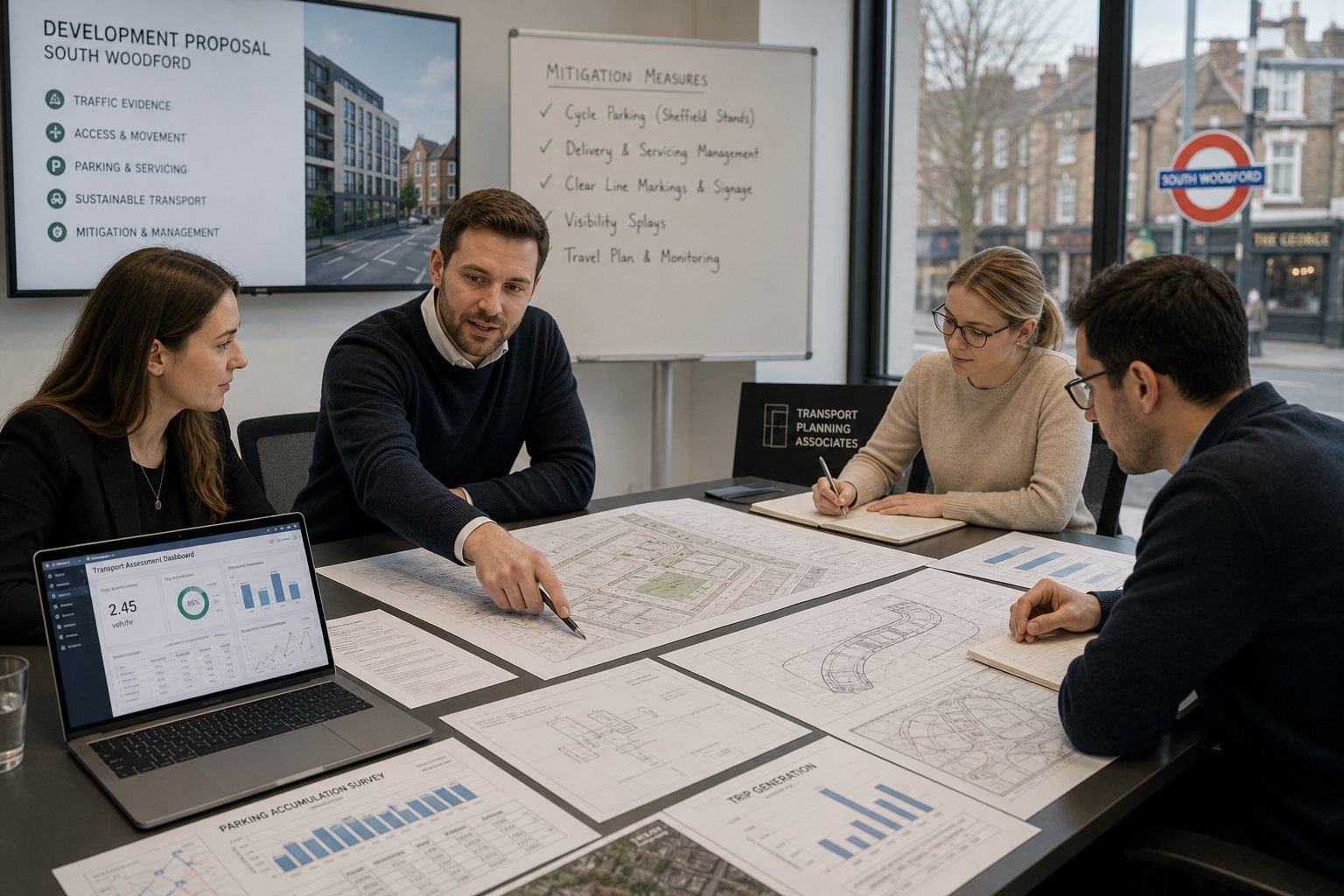
Strong traffic evidence does more than satisfy a validation checklist. It changes the quality of the planning submission itself. When transport issues are properly understood, drawings improve, management measures become more credible, and the planning statement can address likely objections before they harden.
For example, a parking survey may support a restrained parking provision strategy by showing there is genuine local resilience, or it may reveal the need to redesign the scheme before submission. A swept path review may confirm that refuse and emergency access works safely, avoiding a standard but damaging highways objection. A concise assessment of trip generation may demonstrate that a feared traffic impact is, in reality, negligible.
This evidence is also valuable in negotiation. Highway officers are more likely to engage constructively when the applicant’s team has used recognised methodologies, acknowledged constraints honestly and offered proportionate mitigation where needed. That might include amended access geometry, improved cycle parking, delivery controls, car club membership, updated line marking or a financial contribution where policy supports it.
From a legal and planning risk perspective, objective transport work creates a clearer audit trail. It shows that decisions were informed by technical analysis rather than assumption. For multidisciplinary teams, that clarity is often what turns a vulnerable application into a defensible one.
We have found that concise reporting, quick turnaround and borough-specific judgement matter as much as technical competence alone. Broader examples from Traffic Engineer In Liverpool: work underline the same lesson: the best reports do not try to say everything, only what the authority actually needs to support the scheme.
Key Local Factors That Can Affect Highways Advice
South Woodford is not transport-neutral territory. Advice that would be adequate elsewhere can fall short here if it ignores the local network and street environment.
The A406 corridor is one obvious factor. Even where a development does not connect directly to the strategic road network, nearby junction operation, rat-running sensitivity and peak-period congestion can influence how access and trip impacts are viewed. Sites close to strategic junctions tend to require more careful review of routing and operational effects.
Public transport accessibility also matters, but it must be read properly. A decent PTAL does not automatically remove concern about parking demand, especially where occupant profiles, site constraints or local parking controls complicate the picture. Equally, lower car ownership assumptions may still be supportable if the evidence is coherent and the travel plan measures are realistic.
Schools are another recurring factor. A site that functions smoothly at 11am may feel very different during school drop-off and pick-up windows. Nearby parades, bus stops, zebra crossings, cycle movements and existing waiting restrictions can all shape what highway advice is appropriate.
And then there are local safety initiatives, including the South Woodford Road Safety Zone. These can affect how proposals are judged in relation to visibility, pedestrian movement, crossing desire lines and general risk reduction. In practice, that means transport advice needs to be rooted in site observation, not just desktop review. A capable Traffic Engineer In one city may still miss the mark if they do not adapt to South Woodford’s borough-led and corridor-specific realities.
What To Look For When Appointing A Traffic Engineer
First, look for local planning fluency, not just technical software capability. A consultant may know how to run a junction model, but that alone does not mean they understand how Redbridge officers are likely to review a scheme in South Woodford. You want someone who can judge what level of evidence is proportionate and what the probable pressure points will be.
Second, check whether they routinely prepare the documents your project may need: Transport Statements, Transport Assessments, Travel Plans, parking surveys, trip generation work, access reviews and, where necessary, capacity testing. The useful question is not “do they offer transport services?” but “do they regularly produce planning evidence for urban sites like ours?”
Third, communication matters more than many teams expect. Highway issues usually sit between disciplines. The traffic engineer needs to speak clearly with architects, planners, solicitors, project managers and sometimes directly with local authority officers. A technically correct report that no one can easily use is not much help.
Fourth, ask about turnaround and project handling. Planning timetables are rarely generous. At ML Traffic, we know clients often need concise, accurate reporting quickly, especially when a submission window is already moving.
Finally, look for practical judgement. The best consultant is often the one who says a full assessment is unnecessary when a focused note will do, and equally says a layout must change before any report can credibly support it. That balance is what separates basic reporting from planning support that actually earns its keep.
Conclusion
In South Woodford, transport evidence is rarely a box-ticking exercise. It is often the mechanism that shows whether a scheme is workable, policy-aligned and safe in a real urban context shaped by the A406 corridor, local parking pressures, sustainable travel policy and borough highway scrutiny.
A good traffic engineer in South Woodford helps quantify impacts, refine access and servicing, test parking assumptions and present clear evidence that officers can rely on. For architects, planners, developers, lawyers and councils, that means fewer avoidable objections and a stronger basis for decision-making.
The aim is not to produce the biggest report. It is to produce the right one: proportionate, locally informed and technically robust. When that happens, planning applications tend to move forward with fewer surprises and far better prospects of approval.
Common Questions About Traffic Engineering in South Woodford
Why is a traffic engineer important for developments in South Woodford?
A traffic engineer ensures that new developments meet local and London-wide transport policies by assessing access, parking, servicing, and road safety. Their evidence helps planning authorities in Redbridge make informed decisions based on credible, site-specific data.
What types of projects in South Woodford typically require transport input?
Projects such as small to medium residential developments, change-of-use conversions (e.g., office to residential), mixed-use schemes, schools, healthcare facilities, and minor highway works usually need transport analysis to address parking, access, and safety concerns.
How does local context affect traffic engineering advice in South Woodford?
South Woodford’s location near the A406 corridor, existing parking stress, nearby schools, and safety initiatives like the South Woodford Road Safety Zone mean transport advice must consider congestion, peak-period impacts, and local policies including Vision Zero and Healthy Streets principles.
What are Transport Statements and Transport Assessments in the planning process?
Transport Statements provide concise transport impact summaries for smaller developments, while Transport Assessments offer detailed analysis for larger or more complex projects. Both assess trip generation, access, parking, and mitigation measures aligned with Redbridge and TfL standards.
How can a traffic engineer improve the chances of planning consent in South Woodford?
By producing proportionate, locally informed transport evidence that addresses officer concerns early, a traffic engineer can refine access layouts, justify parking provision, ensure safe servicing, and introduce mitigation measures, resulting in stronger applications with fewer objections.
What should I consider when appointing a traffic engineer for a South Woodford project?
Choose an engineer with local Redbridge experience, expertise in Transport Statements and Assessments, clear communication skills, and the ability to liaise with council teams and TfL. Practical judgement to match report scope to project needs is also essential.