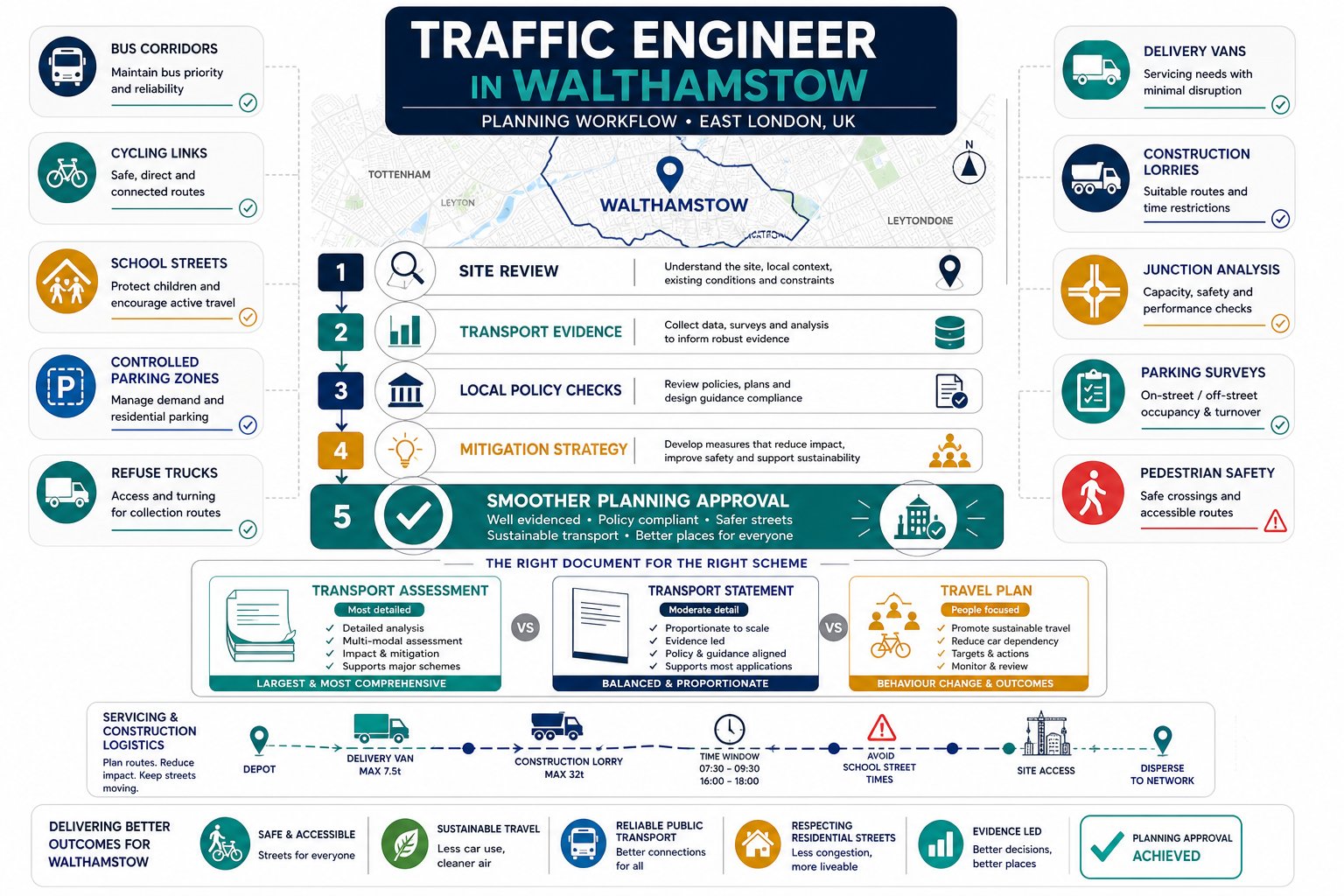
Walthamstow is rarely a place where transport issues sit quietly in the background of a planning application. Tight residential streets, busy bus corridors, low traffic neighbourhoods, School Streets, controlled parking zones and strong sustainable transport policies mean access, servicing, parking and road safety are examined closely. For architects, developers, planners and legal teams, that creates a familiar pressure: even a well-designed scheme can stall if the transport case is weak, late or poorly scoped.
That is where a traffic engineer in Walthamstow becomes central to the project team rather than an afterthought. We help translate development proposals into evidence the local planning authority and highway officers can actually use. In practice, that means assessing likely trip generation, junction effects, walking and cycling links, public transport accessibility, servicing demands, refuse movements and construction impacts, then setting out mitigation that is realistic, policy-led and proportionate.
In Waltham Forest, transport work is not just about vehicle counts. It sits within London Plan policy, Healthy Streets principles, Vision Zero expectations and local sensitivities around overspill parking and neighbourhood traffic. So the value of good advice is not simply technical accuracy: it is knowing what will matter to officers, to TfL where relevant, and to neighbours likely to object.
In this guide, we set out what reports may be needed, what a traffic engineer will examine before submission, and how robust transport evidence can improve the prospects of timely approval in 2026.
Key Takeaways
- A traffic engineer in Walthamstow plays a crucial role in translating development proposals into transport evidence that meets local planning authority and highway officer requirements.
- Robust transport reports like Transport Assessments, Statements, and Travel Plans tailored to the scheme size can significantly improve planning application success and reduce delays.
- Early engagement with a traffic engineer ensures transport considerations are integrated into design, addressing local challenges such as narrow streets, parking stress, and sustainable travel policies.
- Walthamstow’s transport strategy must comply with London Plan, Healthy Streets, and Vision Zero policies while balancing practical issues like servicing, delivery logistics, and community impact.
- Good transport evidence anticipates officer and neighbour concerns, helping to mitigate objections related to parking, road safety, and construction disruptions.
- Choosing a traffic engineer familiar with Walthamstow’s local context and planning policies ensures credible, clear reports that facilitate smoother planning approval processes.
Why A Traffic Engineer Matters For Development In Walthamstow
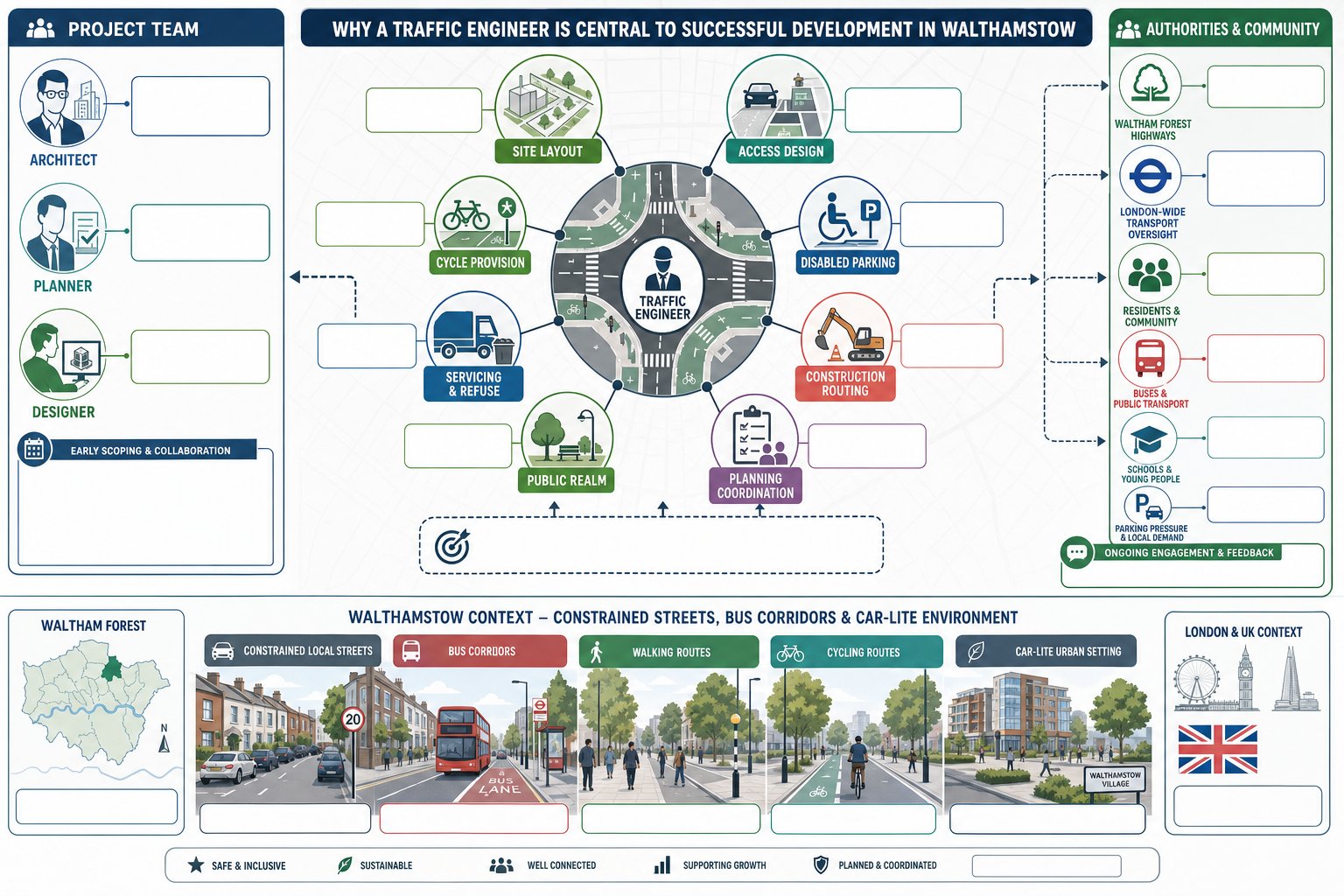
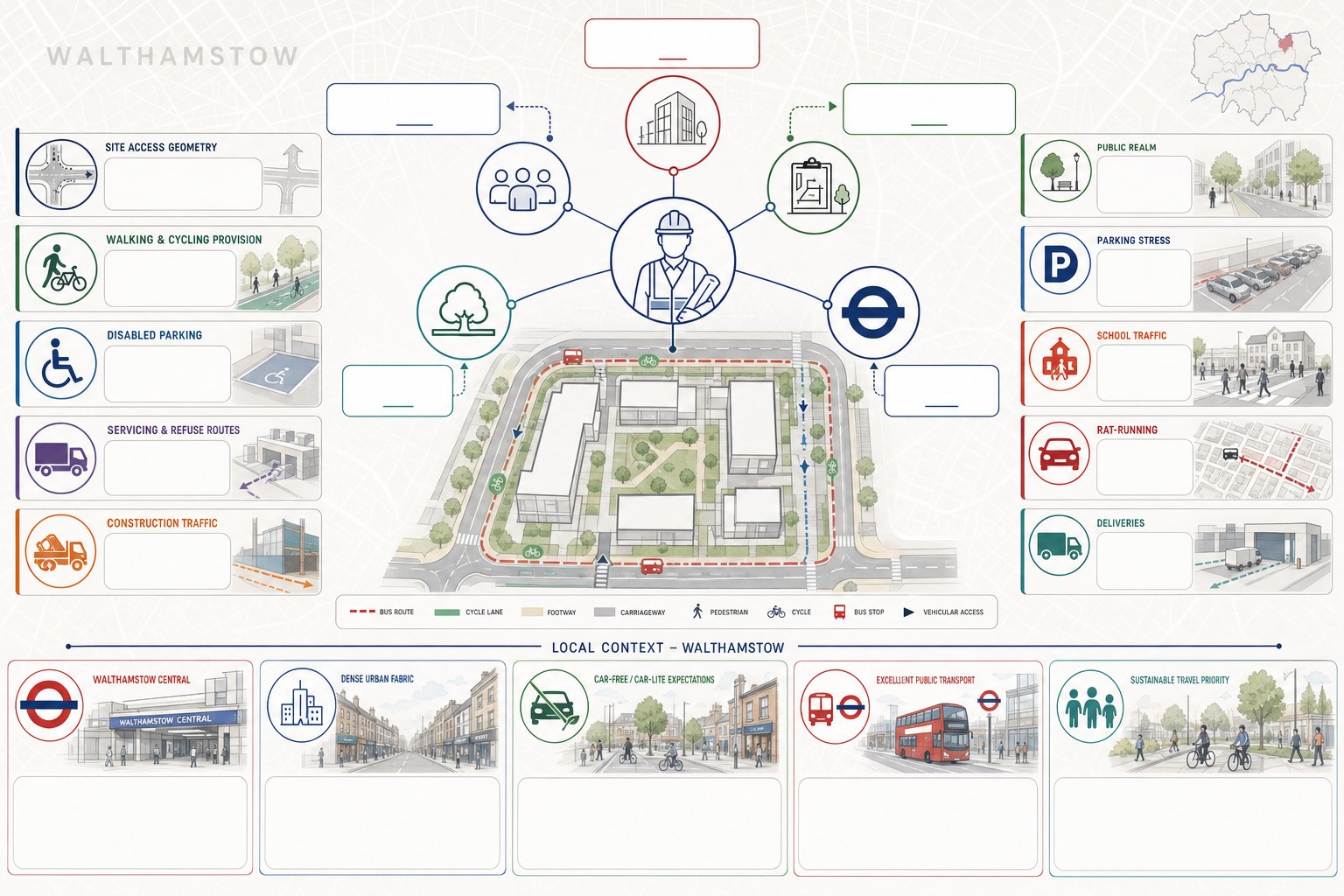
A traffic engineer in Walthamstow does far more than produce a report to satisfy a validation checklist. We act as the link between the design team, planning consultants, architects, the London Borough of Waltham Forest as highway authority, and in some cases Transport for London. That link matters because transport concerns often cut across several disciplines at once: site layout, access geometry, cycle provision, disabled parking, refuse strategy, servicing, construction routing and public realm design.
In Walthamstow, those issues are amplified by context. Streets are often constrained. Bus movement is important. Walking and cycling policy has real weight. Car-free and car-lite expectations can be strong, especially near Walthamstow Central and other well-connected corridors. And local residents tend to pay close attention to parking stress, rat-running, school traffic and delivery activity. A transport submission that ignores those realities may be technically complete yet still unpersuasive.
That is why early scoping is often the difference between a smooth process and weeks of avoidable rework. We typically review the planning context, likely report requirements, site access options and local sensitivities before the application package is fixed. That allows the project team to design with transport in mind instead of trying to defend a poor arrangement later.
For teams working across multiple boroughs, wider Traffic Engineer In London: experience also helps because London authorities share policy themes but apply them in distinct ways. A concise grasp of Traffic Engineering Consultants: support is especially useful when applications need both technical rigour and practical planning judgement.
The Main Transport Reports Needed For Planning Applications
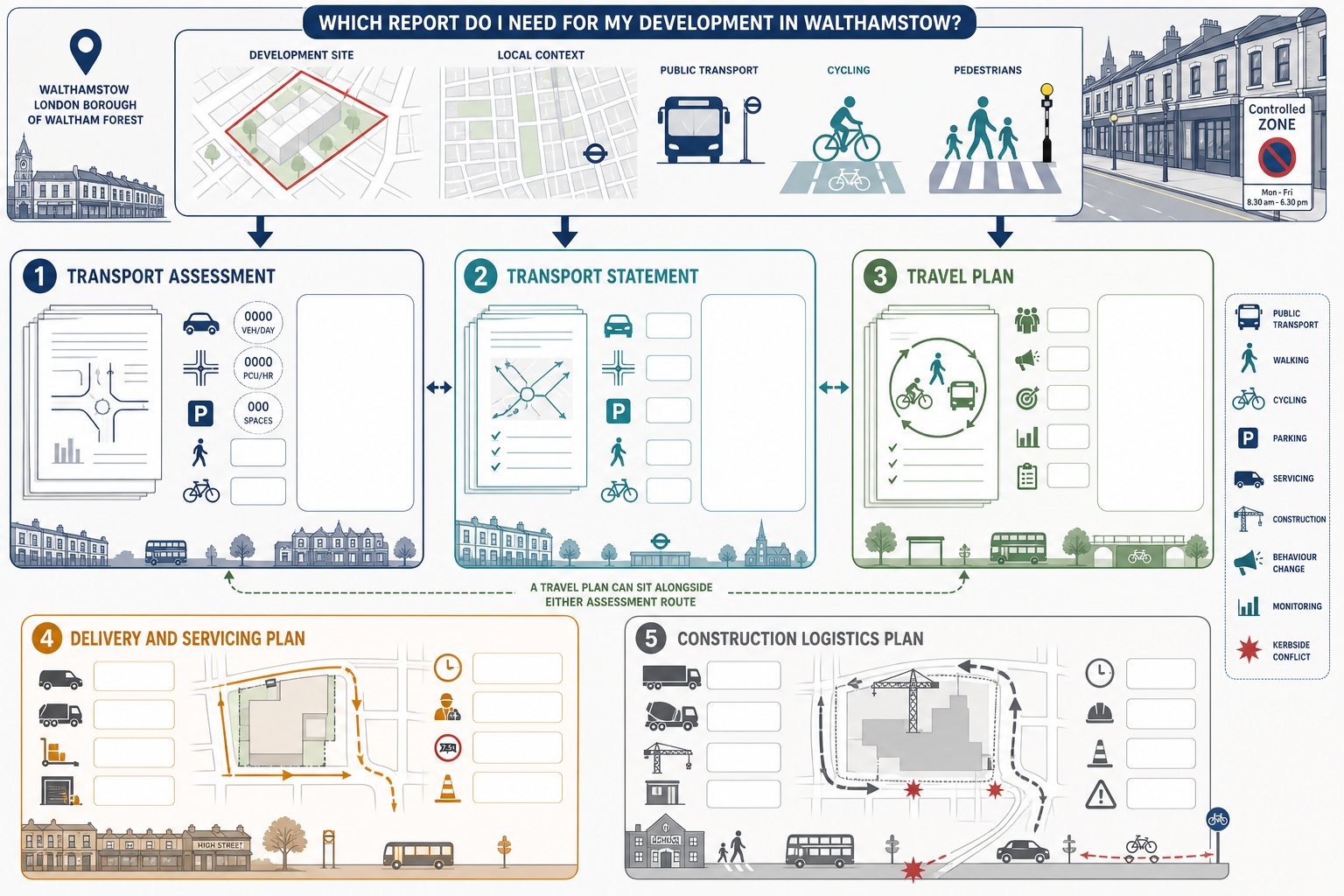
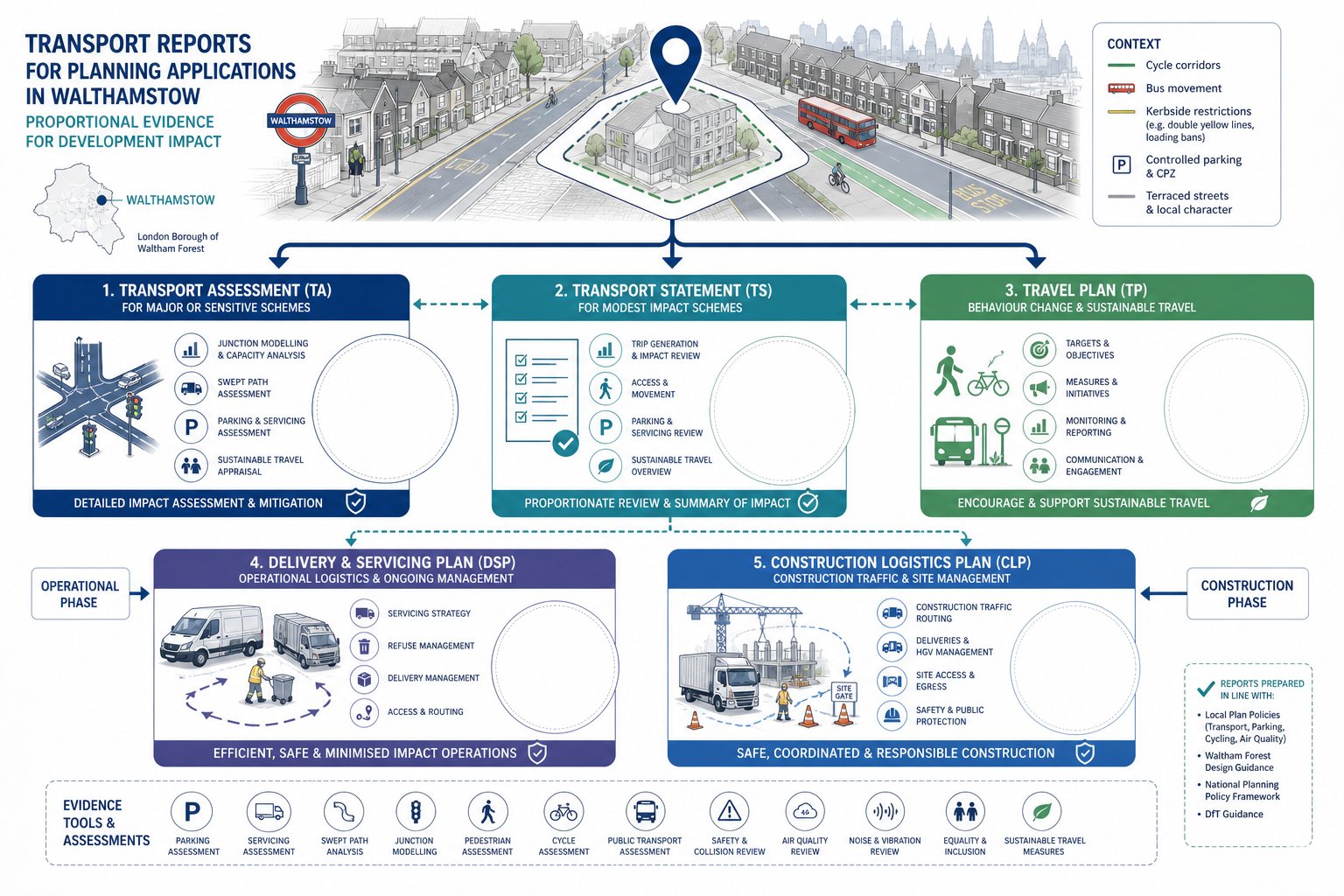
Most planning applications in Walthamstow do not need every possible transport document, but many need at least one. The key is proportionality. Officers want evidence that matches the scale, location and nature of the proposal.
For larger or potentially material developments, a Transport Assessment usually forms the core document. It examines existing conditions, trip generation, likely routing, junction and access effects, parking demand, servicing, road safety and mitigation. For smaller schemes where impacts are expected to be limited, a Transport Statement may be more appropriate. The principle is similar, but the analysis is shorter and more focused on demonstrating that impacts are minor and manageable.
A Travel Plan is different again. It is not primarily about proving impact acceptability: it is about influencing future travel behaviour. On sites with good public transport access, cycle links and walkable catchments, a Travel Plan can be an important part of the planning strategy because it shows how car use will be reduced in practice.
Depending on the scheme, the authority may also require a Delivery and Servicing Plan, a Construction Logistics Plan, swept path analysis, parking surveys, road safety review or junction modelling. Good transport input starts by identifying what is genuinely needed and agreeing scope early, rather than producing a document set that is either thin or excessive.
That broader relationship between planning evidence and movement strategy is covered well in Traffic Engineering and Transportation, while sector-specific expectations are often clearer when teams understand Commercial Traffic Engineering In more generally.
Transport Assessment Vs Transport Statement Vs Travel Plan
A Transport Assessment, or TA, is the most detailed of the three. We would normally prepare one where the proposal could create material effects on the local network or where the site context is sensitive enough that officers need robust evidence. A TA commonly includes traffic counts, trip generation from comparable databases, modal split assumptions, junction capacity analysis where justified, parking accumulation, accessibility review and mitigation recommendations.
A Transport Statement, or TS, is the proportionate alternative. It is used where impacts are expected to be modest and can be explained without full modelling. But concise does not mean casual. A credible TS still needs to address site access, local parking, servicing, sustainable travel opportunities and any obvious safety concern. In many Walthamstow cases, a strong TS can be more effective than an inflated TA because it stays focused on the actual planning questions.
A Travel Plan sits alongside either document where needed. It sets out measures, targets and monitoring arrangements to support sustainable travel. That might include cycle parking management, welcome packs, car-club membership offers, public transport information, staff travel coordinators, delivery consolidation or season-ticket loan measures. In short: the TA or TS explains likely impact, while the Travel Plan explains how behaviour will be nudged in the right direction.
When A Delivery And Servicing Plan Or Construction Logistics Plan May Be Required
A Delivery and Servicing Plan, usually called a DSP, becomes important when regular freight, refuse or servicing trips could create conflict with neighbours, kerbside restrictions or bus movement. Retail units, food-led premises, larger residential blocks, student schemes, mixed-use projects and employment uses often fall into this category. In Walthamstow town centre and other constrained streets, the question is rarely whether deliveries happen: it is whether they can happen without blocking traffic, creating noise problems or forcing unsafe manoeuvres.
A Construction Logistics Plan, or CLP, deals with the build phase rather than the operational phase. It is often required for major works, tight urban plots, sites near schools, bus routes or cycle corridors, and schemes where HGV activity could significantly affect the surrounding area. A good CLP covers routing, timing, holding areas, banksman arrangements, vulnerable road user safety, contractor parking and communication protocols.
This is one area where early drafting saves pain later. If the planning authority fears unmanaged deliveries or construction traffic, objections and conditions multiply very quickly. A practical, site-specific logistics strategy usually does far more than a generic appendix.
Walthamstow Planning And Highway Considerations That Can Affect Transport Strategy
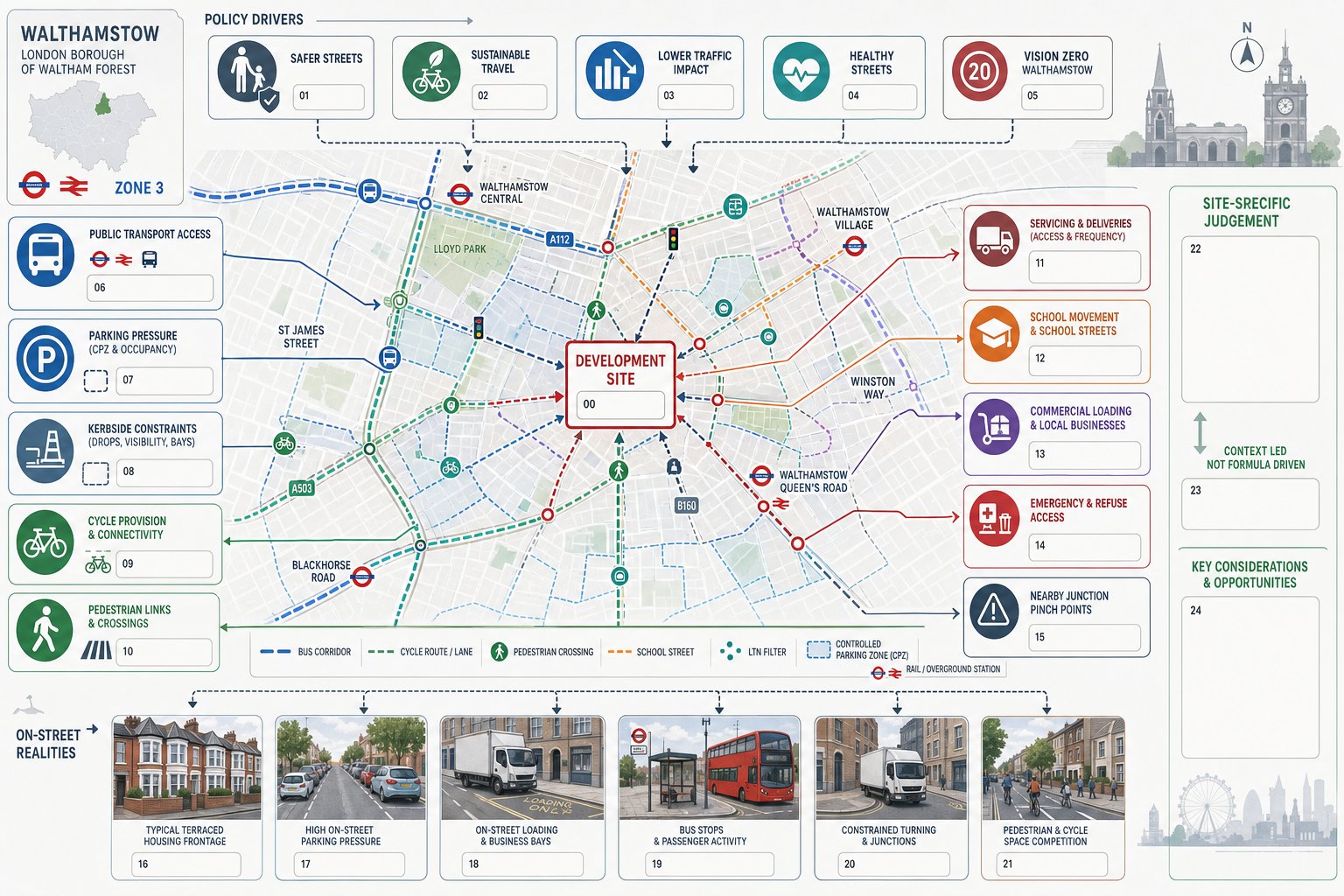
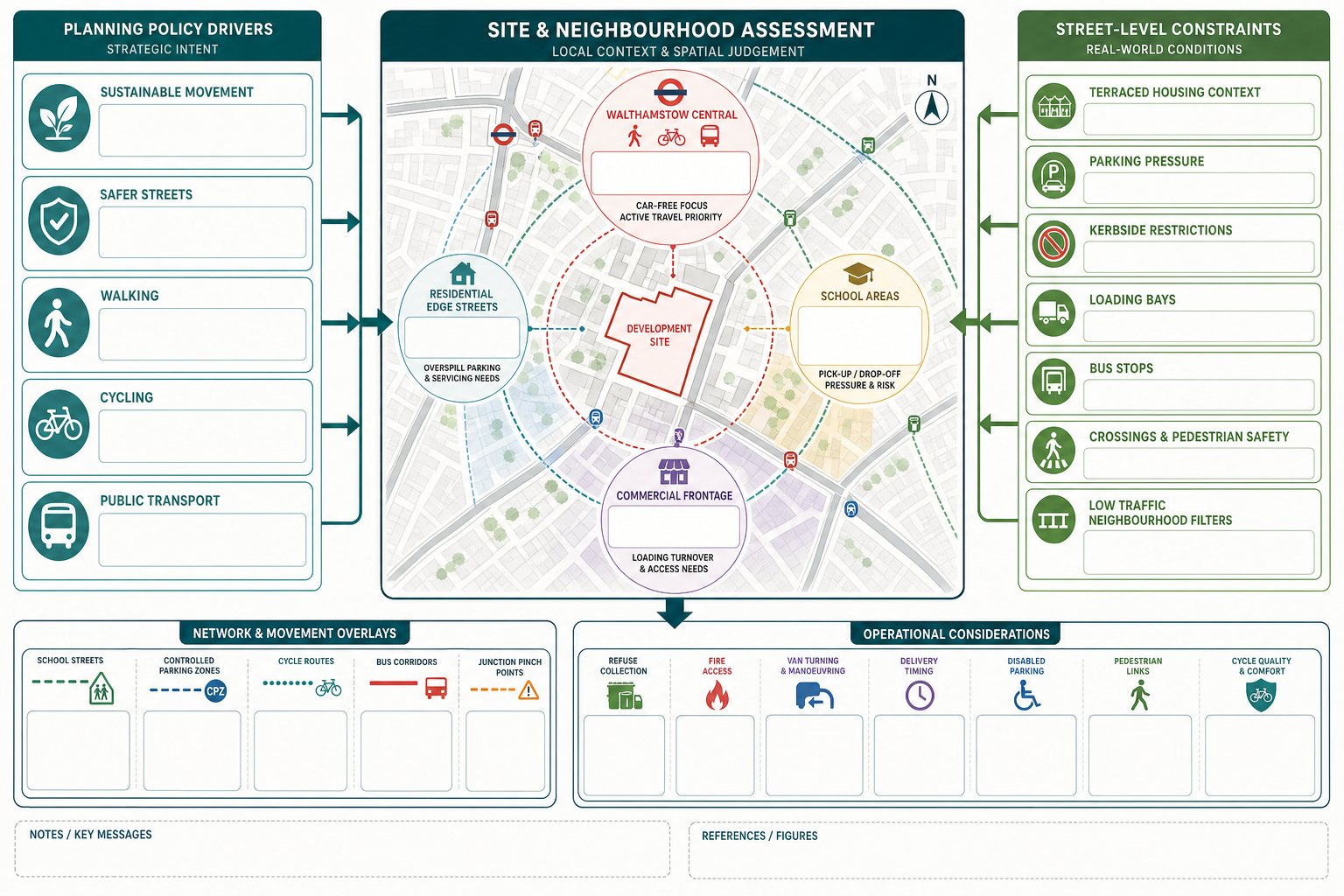
Transport strategy in Walthamstow has to respond to local policy and local street reality at the same time. The policy side is relatively clear: the London Plan, Waltham Forest planning policies, Healthy Streets principles and Vision Zero all favour safer, lower-impact, more sustainable movement. The practical side is messier. Terraced streets may already experience heavy parking pressure. Existing kerbside space may be restricted by loading controls, bus stops, cycle infrastructure or crossing points. And low traffic neighbourhood measures can alter route choice in ways that standard assumptions miss.
So we start by asking a simple question: what will officers actually worry about on this site? Near Walthamstow Central, they may focus on car-free compliance, disabled parking, cycle quality and pedestrian connectivity. On an edge-of-centre residential street, overspill parking and servicing may dominate. Near a school, pickup and drop-off behaviour can become the key issue. Around commercial frontage, loading and kerbside turnover may matter more than peak-hour traffic growth.
Public transport accessibility also shapes strategy. Strong PTAL can support reduced parking and stronger Travel Plan measures, but that argument only works if the walking route quality, cycle provision and operational management are credible. Likewise, proposals on constrained streets often need closer review of refuse collection points, fire access, van turning and delivery timing.
We also pay attention to surrounding networks that are not obvious on a red-line plan: School Streets, controlled parking zones, local cycle routes, bus corridors and nearby junction pinch points. General principles from Traffic Engineering: Your Complete are useful, but Walthamstow schemes succeed when those principles are translated into local, street-by-street judgement.
Typical Development Types That Need Traffic Engineering Input
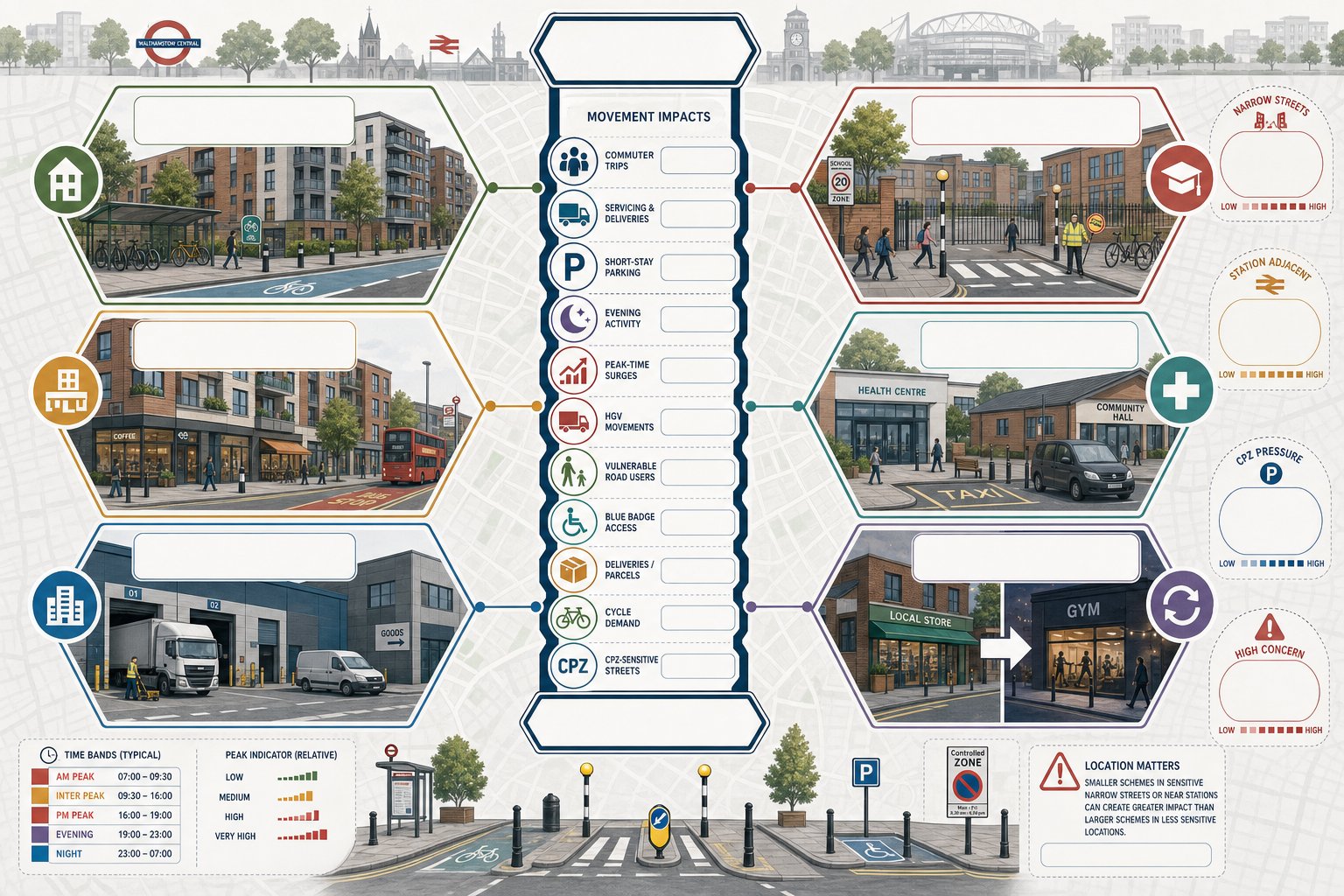
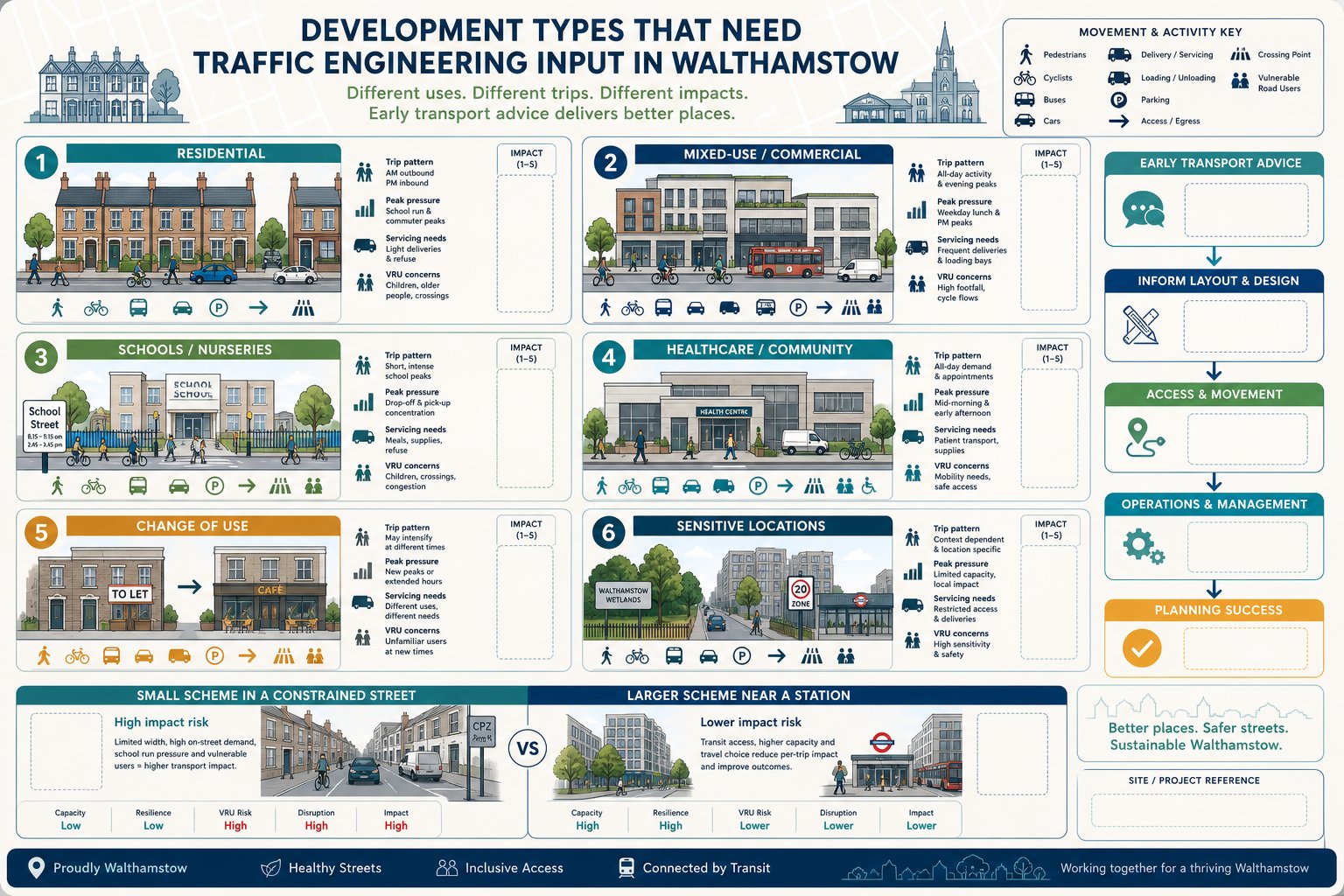
Not every scheme requires the same level of transport work, but many development types in Walthamstow benefit from early traffic engineering input because even modest changes can trigger local concern or policy scrutiny.
Residential intensification, mixed-use redevelopment, retail reconfiguration, commercial floorspace changes, school expansion, healthcare provision and late-running community uses all create different movement patterns. Some increase commuter trips. Some increase servicing. Some hardly add vehicle trips at all but still create sharp peaks at exactly the wrong time of day. Planning success often depends on understanding that nuance rather than relying on a generic threshold-based view.
We are often asked to step in when a scheme looks straightforward on paper but sits in a very sensitive location. A small nursery on a narrow street can create more transport concern than a larger office near a station. A change of use from shop to gym may seem minor yet generate evening activity, short-stay parking and cycle demand that neighbours notice immediately. The technical task is to quantify effects, but the planning task is to explain them in a way that feels grounded and believable.
Across sectors, the common thread is this: the earlier transport advice is integrated into layout, access and operational planning, the easier it becomes to defend the application.
Residential, Mixed-Use, And Commercial Schemes
Residential schemes are among the most common instructions, and they vary widely. A few flats over a shop may only require a concise statement and parking review. A larger flatted development, PBSA or build-to-rent scheme may need a full TA, Travel Plan, servicing strategy and detailed cycle and refuse analysis. In Walthamstow, officers will often look closely at car-free commitments, blue badge provision, cycle storage quality, delivery management and the interaction between resident demand and nearby CPZ conditions.
Mixed-use schemes add complexity because trip patterns overlap. Residential peaks, retail servicing, office staff travel and evening leisure activity can all sit on the same site. That means we assess not just total demand but timing, access hierarchy and whether different uses can share space without conflict.
Commercial development can be equally varied. Light industrial, urban logistics, supermarkets, leisure uses and workspace all raise different questions around HGVs, loading bays, customer turnover and employee travel. For teams preparing these applications, a grounded understanding of Commercial Traffic Engineering can help align operational assumptions with planning evidence from the outset.
Schools, Healthcare, Community, And Change-Of-Use Applications
Schools and nurseries are intensely scrutinised because transport effects are concentrated into short periods and often involve vulnerable road users. A school expansion can be acceptable in overall trip terms yet still trigger serious concern if crossing points, drop-off behaviour or coach movement are poorly planned. We typically examine arrival profiles, staff travel, cycle demand, parent behaviour, nearby restrictions and whether staggered start times or supervised access management are realistic.
Healthcare and community uses bring another layer. GP hubs, clinics, worship spaces and community halls may attract a broad mix of users, including people with reduced mobility, taxi demand, informal pick-up activity and off-peak surges. The transport case hence needs to address accessibility in human terms, not just abstract ratios.
Change-of-use applications can be deceptively sensitive. A former office becoming a gym, a shop turning into a food-led unit, or a hall shifting to a late-night use may alter trip timing, noise, servicing and parking demand more than the floor area suggests. In those cases, comparative assessment is often key: what is changing, when, and why does that matter on this specific street?
What A Traffic Engineer Will Assess Before Submission
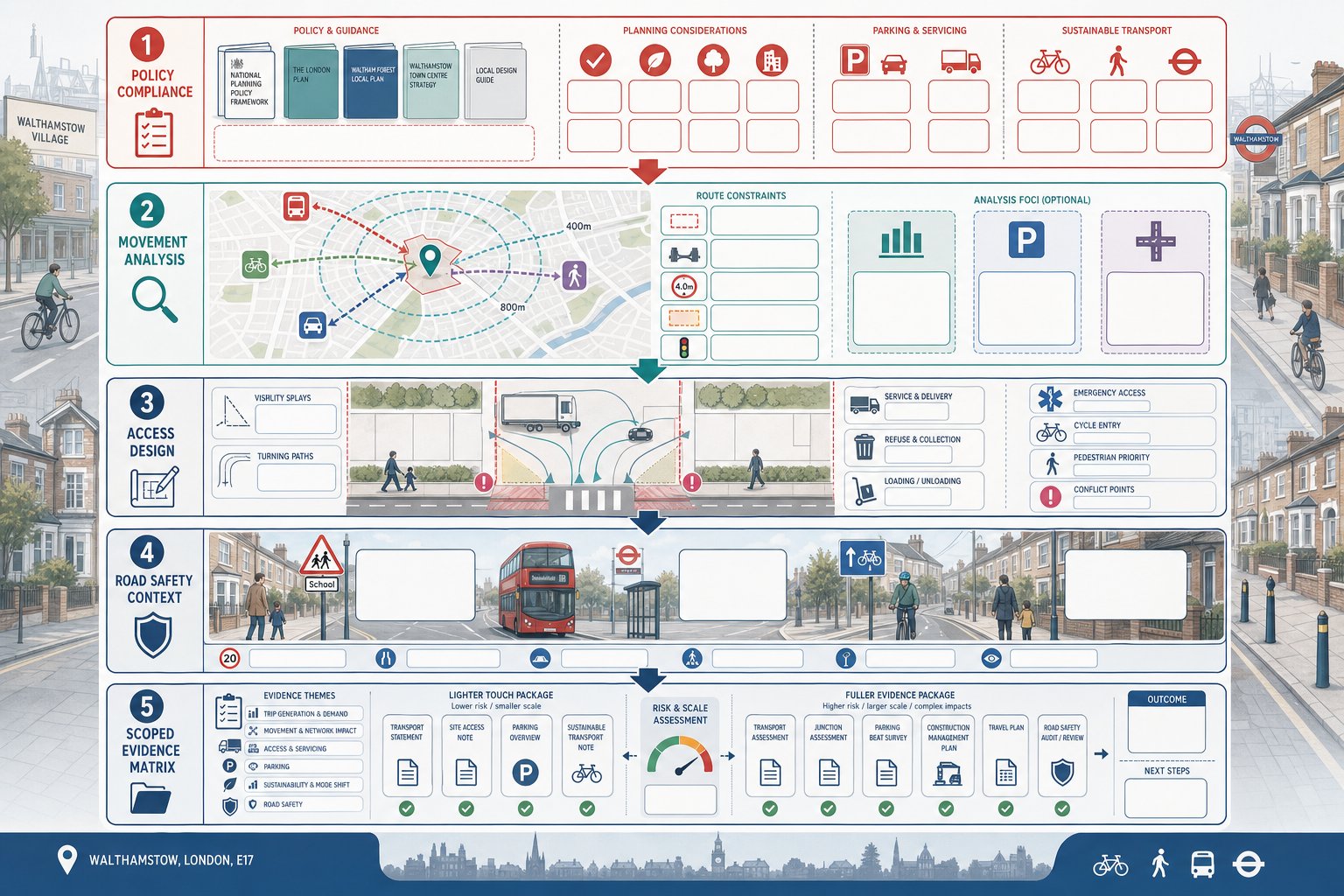
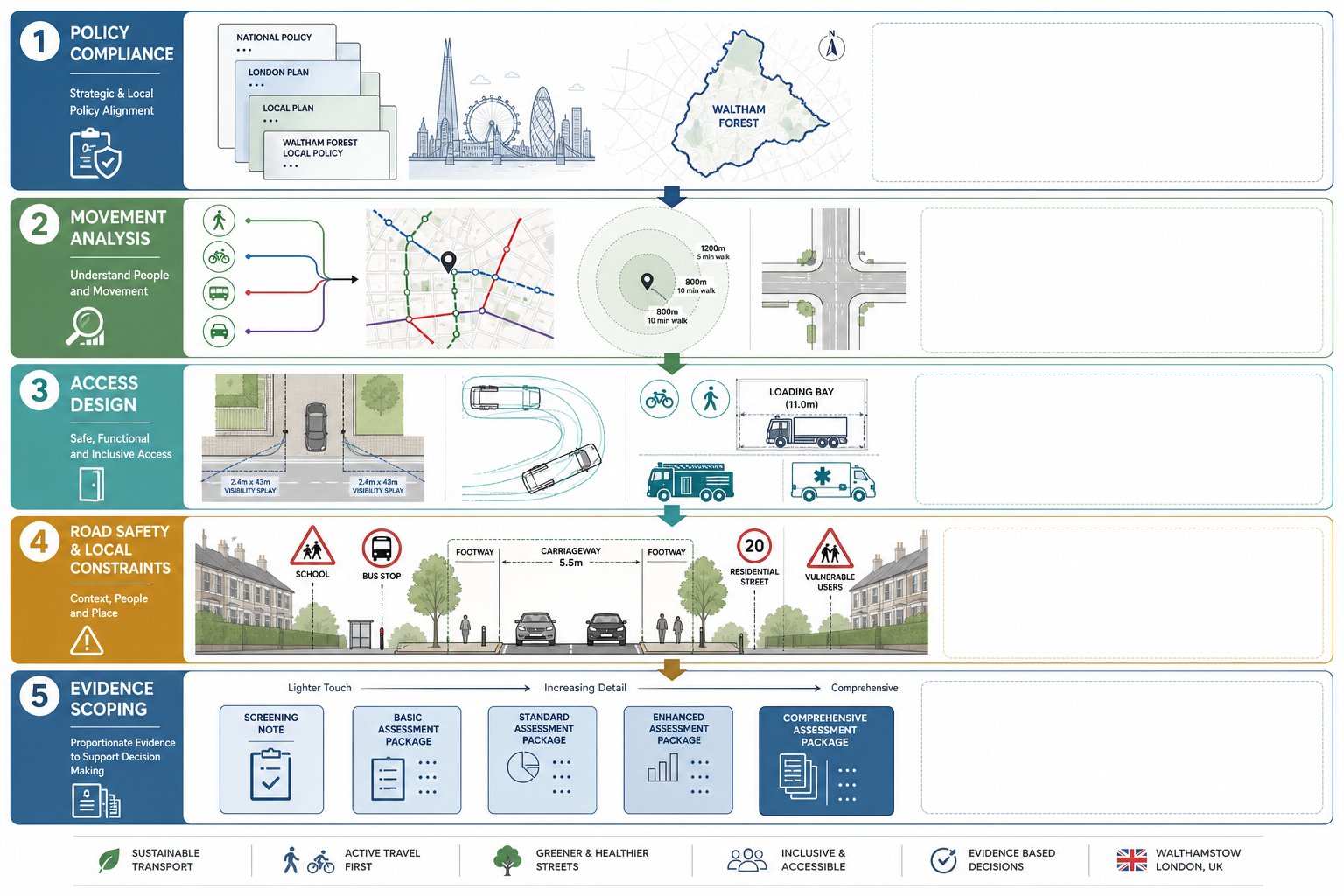
Before submission, we try to answer the questions officers and objectors are likely to ask before they ask them. That usually starts with policy compliance: what does the London Plan require, what does Waltham Forest expect, what parking standards apply, and does the proposal align with local sustainable transport objectives? If there is tension, we identify it early and work out whether it can be justified or whether the scheme needs amendment.
Next comes movement analysis. We assess multimodal trip generation and likely distribution, but not in a vacuum. Existing public transport accessibility, walk and cycle catchments, nearby land uses and route constraints all influence the view we take. For some sites, a parking stress survey will matter more than detailed traffic modelling. For others, junction operation or servicing manoeuvres become the central issue.
We also review access design in detail: visibility, turning, swept paths, refuse collection, loading activity, emergency vehicle access, cycle entry, pedestrian priority and conflict points with vulnerable users. Road safety matters throughout, especially where schools, bus stops or active travel routes are nearby.
Just as important is agreeing the right scope of evidence. A well-pitched TS with a Travel Plan may be enough. Elsewhere, a TA, DSP and CLP may all be necessary. The judgement lies in matching evidence to risk.
That same practical scoping discipline underpins Traffic Engineer In Birmingham: and Traffic Engineer In Leeds: work too, but Walthamstow often demands closer attention to constrained residential streets and active travel policy than many applicants first expect.
How Transport Evidence Can Help Reduce Planning Delays And Objections
Weak transport evidence rarely fails dramatically on day one. More often, it slows the application down in stages. First comes an officer query. Then a request for more survey detail. Then concern from highways about servicing, parking or access geometry. Then neighbour objections citing traffic, safety or construction disturbance. Each point may be manageable, but together they can push determination well off programme.
Robust transport evidence reduces that risk because it frames the discussion early. If we can show clearly how many trips are likely, where they will go, how deliveries will work, why parking provision is appropriate and what mitigation is proposed, the authority has less reason to seek repeated clarification. That does not guarantee a frictionless process, of course, but it materially lowers the chance of avoidable RFIs, excessive conditions or refusal on highway grounds.
Transparent analysis also helps in the public realm of planning. Residents may still object, but a clear explanation of parking controls, cycle provision, servicing hours, construction routing and road safety measures makes those objections easier to answer. And where a concern is valid, transport work gives the team a basis for amending the scheme rather than arguing in the abstract.
Over 30 years of practical reporting experience matters here because speed only helps if the document is concise and credible. Our approach is to keep the evidence proportionate, readable and aligned to what decision-makers actually need.
Choosing The Right Traffic Engineer For A Walthamstow Project
Not all traffic support is equal, especially in inner-London planning contexts. For a Walthamstow project, we would look for a consultant who understands both transport engineering and the planning dynamics that sit around it. That means familiarity with London borough expectations, TfL interfaces where relevant, local policy language, active travel priorities and the realities of constrained urban streets.
Technical competence is the baseline. The consultant should be comfortable preparing TAs, TSs, Travel Plans, DSPs and CLPs: advising on trip generation and parking: coordinating junction modelling where required: and working through access, loading and road safety issues in a way that can stand up to scrutiny. But soft skills matter too. Officers respond better to concise, well-structured reports than to bloated technical dumps. Project teams need someone who can explain trade-offs clearly, flag risk early and join pre-app meetings or hearings if the scheme becomes contentious.
Local judgement is often what separates a routine report from a persuasive one. Does the engineer understand how LTNs may affect routing? Can they explain why a car-lite strategy is credible on this street but not that one? Will they challenge a layout before it becomes expensive to redesign? Those are the questions worth asking.
For clients operating in several cities, comparisons with Traffic Engineer In Manchester: or wider metropolitan work can be helpful, but Walthamstow still needs its own local reading. The best outcomes usually come from consultants who combine broad technical depth with very specific place awareness.
Conclusion
In Walthamstow, transport evidence is rarely a box-ticking exercise. It is often one of the main tests of whether a scheme feels deliverable, neighbour-conscious and policy compliant. A specialist traffic engineer helps the team demonstrate safe access, acceptable highway impact, workable servicing and credible sustainable travel measures in a form officers can assess with confidence.
For architects, planners, lawyers, surveyors, builders, developers and councils, that support is most valuable when it starts early. The right advice can shape layout, reduce planning risk, answer likely objections before they harden, and keep the application moving. In a borough where congestion, active travel and street management are all under close scrutiny, that is not a minor advantage. It is often the difference between a delayed submission and a stronger, faster route to permission in 2026.
Frequently Asked Questions about Traffic Engineering in Walthamstow
What role does a traffic engineer play in Walthamstow development projects?
A traffic engineer in Walthamstow assesses transport impacts like trip generation, junction effects, parking demand, and sustainable travel links to ensure planning proposals comply with local policies and operate safely within constrained streets.
When is a Transport Assessment required in Walthamstow planning applications?
A Transport Assessment is needed for larger or sensitive developments that may materially impact the local network, involving detailed analysis of traffic, junction capacity, parking, road safety, and mitigation measures to meet Waltham Forest and TfL standards.
How do Delivery and Servicing Plans (DSP) and Construction Logistics Plans (CLP) affect Walthamstow schemes?
DSPs manage the impact of regular freight, refuse, and servicing movements in busy or constrained areas, while CLPs coordinate construction phase vehicle routing, timing, and safety to reduce disruption near schools, bus routes, or residential streets.
What local policies influence traffic engineering strategies in Walthamstow?
Traffic strategies must align with the London Plan, Waltham Forest Local Plan, Healthy Streets principles, Vision Zero targets, and consider low traffic neighbourhoods, controlled parking zones, and active travel priorities unique to Walthamstow.
What types of development in Walthamstow typically require traffic engineering input?
Residential intensification, mixed-use, commercial developments, schools, healthcare, community facilities, and change-of-use projects often require transport assessments or statements due to their varying impacts on parking, servicing, and local traffic patterns.
How can early engagement with a traffic engineer benefit a planning application in Walthamstow?
Early scoping by a traffic engineer helps design transport-compliant schemes, reduces risk of delays or objections, and ensures appropriate reports like Transport Assessments or Travel Plans are prepared to satisfy officers and neighbours efficiently.