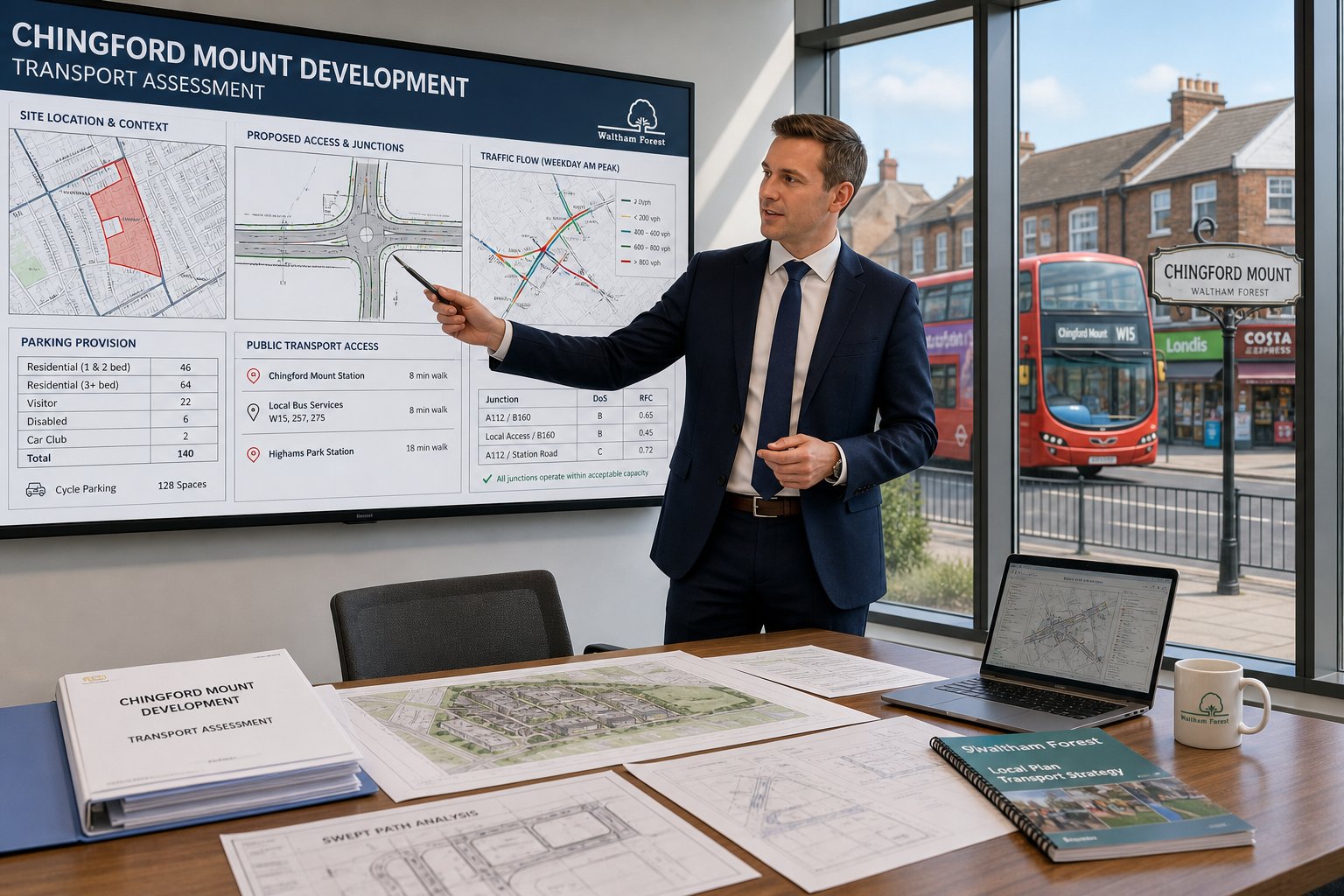
A planning application can look perfectly sensible on paper and still run into trouble once transport is examined properly. In Chingford Mount, that happens more often than many teams expect. A modest infill scheme, a shopfront change with servicing implications, or a small residential intensification can all trigger questions about access, parking stress, safety, bus movements, or network impact. And because the area sits within a busy urban setting shaped by local shops, schools, controlled parking pressures, and strategic movement corridors, those questions tend to arrive early.
That’s why a traffic engineer in Chingford Mount is rarely just a box-ticking consultant. We help turn transport risk into planning evidence: clear reports, realistic trip analysis, practical mitigation, and technical responses that fit the expectations of the London Borough of Waltham Forest, Transport for London, and wider London policy. For architects, planners, developers, solicitors, and surveyors, that usually means fewer surprises, better coordinated submissions, and a stronger chance of moving through consultation without avoidable objections.
The key is not producing a long report for the sake of it. It’s knowing what matters locally, what can be scoped proportionately, and how to present transport issues in a way decision-makers can trust. That is where experienced, planning-led traffic engineering makes a real difference.
Key Takeaways
- A traffic engineer in Chingford Mount plays a crucial role in addressing local transport concerns early, helping to prevent planning delays due to access, parking, or safety issues.
- Transport assessments should be proportionate and tailored to the London Borough of Waltham Forest’s specific policies, focusing on practical impacts rather than generic data.
- Residential and commercial developments alike require detailed analysis of trip generation, parking demand, servicing arrangements, and pedestrian and cycle access to ensure smooth integration into the busy urban environment.
- Providing clear, concise, and locally relevant transport reports increases trust with planning officers and consultees, improving the chances of approval and reducing objections.
- Choosing a traffic engineer with proven London experience, knowledge of local nuances, and strong communication skills is essential for successful planning support in Chingford Mount.
Why A Traffic Engineer Matters For Projects In Chingford Mount
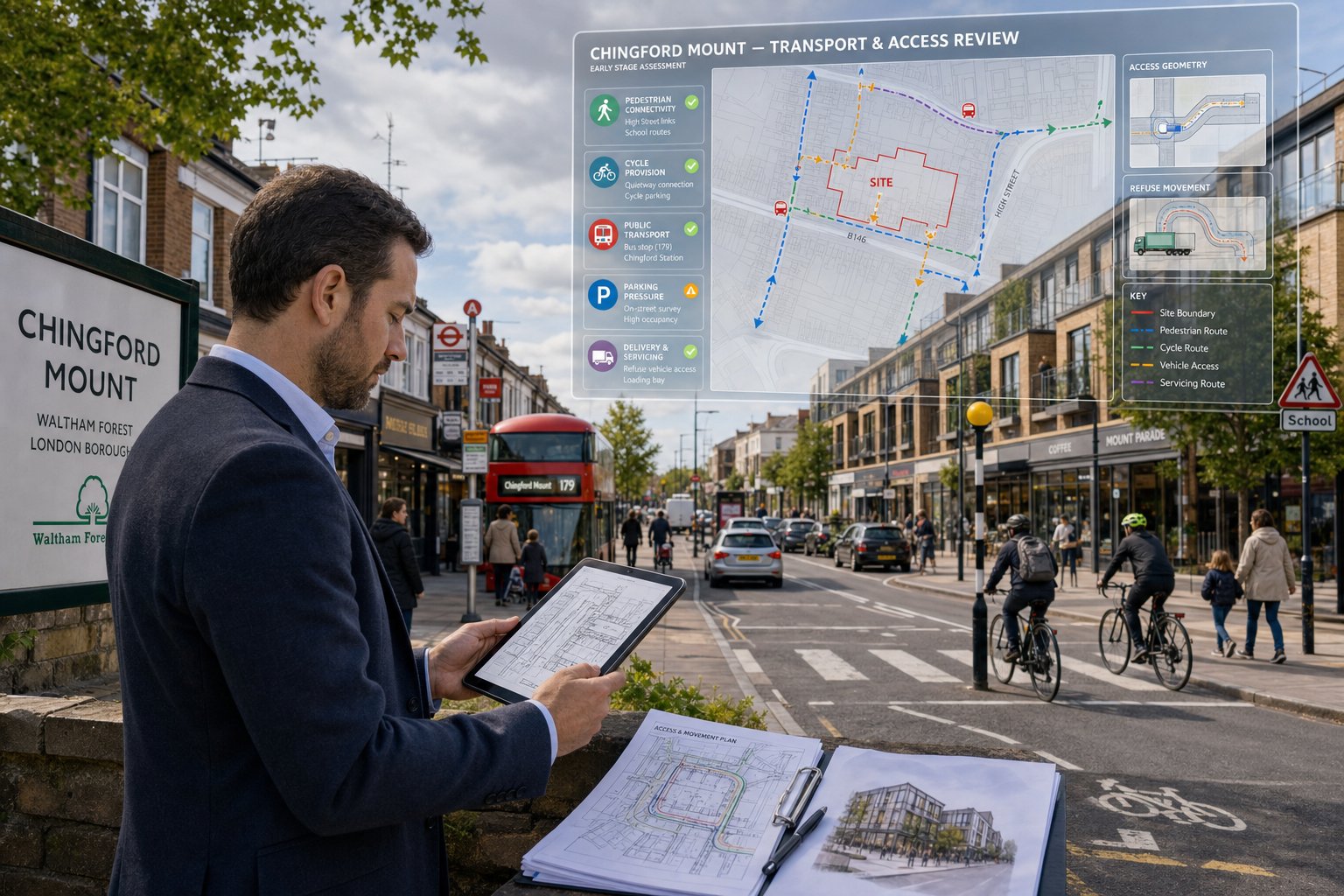
Chingford Mount isn’t a place where transport issues stay theoretical for long. The street environment is active, constrained, and sensitive to change. Bus routes, local retail activity, school travel patterns, side-road parking demand, and established residential streets all mean even relatively small schemes can have noticeable effects on daily movement.
For planning teams, that creates a familiar problem: a development may appear modest in scale, but the local highway authority can still ask detailed questions about how people arrive, where deliveries stop, whether refuse collection works safely, and what happens to already-pressured parking stock. We often find that the difference between a smooth application and a delayed one is not the size of the scheme, but whether those questions were anticipated early.
A traffic engineer in Chingford Mount helps by testing assumptions before they become objections. We review likely trip generation, access geometry, visibility, servicing practicality, pedestrian routes, cycle provision, and public transport context. That evidence then feeds directly into a Transport Statement, technical note, or design amendment.
In practice, this planning-led role is broader than many expect. It sits somewhere between highway design, land-use planning, and strategy. Our work often mirrors the discipline explained in broader Traffic Engineering Consultants: guidance, but applied to the sharper realities of a London borough review process.
And importantly, we’re not only writing reports after a design is fixed. The strongest results usually come when transport advice informs the scheme while layouts are still flexible.
Local Planning And Highway Considerations That Shape Transport Advice
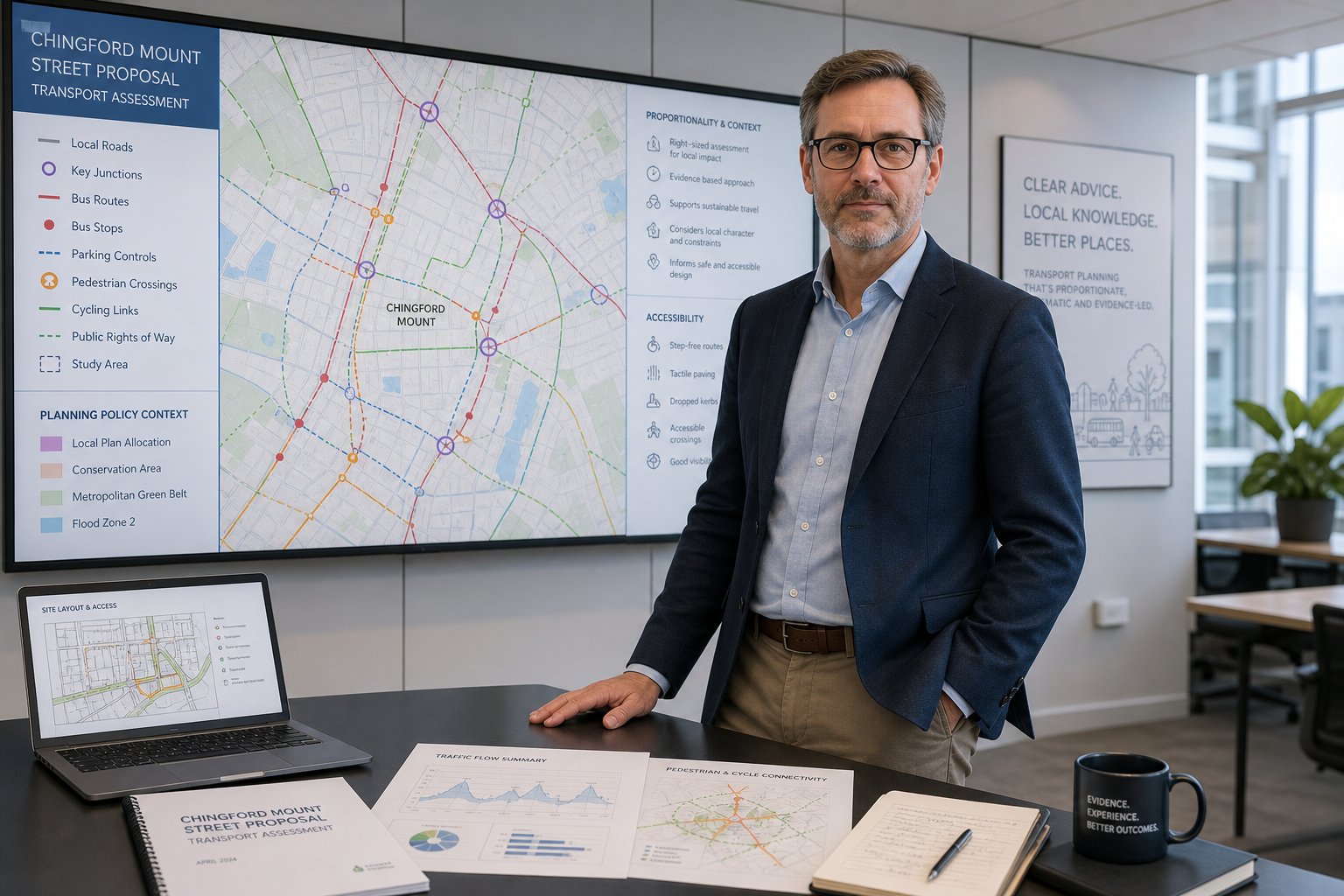
Transport advice in Chingford Mount is shaped by several overlapping layers: the London Plan, local planning policy in Waltham Forest, TfL expectations where relevant, and technical standards such as Manual for Streets, cycling guidance, and inclusive access principles. That sounds dry. But in reality, these frameworks determine what the authority is likely to focus on and how robust your evidence needs to be.
One recurring issue is proportionality. Not every site needs a full Transport Assessment. But not every “small” scheme can rely on a short letter either. A change in use near a busy frontage, a residential proposal with limited on-site parking, or a scheme affecting a main road can quickly justify more detailed analysis. Knowing where that threshold sits locally is one of the most valuable parts of the job.
Another key consideration is context. PTAL levels, nearby bus services, school streets, controlled parking arrangements, collision history, pedestrian crossing opportunities, and junction sensitivity all influence what a professional assessment should cover. Queueing at a nearby junction may matter. So might overspill parking on side roads, step-free access to the entrance, or whether delivery activity would conflict with peak-time kerbside demand.
For teams working across multiple regions, local nuances can be easy to miss. London authorities often expect a different level of transport narrative and policy alignment than less constrained areas. That’s why cross-city experience helps, whether we are preparing a site-specific note in Chingford Mount or drawing on lessons from wider Traffic Engineer In London: planning support.
Good advice is never copied in from another borough. It is shaped around the actual street, the actual proposal, and the actual planning risks.
Common Schemes That Need Traffic Engineering Input
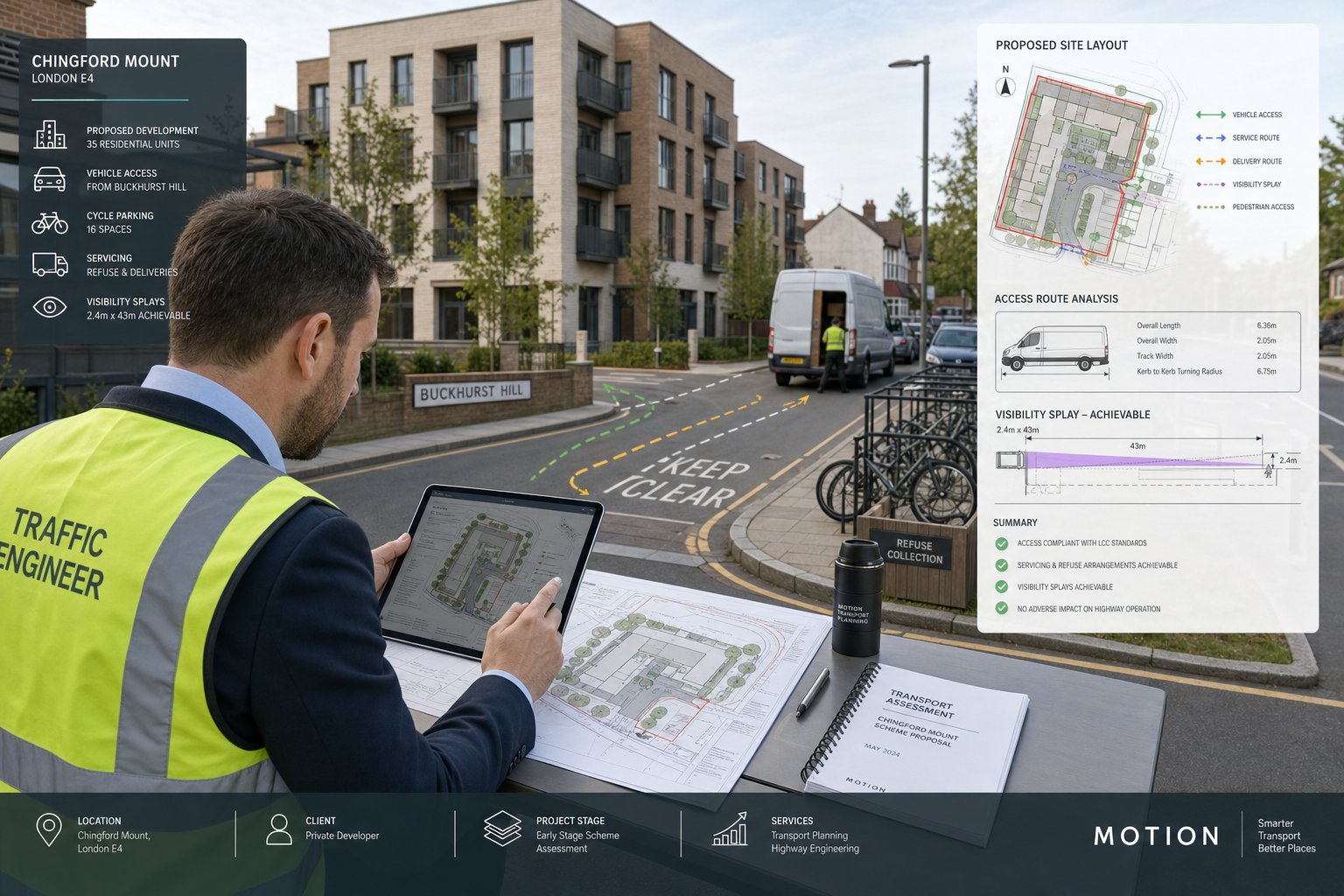
Not every planning application needs detailed transport work, but a surprisingly wide range of projects benefit from it. In Chingford Mount, the trigger is often less about headline floor area and more about practical impact: extra vehicle trips, servicing constraints, tighter access arrangements, parking pressure, or concern from neighbours and consultees.
We’re regularly involved where a proposal changes how a site functions rather than simply how it looks. A new access point, a revised refuse strategy, the loss of informal parking, or an increase in delivery activity can all justify transport input. The earlier those matters are tested, the easier it is to refine the scheme before submission.
That is particularly true on urban sites with limited margins. If a design only “just works” for turning, visibility, loading, or cycle parking, it needs evidence. If it doesn’t yet work, it needs revision before the planning authority says so.
Below are the types of schemes where traffic engineering input most often proves valuable in Chingford Mount.
Residential Developments
Residential schemes are a major part of transport work in Chingford Mount. That includes infill houses, small apartment blocks, backland plots, conversions, HMOs, and prior approval proposals where transport still needs to be addressed clearly.
The issues tend to be familiar, but never identical. Will the site generate a meaningful increase in trips? Is on-site parking sufficient, excessive, or contrary to policy expectations? Could overspill affect neighbouring streets already under pressure? Are cycle stores convenient enough to be used in real life, not just compliant on a drawing? Can refuse vehicles operate without awkward reversing or obstruction?
For flatter, central-looking schemes, teams sometimes assume the transport case will be easy. Yet local objections often focus on parking stress and road safety rather than strategic traffic growth. That means survey work, parking beat analysis, and a realistic understanding of resident travel behaviour can matter as much as formal junction modelling.
We also consider family housing differently from studio-led schemes, and car-free or low-parking proposals differently from suburban formats. Household composition, accessibility to buses and local services, and the availability of controlled parking all influence the right transport response.
Where a development team wants a proportionate but credible evidence base, our role is to frame the residential transport story properly: not over-engineered, not undercooked, and aligned with the authority’s likely concerns.
Commercial, Mixed-Use, And Community Schemes
Commercial and community uses often create more transport complexity than their floor area suggests. A small takeaway can have a very different impact from a small office. A nursery may generate sharp peak-time drop-off pressures. A place of worship can create short-duration surges that standard weekday assumptions miss. And mixed-use schemes add overlap between resident, staff, visitor, and servicing movements.
In Chingford Mount, where local frontages and residential streets sit close together, those details matter. We typically examine arrival profiles, delivery needs, refuse arrangements, short-stay parking demand, disabled access, and whether activity spills onto the public highway at the wrong times.
For retail and service uses, kerbside management is often the hidden issue. If there is no safe, practical place for loading, the planning debate can shift quickly from land use to highway harm. The same goes for schools, health uses, and small industrial premises where operational patterns need to be understood properly.
This is where focused technical input adds value. Our approach to Commercial Traffic Engineering is usually about operational realism: who comes, when they come, how they move through the site, and what mitigation is actually deliverable. Broad assumptions aren’t enough when councillors, residents, and officers are all asking practical questions.
What A Traffic Engineer In Chingford Mount Can Prepare
The output depends on the scale of the proposal, the site context, and what the planning authority is likely to request. Sometimes the right answer is a concise technical note addressing access and parking. Sometimes it is a fuller evidence package with surveys, trip analysis, collision review, drawings, and a Travel Plan.
A traffic engineer in Chingford Mount should be able to scope that package efficiently. Over-reporting wastes time and budget. Under-reporting can delay validation or trigger highways objections that are harder to answer later. The aim is a submission that is proportionate, credible, and tailored to Waltham Forest’s review process.
At ML Traffic, that usually means producing concise technical material quickly, but not generically. With more than 30 years of experience behind our work, we focus on reports that planning officers, highway consultees, and design teams can actually use. In some cases that is a standalone statement. In others, it is a response to consultee comments or a package supporting amended drawings.
The most common deliverables are set out below.
Transport Statements, Transport Assessments, And Travel Plans
Transport Statements and Transport Assessments are the backbone of most planning-related traffic engineering work. The distinction is usually one of scale and complexity. A Transport Statement tends to provide a concise, evidence-based review of likely impacts and mitigation for smaller or less intensive schemes. A Transport Assessment goes further, often including more detailed forecasting, junction analysis, multi-modal review, and technical appendices.
In Chingford Mount, either document may need to cover site accessibility, PTAL context, trip generation, trip distribution, local highway conditions, collision history, parking, servicing, and sustainable travel opportunities. The best reports are selective. They deal with the issues that matter rather than padding out pages with national text that adds little.
Travel Plans are also common, particularly for schemes with staffing, visitors, school travel, or larger residential occupation. Depending on the project, the authority may accept an interim, framework, or full Travel Plan. Effective versions include realistic measures, monitoring arrangements, and targets that reflect the actual site. Promising dramatic mode shift with no mechanism behind it rarely convinces anyone.
Where policy alignment is important, we often position these reports within a wider Traffic Engineering: Your Complete understanding of safer access and smarter planning, while keeping the final document tightly focused on the site itself.
Highway Technical Notes, Swept Path Analysis, And Parking Reviews
Not every scheme requires a full transport report. Many need targeted technical work instead, especially where the design challenge is specific. That might be a difficult access, a constrained yard, a turning issue for refuse vehicles, or concern about local parking capacity.
Highway technical notes are often used to respond to consultee queries, justify design amendments, or provide additional evidence after submission. When done well, they are short, direct, and persuasive. They address the exact point raised by the authority rather than reopening the whole transport case.
Swept path analysis is essential where vehicle movements are tight or unusual. We commonly test cars, vans, refuse wagons, fire appliances, and delivery vehicles to show that access and turning can occur safely without overrunning footways, striking street furniture, or relying on unrealistic manoeuvres. On constrained urban sites, a simple drawing can settle an argument that pages of text won’t.
Parking reviews are another frequent requirement. These can include on-street beat surveys, parking stress calculations, layout reviews, disabled bay provision, and cycle parking design checks. In dense London locations, parking is often the issue residents care about most, so weak evidence here can undermine an otherwise sound planning case.
We sometimes support these tasks as part of a broader Traffic Engineer In style planning workflow: diagnose the exact transport risk, answer it directly, and avoid unnecessary technical bulk.
How Traffic Assessments Support Planning Applications
A good traffic assessment does more than describe a site. It reduces uncertainty for decision-makers. Planning officers, highway engineers, committee members, and sometimes inspectors want evidence that a proposal has been tested properly and that any transport effects are understood, manageable, and policy-compliant.
That support works in several ways. First, the assessment quantifies likely demand: how many person trips and vehicle trips the development could generate, at what times, and by which modes. Second, it tests consequences: whether nearby junctions, accesses, crossings, or parking conditions are likely to be affected materially. Third, it explains mitigation: design features, management measures, servicing arrangements, or sustainable travel steps that reduce risk.
Just as importantly, a transport assessment gives the wider consultant team a common reference point. Architects can adjust layouts. Planning consultants can shape the statement and anticipate objections. Solicitors and developers can understand what obligations or conditions may be realistic. That coordination often saves far more time than the report itself takes to prepare.
In London boroughs, concise clarity is valuable. Officers are not looking for theatrics: they are looking for competent, defensible judgement. That is why we favour direct evidence, transparent assumptions, and plain-English conclusions.
Teams with portfolios beyond the capital often recognise the same principle from comparable urban work such as Traffic Engineer In Birmingham: robust local analysis is what strengthens applications, not generic transport language.
Key Transport Issues Often Reviewed By Local Authorities
When local authorities review a planning application, transport comments usually cluster around a fairly consistent set of themes. The exact emphasis changes from scheme to scheme, but the core questions remain: how many trips will be created, where will they go, can the local network cope, is the layout safe, and does the proposal support sustainable movement rather than simply adding pressure to an already constrained street?
For Chingford Mount projects, those issues are sharpened by the local urban grain. Junctions can be sensitive even where the strategic impact appears limited. Parking pressure can become politically significant. A servicing arrangement that looks acceptable on a plan may not work once street activity, school peaks, and bus operations are considered.
The authority is hence likely to look beyond headline traffic growth and examine whether the proposal functions well day to day. Evidence needs to answer that practical question, not just satisfy a policy checklist.
The two sub-areas below are where review comments most often concentrate.
Trip Generation, Junction Impact, And Road Safety
Trip generation is usually the starting point. We estimate the number of person and vehicle movements likely to be created by the development, often using comparable survey data, professional judgement, and local context. In urban London settings, this analysis needs care. Standard database rates can be useful, but they should not be applied blindly where PTAL, parking restraint, existing use, or mixed-mode accessibility materially affect likely travel behaviour.
Once trips are identified, the next question is impact. Will they materially affect nearby junctions, accesses, or crossing points? For some schemes, a reasoned qualitative case is enough. For others, especially where flows are higher or a junction is already sensitive, more detailed capacity analysis may be needed. The aim is not to create false precision, but to show whether the impact is likely to be severe, negligible, or manageable with mitigation.
Road safety is equally important. Local authorities commonly expect a review of collision records, visibility splays, vehicle manoeuvring, pedestrian desire lines, and conflict points around access arrangements. If there is an existing accident pattern, a report should address it honestly and explain why the proposal would not worsen conditions, or what changes are proposed if it might.
This blend of evidence and judgement is central to the role described across wider Traffic Engineer In Bristol: and other urban planning work, but local street conditions always shape the final answer.
Access, Servicing, Walking, Cycling, And Parking Provision
Access design can make or break a scheme. A technically substandard junction, awkward vehicle tracking, poor visibility, or an entrance that conflicts with pedestrian movement is exactly the kind of issue that draws highways objections. In Chingford Mount, many sites are tight, existing streets are busy, and kerbside conditions are already doing several jobs at once. So access needs to be practical, not just compliant on a drawing.
Servicing is often the overlooked part. Deliveries, refuse collection, maintenance vehicles, and emergency access all need to be thought through. If a van stops in the wrong place every day, the authority will treat that as a design failure, not an operational footnote.
Walking and cycling are also central to policy review. Authorities increasingly expect direct, legible pedestrian routes, secure and convenient cycle parking, inclusive access, and a layout that supports lower-car travel choices where the location allows. These elements should be integrated from the start, because retrofitting them later usually compromises something else.
Then there is parking. Quantity matters, but so do layout, usability, disabled provision, EV charging expectations, visitor demand, and the likelihood of overspill. We’re often asked to demonstrate that parking demand has been assessed realistically and that any restraint-based strategy is supported by local accessibility rather than wishful thinking.
Done properly, these topics come together as one operational story: how the site will work on a normal Tuesday morning, not just in a planning statement.
Choosing The Right Traffic Engineer For Chingford Mount Projects
The right consultant is not simply the one who can produce a report. It is the one who understands how to make that report useful within the planning process. For Chingford Mount projects, we would look for four things.
First, genuine London experience. Waltham Forest and TfL-facing work often demands a sharper grasp of parking policy, sustainable transport expectations, urban servicing constraints, and committee sensitivities than more conventional suburban assessments.
Second, relevant project history. High-street frontages, infill housing, mixed-use schemes, and constrained access sites each come with recurring transport problems. A consultant who has seen those patterns before is more likely to scope work proportionately and spot issues before they escalate.
Third, communication. Technical skill matters, but so does the ability to explain findings clearly to planners, architects, councillors, residents, and clients. Short, direct reporting usually performs better than bloated documentation.
Fourth, responsiveness. Planning programmes are rarely tidy. Designs change, officers request clarification, and comments arrive late. Transport support needs to keep pace.
That is the standard we aim to meet at ML Traffic: concise, accurate, planning-led advice delivered quickly and grounded in long practical experience. In the end, a strong traffic engineer in Chingford Mount helps applications move forward because the transport case is not merely present: it is coherent, local, and trusted.
When that happens, stronger submissions tend to follow, and so do faster decisions.
Frequently Asked Questions About Traffic Engineering in Chingford Mount
What role does a traffic engineer play in planning applications in Chingford Mount?
A traffic engineer in Chingford Mount provides evidence-based assessments on how developments affect local roads, junctions, pedestrian routes and parking. They prepare reports ensuring compliance with London Borough of Waltham Forest and TfL, helping reduce objections and support smoother planning approvals.
Which types of developments in Chingford Mount commonly require traffic engineering input?
Common schemes needing traffic engineering include residential developments like infill houses and HMOs, commercial or mixed-use projects such as shops, nurseries, and places of worship. These schemes often impact access, parking, servicing, or local traffic patterns requiring professional evaluation.
How does a traffic engineer assess trip generation and its impact in Chingford Mount?
They estimate likely person and vehicle trips using local context and comparable data, considering PTAL and accessibility. The assessment evaluates if additional trips affect junctions or crossings significantly, guiding necessary mitigation to avoid severe congestion or safety issues.
What are the key local planning policies and standards shaping transport advice in Chingford Mount?
Transport advice is guided by the London Plan, Waltham Forest Local Plan, TfL guidance, and standards like Manual for Streets. These set expectations for junction capacity, road safety, public transport access, walking, cycling provision, and parking controls tailored to local urban conditions.
Why is early involvement of a traffic engineer beneficial for Chingford Mount projects?
Early traffic engineering input helps identify potential transport risks, allowing design adjustments before submission. This proactive approach reduces surprises, avoids delays from local authority objections, and leads to coordinated, credible transport evidence aligned with planning requirements.
What kinds of reports and technical documents can a Chingford Mount traffic engineer prepare?
They produce Transport Statements, Transport Assessments, Travel Plans, highway technical notes, swept path analyses, and parking reviews. The chosen documents depend on project scale and local authority requirements, ensuring proportionate and effective transport evidence.