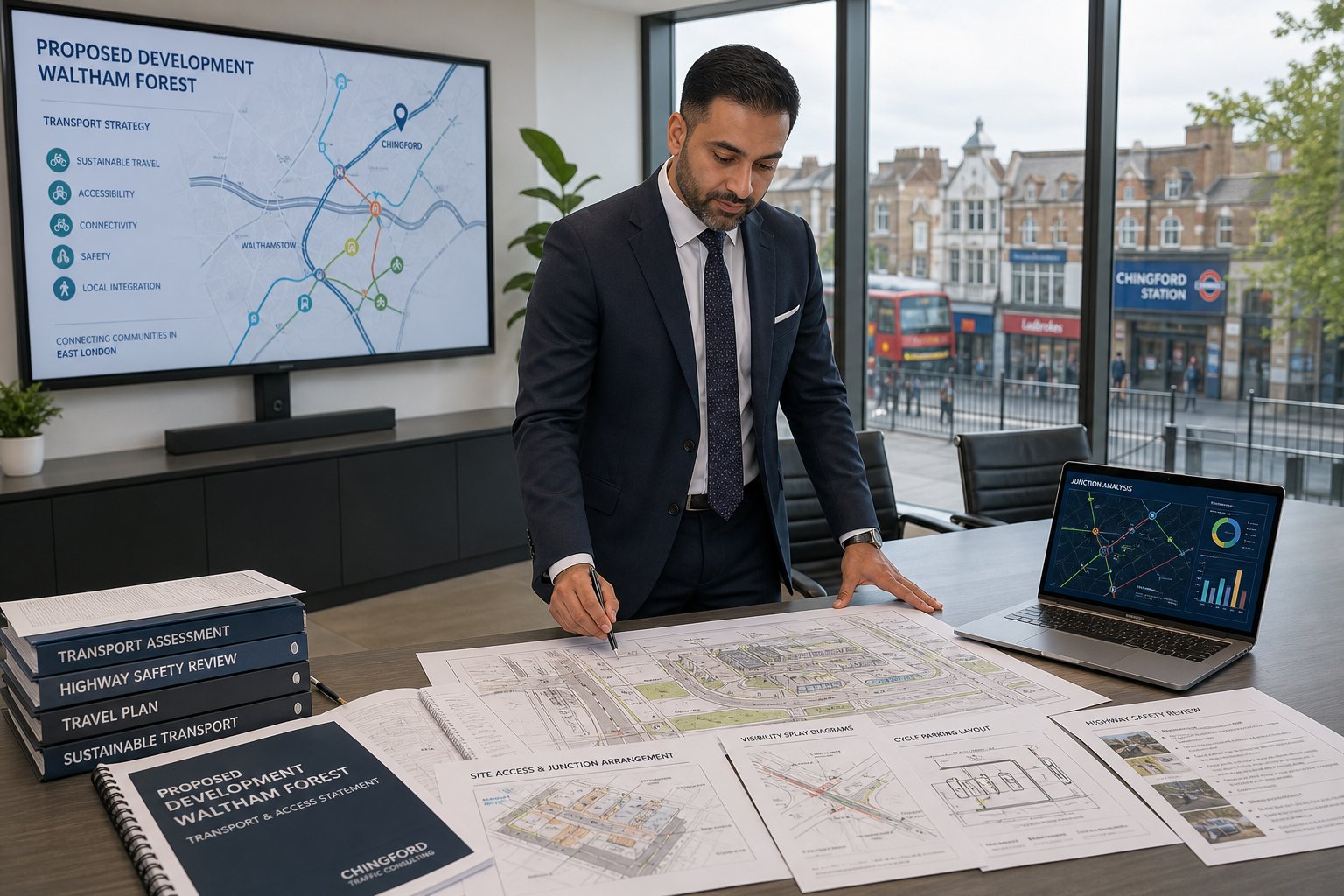
Planning applications in Chingford rarely succeed on architecture alone. But strong the design, a scheme can still stall if the transport case is weak, the parking strategy is unrealistic, or the access arrangement raises avoidable concerns. In a borough like Waltham Forest, where Healthy Streets, active travel, parking restraint and highway safety all carry real weight, transport evidence is not a box-ticking exercise. It is often the difference between a smooth determination and months of back-and-forth.
That is where a traffic engineer in Chingford becomes valuable. We help turn a proposed development into a scheme that can be properly tested, explained and defended in planning terms. That means looking at existing traffic conditions, access geometry, servicing, cycle parking, public transport links, visibility, local road constraints and likely authority expectations before problems harden into objections.
For architects, planners, surveyors, developers, legal teams and local authorities, the practical question is usually the same: what level of transport input is actually needed, and when? The answer depends on scale, use, context and the sensitivity of the surrounding network. In this guide, we set out what a traffic engineer does, when a Transport Statement or Transport Assessment may be needed, how Chingford-specific constraints shape design, and what a robust planning submission should include in 2026.
Key Takeaways
- A traffic engineer in Chingford is essential for integrating transport considerations early in planning to ensure developments meet local policies and avoid delays.
- Transport Statements suit smaller projects with limited impact, while larger or complex schemes require detailed Transport Assessments reflecting local Chingford constraints.
- Local site conditions like narrow streets, parking stress, and junction proximity must shape safe, workable access and parking designs.
- Supporting documents such as Travel Plans, Construction Logistics Plans, and Delivery and Servicing Plans are critical to address operational impacts and local authority expectations.
- Choosing a traffic engineer with local expertise in Waltham Forest and clear communication skills improves planning outcomes and responsiveness to authority concerns.
- Effective transport input aligns with healthy streets policies, active travel, parking restraint, and highway safety, increasing the likelihood of smooth planning approval.
What A Traffic Engineer In Chingford Does For Planning And Development
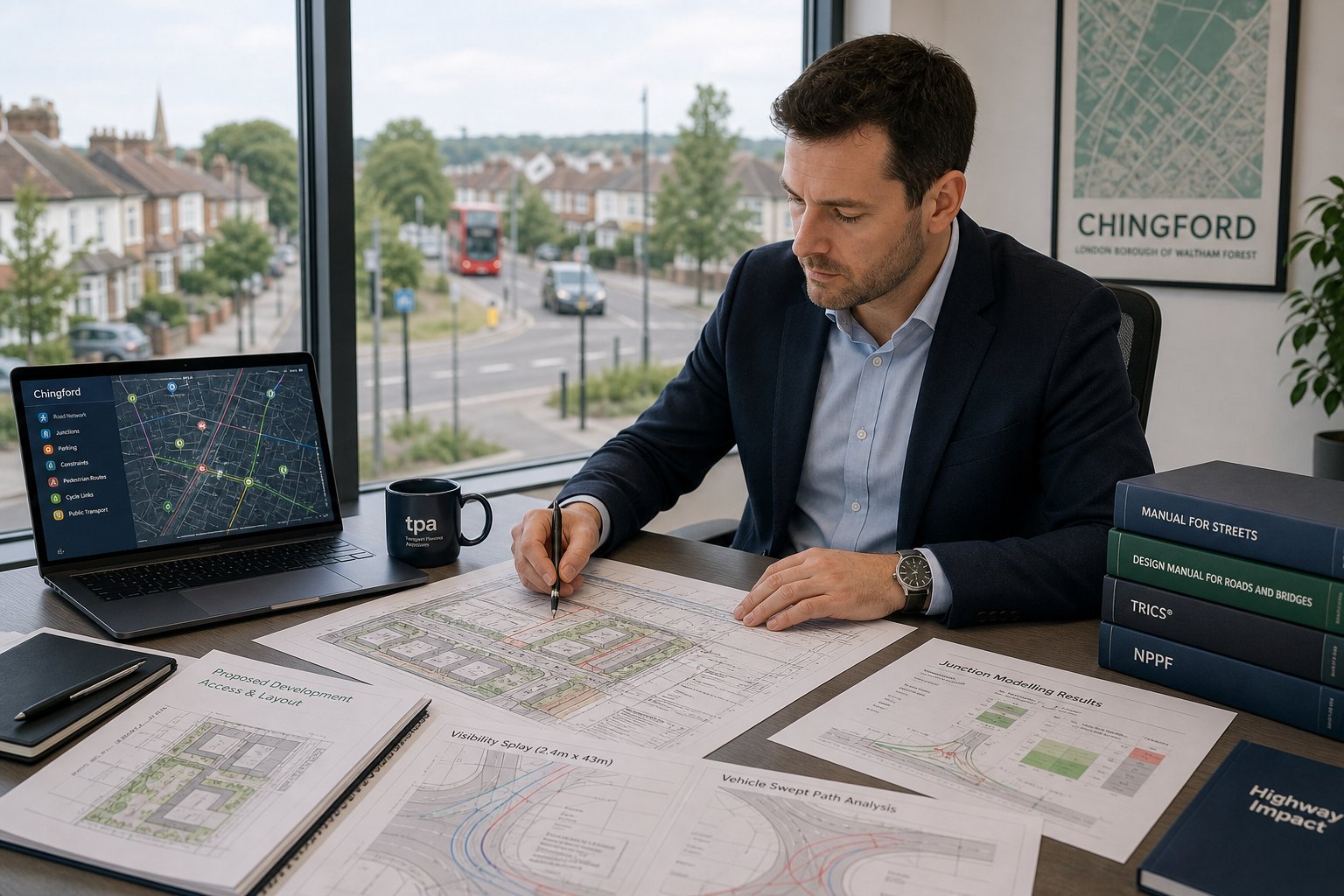
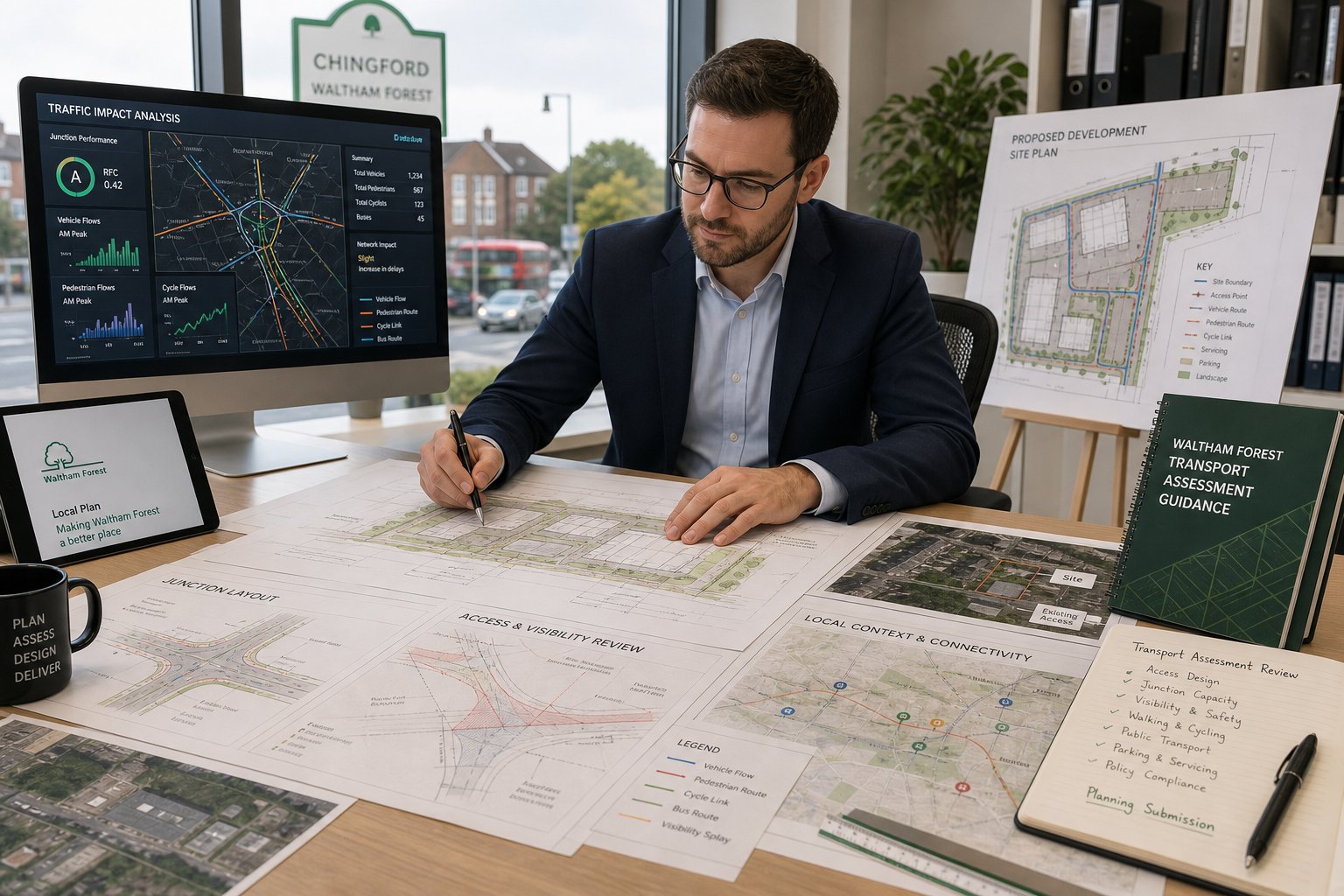
A traffic engineer in Chingford supports planning applications by assessing how a development will interact with the surrounding transport network and whether that interaction is acceptable in policy, safety and operational terms. In practice, that work starts well before submission. We review the site, the proposed land use, likely trip generation, access opportunities, parking pressure, servicing needs and the wider street context.
For some schemes, the key issue is scale: will the development add enough vehicle, cycle or pedestrian movement to require formal assessment? For others, the problem is more localised. A modest site on a constrained residential road may trigger more concern than a larger scheme in a better-connected location. That is why early appraisal matters.
Our role usually includes analysing existing traffic, parking, walking, cycling and public transport conditions: reviewing access design and internal layouts: checking whether servicing and refuse collection can work safely: and preparing the planning reports needed to satisfy the council and highway authority. On more detailed projects, we may also test junction performance, queueing, swept paths and visibility splays.
For teams working across boroughs, it helps to understand the broader planning function of Traffic Engineering: Your Complete, but local interpretation still matters. Chingford sites sit within Waltham Forest’s policy environment, so the transport case needs to reflect that from the outset rather than being retrofitted later.
When A Transport Assessment Or Transport Statement May Be Needed
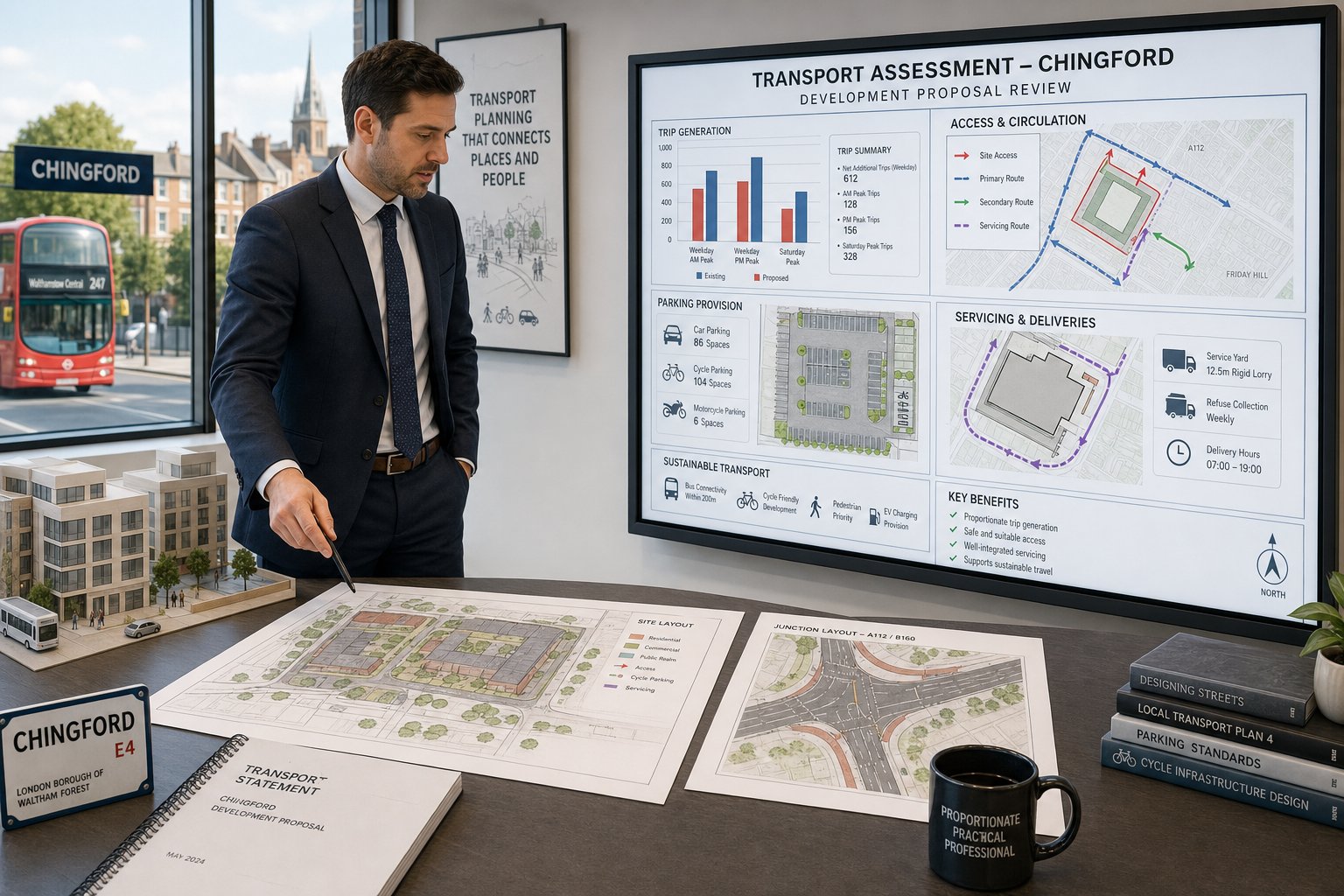
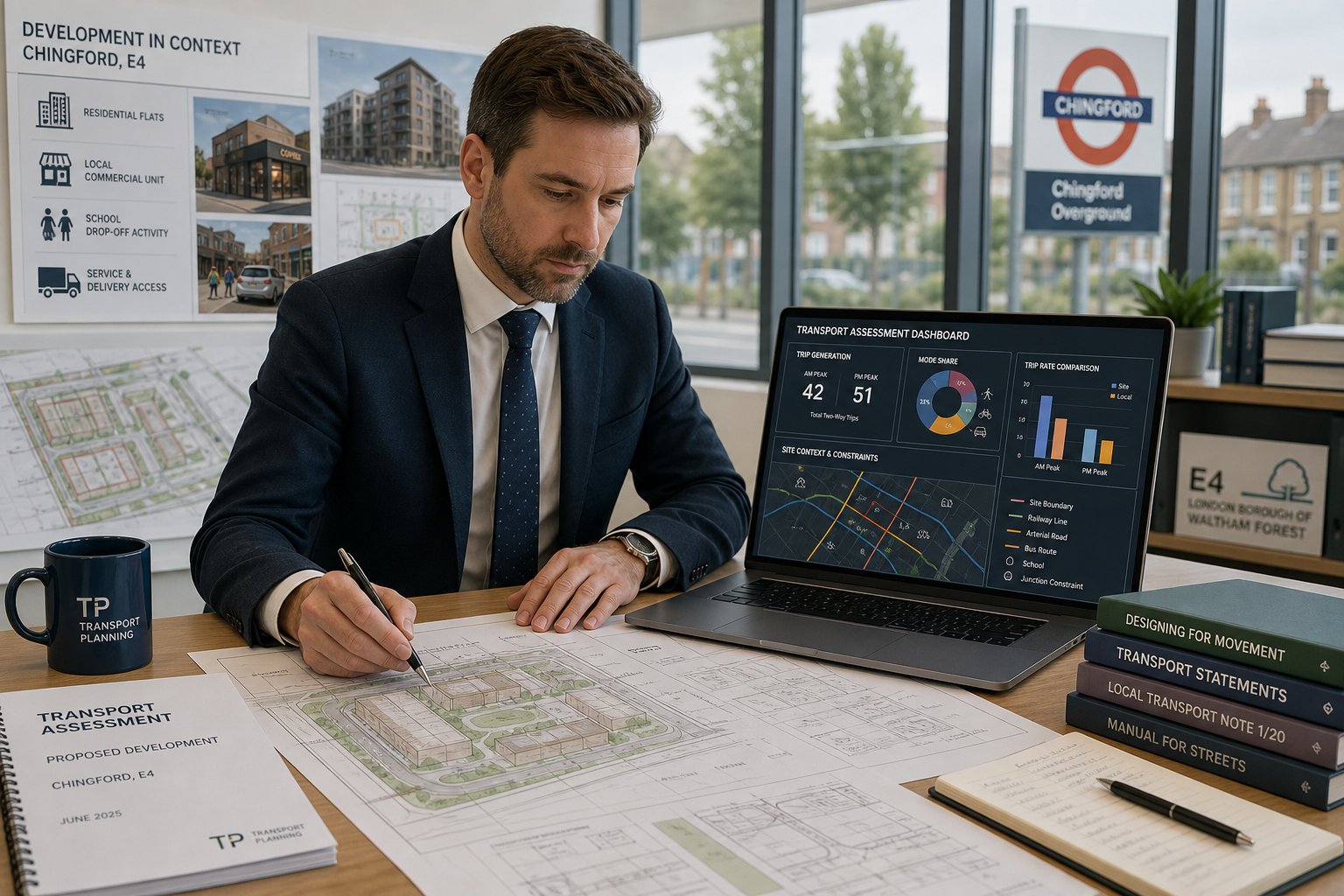
The question we hear most often is whether a scheme needs a Transport Statement or a full Transport Assessment. The short answer: it depends on likely impact. In London, a Transport Statement is typically used for smaller proposals where transport effects are limited and can be explained clearly without extensive modelling. A Transport Assessment is usually needed where a development is larger, more complex, likely to generate significant trips, or likely to alter access, servicing or parking conditions in a material way.
That distinction is not only about unit numbers. A small commercial use with frequent deliveries, short-stay turnover or awkward access may need more scrutiny than a straightforward residential infill scheme. Similarly, prior-approval conversions can appear modest on paper but still create real pressure on parking or servicing if local conditions are already tight.
The sensible approach is to scope the requirement early. We review the development type, local policy context, surrounding constraints and probable authority concerns, then advise on whether concise evidence is enough or whether a more detailed assessment is prudent. On mixed-use and business-led projects, principles used in Commercial Traffic Engineering often become relevant because operational patterns can be less predictable than standard housing schemes.
A good report is not simply longer. It is proportionate, technically sound and aligned with what the decision-maker will expect to see.
Common Development Types That Trigger Traffic Review In Chingford
In Chingford, traffic review is commonly triggered by medium to larger residential developments, estate infill, flat schemes, redevelopment of commercial plots, schools and nurseries, gyms, restaurants, trade counters, industrial uses and logistics-related proposals. Any use that introduces regular servicing, pick-up and drop-off activity, or higher parking demand tends to attract highway scrutiny.
Residential schemes often need evidence on car and cycle parking provision, trip generation, local accessibility and whether the surrounding roads can absorb additional demand. Commercial schemes may require a closer look at delivery patterns, refuse collection, loading arrangements and staff travel.
Sites near schools, bus corridors, local centres or controlled parking zones can be particularly sensitive. Even where total traffic increase is not dramatic, the timing and concentration of movements may still matter. In these cases, a well-judged appraisal from experienced Traffic Engineering Consultants: What can help define the right scope before the planning team commits to a strategy that becomes awkward to defend later.
How Chingford Site Constraints Can Affect Access, Parking, And Highway Design
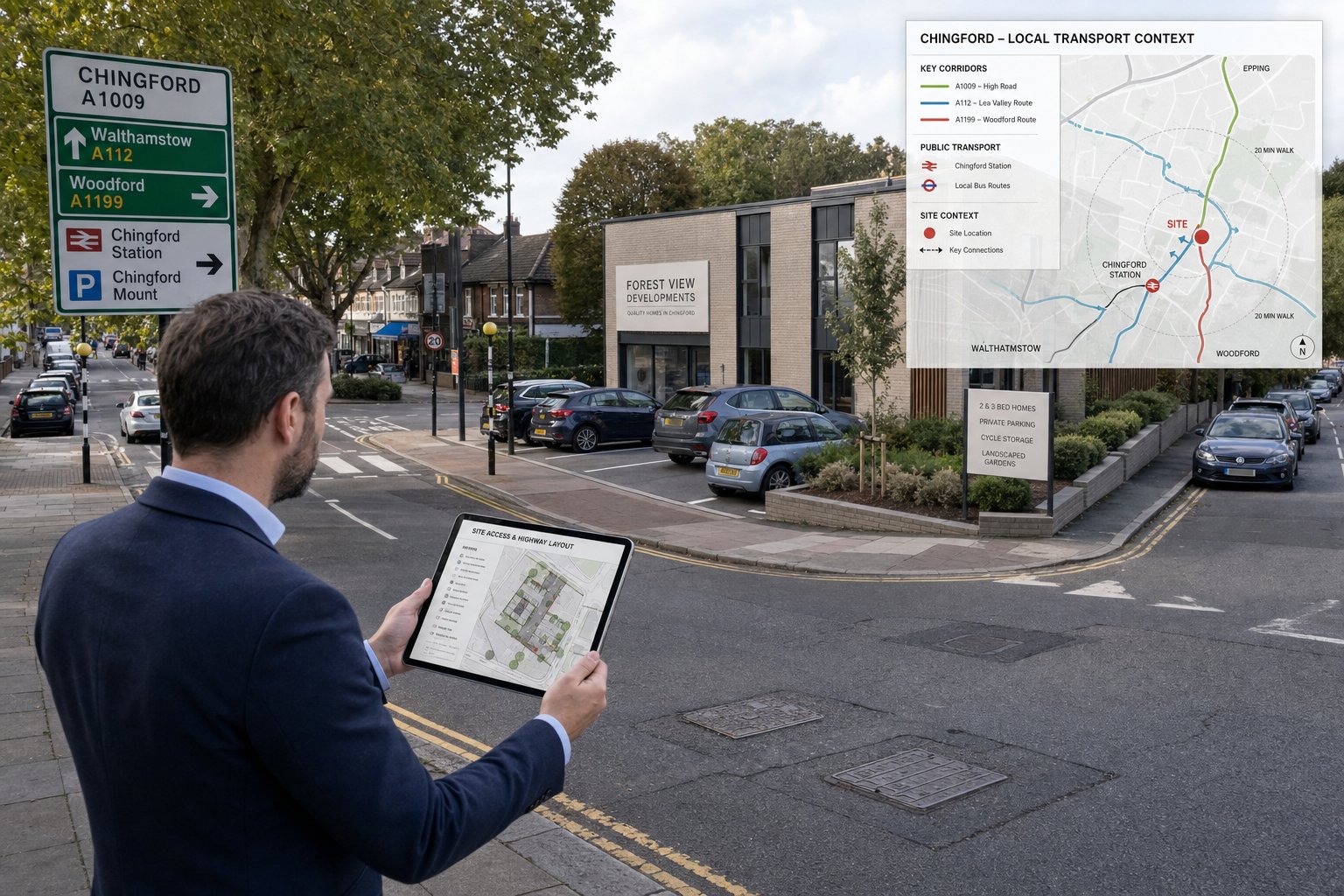
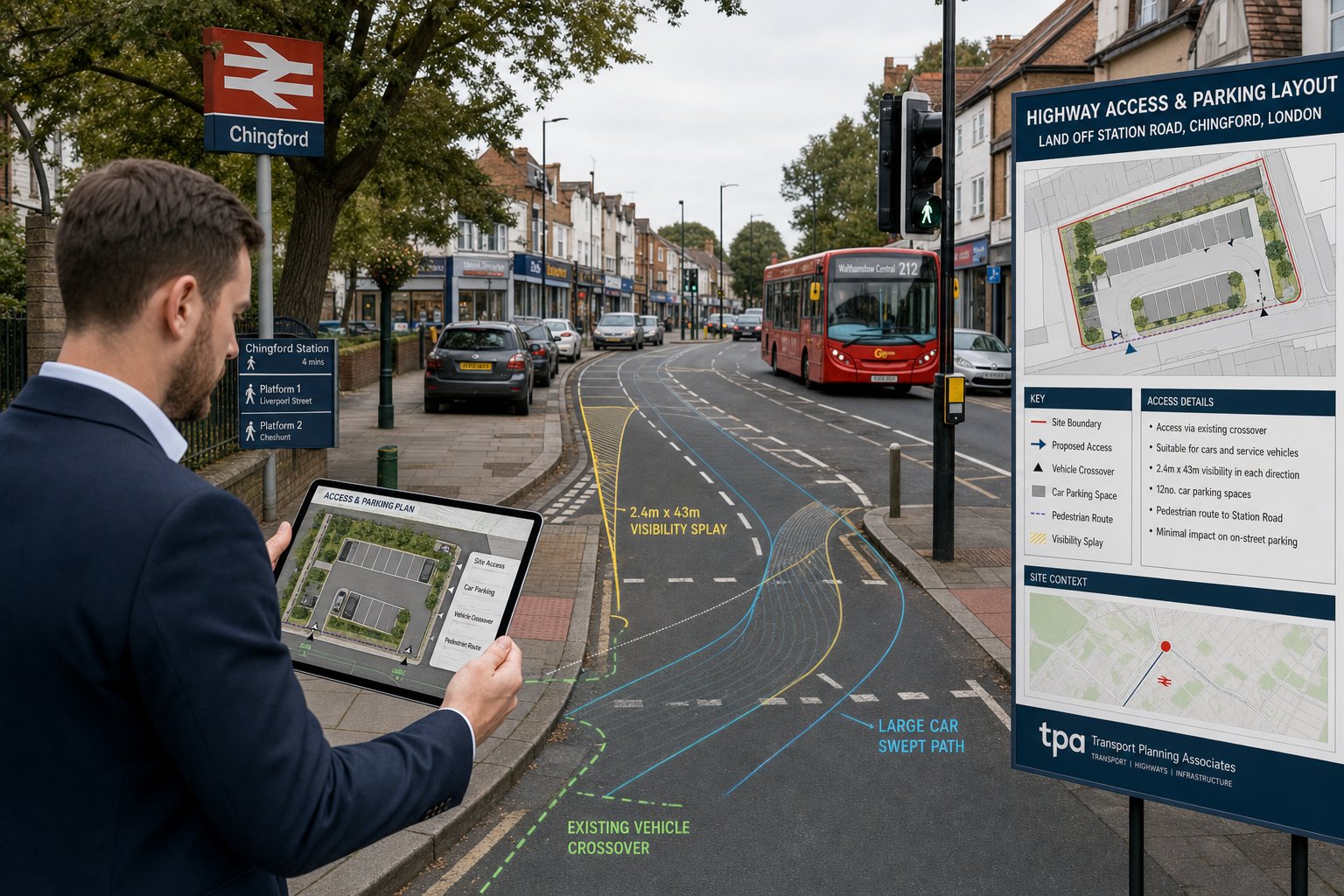
Chingford presents a mix of suburban residential streets, busier distributor roads, local shopping frontages and edge conditions that connect towards Essex and the wider North and East London network. That variety matters because transport design is always site-specific. A layout that works comfortably on one plot may be entirely unsuitable a few streets away.
Common constraints include narrow carriageways, heavy on-street parking, existing crossovers, mature trees, level changes, retaining features, utility apparatus and nearby junctions or crossings. These factors can affect where a vehicle access can be formed, how much visibility can be achieved, whether a car park can function safely, and whether service vehicles can enter and leave in forward gear. Sometimes the constraint is less physical and more operational: a street may technically accommodate an access, but local parking stress or school-run conditions can make it contentious.
This is where early design review pays off. We often find that small geometric adjustments, revised parking layouts or a different servicing approach can avoid major planning objections. On access-led schemes, a careful understanding of access design highway principles is essential, especially where boundary constraints tempt teams into over-optimistic layouts.
The best transport advice is not abstract. It responds to what can genuinely be delivered on the ground.
Local Road Network Considerations Around Chingford And Nearby Routes
A Chingford site does not operate in isolation. Traffic distribution, accessibility and likely authority concerns are shaped by the surrounding network, including links to the A406 North Circular, the A104 and A112 corridors, Chingford Mount Road, routes towards Walthamstow, Enfield and Essex, and the local hierarchy of residential streets feeding into them.
We also consider bus services, station access, walking catchments, cycle routes and parking controls. A site close to Chingford rail services may support a stronger sustainable transport case, but only if the pedestrian routes and trip characteristics make that argument credible. Likewise, a development with limited car parking may be more defensible in one part of the area than another.
Collision history and known congestion points can also influence the assessment. If a proposed access sits close to a busy junction, crossing point or established queue, we need to understand whether the design introduces conflict or worsens existing conditions. Wider comparator experience, including work discussed in Traffic Engineer In London:, is useful, but local evidence remains the anchor for a sound planning submission.
Key Transport Reports Used To Support Planning Applications
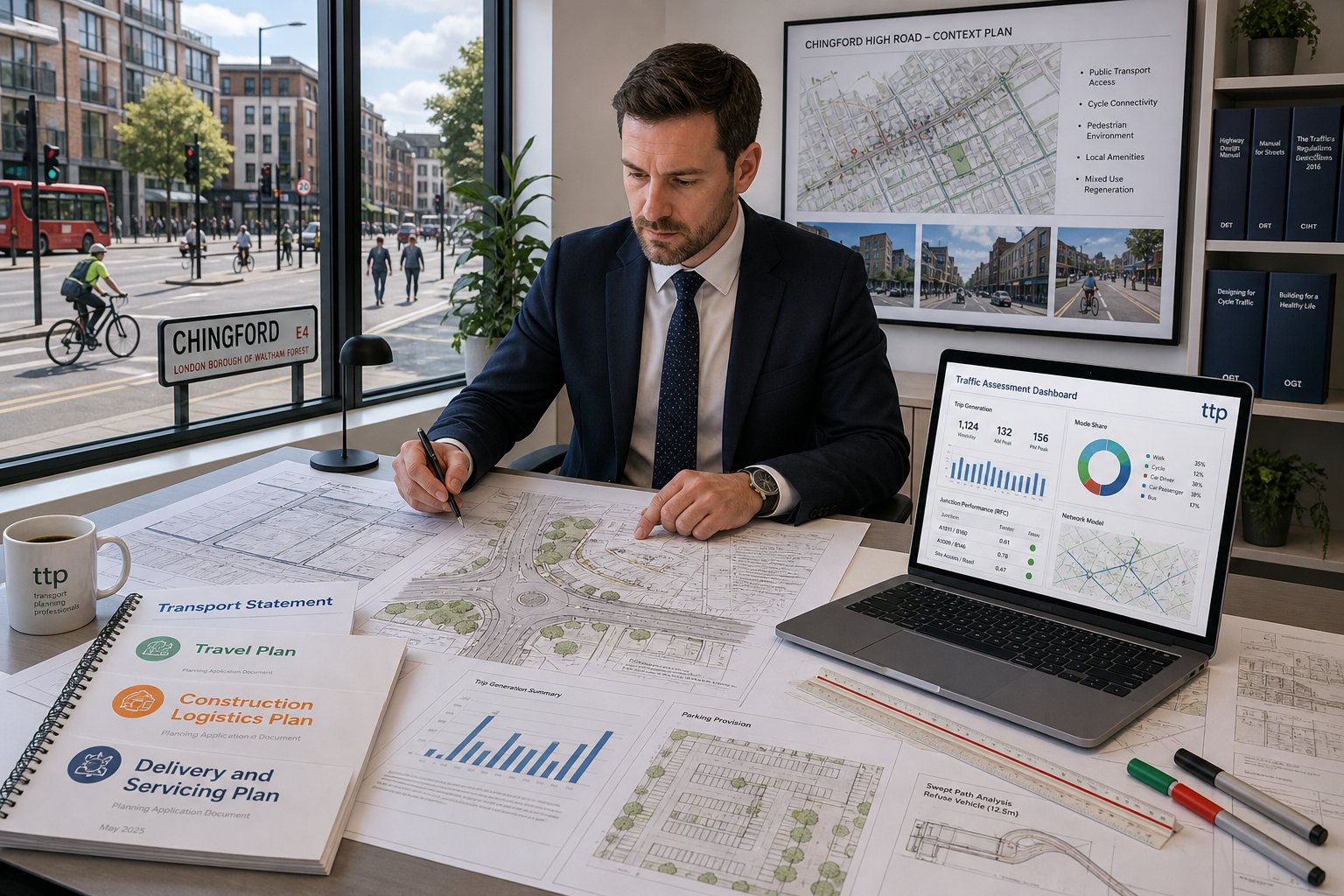
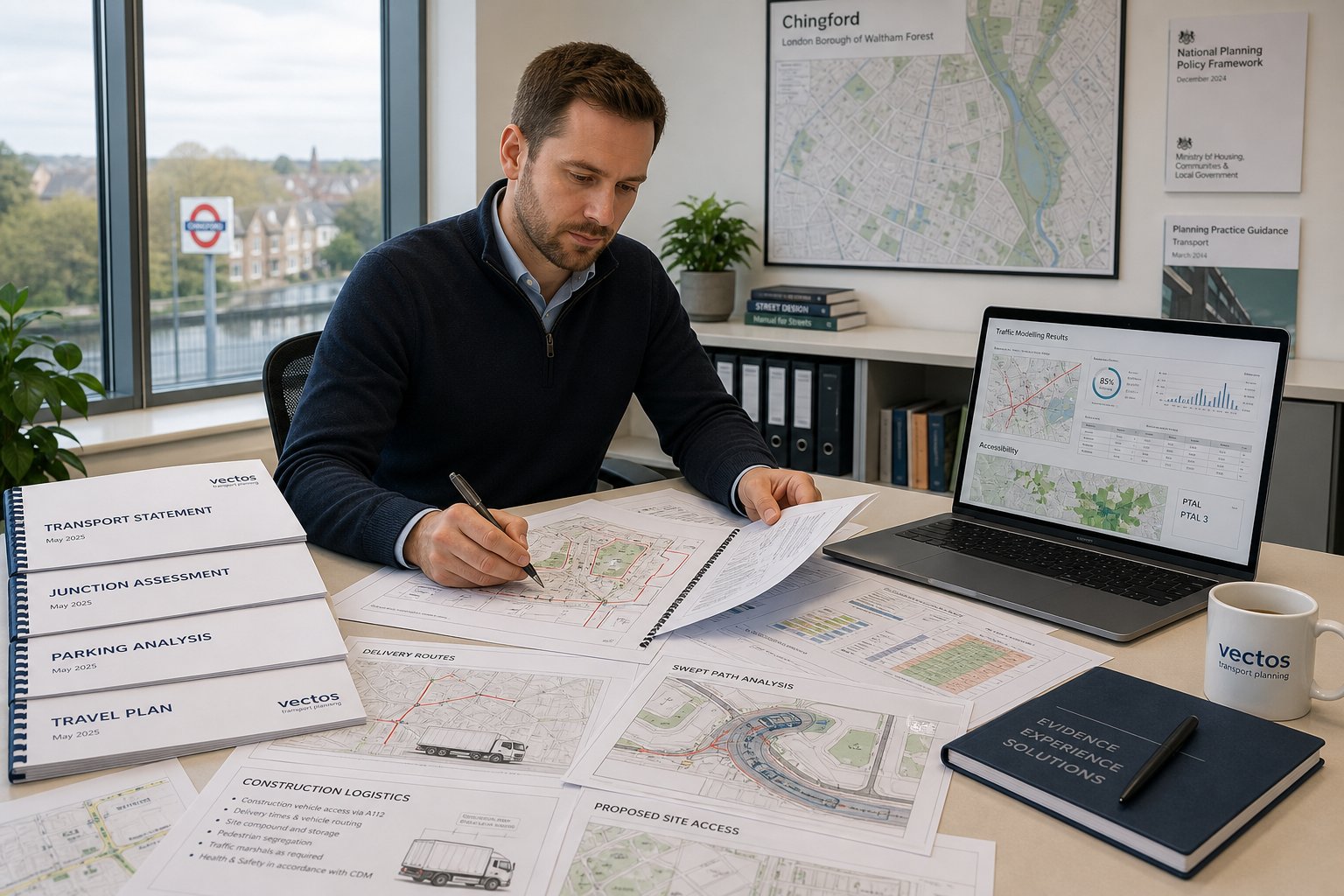
Not every planning application needs the same reporting package. The right combination depends on the scale and complexity of the proposal, the sensitivity of the site, and the likely issues identified by planning and highways officers. The aim is not to produce paperwork for its own sake. It is to provide clear technical evidence that the scheme is safe, policy-compliant and workable.
At the lighter end, a concise report may explain existing conditions, trip expectations, parking provision, accessibility and access arrangements. At the more detailed end, a submission may include technical appendices, modelling outputs, drawings, survey data and management plans. The strongest applications use each report for a specific purpose and avoid overlap or contradiction.
Where schemes evolve quickly, consistency across disciplines matters. Transport assumptions should align with architecture, servicing strategy, refuse arrangements and public realm design. If one drawing shows a workable access and another quietly removes the turning head, the problem will be noticed. That sounds obvious, yet it happens surprisingly often.
Transport Statements, Transport Assessments, And Travel Plans
A Transport Statement is generally used where the transport impact is limited but still needs formal explanation. It usually covers site context, existing conditions, accessibility, expected trips, parking, servicing and the likely effect on the local highway network. It should be proportionate, but it must still be evidence-led.
A Transport Assessment goes further. It is used for larger or more complex schemes and may include detailed trip generation analysis, distribution and assignment, junction capacity assessment, parking accumulation, collision review and mitigation proposals. The level of modelling depends on the proposal and agreed scope.
Travel Plans often sit alongside either document, particularly where policy support for sustainable travel is important. A residential or workplace Travel Plan sets out practical measures to encourage walking, cycling, public transport use, car club membership, EV uptake and smarter travel behaviour. A useful plan is specific, monitored and realistic, not just aspirational language copied from another borough. Experience from projects such as Traffic Engineer In Manchester: shows that authorities respond better when Travel Plans are tailored to the actual place rather than written as generic policy theatre.
Supporting Documents Such As Construction Logistics And Delivery Plans
Depending on the proposal, supporting reports can be just as important as the main assessment. A Construction Logistics Plan explains how construction traffic will be managed during the build phase, including routes, timings, vehicle types, site controls, contractor communication and measures to reduce conflict with residents, schools and vulnerable road users.
A Delivery and Servicing Plan focuses on the operational phase. It sets out how deliveries, collections, waste management and servicing activity will take place once the site is in use. This is particularly relevant for mixed-use, retail, hospitality, industrial and education schemes, where poorly managed servicing can create disproportionate local impact.
Other supporting documents may include parking surveys, swept path analysis, car park management plans and, where relevant, Road Safety Audit input. These documents help translate broad claims into something testable. They also give planning officers confidence that the development team has thought beyond validation and into real operation. In many cases, those practical details are what turn a hesitant response into an acceptable one.
The Process Of Working With A Traffic Engineer From Appraisal To Submission
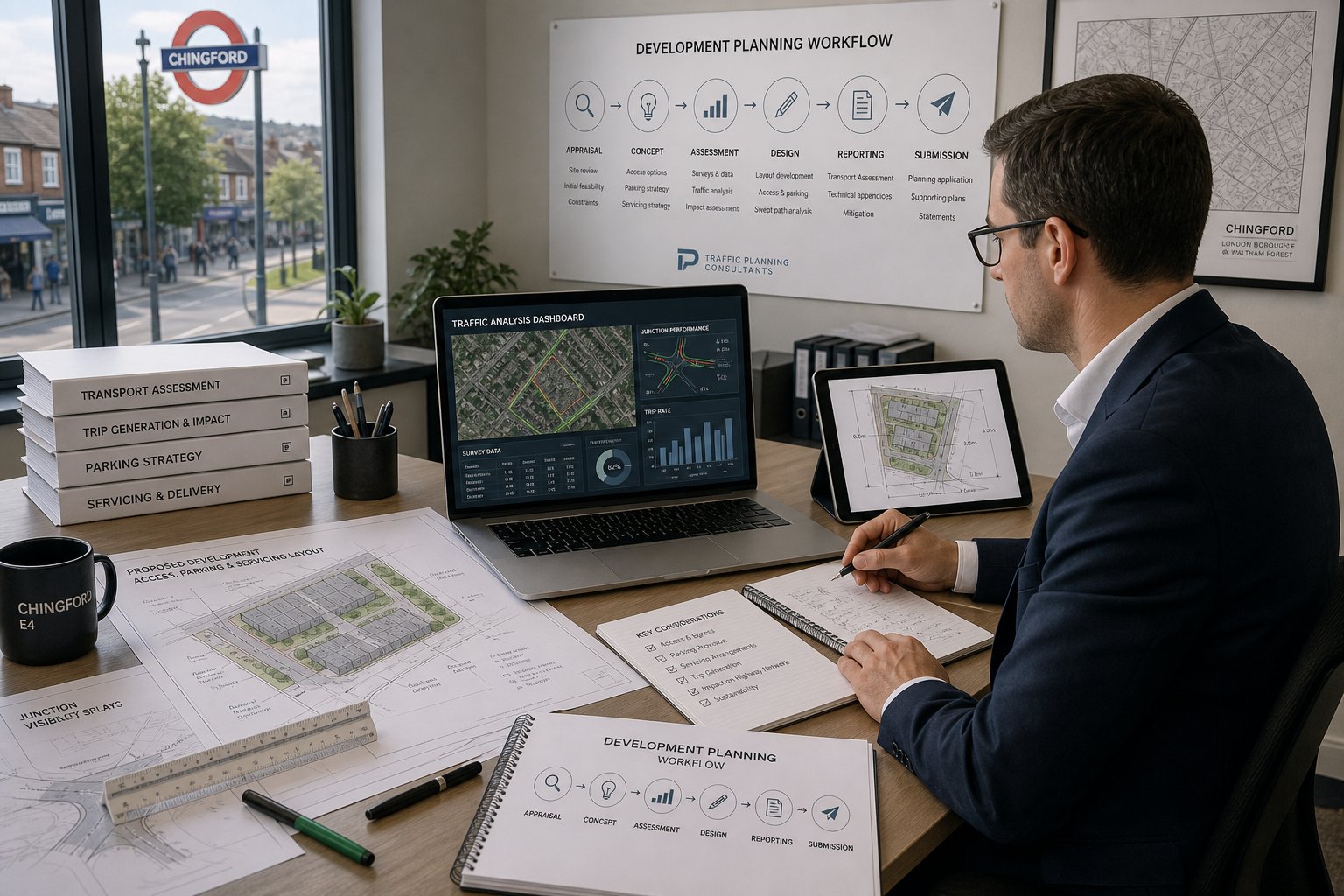

The process usually begins with an initial appraisal. We review the site location, proposed use, indicative drawings, planning context and likely transport risks. At this stage, the goal is to identify what matters most: access, parking, servicing, trip impact, sustainable travel, or a combination of all five. Getting that right early saves time and redesign later.
Next comes scoping. For straightforward proposals, the scope may be internal and relatively simple. For larger or more sensitive schemes, it can be sensible to agree the methodology with the local authority or highway authority before surveys and analysis are finalised. That can cover the survey extent, assessment years, trip assumptions, junctions to be tested and the form of supporting documents.
Surveys and data collection then provide the factual base: traffic counts, parking beat surveys, collision data, accessibility information and site measurements. After that, we carry out the design and assessment work, preparing access reviews, swept paths, parking layouts, trip analysis and report content. The final stage is application support: responding to consultation comments, refining wording, updating drawings and dealing with conditions.
The value of experienced input is not just technical competence. It is knowing when to keep things proportionate and when a point needs more evidence. That broader discipline is common to work in Chingford and other urban authorities, whether the comparison is Traffic Engineer In Birmingham: or elsewhere. Good process reduces friction. And in planning, friction is expensive.
How Highway Safety, Visibility, And Access Suitability Are Assessed
Safety assessment is one of the core functions of a traffic engineer in Chingford. A planning authority may tolerate some debate over predicted trip numbers: it is far less relaxed about an access that appears unsafe, poorly visible or operationally awkward. For that reason, we assess both design standards and real-world behaviour.
Visibility is a starting point. We review whether drivers emerging from the site can see approaching users in time, and whether pedestrians, cyclists and passing vehicles are exposed to conflict. The answer depends on speed environment, geometry, frontage conditions, parking activity and whether the access sits near a bend, junction or crossing. Measured visibility needs to be grounded in the actual street, not idealised drawings.
We also assess junction operation and access suitability. That can include the likely interaction between entering and exiting vehicles, queueing, turning conflicts, and whether vulnerable road users are being placed in uncomfortable positions. Collision records can help show whether a location already has a pattern of safety issues that a new development might aggravate.
Swept path analysis is particularly important where refuse vehicles, fire appliances or delivery vehicles must manoeuvre within tight boundaries. A car may fit almost anywhere: a refuse lorry is much less forgiving. If larger vehicles cannot enter, turn or leave safely, the access strategy may need to change before the planning application goes in.
Why Local Authority Expectations Matter In Chingford Planning Submissions
A technically competent report can still fail to persuade if it does not address the local authority’s priorities. In Chingford, that means understanding the expectations shaped by the London Plan, Waltham Forest’s local policies and the borough’s approach to Healthy Streets, active travel, parking restraint, road danger reduction and sustainable development.
In practical terms, local authority expectations influence parking provision, cycle parking quality, EV charging, servicing controls, Travel Plan commitments, construction logistics and the way access proposals are justified. A submission that leans too heavily on car-based convenience without addressing sustainable travel and local place impacts is likely to face resistance, even if the arithmetic looks tidy.
Validation can also be affected. Some schemes are delayed not because the transport position is fundamentally unacceptable, but because the supporting material is incomplete, inconsistent or misjudged. A proportionate Transport Statement that directly addresses the likely questions can be more effective than a bulky document that avoids them.
That is one reason we emphasise local authority-aware reporting at ML Traffic. With more than 30 years of experience, our approach is to produce concise, accurate transport evidence aligned to the thresholds and planning context that officers actually use. For development teams, that often means fewer surprises, cleaner consultations and a better chance of avoiding drawn-out highways objections.
Choosing The Right Traffic Engineer In Chingford For A Smooth Planning Process
Choosing the right consultant is partly about credentials, but mostly about judgement. You need someone who understands planning, not only highway design: who can write clearly, not only run software: and who knows how local officers tend to read transport evidence. Technical ability matters, obviously. But so does the ability to advise honestly when a proposal needs amendment rather than optimistic spin.
We would usually suggest looking for experience in Waltham Forest and neighbouring London boroughs, a strong record in development planning, and the ability to provide the full range of supporting documents where needed: Transport Statements, Transport Assessments, Travel Plans, Construction Logistics Plans, Delivery and Servicing Plans, parking surveys and swept path reviews. Professional grounding through bodies such as CIHT, ICE or TPS is also a useful indicator.
Responsiveness matters more than many teams admit. Planning programmes move quickly, and transport issues often emerge late. A consultant who can turn around concise, accurate advice without inflating the scope is worth keeping. Equally, the right traffic engineer should be comfortable engaging with architects, planners, lawyers, surveyors and council officers in the same conversation.
Above all, choose someone who can explain what is achievable on your site in plain terms. That tends to produce better schemes, cleaner applications and fewer expensive surprises after submission.
Conclusion
A well-chosen traffic engineer in Chingford does far more than produce a report for the planning portal. We help development teams understand whether a proposal is workable, what transport risks sit beneath the surface, and how those risks can be addressed before they become objections. That includes access, parking, servicing, safety, visibility, policy compliance and the wider effect on the local network.
For architects, planners, developers, lawyers, surveyors and councils, the practical benefit is straightforward: better evidence, fewer avoidable redesigns and a more credible planning submission. In Chingford, where local context and borough expectations carry real weight, that localised transport input can materially improve the prospects of approval.
In 2026, the strongest planning applications are the ones that treat transport as part of the design process, not a late add-on. When that happens, schemes tend to move faster and stand up better under scrutiny.
Frequently Asked Questions About Traffic Engineering in Chingford
What role does a traffic engineer in Chingford play in planning applications?
A traffic engineer in Chingford assesses how a development impacts local traffic, parking, access, and safety, providing detailed reports to ensure proposals comply with Waltham Forest policies and are acceptable to local authorities.
When is a Transport Statement needed versus a Transport Assessment in Chingford?
Transport Statements are required for smaller schemes with limited transport impact, while larger or more complex developments need a full Transport Assessment, especially if they materially affect access, parking, or generate significant trips.
How do local site constraints in Chingford affect traffic and parking design?
Constraints like narrow streets, parking stress, visibility limits, mature trees, and level changes influence where accesses can be located, parking capacity, and vehicle manoeuvrability, requiring tailored designs to ensure safety and policy compliance.
Which types of developments commonly require traffic engineering input in Chingford?
Medium to large residential schemes, commercial uses like shops and gyms, schools, nurseries, and industrial or logistics sites with servicing needs often trigger detailed traffic reviews to address parking, access, and operational impacts.
How does the local road network around Chingford influence traffic assessments?
Proximity to major corridors like the A406 North Circular, nearby bus and rail links, cycle routes, and known congestion or collision hotspots shape traffic distribution and mitigation strategies in planning submissions.
What should I consider when choosing a traffic engineer in Chingford for my planning project?
Select a consultant with local Waltham Forest experience, industry body membership, full service capabilities including Transport Statements and Assessments, plus strong communication skills and a clear understanding of local planning expectations.