
A single highway objection can stall a multi-million-pound residential development for months, turning a profitable site into a regulatory bottleneck. You’re likely facing increased pressure from local authorities regarding parking ratios and the rising costs of sustainability mitigation. It’s a high-stakes environment where precision isn’t just a preference; it’s a functional necessity for your project’s survival. Securing a robust transport assessment and travel plan for planning permission residential projects is no longer just a box-ticking exercise. It is a strategic defense of your site’s commercial viability.
We understand that navigating the December 2024 National Planning Policy Framework and Active Travel England’s statutory requirements can feel like an unnecessary hurdle. This article provides a clear roadmap to help you master these technical nuances and secure planning approval with confidence. You’ll learn how to utilize specialized reports to maximize development density while minimizing S106 and S278 financial obligations through data-driven advocacy. We’ll examine the specific documentation you need to pass planning in 2026 and move your project from inception to completion without avoidable delays.
Key Takeaways
- Align your site design with the latest NPPF standards to maximize unit numbers while meeting stringent Active Travel England requirements.
- Differentiate between Transport Statements and Assessments to ensure you provide the exact level of technical detail required for your scheme’s scale.
- Implement a strategic transport assessment and travel plan for planning permission residential developments to mitigate highway objections and lower S106 financial burdens.
- Use Swept Path Analysis and Lambeth Methodology parking surveys to defend site layouts and density in constrained urban environments.
- Engage in pre-application consultations to identify and resolve critical transport constraints before they become formal planning refusals.
Transport Planning for Residential Developments: Why It Is the Key to Approval
The National Planning Policy Framework (NPPF) 2026 mandates that all residential developments prioritize sustainable transport to support the goal of building 1.5 million homes. Precision in Transportation planning is no longer a secondary consideration; it’s the primary mechanism for securing site viability. Local authorities now scrutinize how a project integrates into existing networks before considering architectural merits. A robust transport assessment and travel plan for planning permission residential schemes ensures your project meets these rigorous safety and sustainability benchmarks from the outset.
To better understand how these strategies integrate into the planning process, watch this overview of travel plan fundamentals:
Modern planning has shifted toward a “Vision-Led” approach. This methodology moves away from traditional “predict and provide” models that often resulted in over-engineered road layouts. Instead, it focuses on the desired outcomes for a community, such as high active travel rates and reduced car dependency. By adopting this vision early in the RIBA Stage 2 and 3 design phases, you can prevent the costly redesigns that frequently plague projects at RIBA Stage 4. Early transport intervention allows you to defend higher site densities by proving that the local infrastructure can handle the increased movement through smart mitigation rather than just physical expansion.
The “Significant Movement” Threshold for Residential Sites
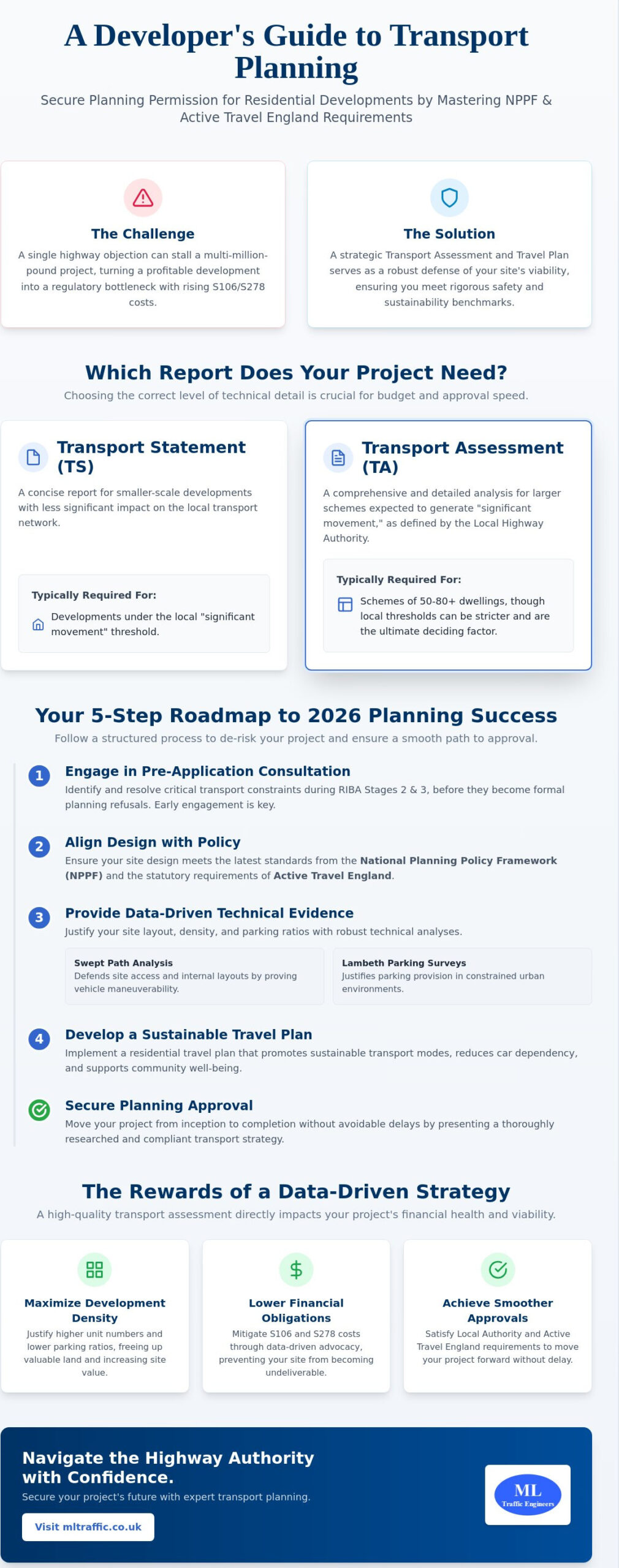
Determining whether your project requires a simple Transport Statement or a comprehensive Assessment depends on the “significant movement” your site generates. While national guidelines often point to a range of 50 to 80 dwellings, local borough variations are common and can be much stricter. In the context of 2026 residential standards, the “significant movement” threshold is a qualitative trigger determined by the local planning authority based on a site’s potential to impact the local highway network’s safety and capacity. We help you identify these triggers early to ensure your reporting matches the specific expectations of the statutory consultees, including Active Travel England for larger schemes.
Impact on Land Value and Planning Viability
Transport reports directly influence the financial health of your development. High-quality data can justify lower parking ratios in areas with high accessibility, which frees up land for additional units and increases the overall land value. Conversely, poor planning leads to excessive S106 and S278 financial obligations that can render a site undeliverable. To understand how these principles apply to high-density urban environments, consult our Transport Assessment London: The Developer’s 2026 Guide to Planning Success. By establishing transport feasibility early, you ensure your site remains a “deliverable” asset in the eyes of the planning committee.
Transport Assessments vs. Statements: Which Does Your Project Require?
Choosing between a Transport Statement (TS) and a Transport Assessment (TA) is a decision that dictates your project’s technical scope and consultant budget. While both documents support a transport assessment and travel plan for planning permission residential application, their depth and geographic focus vary significantly. The official government guidance on transport assessments provides the foundation for this choice, but local highway authorities often apply their own specific thresholds based on local network sensitivity. Precision at this stage prevents you from over-investing in unnecessary data or, conversely, facing a refusal for insufficient evidence.
Transport Statements for Smaller Residential Schemes
Small sites don’t always mean simple approvals. A Transport Statement is typically required for residential schemes falling between 10 and 50 units, though this varies by borough. This report focuses on accessibility audits, local policy reviews, and fundamental safety analysis. You must demonstrate that the site is safely accessible by foot, cycle, and public transport without requiring extensive network upgrades. For those operating in the capital, our Transport Statement London: A Developer’s Buying Guide for 2026 details how borough-specific requirements can influence your submission. Even “minor” sites must prove they won’t compromise the safety of existing road users.
Full Transport Assessments for Major Developments
Major schemes, usually exceeding 50 to 80 units, trigger a full Transport Assessment. This document goes far beyond basic accessibility. It requires rigorous junction capacity modelling and multi-modal impact analysis to evaluate how new residents will affect the wider highway network during peak hours. You must also address the cumulative impact of neighbouring residential sites to ensure the infrastructure can handle the total growth. TRICS data is the industry standard for residential trip forecasting because it provides a statistically robust database of observed multi-modal trip rates from comparable land uses across the UK. This data allows us to predict future traffic flows with a high degree of accuracy, satisfying the demands of highway officers.
The primary difference lies in the scope of the assessment. A TS primarily looks at the site access and its immediate vicinity. A TA expands this scope to include the wider network impact, often requiring detailed modelling of junctions several miles away. If you’re unsure which document your project requires, exploring our technical transport services can clarify your regulatory obligations before you submit. Getting the scope right during the pre-application stage is the most effective way to avoid the logistical and regulatory pressures of a planning delay.
Designing for Sustainability: The Residential Travel Plan
A Residential Travel Plan is a dynamic management tool rather than a static document. It creates a mandatory link between your development’s occupancy and its long-term impact on the local transport network. By securing a comprehensive transport assessment and travel plan for planning permission residential projects, you demonstrate a clear commitment to reducing single-occupancy vehicle trips. This strategic shift often allows developers to mitigate the need for extensive, and expensive, highway capacity works. Instead of widening roads or adding lanes, you invest in behavioral change and sustainable infrastructure that supports the local authority’s modal shift goals.
The success of these plans hinges on a dedicated Travel Plan Coordinator (TPC). This individual manages the implementation of the strategy, acting as the primary liaison between residents, the developer, and the local planning authority. They ensure that the measures promised during the planning phase actually materialize once the site is occupied. Effective TPCs provide residents with the information and incentives they need to choose walking, cycling, or public transport over private car use, which is essential for meeting the strict sustainability targets set in 2026.
To ensure residents have reliable options for longer journeys without needing a private vehicle, developers often include services like Brighton Airport Taxis in their travel packs; click here to learn more about their professional transfer offerings.
Sustainable Mitigation Measures for 2026
Planning requirements in 2026 place a heavy emphasis on future-proofed infrastructure. Integrating car club bays and rapid EV charging points is now a standard expectation rather than an optional extra, especially in areas with lower Public Transport Accessibility Levels (PTAL). Cycle parking must also evolve beyond the basic “shed” requirement. Local authorities now demand high-quality, secure, and accessible storage that accommodates non-standard cycles, such as cargo bikes. For those navigating these specific urban requirements, our London Travel Plans: The Essential Guide for Planning Applications in 2026 provides a detailed breakdown of current expectations and how to meet them efficiently.
Monitoring and Section 106 Obligations
Travel Plans are legally binding through Section 106 agreements, which often include specific monitoring fees and remedial “fallback” measures. A typical 5-year monitoring cycle for residential travel plans involves conducting baseline surveys within six months of first occupation, followed by annual or biennial monitoring reports to verify that the site is meeting its sustainability targets. If these targets aren’t met, the developer may be required to implement pre-agreed fallback measures, such as additional cycle vouchers or enhanced car club subsidies. We help you negotiate these conditions during the planning stage to maintain project flexibility while ensuring long-term compliance and safety.
Technical Requirements: Parking Surveys and Swept Path Analysis
Technical evidence serves as the backbone of any successful transport assessment and travel plan for planning permission residential application. While policy sets the strategic direction, technical data like parking surveys and swept path analysis provide the physical proof that a site functions safely. Highway authorities prioritize these reports because they address the immediate operational impacts on the existing infrastructure. Precision in these technical submissions reduces the likelihood of late-stage objections that could derail your construction timeline or force expensive last-minute redesigns.
Justifying Residential Parking Standards
Defending your proposed parking ratios requires a data-led approach that balances local car ownership trends with Public Transport Accessibility Level (PTAL) ratings. In high PTAL areas, “car-free” developments are increasingly the standard; however, in low PTAL zones, you must justify every space provided to ensure the development remains marketable and functional. We use 2021 Census data and local car ownership statistics to build a robust case for your specific unit mix. This evidence prevents the local authority from imposing arbitrary parking reductions that could impact the commercial appeal of your homes.
For urban infill projects, a Parking Stress Survey using the Lambeth Methodology is often essential. This survey assesses the availability of on-street parking within a 200-meter radius of the site during peak demand times, typically between 00:30 and 05:30 on two separate weekday nights. By proving that the surrounding streets can accommodate any potential overspill, you protect your site density from being reduced due to perceived highway capacity issues. This level of technical detail is a non-negotiable foundation of our comprehensive traffic survey services.
Proving Access with Swept Path Analysis (SPA)
Site safety hinges on the ability of large vehicles to navigate the internal layout without conflict. Swept Path Analysis (SPA) simulates the movement of fire tenders and standard 11.2m refuse vehicles to ensure they can enter, turn, and exit the site in a forward gear. This technical validation is a mandatory requirement for modern residential planning, specifically to satisfy the access needs of emergency services and waste management teams. For developers and landlords seeking to maintain high safety standards post-occupancy, UK Fire Risk Assessments provides professional assessment services across the country. If a refuse vehicle cannot reach within 25 meters of a bin store, or a fire tender cannot reach within 45 meters of all points in a dwelling, the application faces immediate refusal.
Beyond mere compliance, SPA allows you to refine your site layout to avoid “dead” space. Accurate simulations ensure that every square meter of the development is utilized efficiently, maximizing the number of units while maintaining safe access. Our Swept Path Analysis Services in London: Securing Planning Approval in 2026 provides a comprehensive look at how these simulations satisfy the specific requirements of the London Fire Brigade and local councils. You can order a professional Swept Path Analysis to validate your design before formal submission, ensuring your project is ready for immediate review.
Navigating the Highway Authority: The Path to 2026 Planning Success
Negotiating with the Highway Authority is the final strategic hurdle for any residential project. Pre-application consultation acts as a safety net, allowing you to identify “showstopper” issues before you commit to a formal submission. These issues, such as inadequate visibility splays or severe junction capacity constraints, lead to immediate refusal if they aren’t resolved early. By engaging with officers before the clock starts, you transition from a reactive stance to a proactive partnership. This approach significantly reduces the risk of receiving Regulation 25 requests for further information, which frequently stall the determination period.
The Pre-Application Roadmap
The primary goal of pre-application is to agree on a formal Scope of Works. This agreement prevents scope creep during the assessment phase and ensures that the highway officer’s technical expectations align with your project scale. It’s also the stage where you should begin negotiating Section 278 and Section 38 requirements. Understanding these obligations early allows you to factor potential highway improvement costs into your initial viability assessments. For developers operating in high-density areas, our Highway Design S278 & S38: The London Developer’s Guide for 2026 offers specific insights into managing these complex legal agreements. Early agreement on the scope of the transport assessment and travel plan for planning permission residential applications ensures a smoother path through the planning committee.
Why Partner with ML Traffic Engineers UK
Operating within the intricate regional regulations of London Boroughs and the wider requirements of Active Travel England demands specialized expertise. We provide an all-encompassing, fully-managed service that takes the logistical pressure off your team. Our “Right First Time” approach ensures that every report adheres to current legislative requirements and industry benchmarks. We take immense pride in our precision and our ability to manage full project lifecycles from inception to completion. Our team understands that planning is a high-stakes environment where time is a critical asset, so we prioritize the rapid delivery of information.
A dependable partner understands that precision is a functional necessity. We offer constant accessibility and rapid response capabilities to handle post-submission clarifications efficiently. Whether you’re dealing with urban infill or major residential growth, our team ensures your site meets the highest standards of safety and sustainability. You can contact ML Traffic Engineers UK today for a technical review of your residential site to ensure your project is ready for 2026 planning success.
Secure Your Residential Development’s Future
Mastering the technical requirements of transport reports is the most effective way to protect your site’s commercial viability against highway objections. By integrating precise data from Swept Path Analysis and parking surveys, you provide the evidence needed to maximize unit numbers while meeting strict 2026 sustainability standards. A comprehensive transport assessment and travel plan for planning permission residential schemes serves as your strategic defense against excessive S106 and S278 financial obligations.
Navigating these complex regulations requires a partner who understands the intricate nuances of London and England-wide planning policies. We provide full lifecycle support, from initial capacity modelling using the TRICS database to final technical reviews. Our “Right First Time” approach reduces regulatory pressure and eliminates avoidable delays in your project timeline. We take pride in being specialists who manage the entire process so you don’t have to.
Ready to move your development forward? Request a Transport Planning Quote for Your Residential Project to ensure your site meets every technical benchmark with precision. We look forward to helping you achieve a seamless path to planning approval.
Frequently Asked Questions
Is a Transport Assessment always required for residential planning permission?
A full assessment isn’t always mandatory for every site. The requirement depends on the scale of the development and the potential impact on the local highway network. While major schemes usually trigger an assessment, smaller residential projects between 10 and 50 units often only require a Transport Statement. Local planning authorities make this determination during pre-application based on the “significant movement” threshold.
What is the difference between a Transport Statement and a Travel Plan?
A Transport Statement is a technical report that evaluates the immediate physical impact, accessibility, and safety of a development’s access point. In contrast, a Travel Plan is a long-term management strategy designed to influence how people travel. It focuses on encouraging residents to use sustainable modes like cycling and public transport, helping to meet carbon reduction targets over the project’s lifetime.
How much does a residential Transport Assessment cost?
Fees for these technical reports vary based on the project’s complexity and the specific requirements of the local highway authority. Factors such as the number of junctions requiring capacity modelling and the need for fresh traffic surveys will influence the final cost. We recommend requesting a bespoke quote to ensure the technical scope matches your site’s specific regulatory challenges and unit density.
Can I get planning permission for a residential development with no car parking?
Yes, car-free developments are entirely possible, particularly in urban areas with high Public Transport Accessibility Level (PTAL) ratings. You must demonstrate through a transport assessment and travel plan for planning permission residential applications that the site is perfectly situated for walking, cycling, and public transport. Councils may also require a Parking Survey to prove that residents won’t simply park on neighboring streets.
How long does it take to produce a Transport Assessment and Travel Plan?
Developing a transport assessment and travel plan for planning permission residential projects typically takes between 2 and 4 weeks. This timeframe accounts for data analysis, policy review, and report drafting. If your site requires fresh traffic surveys, you must also factor in the time to collect data during neutral weeks when traffic patterns are representative of normal conditions.
What happens if the Highway Authority objects to my residential development?
A highway objection indicates that the authority has concerns regarding safety, capacity, or sustainability that haven’t been fully addressed. It’s often possible to resolve these issues by providing further technical evidence or refining the site layout. We analyze the specific grounds for the objection and use tools like Swept Path Analysis to prove the site functions safely and efficiently.
Do I need a new Transport Assessment for a change of use to residential?
A new transport report is usually required because residential use has a different trip profile compared to commercial or industrial uses. Even if the total number of trips is lower, the timing of those trips during morning and evening peaks is critical. We assess how this change affects the local network to ensure the new residential use doesn’t compromise highway safety.
What is a Section 106 agreement in relation to transport planning?
Section 106 agreements are legal contracts used to offset the impact of a development on local infrastructure and the community. In a transport context, these agreements often secure financial contributions for highway improvements or cycle path extensions. They also mandate the implementation of travel plans, ensuring that developers remain accountable for the long-term sustainability and safety of their residential schemes.

Disclaimer
The content on mltraffic.co.uk, including all technical articles, guides, and resources, is provided for general informational and educational purposes only. It is not intended to constitute professional advice in traffic engineering, transportation planning, development approvals, or any other technical or legal field.
While ML Traffic Engineers makes every reasonable effort to ensure the accuracy, completeness, and timeliness of the information published, we do not provide any warranties or representations (express or implied) regarding its reliability, suitability, or availability for any particular purpose. Any reliance you place on the content is strictly at your own risk.
In no event shall ML Traffic Engineers, its directors, employees, authors, or affiliates be liable for any direct, indirect, incidental, special, consequential, or punitive damages (including, without limitation, loss of profits, data, or business opportunities) arising out of or in connection with the use of, or inability to use, any information provided on this website.
The articles and guides on this site are not a substitute for engaging a qualified, professional traffic engineer to assess your specific project requirements. For tailored advice, compliance assessments, or traffic engineering services, please contact a competent professional.
This disclaimer may be updated from time to time without notice. By accessing or using this website, you agree to be bound by the most current version of this disclaimer.