
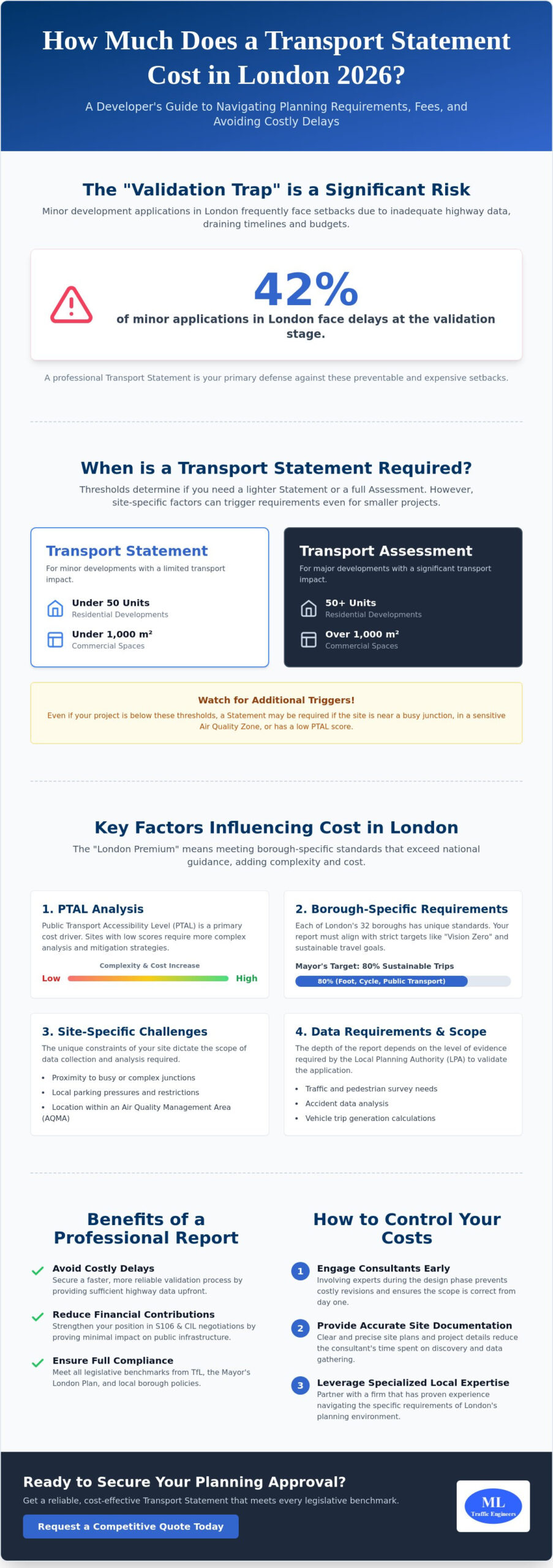
Did you know that 42% of minor development applications in London face delays at the validation stage because of inadequate highway data? When you’re managing a complex project, these regulatory setbacks aren’t just frustrating; they represent a significant drain on your timeline and budget. You’re likely asking, how much does a transport statement cost in London 2026, and why do professional quotes seem to fluctuate so much? In a high-stakes environment where precision is a functional necessity, understanding these variables is the first step toward a successful submission.
We recognize the pressure of navigating London’s intricate regulations, from PTAL accuracy to the strict “Vision Zero” safety targets. This guide clarifies the primary factors that drive Transport Statement pricing for your 2026 planning application. You’ll discover how to determine if your project requires a standard Statement or a full Assessment, helping you avoid the fear of choosing the wrong technical document. We’ll outline the current TfL requirements and show you how to secure a reliable, cost-effective submission that meets every legislative benchmark while reducing your overall delivery risk.
Key Takeaways
- Identify whether your development triggers the requirement for a Transport Statement or a more intensive Transport Assessment based on 2026 thresholds.
- Understand how PTAL ratings and borough-specific parking standards influence the technical complexity and depth of your regulatory submission.
- Learn exactly how much does a transport statement cost in London 2026 by evaluating the specific data requirements and site-specific challenges of your project.
- Discover practical strategies to control technical reporting fees through early consultant engagement and the provision of accurate site documentation.
- Leverage specialized local expertise to navigate TfL’s “Vision Zero” targets and ensure a faster, more reliable validation process for your planning application.
Understanding Transport Statement Requirements for London Planning in 2026
A Transport Statement is a technical report specifically designed for developments that fall below the thresholds of a full assessment but still require a professional evaluation of their traffic impact. In the 2026 planning environment, these documents are no longer optional extras; they’re mandatory for most minor developments across London’s 32 boroughs. The National Planning Policy Framework (NPPF) demands that all applications provide proportionate evidence of their impact on the local network. By securing a well-scoped statement early, you eliminate the risk of the local authority rejecting your submission due to insufficient data. Understanding how much does a transport statement cost in London 2026 starts with recognizing that this document is your primary defense against costly validation delays.
To better understand this concept, watch this helpful video:
Effective transportation planning ensures that your project integrates safely with the existing infrastructure. A professional Transport Statement provides the necessary technical weight to support your application from day one. It serves as a clear record of compliance with both regional and local transport policies.
When is a Transport Statement Required?
Thresholds for these documents usually apply to residential projects under 50 units or commercial spaces smaller than 1,000 square metres. However, size isn’t the only factor. Local Planning Authorities (LPAs) often trigger a requirement if your site is near a busy junction, within a sensitive Air Quality Management Area, or has a low Public Transport Accessibility Level (PTAL). You should always consult with the specific borough early in the design phase. This proactive approach prevents the “validation trap” where many London applications are currently stalled for weeks because they lack technical highway data.
The Statutory Weight of Transport Documentation
These documents carry significant weight during Section 106 and Community Infrastructure Levy (CIL) negotiations. A precise statement proves that your development won’t place an undue burden on the public highway, potentially reducing the financial contributions requested by the council. In 2026, the focus has shifted toward “Vision Zero” and sustainable travel targets, aiming for 80% of all trips to be made by foot, cycle, or public transport. Your documentation must reflect these priorities to be considered valid. Providing proportionate evidence is the standard. It’s the only way to satisfy council officers that your project aligns with the Mayor’s Healthy Streets approach without over-investing in unnecessary reporting. A Transport Statement is the essential bridge between design and planning approval.
Key Factors Influencing Transport Statement Costs in London
Costs for a technical report are rarely fixed because London’s planning environment is highly variable. When you’re determining how much does a transport statement cost in London 2026, you must account for the “London Premium.” This represents the additional technical hours required to meet borough-specific standards that often exceed national UK government guidance. A document that suffices in a rural county will likely fail at the validation stage in a London borough. This is because urban technical reporting requires deeper analysis of local network constraints and public transport connectivity.
Public Transport Accessibility Level (PTAL) analysis is a primary cost driver. A site with a low PTAL score requires a more robust argument for car-free development or extensive mitigation strategies to satisfy the Mayor’s London Plan. This increases the analytical depth and time required for the report. Conversely, a site with high accessibility might seem simpler, but it often triggers more complex pedestrian and cycle infrastructure assessments. Every data point must be verified to ensure the project remains compliant with the latest safety benchmarks.
The Impact of Data Collection and Surveys
In 2026, standards for data accuracy have reached an all-time high. Many councils now strictly enforce the Lambeth Methodology for Parking Surveys. If existing data is outdated or unavailable, you’ll need to commission fresh overnight surveys. These counts ensure your proposal doesn’t overwhelm local on-street capacity. Relying on “desk-based” estimates is often a false economy. Inaccurate data leads to immediate rejection by highway officers, which can cost your project more in delays than the initial survey fee. High-quality data collection includes traffic counts, pedestrian flow analysis, and cycle monitoring, all of which contribute to the final technical fee.
Borough-Specific Technical Requirements
There is a significant technical gap between Inner and Outer London requirements. Inner London boroughs often demand more rigorous analysis of “active travel” and pedestrian counts. If your site fronts a Red Route, you may also face Transport for London (TfL) pre-application advice costs. These fees cover the time TfL officers spend reviewing your access strategy before your formal submission. Specialist analysis for deliveries and waste management is also standard. Utilizing Swept Path Analysis is essential to prove that refuse vehicles can enter and exit your site in a forward gear. Precision in these early stages prevents expensive revisions later. If you’re unsure about the specific survey requirements for your site, obtaining a technical scope review can help clarify your project’s budgetary needs.
Transport Statement vs. Transport Assessment: Comparing Costs and Scope
Determining how much does a transport statement cost in London 2026 requires a clear understanding of where a simple statement ends and a full assessment begins. The tipping point between these two documents usually rests on the scale of the proposed development and its anticipated impact on the local highway network. While both documents serve the planning process, their technical requirements differ significantly. A Statement focuses on site-specific access and local policy compliance, whereas an Assessment examines the wider cumulative impact of a project on the city’s infrastructure.
Resource allocation is the primary driver of the price delta between these reports. A full Transport Assessment often necessitates complex junction modelling using software like VISSIM or JUNCTIONS 9. This level of analysis requires specialized engineering hours to simulate traffic flows across multiple intersections. In contrast, a Transport Statement typically avoids these heavy computational requirements, focusing instead on qualitative arguments and basic trip generation data. Choosing the wrong document type early in the project leads to “scope creep,” where a modest budget for a Statement ballooning into a full Assessment expense because the initial impact was underestimated.
Scope Comparison Table for 2026
The following table outlines the technical differences that dictate reporting depth and associated consultant fees in the current planning landscape.
| Technical Feature | Transport Statement (TS) | Transport Assessment (TA) |
|---|---|---|
| Project Threshold | Small scale (e.g., < 50 residential units) | Major developments (e.g., > 80 units) |
| Traffic Modelling | None or limited to site access | VISSIM, LinSig, or Junctions 9 simulations |
| Data Depth | Local parking and trip generation | Multi-modal network impact analysis |
| Policy Focus | Local borough compliance | Strategic London Plan and TfL oversight |
Junction modelling significantly increases costs because it involves high-intensity data processing and rigorous validation by highway authorities. For smaller sites, we prioritize lean reporting to keep your application moving without unnecessary technical overhead.
Choosing the Right Document for Your Project
Submitting a Transport Statement for a project that technically triggers a full Assessment is a high-risk strategy. It often results in a “Request for Further Information” from the council, which adds weeks to your timeline and thousands to your technical reporting costs. At ML Traffic Engineers, we conduct an initial review of your site’s PTAL rating and borough-specific thresholds to determine the most cost-effective route. This ensures you don’t overpay for unnecessary modelling while still meeting every statutory requirement. A Transport Statement is a tactical tool for speed, while an Assessment is a strategic tool for scale.
How to Control and Reduce Your Transport Planning Costs
Managing the budget for a planning application requires more than just comparing initial quotes. While you’re investigating how much does a transport statement cost in London 2026, you should also look for operational efficiencies that prevent technical rework. Early engagement with a transport consultant is the most effective way to stabilize your budget. By identifying potential highway issues during the pre-design phase, you avoid the high costs of redesigning site access or parking layouts after a submission has failed. We find that early technical input often saves developers more in design fees than the cost of the statement itself.
Providing high-quality, CAD-ready site plans from the outset significantly reduces technical drawing time. If a consultant has to spend hours correcting inaccurate base maps, those costs will inevitably reflect in your final invoice. Precision in your initial documentation allows us to move straight to the analytical phase, ensuring a faster turnaround and a more competitive fee. Clear communication between your architect and our technical team ensures that the data we use is accurate and compliant from day one.
Efficiency Through Integrated Technical Analysis
Bundling your technical requirements is a proven strategy for cost control. Combining a TS with a Travel Plan or Swept Path Analysis allows for a more cohesive technical narrative. This integrated approach prevents the contradictions that often occur when different firms handle separate reports. A single consultant managing the full project lifecycle from inception to completion reduces logistical pressure and ensures all planning conditions are met simultaneously. You can use ML Traffic Resources to understand exactly what data you need to prepare before commissioning your technical report.
Negotiating the Scope with Local Highway Authorities
Professional advocacy plays a vital role in reducing technical overhead. We often negotiate with Local Highway Authorities to “scope out” unnecessary technical work that doesn’t add value to your specific application. For instance, if a borough requests a full parking survey where existing data is already available and valid, we challenge that requirement. Leveraging existing traffic data or recent counts from neighboring developments can save you thousands in survey fees. Proactive scoping ensures that your document is “proportionate” to the development, exactly as the NPPF requires. This strategy focuses your budget on essential data rather than “just in case” reporting.
To get an accurate assessment of your project’s specific needs, contact our technical team for a scoped proposal today.
Securing a Competitive Quote with ML Traffic Engineers
Choosing a partner for your technical reporting shouldn’t involve guesswork. When assessing how much does a transport statement cost in London 2026 for your specific project, you need a partner who provides fixed-fee certainty. We utilize a transparent pricing model that accounts for the technical variables discussed in this guide, ensuring you never face unexpected costs mid-application. Our team understands that in a high-stakes planning environment, budget predictability is just as important as technical accuracy. We prioritize precision and professional integrity in every document we produce.
Local expertise is our primary tool for reducing your project costs. Because we understand the specific requirements of each London borough, we don’t waste time on irrelevant data or unnecessary analysis. We focus exclusively on the technical benchmarks required for your specific site, whether that involves complex PTAL calculations or “Vision Zero” safety compliance. This targeted approach leads to faster approvals and lower overall technical fees. We position ourselves as a vital guardian of public safety while ensuring your development remains commercially viable.
Why Developers Choose ML Traffic Engineers
Our team maintains a consistent track record of success with London Local Planning Authorities (LPAs) and Transport for London (TfL). We specialize in reducing planning friction for residential developments by providing robust, data-driven arguments that satisfy even the most stringent highway officers. We’ve managed full project lifecycles from initial feasibility to final approval, often stepping in to resolve complex access issues that other firms have overlooked. Our commitment to rapid response and constant accessibility means we are ready to act whenever your project timeline demands immediate technical support.
Request Your 2026 Transport Statement Quote
To receive an accurate and competitive fixed-fee proposal, we require specific details about your project. This information allows us to scope the technical work precisely and identify any potential survey requirements early. Please prepare the following details for our technical team:
- The full site address and borough location.
- The type of development (residential, commercial, or mixed-use).
- Total unit numbers or proposed floor space (sqm).
- Existing and proposed site plans or CAD drawings.
- Any previous correspondence from the local highway authority.
We operate with a sense of readiness that matches the fast-moving nature of London’s infrastructure. Our 24/7 reliability promise ensures that your technical queries are addressed without delay, keeping your planning application on track. We manage the intricate regional regulations so that you don’t have to, acting as your comprehensive partner in transport planning. Get a Transport Statement Quote for Your London Project and secure a reliable, expert-led submission today.
Take Decisive Action on Your 2026 Planning Application
Securing planning approval in London requires technical precision and a deep understanding of borough-specific standards. As we’ve explored, determining how much does a transport statement cost in London 2026 depends on your site’s specific data requirements and the scale of your development. By choosing the correct document type and engaging with experts early, you eliminate the risk of costly validation delays and unnecessary technical rework. Precision in your initial submission is the most effective way to protect your project timeline and budget from the start.
ML Traffic Engineers has been a dependable partner for developers since 2014. With over a decade of London planning expertise, we navigate the intricate requirements of all 32 London Boroughs so you don’t have to. Our team specializes in Swept Path Analysis and Parking Surveys, providing the technical authority needed for a successful submission. We offer an all-encompassing, fully-managed service that prioritizes clarity and rapid action. Request a Fixed-Fee Transport Statement Quote today to ensure your project meets every legislative benchmark with unwavering reliability. Your path to a successful planning outcome starts with expert technical support.
Frequently Asked Questions
How much does a Transport Statement typically cost in London?
Professional fees for preparing these documents vary based on project complexity and the volume of technical data required. Factors such as site location, proximity to Red Routes, and the specific requirements of the local borough influence the final cost. We provide fixed-fee proposals after reviewing your site layout and PTAL rating to ensure budgetary certainty. Understanding how much does a transport statement cost in London 2026 requires a detailed review of your project’s specific highway impact.
What is the difference between a Transport Statement and a Transport Assessment?
The primary difference lies in the scale of the development and the depth of technical analysis required. A Transport Statement is a concise report for smaller projects with limited highway impact, typically under 50 residential units. A Transport Assessment is a comprehensive study for major developments that necessitates complex junction modelling and multi-modal network analysis. Thresholds for a full Assessment are usually triggered by projects exceeding 80 residential units or 2,500 square metres of commercial space.
Do I need a separate Travel Plan with my Transport Statement?
Many London boroughs require a Travel Plan alongside a Transport Statement to support the Mayor’s goal of 80% sustainable trips by 2026. This document outlines specific measures to encourage walking, cycling, and public transport use among future occupants. While a Statement assesses current impacts, the Travel Plan manages future travel behavior. Bundling these technical reports often streamlines the planning process and ensures a cohesive narrative for council officers during the validation stage.
Can I use a Transport Statement for a residential development of 10 units?
Yes, a Transport Statement is generally the appropriate document for residential developments of 10 units. This scale falls well below the standard threshold for a full Assessment in most London boroughs. The report will focus on site access safety, local parking capacity, and compliance with PTAL-based parking standards. It provides the proportionate evidence required by the NPPF without the need for expensive traffic simulations or wider network modelling.
How long does it take to produce a Transport Statement in London?
Production timelines typically range from two to four weeks depending on data availability and survey requirements. If your project requires fresh parking surveys or pedestrian counts, the schedule must account for data collection and processing. We prioritize rapid response to meet tight planning deadlines. Providing accurate CAD site plans at the start of the project significantly accelerates the technical drawing and analysis phases, allowing for a faster submission.
Will I need to pay for traffic surveys on top of the consultancy fee?
Traffic surveys are often separate costs because they involve specialized data collection teams and hardware. When calculating how much does a transport statement cost in London 2026, you should check if existing borough data is available or if new counts are necessary. If the local authority demands fresh data using the Lambeth Methodology, we manage the procurement of these surveys. This ensures they meet strict technical standards and provide the precise data required for your statement.
What happens if the Highway Authority objects to my Transport Statement?
If an objection occurs, we engage directly with the highway officer to address their specific technical concerns. This often involves providing additional data or refining the site access strategy to improve safety and compliance. Our role as a reliable partner is to negotiate these points professionally and find a viable technical solution. Proactive scoping at the start of the project minimizes the risk of such objections during the validation stage.
Is a Transport Statement required for a change of use application?
A Transport Statement is frequently required for change of use applications if the new use generates more trips than the previous one. For example, converting a warehouse into residential units changes the timing and volume of traffic flow significantly. The report demonstrates that the existing highway network can accommodate this shift in demand. It also addresses crucial logistical requirements like waste collection and delivery vehicle tracking to ensure the new use is sustainable.

Disclaimer
The content on mltraffic.co.uk, including all technical articles, guides, and resources, is provided for general informational and educational purposes only. It is not intended to constitute professional advice in traffic engineering, transportation planning, development approvals, or any other technical or legal field.
While ML Traffic Engineers makes every reasonable effort to ensure the accuracy, completeness, and timeliness of the information published, we do not provide any warranties or representations (express or implied) regarding its reliability, suitability, or availability for any particular purpose. Any reliance you place on the content is strictly at your own risk.
In no event shall ML Traffic Engineers, its directors, employees, authors, or affiliates be liable for any direct, indirect, incidental, special, consequential, or punitive damages (including, without limitation, loss of profits, data, or business opportunities) arising out of or in connection with the use of, or inability to use, any information provided on this website.
The articles and guides on this site are not a substitute for engaging a qualified, professional traffic engineer to assess your specific project requirements. For tailored advice, compliance assessments, or traffic engineering services, please contact a competent professional.
This disclaimer may be updated from time to time without notice. By accessing or using this website, you agree to be bound by the most current version of this disclaimer.