
In 2026, a single error in a swept path analysis or a misunderstood PTAL rating can derail a multi-million pound London development before the first brick is even laid. You’ve likely felt the frustration of planning delays caused by unexpected transport objections or the shifting requirements of individual London boroughs. To manage these risks, developers rely on transport engineering consultants london who understand that technical precision is a functional necessity. With the London Plan 2026 now mandating car-free developments for sites with a PTAL score of 4 or higher, the margin for error has disappeared.
This guide explains how expert technical reporting helps you secure rapid planning approval without transport-related hitches. You’ll learn how to avoid the unexpected costs of redesigns by utilizing accurate Parking Surveys and Transport Statements from the outset. We’ll detail how to align your project with the latest 2026 mandates, including the requirement for 100% active electric vehicle charging points and stricter Vision Zero safety standards. Discover how to turn rigorous technical data into a clear path for development success.
Key Takeaways
- Understand how London’s 2026 Vision Zero and sustainability mandates shift the technical requirements for planning approval.
- Learn how transport engineering consultants london use Swept Path Analysis and Transport Statements to prove development viability to local authorities.
- Navigate complex London-specific metrics like PTAL and the Lambeth Methodology to ensure parking allocations meet strict borough standards.
- Identify the critical technical proficiencies and software expertise required to evaluate a transport consultancy for high-stakes urban projects.
- Discover how precision-driven reporting and rapid response times reduce the risk of costly redesigns and planning objections.
The Role of Transport Engineering Consultants in London’s 2026 Planning Landscape
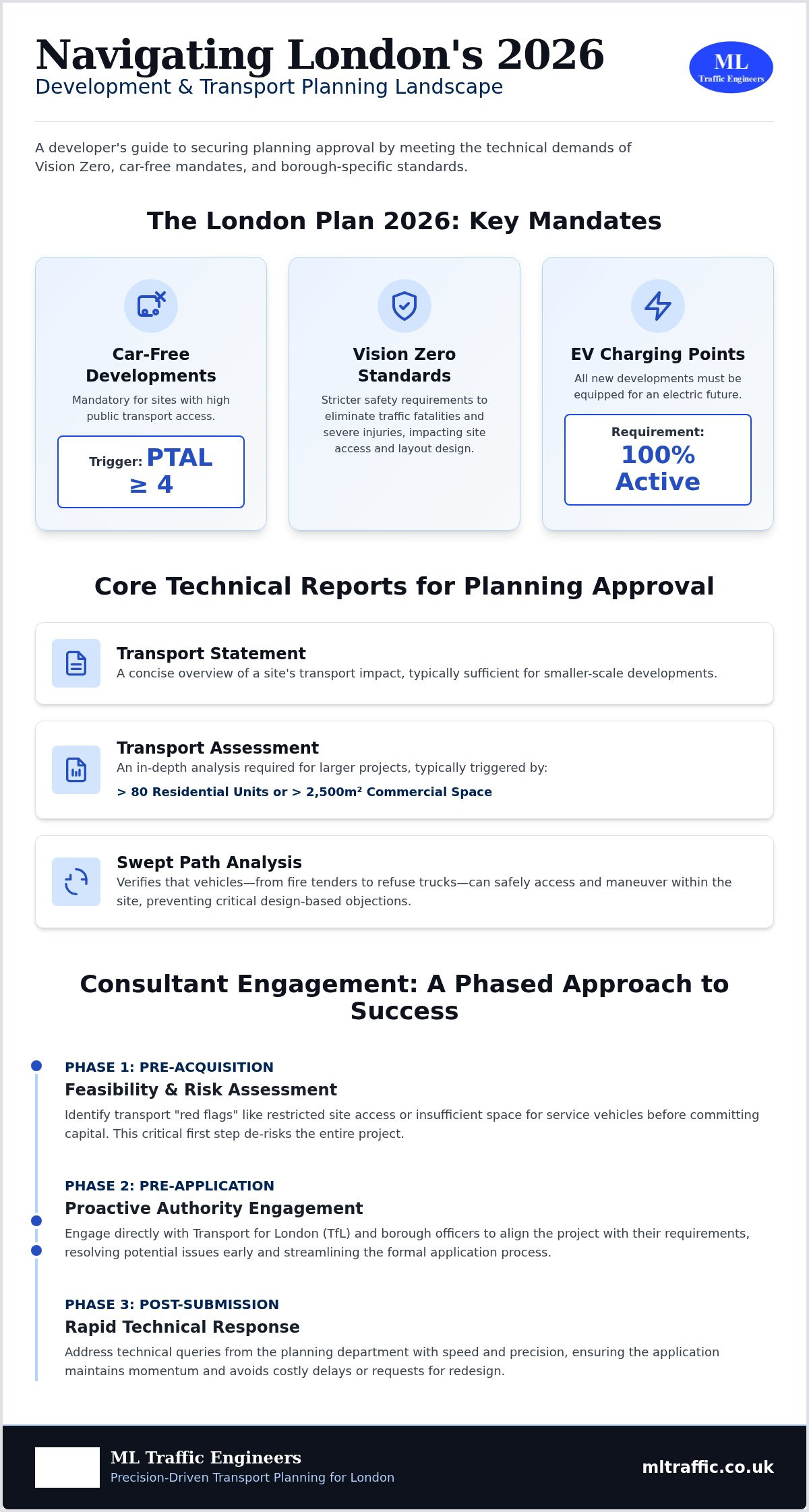
In the high-stakes environment of London property development, transport engineering consultants london serve as the technical backbone of a successful planning application. They manage the complex transportation planning process to ensure that proposed sites don’t just look good on paper but function safely and efficiently in reality. By 2026, the shift toward “Active Travel” and the strict “Vision Zero” safety standards has made these experts indispensable. They provide the rigorous data required to satisfy the London Plan 2026 mandates, such as the requirement for car-free developments in areas with a PTAL score of 4 or higher.
To better understand how these experts shape the urban environment, watch this overview of the profession:
When to Engage a Consultant in the Project Lifecycle
Early engagement is a functional necessity for maintaining project timelines. During pre-acquisition feasibility, consultants identify transport “red flags” like restricted site access or insufficient space for fire tenders before you commit capital. In the pre-application stage, they engage with TfL and borough officers to resolve potential issues early. Post-submission, they provide the rapid response capabilities needed to address technical queries from the planning department, ensuring the project moves from inception to completion without hitches.
Key Regulatory Bodies for London Developments
Navigating London requires managing overlapping jurisdictions. Transport for London (TfL) maintains oversight on red routes and larger developments, while the 33 individual boroughs enforce their own specific parking and access standards. While the National Planning Policy Framework (NPPF) provides the baseline for 2026, the London Plan imposes much stricter local requirements. Your consultant ensures your technical documentation, such as a Transport Assessment, meets these multi-layered criteria while accounting for borough-specific parking standards and carbon reduction targets.
Core Technical Services: From Transport Statements to Swept Path Analysis
Securing planning approval in London requires more than a vision; it demands raw data and technical validation. Expert transport engineering consultants london provide the specific documentation needed to satisfy both Transport for London (TfL) and individual borough requirements. Choosing the right report is your first critical decision. For smaller developments, a Transport Statement provides a concise overview of the site’s impact. However, projects exceeding 80 residential units or 2,500 square meters of commercial space typically trigger a full Transport Assessment. In 2026, even smaller sites of 30 to 40 units in Air Quality Focus Areas may require these deeper technical dives.
Precision Reporting for Planning Success
A robust technical report does not just list facts; it builds a case for your development. We utilize the TRICS database to provide accurate trip generation forecasting, ensuring your site’s projected impact is based on verified industry data. These reports must align with the standards set by the Chartered Institution of Highways & Transportation to ensure they hold up under scrutiny from local highway authorities. If you need to justify your design choices, our technical service offerings provide the necessary evidence to overcome planning objections.
Traffic and Parking Surveys provide the foundation for these reports. By 2026, the London Plan mandates 100% active electric vehicle charging for any permitted spaces, making precise parking data essential. We collect real-time data to justify your site design, ensuring your parking allocation aligns with strict borough standards while promoting sustainable transport through comprehensive Travel Plans. This data-led approach ensures your project meets environmental targets without compromising functionality.
The Importance of Swept Path Analysis (SPA)
Swept Path Analysis is a technical tool used to demonstrate vehicle access feasibility within site designs through computer-simulated movements. Using industry-standard AutoTURN software, we prove that your site can safely accommodate essential vehicles. This precision is a functional necessity to prevent costly construction errors or redesigns after a failed access test. Transport engineering consultants london use these simulations to guarantee that your site layout works in practice, not just in theory.
Our simulations are specifically calibrated for London’s unique requirements. We use precise templates for:
- London Fire Brigade tenders to ensure emergency access compliance.
- Standard refuse lorries for municipal waste collection.
- Delivery vans and petrol tankers for commercial loading requirements.
By proving maneuverability at the design stage, we remove the logistical pressures that often lead to planning delays.
Navigating London-Specific Challenges: PTAL, TfL, and Borough Standards
London’s transport planning environment is a complex patchwork of overlapping jurisdictions and strict technical benchmarks. Developers must satisfy the requirements of both Transport for London (TfL) and the specific local highway authority of the borough. In 2026, the regulatory pressure is higher than ever. Success depends on a deep understanding of regional regulations and the ability to produce documentation that stands up to rigorous scrutiny. Expert transport engineering consultants london act as the vital bridge between your commercial goals and these intricate public standards.
The PTAL Rating System Explained
The Public Transport Accessibility Level (PTAL) is the primary metric used to dictate your site’s parking allowance. Under the London Plan 2026, any development in an area with a PTAL score of 4 or higher must be car-free. If your project sits in a high-accessibility zone, your planning application will likely fail if it includes private residential parking. For sites with low PTAL ratings of 1 or 2, the challenge shifts to proving that the development won’t overwhelm local infrastructure. We utilize comprehensive Travel Plans to offset car dependency in these areas, demonstrating a clear commitment to sustainable transport targets.
Central London developments face even stricter “Zero Parking” policies. In these high-stakes environments, we focus on technical data for cycle storage and delivery management. We also assess the impact on the Strategic Road Network (SRN) and the Transport for London Road Network (TLRN). Protecting these arterial routes is a functional necessity for TfL. Our reports ensure your site access doesn’t compromise the safety or efficiency of London’s primary traffic flows.
Parking Survey Methodologies in 2026
Proving that a development won’t create “parking stress” requires a specialized technical approach. The Lambeth Methodology remains the gold standard for parking surveys across most London boroughs. It isn’t just about counting cars; it’s a rigorous assessment of street capacity within a set radius of your site. We conduct overnight surveys to capture peak residential parking demand, ensuring the data is accurate and beyond reproach. Transport engineering consultants london use this raw data to justify your site design to skeptical planning officers.
Accuracy in these surveys prevents planning refusal based on the cumulative impact of nearby developments. We analyze the surrounding streetscape to ensure that new residents or commercial tenants don’t exhaust local parking resources. This level of technical precision is non-negotiable for securing approval. By providing clear, data-driven evidence of parking capacity, we reduce the risk of costly delays and objections from local residents and highway authorities.
How to Evaluate a London Transport Consultancy for Your Project
Selecting a partner for your development is a decision that directly impacts your project timeline and capital expenditure. In 2026, you don’t just need a designer; you need transport engineering consultants london who operate with technical authority and a sense of readiness. You should prioritize a firm that offers a fully managed service. This ensures that a single expert team manages the entire process from the initial parking survey to the final technical report, preventing the data gaps that often occur when using multiple subcontractors.
To ensure your project remains on track, follow these four evaluation steps:
- Verify Borough Track Record: Confirm they’ve successfully secured approvals in the specific London borough where your site is located.
- Check Software Proficiency: Ensure they use industry-standard tools like AutoTURN for swept path analysis, TRICS for trip forecasting, and Junctions 10 for capacity modeling.
- Assess Response Time: Planning deadlines don’t move; you need a consultant who demonstrates constant accessibility and can handle urgent technical queries from highway officers.
- Confirm Engineering Depth: Verify they can provide data-led justifications for access issues rather than just surface-level policy advice.
Technical Competency vs. General Design
There’s a critical difference between a general transport planner and a transport engineer. While a planner understands policy, an engineer solves complex access and safety issues through technical precision. For high-stakes London developments, you need an engineer who can use data to defend your site design. Finding these specialized professionals is increasingly competitive, which is why many top-tier firms partner with TrustTech Recruitment, a tech recruitment agency UK, to secure the niche technical talent required for 2026 planning standards. Before hiring, ask about their relationship with local highway officers. A consultant who speaks the technical language of the authority can often resolve potential objections before they become formal planning hurdles.
The Importance of Local Knowledge
Local knowledge is a functional necessity in London’s fragmented regulatory environment. A consultant familiar with the specific requirements of Tower Hamlets or Southwark will understand borough-specific quirks, such as unique cycle storage standards or local air quality focus areas, that a national firm might overlook. Establishing a local rapport can significantly expedite the s278 agreement process by ensuring your highway works designs align with the borough’s preferred specifications from the first draft. If you require a partner that understands these intricate regional regulations, explore how our transport planning services can secure your project’s success.
ML Traffic Engineers: Precision-Driven Transport Planning for London
Success in London’s infrastructure sector requires a partner that mirrors the city’s own round-the-clock momentum. At ML Traffic Engineers, we provide the technical authority and rapid response capabilities that developers need to navigate the high-stakes planning environment of 2026. As established transport engineering consultants london, we prioritize precision as a functional necessity. We understand that a single day’s delay in planning can impact your bottom line. That’s why we maintain a sense of readiness and constant availability to address technical objections as they arise.
Our specialized focus centers on the core technical documents that drive planning success. We deliver compliance-focused Transport Statements and detailed Swept Path Analysis tailored to the specific vehicle templates required by London boroughs. By managing the full project lifecycle from initial surveys to final approval, we reduce the regulatory pressure on your team. Our reports don’t just present data; they provide a robust defense of your site’s viability based on industry benchmarks and legislative requirements.
Why Developers Trust ML Traffic
Developers choose us because we take immense pride in our adherence to standards and our precision-first approach. We’ve built a proven track record of securing planning approval across all 33 London boroughs, from the car-free mandates of the City to the complex parking requirements of the outer boroughs. As expert transport engineering consultants london, our team recently resolved a critical access issue for a constrained urban site in East London. By using advanced simulation software, we proved that fire tenders could safely maneuver within the tight site boundaries, preventing a total redesign of the ground floor layout. This level of technical proficiency ensures your project moves from inception to completion without hitches.
Get Started with Your London Project
Securing expert advice early in your project lifecycle is the best way to identify transport “red flags.” When you request a quote for a technical report or parking survey, you’ll receive a clear, functional proposal that outlines the scope of work. During our initial site assessment, we evaluate the existing transport infrastructure and identify potential borough-specific quirks that could impact your application. We prioritize clarity and the rapid delivery of information, ensuring you have the data you need when you need it.
Don’t let transport objections stall your development. Contact ML Traffic Engineers for expert transport planning advice and discover how our precision-driven reporting can secure your planning success in 2026.
Securing Your Planning Approval in 2026
Navigating London’s 2026 planning landscape requires more than just a vision; it demands technical authority and a commitment to precision. By utilizing expert transport engineering consultants london, you ensure that your project meets the strict Vision Zero safety standards and borough-specific parking requirements. Precision data, such as expert Swept Path Analysis using AutoTURN, provides the objective evidence needed to satisfy local highway authorities and avoid costly redesigns. Technical excellence isn’t just a preference; it’s a functional necessity for site viability.
Since our founding in 2014, ML Traffic Engineers has focused on technical precision to help developers manage full project lifecycles from inception to completion. We specialize in London Borough planning requirements, ensuring your documentation is compliant and ready for immediate review. Our team understands the intricate regional regulations so that you don’t have to. Don’t let regulatory hurdles delay your progress. Request a technical quote for your London transport planning needs today. We’re ready to provide the reliable, data-driven support your development deserves.
Frequently Asked Questions
What does a transport engineering consultant actually do for a planning application?
A consultant provides the technical documentation required to prove your development is safe and viable. They produce reports such as Transport Statements and Assessments that analyze site access, traffic impact, and parking compliance. By translating your commercial goals into technical language, they help you navigate the requirements of TfL and individual London boroughs to avoid planning objections.
When is a Transport Statement required instead of a full Transport Assessment in London?
The choice depends on the scale of your development and its potential impact on the road network. In 2026, the standard trigger for a full Transport Assessment is 80 or more residential units or commercial space exceeding 2,500 square meters. Smaller projects usually only require a Transport Statement, though sites in Sensitive Areas like Air Quality Focus Areas may face stricter requirements.
How much does it cost to hire a transport consultant for a London project in 2026?
Fees for transport consultancy are based on the specific scope of your project and the complexity of the required reports. A simple Swept Path Analysis will have a different cost structure than a full Transport Assessment that includes extensive traffic surveys. You should request a tailored quote to ensure the service matches your site’s specific regulatory needs and borough standards.
What is Swept Path Analysis and why does my architect need it?
Swept Path Analysis is a technical simulation that proves vehicles can maneuver safely within your site layout. Architects need this data to confirm that essential vehicles, such as London Fire Brigade tenders and refuse lorries, can access the site without conflict. Providing this evidence during the design stage is a functional necessity to prevent costly redesigns after you submit your planning application.
Can a transport consultant help me if my planning application was already refused?
Yes, consultants specialize in resolving transport-related objections that lead to refusals. Transport engineering consultants london can analyze the council’s feedback and provide new technical data, such as an updated Parking Survey, to address specific concerns. This data-led approach provides the objective evidence needed to overcome objections and move your project toward approval through a resubmission or appeal.
How long does it take to produce a Transport Statement for a London site?
Production timelines typically range from two to four weeks depending on the complexity of the project. This timeframe accounts for initial site assessments, data collection, and the drafting of the technical report. We maintain a sense of urgency to ensure your documentation is ready for submission in line with your project’s critical planning deadlines.
What is the TRICS database and why is it used in transport planning?
TRICS is the national standard system for trip generation analysis used by transport engineering consultants london to forecast development impact. It provides verified data from similar existing sites to predict how much traffic your new project will create. Planning officers require this data because it offers an objective, industry-standard baseline for assessing whether the local road network can accommodate your proposal.
Do I need a separate parking survey if I already have a transport assessment?
Most London boroughs require a standalone parking survey even if you have a Transport Assessment. This is because authorities need granular data on “parking stress” within a specific radius of your site, usually following the Lambeth Methodology. A dedicated survey provides the raw evidence needed to prove that your parking allocation, or lack thereof in car-free zones, won’t negatively impact local residents.

Disclaimer
The content on mltraffic.co.uk, including all technical articles, guides, and resources, is provided for general informational and educational purposes only. It is not intended to constitute professional advice in traffic engineering, transportation planning, development approvals, or any other technical or legal field.
While ML Traffic Engineers makes every reasonable effort to ensure the accuracy, completeness, and timeliness of the information published, we do not provide any warranties or representations (express or implied) regarding its reliability, suitability, or availability for any particular purpose. Any reliance you place on the content is strictly at your own risk.
In no event shall ML Traffic Engineers, its directors, employees, authors, or affiliates be liable for any direct, indirect, incidental, special, consequential, or punitive damages (including, without limitation, loss of profits, data, or business opportunities) arising out of or in connection with the use of, or inability to use, any information provided on this website.
The articles and guides on this site are not a substitute for engaging a qualified, professional traffic engineer to assess your specific project requirements. For tailored advice, compliance assessments, or traffic engineering services, please contact a competent professional.
This disclaimer may be updated from time to time without notice. By accessing or using this website, you agree to be bound by the most current version of this disclaimer.