
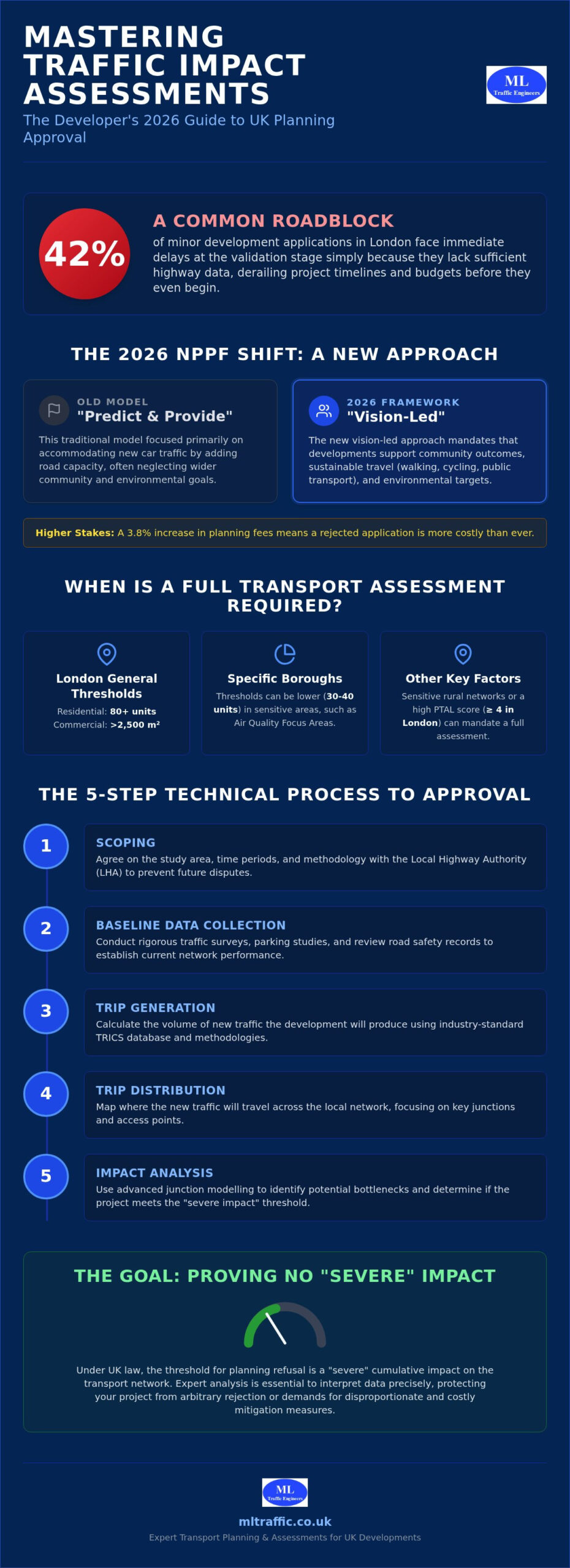
Did you know that 42% of minor development applications in London face immediate delays at the validation stage simply because they lack sufficient highway data? For developers across the UK, securing a traffic impact assessment for new developments has become a high-stakes hurdle where technical precision is a functional necessity. You’re likely all too familiar with the unpredictable delays from local highway authorities and the soaring costs of unplanned mitigation measures that can derail a project’s budget before it even begins.
It’s frustrating when regulatory confusion between Transport Statements and full Assessments stalls your progress. This guide provides a clear path to planning approval by mastering the complexities of the 2026 transport planning landscape. We’ll examine the shift toward “vision-led” outcomes in the latest NPPF guidelines and show you how to implement proportionate, cost-effective mitigation strategies. From navigating the recent 3.8% planning fee increase to understanding specific regional thresholds, this comprehensive manual ensures your development remains compliant, reliable, and ready for execution.
Key Takeaways
- Establish a clear project scope through early Highway Authority engagement to prevent methodology disputes and validation delays.
- Identify the specific technical thresholds and regional regulations that determine when you must provide a traffic impact assessment for new developments.
- Transition from traditional “predict and provide” models to the latest vision-led planning frameworks mandated by the revised 2026 NPPF.
- Secure planning approval by implementing proportionate mitigation strategies that align with your project’s actual transport footprint.
- Streamline the planning lifecycle from inception to completion by utilizing expert Transport Assessments and professional data collection.
Understanding Traffic Impact Assessments in the UK Planning System
A traffic impact assessment for new developments is a technical study that evaluates how a proposed project will interact with the existing transport network. It serves as a critical bridge between architectural vision and infrastructure reality. Rooted in the discipline of Traffic engineering, these assessments provide Local Highway Authorities (LHAs) with the necessary data to ensure road safety and network efficiency. While the industry often uses the term “Traffic Impact Assessment” (TIA) as a general descriptor, in the UK planning system, it specifically refers to the technical analysis that underpins a formal Transport Statement or a full Transport Assessment.
In 2026, the regulatory environment has shifted significantly. The revised National Planning Policy Framework (NPPF) now prioritizes a vision-led approach over the traditional “predict and provide” model. This means your assessment must demonstrate how a development supports specific community outcomes and sustainable travel rather than just adding road capacity for cars. With planning fees in England having increased by 3.8% as of April 2026, the financial risk of a rejected application is higher than ever. Precision in your initial submission is a functional necessity to avoid the costs of rework and delays.
The Purpose of a TIA: Beyond Simple Congestion
Assessments don’t just look at traffic jams. They evaluate road safety and accessibility for all transport modes, including pedestrians, cyclists, and public transport users. LHAs use these reports to gauge the cumulative impact of several developments within a single area, ensuring that the local infrastructure can handle the combined pressure of multiple projects. Under UK law, the threshold for planning refusal is a “severe” impact on the transport network. Defining what constitutes “severe” requires professional precision and expert interpretation of data to protect your project from arbitrary rejection or disproportionate mitigation demands.
Maintaining this standard of safety often involves coordination with external services. For instance, in regions like West Yorkshire, PL Mobile Tyres provides critical 24/7 roadside assistance, ensuring that tyre-related incidents do not cause the “severe” network impacts that planners work so hard to avoid.
When is a TIA Legally Required?
Requirements for a traffic impact assessment for new developments vary based on scale and location. In London, a full Transport Assessment is typically required for residential sites with 80 or more units or commercial spaces exceeding 2,500 square metres. However, some boroughs have lowered these thresholds to 30 or 40 units, particularly in Air Quality Focus Areas. Even small developments may require a full study if the local network is sensitive or located in a rural area with limited access. Factors like a site’s Public Transport Accessibility Level (PTAL) score also dictate the scope of the study. Sites with a PTAL score of 4 or higher in London are generally mandated to be car-free, which fundamentally changes the methodology of the assessment.
The 5-Step Technical Process of a Traffic Impact Assessment
Conducting a traffic impact assessment for new developments requires a methodical approach to ensure regulatory approval. The 5-Step Technical Process begins long before any data is collected on-site. By following a structured sequence, developers can mitigate the risk of local highway authority objections and avoid costly last-minute redesigns. Precision is a functional necessity at every stage to reduce logistical and regulatory pressures.
- Scoping: You must first agree on the study area, time periods, and assessment methodology with the Local Highway Authority. This prevents fundamental disagreements later in the planning lifecycle.
- Baseline Data Collection: Our team conducts rigorous Traffic Surveys and parking surveys to establish the current network performance. We also review existing road safety records to identify any pre-existing issues.
- Trip Generation: We calculate the volume of new traffic the development will produce using industry-standard databases.
- Trip Distribution: This stage maps where that new traffic will travel across the local network, focusing on key junctions and access points.
- Impact Analysis: Using advanced junction modelling, we identify potential bottlenecks. This stage is critical for determining if the project meets the “severe impact” threshold discussed previously.
Utilising the TRICS Database for Accurate Predictions
The TRICS database is the national standard for trip generation analysis in the UK. It allows us to predict traffic volumes by comparing your project with data from thousands of established sites across the country. Selecting comparable sites is a high-stakes task that requires technical authority. If the chosen data points don’t align with your development’s specific land use or location, the highway authority will likely reject the findings. We ensure your submission is defensible by filtering for precise variables like site size, regional context, and transport accessibility.
Swept Path Analysis: Proving Site Feasibility
A successful traffic impact assessment for new developments must prove that the physical site layout is functional. Swept Path Analysis uses AutoTURN software to simulate the movement of large vehicles, such as refuse trucks and fire tenders, through your proposed roads. This technical simulation prevents the logistical pressure of discovering that a vehicle cannot navigate a turn after construction has begun. By identifying these issues during the assessment phase, we help you avoid expensive post-submission redesigns. Ensuring that emergency services and delivery vehicles have unhindered access is a non-negotiable foundation of safety-conscious planning.
Transport Statement vs. Assessment: Which One Do You Need?
Determining the appropriate depth of reporting is the first strategic decision in your planning application. A misstep here causes immediate friction with the Local Highway Authority and can lead to unnecessary expenditure. The distinction between a Transport Statement and a full Assessment is primarily defined by the scale of the project and its anticipated trip generation. Selecting the wrong report type often results in the validation stage delays that currently affect 42% of minor development applications in London as of August 2026.
In the capital, a London-specific Transport Assessment follows stricter criteria set by individual boroughs and the London Plan. These requirements directly impact project timelines, as the level of data scrutiny is significantly higher than in other regions. Early engagement during the pre-application stage is the only way to confirm which report you need. We manage this dialogue for you to ensure the scope is proportionate to your project’s impact, reducing logistical pressure from the start.
Criteria for a Transport Statement
A Transport Statement (TS) is a concise report designed for smaller developments with limited transport implications. Typically, this applies to residential projects between 50 and 80 dwellings, though some local authorities set lower thresholds. The TS focuses on immediate site matters: safe access, adequate parking provision, and links to sustainable travel networks. It is often the most cost-effective route for SMEs because it avoids the complex junction modelling required for larger schemes. Precision remains vital; even a shorter statement must satisfy the highway authority’s safety standards to avoid a recommendation for refusal.
When a Full Transport Assessment is Mandatory
Developments exceeding 80 residential units or significant commercial floor space require a full Transport Assessment (TA). This is a comprehensive traffic impact assessment for new developments that explores the cumulative effect on the wider transport network. A TA demands multi-modal analysis, evaluating how the project supports cycling, walking, and public transport integration. In 2026, any TA must be accompanied by a Travel Plan. This supporting document outlines long-term strategies to reduce car dependency and promote sustainable transport. Failing to include a robust Travel Plan is a common reason for application deferral under current NPPF guidelines. We ensure your TA includes all necessary technical data to withstand rigorous scrutiny from highway officers.
Mitigation Strategies and Section 278 Agreements
Identifying potential bottlenecks in your traffic impact assessment for new developments is only half the battle. The subsequent stage involves defining “proportionate mitigation.” This principle ensures that you only pay for the infrastructure improvements directly necessitated by your project’s impact. Under the 2026 vision-led NPPF framework, the focus has shifted from simply adding road capacity to creating sustainable, safe environments. This shift allows developers to propose a mix of physical and soft mitigation measures that satisfy the Local Highway Authority (LHA) while protecting project margins.
Physical mitigation involves tangible changes to the road network, such as installing a new roundabout or widening a junction. These works typically fall under a Section 278 (S278) agreement. Developers must account for the high costs associated with these agreements, including technical approval fees and performance bonds. In regions like Worcestershire, technical approval and inspection fees as of June 2026 reach 8% to 10% of the scheme value. A major variable often overlooked is utility diversions, which can constitute 30% to 50% of the total cost for medium-scale schemes. Soft mitigation, conversely, focuses on behavioral changes, often managed through Section 106 (S106) financial contributions to wider transport infrastructure or the implementation of a Travel Plan.
Negotiating with Local Highway Authorities
Securing a fair outcome requires professional representation in LHA meetings. Local authorities often request extensive mitigation that exceeds the actual requirements of the development. Our team uses technical evidence from the assessment phase to challenge unreasonable requests. We ensure that any suggested works are strictly necessary and directly related to your site. A well-scoped TIA can limit a developer’s S106 financial liability by proving that specific off-site infrastructure upgrades are not directly necessitated by the proposed scheme. This technical authority reduces regulatory pressure and prevents budget creep.
Travel Plans: A Tool for Reducing Physical Mitigation
Modern planning policy prioritizes sustainable travel over road construction. Travel Plans are strategic documents that promote walking, cycling, and public transport use to reduce the total number of vehicle trips generated by a site. By demonstrating a credible reduction in car use, you can often negotiate a decrease in the required physical road improvements. This is particularly effective for Workplace Travel Plans, where employer-led initiatives like car-sharing or cycle-to-work schemes significantly lower peak-hour traffic. Integrating these “soft” measures into your development strategy is a cost-effective way to achieve compliance without the heavy engineering costs of S278 works. If you need to navigate these complex negotiations, view our full range of transport planning services to see how we can assist.
Securing Approval: Why Expert Transport Planning Matters
Attempting a DIY traffic impact assessment for new developments is a high-stakes strategy that often leads to planning refusal. Inaccurate baseline data or flawed trip generation models provide Local Highway Authorities (LHAs) with immediate grounds for objection. When technical data is scrutinized by planning officers, even minor discrepancies in survey methodology can invalidate an entire submission. Precision is a functional necessity in this environment to protect your investment and maintain your project timeline.
The fast-moving nature of infrastructure development requires a partner with a sense of readiness and urgency. Our team remains constantly available to address sudden requests for additional data or technical clarifications from the LHA. This rapid response capability is a hallmark of our service promise. It ensures that your application doesn’t stall due to administrative bottlenecks or technical queries. By positioning ourselves as a comprehensive partner rather than a simple data provider, we navigate the intricate regional regulations so you don’t have to.
The ML Traffic Advantage: Precision and Reliability
Our technical lexicon and professional reporting speak the language of local planning officers. We conduct specialized Traffic Surveys and parking surveys that provide a robust evidence base for your application. This data-driven precision allows us to defend your development against unreasonable mitigation requests. We take pride in our adherence to standards, utilizing our expertise in TRICS database analysis and Swept Path Analysis to deliver tailored reports. This all-encompassing service minimizes the risk of validation delays and strengthens your path to approval.
Next Steps for Your Development
Engaging a transport consultant early in the concept stage is the most effective way to streamline the planning process. Early involvement allows us to identify potential transport constraints before they become costly obstacles. We provide bespoke documentation that aligns with your specific site requirements and local authority expectations. To secure expert support for your next project, you can contact ML Traffic Engineers for a comprehensive transport planning review. Our team is ready to provide the technical precision and reliable support your development needs to succeed.
Securing Your Development’s Future with Technical Precision
The 2026 planning landscape demands a shift from traditional traffic forecasting to outcome-focused, vision-led strategies. Successfully navigating a traffic impact assessment for new developments requires more than just data collection. It necessitates a deep understanding of regional thresholds and the ability to negotiate proportionate mitigation through formal excellence. By establishing a robust technical baseline early in the concept stage, you protect your project from the validation delays and unpredictable costs that frequently stall UK developments.
Precision is a functional necessity in transport planning. ML Traffic Engineers provides full project lifecycle management, from initial surveys to final submission, ensuring your reporting speaks the language of local planning officers. Our expertise in TRICS database analysis and junction modelling, combined with specialized knowledge in S278 and S38 highway design, reduces the regulatory pressure on your team. Secure your planning approval with ML Traffic Engineers’ expert transport reports. We remain ready to provide the professional, safety-conscious support required to move your project forward with confidence.
Frequently Asked Questions
How much does a Traffic Impact Assessment cost for a new development?
Costs vary based on project scale, site complexity, and the specific requirements of the Local Highway Authority. A residential scheme with 100 units requires more intensive junction modelling than a small commercial unit. Factors like utility diversion investigations and technical approval fees also influence the total budget. This ensures your budget accounts for all necessary technical surveys and regulatory fees. Requesting a project-specific quote is the most reliable approach.
How long does it take to complete a Transport Assessment in 2026?
A typical assessment takes between four to eight weeks to complete, depending on the availability of baseline data. This timeline includes the initial scoping with the highway authority, on-site traffic counts, and technical analysis. Complex projects requiring extensive junction modelling or multi-modal studies may take longer. Early engagement is essential to ensure the final report is ready for the validation stage of your planning application. Precision in timing helps avoid unnecessary logistical pressure.
Can I get planning permission if the TIA shows a significant increase in traffic?
Yes, provided the impact is not deemed severe under the National Planning Policy Framework and suitable mitigation is proposed. A traffic impact assessment for new developments identifies these increases so that developers can implement improvements like junction upgrades or Travel Plan initiatives. If the proposed mitigation effectively manages the additional volume, the Local Highway Authority is more likely to support the application. Technical precision in your report is a functional necessity here.
What is the difference between a Traffic Impact Assessment and a Transport Statement?
The primary difference lies in the scale of the development and the depth of the required technical analysis. A Transport Statement is a concise report for smaller projects with limited transport implications. A full Assessment is a comprehensive study for larger developments that includes detailed junction modelling. The Local Highway Authority typically sets specific thresholds to determine which report type is necessary for a traffic impact assessment for new developments.
What data is required for a parking survey in a UK planning application?
Parking surveys must capture the existing parking demand and capacity within a defined area, usually following the Lambeth Methodology in urban settings. Data includes the total number of available spaces, current occupancy levels during peak hours, and any existing parking restrictions. This information proves that the development’s parking provision is adequate and won’t lead to overspill on the local road network. It’s a non-negotiable foundation for safety-conscious planning and regulatory compliance.
Do I need a Travel Plan if I already have a Traffic Impact Assessment?
A Travel Plan is almost always required as a supporting document for a full Transport Assessment in 2026. While the assessment identifies the physical impact of traffic, the Travel Plan outlines long-term strategies to encourage sustainable travel. These documents work together to show how the development will reduce car dependency and align with the latest vision-led NPPF guidelines. Integrating both documents demonstrates a commitment to professional integrity and civic responsibility.
What happens if the Highway Authority objects to my TIA results?
If an objection occurs, you must enter technical negotiations to address the authority’s concerns. This often involves providing additional data, refining modelling parameters, or proposing more robust mitigation measures. Professional representation is a functional necessity during these meetings to challenge unreasonable requests with technical evidence. Resolving these objections through expert reporting is critical to securing planning approval and avoiding a formal refusal. Our team remains ready to assist with these urgent requirements.
Is a Swept Path Analysis always required for residential developments?
Swept Path Analysis is essential for any development where large vehicles, such as refuse trucks or fire tenders, must navigate the site. While not always mandatory for very small infill projects, most Local Highway Authorities require it to prove site feasibility. This technical simulation ensures that emergency services have unhindered access and prevents the logistical pressure of expensive post-construction redesigns. It remains a hallmark of reliable, safety-conscious site planning that adheres to strict industry benchmarks.

Disclaimer
The content on mltraffic.co.uk, including all technical articles, guides, and resources, is provided for general informational and educational purposes only. It is not intended to constitute professional advice in traffic engineering, transportation planning, development approvals, or any other technical or legal field.
While ML Traffic Engineers makes every reasonable effort to ensure the accuracy, completeness, and timeliness of the information published, we do not provide any warranties or representations (express or implied) regarding its reliability, suitability, or availability for any particular purpose. Any reliance you place on the content is strictly at your own risk.
In no event shall ML Traffic Engineers, its directors, employees, authors, or affiliates be liable for any direct, indirect, incidental, special, consequential, or punitive damages (including, without limitation, loss of profits, data, or business opportunities) arising out of or in connection with the use of, or inability to use, any information provided on this website.
The articles and guides on this site are not a substitute for engaging a qualified, professional traffic engineer to assess your specific project requirements. For tailored advice, compliance assessments, or traffic engineering services, please contact a competent professional.
This disclaimer may be updated from time to time without notice. By accessing or using this website, you agree to be bound by the most current version of this disclaimer.