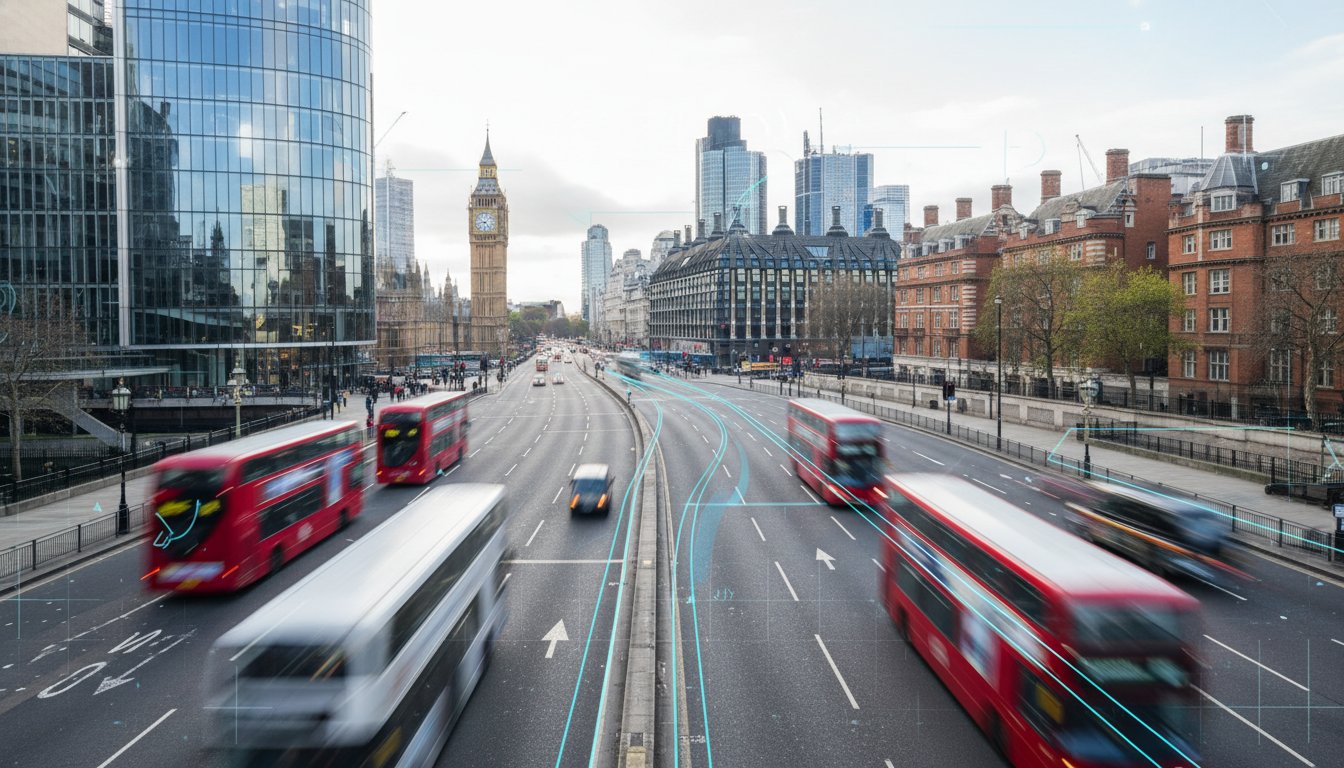
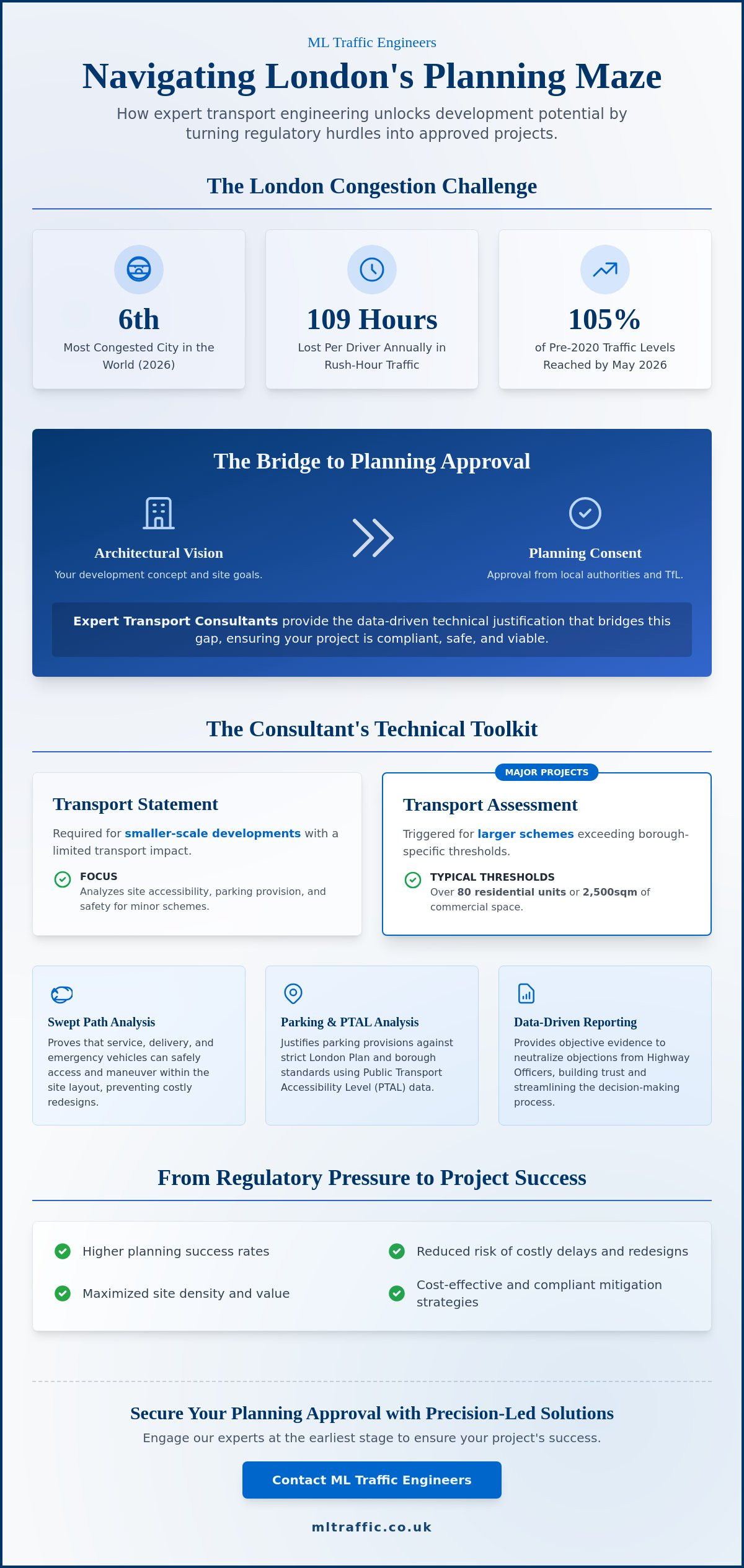
In 2026, London ranks as the sixth most congested city in the world, with drivers losing an average of 109 hours a year in rush-hour traffic. You likely feel the weight of these statistics every time you submit a planning application. Between the London Plan’s strict car-free mandates for areas with a PTAL of 4 or higher and the varying parking standards across individual boroughs, securing consent often feels like a moving target. Insufficient transport data or a poorly timed submission can lead to expensive delays that stall your project’s momentum.
This guide demonstrates how expert transport engineering consultants london provide the technical precision required to navigate these regulatory hurdles and unlock your site’s maximum potential. We’ll show you how to transform logistical constraints into approved developments through accurate data and strategic planning. We’ll examine the role of professional Transport Assessments, Swept Path Analysis, and tailored Travel Plans in securing successful outcomes while keeping your mitigation strategies cost-effective.
Key Takeaways
- Understand how technical justification bridges architectural vision and statutory requirements in London’s high-density environment.
- Learn how transport engineering consultants london determine whether your project requires a Transport Statement or a full Assessment to satisfy borough-specific structures.
- Discover how Swept Path Analysis and Parking Surveys prove site layout viability and justify parking provisions on constrained city streets.
- Master the complexities of PTAL ratings and borough standards to maintain high-density residential goals even in areas with lower accessibility scores.
- Identify how precision-led reporting and rapid response capabilities help developers meet urgent planning deadlines and reduce regulatory pressure.
Table of Contents
- The Strategic Role of Transport Engineering Consultants in London Planning
- Core Technical Deliverables: Transport Statements and Assessments
- Ensuring Site Feasibility through Swept Path Analysis and Parking Surveys
- Navigating London-Specific Constraints: PTAL and Borough Standards
- Choosing ML Traffic Engineers: Precision-Led Transport Solutions
The Strategic Role of Transport Engineering Consultants in London Planning
Transport engineering serves as the technical bridge between an architectural concept and its operational reality on the highway network. In London, where traffic volumes in May 2026 reached 105% of pre-2020 levels, every new development faces intense scrutiny from local authorities. Professional transport engineering consultants london provide the evidence-based justification required to prove that a project won’t negatively affect local traffic flow, safety, or public transport efficiency. This technical rigor is essential for both minor residential schemes and major commercial hubs that must coexist within the city’s limited road space.
Unlocking a site’s value in a city ranked the sixth most congested globally requires more than just good design. It demands a deep understanding of transportation planning principles and the specific constraints of the capital’s infrastructure. With Islington’s Local Plan aiming for 87% of journeys to be sustainable by 2041, the pressure to deliver high-density, car-free schemes is immense. Consultants translate these policy targets into viable site layouts by providing accurate data on vehicle movements and access requirements. This helps developers maximize their site’s density while remaining compliant with statutory requirements.
When Do You Need a Transport Consultant?
Many developers wait until they receive an objection from a Highway Officer before seeking professional help. This reactive approach often leads to expensive delays and redesign costs. You should engage a consultant at the earliest feasibility stage for triggers such as a change of use, the addition of new residential units, or significant commercial expansions. Early involvement identifies fundamental design flaws, such as inadequate access for service vehicles or non-compliant parking layouts, before they become built-in problems that are difficult to fix.
Expert guidance is particularly valuable during pre-application discussions with London Boroughs and Transport for London (TfL). These meetings set the scope for all required technical work. Establishing a clear, data-backed strategy during these early talks reduces the risk of being asked for additional, costly surveys later in the process. It ensures that the project team understands the specific expectations of the highway authority from day one.
The Impact on Planning Success Rates
Professional credibility is a decisive factor when an application reaches a planning committee. Data-driven reports, such as Transport Statements and Assessments, provide the objective evidence needed to neutralize objections from statutory consultees. When a Highway Officer reviews a submission backed by precise technical analysis and current traffic data, the path to approval becomes significantly clearer. The goal is to present a project that feels like a low-risk addition to the existing network.
High-quality reporting demonstrates a commitment to safety and regulatory excellence. This proactive stance builds trust with planning authorities and helps streamline the decision-making process. For sector-specific examples of how this technical authority applies to different developments, you can explore various ML Traffic Engineers project types. Ultimately, the right consultant provides a seamless transition from the planning stage to execution, ensuring your development is both viable and safe.
Core Technical Deliverables: Transport Statements and Assessments
Distinguishing between a Transport Statement and a Transport Assessment is the first step in any successful planning application. The scale of your development dictates which report is necessary. Smaller schemes often only require a Statement, while larger developments exceeding 80 residential units or 2,500sqm of commercial space usually trigger a full Assessment. Professional transport engineering consultants london ensure these reports align with the London Plan and individual borough requirements to prevent costly delays during the review process.
Every report must be compliant with 2026 policy standards. This includes calculating the Public Transport Accessibility Level (PTAL) of the site and demonstrating how the project supports the Mayor’s target for 80% of all journeys to be made by walking, cycling, or public transport. For a deeper dive into the technical requirements, consult our Transport Assessment London Guide.
Transport Statements for Small to Medium Developments
A Transport Statement focuses on site-specific logistics such as access points, parking provision, and basic trip generation. These reports satisfy local borough requirements for minor applications by proving that the development’s impact on the immediate highway is negligible. We use localized data to justify parking ratios, especially in boroughs like Islington where car-free developments are mandated for schemes with a PTAL rating of 4 or higher. These documents provide the technical reassurance Highway Officers need to recommend approval for smaller sites.
Comprehensive Transport Assessments for Major Sites
Major developments require a more rigorous approach. A full Transport Assessment includes complex junction modelling and a wider network impact analysis. We utilize the TRICS database for accurate trip rate forecasting, ensuring that the predicted traffic volume is based on comparable, real-world sites. This data-driven precision is vital when negotiating mitigation measures with planning authorities.
A critical outcome of these assessments is the identification of necessary infrastructure improvements. These often lead to S106 contributions or S278 agreements. In 2026, for example, Islington Council’s drawing approval fee for major S278 works valued over £1m is £6,380. Identifying these requirements early allows you to factor these costs into your initial feasibility studies. If you need clarity on your site’s specific requirements, you can explore our full range of technical services to see how we manage these complex deliverables.
Ensuring Site Feasibility through Swept Path Analysis and Parking Surveys
Feasibility is fundamentally about risk mitigation. Redesigning a site layout after you have submitted a planning application is a costly error that stalls project timelines. Expert transport engineering consultants london use digital modeling to prove that a development’s internal geometry works for real-world vehicles before a single brick is laid. By simulating vehicle movements during the design phase, we identify potential pinch points that would otherwise trigger objections from highway officers. This technical foresight ensures that your site layout is both operationally efficient and compliant with the rigorous standards set by the Chartered Institution of Highways & Transportation (CIHT).
We utilize the latest industry software, such as AutoTURN 2026.12.1.0, to conduct Swept Path Analysis (SPA). This tool allows us to map the precise path of various vehicles as they navigate site entrances, turning heads, and loading bays. Relying on generic dimensions isn’t enough in London’s constrained urban environment. Precision is a functional necessity to ensure that your architectural vision doesn’t conflict with the physical requirements of the highway network.
Swept Path Analysis: Fire Tenders to Refuse Vehicles
Fire tender access is a non-negotiable safety requirement. If a fire engine cannot reach every part of a building within statutory distances, the application will fail. We perform detailed tracking to confirm that emergency vehicles can enter, turn, and exit the site without obstruction. Similarly, we use SPA to satisfy council waste management teams by proving that refuse vehicles can service the development safely. Demonstrating this capability early in the process protects your project from fundamental design flaws. For more details on these technical requirements, see our Swept Path Analysis Services in London.
Parking Surveys: Navigating the Lambeth Methodology
Parking provision is often the most contested element of a London planning application. When a developer proposes a car-free or car-capped scheme, they must prove that the development won’t increase “parking stress” on surrounding streets. We conduct Parking Surveys using the Lambeth Methodology, which is the industry standard for London stress tests. This process involves precise data collection during the peak period of residential parking demand, typically between 00:30 and 05:30 on two separate weekday nights.
The resulting data provides a clear picture of the available capacity within a 200-meter walking distance of the site. In areas with high Controlled Parking Zone (CPZ) pressure, this evidence is vital. It allows transport engineering consultants london to justify lower parking ratios by showing that the local network can absorb any residual demand. Accurate survey data turns a subjective debate about parking into an objective, technical discussion, significantly increasing your chances of a successful outcome.
Navigating London-Specific Constraints: PTAL and Borough Standards
The Public Transport Accessibility Level (PTAL) is the primary metric used by Transport for London (TfL) to quantify how well a site connects to the public transport network. For developers, this score is a non-negotiable determinant of a project’s density and parking capacity. In a city where traffic volumes reached 105% of 2020 levels by May 2026, transport engineering consultants london use these ratings to establish the technical boundaries of what can be built. While a high PTAL rating of 4 or above typically mandates car-free development under the London Plan, sites with lower scores require a more nuanced technical strategy to justify high-density residential use.
A common objection developers face is the assumption that a low PTAL rating automatically limits development density. You can often overcome this hurdle by implementing a comprehensive Travel Plan. We use these documents to propose sustainable travel alternatives, such as improved cycling infrastructure or car-club memberships, which satisfy the “Healthy Streets” approach favored by planning officers. This allows you to maintain higher density targets by proving the development won’t create additional pressure on the local highway network.
Understanding PTAL Ratings for Developers
TfL calculates PTAL on a scale of 0 to 6b. This score depends on the walking distance to transport nodes and the frequency of services. These numbers directly dictate the maximum allowable parking spaces. For example, the London Plan mandates car-free developments for any scheme with a PTAL of 4 or higher in Inner London. If your site sits on the boundary of two different zones, we conduct a detailed assessment to ensure the most favorable rating is applied. We don’t just accept automated outputs; we verify the data against current service levels to ensure your site’s accessibility is represented accurately.
Borough-Specific Planning Nuances
Every London borough interprets the London Plan through its own Local Plan, creating a complex web of varying standards. Requirements in high-density areas like Westminster or Tower Hamlets are vastly different from those in Outer London boroughs. For specific insights into these regional challenges, consult our guide for Transport Planning Consultants Tower Hamlets. In these central locations, the focus shifts almost entirely to pedestrian safety and the management of delivery movements within constrained spaces.
Experienced transport engineering consultants london act as your technical mediator during discussions with the Borough Highway Officer. We provide the professional credibility needed to navigate these intricate regional regulations so you don’t have to. By presenting clear, data-driven justifications for your site’s transport strategy, we reduce the likelihood of costly delays or planning refusals. If you’re preparing a submission for a challenging London site, our technical team is ready to provide the specialized support required for planning success.
Choosing ML Traffic Engineers: Precision-Led Transport Solutions
Selecting the right technical partner is the final step in de-risking your development. ML Traffic Engineers operates with a focus on technical accuracy and safety-conscious reporting, ensuring that every document survives the most rigorous highway authority audits. As transport engineering consultants london, we provide the technical authority needed to reduce regulatory pressure on your team. We manage the full project lifecycle from initial data collection through to final report submission. This all-encompassing service ensures consistency across your Traffic Surveys, Transport Assessments, and Travel Plans.
Precision is a functional necessity in London’s high-stakes planning environment. We understand that planning deadlines are often unforgiving. Our firm maintains a constant sense of readiness and urgency to meet these demands. We combine an intimate knowledge of regional London regulations with a client-focused approach, positioning ourselves as a dependable partner rather than a simple service provider. We take pride in our adherence to industry benchmarks, ensuring that your submission is compliant with the latest legislative requirements from the outset.
From Planning Approval to Section 278 Implementation
Our support doesn’t end when you receive planning consent. The transition from a successful application to physical implementation requires detailed technical design and further statutory approvals. We support the post-planning phase by managing the highway design requirements for S278 and S38 agreements. These agreements are essential for any development that involves modifications to the existing public highway or the adoption of new roads. We provide the technical drawings and justification needed to secure these legal agreements efficiently. For a comprehensive look at this process, read our Highway Design S278 & S38 Guide.
Contact Our London Transport Experts
Successful planning outcomes rely on the quality of the data and the credibility of the consultant. Whether you’re managing a minor residential scheme or a major commercial hub, our team provides the specialized support required for 2026 approvals. We offer extensive coverage across London, High Wycombe, and Slough, bringing localized expertise to every project. Our commitment to formal excellence and professional integrity ensures that your development is viewed as a safe, viable addition to the city’s infrastructure.
Don’t let logistical or regulatory hurdles stall your project’s progress. You can access our full suite of technical documents and industry guidance by visiting the ML Traffic Engineers resources page. If you require a project-specific quote or an initial access review, contact our experts today. We’re ready to provide the precision-led solutions your site needs to achieve planning success.
Securing Your Site’s Future in London’s 2026 Planning Landscape
Navigating the technical requirements of the London Plan and borough-specific mandates requires more than just high-level strategy. It demands the precision of data-driven reporting to ensure your site layout is viable and compliant. By integrating detailed Swept Path Analysis and comprehensive Parking Surveys early in the process, you eliminate the risk of late-stage redesigns and highway authority objections. These technical justifications don’t just support your application; they protect your investment from avoidable delays and ensure your project aligns with the city’s evolving infrastructure goals.
ML Traffic Engineers provides the technical authority and expert knowledge of London Borough highway requirements needed to streamline your application. Our proven track record in securing planning consents for complex sites ensures your development moves efficiently from inception to execution. When you partner with transport engineering consultants london, you gain a reliable ally that understands the intricate regional regulations so you don’t have to. We’re ready to help you unlock your site’s full potential and move your project forward with certainty.
Contact ML Traffic Engineers for a Professional Transport Quote today and ensure your project meets every regulatory benchmark with confidence.
Frequently Asked Questions
What is the difference between a Transport Statement and a Transport Assessment in London?
The scale and potential impact of your development determine which document is required. A Transport Statement is typically sufficient for minor applications with lower trip generation, while a Transport Assessment is mandatory for major developments that require detailed junction modeling and wider network analysis. Expert transport engineering consultants london ensure the correct report is prepared to meet specific borough thresholds and avoid processing delays.
How much does a parking survey cost for a London planning application?
The cost of a parking survey depends on the size of the survey area and the specific methodology required by the local council. Factors such as the number of nights surveyed and the complexity of the street network influence the final fee. Developers should request a project-specific quote to ensure the survey meets the exact technical standards of the relevant London borough and provides the necessary data for approval.
When is Swept Path Analysis legally required for a new development?
Swept Path Analysis is required whenever a development needs to prove that specific vehicles can safely enter, maneuver within, and exit the site. This is most common for fire tender access and refuse collection, where highway officers require technical proof that these vehicles won’t be obstructed. It’s a non-negotiable safety requirement for most new site layouts in London and protects the project from fundamental design flaws.
Can a Transport Consultant help me get a car-free development approved?
Yes, a consultant justifies car-free schemes by providing data-driven evidence that the local network can support the development without private vehicle parking. This often involves using high PTAL ratings and a robust Travel Plan to demonstrate that residents have viable sustainable travel alternatives. This technical justification is essential for aligning with the Mayor’s Transport Strategy and borough-level sustainability targets.
How does a high PTAL rating affect my parking provision?
A high Public Transport Accessibility Level (PTAL) rating of 4 or above significantly reduces the maximum number of parking spaces allowed. In many Inner London boroughs, a high rating mandates a car-free development, with the exception of disabled person parking. Professional transport engineering consultants london use these ratings to establish the technical boundaries for parking density during the initial design phase to ensure policy compliance.
What is the Lambeth Methodology for parking surveys?
The Lambeth Methodology is the industry standard for measuring parking stress in London. It involves counting parked vehicles within a 200-meter walking distance of the site during the early morning hours, typically between 00:30 and 05:30. This data proves whether there’s sufficient on-street capacity to absorb any parking demand generated by the new development, which is vital in areas with high parking pressure.
How long does it take to prepare a Transport Statement?
Preparation time varies based on the availability of survey data and the complexity of the site access. Once all required Traffic Surveys and data collection are complete, the technical reporting phase usually takes between two to four weeks. Engaging a consultant early in the project lifecycle ensures that these timelines align with your planned submission dates and prevents urgent planning deadlines from being missed.
Do I need a Travel Plan for a small residential development?
While smaller developments often only require a Transport Statement, some boroughs may request a Travel Plan as a condition of approval. This is particularly common if the development is in an area with low transport accessibility or if the developer is seeking to mitigate potential traffic impacts. A Travel Plan outlines the long-term management strategy for encouraging sustainable travel among residents and is often a requirement for securing planning consent.
Which areas in London do you cover?
We service Acton, Balham, Barking, Barnes, Barnet, Battersea, Beckenham, Bexleyheath, Brentford, Brixton, Bromley, Camberwell, Carshalton, Charlton, Chelsea, Chiswick, Clapham, Coulsdon, Croydon, Crystal Palace, Dagenham, Dulwich, Ealing, Edgware, Eltham, Enfield, Finchley, Forest Gate, Fulham, Golders Green, Greenwich, Hackney, Hammersmith, Hampstead, Harrow, Hayes, Highgate, Hounslow, Ilford, Islington, Kensington, Kentish Town, Kingston upon Thames, Lewisham, Mitcham, Muswell Hill, New Malden, Notting Hill, Orpington, Peckham, Pinner, Purley, Putney, Richmond, Romford, Ruislip, Sidcup, Southall, Southgate, Streatham, Surbiton, Sutton, Tooting, Tottenham, Twickenham, Uxbridge, Walthamstow, Wembley, West Norwood, Wimbledon, Wood Green, Woolwich, Bethnal Green, Shoreditch, Canary Wharf, Deptford, Leyton, Palmers Green, Stanmore, Upminster, Chislehurst, Erith, Feltham.
Which cities in England do you cover?
We service London, Birmingham, Manchester, Liverpool, Sheffield, Leeds.

Article by
Michael Lee
Transport planner with over 35 years’ experience.
Disclaimer
The content on mltraffic.co.uk, including all technical articles, guides, and resources, is provided for general informational and educational purposes only. It is not intended to constitute professional advice in traffic engineering, transportation planning, development approvals, or any other technical or legal field.
While ML Traffic Engineers makes every reasonable effort to ensure the accuracy, completeness, and timeliness of the information published, we do not provide any warranties or representations (express or implied) regarding its reliability, suitability, or availability for any particular purpose. Any reliance you place on the content is strictly at your own risk.
In no event shall ML Traffic Engineers, its directors, employees, authors, or affiliates be liable for any direct, indirect, incidental, special, consequential, or punitive damages (including, without limitation, loss of profits, data, or business opportunities) arising out of or in connection with the use of, or inability to use, any information provided on this website.
The articles and guides on this site are not a substitute for engaging a qualified, professional traffic engineer to assess your specific project requirements. For tailored advice, compliance assessments, or traffic engineering services, please contact a competent professional.
This disclaimer may be updated from time to time without notice. By accessing or using this website, you agree to be bound by the most current version of this disclaimer.