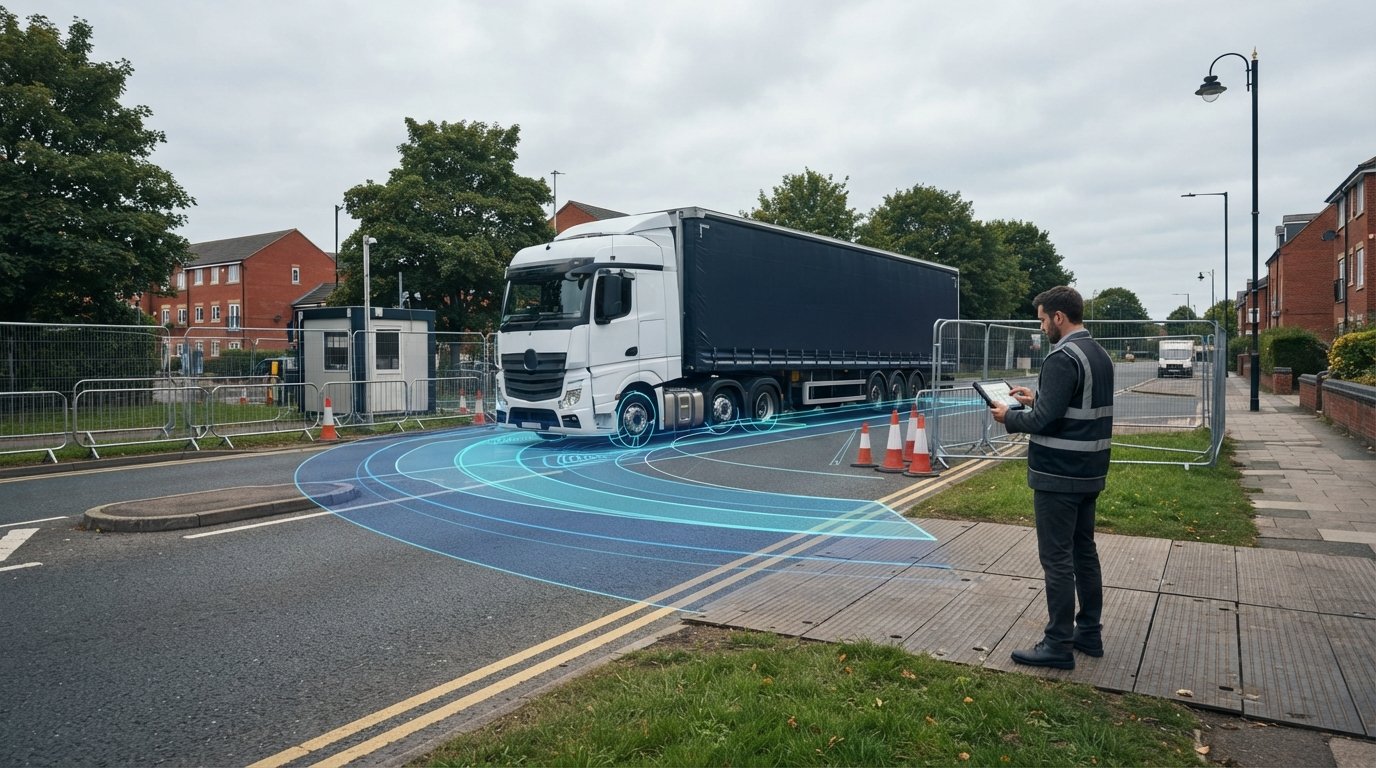
Imagine the “bump-in” phase of your 2026 festival coming to a grinding halt because a 19-metre articulated vehicle cannot clear the temporary ticket booths. It’s a scenario that keeps developers awake at night. A planning application is frequently rejected by the local highway authority because of “insufficient access data.” Conducting a professional swept path analysis for temporary event access is the only way to prove your site can handle everything from heavy stage flatbeds to heavy rigid vehicles. Without this technical validation, you’re not just risking logistical delays. You’re risking the entire event’s viability.
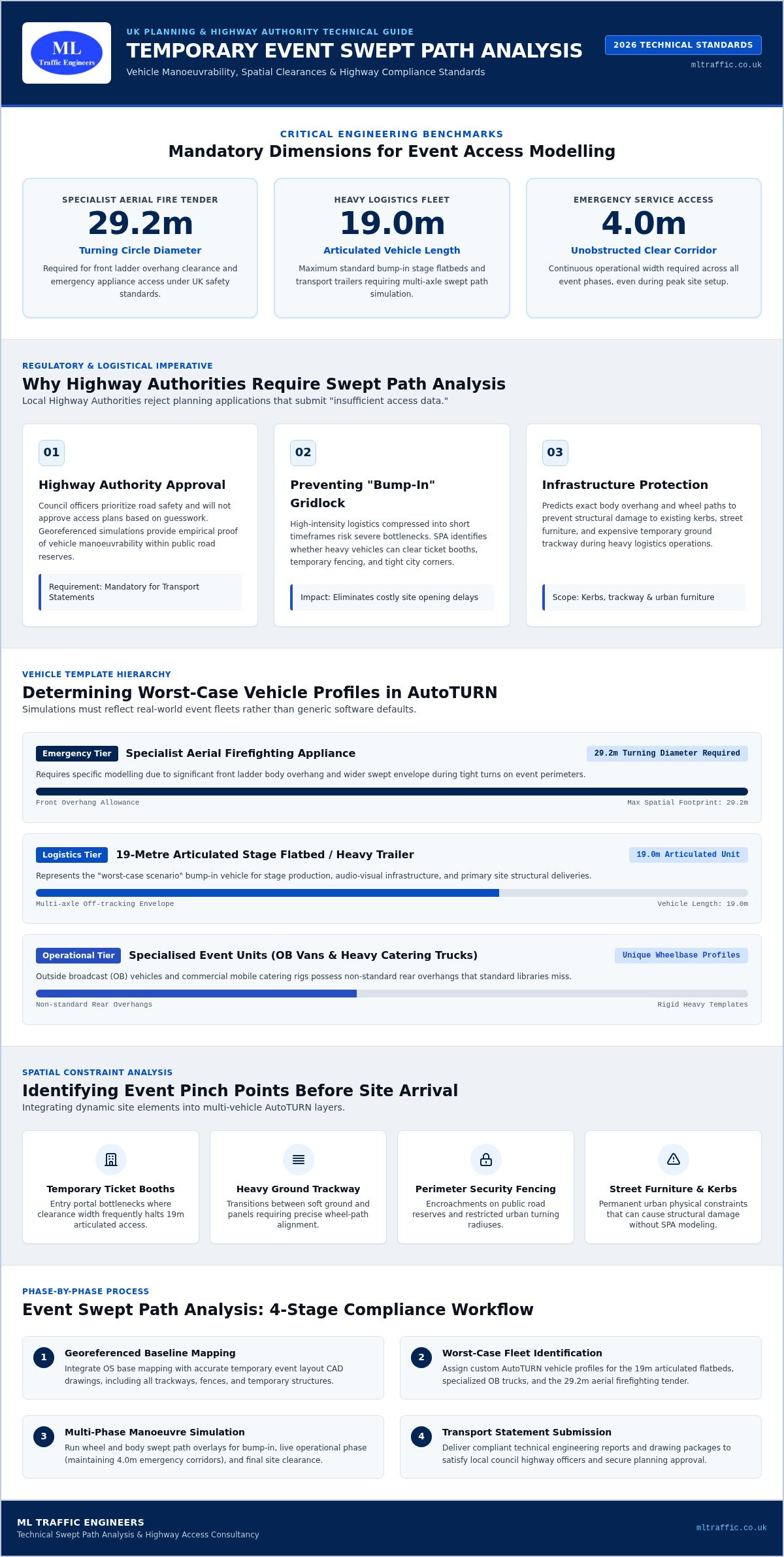
We understand the pressure of meeting strict safety benchmarks while navigating the intricate requirements of UK planning permissions. You’re likely worried about the exact dimensions of catering trucks or whether a fire tender has the 29.2-metre turning circle diameter required for specialist aerial appliances. This guide provides a definitive 2026 checklist to ensure your access plan is robust and compliant. We will examine how to model multi-vehicle layers in AutoTURN, secure necessary local authority approvals, and maintain the 4.0-metre unobstructed corridors essential for emergency services.
Key Takeaways
- Understand why swept path analysis for temporary event access is the essential technical requirement for securing local highway authority approval and preventing costly logistical gridlock.
- Learn how to identify the most demanding vehicle templates for 2026, including the 29.2-metre turning circle necessary for specialist aerial firefighting appliances.
- Discover the methods for integrating temporary infrastructure, such as trackway and security fencing, into your simulations to identify potential “pinch points” before they cause delays.
- Access a comprehensive compliance checklist that ensures every phase of your event, from the initial setup to the final site clearance, meets UK safety standards.
- Find out how professional engineering reports and AutoTURN modeling provide the precise data needed to satisfy council highway officers and protect public safety.
Why Swept Path Analysis is Critical for Temporary Event Access
Planning a temporary event in London involves managing high-intensity traffic within restricted urban footprints. Unlike permanent developments where access is static, events introduce a surge of heavy logistics vehicles over a short period. Swept path analysis for temporary event access provides the empirical data needed to prove these vehicles can enter, manoeuvre, and exit safely without causing gridlock. SPA is a computer-aided simulation of vehicle wheel and body paths. This technical validation is vital for high-stakes environments where even a few centimetres of error can halt operations.
To better understand how this technology works in a professional context, watch this demonstration of modern vehicle tracking software:
By modelling the vehicle turning radius and off-tracking of specific fleet profiles, engineers identify “pinch points” before any equipment arrives on-site. This foresight prevents logistical failures that could delay a festival opening or a major corporate activation. We use these simulations to verify that 19-metre articulated trailers can successfully navigate tight city corners without striking permanent street furniture or temporary barriers.
The Legal and Regulatory Necessity
Local highway authorities in the UK increasingly demand technical proof of vehicle manoeuvrability for any event encroaching on public road reserves. A professional autoturn swept path analysis is often a mandatory component of a comprehensive Transport Statement. Without this data, developers face a high risk of planning permission refusal. Council officers prioritising road safety won’t approve an access plan based on guesswork; they require georeferenced simulations that adhere to current UK highway standards. This documentation provides the reassurance that your event layout respects the structural limits of the surrounding infrastructure.
Operational Safety and Risk Mitigation
Safety is the non-negotiable foundation of event planning. Precise analysis ensures that fire tenders and other emergency vehicles maintain 4.0-metre unobstructed travel widths at all times, even during the peak bump-in phase. In 2026, many authorities require specific modelling for aerial firefighting appliances, which demand a 29.2-metre turning circle diameter due to front ladder overhang. Swept path analysis for temporary event access also protects the site’s physical integrity. By accurately predicting body overhangs, we prevent damage to existing kerbs, street furniture, and expensive temporary trackway. This level of precision reduces the logistical and regulatory pressure on your team, ensuring a seamless transition from planning to execution.
Determining Critical Vehicle Templates for Event Access
Selecting the correct vehicle template is the foundation of a valid simulation. You cannot rely on generic models for high-stakes event planning. Every site has a “worst-case scenario” vehicle. This is usually the largest or least manoeuvrable unit required for the bump-in phase. Identifying this vehicle early prevents the need for costly site re-designs later. Precise swept path analysis for temporary event access must account for these variations to ensure total site safety and regulatory compliance.
Accuracy depends on using specific AutoTURN vehicle templates that reflect the real-world fleet. This is especially true for specialized equipment like mobile stages, outside broadcast (OB) vans, or heavy catering units. These vehicles often possess unique wheelbases or significant body overhangs that standard software libraries might miss. We ensure every simulation uses georeferenced data to match the exact dimensions of the equipment arriving on your site.
The Heavy Goods Vehicle (HGV) Profile
Most large-scale UK events require 16.5-metre articulated trucks for stage deliveries and infrastructure transport. We model these using rear-steer parameters to navigate tight urban entrances and narrow site gates. For smaller venues or park-based activations, the 12-metre rigid vehicle is often the critical template. Adhering to Manual for Streets swept path guidance ensures these simulations meet the geometric design principles expected by council highway officers. We also simulate 19.0-metre articulated vehicles for major stage production deliveries to guarantee they can turn without striking permanent infrastructure.
Emergency and Service Vehicle Access
Compliance is not just about logistics. You must maintain access for a standard UK fire tender at all times. This typically requires a 3.7-metre clear width between kerbs and a 4.0-metre unobstructed roadway width within the event space. We also model ambulance access to designated first-aid points and triage areas. These routes must remain clear even when the site is at full capacity. If you’re unsure which templates your project requires, our team provides expert swept path analysis services to help you navigate these technical requirements.
Service vehicle routes are equally important. Waste management and sanitation trucks need dedicated paths to operate during the event lifecycle. By modelling the specific vehicles that will actually visit your site, we reduce the risk of planning rejection and operational failure. This proactive approach ensures your event stays on schedule and meets all safety benchmarks set by the local authority.
Assessing Temporary Infrastructure and Urban Constraints
Temporary event sites often exist in challenging environments where permanent infrastructure meets transient barriers. Success depends on accurately modelling how these elements interact. Swept path analysis for temporary event access is essential for evaluating the impact of temporary gates, fencing, and security bollards on vehicle movement. We also have to account for fixed urban constraints such as low bridges, narrow junctions, and on-street parking that can complicate ingress. These constraints aren’t just inconveniences; they are potential points of failure that can lead to planning rejection. Reviewing our ML Traffic project types can help you identify specific site challenges common to London event spaces, from stadium concerts to park festivals.
Temporary Trackway and Turning Circles
When events take place on grass or soft ground, developers rely on temporary trackway to support heavy loads. We calculate the minimum width of trackway required for safe HGV passage, ensuring the vehicle’s body and wheels remain on the mats at all times. Turning radii on these surfaces are often tighter than on tarmac because of the physical limitations of the matting systems. Trackway must extend beyond the swept path to prevent ground rutting. This extra margin ensures that even minor steering deviations don’t lead to vehicles becoming bogged down, which would cause immediate logistical delays. We recommend a safety envelope of at least 300mm to 500mm beyond the calculated wheel path to account for these variables.
Junction Manoeuvrability and Public Highway Impact
The transition from a narrow public road to an event site is often the most critical phase where swept path analysis for temporary event access proves its value. Long vehicles require a significant “swing” to enter without striking kerbs, street furniture, or temporary fencing. This movement often creates a conflict between event traffic and existing pedestrian flows. Following HSE event transport and vehicle access guidelines is vital for maintaining safe separation between people and plant. We use SPA to determine if temporary Traffic Regulation Orders (TTROs) are necessary to suspend parking or close lanes temporarily. This technical proof is what council highway officers look for when approving your traffic management plan. By identifying these constraints during the design phase, we help you avoid last-minute alterations that could compromise site safety. Our simulations provide the reassurance that your event won’t cause dangerous congestion on the public highway.
The 2026 Checklist for Event Swept Path Analysis Compliance
Achieving approval for a temporary event requires a systematic approach to technical documentation. A comprehensive checklist ensures that your swept path analysis for temporary event access meets the rigorous standards of UK highway authorities. This process moves beyond simple site plans. It provides georeferenced proof that your logistics strategy is viable within the physical constraints of the venue. Following these five steps will help you secure council approval while minimising the risk of operational gridlock during the build phase.
- Step 1: Define the site boundary and temporary access points. Identify every ingress and egress point, including those reserved strictly for emergency vehicles or staff.
- Step 2: Compile a vehicle list for all phases. You must account for different fleets used during the build-out, the live event, and the final break-down. This includes 16.5m articulated trucks and smaller 6.5m ambulances.
- Step 3: Secure accurate mapping. Use a topographical survey or high-resolution OS mapping to ensure the simulation reacts to real-world kerb lines and permanent street furniture.
- Step 4: Execute SPA simulations. Model all critical movements, including entry from the public highway, internal turns around staging, and the final exit path.
- Step 5: Review safety margins. We recommend a minimum 0.5m (500mm) safety clearance between the vehicle’s swept envelope and any rigid structures or pedestrian fencing.
Technical Drawing Requirements
A valid technical drawing must provide more than just a line on a map. It needs to show the full wheel path and the body overhang to account for “swing” during tight turns. Every simulation should include directional arrows and clearly stated vehicle speed assumptions, which are typically capped at 5-10mph for event sites. We layer these simulations directly over your temporary Event Management Plan (EMP) layout. This ensures that the placement of stages, kiosks, and toilets doesn’t interfere with essential vehicle tracks. If you need assistance preparing these technical documents, you can order a professional swept path analysis to ensure your drawings satisfy council highway officers.
Common Pitfalls to Cross-Check
Many developers focus only on the “bump-in” and forget to model the outbound journey. Long vehicles often require different steering angles when exiting a site, especially if they must merge into moving traffic. You should also check vertical clearances. Festival arches, festoon lighting, and low-hanging branches must sit at least 4.5m above the roadway to accommodate HGVs—an essential coordination point when working with audio, visual, and lighting production teams like livewireav.co.nz. Finally, ensure your model includes temporary site offices and generator placements. These “small” additions often create unexpected pinch points that can derail your entire transport strategy if not modelled during the initial swept path analysis for temporary event access.
Securing Approval: How ML Traffic Engineers Supports Your Event
Navigating the final stages of a planning application requires more than just automated software outputs. While digital tools provide a foundation, council highway officers require professional engineering judgment to validate the results. Our team at ML Traffic Engineers UK provides the technical expertise to interpret complex simulations and translate them into actionable reports. We ensure your swept path analysis for temporary event access stands up to rigorous scrutiny from local authorities across the UK. Since 2014, we’ve specialised in navigating these regulatory hurdles with precise data and authoritative engineering sign-offs.
We understand that event timelines are often compressed. A delay in receiving an access report can halt the entire production schedule. ML Traffic Engineers UK prioritises rapid turnaround times to meet these time-sensitive demands without compromising on accuracy. Whether you’re planning a one-off festival or a recurring stadium event, we integrate SPA results into a wider Transport Statement for London or UK-wide planning project to provide a comprehensive view of your site’s operational feasibility.
From Initial Survey to Final Report
Our process begins with a detailed assessment of your proposed layout. We use current traffic data and high-resolution mapping to justify every temporary access solution. ML Traffic Engineers UK doesn’t just identify problems; we collaborate with event planners to optimise site layouts for better vehicle flow. This proactive approach often uncovers opportunities to increase usable event space while maintaining safety margins. By providing a professional “stamp of authority” on every submission, we reduce the likelihood of revisions and accelerate the path to approval. This level of support ensures that your technical documentation is robust, defensible, and ready for council review.
Our Commitment to Event Safety
Safety remains our primary driver. We ensure every temporary layout prioritises the protection of both the public and site workers. The team at ML Traffic Engineers UK understands the intricate regional regulations in England, allowing us to manage the technical complexities so you don’t have to. We take immense pride in our role as guardians of site safety. We ensure that even the most ambitious event designs remain compliant and functional throughout the build, live, and break-down phases. If you’re ready to secure your site’s access plan with a reliable partner, contact ML Traffic Engineers UK for a professional SPA quote today.
Securing Your 2026 Event Access
Successful event delivery starts with a technical foundation that leaves no room for error. We’ve seen how precise vehicle templates and the careful modelling of temporary infrastructure are vital for navigating narrow urban junctions. A robust swept path analysis for temporary event access doesn’t just prevent logistical gridlock. It provides the empirical evidence required to secure essential planning permissions from local highway authorities. By addressing pinch points during the design phase, you protect your production schedule and ensure public safety.
Precision is a functional necessity in the high-stakes world of event logistics. As planning approval specialists since 2014, ML Traffic Engineers delivers the expert AutoTURN analysis you need to satisfy council requirements. We provide a rapid UK-wide service that balances technical authority with a client-focused approach, reducing the regulatory pressure on your team. Don’t leave your site access to chance. Get a Professional Swept Path Analysis for Your Event to guarantee a compliant, safe, and efficient build-out. We’re ready to help you turn your event vision into a logistical success.
Frequently Asked Questions
What is swept path analysis for temporary event access?
Swept path analysis for temporary event access is a technical simulation that calculates the space required by vehicles as they manoeuvre through a site. Unlike permanent developments, this analysis factors in transient obstacles like water-filled barriers, scaffolding, and temporary fencing. It tracks both the wheel paths and the outer body swing to ensure that heavy logistics trucks don’t strike permanent street furniture or temporary infrastructure during the build phase.
Do I really need SPA for a three-day festival?
You almost certainly need it if your event involves large vehicles on public roads or restricted sites. Highway authorities in England prioritise road safety and traffic flow regardless of the event’s duration. Even a short festival requires proof that emergency services can access the site and that delivery HGVs won’t cause gridlock. Failing to provide this technical data often leads to an immediate refusal of your planning application.
Which vehicle templates are most important for event planning?
The most critical templates include the 16.5m articulated vehicle for stage deliveries and the 12m rigid HGV for general logistics. For safety compliance, you must also model emergency vehicles. In 2026, many councils require specific simulations for aerial firefighting appliances, which have a larger turning circle diameter than standard fire pumpers. Modelling these “worst-case” vehicles ensures your site layout is robust enough for any operational requirement.
Can I perform my own swept path analysis for a council application?
While software is available, council highway officers typically reject drawings that lack professional engineering sign-off. A valid analysis requires expert knowledge of vehicle kinematics and local authority standards. Professional reports from specialists like ML Traffic Engineers provide the “stamp of authority” needed for approval. We use industry-standard AutoTURN software to ensure every simulation is georeferenced and accurate to the millimetre, reducing the risk of costly revisions.
How much does a swept path analysis cost for a temporary event?
The cost depends on the number of vehicle templates required and the complexity of the site layout. A single entrance simulation for one vehicle type is less intensive than modelling a full festival site with multiple emergency access routes. We provide tailored quotes based on the specific needs of your project. Investing in professional analysis early prevents expensive logistical failures and site re-designs that often occur when access issues aren’t identified.
What happens if the SPA shows a vehicle cannot make a turn?
If a simulation identifies a “pinch point” where a vehicle cannot turn, you must adjust the site layout before equipment arrives. This might involve moving temporary fencing, re-positioning ticket booths, or widening trackway sections. In some urban environments, we might suggest applying for a temporary Traffic Regulation Order to suspend on-street parking. Identifying these failures digitally allows you to solve access problems without delaying the event’s build-out schedule.
Does the council require SPA for emergency fire tender access?
Yes, fire tender access is a mandatory requirement for almost all UK event permits. You must demonstrate that a standard fire appliance can reach all parts of the site and manoeuvre safely. This usually requires a 3.7m clear width and specific turning radii. Without a verified swept path analysis for temporary event access, the council cannot guarantee public safety, which is a primary reason for the rejection of event management plans.
How long does it take to get an SPA report for an event?
We understand the urgency of event planning and typically deliver technical reports within a few working days. The exact timeline depends on the quality of the site plans provided and the number of vehicle movements to be modelled. For time-sensitive applications, we offer rapid turnaround services to ensure your submission meets council deadlines. Our goal is to reduce regulatory pressure by delivering precise, compliant reports as quickly as possible.

Disclaimer
The content on mltraffic.co.uk, including all technical articles, guides, and resources, is provided for general informational and educational purposes only. It is not intended to constitute professional advice in traffic engineering, transportation planning, development approvals, or any other technical or legal field.
While ML Traffic Engineers makes every reasonable effort to ensure the accuracy, completeness, and timeliness of the information published, we do not provide any warranties or representations (express or implied) regarding its reliability, suitability, or availability for any particular purpose. Any reliance you place on the content is strictly at your own risk.
In no event shall ML Traffic Engineers, its directors, employees, authors, or affiliates be liable for any direct, indirect, incidental, special, consequential, or punitive damages (including, without limitation, loss of profits, data, or business opportunities) arising out of or in connection with the use of, or inability to use, any information provided on this website.
The articles and guides on this site are not a substitute for engaging a qualified, professional traffic engineer to assess your specific project requirements. For tailored advice, compliance assessments, or traffic engineering services, please contact a competent professional.
This disclaimer may be updated from time to time without notice. By accessing or using this website, you agree to be bound by the most current version of this disclaimer.