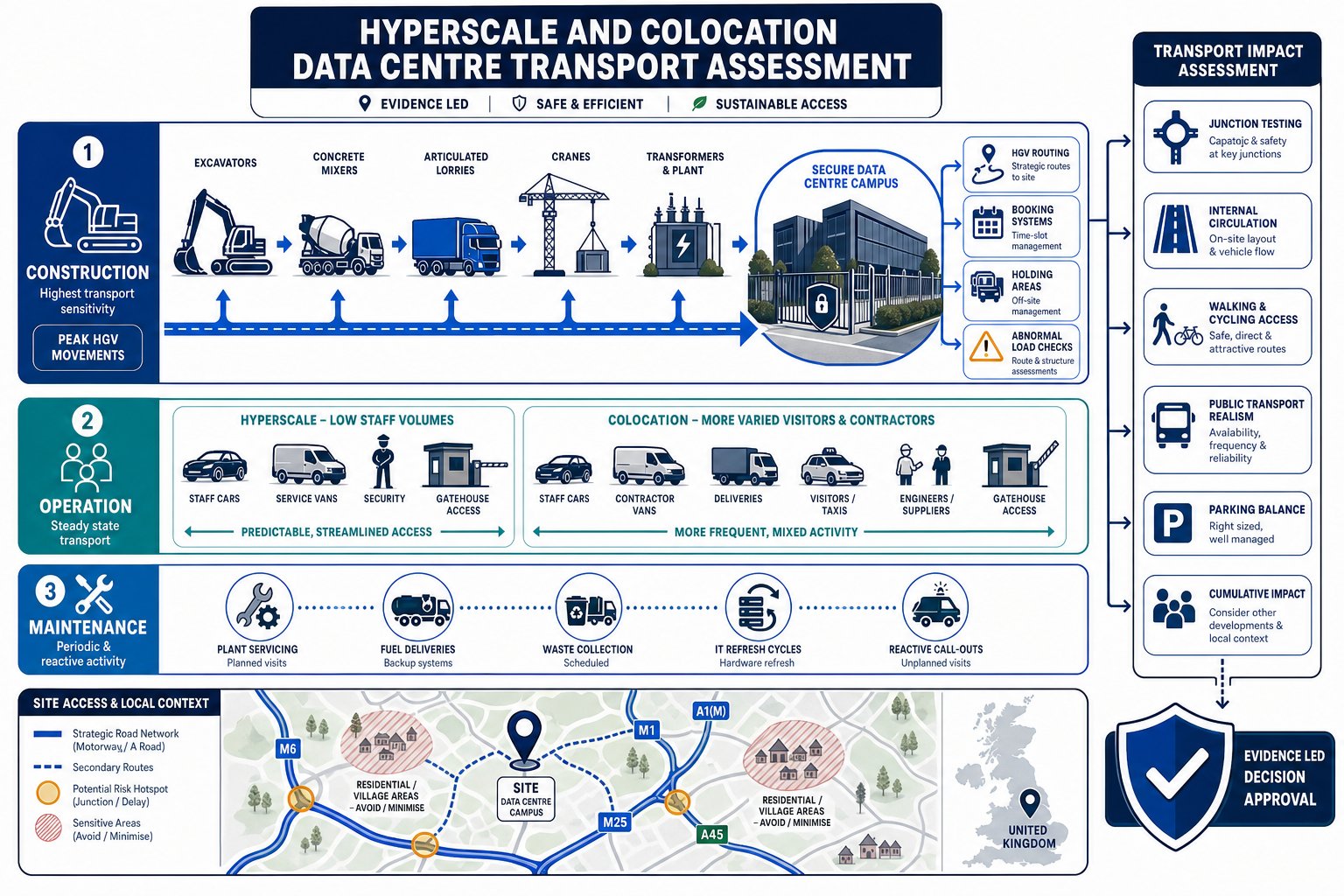
Planning teams already know the headline point: data centres don’t behave like offices, warehouses, or standard industrial estates. But that’s exactly why transport work around them is often misunderstood. A hyperscale campus can involve huge construction volumes and surprisingly low day-to-day staffing. A colocation scheme may look similar on a site plan, yet generate a steadier stream of contractor visits, client access, and phased fit-out activity. If those differences are flattened into generic assumptions, planning risk rises quickly.
In 2026, that risk is sharper. Local planning authorities are asking harder questions about HGV routing, construction impacts, staff travel realism, and whether the submitted evidence genuinely reflects how the facility will be built and run. A weak transport narrative can slow determination, trigger objections from highways officers, or create awkward inconsistencies with environmental and design documents.
Our view is simple: a strong Hyperscale and Colocation Data Centre Transport Assessment must be phased, site-specific, and practical. It should explain not just trip numbers, but how traffic will actually be managed on the ground, during earthworks, fit-out, operation, maintenance, and occasional abnormal load movements. When that work is done properly, it gives planners, architects, lawyers, developers, and councils a much clearer path through the application process.
Key Takeaways
- A robust Hyperscale and Colocation Data Centre Transport Assessment must be phased, site-specific, and practical, detailing traffic management throughout construction, operation, and maintenance phases.
- Construction traffic is the most sensitive phase requiring detailed management plans for HGV routing, timing restrictions, and on-site controls to prevent network disruption and community objections.
- Hyperscale and colocation data centres create distinct transport demands; hyperscale sites have low staff trip rates but require specialist servicing assessments, while colocation sites need detailed tenant and contractor trip forecasting.
- Access strategies must accommodate secure entry, large vehicles, and internal circulation with thorough junction performance analysis reflecting real traffic profiles across all phases.
- Transport assessments should align closely with the wider planning submission, including masterplans, environmental reports, and travel plans, to ensure internal consistency and reduce approval delays.
- Demonstrating credible sustainable travel measures and clear HGV routing plans is essential to address local authority concerns and avoid objections during planning determination.
Why Transport Assessment Matters For Data Centre Planning Applications
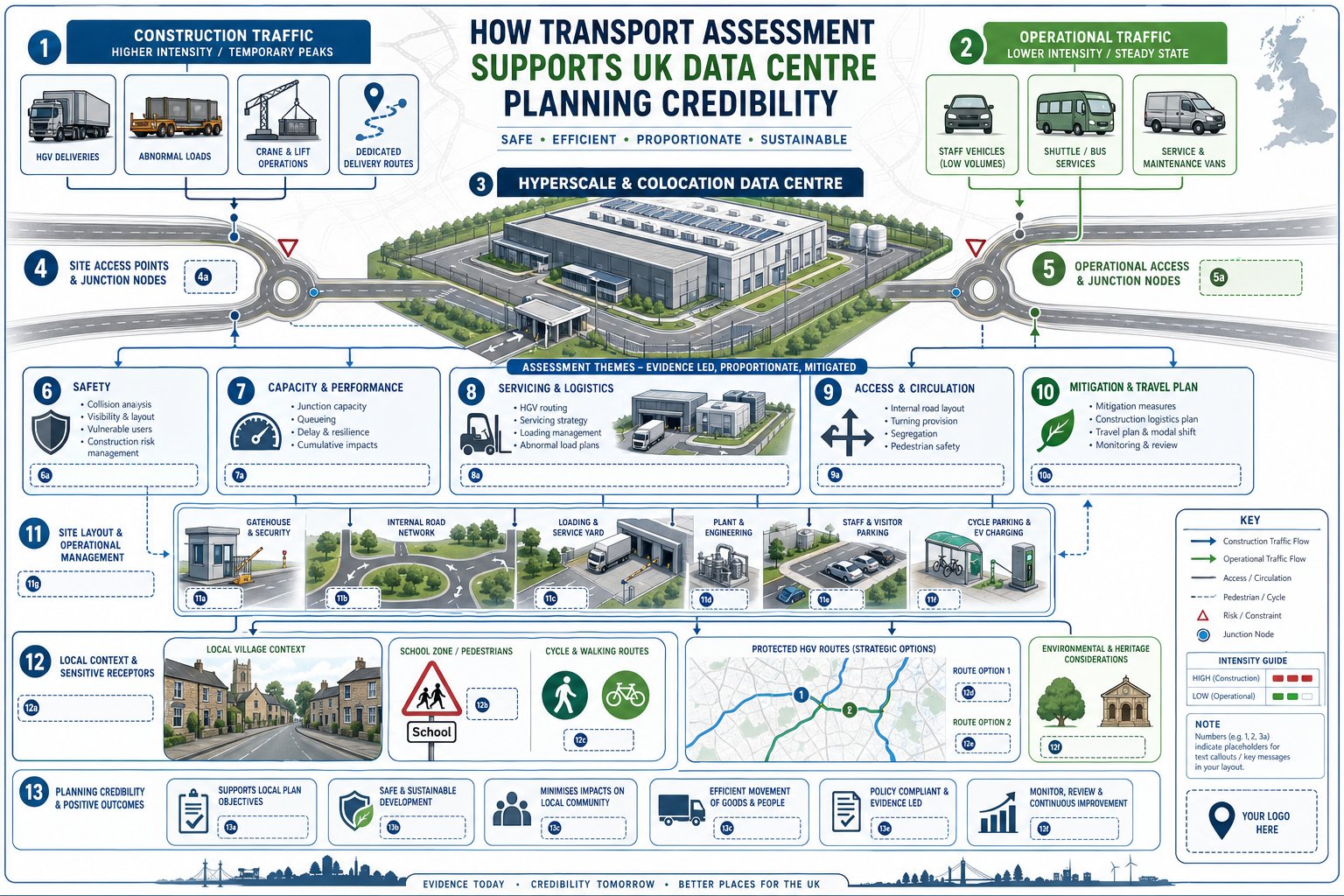
A transport assessment is rarely a box-ticking exercise for data centre schemes. It is one of the documents that determines whether the project feels credible to a local authority. For hyperscale and colocation proposals, that matters because the transport profile is unusual: low employment density, high servicing sensitivity, and a construction phase that can be far more intense than the eventual operational use.
The purpose is straightforward. We need to demonstrate that construction and operational traffic can be accommodated safely, that the residual cumulative effect on the network would not be severe, and that realistic mitigation has been built into the scheme from the outset. That includes access design, junction assessment, internal circulation, travel planning, and delivery controls.
For many authorities, the transport case also becomes the place where wider concerns are tested. Will HGVs pass through villages? Will shift traffic coincide with school peaks? Can large plant deliveries enter and leave without blocking the network? Those questions often sit alongside the broader principles set out in a transport assessment for planning submission, but data centres demand more tailored assumptions.
In practice, a good assessment reduces uncertainty. That is often the difference between a scheme progressing smoothly and one that spends months answering avoidable technical queries.
How Hyperscale And Colocation Schemes Create Different Transport Demands
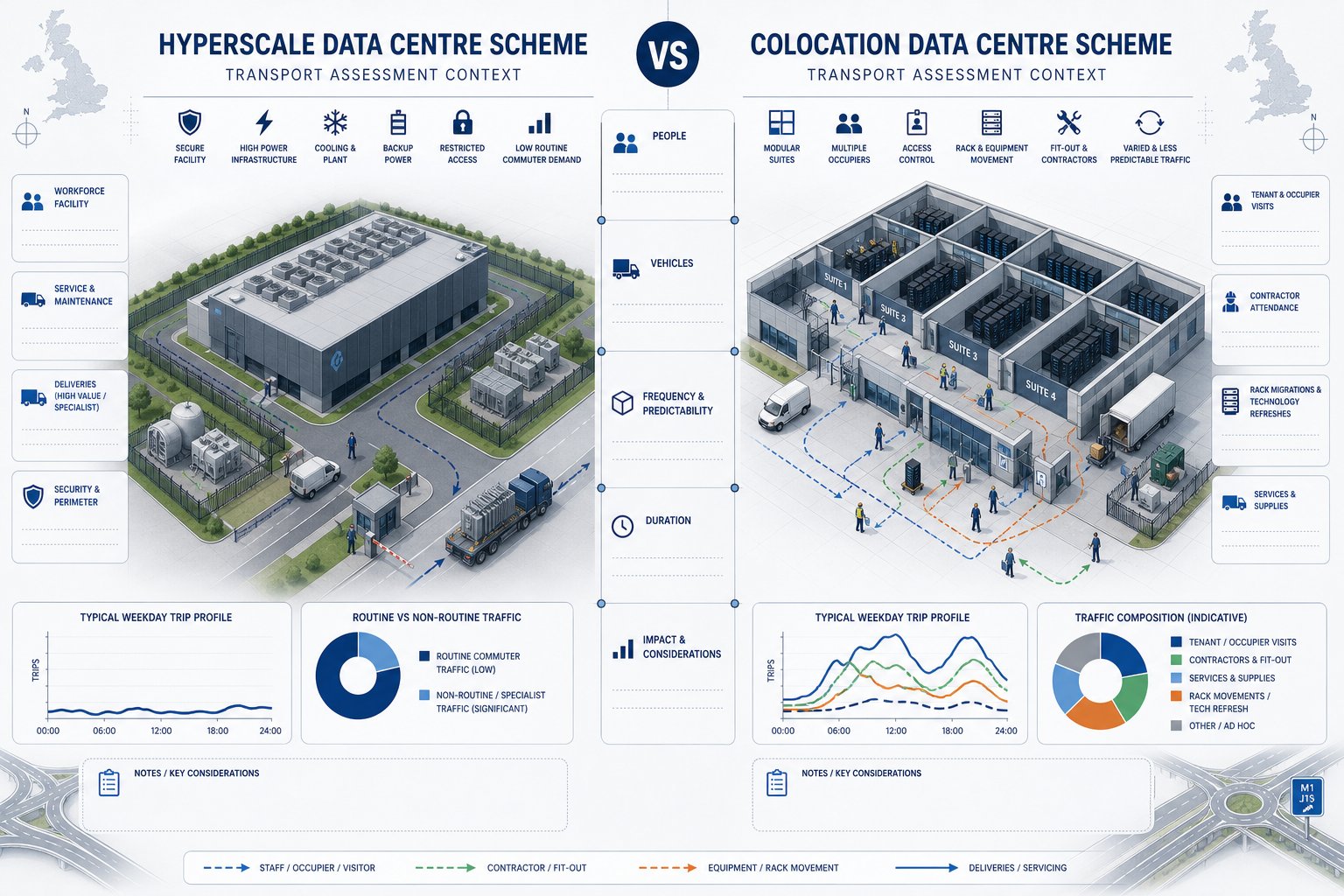
This is where many reports either win trust or lose it.
Hyperscale facilities are usually large, highly automated, and operated by a single major user or cloud provider. Their built form can be vast, power demand substantial, and security strict, yet everyday staffing levels are typically modest for the amount of floorspace involved. As a result, the long-term transport picture is often shaped less by commuter demand and more by specialist servicing, facilities management, security, and occasional high-value equipment movements.
Colocation schemes tend to be more varied. Because they host multiple customers, they often see a broader mix of occupier-related access, contractor attendance, rack migrations, staged fit-outs, and periodic technology refreshes. The total staff count may still be low compared with mainstream employment uses, but trip patterns can be less predictable and more operationally diverse.
That difference matters for forecasting. A hyperscale site may justify very low employee trip rates but require robust assessment of plant replacement and backup infrastructure deliveries. A colocation site may need a finer-grained explanation of tenant visits, van traffic, and ongoing churn within occupied suites.
We usually advise teams not to rely on generic B8, office, or industrial proxies unless there is a clear reason. Highways officers are increasingly alive to the distinction, and the quality of benchmarking, plus the experience of the Transport Assessment Consultants: preparing the evidence, can shape how quickly those assumptions are accepted.
Key Trip Generation Drivers Across Construction, Operation, And Maintenance
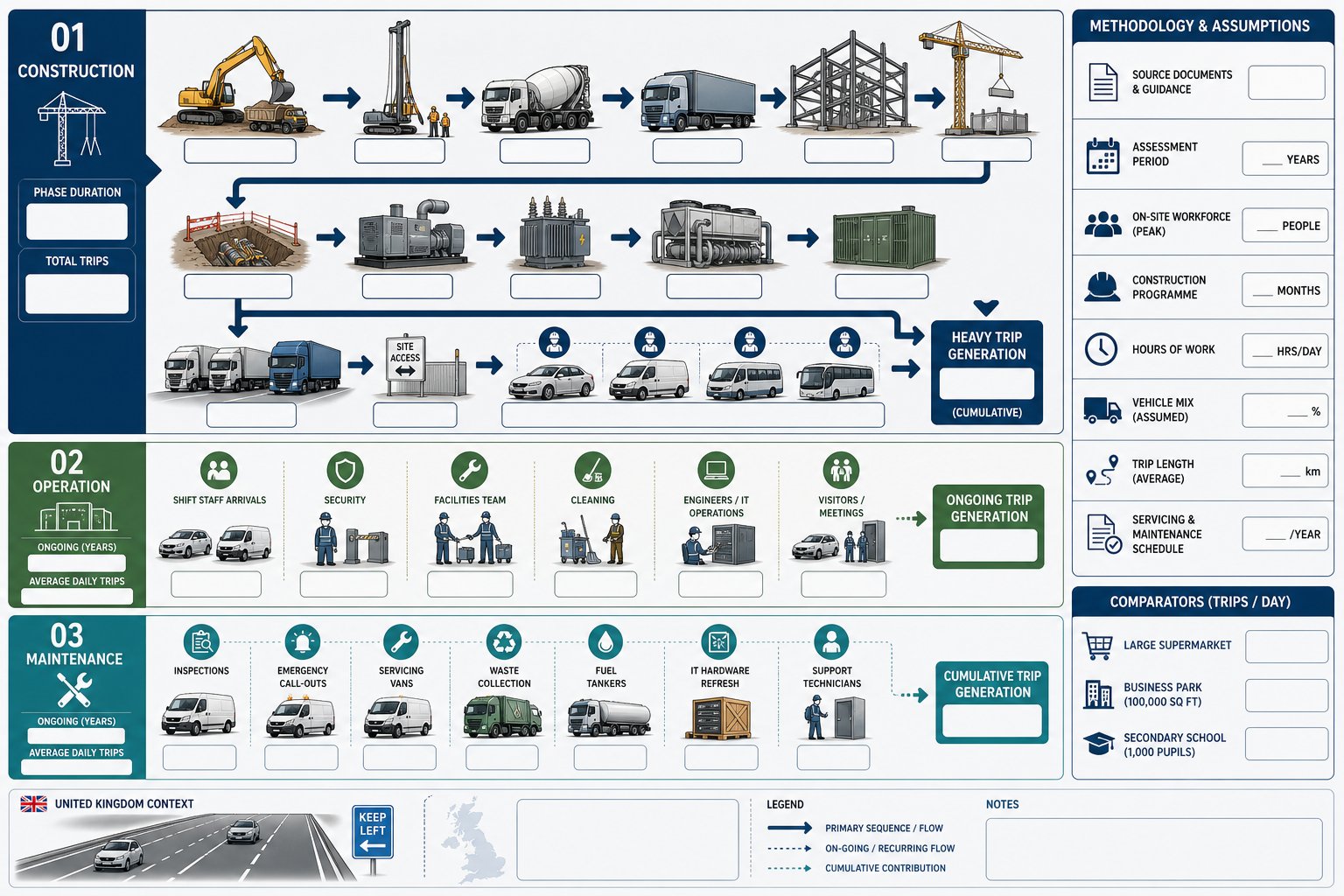
For a robust Hyperscale and Colocation Data Centre Transport Assessment, trip generation should be broken down by phase rather than treated as a single blended number.
Construction is usually the dominant issue. Early stages may involve bulk excavation, cut-and-fill, piling, drainage, utilities, and concrete pours. Then come steel or structural frame deliveries, envelope materials, mechanical and electrical plant, generators, transformers, chillers, fuel systems, and highly coordinated data hall fit-out. Workforce travel can also be significant, especially where labour is drawn from a wide catchment and public transport is limited.
Operation is a different story. Daily staff arrivals are often modest and spread across shifts. Security, facilities management, cleaning, limited administration, and engineering personnel tend to form the core. Visitor demand is normally low, but not always negligible, particularly at colocation sites.
Maintenance introduces another layer. Planned inspections, reactive call-outs, software and hardware support, plant servicing, waste collections, fuel deliveries for testing regimes, and periodic IT refresh cycles all create movement. Individually, many of those trips are small in number. Collectively, they still need a transparent methodology.
The best assessments explain what drives each category, state assumptions clearly, and tie them back to programme, staffing plans, servicing schedules, and realistic comparators, not optimistic guesswork.
Construction Traffic: The Most Sensitive Phase In Many Data Centre Schemes
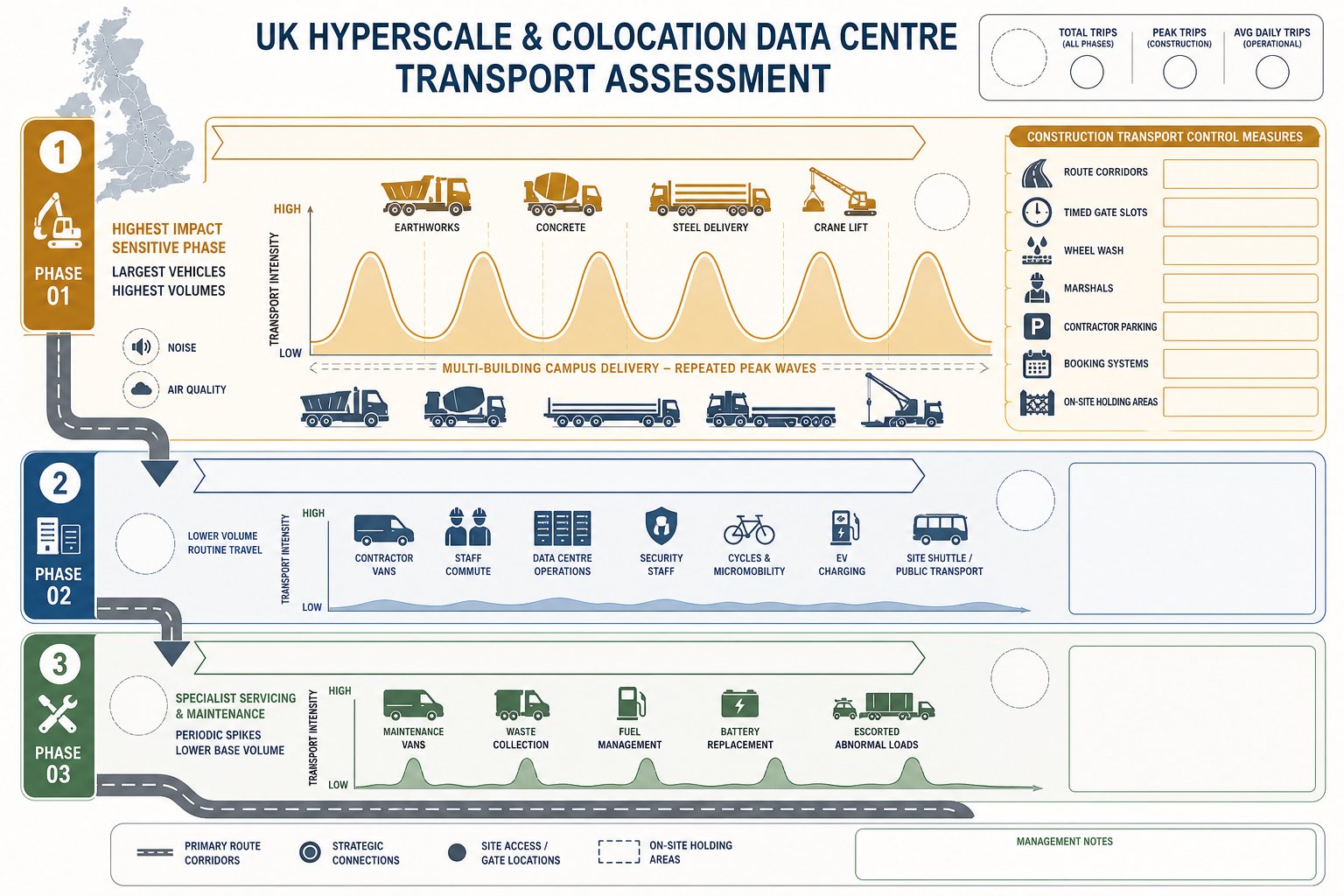
For most data centre applications, construction is the phase that draws the closest scrutiny, and rightly so. The completed facility may generate relatively few daily person trips, but the build programme can place substantial pressure on local roads if it is not properly planned.
The peak is not constant across the programme. Earthworks and remediation can produce heavy outbound and inbound HGV flows. Structural phases bring concrete wagons, steel deliveries, cranage logistics, and a sizeable contractor workforce. M&E installation and fit-out then introduce specialist vans, supplier vehicles, and occasional large plant movements. On multi-building campuses, those peaks can repeat in waves.
That is why we normally treat construction transport as a live management issue, not just a forecast table in an appendix. Routing, timing restrictions, marshal arrangements, contractor parking controls, wheel washing, booking systems, and on-site holding areas all need to be considered early. If neighbouring strategic employment schemes are also coming forward, cumulative construction traffic can become a material issue very quickly.
Where significant effects may arise, the transport evidence should sit consistently with any environmental impact assessment work, especially around noise, air quality, and the assessed construction programme.
And bluntly, if the build phase looks undercooked, the whole submission tends to look undercooked too.
Staffing, Shift Patterns, And Low-Occupancy Operational Travel
Operational travel often appears simple because staff numbers are low. In reality, authorities still want a credible explanation of who comes to site, when they arrive, and how those movements fit local conditions.
Hyperscale facilities are classic low-occupancy, high-floorspace uses. A very large building can operate with a relatively compact staffing model because monitoring, control systems, and building management functions are highly automated. Even so, the assessment should set out staffing by role and by shift: operations, engineering, security, management, cleaning, and facilities teams. Arrival and departure profiles matter more than annual headcount.
We also need to be realistic about mode share. Peripheral sites with weak bus links and fragmented footways are unlikely to support ambitious non-car assumptions unless practical measures are in place. Car sharing, staggered starts, shuttle links to stations, EV charging, and secure cycle facilities can all help, but only where they align with actual workforce patterns.
Parking provision is part of that narrative. Too little, and overspill concerns emerge. Too much, and sustainable travel claims can look hollow. The balance should reflect a site-specific staff profile rather than generic employment standards.
Servicing, Maintenance Visits, And Specialist Contractor Movements
Operational traffic at a data centre is not just staff cars. In many schemes, servicing and specialist contractor movements are the more distinctive element.
Routine activity can include consumables, waste collection, building maintenance, FM support, security servicing, water treatment visits, and fuel management linked to backup generation regimes. Colocation sites may also have a more regular flow of customer-side engineers, IT deployment teams, and small hardware deliveries.
Then there are periodic spikes. Plant replacement, battery upgrades, switchgear work, cooling infrastructure renewal, and major server or rack migration events can all generate short bursts of van, rigid, or articulated vehicle activity. These events do not occur every day, but omitting them entirely weakens the credibility of the assessment.
The cleanest approach is to distinguish among car trips, LGV and van trips, standard HGV servicing, and abnormal or escorted loads. Once those categories are separated, it becomes much easier to explain likely frequency, routeing, on-site handling, and any need for management controls.
Access Strategy, Highway Capacity, And Junction Performance

Access design for a data centre has to work harder than a typical commercial access. We are usually accommodating secure entry arrangements, occasional large vehicles, staff traffic, emergency access, and internal circulation that avoids conflict between cars, vans, and HGVs.
The primary access point should be tested for visibility, geometry, entry stacking, gatehouse operation where relevant, and the ability of articulated vehicles to enter and leave without overrunning or causing delay on the public highway. Separate staff and service accesses can be helpful on larger campuses, but only if they genuinely improve operation and do not create extra complexity.
Junction performance then needs to be assessed in a way that reflects the project’s real traffic profile. For construction, that may mean testing worst-case HGV and workforce periods. For operation, standard weekday AM and PM peaks are still common, but sensitive local peaks, schools, shift changes, town centre constraints, may be just as important.
Accepted tools matter here. Depending on junction type and context, assessments may rely on priority, roundabout, signal, or network modelling, often supported by Junctions 11 Software and broader Capacity Assessment Traffic methods. The key point is not the software brand: it is whether the modelling assumptions, scenarios, and mitigation logic are transparent and defensible.
If the access strategy is unresolved at application stage, questions multiply fast.
Walking, Cycling, Public Transport, And Sustainable Travel Expectations
A common mistake is to assume sustainable travel barely matters because data centres have low staffing levels. Planning policy rarely lets us take that shortcut.
Even for peripheral or semi-rural sites, authorities generally expect applicants to assess walking, cycling, and public transport conditions properly and to show that reasonable opportunities have been considered. That does not mean pretending the site behaves like a city-centre office. It means being honest about current constraints and proportionate about improvements.
Walking routes should be tested for continuity, lighting, crossing opportunities, gradients, and practical connections to nearby settlements or employment areas. Cycling provision should cover safe access, secure parking, showers, lockers, and where relevant e-bike charging. Public transport analysis should address service frequency, span of service, reliability, and whether shift times align with real timetables rather than theoretical availability.
Where accessibility is limited, mitigation can still be credible: staff shuttles to rail stations, lift-share platforms, travel plan coordinators, protected cycle links, or contributions to service enhancements. A framework travel plan is often the right mechanism, particularly for phased campuses.
Interestingly, lessons from Residential Development Transport work can help here too, not because the land use is similar, but because the discipline of proving realistic mode choice is exactly the same.
HGV Routing, Abnormal Loads, And Delivery Management Planning
If there is one issue that can trigger local concern fastest, it is HGV routing.
Data centre schemes often depend on strategic road access, and for good reason. Construction materials, generators, transformers, chillers, fuel systems, and large M&E components are not movements we want filtering through constrained residential streets or village centres. The preferred route strategy hence needs to be explicit, mapped, and realistic. Vague wording about drivers being “encouraged” to use suitable roads is rarely enough.
For standard HGVs, the assessment should identify approach routes, any prohibited links, temporary signage needs, and how compliance will be managed through contractor induction, booking systems, and haulage instructions. For abnormal indivisible loads, more detail is usually needed: swept path testing, bridge or structure constraints, street furniture checks, timing windows, and liaison with highway authorities or police where required.
Delivery management is the practical backbone of all this. Time slots, caps on arrivals, on-site waiting space, gate protocols, and contingency arrangements help prevent queuing back onto the highway. On large campuses, a digital booking system is often worth specifying from the outset.
This is one of those areas where planning committees often read the summary, not the technical appendix. So the strategy needs to be clear enough that a non-transport audience can still understand how risk is being controlled.
Evidence, Surveys, And Modelling Needed To Support A Robust Assessment
The quality of a Hyperscale and Colocation Data Centre Transport Assessment is only as good as the evidence behind it. If the baseline is weak, every later assumption becomes easier to challenge.
We generally start with recent traffic counts, turning counts at key junctions, queue observations where congestion is sensitive, speed data where access visibility matters, and a current review of road safety records. For some sites, school-time conditions or seasonal patterns also need to be captured because they materially affect local acceptability.
Trip generation evidence should then be phase-specific. Construction forecasts should be linked to material quantities, programme sequencing, vehicle types, workforce estimates, and expected peak periods. Operational forecasts should reflect staffing rosters, building management assumptions, servicing frequencies, and, where used, carefully selected comparison sites.
Modelling should normally test baseline, committed development, and development scenarios for opening and future years. If multiple plots or phases may come forward, sensitivity testing is often sensible. That broader methodology mirrors what we expect from a strong transport assessment for major schemes, but data centres often need sharper distinction between temporary and permanent impacts.
The important thing is not volume of data for its own sake. It is whether the evidence genuinely answers the questions the authority is likely to ask.
Common Planning Risks And Reasons Data Centre Transport Submissions Are Challenged
Most challenged submissions do not fail because data centres are impossible to assess. They fail because the evidence leaves obvious gaps.
One recurring problem is underestimating construction traffic, especially HGVs linked to earthworks, concrete, and large plant deliveries. Another is ignoring overlap with nearby development programmes, which can make a “modest” individual impact look very different in cumulative terms.
A second weakness is unclear routing. If the assessment does not identify how HGVs will avoid sensitive roads, or if abnormal loads are mentioned only in passing, objections from local communities and highways officers are predictable.
Mode share can be another sticking point. We sometimes see optimistic assumptions about bus or cycle use on isolated sites with poor infrastructure and shift patterns that simply do not support those choices. Authorities usually spot that quickly.
Technical inconsistencies also cause trouble. The traffic flows in the TA should match the wider planning package, including programme assumptions, access drawings, and any environmental impact assessment transport: evidence. If one document describes a peak construction phase that another barely acknowledges, confidence drops.
The lesson is simple enough: challenge tends to arise where submissions are generic, thin on management detail, or internally inconsistent.
How To Align The Transport Assessment With The Wider Planning Submission
A transport assessment works best when it is clearly woven into the wider planning story rather than appended at the end.
That starts with the masterplan. Access points, internal roads, tracking layouts, parking, service yards, and gatehouse arrangements should match the drawings exactly. Small discrepancies, one extra access arm, a different parking total, a yard dimension that no longer accommodates turning, can create disproportionate delay during determination.
The TA should also align with the planning statement and design narrative. If the application promotes high-quality placemaking, secure active travel routes, or a carefully managed campus environment, the transport document should demonstrate how those outcomes are delivered in physical and operational terms.
Construction assumptions need to align with programme and environmental documents. If the environmental team has assessed a 24-month build with peak HGV activity in year one, the transport case should not quietly assume something gentler. Likewise, drainage, landscape, utilities, and energy strategies can all affect access corridors, compound space, and delivery patterns.
For planning teams, consistency is often the hidden time-saver. With the right technical lead and the discipline of experienced Transport Assessment Consultants:, the TA becomes evidence that supports the whole submission, not a separate report that everyone else has to explain away.
Conclusion
A well-prepared Hyperscale and Colocation Data Centre Transport Assessment does more than estimate trips. It explains how a complex, high-value facility will be built, accessed, serviced, and managed without creating unacceptable effects on the surrounding network.
In our experience, the strongest submissions are phased, evidence-led, and honest about where the real transport sensitivity sits, usually in construction logistics, HGV routing, and the practicalities of low-occupancy but specialist operational travel. They also stay aligned with the rest of the planning package, from access drawings to environmental reporting and travel plan commitments.
For architects, planners, lawyers, developers, surveyors, councils, and project teams, that is the real goal in 2026: not a generic report, but a transport case that answers likely objections before they become delays. When the assessment is specific, coordinated, and grounded in how the site will actually function, planning decisions tend to become much easier to defend.
Frequently Asked Questions about Hyperscale and Colocation Data Centre Transport Assessment
Why is a transport assessment essential for hyperscale and colocation data centre planning applications?
A transport assessment demonstrates that construction and operational traffic can be safely managed without causing severe impacts on local networks. It informs access strategies, junction design, and mitigation measures, providing evidence to local authorities about HGV routing, congestion, and safety concerns.
How do transport demands differ between hyperscale and colocation data centres?
Hyperscale data centres typically involve a single user with large floorspace but low staffing, leading to trip patterns dominated by construction and specialist servicing. Colocation centres have multiple tenants, resulting in more diverse contractor visits, client access, and ongoing fit-out activity with higher operational traffic variability.
What are the key trip generation factors during the construction and operation of data centres?
Construction trips include earthworks, bulk material deliveries, and plant fit-out, often peaking with HGV flows. Operational trips mostly involve staff shifts, security, maintenance visits, routine deliveries, and periodic IT refreshes. Each phase requires distinct transport planning and assessment to capture realistic movements.
How can HGV routing and abnormal load management reduce community impact during data centre construction?
Clear routing strategies using strategic roads and avoiding sensitive residential areas are critical. Abnormal loads need swept path analysis and timed movements, often off-peak. Delivery management systems with booking, time windows, and on-site holding prevent highway queuing and address local concerns effectively.
What sustainable travel measures are relevant for data centre transport assessments despite typically low staffing levels?
Planning expects assessments of walking, cycling, and public transport accessibility, with provisions like secure cycle parking, showers, shuttle services to stations, and travel plans with mode share targets. These measures align with realistic site constraints and support sustainable staff travel options.
What common pitfalls cause objections to data centre transport assessments, and how can they be avoided?
Common issues include underestimating construction HGV volumes, unclear vehicle routing, optimistic staff mode share assumptions without controls, and inconsistencies between transport, environmental, and design documents. Avoiding these requires phased, evidence-based assessments aligned with the entire planning submission.