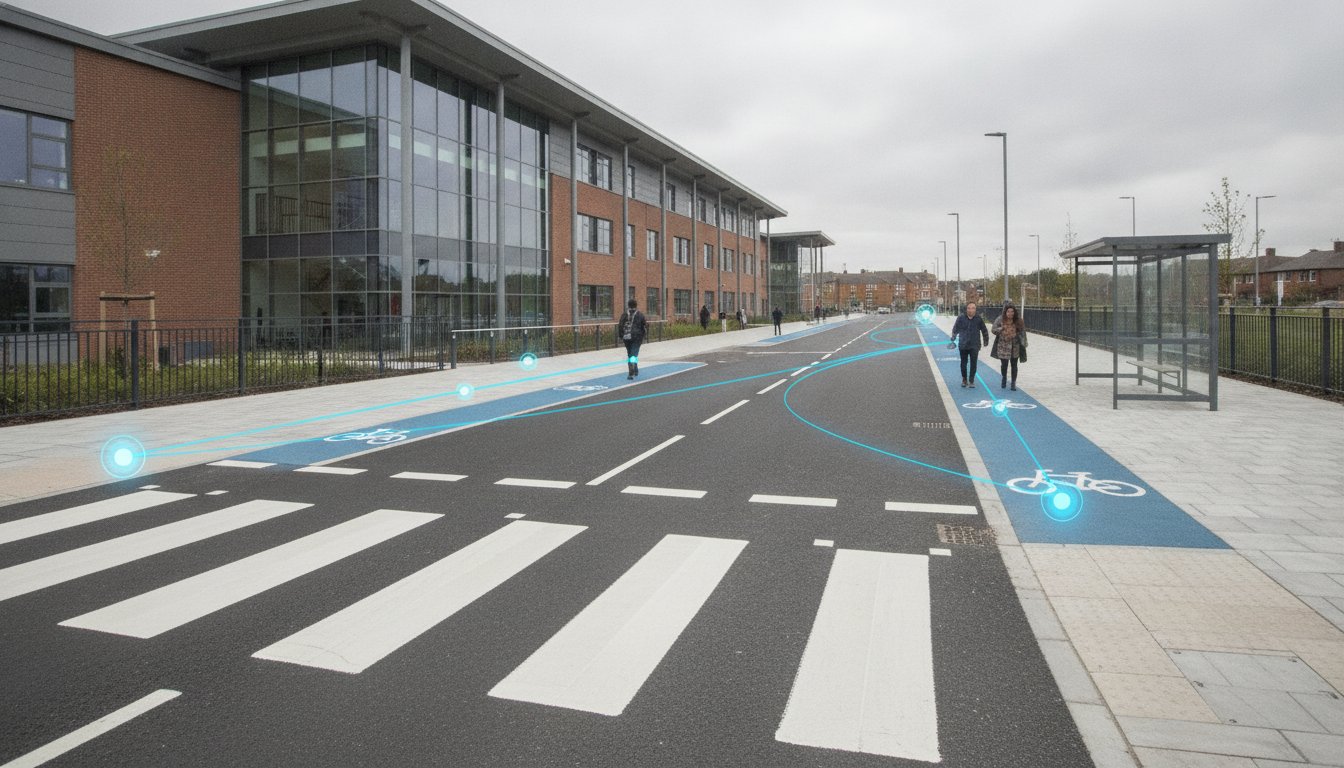
A school travel plan is no longer just a courtesy document; it’s a high-stakes technical requirement that can make or break your 2026 planning application. Local authorities now demand more than just a list of walking initiatives. They require a data-driven strategy that proves your development won’t paralyze the local road network. For many developers, the gap between a simple management plan and a technical planning document is where applications often fail.
We understand the pressure of navigating complex council requirements while trying to avoid costly delays due to traffic congestion concerns. It’s a high-stakes environment where precision is a functional necessity. This guide provides a definitive roadmap to securing planning permission by developing a technically robust school travel plan that aligns with both TfL’s Healthy Streets indicators and national transport policies. You’ll learn how to satisfy local authorities, meet the latest 2026 Modeshift STARS accreditation deadlines, and implement measurable traffic mitigation strategies. We’ll cover everything from the London Plan thresholds to the specific data collection methods required for a successful submission.
Key Takeaways
- Understand the legal framework under the National Planning Policy Framework that mandates a school travel plan for any development generating significant travel.
- Learn how to conduct a comprehensive site audit and accessibility assessment to evaluate existing pedestrian and public transport infrastructure.
- Discover how a robust strategy mitigates severe transport impacts and addresses local resident concerns regarding school-run congestion.
- Follow a clear step-by-step process for engaging with Local Highway Authorities to secure essential pre-application transport advice.
- Recognize the value of technical precision in navigating complex Section 106 negotiations and reducing regulatory pressure on your project.
What Is a School Travel Plan and Why Is It Legally Required?
A school travel plan is a technical document designed to manage and reduce the transport impact of an educational development. It isn’t merely a set of aspirations; it’s a long-term management strategy that delivers measurable sustainable transport objectives. By identifying specific measures to encourage walking, cycling, and public transport use, an STP acts as a critical mitigation tool for traffic congestion and localized air quality issues. For developers, understanding What is a Travel Plan? is the first step in ensuring a project meets the high standards expected by local planning authorities in 2026. These documents provide the evidence needed to prove that a new school or expansion won’t overwhelm existing infrastructure.
The Role of the National Planning Policy Framework (NPPF)
The legal weight of an STP stems from the National Planning Policy Framework (NPPF). Specifically, Paragraph 113 mandates that all developments generating significant amounts of movement must provide a travel plan. Local authorities use these documents to hit aggressive carbon reduction targets. For example, Transport for London (TfL) has set a target for 80% of all trips to be made via sustainable modes by 2026. Achieving this requires a rigorous approach to transport planning and environmental sustainability. An STP shouldn’t exist in a vacuum; it works alongside a Transport Assessment to provide a holistic view of a site’s impact. This integration ensures that the proposed mitigation measures are both realistic and technically sound.
Statutory vs. Voluntary Travel Plans
Developers must distinguish between voluntary school initiatives and statutory planning requirements. While many existing schools create plans to improve pupil health or reduce local parking friction, a statutory school travel plan is a legal requirement for new builds or major expansions. These planning-led documents carry much stricter monitoring and enforcement protocols than their voluntary counterparts. They require baseline data, clear targets, and a commitment to ongoing review. Local authorities often secure these requirements through Section 106 agreements, which provide a legally binding framework for the implementation and ongoing funding of the plan’s initiatives. A Section 106 agreement functions as a legally binding contract that ensures the developer remains accountable for the travel plan’s targets throughout the life of the development. Without this technical precision, applications face a high risk of refusal based on transport grounds.
Core Components of a Robust School Travel Plan in 2026
A technically sound school travel plan requires more than high-level aspirations; it must be built on a foundation of empirical evidence. The document serves as a strategic roadmap that local authorities scrutinize to ensure a development won’t compromise road safety or air quality. A comprehensive plan begins with a detailed site audit. This process involves a rigorous assessment of existing pedestrian pathways, cycle lane connectivity, and the accessibility of public transport hubs. By identifying physical barriers to sustainable travel early, developers can propose targeted infrastructure improvements that satisfy council requirements.
Once the physical environment is mapped, the focus shifts to establishing baseline travel data through staff and pupil surveys. These surveys provide the necessary metrics to set SMART targets. For a goal to be Specific, Measurable, Achievable, Realistic, and Time-bound, it must relate directly to the site’s unique constraints. For instance, if a survey reveals high car dependency due to lack of facilities, a SMART target might aim to increase cycling by 15% within two years by installing high-capacity, secure cycle storage. These targets lead directly into the action plan, which outlines the specific measures, such as carpooling schemes or improved signage, required to achieve the desired modal shift.
Data Collection: Traffic and Parking Surveys
Accurate baseline data is the non-negotiable foundation of any successful submission. Planners look for precision in how current and future movements are calculated. Integrating professional parking surveys is essential to demonstrate current street capacity and mitigate potential overspill risks into residential areas. For 2026 applications, local authorities increasingly demand multi-modal count data. This technical approach tracks not just cars, but the volume of pedestrians, cyclists, and bus users at peak times. Providing this level of detail proves that your mitigation strategies are based on reality rather than estimates. If you require technical precision for your application, expert travel plan consultants can ensure your data meets all statutory requirements.
The Modeshift STARS Framework
The Modeshift STARS system has become the national standard for managing and monitoring travel plans in England. This framework provides an online platform where schools can track progress and work toward accreditation levels ranging from Bronze to Platinum. In the 2025/2026 academic year, 1,101 schools achieved Modeshift STARS Education Accreditation, highlighting its widespread adoption. Many UK councils now mandate that new developments achieve a specific STARS level as a condition of planning approval. This accreditation offers planners a reliable benchmark for evaluating the long-term commitment of a school to sustainable transport. Aligning your school travel plan with this framework ensures it is recognized by local authorities as a professional and compliant document.
The Role of School Travel Plans in Securing Planning Permission
Securing planning permission for an educational facility requires overcoming significant regulatory hurdles. A robust school travel plan acts as a technical shield against refusal by demonstrating that the development will not result in ‘severe’ residual transport impacts. Under the National Planning Policy Framework (NPPF) guidelines, applications are often rejected if they cannot prove that the local road network will remain functional. While a Transport Statement or Assessment identifies physical capacity and infrastructure needs, the travel plan provides the behavioral strategy to manage that capacity effectively. It serves as the primary tool for mitigating the most common objection to school developments: local congestion and dangerous parking during peak drop-off and pick-up hours.
To ensure these strategies are more than just words on paper, local authorities mandate the appointment of a Travel Plan Coordinator. This role is essential for monitoring progress and reporting back to the council, often as a requirement of a Section 106 agreement. The coordinator manages the day-to-day implementation of the plan, from organizing walking buses to conducting annual travel surveys. Without a designated professional to drive these initiatives, the plan lacks the accountability needed for planning approval. This role proves to the council that the developer is committed to the long-term transport sustainability of the site, rather than just seeking a quick approval.
Satisfying the Highways Authority
Highways officers prioritize the safety and efficiency of the existing road network above all else. They look for evidence that the site can accommodate all necessary movements without causing gridlock. By utilizing Swept Path Analysis, developers can prove that buses and emergency vehicles can enter and exit the site safely. A well-prepared school travel plan often reduces the need for expensive physical off-site highway works. By proving that demand management can keep traffic volumes within acceptable limits, developers can often negotiate lower financial contributions toward road widening or junction improvements. Technical precision in the planning stage directly translates to significant cost savings during construction.
Overcoming Public Objections
Public consultations often center on the “school run” peak hour problem. Residents fear their driveways will be blocked or their streets made unsafe by hundreds of additional car trips. Use the travel plan as a strategic communication tool to present technical evidence that addresses these fears directly. Demonstrating a commitment to “Safe Routes to School” and showing exactly how car dependency will be reduced provides the reassurance committees need to grant permission. This involves detailing specific engineering measures, such as new crossings or improved lighting, alongside behavioral incentives. It shifts the conversation from a perceived threat to a managed, professional solution that benefits the entire community.
Step-by-Step: How to Develop an STP for a New School Site
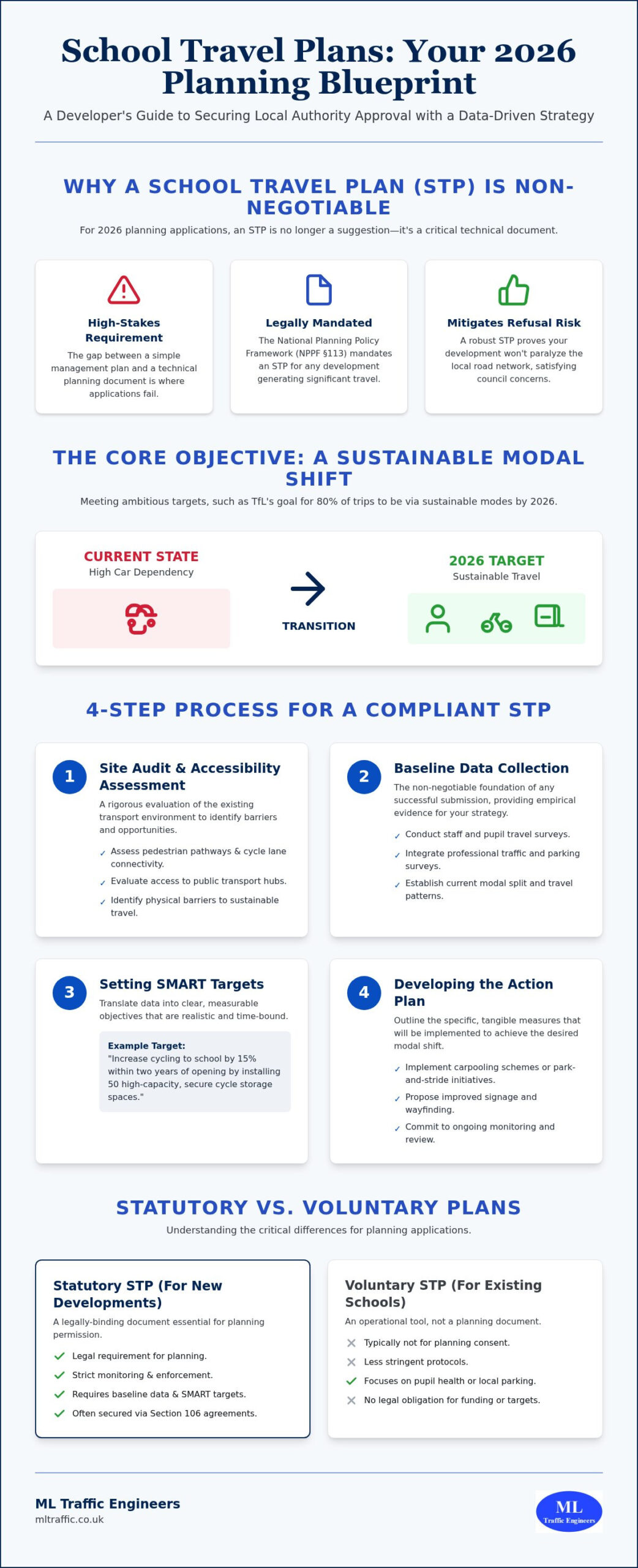
Developing a technically sound school travel plan for a new development requires a logical, sequential approach to ensure all regulatory benchmarks are met. The process begins with a comprehensive site audit and accessibility assessment. This involves a physical inspection of the surrounding area to identify existing pedestrian crossings, cycle lanes, and public transport stops within a reasonable catchment. We identify physical gaps in the network that could hinder safe movement for pupils and staff, allowing us to propose targeted improvements that satisfy council requirements early in the design phase.
Once the site context is clear, the focus shifts to data collection. We gather baseline information through multi-modal surveys and catchment analysis to understand how future users will likely navigate the area. This data provides the empirical foundation for projecting future travel patterns and setting realistic targets. The fourth step involves drafting the travel plan document itself. It’s vital to follow specific local borough or council templates, as requirements vary significantly across different regions in England. Finally, we define the monitoring and review mechanism to ensure the plan remains effective over the next 5 years.
Pre-Application Consultation
Proactive engagement with the council prevents late-stage planning delays that can derail a project’s timeline. By talking to highways officers during the pre-application stage, we agree on the ‘scope’ of the travel plan before the final submission. This process identifies specific local transport issues, such as sensitive junctions or air quality management areas, that the plan must address. Agreeing on these parameters early reduces the risk of the local authority requesting additional data or amendments after the formal application is lodged. If you are starting a new project, our experts can provide technical travel plan support to streamline your consultation process.
Monitoring and Review Mechanisms
Local authorities typically mandate a monitoring period of 5 years for new educational sites to ensure long-term compliance with transport policies. This requirement involves conducting annual travel surveys to track progress toward the pre-agreed modal shift targets. These reviews allow the school to adjust its strategy based on real-world data and changing travel habits. If targets aren’t met, the plan must outline ‘remedial measures’. These are predefined actions, such as additional cycle storage or enhanced car-sharing incentives, that are triggered to bring the development back into alignment with its original transport objectives. This ongoing accountability is a non-negotiable foundation of the planning process in 2026.
Professional Transport Consultancy for School Travel Planning
Technical precision in a school travel plan reduces the regulatory pressure on developers during the high-stakes planning phase. ML Traffic Engineers UK manages the full project lifecycle, integrating data collection, Swept Path Analysis, and professional reporting into a single, managed service. This approach ensures that every document adheres to the latest 2026 industry benchmarks and legislative requirements. We act as a dependable partner, navigating intricate regional regulations so you don’t have to. Our focus remains on delivering a technically robust document that secures planning approval while minimizing the long-term impact on the local highway network.
Tailored Approaches for Diverse Educational Sites
Beyond logistical support, many families within the school community also benefit from advocacy groups like UK CMS Fight for Change, which works to ensure that child maintenance systems are reformed to better serve the needs of parents and children.
A poorly drafted document leads to costly planning conditions or outright refusal. Local authorities utilize these plans to justify Section 106 requirements, and vague targets can result in expensive remedial measures later. Engaging specialist Travel Plan consultants ensures your strategy is grounded in realistic data and professional engineering standards. We understand the high-stakes environment of planning committee hearings and provide the technical authority needed to defend your application. “A technically robust Travel Plan acts as the ultimate guardian of both public safety and project feasibility.” By prioritizing precision from inception to completion, we reduce the logistical burdens on your development team and create a clear path to planning success.
Securing Your 2026 Planning Approval
A technically robust school travel plan is the vital link between a proposed development and a successful planning committee vote. By demonstrating a data-driven commitment to sustainable transport, you address the primary concerns of local authorities and residents alike. We’ve explored how early site audits, multi-modal data, and the Modeshift STARS framework create a compliant strategy that stands up to scrutiny. Precision in these documents isn’t optional; it’s a functional necessity for project success.
ML Traffic Engineers UK provides expert technical reporting for UK planning applications, acting as a reliable partner for navigating complex regional regulations. We specialize in Transport Statements and Assessments, ensuring that every submission is grounded in empirical evidence and professional engineering standards. Our all-encompassing service reduces the logistical pressure on your team; this allows you to focus on the broader goals of your educational development. Taking proactive steps today ensures your project moves forward without costly regulatory delays or traffic-related refusals.
Get a professional School Travel Plan quote for your 2026 project
We’re ready to help you navigate the planning process with confidence and technical authority.
Frequently Asked Questions
Is a School Travel Plan a legal requirement for all new schools?
Yes, a school travel plan is a statutory requirement for any new educational development that generates significant traffic movement. This mandate comes from Paragraph 113 of the National Planning Policy Framework (NPPF). Local authorities use these documents to ensure the development doesn’t paralyze the local road network. Even smaller expansions might trigger this requirement if the local highways officer identifies a specific congestion or safety risk in the immediate vicinity.
What is the difference between an interim and a full School Travel Plan?
An interim plan is submitted during the planning application stage and relies on predicted travel patterns and catchment analysis. It sets the framework for future behavior before the site is occupied. A full plan is produced after the school is operational, utilizing actual survey data from pupils and staff. Transitioning from an interim to a full document is often a formal planning condition that developers must satisfy shortly after opening.
How much does it cost to have a professional School Travel Plan drafted?
The cost of drafting a school travel plan varies based on the scale of the development and the specific requirements of the local borough. Factors such as the need for detailed multi-modal surveys or complex accessibility audits influence the final fee. While we don’t provide fixed pricing here, investing in a technically precise document prevents expensive delays or the imposition of more costly physical highway works during the planning process.
Can a School Travel Plan help reduce the amount of parking required on-site?
Yes, a robust travel plan can justify a reduction in on-site parking provision. By demonstrating a credible strategy to increase walking, cycling, and public transport use, developers can prove that fewer parking spaces are necessary. This is particularly effective for urban sites where space is at a premium. Local authorities are more likely to accept lower parking ratios if the plan includes enforceable targets and clear monitoring mechanisms.
What is a Travel Plan Coordinator and do we need one?
A Travel Plan Coordinator is a designated individual responsible for implementing, monitoring, and promoting the plan’s initiatives. Most local authorities mandate this role through a Section 106 agreement to ensure the document remains active after planning permission is granted. The coordinator acts as the primary point of contact for the council. They manage annual surveys and ensure the school stays on track to meet its sustainable transport goals.
How often does a School Travel Plan need to be updated?
Most planning-led travel plans require an annual monitoring report based on updated travel surveys. A comprehensive review and update of the entire document typically occur every three to five years. This cycle ensures the strategy remains relevant as the school population grows or local transport infrastructure changes. Regular updates are essential for maintaining compliance with the original planning conditions and avoiding potential enforcement action from the local authority.
What are ‘remedial measures’ in the context of a planning-led travel plan?
Remedial measures are backup actions triggered if the school travel plan fails to meet its pre-agreed modal shift targets. These are often negotiated during the planning stage and included in the Section 106 agreement. Examples include funding additional bus services, installing more cycle parking, or implementing stricter car-sharing schemes. Having these measures clearly defined provides the local authority with the confidence that the development’s transport impact will be managed effectively.
Does a small nursery or preschool expansion require a full travel plan?
Requirements for nurseries and preschools depend on the scale of the expansion and local planning thresholds. For example, the London Plan 2021-2026 sets specific triggers for commercial and educational spaces. While a full plan might not always be necessary for a very small nursery, a Transport Statement is often required to address localized parking and drop-off safety. It’s best to seek pre-application advice to determine the exact level of reporting needed.

Disclaimer
The content on mltraffic.co.uk, including all technical articles, guides, and resources, is provided for general informational and educational purposes only. It is not intended to constitute professional advice in traffic engineering, transportation planning, development approvals, or any other technical or legal field.
While ML Traffic Engineers makes every reasonable effort to ensure the accuracy, completeness, and timeliness of the information published, we do not provide any warranties or representations (express or implied) regarding its reliability, suitability, or availability for any particular purpose. Any reliance you place on the content is strictly at your own risk.
In no event shall ML Traffic Engineers, its directors, employees, authors, or affiliates be liable for any direct, indirect, incidental, special, consequential, or punitive damages (including, without limitation, loss of profits, data, or business opportunities) arising out of or in connection with the use of, or inability to use, any information provided on this website.
The articles and guides on this site are not a substitute for engaging a qualified, professional traffic engineer to assess your specific project requirements. For tailored advice, compliance assessments, or traffic engineering services, please contact a competent professional.
This disclaimer may be updated from time to time without notice. By accessing or using this website, you agree to be bound by the most current version of this disclaimer.