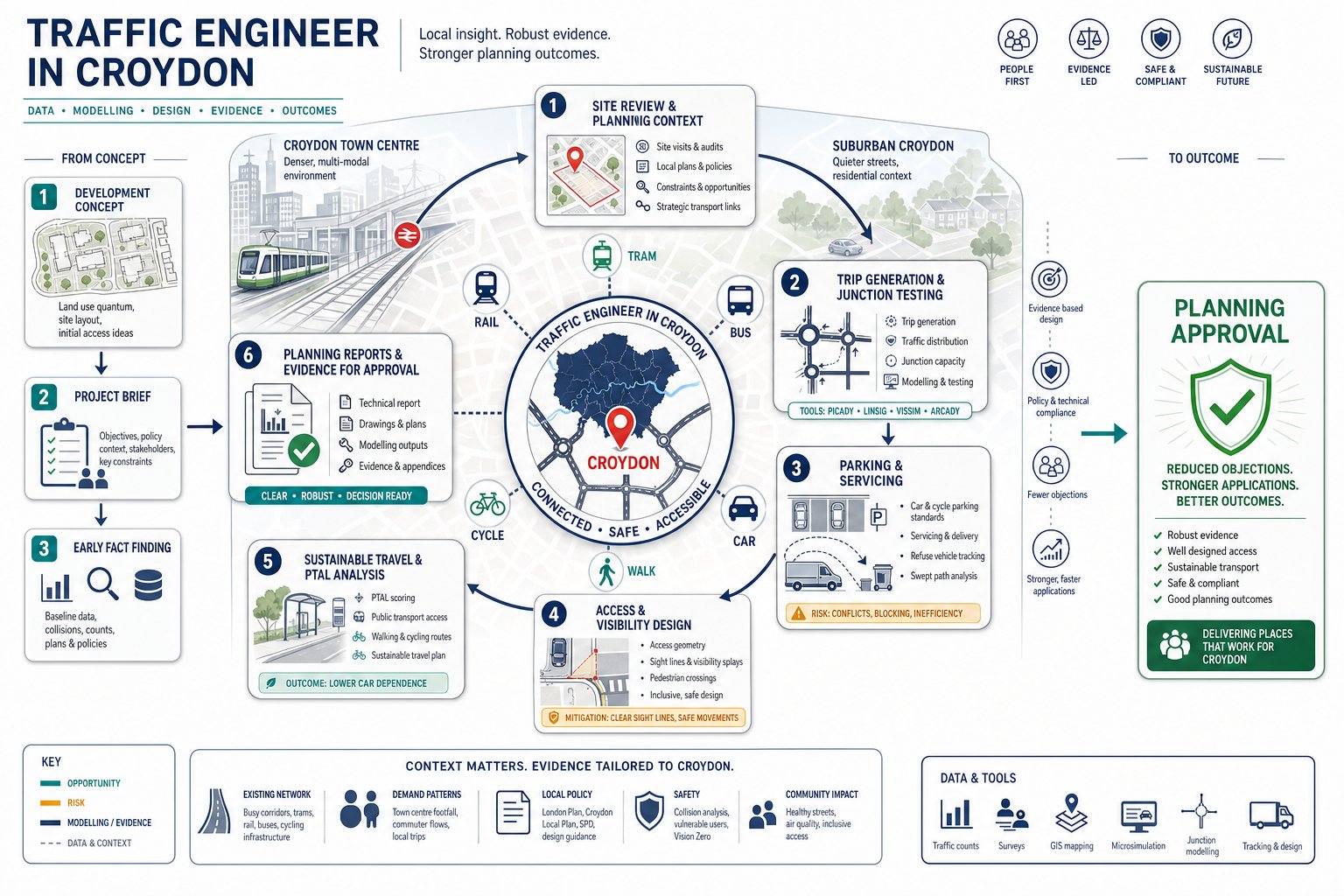
Croydon schemes rarely get far on layout and land use alone. But strong the architecture or commercial case may be, the planning outcome often turns on a more practical question: can the development work on the ground without creating transport problems the council, TfL, neighbours, or committee members can point to? That is where a traffic engineer in Croydon becomes central rather than optional.
We’re usually brought in when a project team needs clear, defensible transport evidence that matches local conditions. In Croydon, that means dealing with a borough that combines dense town-centre activity, strategic roads, tram infrastructure, rail interchanges, suburban residential streets, and sharply different accessibility levels from one site to the next. A generic report won’t do much good here.
Our role is to turn transport risk into something structured and manageable: assess likely trips, test junction effects, review parking and servicing, design access, and present the findings in a form planning officers can actually use. Done early, this work saves redesign, reduces objections, and gives applications a stronger footing from the outset.
In the sections below, we explain what a traffic engineer in Croydon does, which reports are commonly required, when to instruct one, and how transport evidence is shaped by Croydon Council policy, London Plan requirements, and the reality of the local network in 2026.
Key Takeaways
- A traffic engineer in Croydon is essential for providing location-specific transport evidence that ensures developments do not create transport problems for the council, neighbours, or TfL.
- Early involvement of a traffic engineer in the planning process helps influence access, parking, servicing, and layout decisions, reducing objections and costly redesigns.
- Transport reports for Croydon schemes must be proportional, ranging from concise technical notes to full Transport Assessments, aligned with local conditions and policy.
- Key transport concerns include junction capacity, parking stress, servicing logistics, sustainable travel promotion, and safety, all requiring tailored assessment.
- Effective transport evidence reflects Croydon’s varied accessibility levels, infrastructure, and policy expectations, grounding planning applications in realistic local network conditions.
What A Traffic Engineer In Croydon Does For Planning Applications
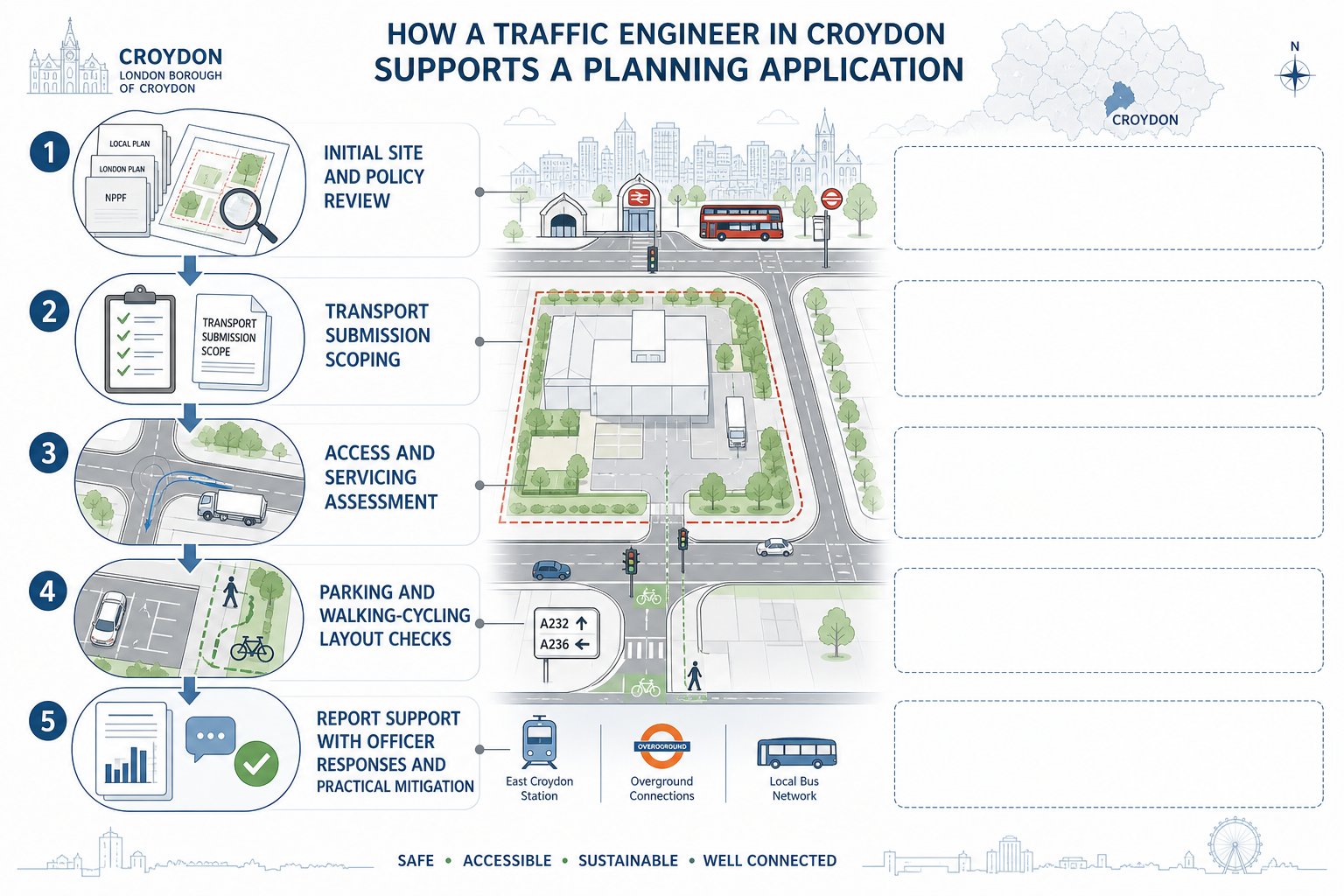

A traffic engineer in Croydon supports planning applications by providing technical evidence on how a development will interact with the highway and transport network. In practice, that means far more than counting cars. We assess whether a proposal can be accessed safely, whether servicing will work on site, whether parking levels are justified, and whether the surrounding network can absorb the additional demand.
For most schemes, our work begins with a review of the development quantum, land use, policy setting, and site constraints. We then advise on what transport submissions are likely to be needed. That may be a proportionate statement for a smaller scheme or a fuller assessment with modelling, mitigation, and supporting plans for larger or more sensitive sites.
We also bridge the gap between design teams and decision-makers. Architects may draw an efficient site plan, but if refuse vehicles cannot turn, visibility is substandard, or cycle parking conflicts with pedestrian routes, the planning risk rises quickly. Our job is to identify those issues early and resolve them before they become objections.
In London boroughs, and especially in Croydon, transport evidence also needs to align with wider policy and network expectations. That is why many teams use broader Traffic Engineering Consultants: support alongside scheme-specific local advice. We prepare reports, respond to officer comments, and help negotiate practical solutions that keep applications moving.
Why Croydon Developments Need Location-Specific Transport Evidence
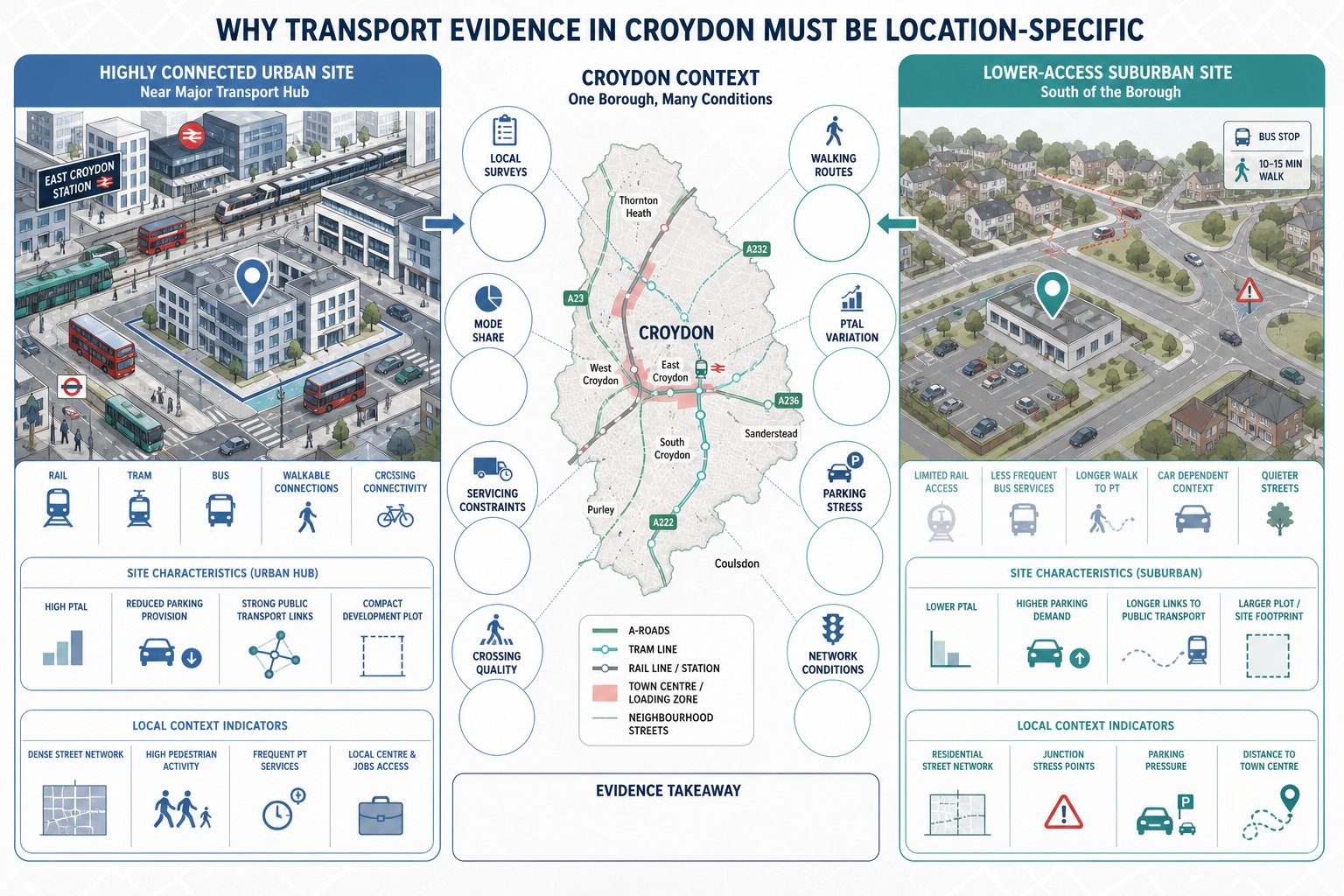
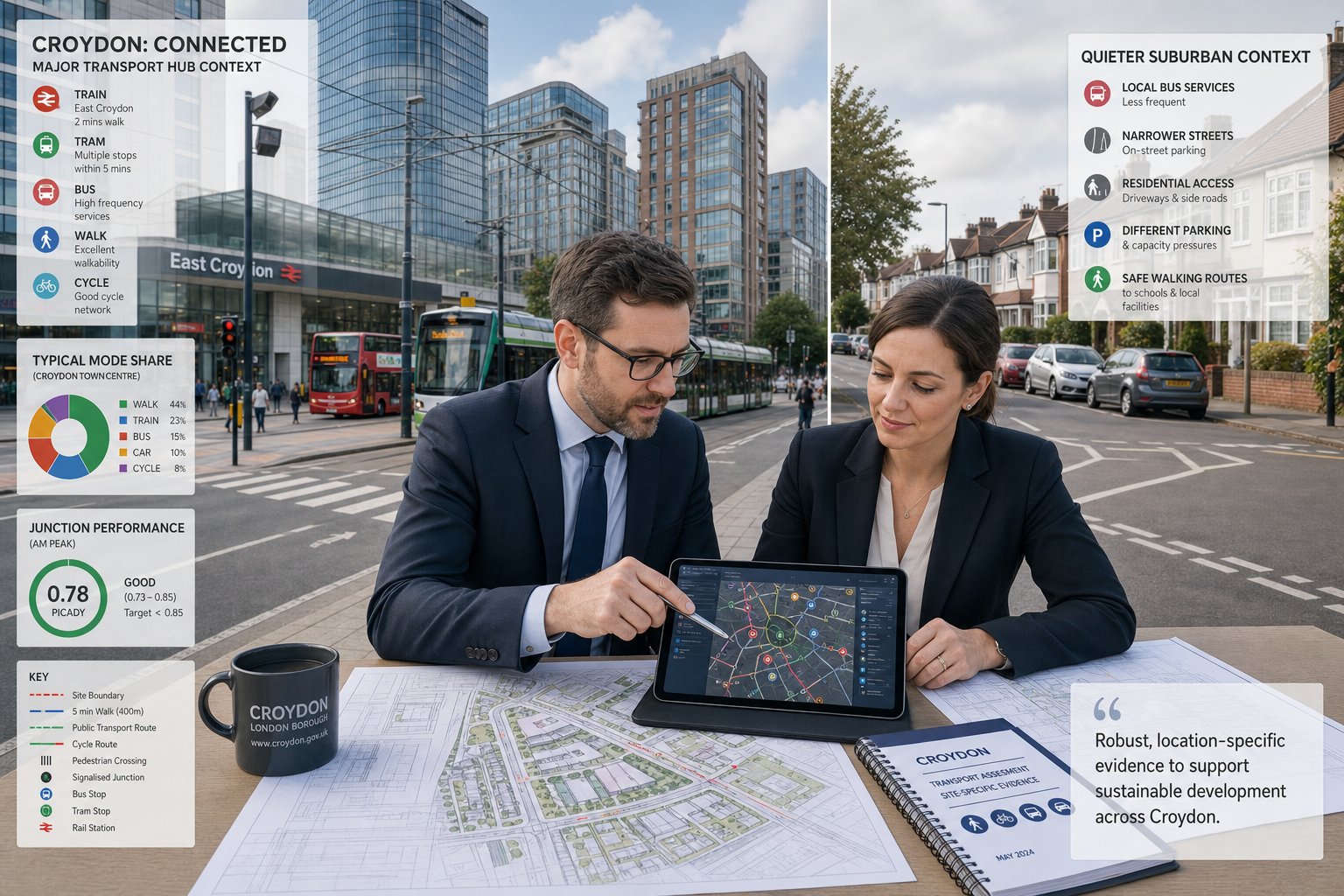
Croydon is not a place where standard assumptions travel well. A site near East Croydon, for example, may sit in a high-accessibility location with strong rail, bus, and tram connections and a clear policy basis for reduced car parking. A suburban site in the south of the borough may face a very different picture: lower PTAL, different parking expectations, more reliance on local junction capacity, and greater sensitivity from neighbouring streets.
That local variation matters because report credibility often depends on whether the evidence reflects the actual character of the site. Trip rates may need adjustment for mode share. Servicing arrangements may need to reflect constrained frontages or timed restrictions. Walking routes, crossing quality, and links to public transport can make the difference between a robust car-lite case and a weak one.
Croydon also contains strategic corridors, busy A-roads, tram movements, town-centre loading pressure, and residential roads already experiencing parking stress. The right baseline hence comes from local surveys, local policy review, and a realistic understanding of network conditions rather than broad national averages alone.
That borough-specific approach is one reason project teams often compare local work with wider Traffic Engineer In London: planning support. The London policy framework sets the backdrop, but the planning argument still has to be grounded in Croydon’s own streets, thresholds, and officer expectations.
When To Instruct A Traffic Engineer During The Planning Process
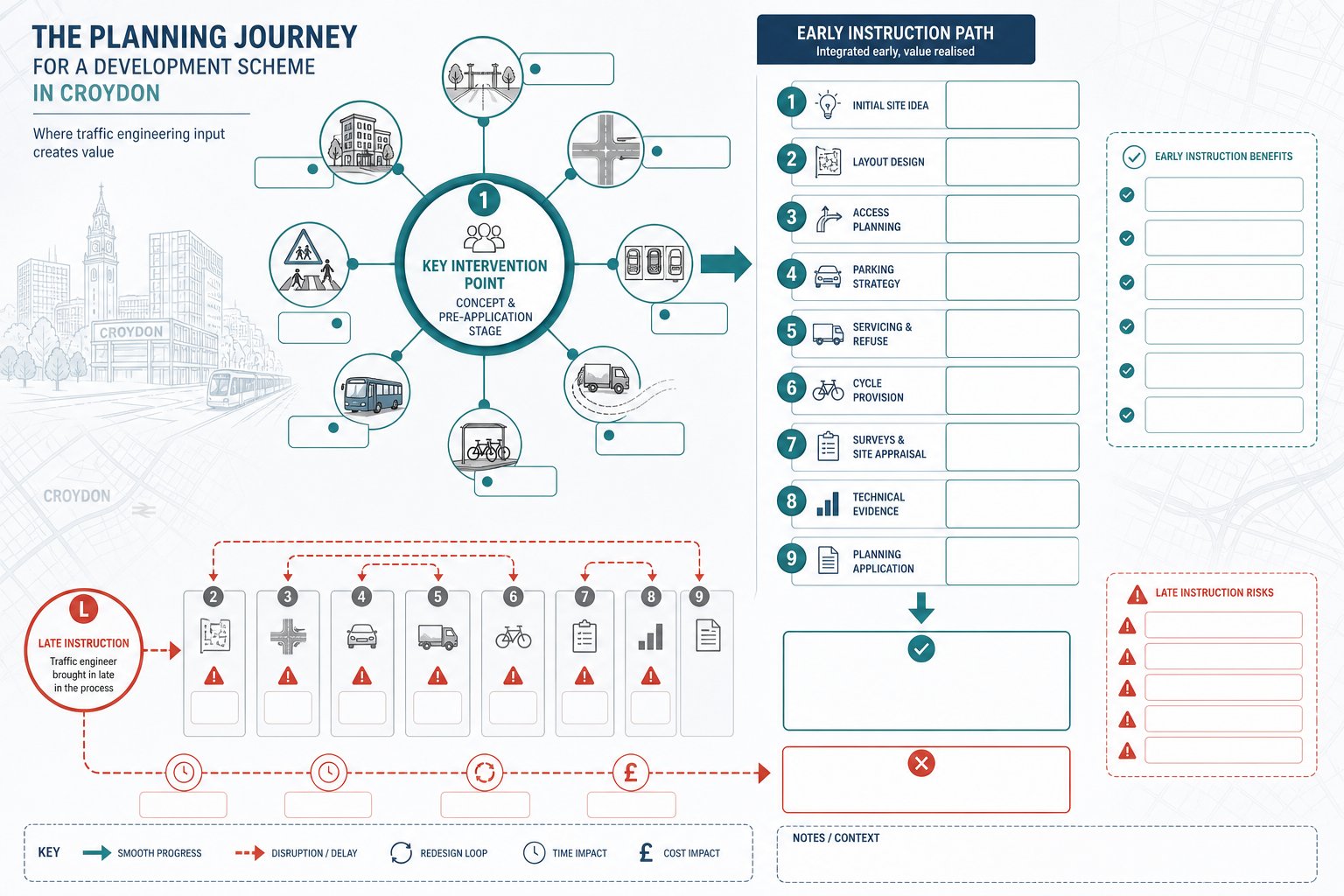

Early. In most cases, earlier than the team first expects.
For anything beyond a very minor householder proposal, we generally advise appointing a traffic engineer at concept or pre-application stage. That timing lets us influence the fundamentals: access location, internal layout, parking ratio, servicing strategy, and whether the proposed scale of development is likely to trigger more detailed assessment. If transport input waits until the application pack is nearly finished, the design may already be carrying avoidable problems.
A familiar example is a scheme with a neat architectural arrangement but no workable refuse tracking, no policy-compliant cycle provision, and a car park layout that cannot be used safely. Fixing those points late usually means redesign, delay, and extra cost. Fixing them early is routine.
Pre-application input is also valuable where officer or stakeholder concerns are likely. If a site sits near a constrained junction, a school, a bus corridor, or a sensitive residential street, we can help frame the evidence before the debate hardens. Sometimes that means recommending scoped surveys or a targeted technical note rather than waiting for the council to request more information after validation.
For developer teams dealing with employment or mixed-use schemes, the same principle applies across Commercial Traffic Engineering: transport should shape the proposal, not simply justify it after the fact.
Common Planning Reports Required For Croydon Schemes
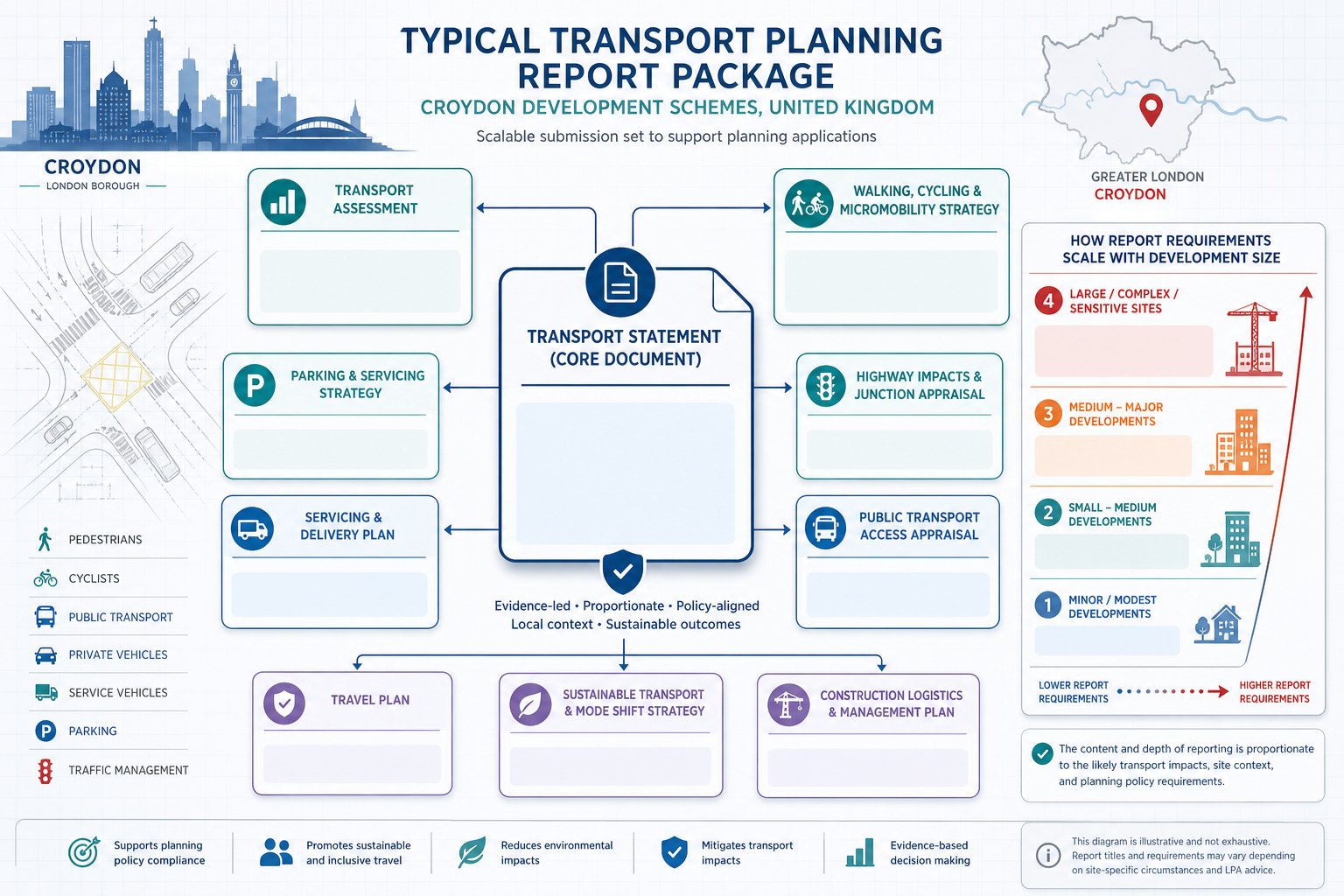

The reports required for a Croydon planning application depend on the scale of development, site sensitivity, land use, and likely transport impact. Some applications need only a concise technical note. Others need a full suite of submissions coordinated with the planning statement, design material, and environmental work.
The most common starting point is a Transport Assessment or Transport Statement. Around that core, we may also prepare a Travel Plan, Delivery and Servicing Plan, Construction Logistics Plan, parking review, access appraisal, or junction note. On more complex schemes, those documents need to work together rather than read like separate exercises prepared in isolation.
The important thing is proportionality. Planning officers usually respond best to evidence that is neither thin nor bloated. A modest development with limited impact should not carry an oversized transport package. Equally, a larger proposal near a sensitive junction or high-PTAL town-centre location should not rely on a lightweight statement that leaves obvious questions unanswered.
Below are the reports we most often prepare and how they are used in Croydon applications.
Transport Assessments And Transport Statements
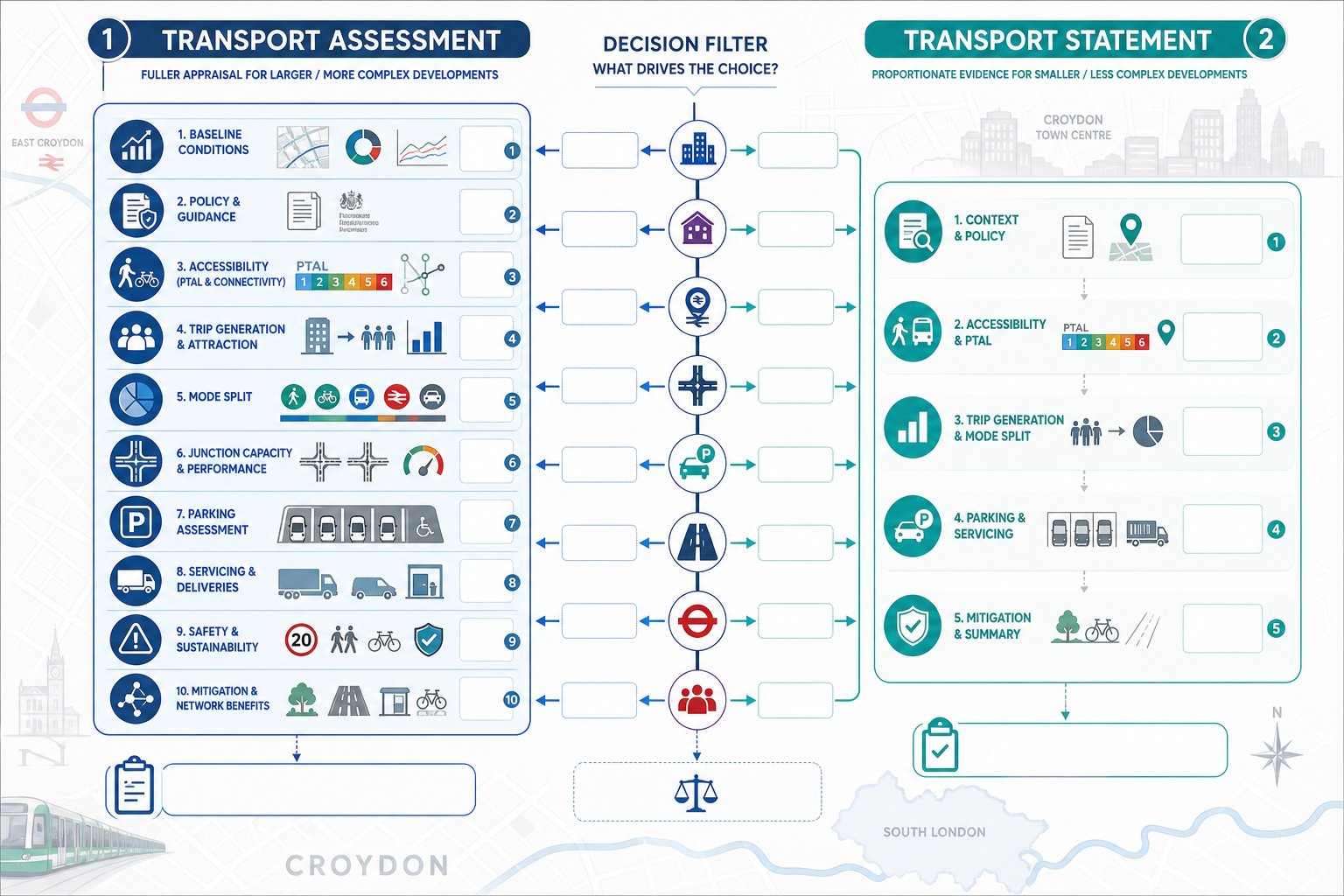
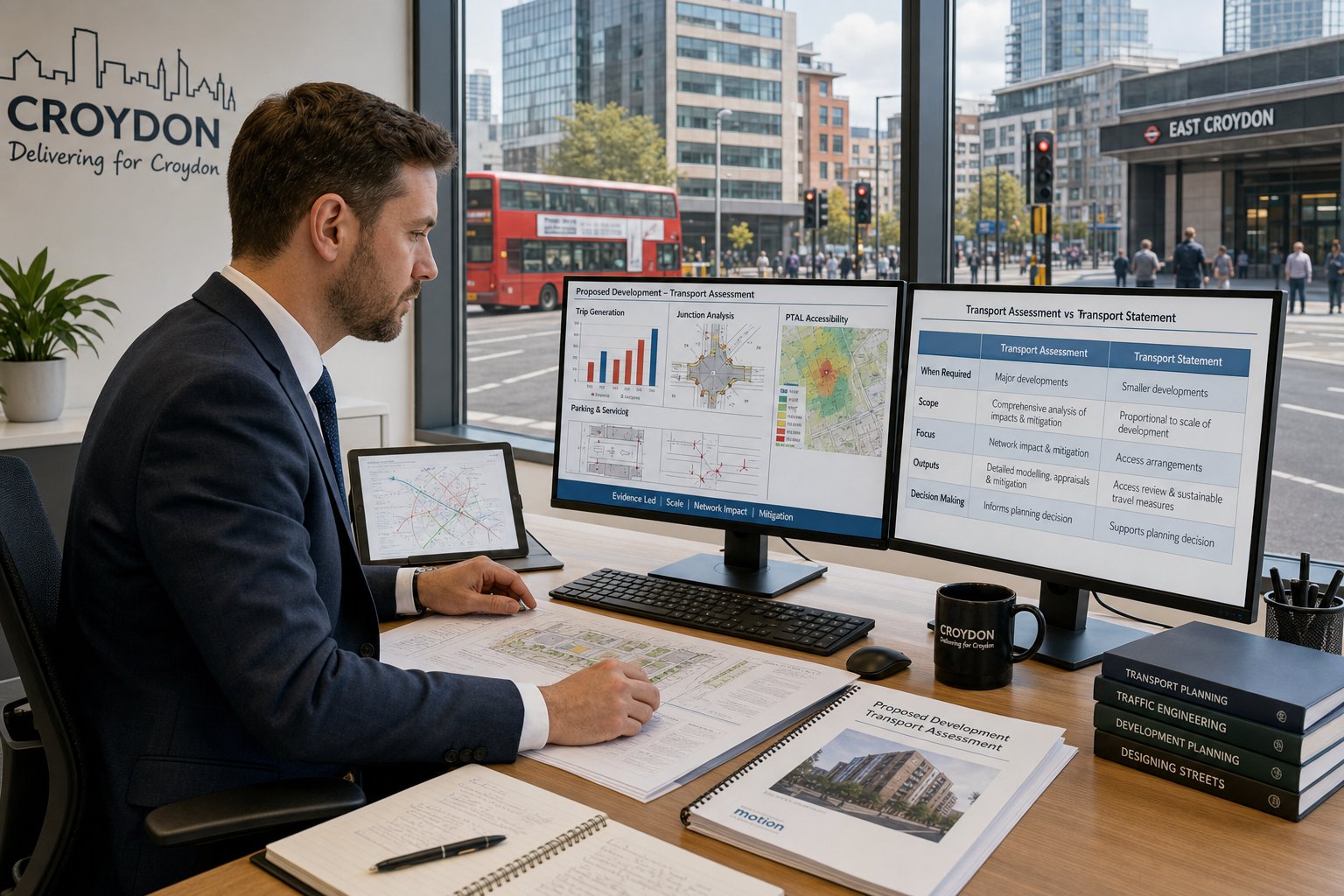
A Transport Assessment (TA) is the fuller option. It is typically used where a development could create material transport effects, where the site is sensitive, or where officers and TfL are likely to expect robust evidence. A TA usually covers baseline conditions, local policy, accessibility, trip generation, mode split, junction operation, road safety context, parking, servicing, and mitigation.
A Transport Statement (TS) is a more proportionate report for smaller or less impactful schemes. It still needs to be evidence-based, but it is usually shorter and more focused. The difference is not cosmetic: it is about scale, complexity, and likely effect.
In Croydon, the decision between TA and TS often turns on a mix of factors: development size, use class, PTAL, nearby junction sensitivity, parking stress, and whether the site touches strategic routes or TfL interests. Officers may also expect a stronger report where local objections are foreseeable, even if the formal threshold is arguable.
Good assessments are not just descriptive. They explain what the scheme generates, where those trips are likely to go, whether the network can accommodate them, and what design or operational changes are proposed if it cannot. That evidence-led approach sits at the heart of Traffic Engineering and transportation planning for planning-led development.
Travel Plans, Delivery And Servicing Plans, And Construction Logistics
These documents are sometimes treated as add-ons. They shouldn’t be. In Croydon, they can be central to making a scheme acceptable, especially where reduced parking, constrained streets, or town-centre conditions are part of the planning picture.
A Travel Plan sets out how a development will encourage sustainable travel. That may include cycle parking, travel information packs, car club measures, public transport promotion, monitoring, and mode-share targets. For residential schemes, the emphasis is often on reducing dependency on private car use. For offices, schools, and larger mixed-use schemes, monitoring and management become more important.
A Delivery and Servicing Plan (DSP) explains how day-to-day servicing will operate: vehicle types, timing, routing, loading locations, refuse collection, and any controls needed to avoid conflict with traffic or pedestrians. On tight urban sites, a DSP can answer the exact operational concerns that otherwise delay determination.
A Construction Logistics Plan (CLP) deals with the temporary but very real impacts of the build phase: HGV routes, contractor parking, site access, phasing, and safety controls. This is especially important where roads are narrow, nearby uses are sensitive, or there is interaction with busier corridors. Sound Highway And Traffic advice helps ensure these plans are practical rather than boilerplate.
Key Transport Issues That Often Affect Croydon Sites
Certain transport issues come up in Croydon again and again, regardless of whether the scheme is residential, commercial, educational, or mixed use.
The first is junction and corridor pressure. Sites near busy A-roads or town-centre approaches often need careful consideration of peak period operation, queueing, and turning movements. The second is parking stress. Even where policy supports low parking provision, neighbouring streets may already be sensitive, and applications need a credible explanation of likely car ownership, management, and permit context.
Servicing is another frequent pinch point. Many Croydon plots are constrained, with limited frontage, nearby activity, or little room for vehicles to wait, turn, or load safely. What looks manageable on a drawing can unravel quickly when refuse collection, parcel deliveries, and move-in activity are tested properly.
Then there is mode shift. High-PTAL locations may justify car-lite or car-free approaches, but only where walking, cycling, and public transport access are assessed honestly. Officers will usually expect the sustainable travel case to be backed by real site analysis, not broad aspiration.
And, of course, safety. Access width, sightlines, pedestrian conflict, and internal circulation remain basic issues, but they still trip up applications more often than they should. Solid Traffic Engineering: Your grounding helps teams spot these risks before submission.
Trip Generation, Junction Capacity, And Highway Impact Explained
This is often the section decision-makers focus on first, because it gets closest to the question everyone asks: how much extra traffic will the scheme create, and will that be a problem?
Trip generation estimates usually start with recognised survey sources such as TRICS, then get adjusted where justified by local context. In Croydon, those adjustments may reflect PTAL, land use mix, existing mode share, town-centre characteristics, or highly accessible rail and tram links. A poor report either ignores those factors or over-claims them. A good one uses them carefully and transparently.
Once trips are estimated, we test likely effects on the surrounding network. Depending on the site and issue, that can involve priority junction modelling, roundabout modelling, signal assessment, distribution analysis, or a focused review of operational conditions. The point is not to produce technical output for its own sake. It is to understand whether queues, delays, or turning conflicts become materially worse and whether mitigation is needed.
Highway impact is broader than capacity alone. We also consider safety, servicing interaction, network resilience, and strategic route sensitivity. In some cases the conclusion is simple: impact is limited and no mitigation is required. In others, mitigation may include layout changes, routing controls, servicing adjustments, or contributions. The strength of the planning case depends on how clearly that chain of reasoning is set out.
Parking, Access, Swept Path, And Visibility Requirements
Parking and access details often look like technical footnotes until they become the reason an application stalls. In Croydon, these points are rarely incidental. They sit right at the intersection of policy, highway safety, and day-to-day usability.
Parking provision needs to be tested against London Plan expectations, local standards, accessibility, and development type. In higher-PTAL areas, reduced levels may be entirely appropriate, but they still need to be justified. That usually means showing the site’s sustainable travel credentials, cycle provision, and likely demand profile rather than simply quoting policy headlines.
Access design must also work geometrically and safely. Widths, radii, gradients, pedestrian interaction, and vehicle conflict all need checking. For many schemes, swept path analysis is essential to confirm that cars, vans, refuse vehicles, or larger service vehicles can enter, manoeuvre, and leave in a forward gear where required. We often find that one tracking test answers weeks of debate.
Visibility is equally important. The standard depends on the road environment and applicable guidance, but the principle is constant: drivers and pedestrians need enough sight distance to use the access safely. Detailed access design highway work is often what turns a borderline arrangement into one that planning officers can support with confidence.
Walking, Cycling, Public Transport, And Accessibility Considerations
Transport planning in Croydon is not only about vehicle movements. In many schemes, especially those seeking lower parking ratios, the stronger argument sits with sustainable access.
We assess walking routes to local facilities, public transport stops, and surrounding streets. That includes footway width, crossing opportunities, lighting, directness, and whether routes feel realistic for everyday use rather than theoretical use. A station may be close in straight-line terms but much less persuasive if the route is awkward, indirect, or unpleasant.
Cycling needs the same realism. Good reports look at nearby routes, junction comfort, cycle parking quality, and end-of-trip provision where relevant. It is not enough to draw cycle stands: they have to be secure, accessible, and convenient enough that people will actually use them.
Public transport analysis usually covers PTAL, nearby bus stops, tram and rail availability, service frequencies, and the practical relationship between the site and those services. For larger schemes, capacity and network effects may also need discussion.
The broader accessibility picture often underpins the whole transport case. When we argue that a scheme can support reduced parking or a stronger sustainable mode share, this is the evidence base that carries that argument. And in Croydon, where accessibility changes sharply across the borough, that local analysis matters a great deal.
How Local Authority Thresholds And Policy Shape Report Requirements
Transport reporting requirements are shaped by both policy and judgement. The London Plan, Croydon policy framework, local validation expectations, and TfL guidance all play a role, but they do not operate as a simple tick-box list.
Thresholds help determine what is likely to be required: a TA or TS, Travel Plan, DSP, CLP, parking note, or modelling package. Yet in practice, site context can push requirements up or down. A development below a nominal threshold may still need stronger evidence if it sits on a constrained corridor, near a sensitive junction, or in an area with significant parking tension. Equally, a well-located site with modest impact may justify a more proportionate submission.
That is why experience matters. Knowing the wording of policy is one thing: knowing how it is usually applied in live Croydon cases is another. We tend to advise clients on both the formal trigger points and the likely officer expectations behind them.
This broader policy judgement is part of what differentiates routine transport input from more strategic Traffic Engineer in Croydon planning support. The goal is not just compliance on paper, but the right level of evidence for the actual planning risk.
What To Prepare Before Commissioning A Traffic Engineer
Clients get better, quicker advice when the basic project information is organised before instruction. It sounds obvious, but missing fundamentals are still one of the main causes of delay.
At minimum, we usually need the site location, red-line boundary, existing and proposed use, floorspace or unit numbers, and any available drawings showing access, parking, and servicing intent. Even an early sketch can be useful if it reveals what the design team is trying to achieve.
Planning background matters too. If there has been pre-application advice, previous refusals, appeal history, or known local concern, we need to know about it early. The same goes for stakeholder sensitivities, whether from neighbours, ward members, highways officers, or TfL. These issues often shape the report strategy as much as the site geometry does.
Programme is another practical point. Surveys, modelling, design revisions, and negotiation all take time. If the submission date is fixed, we need to understand that from the outset so the scope is realistic.
In short, the better the initial brief, the more targeted and proportionate the transport advice will be. A little preparation at the start usually saves a lot of avoidable iteration later.
How To Choose The Right Traffic Engineer For A Croydon Project
Not every transport consultant is the right fit for a Croydon planning application. The question is not just whether they can write a report. It is whether they can identify the likely issues early, scope the right evidence, and defend it through the planning process.
We would look first for local and London experience. A consultant familiar with Croydon Council, TfL expectations, London Plan parking and accessibility principles, and the realities of town-centre versus suburban sites will usually add value faster. Report quality also matters. Planning reports need to be concise, technically sound, and readable by non-engineers. Dense output without clear judgement rarely helps.
Capability is another filter. Can the team handle access design, swept path work, trip analysis, and junction modelling in-house where needed? Can they attend meetings and respond promptly to officer comments? If a scheme is politically sensitive or likely to go to committee, can they explain transport issues in plain English under pressure?
Finally, look at how they scope work. Good consultants are clear about what is required, what may be optional, and where risk sits. That approach is central to how we work at ML Traffic: concise, accurate transport reporting shaped around local authority thresholds and real planning context, backed by decades of practical experience.
For teams comparing options, consistency across wider Traffic Engineer In and London-area work can be helpful, but the deciding factor should always be whether the advice is grounded, proportionate, and genuinely planning-ready.
A Croydon application does not need transport paperwork for its own sake. It needs evidence that answers the right questions before someone else asks them. That is usually the difference between a report that simply accompanies an application and one that actively strengthens it.
Common Questions About Traffic Engineering in Croydon
What role does a traffic engineer play in Croydon planning applications?
A traffic engineer in Croydon provides technical evidence on highway and transport impacts of developments. They assess access, servicing, parking, and network effects, ensuring schemes comply with Croydon Council and TfL requirements to support planning approvals.
Why is location-specific transport evidence important for Croydon developments?
Croydon features diverse transport conditions—dense town centres, busy A-roads, tram and rail interchanges, and varying PTAL levels. Accurate, site-specific transport data is essential to reflect local road capacity, parking stress, and accessibility in planning reports.
When should developers appoint a traffic engineer for their Croydon project?
For anything beyond small householder schemes, appointing a traffic engineer at the concept or pre-application stage is best. Early involvement helps address access, parking, and safety issues before designs are finalised, reducing redesign and delays.
What are the typical transport reports required for a Croydon planning application?
Common reports include Transport Assessments or Statements, Travel Plans, Delivery and Servicing Plans, Construction Logistics Plans, and sometimes parking or junction modelling notes. Report scope depends on development scale, site context, and local policy thresholds.
How do Croydon’s parking and access standards affect planning applications?
Parking and access must meet London Plan and Croydon standards. In high-PTAL areas, reduced parking can be justified with strong sustainable travel evidence. Access designs and swept path analyses ensure safe vehicle manoeuvring and adequate visibility on site.
How does sustainable transport factor into Croydon traffic engineering?
Traffic engineers evaluate walking routes, cycle infrastructure, public transport access, and overall site accessibility. Robust evidence supports car-lite developments by demonstrating practical sustainable travel options aligned with local policies and TfL guidance.