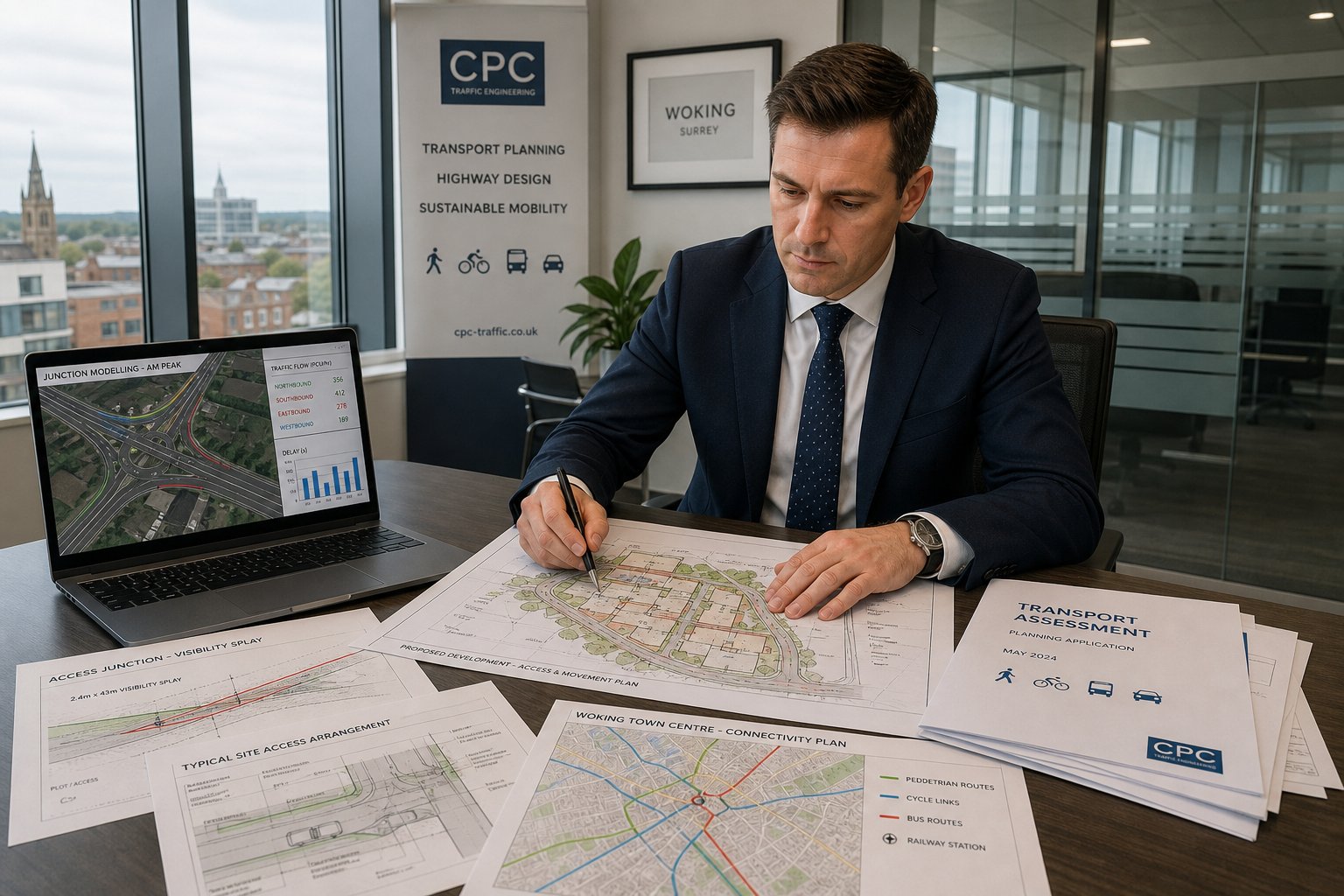
Planning applications rarely fail because of one dramatic issue. More often, they slow down because a practical transport question was left hanging too long: is the access safe, will the junction cope, is the parking sensible, will Surrey object? In Woking, those questions matter early. The combination of busy commuter corridors, town-centre regeneration, residential pressure, and close scrutiny from the local highway authority means transport evidence can shape a scheme long before committee.
That is where a traffic engineer in Woking adds real value. We help development teams understand how a proposal will interact with the surrounding network, what level of assessment is likely to be needed, and how to present that evidence in a way planning officers and highway consultees can work with. For architects, planners, developers, solicitors and surveyors, good transport input is not just about satisfying a technical requirement. It can influence site capacity, viability, access strategy, design quality and timing.
In this guide, we set out what a traffic engineer does, when a Transport Assessment or Transport Statement may be required, how Woking and Surrey typically review highway impacts, and what to prepare before instruction. The aim is simple: help you move from uncertainty to a cleaner, more defensible planning submission in 2026.
Key Takeaways
- A traffic engineer in Woking plays a crucial role in ensuring safe and efficient access while addressing local highway authority concerns early in the planning process.
- Transport Assessments are typically required for larger developments, while smaller schemes may suffice with a Transport Statement or technical note tailored to local network sensitivity.
- Surrey County Council and Woking Borough Council jointly assess applications, focusing on safe access, highway impact, and sustainable travel alternatives to reduce objections and delays.
- Early engagement with a traffic engineer helps identify design and access issues, enabling smoother, faster planning submissions and avoiding costly redesigns later.
- Comprehensive traffic evidence must consider junction capacity, highway safety, parking, servicing, and accessibility to meet Woking’s specific transport demands.
- Selecting a traffic engineer with local knowledge and a clear, proportionate reporting style enhances the chances of planning success and effective communication with authorities and stakeholders.
What A Traffic Engineer In Woking Does For Planning And Development Projects
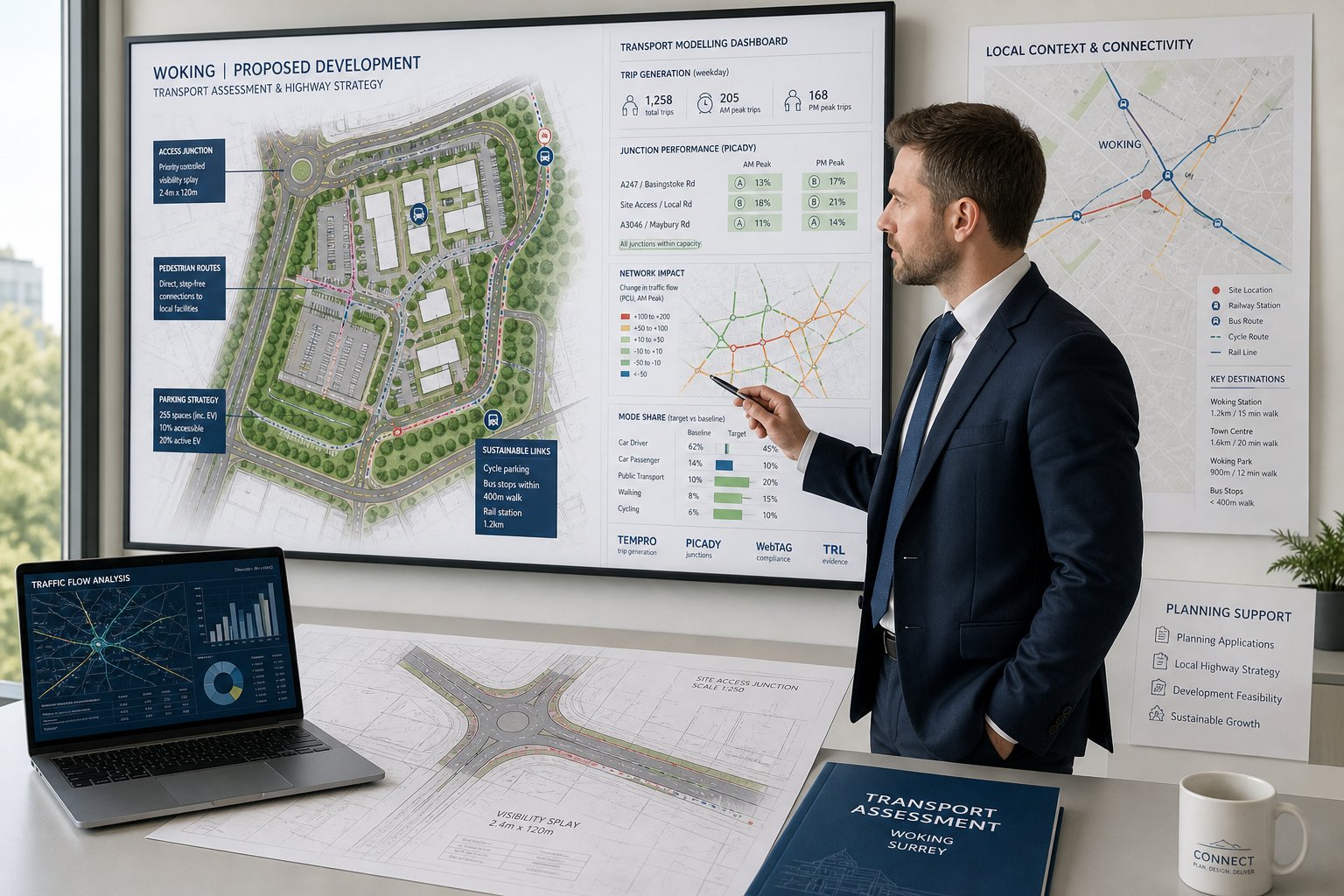
A traffic engineer in Woking supports planning applications by testing whether development can be accessed safely and accommodated sensibly on the surrounding network. That sounds straightforward. In practice, it covers a wide range of tasks, from early feasibility advice through to detailed modelling, report writing, drawing review and consultee responses.
At the front end of a project, we usually review the site context: highway classification, nearby junctions, traffic conditions, collision history, parking controls, walking and cycling links, and the relationship to bus or rail services. That early pass often reveals the real constraints quickly. Sometimes the issue is a substandard visibility splay. Sometimes it is servicing. Sometimes the access works technically, but the likely trip impact means a stronger sustainable travel package is needed.
We then estimate how many trips the development is likely to generate, when those trips occur, and where pressure may fall on the network. Depending on the scale of the proposal, that can involve first-principles review, TEMPro-informed forecasting, TRICS analysis and capacity testing with recognised software such as PICADY, ARCADY, LinSig or microsimulation tools where appropriate. Broader context from Traffic Engineering Consultants: and Traffic Engineering and often helps teams understand how this evidence fits into the planning process.
Just as importantly, we help shape the design. Access geometry, swept paths, internal circulation, parking layouts, refuse collection arrangements, delivery movements and pedestrian routes all need to work together. A good traffic engineer is not there to produce paperwork after the design is fixed: we are there to improve the scheme before it is exposed to formal review.
For Woking projects, local knowledge matters. The way issues are scoped, the detail expected by Surrey County Council, and the relationship between highway comments and planning strategy can make a material difference to programme and risk.
When You May Need A Transport Assessment Or Transport Statement In Woking
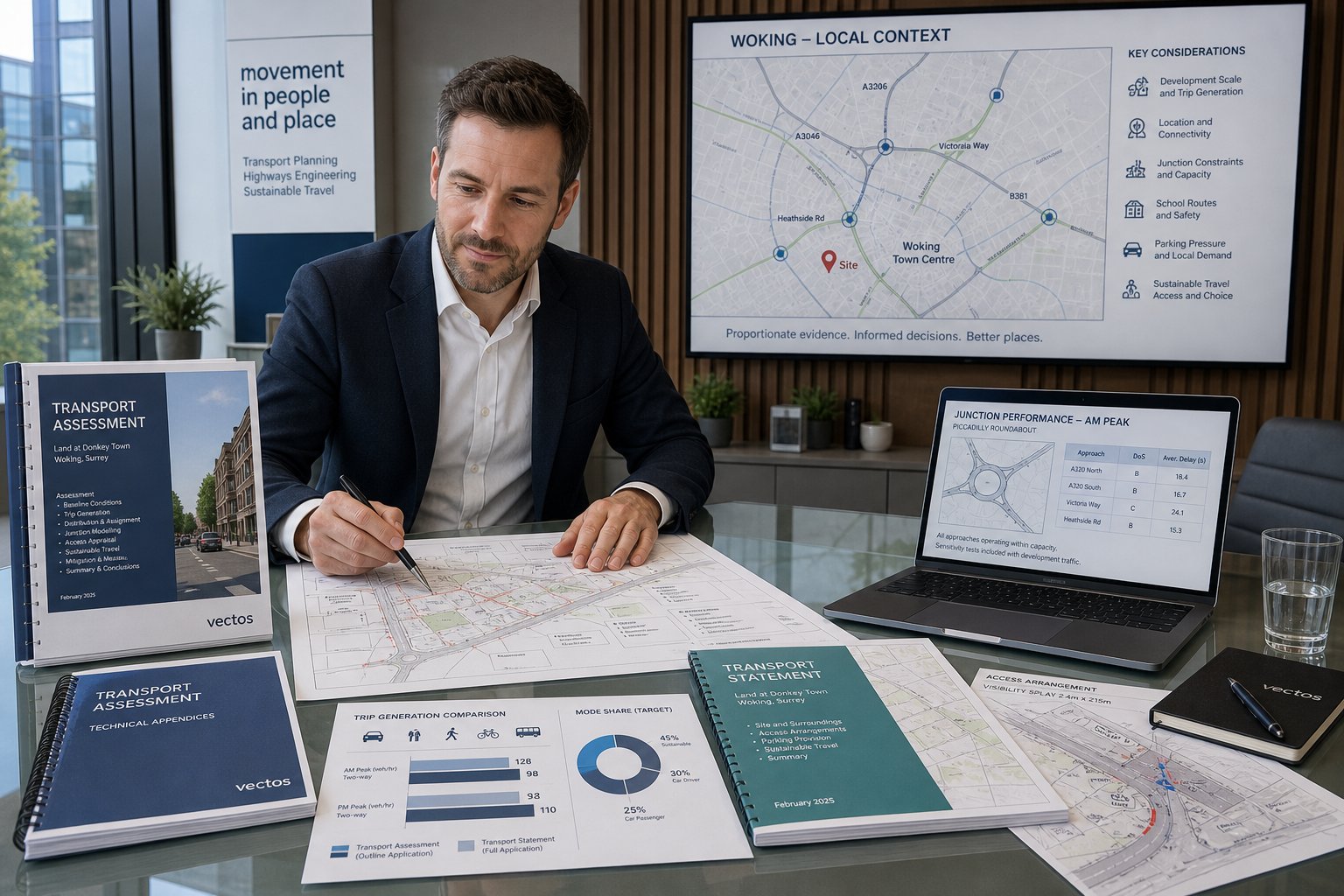
Not every scheme needs a full Transport Assessment, and not every smaller development can rely on a light-touch note. The right level of transport evidence depends on scale, use, location, access conditions and likely impact on the network.
In broad terms, larger or more traffic-intensive proposals usually require a Transport Assessment (TA). That often includes major housing schemes, food retail, schools, substantial employment uses, mixed-use regeneration sites and developments in sensitive locations where junction performance or safety is already under pressure. A TA is the fuller document: baseline conditions, trip generation, trip distribution, capacity assessment, sustainable travel review, mitigation and sometimes framework travel planning.
A Transport Statement (TS) is generally used for smaller schemes where impacts are expected to be limited and can be explained proportionately. Typical examples include modest residential proposals, small commercial changes of use, local infill sites, or developments where the highway effects are clearly manageable. A concise technical note may also be suitable where one issue needs focused analysis rather than a complete TA or TS.
The important point is this: thresholds are not just about unit numbers or floor area. Context matters. A development beside a constrained junction, a school route, or a heavily parked street may need more evidence than its size alone suggests. Equally, a well-located town-centre scheme with strong non-car accessibility may justify a more proportionate approach.
In Woking, the best course is usually to agree scope during pre-application discussions, particularly where the site is finely balanced. National guidance from the Department for Transport provides the framework, but Surrey County Council will still want the assessment to reflect local conditions and the actual planning risk.
How Woking Planning And Surrey Transport Consider Highway And Access Impacts
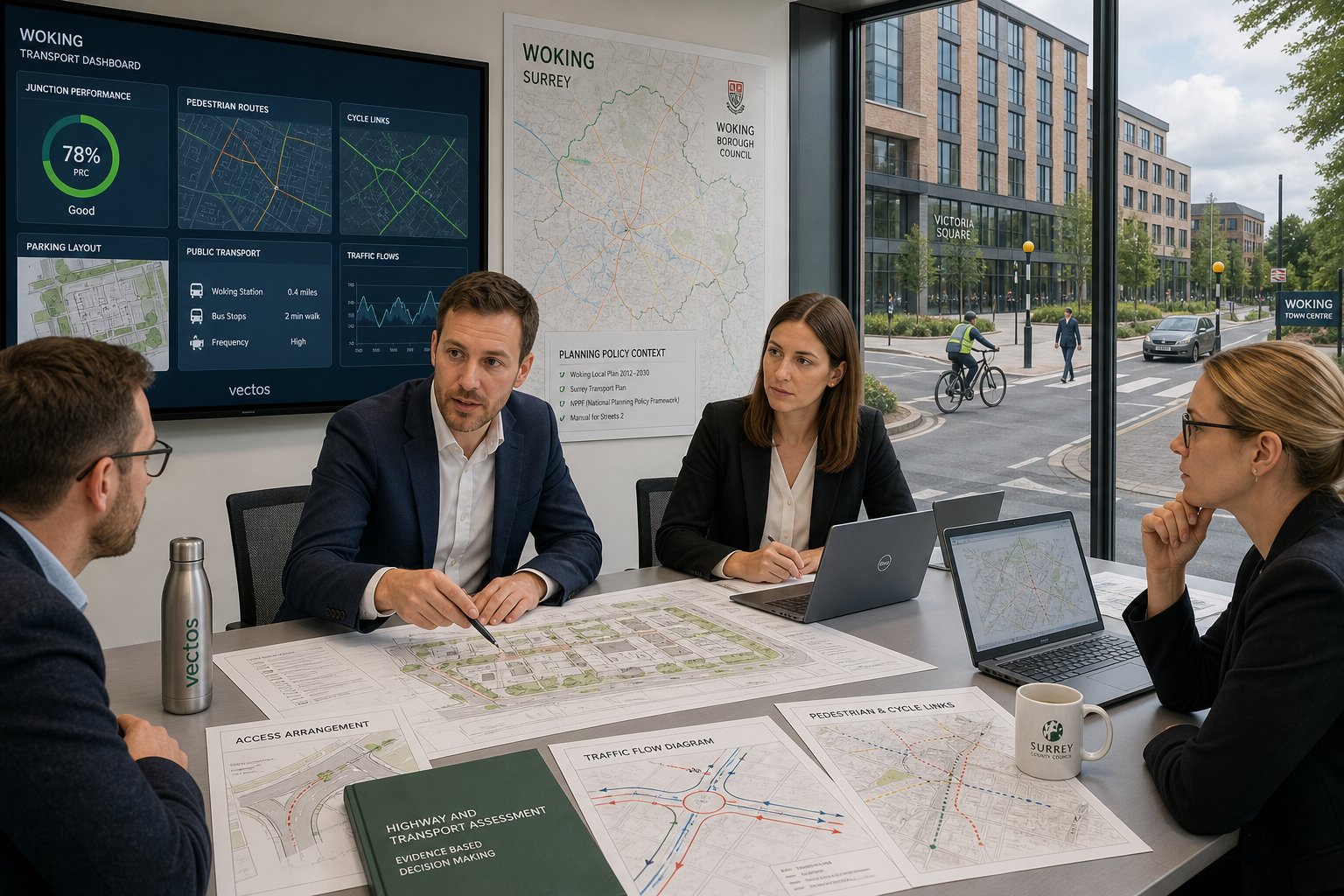
Planning decisions in Woking typically involve two connected but distinct perspectives. Woking Borough Council considers the wider planning balance: land use, design, amenity, policy fit and deliverability. Surrey County Council, as local highway authority, focuses on transport and highway matters as a statutory consultee. If those two strands are not aligned, applications can stall.
From the highway side, the core tests are familiar but important: is there safe and suitable access for all users, would the development create an unacceptable impact on highway safety, and would the residual cumulative effect on the road network be severe? Those principles flow from national policy, but their application is site-specific.
Officers will normally examine access geometry, visibility, interaction with nearby junctions, pedestrian crossing opportunities, cycle access, servicing, parking provision, and whether emergency and refuse vehicles can operate properly. For larger schemes, they may also look closely at peak-hour queues, turning conflicts, rat-running risks, and cumulative effects with nearby committed development.
Sustainable travel is now a much bigger part of the conversation than it was a decade ago. A scheme in Woking will often be judged not only on whether cars can get in and out safely, but on whether future occupants, staff or visitors have realistic alternatives to the private car. That means walking links, cycle parking, public transport accessibility, travel planning measures and sometimes contributions to off-site improvements all come into play.
There is also a practical dimension. Surrey officers tend to respond better to reports that are proportionate, transparent and grounded in local reality. Overstated assumptions or generic mitigation wording rarely help. Guidance around Highway And Traffic and robust access design highway principles often underpins that dialogue.
When transport evidence is clear, planning officers can usually frame conditions or obligations with confidence. When it is vague, objections become more likely, and even minor schemes can end up circling through revisions.
Typical Developments That Require Traffic Engineering Input
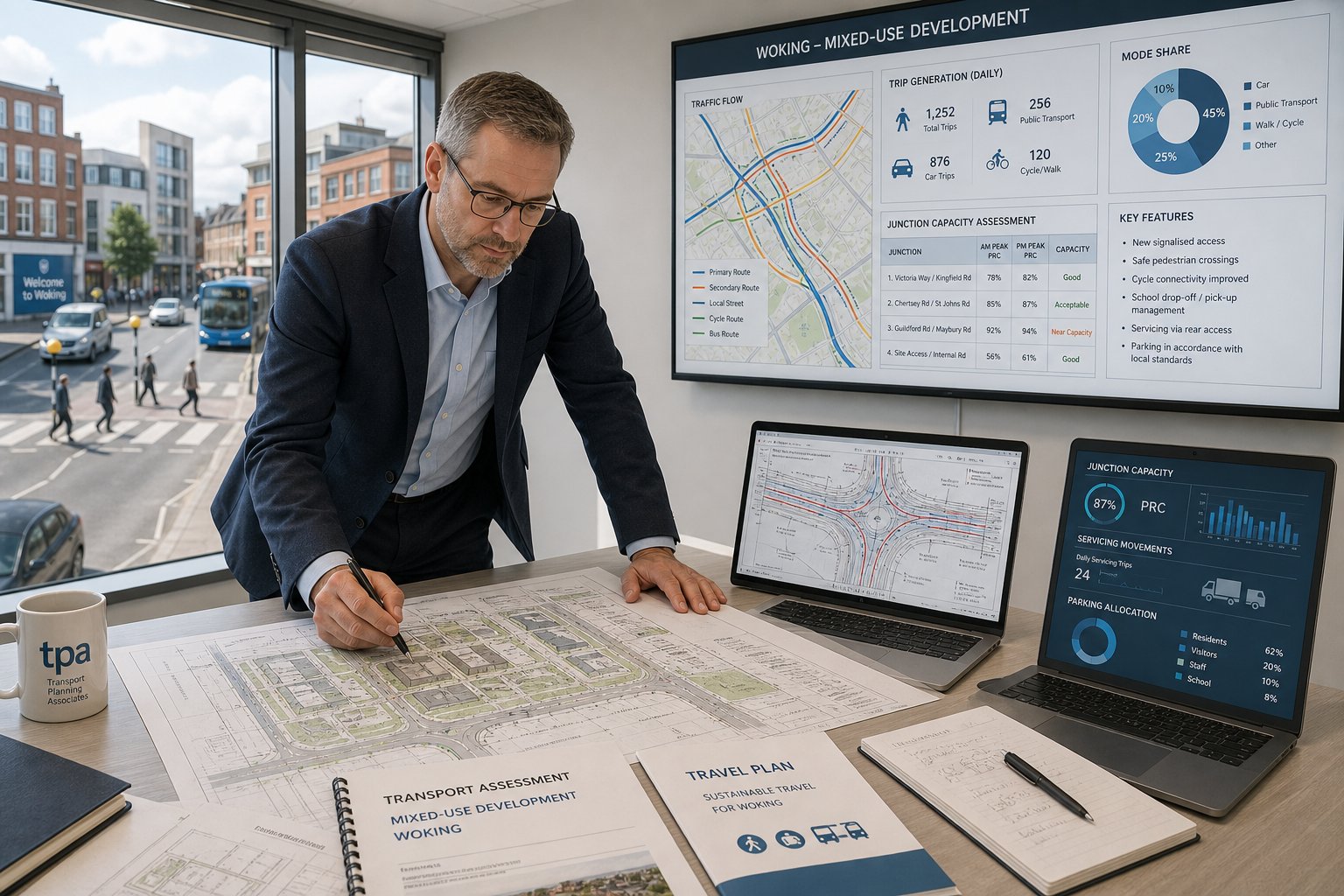
The range is broader than many clients expect. Traffic engineering is not reserved for strategic land promotions or hundred-unit estates. In Woking, even relatively modest proposals can trigger transport questions if the location is constrained, heavily trafficked, or sensitive in safety terms.
Some projects need only a short review to confirm likely requirements. Others need a fully integrated package of access design, traffic analysis and travel planning. The common thread is that development changes how people and vehicles move, and planning authorities need confidence that the change has been thought through properly.
Residential Schemes
Residential development is the most frequent source of traffic engineering instruction in Woking, but the needs vary sharply by scale and context. A single dwelling on a narrow frontage may turn on one issue only: can safe access and visibility be achieved without harming the street scene or conflicting with parked vehicles? A block of flats near the town centre may instead hinge on parking accumulation, servicing, cycle provision and realistic assumptions about trip generation. Larger estate redevelopments or urban extensions raise wider questions around junction capacity, internal hierarchy, active travel permeability and cumulative network effects.
Residential schemes also attract local concern quickly. Neighbours may object on speeding, overspill parking, school-run congestion or road safety, even where the measured technical impact is modest. Good evidence matters because it separates perceived harm from demonstrable harm without dismissing lived experience. We often find that careful layout changes, clearer tracking, or a more credible parking and travel strategy can resolve issues before they harden into formal objection.
Commercial, Mixed-Use, And Education Projects
Commercial and institutional development often creates more complex movement patterns than housing. Food retail can generate linked trips and sharp peak spreads. Industrial and warehousing schemes bring servicing, HGV routing and gate management into focus. Offices and leisure uses may have lower peak trip rates than expected in strong public transport locations, but they still need defensible assumptions. The planning considerations set out in Commercial Traffic Engineering are especially relevant here.
Mixed-use projects can be efficient from a transport perspective, yet they are rarely simple to assess. Shared access, different peak periods, servicing overlap and town-centre constraints all require careful handling. Education schemes are another distinct category: school travel patterns, parent drop-off behaviour, coach movements and safeguarding of pedestrian routes can dominate the review. Even where the highway network appears capable on paper, operational details often decide whether officers are comfortable supporting the application.
Health uses, care homes and hotels also need tailored appraisal rather than recycled assumptions. In short, land use matters, but local operating conditions matter just as much.
Core Traffic Engineering Reports Used In Woking Planning Applications
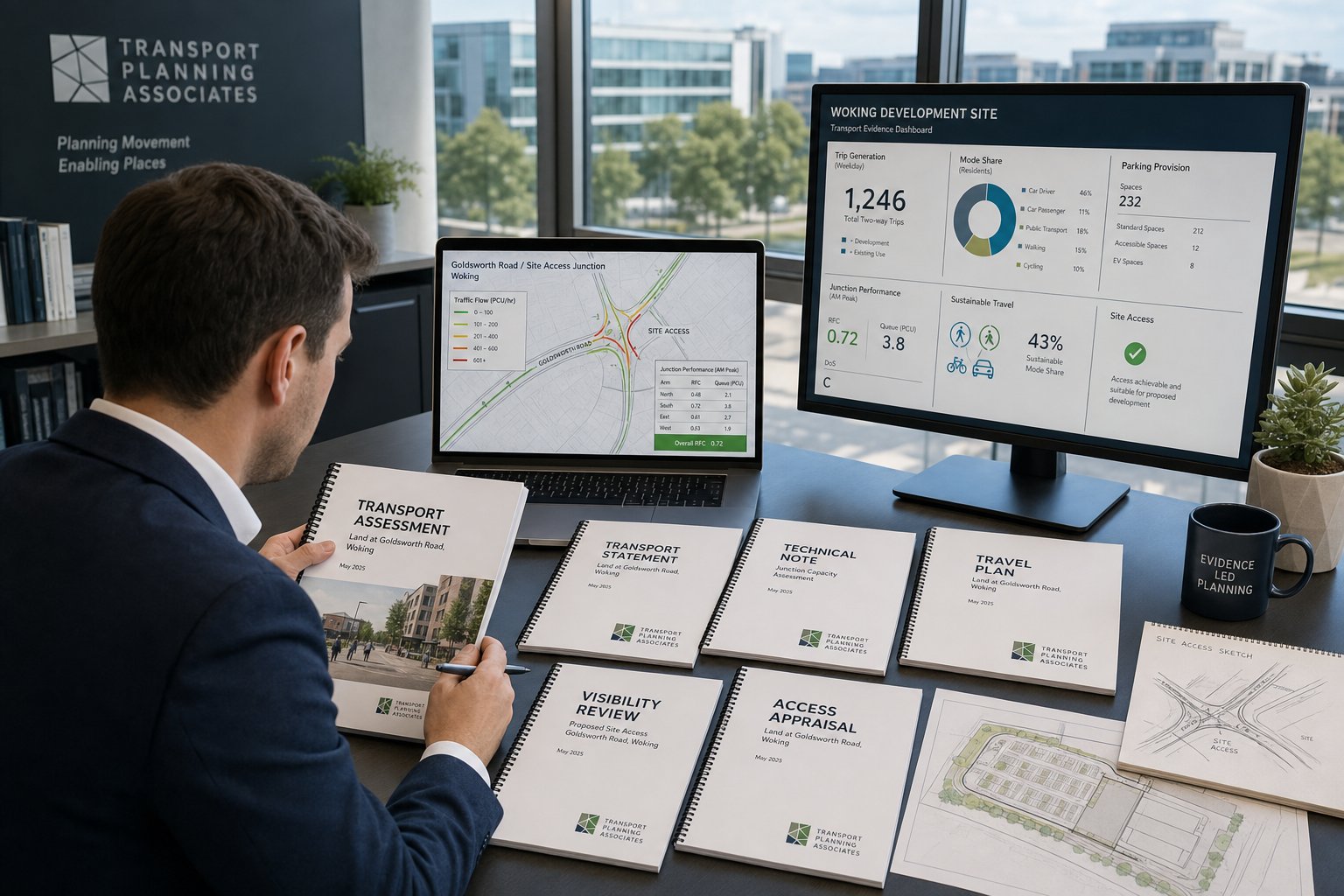
Most planning teams hear the names of transport documents long before anyone explains the differences properly. In Woking, choosing the right report format is not just an administrative decision: it affects scope, cost, programme and the level of scrutiny the application will attract.
Transport Assessments, Transport Statements, And Technical Notes
A Transport Assessment is the main evidence base for developments with potentially material transport effects. It usually covers baseline conditions, planning context, site accessibility, trip generation, distribution and assignment, junction analysis, safety review, parking and servicing, and any required mitigation. For larger or more sensitive schemes, it can also include committed development, cumulative impact assessment and detailed appendices on modelling methodology.
A Transport Statement is shorter and more proportionate. It still needs to be evidence-led, but it is designed for schemes where impacts are expected to be limited. The best TS documents are concise without being thin: they explain why a full TA is unnecessary while still addressing access, parking, sustainable travel and local highway conditions in enough detail to satisfy review.
Technical Notes are often underrated. They can be extremely useful where a single issue needs clarification, where officer comments require targeted response, or where an addendum is needed following design evolution. Sometimes a well-timed technical note avoids reopening an entire assessment. Practical reporting approaches similar to Traffic Engineering: Your and even cross-authority comparisons such as Traffic Engineer In show how proportionate documentation can still be persuasive.
Travel Plans, Visibility Reviews, And Access Appraisals
Beyond the main assessment, several supporting documents commonly appear in Woking applications. A Travel Plan sets out how the development will encourage sustainable trips, reduce single-occupancy car use where possible, and monitor outcomes over time. For employment, education and larger residential schemes, this can be a meaningful part of the package rather than a token appendix.
A visibility review checks whether drivers and vulnerable road users can see and be seen at the proposed access, in line with relevant guidance and actual operating speeds. Small discrepancies here can become major planning issues, particularly on roads with frontage parking, bends or vertical alignment constraints.
An access appraisal goes wider. It considers geometry, junction form, tracking for refuse and fire appliances, gradients, gates, internal turning and how the site connects to footways and cycle routes. On some projects, this is where the real planning battle is won. If the access strategy is credible, much of the rest of the submission becomes easier to defend.
Key Issues Assessed By A Traffic Engineer In Woking
Although every site is different, the same technical themes recur across Woking planning applications.
Junction capacity is usually near the top of the list. We assess whether nearby junctions can accommodate forecast trips in peak periods and, if not, whether mitigation is available and proportionate. Queue length can matter as much as reserve capacity, especially where blocking back affects adjacent accesses or signal stages.
Highway safety is another core issue. That includes personal injury collision records, site-specific hazards, the behaviour of vulnerable road users, and whether the proposal could intensify an existing conflict. Safety is rarely just about numerical accident data: geometry, parking stress, visibility and user behaviour all count.
Access design is scrutinised closely. Surrey will typically want confidence on width, radii, gradients, intervisibility, turning provision and the relationship between the site access and nearby junction features or restrictions. Small access flaws have a habit of causing disproportionate delay because they cut across both highways and design considerations.
Parking and servicing also need a realistic approach. Too little parking can trigger overspill objections. Too much can undermine sustainable transport claims and weaken urban design. Servicing is often where schemes come unstuck late in the day, particularly if tracking was not checked against the actual layout.
Then there is accessibility in the wider sense: walking routes, cycle connections, distance to bus stops and rail services, crossing opportunities, step-free movement and practical day-to-day usability. These factors increasingly shape whether a development is considered sustainable in transport terms.
A capable Traffic Engineer In any location will cover those basics, but in Woking the local street context, commuter patterns and sensitivity around parking often mean the detail matters more than the headline trip rate.
Why Early Traffic Advice Can Reduce Planning Delays And Objections
Early traffic advice saves time because it prevents the wrong design from becoming emotionally or commercially fixed.
We have seen this repeatedly. An architect develops a layout around an assumed access point: a developer prices the scheme: a planning statement is drafted: then highway review identifies a visibility shortfall, refuse tracking problem or unacceptable parking arrangement. At that stage, even a modest technical issue can trigger redesign, resubmission of drawings, new consultation and weeks of lost programme.
Bringing a traffic engineer in early helps test the fundamentals before too much depends on them. Can the site be accessed safely? Is the likely quantum realistic given local highway constraints? Will Surrey expect a TS, a TA, or something more focused? Are there nearby junctions that may need modelling? Is the sustainable travel case strong enough? Those are better asked before the red-line assumptions harden.
Early advice also improves pre-application engagement. When scope is discussed with officers on the basis of a credible transport review, the planning team can often narrow the issues, agree proportionate work and avoid over-commissioning. That is good for budget as well as timing.
And there is a softer benefit. Local objections often focus on traffic, even where the planning merits lie elsewhere. If the application already contains clear access drawings, reasoned parking analysis and a proportionate transport narrative, it is easier for officers to answer concerns confidently. The scheme looks prepared rather than defensive.
In practical terms, early transport input usually costs less than late redesign. That is not a slogan: it is just how projects behave.
What To Prepare Before Instructing A Traffic Engineer
The better the starting information, the quicker we can advise and the more accurately we can scope the work.
At minimum, we usually need a red-line site plan, the proposed development quantum, and a clear description of the intended use or mix of uses. Unit numbers, floor areas, likely staffing, servicing expectations and parking assumptions are all useful. Even if the design is still fluid, an indicative layout helps us test whether the access and internal arrangement are likely to work.
It also helps to share any planning history, previous refusals, appeal decisions, pre-application notes and known local concerns. If neighbours have consistently raised school-run congestion, dangerous reversing, or on-street parking pressure, that context should be on the table from day one. It may not change the technical answer, but it often changes how the evidence needs to be presented.
Programme matters too. Survey requirements, junction modelling, design iterations and officer engagement all take time. If there is a fixed submission date, we need to know early so that scope can be prioritised sensibly. Budget is part of the same conversation: there is little value pretending a full modelling exercise is feasible if the actual need is a proportionate note tied to a fast submission.
On more complex projects, it is worth aligning the transport brief with architecture, planning and flood or drainage inputs at the outset. Site design decisions overlap more than teams sometimes expect.
In short: bring the facts, the timetable, the constraints and the current drawings. We can do a lot with incomplete information, but good instructions usually produce better, faster outcomes.
Choosing The Right Traffic Engineer In Woking For Your Project
Choosing the right consultant is not only about technical competence. It is about judgement, proportion and familiarity with the planning environment your application will move through.
First, look for genuine experience with Woking and Surrey County Council processes. Local authority expectations are never identical from place to place, even when the national policy framework is shared. A consultant who understands likely scoping positions, recurring officer concerns and local network sensitivities can often save a project from avoidable detours.
Second, review the consultant’s reporting style. Strong transport documents are clear, evidence-led and readable by non-specialists. Planning officers, committee members, solicitors and local residents may all end up relying on them. Dense technical writing with weak narrative can be just as unhelpful as an oversimplified note.
Third, ask about range of support. Can they handle a quick TS for a small scheme, but also undertake modelling, access design review, travel planning and responses to consultee comments if the job expands? Can they attend meetings or support appeal work if needed? That flexibility matters when projects evolve.
Credentials still count. Relevant chartership, professional memberships and a demonstrable traffic and transport track record are all sensible indicators. But equally, look for responsiveness. Planning programmes do not always wait politely.
For many clients, the sweet spot is a consultant who combines technical depth with concise delivery. That is particularly valuable when teams need robust reports quickly, tailored to local thresholds and actual planning risk rather than padded with unnecessary analysis.
If you are appointing a traffic engineer in Woking, choose someone who can improve the scheme, not just describe it after the fact. That difference is where smoother applications usually start.
Frequently Asked Questions About Traffic Engineering in Woking
What role does a traffic engineer in Woking play in planning applications?
A traffic engineer in Woking assesses how a development affects local traffic and designs safe access, parking, and movement for vehicles, cyclists, and pedestrians, ensuring compliance with Surrey County Council standards and supporting successful planning submissions.
When is a Transport Assessment or Transport Statement required for developments in Woking?
Major developments like large housing schemes, schools, or retail projects typically need a full Transport Assessment, while smaller projects or changes of use with limited impact usually require a proportionate Transport Statement or a focused Technical Note agreed with Surrey County Council during pre-application discussions.
How do Woking Borough Council and Surrey County Council assess highway and access impacts?
Woking Borough Council reviews land use and design policy, while Surrey County Council evaluates highway safety, access, parking, and sustainable travel provisions. Key assessments focus on safe access, traffic impact severity, and promotion of sustainable transport consistent with national policy.
Why is early traffic engineering advice important for development projects in Woking?
Early advice helps identify access and highway constraints before finalising designs, allowing negotiation of assessment scope and mitigation with Surrey officers, which reduces risks of objections, redesign, and planning delays, leading to more efficient project delivery.
What information should I prepare before instructing a traffic engineer in Woking?
Provide a red-line site plan, proposed development details, initial access and parking ideas, relevant planning history or local concerns, timescales for submission, and budget. This enables accurate scoping of traffic studies and timely, cost-effective advice.
What typical developments in Woking require traffic engineering input?
Traffic engineering is needed for a broad range of projects including residential infill plots, flats, estate redevelopments, commercial and mixed-use sites, schools, care homes, and retail developments, especially where local traffic, safety, or parking are sensitive issues.