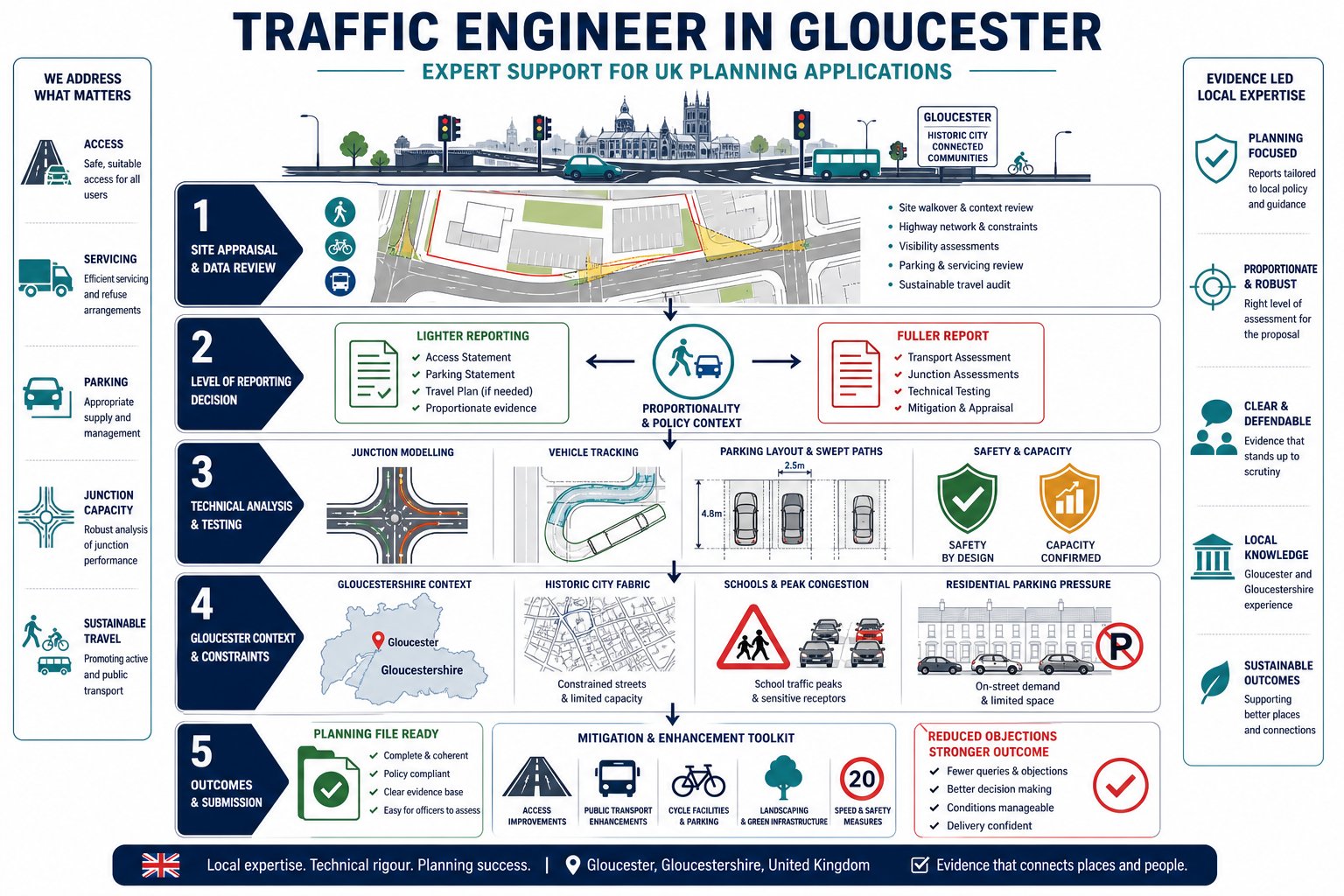
Planning applications rarely fail because of one dramatic problem. More often, they stall over the details: an access that doesn’t quite work, parking that feels under-justified, a junction impact that hasn’t been tested properly, or a highway consultee asking for evidence the team assumed wouldn’t be needed. In Gloucester, that transport layer matters more than many applicants expect.
For architects, planners, developers, solicitors and land teams, a traffic engineer in Gloucester is there to turn that uncertainty into a technical case the local planning authority and highway authority can actually review with confidence. That means assessing likely vehicle movements, understanding site constraints, testing capacity, reviewing servicing, and setting out practical mitigation where it’s needed.
The job is not simply to “write a report”. It’s to align development proposals with local expectations, county highway standards, and the realities of the surrounding network so an application has a better chance of progressing without avoidable objections or repeated rounds of comments.
In this guide, we explain what a traffic engineer in Gloucester typically does, when a Transport Statement, Transport Assessment or Travel Plan is likely to be required, how Gloucester’s planning context influences transport work, which schemes most often need technical input, and what separates a useful consultant from one that just adds another document to the pile.
Key Takeaways
- A traffic engineer in Gloucester provides essential technical evidence to ensure planning applications address local highway safety, access, parking, and traffic flow effectively.
- Transport Statements, Transport Assessments, or Travel Plans are chosen based on development scale and local sensitivity, with early professional judgement being crucial for accurate scoping.
- Gloucester’s unique urban constraints, historic street patterns, and planning expectations necessitate transport evidence specifically tailored to local conditions.
- Common delays in transport reports arise from poor scoping, inconsistent site information, weak practical evidence on access or parking, and a lack of localised knowledge.
- Selecting a traffic engineer with local expertise, technical competence across assessments, clarity, responsiveness, and willingness to provide honest advice enhances the likelihood of smoother planning approval.
- Early involvement of a skilled traffic engineer helps identify and mitigate transport-related issues upfront, improving application credibility and reducing objection risks.
What A Traffic Engineer In Gloucester Does For Planning Applications
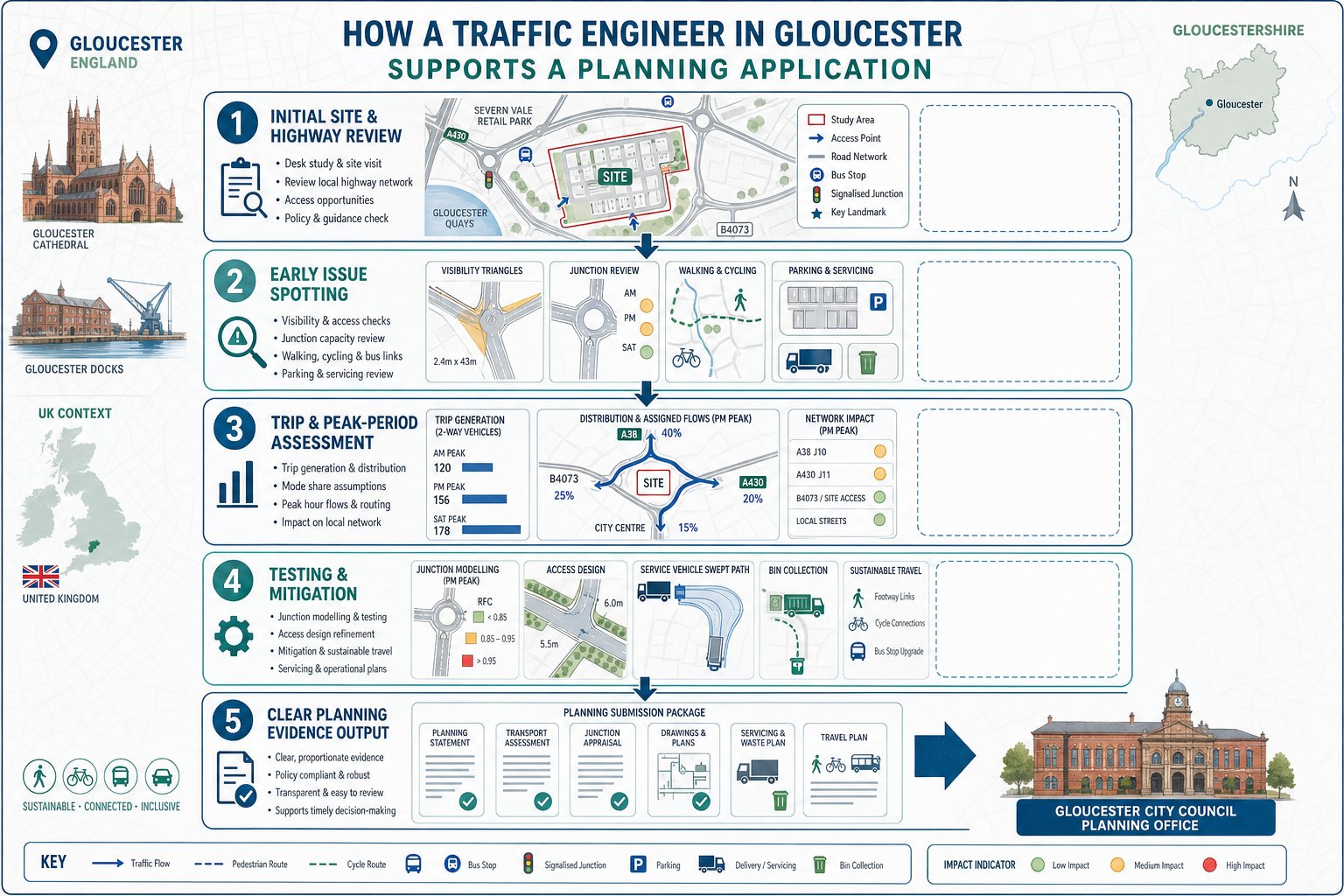
A traffic engineer in Gloucester supports planning applications by providing technical evidence on how a development will operate on the highway network and whether it can do so safely and efficiently. In practice, that covers far more than traffic counts.
At the early stage, we usually review the site layout, surrounding roads, nearby junctions, visibility, parking provision, servicing strategy, walking links, cycle access and public transport opportunities. From there, we advise whether the proposal is likely to need a light-touch statement or a more detailed assessment.
For many schemes, the value is in spotting the issues early. A narrow access, substandard turning area, weak bin collection strategy or unrealistic parking ratio can be addressed before submission rather than after an objection lands. That is often where experienced Traffic Engineering Consultants: make the biggest difference.
We also assess trip generation, distribution and assignment, estimate likely impacts during peak periods, and review whether mitigation is needed. Depending on the site, that could involve junction modelling, swept path analysis, road safety review, parking stress considerations or sustainable travel measures.
Just as important, we translate technical findings into planning language. Planning officers and highway consultees need clear, proportionate evidence. A good report doesn’t overwhelm them: it answers the right questions, with the right level of detail, at the right moment.
When A Transport Assessment, Transport Statement, Or Travel Plan Is Needed
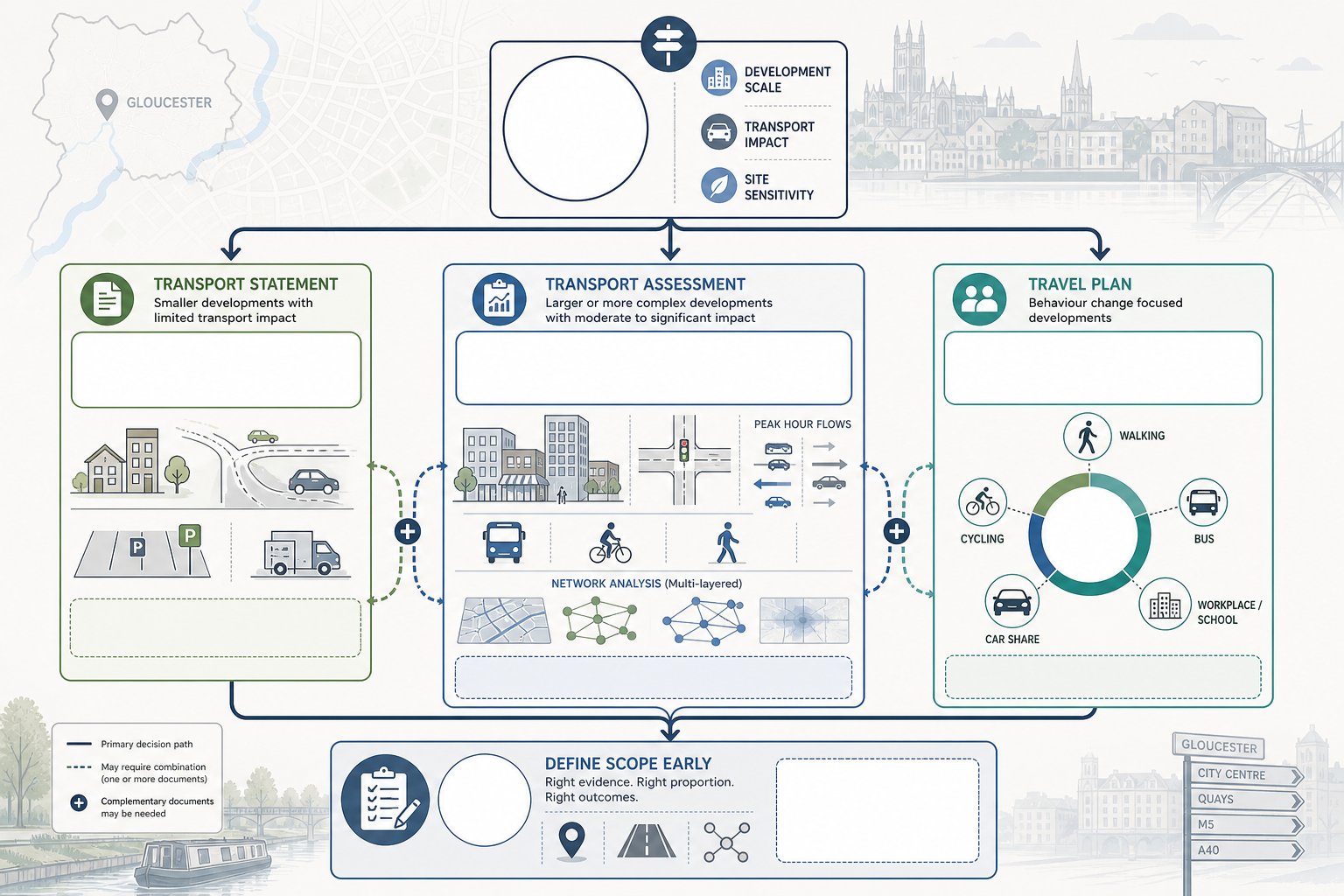
The right document depends on scale, impact and local sensitivity. There is no universal threshold that applies neatly to every Gloucester site, which is why early professional judgement matters.
A Transport Statement is generally suitable for smaller developments where impacts are expected to be limited. It still needs to be evidence-based, but the scope is usually narrower: existing conditions, accessibility, access arrangements, parking, servicing and a concise review of expected traffic effects.
A Transport Assessment is used when a proposal is likely to generate more material transport impacts or where the site context is more complex. That might mean testing peak-hour junction effects, reviewing multi-modal accessibility in greater depth, or considering cumulative development nearby. Larger residential schemes, mixed-use proposals and more intensive commercial uses often fall into this category.
A Travel Plan is typically required where the authority wants active measures to reduce reliance on private car trips and encourage walking, cycling, public transport, car sharing or demand management. Travel Plans are especially common for schools, workplaces, larger residential schemes and uses with regular staff or visitor travel patterns.
The challenge is that some applications need a combination of documents. A smaller scheme may still need a Travel Plan if mode shift is important, while a modest change of use could trigger a fuller assessment if parking or servicing is sensitive. Our approach is to define scope early, based on local expectations and the specifics of the site, rather than relying on generic assumptions. For broader context on report scoping, the principles discussed in Highway And Traffic work just as well here.
How Gloucester Planning Context Shapes Transport Requirements
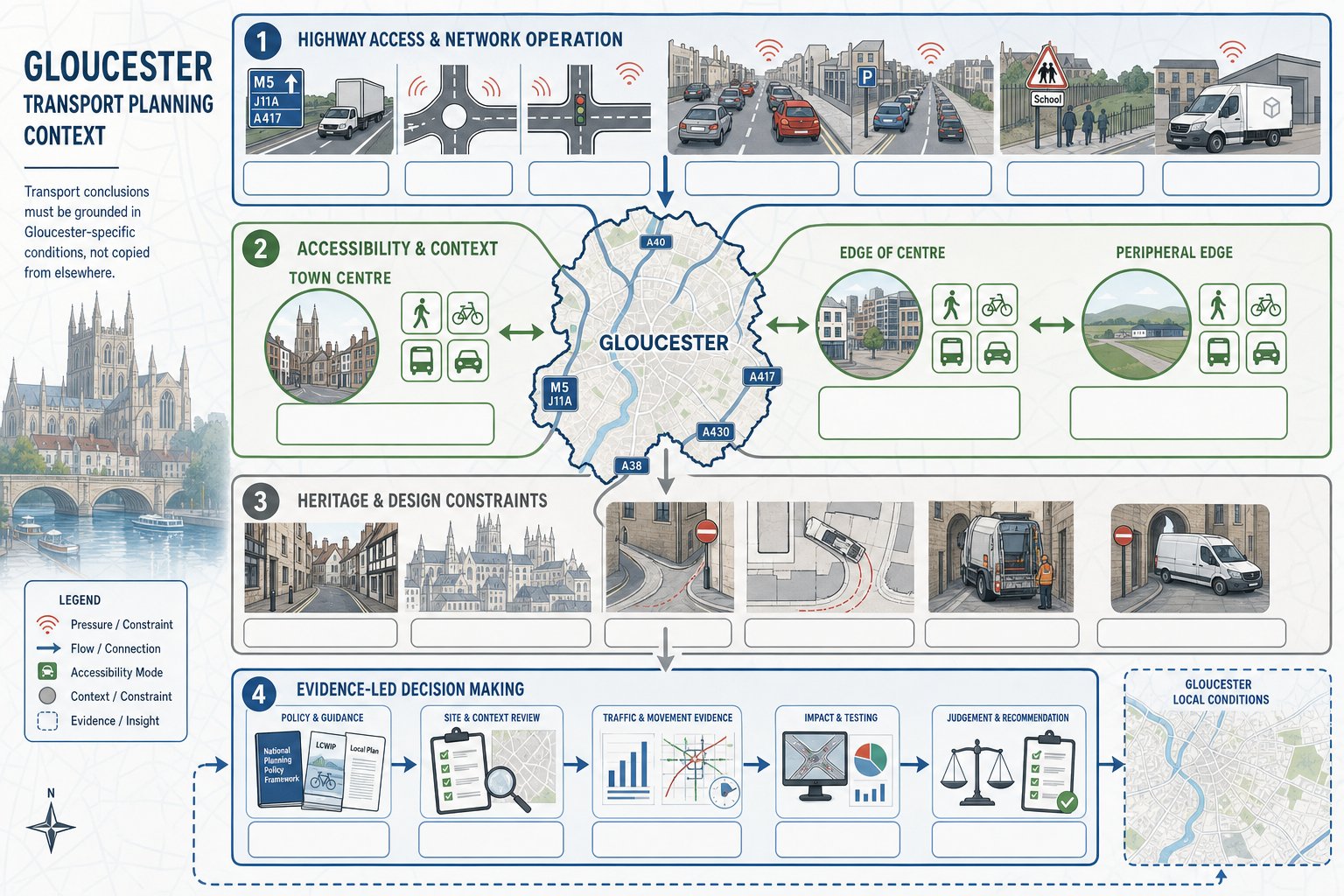
Gloucester is not a place where transport evidence can be copied in from another authority and expected to land well. The city and wider county context matter.
First, Gloucestershire County Council, as highway authority, will look closely at whether a development can be accessed safely and whether it will operate acceptably on the surrounding network. That sounds obvious, but in practice it means the assessment has to engage with real local conditions: constrained urban streets, established residential parking pressure, school-time congestion, servicing conflicts, and junctions that are already busy before a new development appears.
Second, site location changes everything. A town-centre or edge-of-centre scheme may justify lower parking and stronger sustainable travel assumptions if those assumptions are backed by actual accessibility. A more peripheral site often needs a tougher evidence base. It is not enough to say a bus stop exists: officers will want to know whether the service is realistic for the intended users.
Third, Gloucester applications are often shaped by design heritage, historic street patterns and redevelopment constraints. Access cannot always be made perfect. When geometry is tight, the report has to explain how the proposal will still function safely, what vehicle types can use it, and whether operational controls are needed.
That local sensitivity is why experience matters. The logic applied on Traffic Engineer In Bristol: or in other West Country authorities can be informative, but Gloucester needs its own transport story, grounded in the actual road network, planning history and officer expectations.
Typical Development Types That Need Traffic Engineering Input
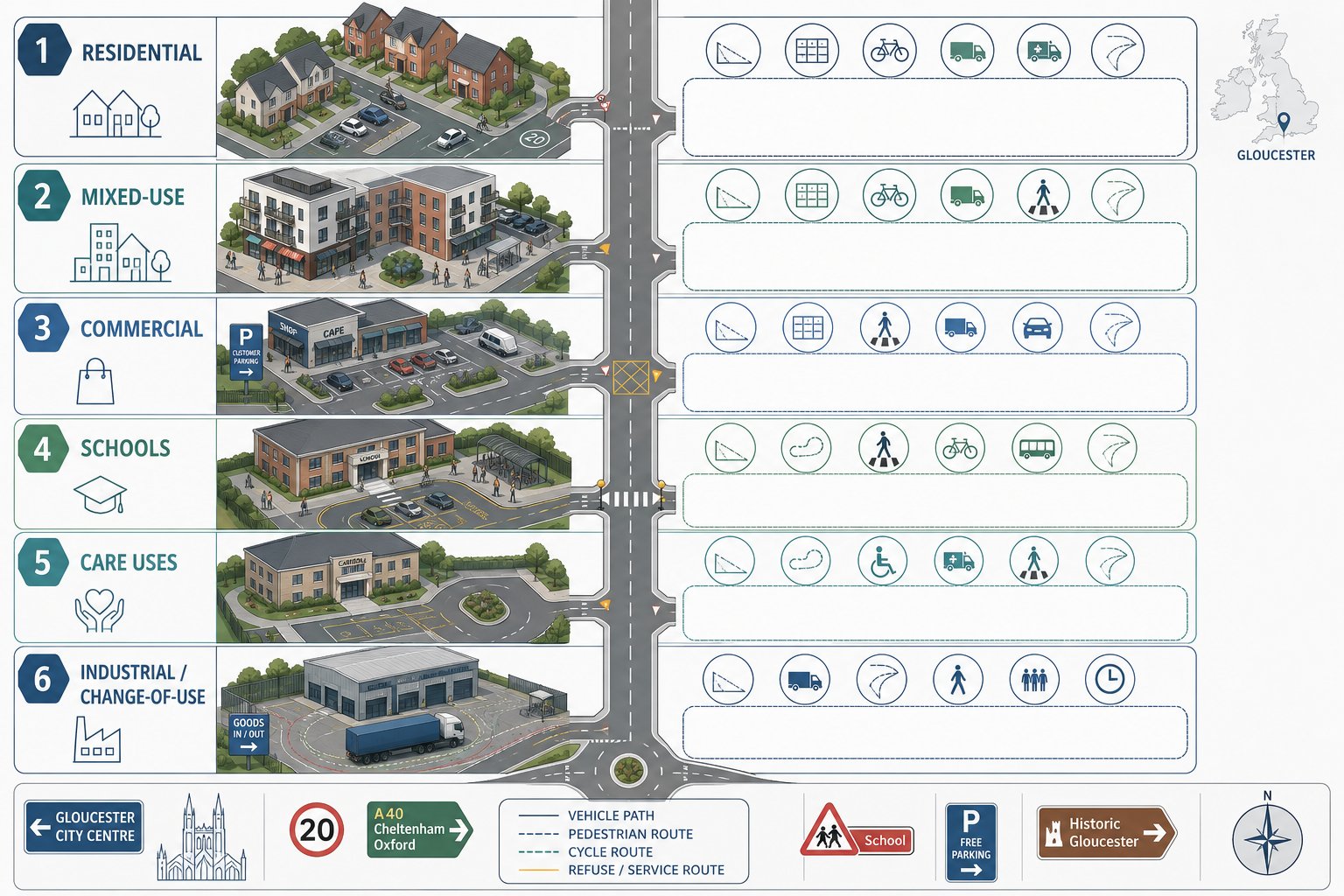
Some projects clearly need transport input from day one. Others look straightforward until a consultee starts asking awkward, entirely predictable questions. In Gloucester, we regularly see traffic engineering become important across a surprisingly wide range of applications.
Residential, Mixed-Use, And Commercial Schemes
Residential development is the most familiar example. New housing raises questions around access design, trip generation, visibility, refuse collection, emergency access, parking ratios, cycle storage and the effect on nearby junctions. Even relatively small sites can trigger scrutiny if they sit on constrained streets or rely on awkward access points.
Mixed-use schemes add another layer. Different land uses peak at different times, servicing can conflict with residential amenity, and parking demand often needs a shared strategy rather than a simple total. In those cases, technical work helps demonstrate that the scheme will function operationally, not just look coherent on a layout drawing.
Commercial proposals, meanwhile, often face detailed review of delivery activity, staff parking, customer turnover, access geometry and junction effects. For retail, trade counter, roadside or employment uses, highway officers usually want confidence that the site can cope with real-world patterns, not idealised assumptions. That is where experience in Commercial Traffic Engineering becomes directly relevant.
Schools, Care Uses, Industrial Sites, And Change Of Use Applications
Schools create intense peak activity over very short periods, often on roads already under pressure. A robust assessment may need to address drop-off behaviour, staff parking, walking routes, crossing demand and the practical realities of parent travel patterns. If those details are skipped, objections arrive quickly.
Care uses also need careful handling. A care home may generate fewer commuter-style trips than general residential development, but ambulance access, servicing, staff shift patterns and visitor parking still need to be justified. Assisted living or specialist accommodation can be even more nuanced because occupancy profile matters.
Industrial and logistics-related schemes bring obvious concerns around HGV routing, yard turning, servicing hours, access width and conflict between heavy vehicles and vulnerable road users. Swept path analysis is often critical here, as is a realistic review of whether larger vehicles can enter, manoeuvre and leave in forward gear where necessary.
And then there are change of use applications, which many teams underestimate. A former office becoming a clinic, gym, place of worship, food-led use or education space can change parking demand and traffic patterns dramatically. A concise but well-argued transport note can be the difference between a smooth decision and a prolonged highways debate.
Core Traffic Engineering Reports And Technical Documents
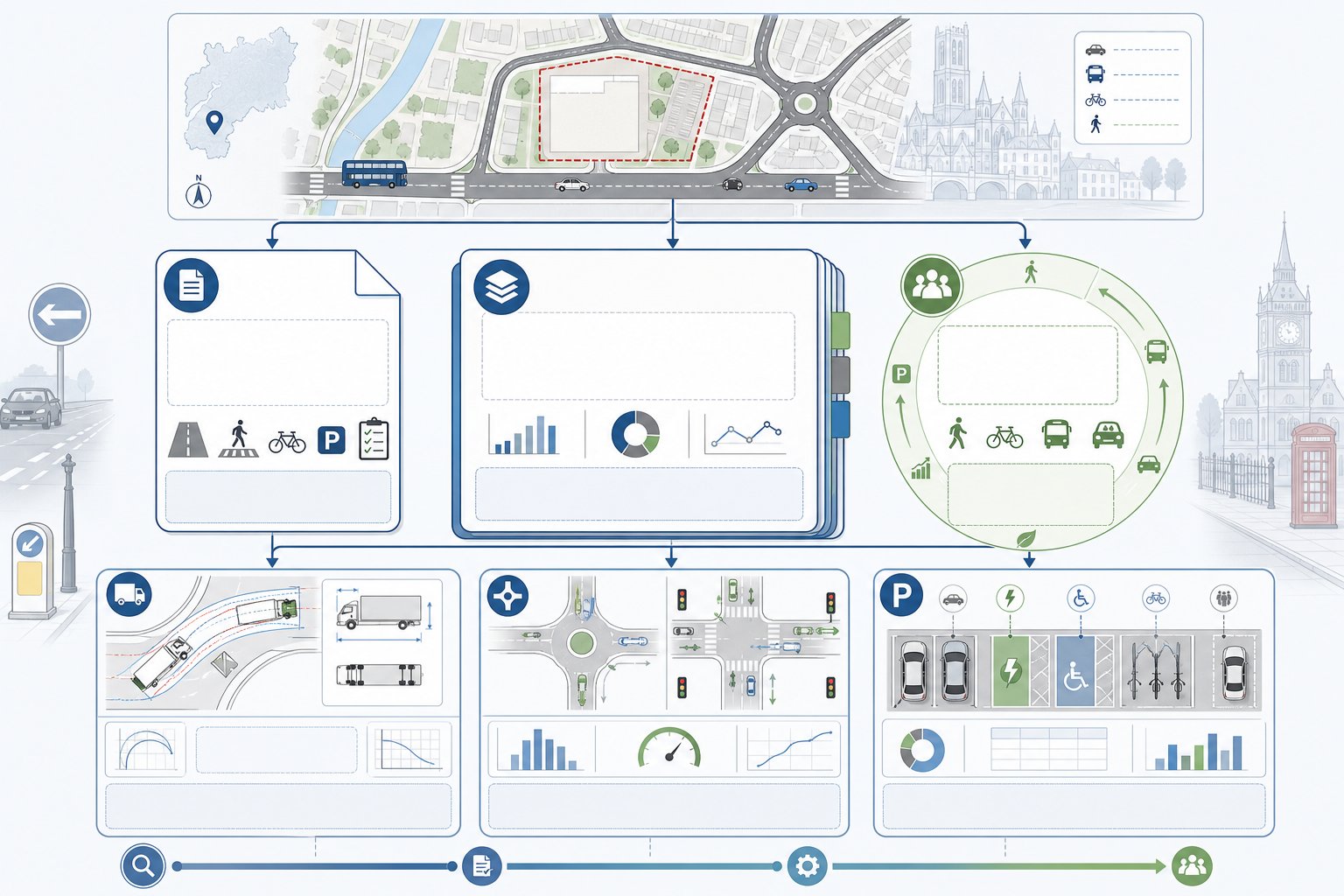
Transport planning work in Gloucester is usually built around a core set of reports and technical appendices. The trick is not producing everything possible: it is producing the right documents, at the right depth, in a way that answers likely consultee concerns before they are raised.
Transport Statements, Transport Assessments, And Travel Plans
These are the backbone documents for planning transport submissions.
A Transport Statement is generally concise and proportionate. It explains the development, summarises site accessibility, sets out expected trip movements, reviews access and parking, and considers whether any mitigation is needed. It is often the right fit for smaller or less impactful schemes.
A Transport Assessment goes further. It may include survey data, committed development review, trip distribution and assignment, junction capacity testing, accident analysis, servicing strategy and a fuller justification of transport impacts. For larger or more sensitive schemes, this is often the document that allows the authority to conclude that residual cumulative impacts would not be severe.
A Travel Plan adds a behavioural layer. It sets objectives, measures, responsibilities and monitoring arrangements aimed at encouraging more sustainable travel choices. Done well, it is not vague aspiration. It is targeted, site-specific and deliverable.
We often advise clients alongside wider Traffic Engineering: Your principles so the planning case and the technical evidence support each other rather than reading like separate pieces of work.
Swept Path Analysis, Junction Capacity, And Parking Reviews
Supporting documents are often where credibility is won or lost.
Swept path analysis demonstrates whether vehicles can manoeuvre within a site or at an access point. This is especially important for refuse vehicles, fire appliances, delivery vans and HGVs. If the tracking is unrealistic, highway officers notice.
Junction capacity assessments test whether surrounding junctions can continue to operate acceptably with development traffic. Depending on the site, that might involve priority junction analysis, roundabout modelling or signal junction review. The methodology has to fit the network: copying standard assumptions from another location is a common mistake.
Parking reviews assess whether the quantity and layout of parking is appropriate for the proposed use and location. That can include car parking, cycle provision, EV charging, disabled bays, visitor spaces and operational parking for staff or service vehicles. In tighter urban locations, parking evidence often needs to go beyond a simple schedule and address likely overspill risk.
Access geometry can also be central, especially on constrained plots, which is why practical knowledge of access design highway work often feeds directly into planning submissions.
The Process From Initial Enquiry To Planning Submission
A well-run transport instruction should feel structured, not mysterious. Most successful projects follow a fairly consistent path.
We start with the initial enquiry and a desktop review. At that point, we want the red line boundary, site layout if available, proposed use, scale of development, likely access points and any known planning history. Even a rough pack helps us identify likely report requirements and possible risks.
Next comes site review and data collection. That may include a site visit, review of local junctions, parking observations, collision data checks, accessibility mapping and traffic survey scoping where needed. For some schemes, this stage is quick. For others, especially those with operational complexity, it is where the key issues first become obvious.
Then we move into analysis and option testing. We assess trips, test access arrangements, review servicing, examine parking strategy and, where necessary, model junction effects. If something is weak, we would rather say so early and work with the design team on alternatives than force a poor scheme into a polished report.
After that, we draft the report and coordinate with the wider consultant team. Architects, planning consultants and highways specialists need a consistent narrative. This is also where lessons from comparable urban authorities, including the kind of approaches discussed in Traffic Engineer In Birmingham:, can be useful as reference points, though Gloucester-specific judgement still leads.
Finally, the package goes into planning, sometimes with follow-up responses to officer or consultee comments. Quick turnaround matters, but accuracy matters more. A fast report that misses the real issue is rarely fast in the long run.
What Local Councils, Planning Officers, And Highway Authorities Look For
Planning officers and highway authorities are not usually looking for flashy transport documents. They are looking for dependable evidence that answers practical questions.
The first question is usually safe and suitable access. Can vehicles enter and leave without unacceptable risk? Are visibility splays appropriate? Can pedestrians move around the site access sensibly? If larger vehicles are expected, can they manoeuvre without conflict or excessive reversing?
The second is traffic impact. Officers want to understand whether the proposal would materially worsen junction performance, create queueing problems, or intensify stress on already sensitive routes. They do not expect every scheme to have zero impact: they expect impacts to be properly assessed and, where necessary, mitigated.
Third is parking and servicing. Is the parking provision realistic for the use and location? Will deliveries block the highway? Is refuse collection workable? Can disabled users access the site properly? A lot of transport objections are really operational objections dressed in highway language.
Fourth is sustainable travel. If an application relies on walking, cycling or public transport to support lower car use, the evidence needs to be credible. Distances, route quality, crossings, gradients and service frequency all matter.
And finally, they look for proportionate reporting. Authorities appreciate concise, technically sound submissions that engage directly with local concerns. Bloated reports can be as unhelpful as thin ones. The benchmark is whether the document gives decision-makers enough confidence to recommend approval, ask for targeted revisions, or object for clear reasons.
Common Reasons Transport Reports Are Delayed Or Challenged
Most delays are preventable. Not all, but most.
One common issue is incomplete or changing site information. If the layout shifts after transport work is substantially complete, access tracking, parking numbers, trip assumptions and servicing arrangements may all need to be revisited. That can add weeks, not days.
Another is poor scoping at the start. Teams sometimes assume a Transport Statement will be enough, only to find the authority expects a fuller assessment or a Travel Plan. Equally, some reports overreach and become bulky without resolving the key local issue. Early judgement is what keeps the scope proportionate.
A third problem is weak evidence on access, parking or servicing. These are practical matters officers can visualise immediately. If the swept paths don’t work, if parking is clearly underprovided, or if refuse vehicles cannot operate sensibly, the report will struggle regardless of how polished the wording is.
Data quality matters too. Out-of-date surveys, unrepresentative count days, vague trip assumptions and generic mode share claims are easy targets for challenge. So is a report that ignores nearby consented development or local highway constraints.
We also see delays caused by disconnects between consultants. If the architect shows one layout, the planning statement describes another, and the transport report relies on a third version, confidence drops fast. On more complex schemes, the coordinated discipline discussed in Traffic Engineer In Manchester: style projects is a useful reminder: the planning story has to align across the whole team.
Finally, some reports are challenged simply because they read as generic. Gloucester officers can tell when a document has been localised properly and when it has not.
How To Choose The Right Traffic Engineer In Gloucester
If you are appointing a transport consultant for a Gloucester planning application, technical competence is only the starting point. The real question is whether they can produce the right evidence, at the right level, in a way that helps the application move.
First, look for local planning and highway awareness. They do not need to have worked on your exact street before, but they should understand how county highway review, urban constraints, parking sensitivities and access design expectations shape submissions in Gloucestershire.
Second, assess report judgement. Anyone can promise a Transport Statement or Transport Assessment. Fewer consultants are good at deciding what is genuinely necessary, what can be scoped out, and what supporting analysis will carry weight with officers.
Third, ask about technical range. A strong traffic engineer should be comfortable not only with written reports, but also with junction capacity, parking review, swept path analysis, travel planning and site access design. In live projects, these issues overlap constantly.
Fourth, consider speed and clarity. Developers and planners usually do not need long theoretical essays: they need concise, accurate work that responds quickly to programme pressure. That is where a specialist practice with focused planning support can outperform larger but slower teams.
Finally, choose someone who will tell you when a scheme has a weakness. Honest early advice saves money. With more than 30 years of experience delivering concise planning-focused transport work, our approach at ML Traffic is built around that principle: identify the real issue, address it directly, and give officers a transport submission that is easier to approve.
A good traffic engineer in Gloucester does not just add another report to the application. We help make the whole planning case more robust, more credible and, quite often, faster.
Frequently Asked Questions About Traffic Engineering in Gloucester
What is the role of a traffic engineer in Gloucester for planning applications?
A traffic engineer in Gloucester provides technical evidence on how developments impact local highways. They assess vehicle movements, parking, access safety, and the surrounding network to support planning applications that meet county highway standards.
When is a Transport Assessment required instead of a Transport Statement in Gloucester?
A Transport Assessment is needed for larger developments with significant traffic impacts or complex site contexts, such as peak hour junction testing. Smaller schemes with limited impacts typically require a lighter Transport Statement.
How does Gloucester’s local planning context affect transport planning requirements?
Gloucester’s planning context demands engagement with local highway constraints like busy junctions, urban street layouts, and realistic public transport options. Transport evidence must reflect these specific conditions rather than generic data from other areas.
What types of developments in Gloucester usually require traffic engineering input?
Residential, mixed-use, commercial developments, schools, care facilities, industrial sites, and change-of-use projects often require traffic engineering support to address access, parking, servicing, and network impacts effectively.
How do traffic engineers support sustainable travel in Gloucester developments?
They often develop Travel Plans with measures to reduce private car use, encouraging walking, cycling, public transport, and car sharing, particularly for schools, workplaces, and larger residential schemes to align with local sustainable travel goals.
What should I look for when choosing a traffic engineer in Gloucester?
Choose a traffic engineer with local highway authority knowledge, strong report judgment, technical expertise in junction modelling and parking reviews, and the ability to produce clear, concise submissions that meet Gloucester’s specific planning expectations.