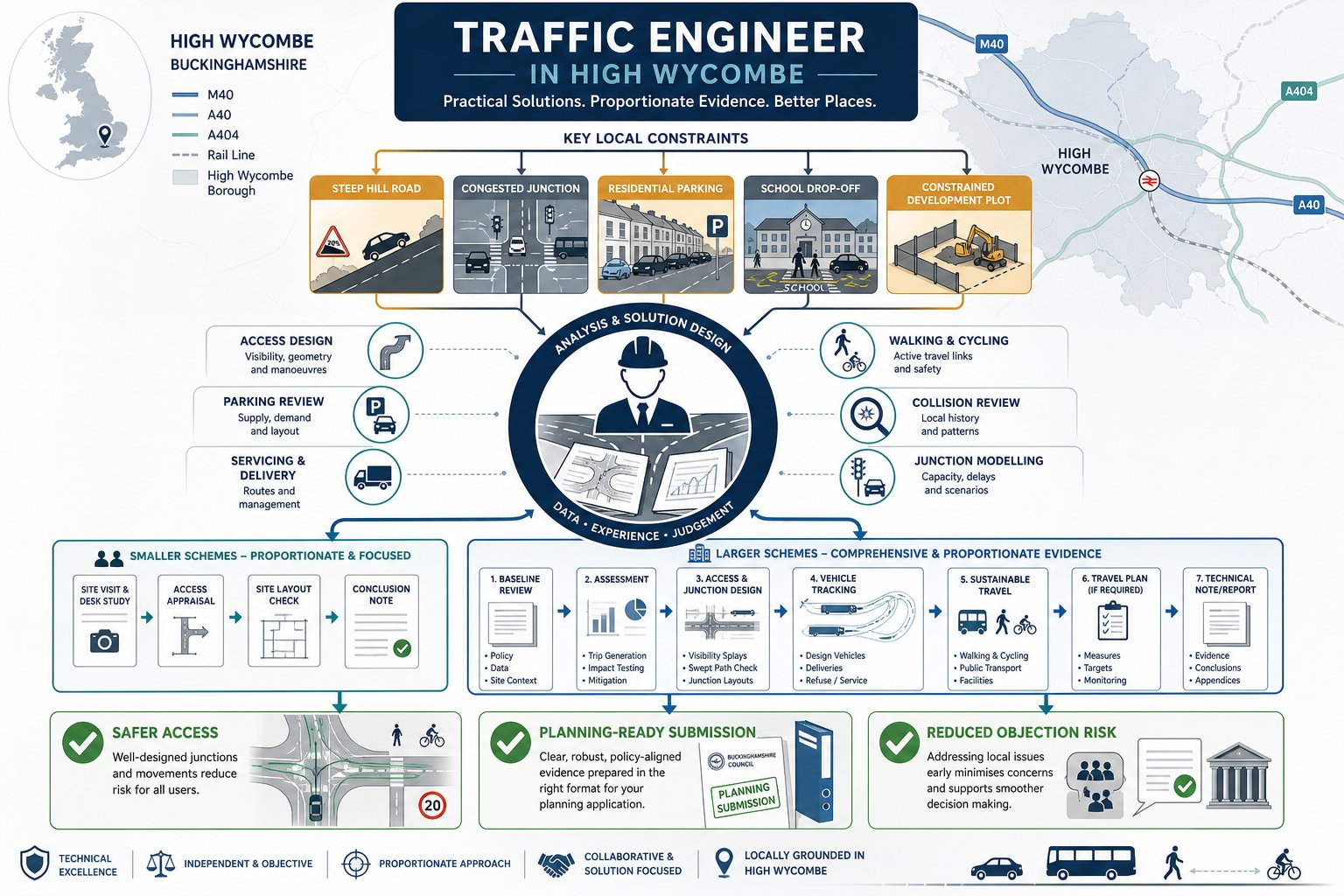
High Wycombe can look straightforward on a location plan. Then you get into the real-world details: steep roads, constrained junctions, parking pressure on residential streets, school-run peaks, and development sites that sit awkwardly against an already busy network. That’s usually the point where transport stops being a box to tick and becomes central to whether a scheme moves forward smoothly.
For architects, planners, developers, lawyers, and local authorities, the value of a good traffic engineer in High Wycombe is simple: we help turn transport risk into a clear, evidence-backed planning strategy. That might mean proving a proposal’s traffic impact is acceptable, designing a safer access, resolving servicing issues, or producing the right report in the right format for Buckinghamshire Council and highway consultees.
In practice, that support needs to be proportionate. A small change-of-use scheme may only need a concise technical note and parking review. A larger residential or mixed-use development may require a full Transport Assessment, Travel Plan, junction modelling, and detailed access advice. Either way, the quality of the early analysis matters.
With more than 30 years of transport planning and highway experience behind our approach, we focus on concise, technically robust reporting that reflects local authority expectations rather than generic templates. In this guide, we explain what a traffic engineer in High Wycombe actually does, when input is needed, which documents are commonly required, and how to choose the right support for a planning application in 2026.
Key Takeaways
- A traffic engineer in High Wycombe provides essential transport assessments and strategies tailored to local road conditions and planning requirements.
- Early involvement of a traffic engineer can prevent costly design revisions and smooth planning submissions by addressing access, parking, and safety concerns upfront.
- Transport documents such as Transport Statements, Assessments, and Travel Plans must be proportionate and precisely targeted to the scale and sensitivity of the development.
- Local factors like steep gradients, constrained junctions, and peak traffic events heavily influence transport planning in High Wycombe and require site-specific evidence.
- Effective traffic engineering involves close collaboration with architects, planners, and authorities to align technical analysis with planning policy and mitigate consultation risks.
- Choosing a traffic engineer with development-control expertise and familiarity with Buckinghamshire’s planning context ensures practical, clear, and robust transport reports.
What A Traffic Engineer In High Wycombe Does For Planning And Development
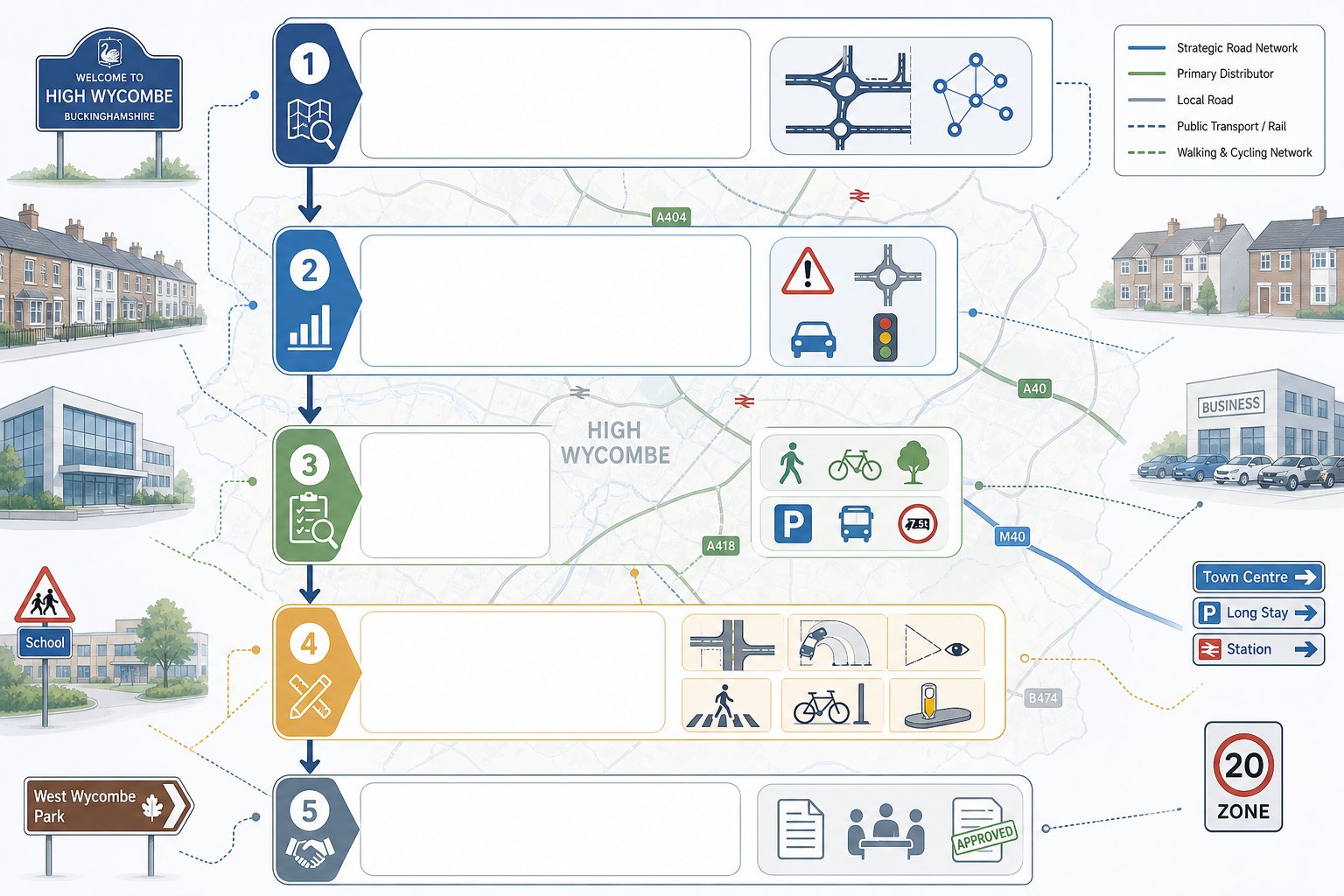
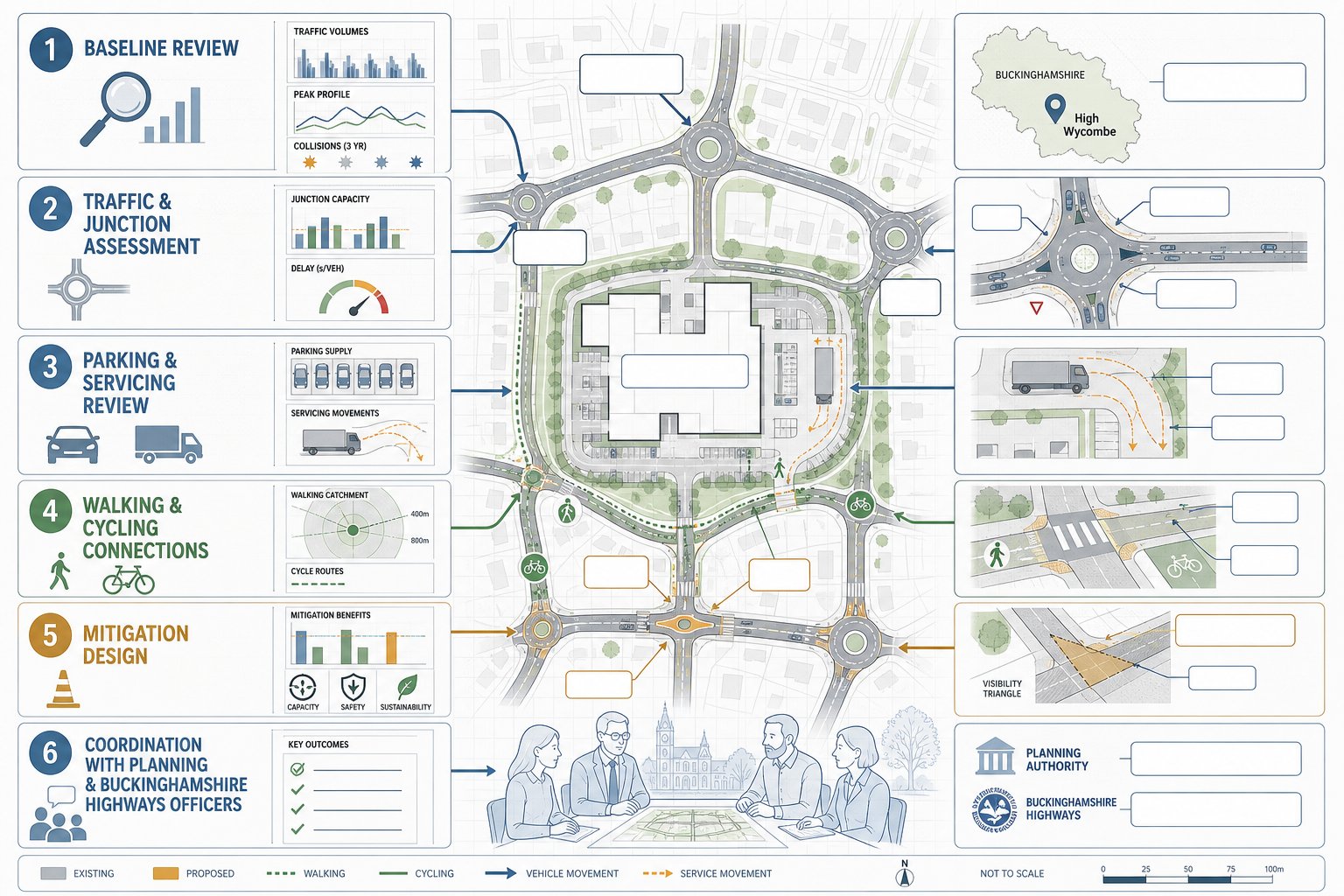
A traffic engineer in High Wycombe supports the planning process by assessing how a development will interact with the surrounding highway network, access arrangements, parking supply, and sustainable travel opportunities. In plain terms, we test whether a site can function safely and acceptably once people start living there, working there, studying there, or visiting it.
That usually starts with baseline work: reviewing local roads, junction operation, collision history, walking and cycling connections, parking stress, servicing routes, and policy context. We then look at likely trip generation and how a proposal could affect nearby links and junctions. On constrained sites, that can be the difference between a workable layout and one that runs into immediate objection.
Our role often overlaps with wider development control advice provided by Traffic Engineering Consultants: but the local detail matters. High Wycombe has road corridors and neighbourhood streets that can be sensitive to even moderate changes in traffic or parking demand.
We also advise on mitigation. That might include access geometry, visibility splays, pedestrian crossings, cycle parking, delivery arrangements, refuse tracking, or demand-management measures through a Travel Plan. In some schemes, a robust technical response is enough. In others, a redesigned access or a revised parking strategy is what unlocks progress.
Just as importantly, we liaise with planning officers and Buckinghamshire highways officers in a way that keeps issues focused and evidence-led.
When Traffic Engineering Input Is Needed For A Planning Application
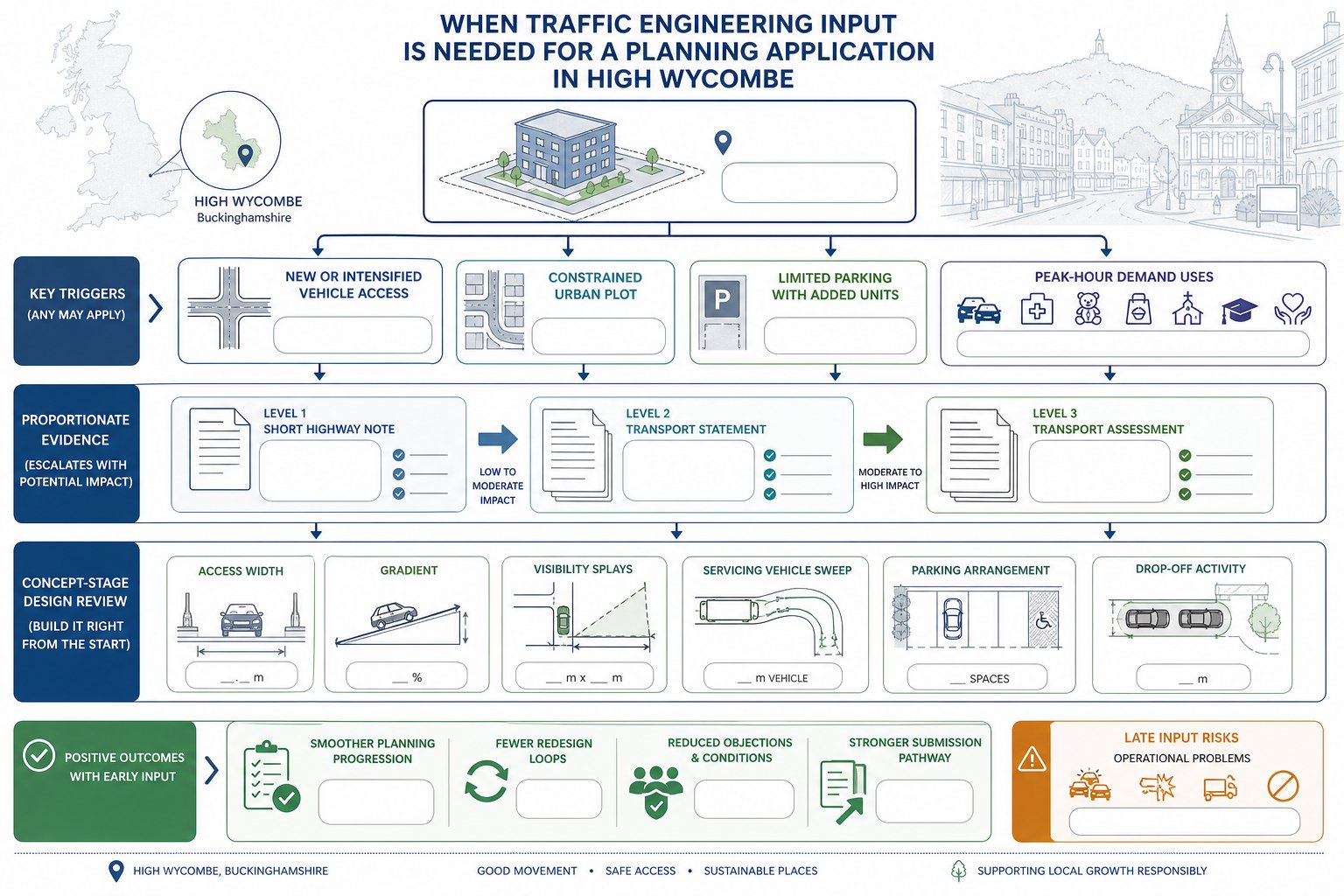
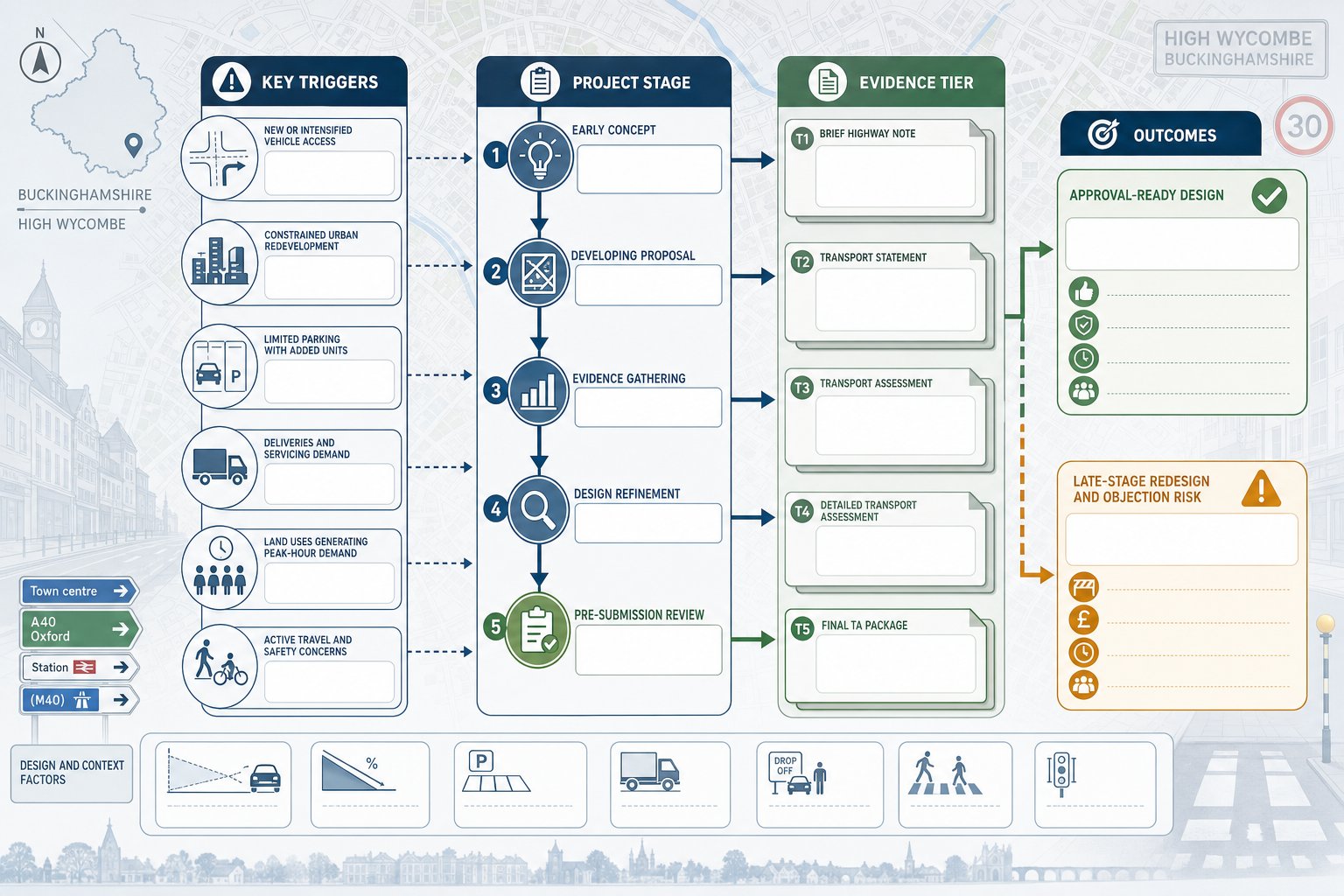
Not every planning application needs a full transport package, but many benefit from traffic engineering input much earlier than applicants first expect. The trigger is usually not the size of the site alone: it is whether the proposal could materially affect traffic, safety, access, servicing, or parking conditions.
Common examples include a new or intensified vehicular access, redevelopment of a constrained urban plot, additional units on a site with limited parking, or a use that creates concentrated peak-hour demand. A nursery, takeaway, medical use, place of worship, student accommodation scheme, or care-related use can all generate local concerns even where the floorspace looks modest on paper.
In Buckinghamshire, the planning and highway response often turns on whether the submission has proportionate evidence behind it. That can mean anything from a short highway note to a full Transport Assessment. Where applicants leave transport work too late, the design team may end up defending a layout that was never operationally comfortable in the first place.
We regularly see value in bringing in transport advice at concept stage, especially where access width, gradient, visibility, parking ratios, servicing, or drop-off activity could become contentious. Wider experience from projects such as Highway And Traffic Engineering support elsewhere shows the same pattern: early input reduces redesign, avoids avoidable objections, and sharpens the planning narrative.
If highways could plausibly be a consultation issue, it is usually worth assessing that risk before submission rather than after a holding objection lands.
Typical Projects That Require Transport Assessment In High Wycombe
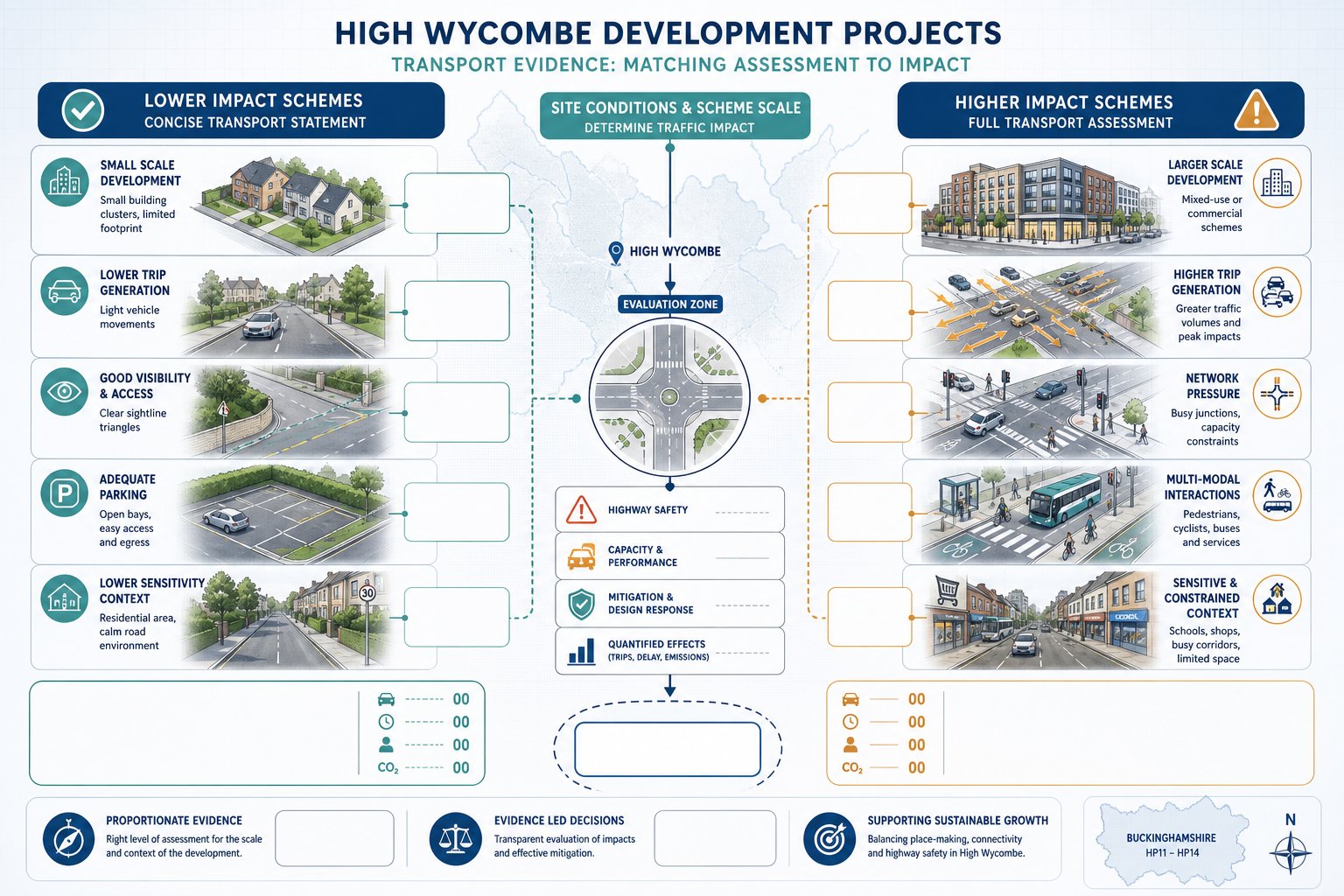
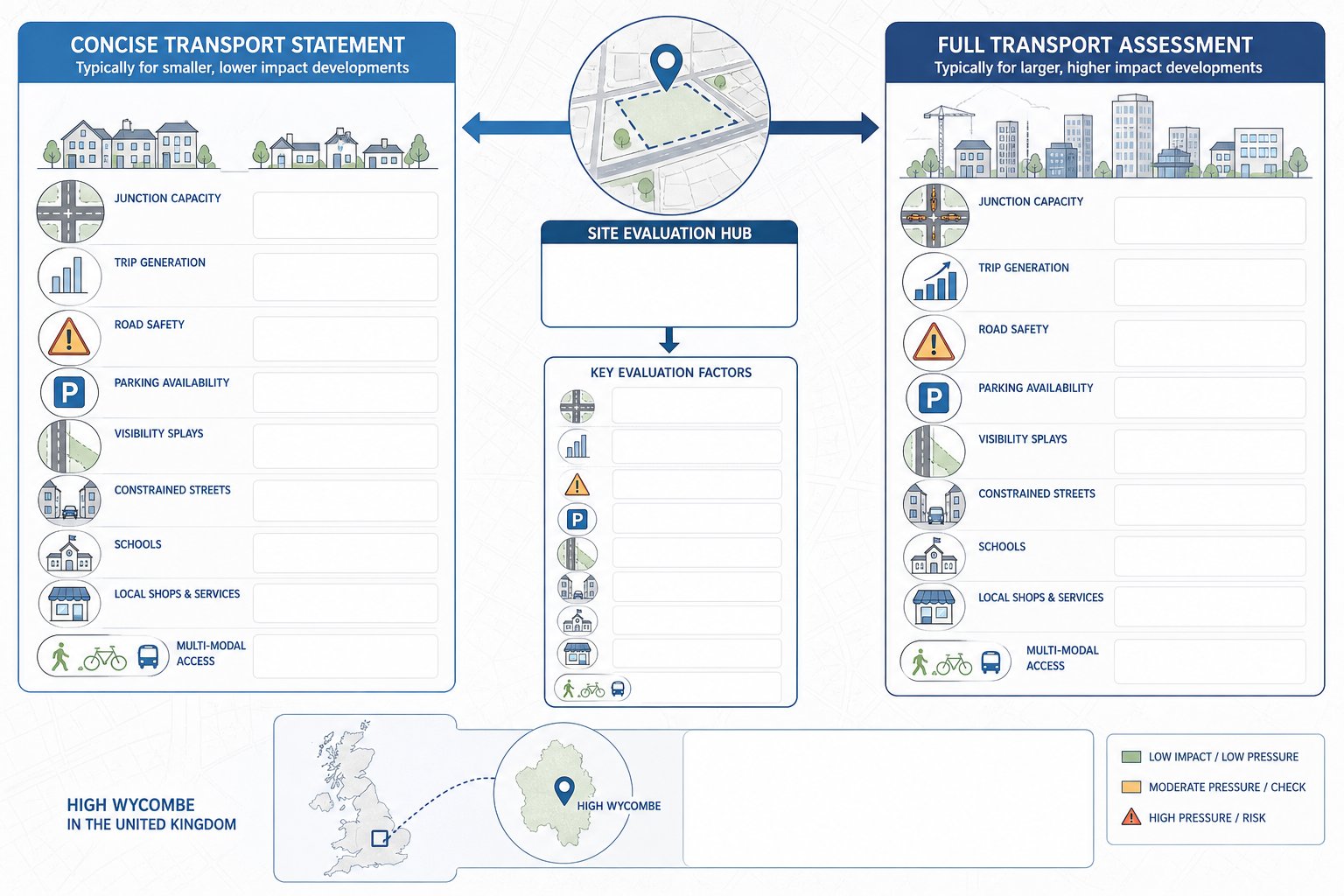
Transport assessment requirements in High Wycombe vary by scale, land use, and local sensitivity. The central question is always the same: will the development create effects that need to be quantified, managed, or mitigated?
Some schemes need only a concise Transport Statement because impacts are limited and clearly understood. Others need a full Transport Assessment because there are junction capacity questions, significant trip generation, multi-modal considerations, or highway safety concerns. The nature of the site matters too. A proposal on a calm road with good visibility and ample parking behaves very differently from one tucked into a constrained street near schools, local shops, or already-stressed junctions.
Residential, Mixed-Use, And Commercial Development Schemes
Residential development is one of the most common triggers for transport work in High Wycombe. Even relatively modest schemes can raise questions around access width, turning, refuse collection, parking stress, and cumulative impact on nearby junctions. Larger housing schemes may require traffic counts, trip generation analysis, distribution and assignment, junction modelling, and sustainable travel measures.
Mixed-use development is often more complex because it combines different travel patterns across the day. Residential elements may peak in the morning and evening, while retail, office, or leisure uses create different demand profiles. That can be positive in some cases, but it still needs to be demonstrated with evidence rather than assumption.
Commercial proposals bring their own issues: servicing strategy, HGV routing, staff parking, customer parking turnover, delivery windows, and internal circulation. On constrained sites, swept path analysis and loading arrangements can become just as important as traffic generation. Comparable urban work, including Traffic Engineer In London: style development-control support, tends to show that servicing failures can derail otherwise policy-compliant schemes.
In High Wycombe, we also pay close attention to topography. Steeper gradients affect walking mode share assumptions, cycle attractiveness, visibility design, and the practical operation of accesses, especially in tighter residential streets.
Schools, Care Facilities, Community Uses, And Change-Of-Use Proposals
Schools, nurseries, care homes, medical centres, places of worship, and community buildings often generate more planning sensitivity than headline floorspace suggests. The reason is timing and concentration. A school or nursery may create intense drop-off and pick-up activity within short windows. A medical use may spread trips through the day but generate parking turnover and occasional stopping activity. A care facility may require regular servicing, staff shift changes, and ambulance access.
Change-of-use proposals are especially important to assess properly. A former office becoming a nursery, a retail unit becoming a takeaway, or a house converting to a higher-intensity use can alter parking demand and traffic patterns quite sharply. Neighbours usually notice that before anyone else does.
For these schemes, we often combine a review of local parking conditions with access appraisal, servicing checks, and a proportionate transport statement or technical note. If there is likely to be overspill parking, school-gate conflict, or concern around vulnerable road users, that needs direct treatment in the submission.
Experience from projects similar in profile to Traffic Engineer In Birmingham: and other authority areas shows that change-of-use cases are won on detail: observed parking demand, realistic trip assumptions, and practical mitigation, not broad claims that impact will be negligible.
Core Transport Documents Required By Buckinghamshire Planning And Highway Authorities
The transport documents needed for a planning application should match the scale and complexity of the proposal. Submitting too little can lead to objections or validation issues. Submitting a bloated, generic report can be nearly as unhelpful because it obscures the real questions.
In High Wycombe, Buckinghamshire’s planning and highway review will typically focus on whether the evidence is proportionate, local, and technically sound. That means selecting the right document set from the start and making sure each piece addresses the site’s actual constraints rather than relying on standard wording.
Transport Statements, Transport Assessments, And Travel Plans
A Transport Statement is usually prepared for smaller or less impactful schemes. It explains the site context, existing travel conditions, likely trip generation, access arrangements, parking provision, and any local effects in a concise format. The goal is to show that the proposal can operate acceptably without extensive modelling.
A Transport Assessment goes further. It is used where a scheme has potentially significant transport implications, whether because of scale, location, access sensitivity, or local network conditions. A TA may include traffic surveys, junction capacity assessments, distribution and assignment, personal injury collision review, sustainable travel analysis, and mitigation proposals.
A Travel Plan supports behavioural change. It sets out practical measures to encourage walking, cycling, public transport use, car sharing, and responsible travel management. On many schemes, especially residential, education, and employment uses, the Travel Plan is part of the package that demonstrates the development is not simply relying on private car use.
Where appropriate, we align this work with broader best practice used across places such as Traffic Engineer In Bristol: and comparable authorities, while tailoring assumptions and mitigation to Buckinghamshire’s local context. That local tailoring is what gives the report weight.
Technical Notes, Swept Path Analysis, And Parking Assessments
Not every issue needs a full TS or TA. Sometimes the most effective submission is a targeted technical note responding to one specific concern: visibility at an access, likely parking demand from a new use, refuse vehicle turning, or whether a small amendment alters traffic impact materially.
Swept path analysis is often critical on constrained sites. Using CAD-based vehicle tracking, we test whether cars, delivery vans, refuse vehicles, and emergency vehicles can enter, turn, load, and leave safely. On tight backland or infill plots, this can quickly expose whether a layout is genuinely workable or only works on paper.
Parking assessments are equally important in High Wycombe, where overspill parking can trigger local objection fast. A good parking review considers local standards, site-specific demand, surrounding on-street conditions, likely accumulation, disabled parking needs, cycle parking, and servicing conflicts. It is not just a space-count exercise.
We often prepare these focused studies alongside wider planning submissions, much as we do on schemes comparable to Traffic Engineer In Manchester: support in other urban areas. The key is precision: answer the exact highway question being asked, with drawings and data that stand up to scrutiny.
Key Traffic And Access Issues That Affect Sites In High Wycombe
High Wycombe has transport characteristics that make local knowledge valuable. The town’s topography is a big one. Steeper roads can affect access design, visibility, active travel assumptions, and the day-to-day practicality of walking and cycling routes, particularly for families, older users, and less confident riders.
Then there is the network structure. Valley corridors and constrained junctions can create pressure points where even moderate additional traffic becomes noticeable at peak times. Corridors linked to the A40 and A404 are often part of the discussion, but local residential streets and district centres can be just as sensitive, especially where parking already spills onto carriageways.
Pedestrian safety matters too. Sites near schools, local centres, bus stops, or crossing points need careful consideration of footway continuity, desire lines, visibility, and conflict with turning vehicles. In some cases the right mitigation is minor and inexpensive: in others, a redesign is more realistic than trying to defend a weak arrangement.
Servicing is another recurring issue. Refuse vehicles, delivery vans, and emergency access all need to be accommodated without awkward reversing, blockage, or unsafe manoeuvring. This is especially relevant in backland schemes, town-centre sites, and conversions where plot constraints are severe.
Because of these factors, a traffic engineer in High Wycombe cannot rely on generic assumptions. We need site-specific evidence, local observation, and a practical understanding of what Buckinghamshire officers are likely to focus on.
How A Traffic Engineer Supports Architects, Planners, Lawyers, And Developers
The best transport input is collaborative, not isolated. We work with architects early so access geometry, tracking, parking layout, cycle provision, bin collection strategy, and visibility can be resolved before the design hardens. That saves time, but more importantly it prevents expensive late-stage redesign where building footprints and landscape proposals are already fixed.
For town planners, we provide the evidence base that links a scheme to transport policy and addresses consultation risk. That includes explaining why a Transport Statement is proportionate, setting out mitigation, and responding to highways comments clearly rather than defensively.
For lawyers and developers, transport advice often becomes important once obligations and risk allocation come into view. Section 106 contributions, Section 278 works, access rights, highway boundary questions, and appeal strategy all benefit from precise technical input. On some projects, the transport issue is not whether development is acceptable in principle but exactly what off-site works or controls are required.
Our role can extend to appeal support and expert evidence where highways form part of a refusal case. And because we write concise reports tailored to planning decisions, not academic exercises, the output is easier for the wider team to use.
That joined-up approach mirrors the way we handle related work in places such as Traffic Engineer In Leeds: and similarly complex authority environments: practical advice first, technical depth where needed, and constant alignment with the planning strategy.
The Process From Initial Site Review To Report Submission
A sound transport submission usually follows a clear sequence, even if the scale of analysis varies.
First comes the initial site review. We visit the site, review the surrounding highway network, identify access constraints, check local parking conditions, and look at nearby junctions, walking routes, bus stops, schools, and sensitive frontages. We also review policy and planning history where relevant.
Next, for larger or more sensitive schemes, there may be scoping with Buckinghamshire highways officers. This helps agree the study area, survey requirements, likely assessment methodology, and whether junction modelling, Travel Plan measures, or collision analysis will be expected.
Then comes data collection and analysis. Depending on the scheme, that may involve traffic counts, queue observations, parking beat surveys, trip generation calculations, and junction capacity modelling. We use that evidence to test whether the development’s impact is acceptable and what mitigation, if any, is justified.
After that, we move into option testing and mitigation design. This is where access revisions, parking changes, tracking refinements, pedestrian improvements, or servicing strategies are developed in tandem with the design team.
Finally, we prepare the required submission documents and provide post-submission support. That often includes clarifying points raised by case officers, responding to highway comments, or updating drawings and notes to reflect negotiated amendments. A good report is rarely the end of the process: it is the foundation for efficient planning dialogue.
Choosing The Right Traffic Engineer In High Wycombe
Choosing the right consultant is partly about technical capability and partly about judgement. Plenty of firms can produce a transport report. Fewer know how to shape one around the real planning risks of a High Wycombe site.
We would look first for proven development-control experience in the UK planning system, not just broad highways design credentials. A strong consultant should understand when a concise technical note will do, when a full TA is needed, and how Buckinghamshire officers are likely to interrogate access, parking, servicing, and network impact.
Local familiarity helps, but so does wider comparative experience. A team working across multiple authority areas, including projects akin to Traffic Engineer In Liverpool:, can often spot where local expectations are genuinely unique and where they are simply standard development-control issues dressed in local language.
It is also worth checking software capability and presentation quality. Junction capacity tools, CAD-based swept path analysis, and clear drawings matter. But report writing matters just as much. If the technical case is buried in vague language or generic appendices, it will not carry much weight.
At ML Traffic, our approach is built around concise, accurate reporting, fast turnaround where needed, and practical advice shaped by more than 30 years of experience. For clients facing planning deadlines, that combination usually matters more than glossy jargon.
Conclusion
For many schemes, transport is the issue that quietly determines whether planning progresses cleanly or stalls in consultation. In High Wycombe, that is especially true where access is constrained, parking is sensitive, or local roads already operate under pressure.
Bringing in a traffic engineer in High Wycombe early allows us to identify the real risks, choose the right level of assessment, and present clear evidence on access, safety, parking, servicing, and wider network impact. That gives architects, planners, lawyers, developers, and councils a much firmer basis for decision-making.
In 2026, the strongest planning submissions are rarely the longest. They are the ones that answer the right transport questions, with local knowledge, proportionate technical work, and reports that highway officers can actually use. That is where experienced transport input adds real value.
Frequently Asked Questions About Traffic Engineering in High Wycombe
What does a traffic engineer in High Wycombe do for planning applications?
A traffic engineer in High Wycombe assesses traffic flows, junction safety, access, parking, and sustainable travel for developments, providing evidence-backed reports and mitigation advice to satisfy Buckinghamshire Council’s planning and highway requirements.
When is traffic engineering input required for a planning application in High Wycombe?
Input is needed when a proposal may significantly change traffic, parking patterns, or access arrangements, such as new vehicular access, increased trip generation, or intensified servicing demand on the local road network.
What types of developments typically require a Transport Assessment in High Wycombe?
Residential, mixed-use, and commercial schemes, as well as schools, care facilities, community buildings, and change-of-use proposals that increase traffic or parking demand, commonly require a Transport Assessment to quantify and mitigate impacts.
How does a traffic engineer support architects, planners, and developers in High Wycombe?
They collaborate early to shape access, layout, and parking; advise planners on policy compliance and highway negotiations; assist developers with obligations like Section 106 contributions; and provide expert evidence for appeals involving highways issues.
What key local issues must traffic engineers consider in High Wycombe?
Important factors include the town’s steep topography, constrained valley corridors, sensitive junctions and streets, pedestrian and cycle safety around schools and centres, plus servicing and refuse access challenges on tight sites.
How can early engagement with a traffic engineer improve planning outcomes in High Wycombe?
Early involvement helps identify real transport risks, select appropriate assessments, avoid redesigns and objections, and produce concise, locally tailored reports that Buckinghamshire officers rely on, increasing the chance of smooth planning approval.