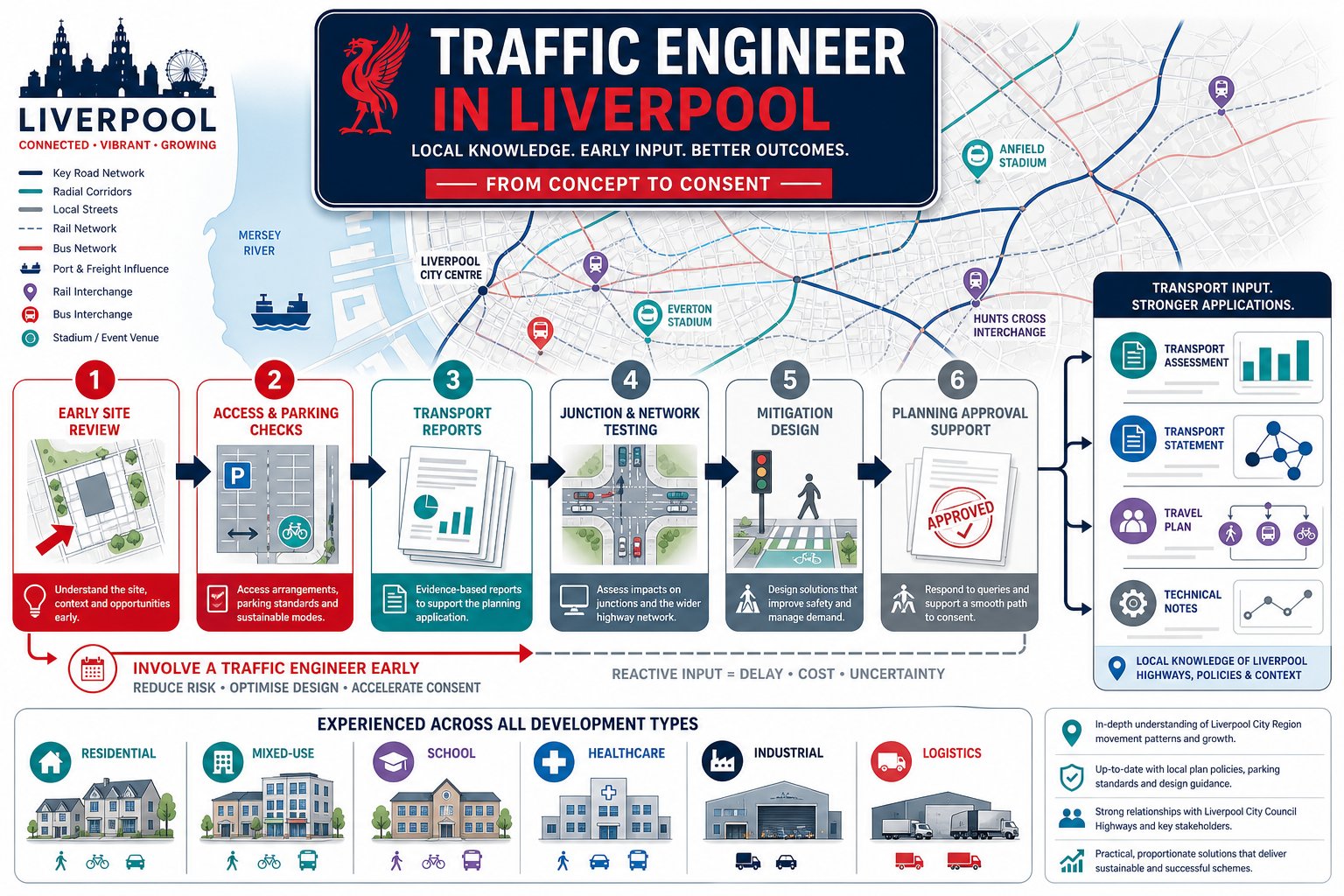
Liverpool schemes rarely fail on ambition. They usually get stuck on detail: an access point that looked fine at concept stage, parking that no longer aligns with policy, or a junction impact that wasn’t tested early enough. That’s where a traffic engineer in Liverpool becomes central rather than optional.
For architects, planners, surveyors, developers and legal teams, transport work is often the thread that ties planning strategy to something authorities can actually approve. We’re not just talking about traffic counts and diagrams. We’re talking about evidence that a site can function, that it connects properly to walking, cycling, bus and rail networks, and that the surrounding highway network won’t be pushed beyond what Liverpool’s planning and highway officers will accept.
In a city with busy radial routes, constrained urban streets, major event traffic, port-related freight movements and intense regeneration pressure, generic transport advice doesn’t go very far. Local knowledge matters. Timing matters too. Bring in the right technical input early and a scheme can be shaped around realistic access, servicing and movement assumptions. Leave it late, and even a strong proposal can end up reacting to objections instead of leading the case.
In this guide, we’ll break down what a traffic engineer in Liverpool actually does, which reports are commonly needed, when to appoint one, and what local authorities are usually looking for in 2026 planning submissions.
Key Takeaways
- A traffic engineer in Liverpool is essential for aligning development proposals with local transport policies and practical network realities to secure planning consent.
- Early involvement of a traffic engineer helps shape realistic access, parking, servicing, and movement strategies, reducing costly redesigns and delays.
- Transport reports such as Transport Assessments, Statements, Travel Plans, and junction reviews must reflect Liverpool’s unique urban environment and local travel patterns to be persuasive.
- Liverpool’s planning authorities prioritise detailed local context, including active travel links, freight routes, event traffic, and road safety, in evaluating transport evidence.
- Choosing a traffic engineer with proven local experience, technical depth, clear communication, and responsiveness significantly improves planning outcomes.
- Effective traffic engineering in Liverpool transforms transport challenges into planning strengths, speeding up approvals and reducing objection risks.
What A Traffic Engineer In Liverpool Does For Planning And Development


A traffic engineer in Liverpool provides the transport evidence that helps development move from concept to consent. In practical terms, that means assessing existing conditions, forecasting likely movement patterns, testing network effects, and recommending changes that make a proposal both policy-compliant and operationally workable.
At site level, we typically review access geometry, visibility, internal circulation, parking provision, turning for service vehicles, and how pedestrians and cyclists move through and around the development. For larger schemes, we may also carry out junction capacity assessments, queue analysis or microsimulation to understand whether surrounding roads can absorb forecast demand.
Just as important is interpretation. Data alone doesn’t persuade an authority. It has to be explained in the context of local thresholds, planning policy, and the actual character of the network. A city-centre apartment scheme near strong public transport links is assessed differently from an edge-of-city logistics site or a suburban school expansion.
We also help shape mitigation. That might include altered site access, revised parking ratios, delivery controls, pedestrian crossing improvements, cycle provision, or travel planning measures. The point isn’t simply to “do a report”. It’s to reduce risk and produce a scheme that stands up technically.
For clients comparing broader advisory support, pages on Traffic Engineering Consultants: and Highway And Traffic Engineering give a useful wider picture of how transport input fits into planning strategy.
Why Liverpool Projects Need Location-Specific Transport Input


Liverpool is not a place where off-the-shelf transport advice works especially well. The city has dense central areas, older streets with limited width, sensitive residential corridors, strategic freight connections, heavy bus movement, rail interchanges, and recurring event pressure linked to football and city-centre activity. Those factors change how transport impacts are judged.
Liverpool City Council and the Liverpool City Region Combined Authority also expect local context to be understood, not glossed over. A report that relies heavily on generic assumptions but barely addresses nearby bus services, active travel links, school traffic, stadium effects, dock-related HGV routes or townscape constraints is likely to invite questions.
This is where local experience makes a noticeable difference. We can identify early whether on-street parking stress will become a planning issue, whether a proposed servicing arrangement conflicts with surrounding activity, or whether a junction that appears acceptable in desktop terms is already sensitive at peak times. Those are the sorts of details that often decide whether a consultee response is supportive, neutral or resistant.
Location-specific input also improves design efficiency. If the site layout responds to actual street conditions from the start, the planning team avoids expensive late redesign. That matters even more on tighter programmes, where transport revisions can delay validation or trigger fresh rounds of consultation.
A more general overview of this planning-led approach is reflected in Traffic Engineering and modern development advice, but Liverpool projects usually need a sharper local lens.
Key Planning And Transport Reports Often Required In Liverpool


The documents required depend on the scale, use and likely impact of the proposal, but several report types come up repeatedly in Liverpool planning work. Authorities typically want enough evidence to understand trip generation, access safety, junction performance, parking demand, servicing practicality and the scheme’s relationship with sustainable transport.
For smaller developments, a concise statement may be enough. For larger or more sensitive proposals, a fuller evidence base is normally expected. In either case, the report has to be proportionate but robust. Too little detail and the application can be challenged. Too much irrelevant material and the key points get buried.
Liverpool submissions commonly involve transport assessments, transport statements, travel plans, technical notes and targeted junction reviews. Depending on the site, there may also be supporting drawings, swept path analysis, collision reviews, construction traffic material and responses to consultation comments.
Good report preparation is partly technical and partly strategic. We don’t just ask what can be written: we ask what the authority is likely to test. If a proposal sits near a constrained junction, schools, heavy pedestrian movement or sensitive residential parking conditions, those issues need clear treatment up front rather than defensive follow-up later.
Transport Assessments And Transport Statements
Transport Assessments and Transport Statements sit at the core of many planning submissions. Broadly, a Transport Statement is used for smaller proposals with lower expected impact, while a Transport Assessment is more detailed and suited to schemes where network effects, access complexity or policy sensitivity are greater.
Both are usually prepared with reference to Department for Transport guidance, the National Planning Policy Framework and local validation expectations. They often include baseline site context, sustainable transport review, traffic surveys, TRICS-based trip generation, trip distribution, junction impact analysis, access appraisal, parking and servicing assessment, and road safety commentary.
In Liverpool, the difference between an acceptable report and a persuasive one often comes down to local realism. Trip assumptions should reflect the city’s actual mode choice opportunities. Parking justification should be tied to site location and use type. Collision data should be interpreted rather than dumped into an appendix and forgotten.
Where a full strategic picture helps, Traffic Engineering: Your shows how these studies support safer, better-argued planning decisions.
Travel Plans, Technical Notes, And Junction Reviews
Travel Plans are frequently required either as part of the application package or by condition. A useful Travel Plan isn’t vague encouragement to “use sustainable transport”. It sets measures, targets, responsibilities, monitoring arrangements and realistic interventions such as cycle parking, travel information, car club membership, bus incentives, staff travel management or school drop-off controls.
Technical notes are another common requirement, especially once comments come back from highways officers or National Highways. These concise documents can address revised modelling, tracking details, visibility splays, parking clarification, servicing amendments or policy interpretation. A good technical note is brief, focused and hard to misread.
Junction reviews come into play where a development could alter operation or safety on nearby roads. That might involve priority junctions, signalised junctions, roundabouts or internal site access points. The assessment may lead to recommendations such as lane reallocation, signal timing changes, pedestrian crossing facilities, lining adjustments or access redesign.
For commercial and employment-led sites, issues around servicing, peak overlap and operational resilience are especially important, which is why Commercial Traffic Engineering has become a bigger planning topic in 2026.
When To Appoint A Traffic Engineer During A Project


The best time to appoint a traffic engineer is usually before the scheme starts feeling fixed. In other words: early. Pre-application stage is ideal because access, parking, servicing, tracking, and junction assumptions can still be shaped without ripping up the design team’s work.
That early input often prevents predictable problems. We can flag whether the proposed access point is likely to be resisted, whether vehicle tracking will drive layout changes, whether cycle parking is underprovided, or whether a Transport Assessment threshold is likely to be triggered. That’s much cheaper to resolve before submission drawings are locked.
At minimum, a traffic engineer should be involved before the planning application is finalised wherever Liverpool’s validation expectations indicate a TA, TS, Travel Plan or supporting highways note may be needed. Waiting until an authority asks for more information can create delays, re-consultation and credibility problems.
There are also later-stage appointments that still add value. We’re often brought in when objections emerge, when legal teams need technical evidence for appeal, or when a redesign creates new transport implications. But those are usually reactive positions.
The practical rule is simple: if movement, access, parking, servicing or network effect could influence planning outcome, bring transport input in early enough to steer the proposal rather than merely defend it.
How Traffic Engineering Supports Planning Applications And Appeals


Planning applications succeed more easily when transport evidence is clear, proportionate and aligned with policy. That’s the real role of traffic engineering in the process. We help translate a development proposal into transport terms the authority can test, understand and, ideally, accept.
For applications, that means preparing reports and drawings that explain baseline conditions, likely trip effects, sustainable travel opportunities, access arrangements, parking rationale, servicing proposals and any mitigation needed. It also means responding quickly and precisely when comments come back. Many applications are not refused because of one fatal issue: they stall because concerns aren’t answered well enough.
Traffic engineering also matters in negotiation. Meetings with highways officers, combined authority representatives or design teams are often where technical issues are narrowed. If the evidence is weak, those meetings drift. If the evidence is sound, they become problem-solving sessions.
Appeals raise the stakes. At that point, transport work may need to withstand formal scrutiny by inspectors, legal representatives and expert witnesses. We may prepare rebuttal notes, statement of common ground input, proofs of evidence or hearing material. In those cases, concise reasoning matters as much as technical accuracy.
For teams working across more than one city, comparing local approaches can be useful. The contrast with Traffic Engineer In Manchester: or Traffic Engineer In Leeds: shows how regional context can shift report emphasis, even when the core methodology is similar.
Common Development Types That Need Traffic Engineering Input
Not every site needs the same depth of transport work, but certain development types regularly trigger detailed review because they affect movement patterns, parking demand, servicing or road safety in obvious ways. In Liverpool, that list spans everything from city-centre residential towers to education sites and port-linked industrial uses.
Residential, Mixed-Use, And Commercial Schemes
Residential development is one of the most common areas for traffic engineering input, but the issues vary sharply by location. Edge-of-city housing may raise questions about junction capacity, school-run overlap and car dependency. City-centre apartments often turn instead on parking restraint, servicing strategy, active travel links and realistic mode share assumptions. Purpose-built student accommodation adds another layer, with term-time peaks, drop-off activity and low-car but high-delivery movement.
Mixed-use schemes are more complex because different uses peak at different times. A development combining residential, retail, workspace and leisure may produce a balanced profile overall, yet still create local pinch points if servicing and public realm planning are weak.
Commercial proposals need particular care around servicing, parking turnover, pedestrian desire lines and customer access. Retail and leisure uses can produce compressed peaks and high weekend activity. Office-led schemes may depend heavily on public transport accessibility and travel planning credibility. Regeneration projects often involve all of this at once.
Schools, Healthcare, Industrial, And Logistics Sites
Schools and higher education sites are transport-sensitive almost by definition. Drop-off and pick-up activity, bus movement, walking routes, road safety and neighbour impact all come under scrutiny. Even modest expansions can generate strong local concern if traffic management is not thought through properly.
Healthcare sites bring another pattern. Clinics, hospitals, care homes and extra-care accommodation may involve staff shifts, ambulance access, visitor parking, servicing and accessibility for people with reduced mobility. These schemes need practical movement planning, not just policy citations.
Industrial and logistics developments can be especially demanding in Liverpool because HGV routing, port-related movements, last-mile delivery patterns and strategic road network effects may all be relevant. Vehicle tracking, yard operation, gatehouse arrangements, shift changes and driver welfare facilities can all influence whether the transport case feels credible.
Across these use classes, the core value of a traffic engineer in Liverpool is the same: proving that the development can function safely and sensibly in its real-world setting.
What Liverpool Planning Teams And Highway Authorities Typically Review
Liverpool planning and highways officers usually focus on a practical set of questions. Can vehicles enter and leave safely? Will the surrounding network continue to operate acceptably? Does the parking and servicing arrangement make sense? Are pedestrians, cyclists and public transport users properly considered? And does the evidence stack up?
Access design is often the starting point. Authorities will review geometry, visibility, relationship to nearby junctions, footway crossings, adoptability issues and whether larger vehicles can manoeuvre without conflict. Internal layout matters too, particularly where refuse, emergency or delivery vehicles need reliable access.
Junction operation is another frequent focus. If a site adds material traffic to a constrained location, the authority will want to know how queues, delays and network interaction have been assessed. It isn’t only about model outputs: officers will usually consider whether the assumptions behind those outputs are believable.
Parking and servicing are closely scrutinised in Liverpool because many sites sit within constrained urban environments. Numbers alone are rarely enough. Layout, accessibility, cycle provision, disabled spaces, loading strategy and conflict with surrounding kerbside activity all matter.
Road safety is never an afterthought. Collision history, pedestrian crossing conditions, school route sensitivity and HGV impacts can all shape the response. Construction traffic is also increasingly reviewed, especially on tighter urban sites where routing, timing and site management can affect both safety and local amenity.
And, more than some applicants expect, sustainable transport integration carries real weight. Good walking links, bus accessibility, rail proximity and cycle facilities are part of the planning case, not decorative extras.
How To Choose The Right Traffic Engineer In Liverpool
Choosing the right consultant is not just about finding someone who can produce a report. Most competent engineers can do that. The better question is whether they can produce the right report, at the right stage, in a way that helps the wider planning strategy.
First, look for proven local experience. Liverpool has its own transport character, policy emphasis and review culture. A consultant who understands local authority thresholds, the shape of common highways concerns and the reality of the city’s network will usually spot issues faster and frame responses better.
Second, test technical depth. Depending on the scheme, you may need trip generation analysis, junction modelling, swept path work, Travel Plans, collision analysis, appeal evidence or quick-turnaround technical notes. Ask about recent comparable projects, not just general capability.
Third, assess communication. Reports should be clear enough for planners and committee members, not written only for modellers. We’d always favour concise argument over bulky paperwork. That matters even more when lawyers, architects and project managers need transport advice translated into decisions.
Finally, consider responsiveness. Planning programmes move quickly, and transport work often sits on the critical path. At ML Traffic, our approach is built around concise, accurate reporting and more than 30 years of experience, tailored to local authority expectations. That’s the difference between a document that merely exists and one that actively helps secure consent.
A current Traffic Engineer in Liverpool resource can help benchmark what local, planning-led support should look like in practice.
Conclusion
For 2026 development work, a traffic engineer in Liverpool is rarely just a box-ticking appointment. The role is central to de-risking planning, shaping access and movement strategy early, and giving councils and highway officers the evidence they need to support a proposal with confidence.
The strongest schemes usually have one thing in common: transport issues were identified before they became objections. That means local analysis, proportionate reporting, realistic mitigation and clear communication with planning and highways stakeholders.
Whether the project is residential, commercial, educational, healthcare-led or logistics-based, the transport case needs to reflect Liverpool as it actually operates, not as a generic template assumes it does. Get that right, and planning discussions tend to become more focused, more constructive and, frankly, faster. Get it wrong, and transport can become the reason an otherwise sound scheme starts slipping.
Frequently Asked Questions About Traffic Engineers in Liverpool
What role does a traffic engineer in Liverpool play in planning and development?
A traffic engineer in Liverpool analyses transport conditions, designs site access and parking, assesses junction impacts using modelling, and advises on mitigation measures to ensure developments comply with local policies and function safely within the transport network.
Why is local knowledge important for traffic engineering projects in Liverpool?
Liverpool’s unique transport context—including narrow streets, event traffic, bus and freight routes—requires traffic engineers to provide location-specific advice that meets Liverpool City Council standards and addresses local constraints for effective planning support.
When should a developer appoint a traffic engineer during a project in Liverpool?
Ideally, a traffic engineer should be engaged at the pre-application stage to influence design decisions on access, parking, and servicing early, avoiding costly revisions and ensuring planning submissions meet Liverpool’s validation requirements for transport evidence.
What types of transport reports are typically needed in Liverpool planning applications?
Common reports include Transport Assessments for larger developments, Transport Statements for smaller proposals, Travel Plans with sustainability measures, and technical notes or junction reviews responding to highway authority concerns, all tailored to Liverpool’s local guidance.
How do traffic engineers contribute to planning appeals in Liverpool?
They prepare robust, evidence-based reports and expert witness statements, engage with highway authorities, and address objections through clear, localised transport analysis to support appeals effectively within Liverpool’s planning framework.
What factors should be considered when choosing the right traffic engineer in Liverpool?
Select a chartered engineer with proven Liverpool experience, familiarity with local standards and modelling practices, strong communication skills, responsiveness, and a track record of helping secure planning consent through clear, concise transport evidence.