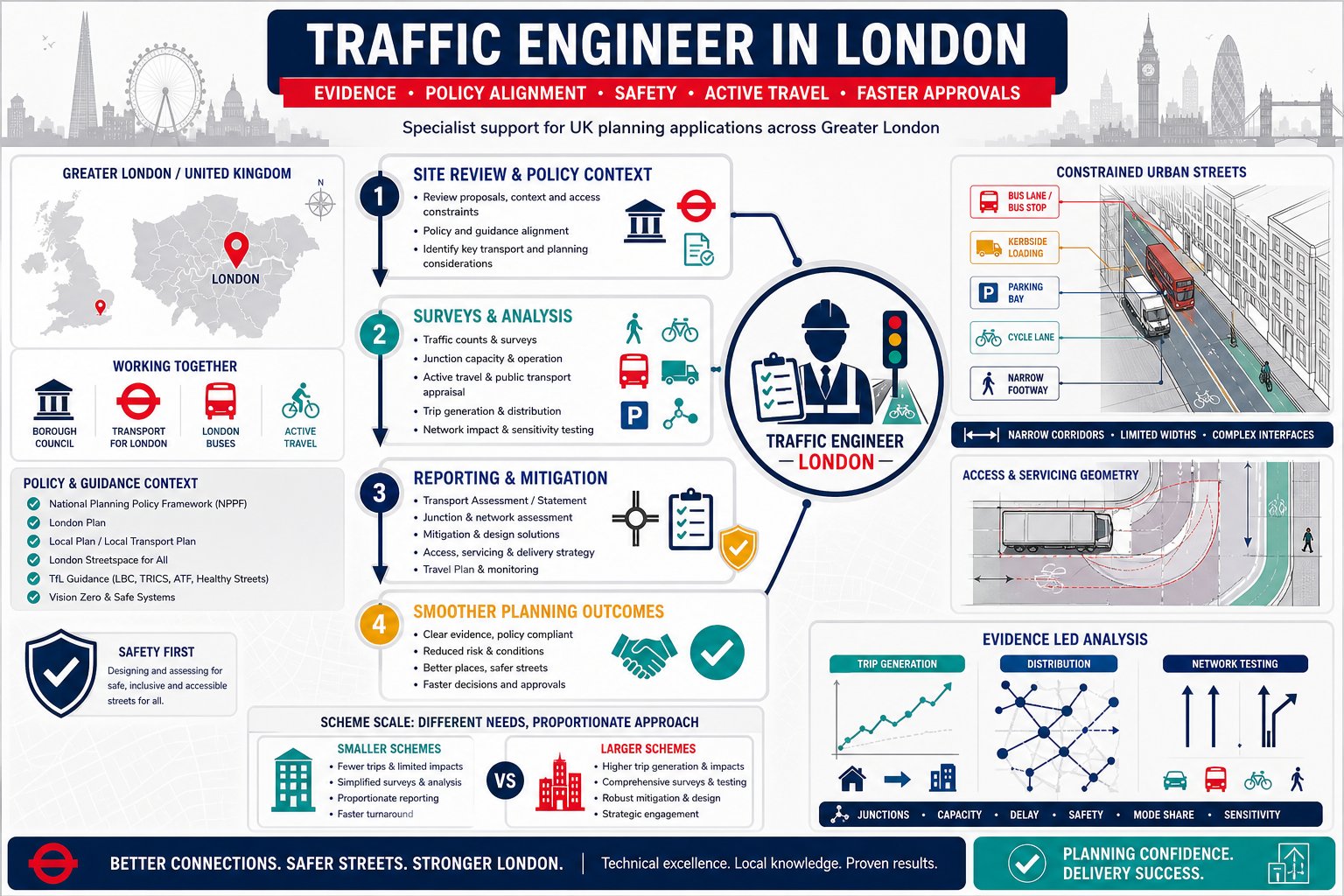
London planning is rarely held up by architecture alone. More often, the friction appears where a scheme meets the street: vehicle access, servicing, parking pressure, bus operations, cycle safety, or a borough officer’s perfectly fair question about whether the junction can actually cope. That’s where a traffic engineer in London becomes central to the planning team, not an afterthought.
We work with architects, planners, developers, surveyors, lawyers and councils to turn transport risk into structured planning evidence. In practice, that means assessing how a proposal will function on the highway network, how people will reach it, how deliveries will be handled, and whether the development aligns with London’s policy push toward public transport, walking, cycling and Vision Zero.
In 2026, the standard is higher than simply proving “no severe impact”. Boroughs and TfL increasingly expect robust survey work, policy-led reasoning, realistic mitigation and clear reporting that fits the local context. A weak transport submission can slow validation, trigger rounds of objections, or force redesign when the project can least afford it.
This guide explains what a traffic engineer in London actually does for planning applications, when input is needed, what reports are typically required, and why some submissions sail through while others stall. If your project sits on a constrained urban site, and in London, most do, the details matter more than ever.
Key Takeaways
- A traffic engineer in London plays a vital role in planning applications by transforming transport risks into structured, policy-aligned evidence that supports smooth project approvals.
- Successful transport reports must go beyond vehicle counts to address London’s local policies on public transport, active travel, parking, servicing, and Vision Zero road safety principles.
- Early involvement of a traffic engineer is crucial in London developments, especially for sites with constrained access or near busy transport networks, to avoid delays and costly redesigns.
- Comprehensive transport assessments in London typically include trip generation, junction impact analysis, servicing strategies, and tailored mitigation measures that reflect the borough’s specific concerns.
- Robust baseline data, including traffic counts, parking surveys, and active travel audits, must be recent and relevant to the local conditions to withstand borough scrutiny and support sound recommendations.
- Selecting a traffic engineer with London-specific experience and strong communication skills ensures planning submissions are credible, context-sensitive, and address local authority expectations effectively.
What A Traffic Engineer In London Does For Planning Applications
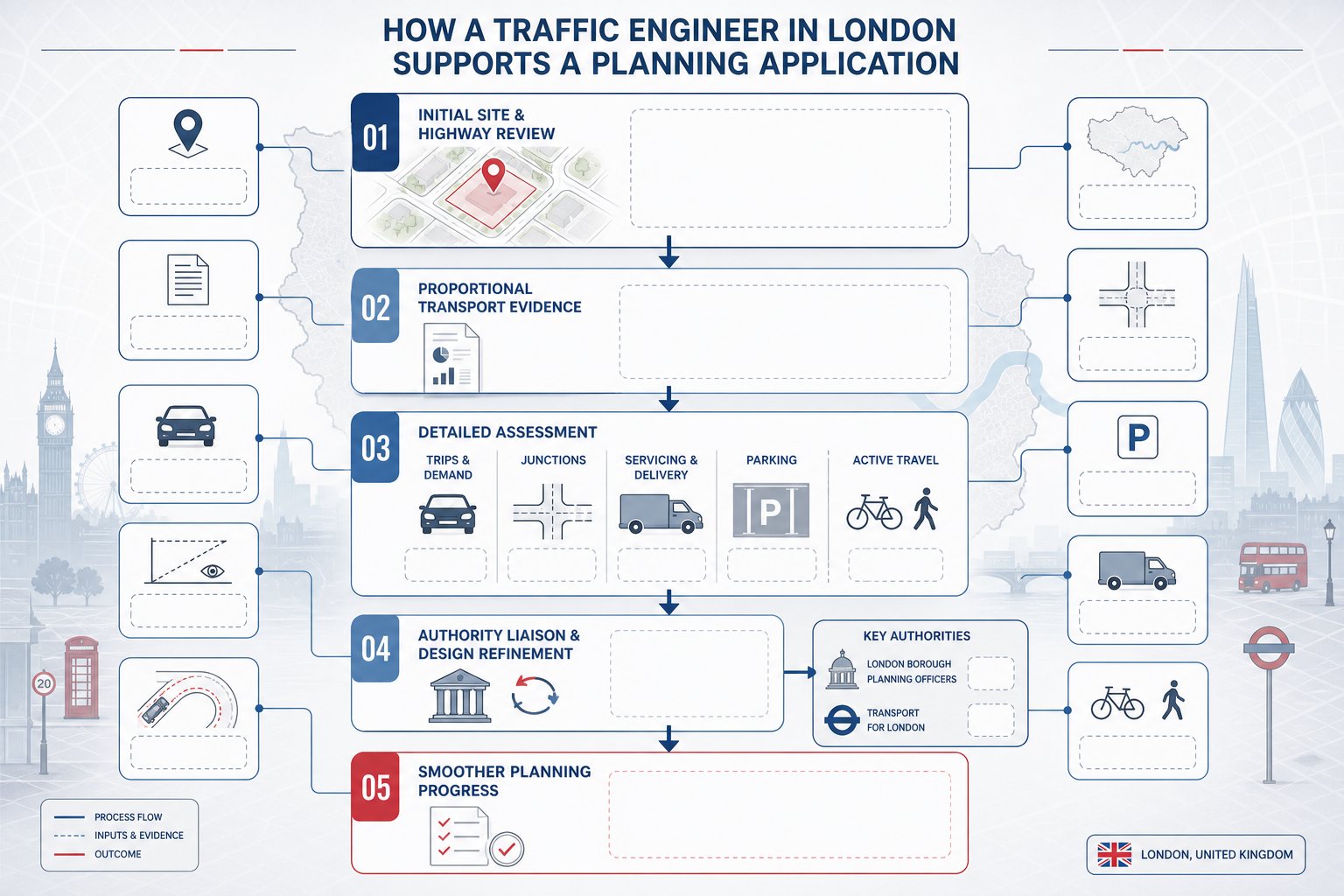
A traffic engineer in London supports the planning process by translating transport risk into evidence that local authorities can assess. At the start of a project, we review the site, proposed land use, access points, surrounding highway conditions and likely planning triggers. That early review often saves weeks later, because transport issues have a habit of surfacing after layouts feel fixed.
For smaller schemes, we may prepare a concise statement demonstrating that impacts are limited and manageable. For more complex developments, we produce a full assessment covering trip generation, mode share, junction performance, servicing, parking, active travel and mitigation. We also review tracking, refuse collection strategy, delivery arrangements, visibility, swept paths and access geometry.
Just as important, we liaise with borough highways officers and, where relevant, Transport for London. London’s planning environment is collaborative but exacting. Officers want evidence, not optimism. That means our role is partly technical and partly strategic: understanding what level of assessment is proportionate, what policy concerns are likely to arise, and how to answer them before they become objections.
For many teams, that wider advisory role is as valuable as the report itself. Good Traffic Engineering Consultants: What help shape site design, not just comment on it. And where a client needs concise, authority-aware reporting, a specialist Traffic Engineer in London can make the planning path noticeably smoother.
How London Planning Policy And Local Authority Requirements Shape Transport Reports
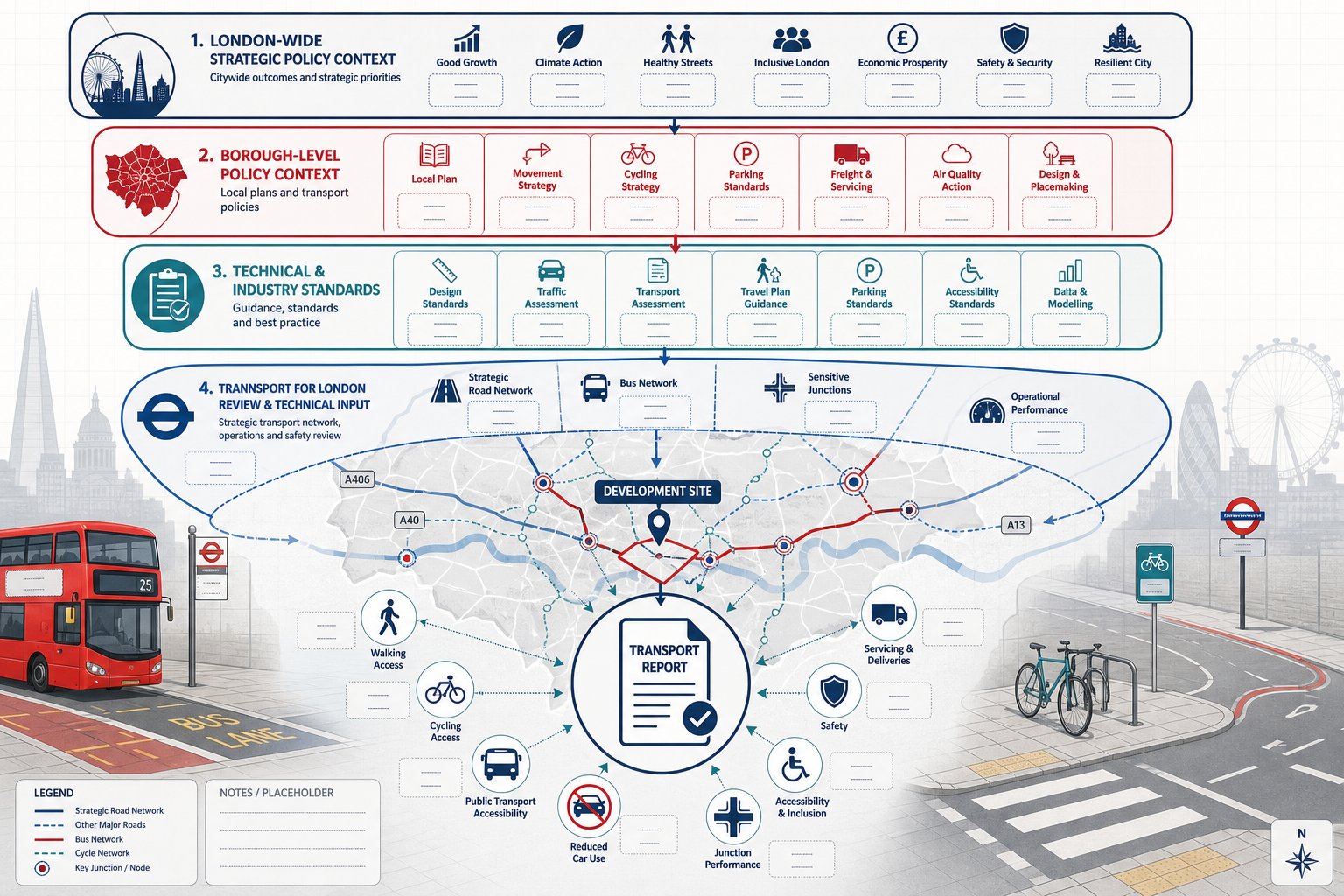
Transport reports in London are policy documents as much as technical ones. We do not simply count vehicles and attach a few drawings. We have to show how a scheme aligns with the London Plan, the relevant borough Local Plan, any transport supplementary planning guidance, and technical standards such as Manual for Streets, DMRB where applicable, and the Traffic Signs Regulations.
That policy framework changes the emphasis of reporting. In many towns, the main question is highway capacity. In London, capacity still matters, but so do mode shift, accessibility, public transport integration, cycle parking, walkability, servicing restraint and road danger reduction. Boroughs often expect clear evidence that car use has been minimised where feasible and that the development supports a car-free or car-lite approach if the location justifies it.
TfL adds another layer for sites on or near the Transport for London Road Network, major bus corridors or sensitive junctions. A report may need to address bus stop accessibility, pedestrian demand, freight management, signal impacts or network resilience beyond the immediate frontage.
This is why local experience matters. A technically correct report can still struggle if it misses the policy mood of the borough. Practical London Development Transport advice should connect transport evidence to planning policy in plain terms. The strongest submissions also reflect broader Traffic Engineering and Transportation principles: accessibility, safety, proportionality and a realistic understanding of how London streets actually operate.
When A Development In London Needs Traffic Engineering Input
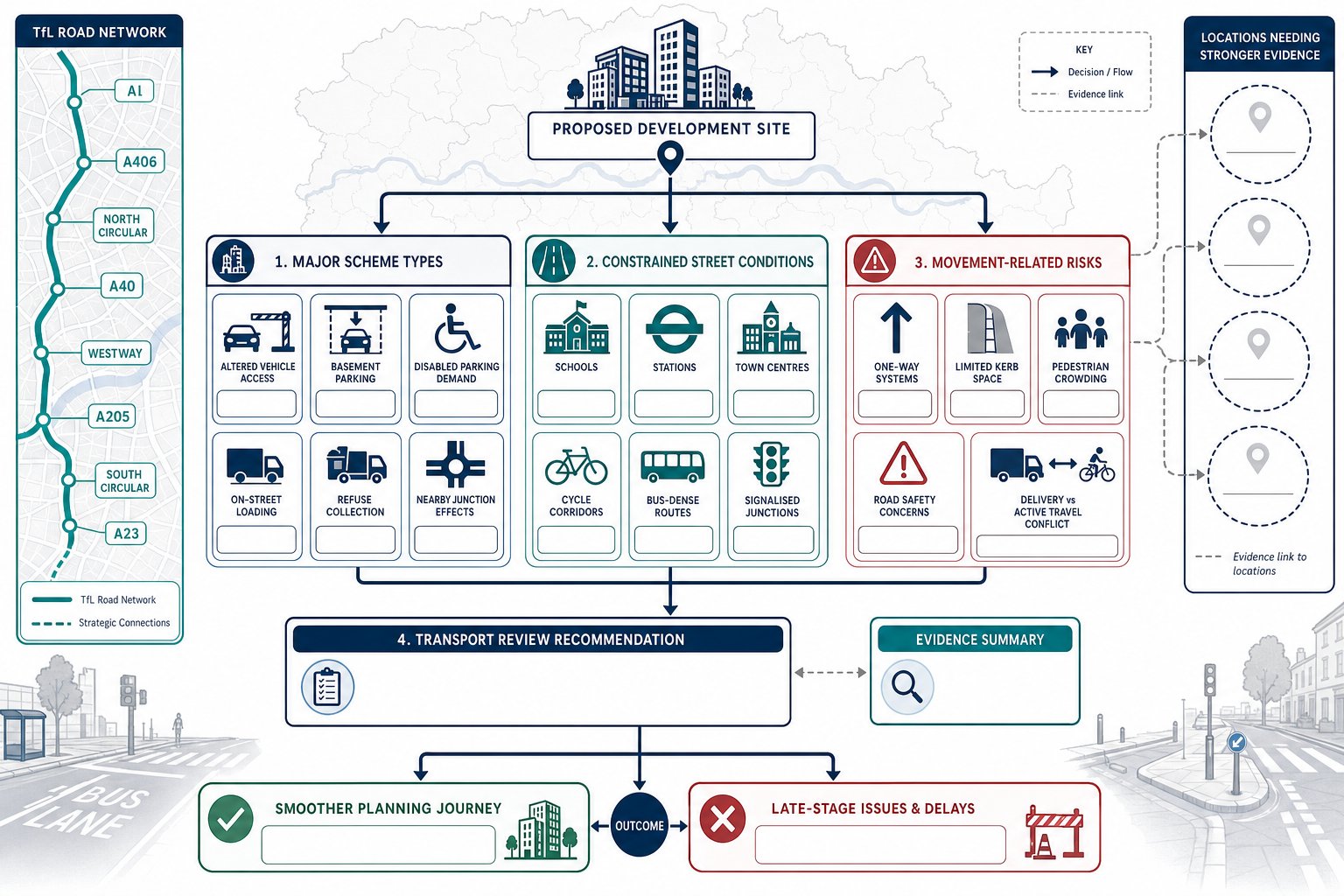
Some projects obviously need traffic engineering input. Others only seem simple until the access, servicing or parking questions arrive. In London, we’d usually advise early transport input for any major residential, office, retail, leisure, logistics, education or mixed-use scheme. But smaller developments can need it too, particularly where the site sits on a constrained street or relies on awkward servicing.
Typical triggers include a new or altered vehicular access, basement parking, blue badge parking pressure, on-street loading, refuse collection from the carriageway, or any change likely to affect a nearby junction. Sites close to schools, stations, town centres, cycle corridors or bus-heavy routes often attract closer scrutiny because the street is already doing a lot of work.
Location matters hugely. If a site is near the TfL Road Network, a signalised junction, a busy high street, or a one-way system with limited kerb space, even modest development can require robust evidence. We also see transport input requested where councils are concerned about road safety history, pedestrian crowding, or conflict between deliveries and active travel.
The practical rule is simple: if movement to and from the site could become a planning issue, bring in a transport specialist before the design is locked. That is particularly true in commercial schemes, where Commercial Traffic Engineering decisions can affect viability. For schemes facing likely network scrutiny, a focused traffic impact assessment is often the difference between a manageable planning discussion and a late-stage problem.
Transport Statements, Transport Assessments, And Travel Plans Explained
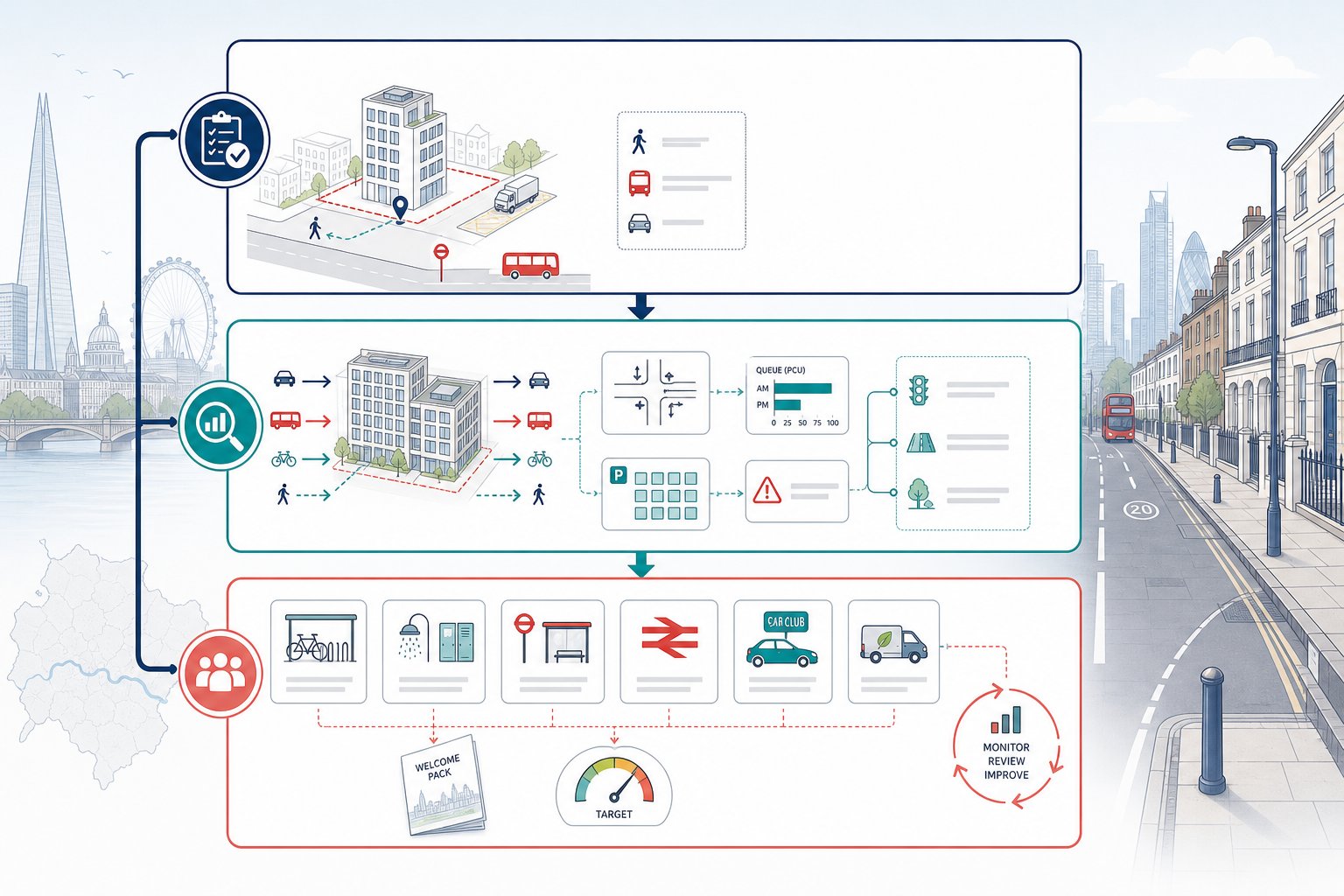
These three documents are often mentioned together, but they do different jobs.
A Transport Statement is usually used for smaller developments where transport effects are expected to be limited. It describes existing conditions, accessibility, likely travel demand, access and servicing arrangements, and explains why the impacts are acceptable. Think of it as proportionate planning evidence rather than a deep modelling exercise.
A Transport Assessment goes further. It is typically required for larger or more sensitive schemes and provides a detailed review of person trips and vehicle trips, mode split, trip generation, distribution, assignment, junction performance, parking demand, servicing, road safety and mitigation. This is where junction modelling, queue analysis and more extensive survey data often appear.
A Travel Plan is not a technical appendix for the shelf. It is a management strategy designed to reduce private car reliance and encourage sustainable travel through measures such as cycle parking, showers, car club membership, public transport information, delivery management, welcome packs, targets and monitoring.
In London, councils frequently look at these documents as a package. A technically competent assessment can still feel weak if the Travel Plan is generic, or if the statement glosses over servicing tension on a narrow street. The best reports are concise where they can be and detailed where they must be. That broader discipline sits at the heart of Highway And Traffic Engineering: matching evidence to risk, and not pretending a short report can answer a long list of transport concerns.
How A Traffic Engineer Assesses Trip Generation, Distribution, And Junction Impact
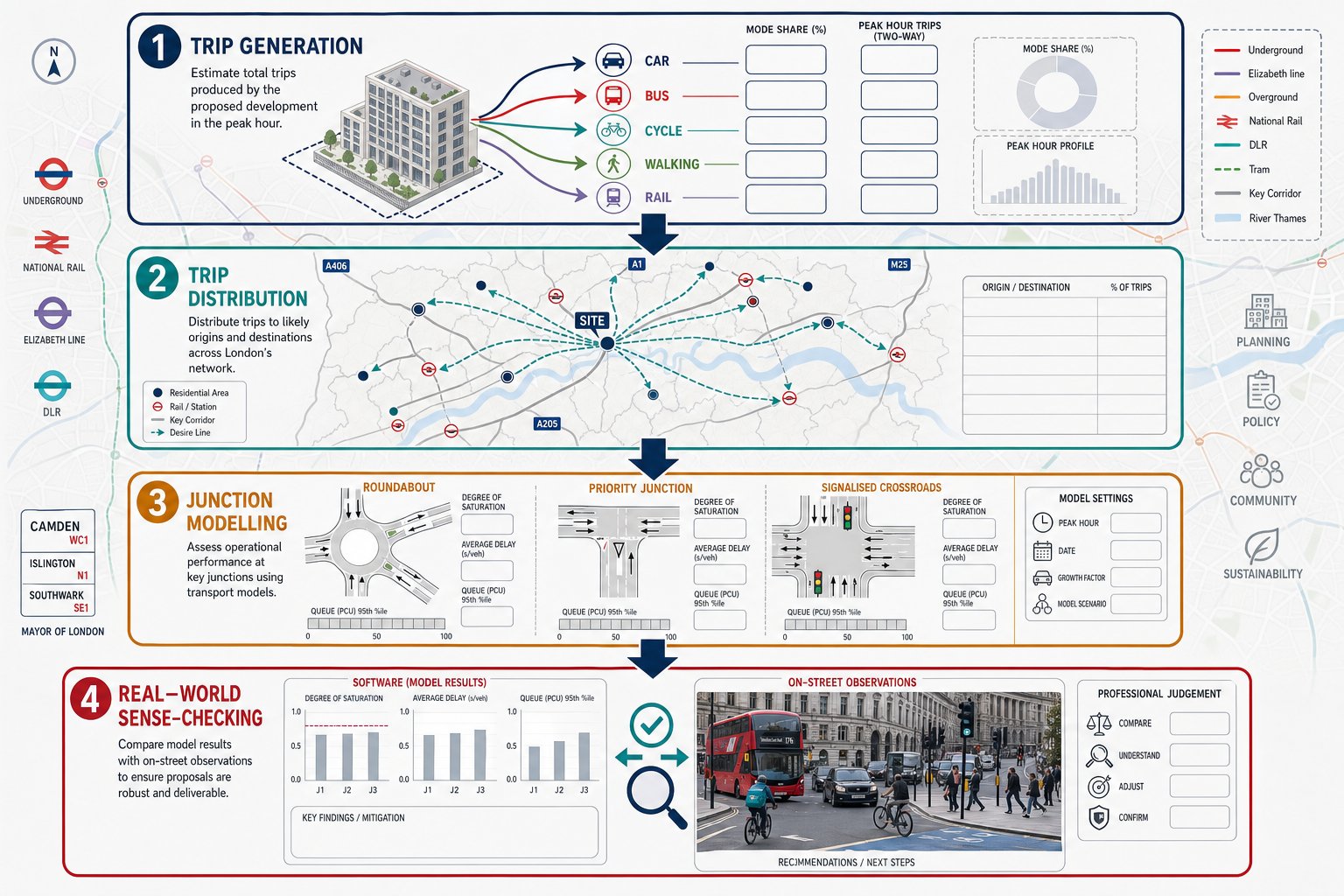
This is the part many planning teams hear about first, but it only works when the basics are sound. We begin by estimating how many trips the proposed development is likely to generate by mode and by time period. That usually involves TRICS or comparable data sources, adjusted for London context, public transport accessibility, land use, scale and local travel behaviour.
Then we look at where those trips are likely to come from and go to. Distribution is never a guess dressed up as a diagram. We use census patterns, local network logic, station catchments, observed turning movements, committed developments and accessibility data to assign trips in a way that reflects real movement patterns.
Only then do we test junction impact. Depending on the junction type, that may involve software such as ARCADY for roundabouts, PICADY for priority junctions, LINSIG or LinSig-style signal modelling for controlled junctions, or other accepted tools such as SYNCHRO. But modelling is only as credible as the assumptions behind it. Overstate pass-by trips, understate delivery activity, or choose the wrong baseline year, and the numbers become fragile very quickly.
We also sense-check the outputs. If a model says everything is fine but site observations show chronic blocking back, something is wrong. Sound Traffic Engineering: Your Complete approach means combining software, observed conditions and planning judgement. Borough officers usually spot formulaic modelling: they respond far better to analysis that feels grounded in the street network they know.
Key Surveys And Data Used To Support Planning Submissions
Good transport evidence starts with good baseline data. In London, that usually means more than one survey type because a site rarely has only one transport question. We may need to understand traffic volumes, turning movements, queues, pedestrian flows, cycle movements, parking occupancy, servicing behaviour, bus availability, collision history and the walk quality between the site and nearby stations or bus stops.
The right survey package depends on the proposal. A small infill residential scheme may only need focused counts, parking surveys and access review. A larger mixed-use development may need multi-day counts, junction turning surveys, queue observations, servicing assessments, active travel audits and public transport accessibility commentary.
Timing matters as much as the survey itself. Data should be recent, representative and collected at periods relevant to the land use. School peak conditions, weekend retail peaks, event impacts and seasonal distortion can all change the picture.
Traffic Counts, Turning Counts, And Queue Surveys
Traffic counts establish existing flow levels on surrounding roads, often as 24-hour automatic counts over several days. Turning counts record how vehicles move through specific junctions during peak periods. Queue surveys help us understand not just volume, but operational stress: how far traffic stacks back, whether it blocks side roads, and where delay becomes problematic.
Those surveys are often the backbone of any assessment or modelling exercise. If the count locations are poorly chosen, or if peak periods miss the true network pressure, the rest of the report may be challenged.
Parking, Servicing, And Active Travel Site Reviews
Parking surveys test how much kerbside or off-street capacity really exists, rather than how much appears available at a quick glance. In dense London streets, that distinction matters. We also assess servicing by reviewing delivery patterns, loading restrictions, vehicle sizes and whether manoeuvres can occur safely without unreasonable conflict.
Active travel reviews examine footway widths, crossing points, dropped kerbs, lighting, cycle access, secure cycle parking and the realism of walking and cycling routes. In 2026, boroughs increasingly expect these elements to be treated as core evidence, not a short afterthought tucked behind vehicle analysis.
Access, Servicing, And Delivery Strategy In Constrained London Streets
London sites often fail or succeed on servicing detail. A scheme can look entirely sensible on the plans, then unravel because a delivery van has nowhere lawful to stop, a refuse vehicle cannot manoeuvre without reversing onto the highway, or loading activity would conflict with a cycle lane at precisely the wrong hour.
That is why we treat access and servicing strategy as a design exercise, not a compliance note. We look at street width, one-way operation, bus movements, parking controls, loading windows, neighbouring frontages, swept path requirements and whether on-site turning is realistic. Sometimes the answer is a redesigned access. Sometimes it is timed deliveries, smaller vehicles, consolidation, a booking system, or keeping certain servicing activity off peak.
On constrained sites, being “technically possible” is not enough. Borough officers want arrangements that are workable in normal conditions, not only when the street is unusually empty. We hence test how servicing will happen day to day, who will manage it, and whether the operation depends on unrealistic driver behaviour.
This is where practical experience counts. Developers often benefit from Traffic Engineer in London input before layouts are finalised, because access geometry and servicing strategy can influence bin stores, cores, basement ramps and frontage design. For broader project coordination, Traffic Engineer In work is most effective when transport, architecture and operations are considered together rather than in sequence.
Road Safety, Visibility, And Highway Design Considerations
Road safety is no longer a box to tick in London planning. It sits at the centre of transport review, especially under Vision Zero principles. We assess whether a proposal creates or worsens conflict between drivers, pedestrians and cyclists, whether visibility at access points is appropriate, and whether highway design supports lower-risk movement for all users.
That includes checking visibility splays, access width, radii, footway continuity, crossing desire lines, cycle interactions, gradients, tracking and the relationship between site access and nearby junctions or bus stops. A visibility standard lifted from a rural road context rarely tells the whole story on an urban London street: we need design judgement as well as standards.
Collision analysis also matters. If the surrounding network has a recent pattern of pedestrian injury, turning collisions or side-swipe incidents involving cyclists, a borough may expect more than a simple assurance that the proposal is acceptable. It may require physical mitigation, operational changes or a stronger rationale for the chosen layout.
Good highway design balances safety with place. It should allow access without inviting excessive speed, support walking and cycling without creating ambiguity, and fit the local street character. Done well, this strengthens planning credibility because officers can see the scheme has been designed with actual street users in mind, not just with vehicles in mind.
Common Reasons Transport Reports Are Challenged By Boroughs
Most challenged transport reports are not rejected because they are wildly incompetent. They struggle because something important feels thin, outdated or too convenient.
A common issue is underestimated trip generation. If a borough believes the land use, occupancy profile or delivery demand has been softened to keep impacts low, confidence drops quickly. The same goes for parking assumptions that ignore real local stress or overstate the effect of nearby public transport.
Outdated survey data is another recurring problem. London streets change fast: road space reallocation, new cycle lanes, bus priority, nearby development and kerbside policy can all alter conditions. Data that looked acceptable 18 months ago may no longer reflect reality.
Reports are also challenged when they treat walking, cycling and buses lightly while focusing heavily on vehicles. In London, that balance matters. Boroughs expect assessments to address sustainable travel seriously, especially where policy pushes car-free or low-car development.
Then there is mitigation. Vague promises of management plans “if required” rarely satisfy officers. They want specific, deliverable measures with clear responsibility and, where relevant, monitoring.
In our experience, the best defence against challenge is proportionate honesty. If there is a constraint, acknowledge it and show how it will be managed. That is the difference between a report that feels written to persuade and one written to inform planning judgement.
How To Choose The Right Traffic Engineer In London For Your Project
The right consultant is not simply the one who can produce a report fastest, although speed matters. You need someone who understands London borough expectations, TfL interfaces, urban servicing problems and the difference between theoretical compliance and a submission that will actually stand up under review.
Start with relevant experience. Has the consultant worked on similar sites, similar land uses and similar borough contexts? A town centre retrofit in Camden or Southwark presents different transport issues from an edge-of-borough logistics site or a suburban infill scheme.
Then look at technical range. A strong traffic engineer should be comfortable with Transport Statements, Transport Assessments, Travel Plans, junction modelling, access design, servicing strategy, parking analysis and road safety considerations. Professional credentials such as MICE, MCIHT or MILT are useful indicators, but practical planning judgment matters just as much.
Communication is often the deciding factor. Can they explain risk clearly to architects and lawyers? Can they negotiate sensibly with officers? Can they defend assumptions without sounding defensive? Those skills save time.
We’d also suggest reviewing whether the consultant tailors work to thresholds and local authority expectations rather than applying the same template everywhere. That is one reason many teams value Highway And Traffic specialists with borough-specific experience. For clients needing concise and fast-moving planning support, Traffic Engineer in London expertise is most useful when it combines technical precision with genuinely practical advice.
Conclusion
A competent traffic engineer in London does far more than calculate vehicle trips. The real job is to show, with evidence, that a development can function safely, sustainably and credibly within one of the most demanding planning environments in the country.
That means understanding borough policy, TfL expectations, constrained streets, realistic servicing, active travel, road safety and the everyday behaviour of the network around the site. It also means knowing when a short statement is enough and when a detailed assessment, modelling package or travel plan is unavoidable.
For architects, planners, developers and councils, the value is straightforward: fewer surprises, stronger planning submissions and a better chance of addressing transport concerns before they harden into objections. In London, smoother approvals rarely happen by accident. They are usually built on early input, robust data and transport advice that is both technically sound and locally aware.
Frequently Asked Questions about Traffic Engineers in London
What role does a traffic engineer in London play in planning applications?
A traffic engineer in London assesses how developments affect highway access, parking, servicing and safety. They prepare transport reports and liaise with borough officers and TfL to provide evidence supporting planning applications.
When is traffic engineering input necessary for a London development project?
Traffic engineering input is typically needed for major residential, office, retail or mixed-use schemes, especially where there is new vehicular access, significant parking, or sites near TfL roads or busy junctions.
What documents do traffic engineers prepare for London planning submissions?
They prepare Transport Statements for smaller schemes, detailed Transport Assessments for larger projects analysing trip impacts and junctions, and Travel Plans promoting sustainable travel with targets and monitoring.
How do London planning policies influence traffic engineering reports?
Reports must align with the London Plan and borough policies promoting public transport use, walking, cycling, and Vision Zero road safety, beyond just highway capacity, to encourage car-free or car-lite developments.
What surveys and data support a transport report in London?
Key data include traffic flow counts, turning movements, queue surveys, parking occupancy, pedestrian and cycle flows, public transport accessibility, and collision history to provide robust baseline evidence.
How do traffic engineers assess trip generation and junction impacts for developments?
They estimate trips using TRICS data adjusted for local context, distribute trips based on census and network data, then model junction performance with software like ARCADY or LINSIG, validating results against real observations.