
A planning application can look perfectly sound on paper and still stall on highways. We’ve seen it happen repeatedly: a decent scheme, a reasonable layout, but one awkward access point, one undercooked parking argument, or one transport report that’s either too thin or wildly over-scoped. In Northampton, that matters because transport issues are often where practical deliverability gets tested.
A traffic engineer in Northampton helps bridge that gap between planning ambition and highway reality. Our role is to turn broad development proposals into evidence-led transport strategies that local decision-makers can actually rely on. That usually means reviewing access, traffic impact, visibility, servicing, sustainable travel opportunities, and the policy context that sits behind them.
For architects, planners, surveyors, developers, legal teams and councils, the challenge is rarely just “do we need a report?” It’s more often: what level of reporting is proportionate, what will West Northamptonshire Council expect, and how do we keep the process moving without creating technical problems later?
In this guide, we set out what a traffic engineer does in Northampton planning projects, when transport input is likely to be needed, which reports typically support an application, and how to choose advice that is accurate, locally informed and commercially realistic for 2026.
Key Takeaways
- A traffic engineer in Northampton transforms development proposals into evidence-based transport strategies that align with local council expectations and planning policies.
- Early involvement of a traffic engineer ensures proportionate and accurate transport reporting, preventing delays and costly redesigns in planning applications.
- Transport Assessments and Statements are tailored to project scale, with local context and validation requirements shaping report scope for Northampton developments.
- Local knowledge of West Northamptonshire Council’s review process and network specifics is crucial when selecting a traffic engineer to achieve credible, defensible planning outcomes.
- Effective transport input integrates with architectural and planning teams to address access, parking, servicing, and sustainable travel, enhancing deliverability and reducing objections.
- Thorough understanding of local highway conditions, policy context, and careful scoping keeps transport reports concise, timely, and focused on material impacts for Northampton planning projects.
What A Traffic Engineer Does In Northampton Planning Projects

In practical terms, we provide the transport and highways evidence that helps a planning application stand up to scrutiny. That starts with the basics: how vehicles, pedestrians and cyclists get to and from a site, whether an access arrangement is safe, whether parking and servicing work properly, and whether the surrounding road network can accommodate the development.
In Northampton, that often means looking closely at frontage conditions, visibility splays, traffic speeds, turning movements, pedestrian links, bus accessibility and the likely interaction with nearby junctions. We also review how a proposal fits with local and national policy rather than treating engineering as a purely geometric exercise.
A good traffic engineer doesn’t just produce a document. We identify risks early, scope the right level of evidence, commission surveys where needed, run junction modelling where justified, and respond to consultation comments from highways officers. On some schemes, the key issue is simple access design. On others, it’s cumulative impact, servicing, school-run pressure, or whether a proposal risks triggering concerns about the strategic road network.
That broader advisory role is why developers often involve us early, much as they would other Traffic Engineering Consultants: supporting planning teams. With more than 30 years of sector experience behind our approach, we aim to keep reporting concise, technically robust and aligned with local authority expectations rather than padded with analysis nobody asked for.
When You May Need A Traffic Engineer For A Planning Application

Not every scheme in Northampton needs a full Transport Assessment, but many more projects need transport input than applicants first assume. If a development creates a new access, intensifies an existing one, alters servicing patterns, or sits on a busier classified route, there is a fair chance highways comments will become material.
We’re commonly instructed where a site has constrained visibility, sits close to a sensitive junction, borders a school, or has an awkward parking and turning arrangement. Schemes affecting roads linked to the A45, A43, A508, A4500, A428 or M1 corridors can attract closer scrutiny as well, especially where peak-hour effects are a concern.
There is also the planning reality: even when transport impacts are modest, validation requirements may still call for a Transport Statement, Travel Plan, parking note, or a focused technical response. Leaving that until after submission usually costs more time than addressing it at the start.
For clients working across multiple authorities, the trigger points are not always identical: the same broad development type can be treated differently in different areas, much like projects led by a Traffic Engineer In London: team or elsewhere in the country. That’s why local judgement matters as much as generic guidance.
Common Project Types That Require Transport Input
Some project types almost routinely benefit from a traffic engineer in Northampton. Residential development is the obvious one, but not just large estates. We regularly see transport issues arise on infill plots, apartment schemes, build-to-rent proposals, extra-care schemes and student-style accommodation where parking demand, refuse collection, and servicing have been under-considered.
Commercial schemes are another regular trigger. Retail units, food and drink uses, drive-throughs, trade counters, offices, industrial premises, warehousing and logistics proposals can all create traffic, parking or delivery concerns disproportionate to their size. Change-of-use applications are especially easy to underestimate because the building already exists, yet the trip profile may shift sharply.
Education, healthcare, leisure and mixed-use sites also tend to need transport review because they involve timed peaks, vulnerable users, coach or service vehicle access, or more complicated internal circulation.
Even where a full assessment is unnecessary, a proportionate note can make the difference between a smooth consultation and a holding objection. That’s often the value of early advice: identifying whether the issue is capacity, access geometry, travel planning, or simply presenting the case clearly enough that it doesn’t become a problem later.
Northampton Planning And Highway Context To Consider
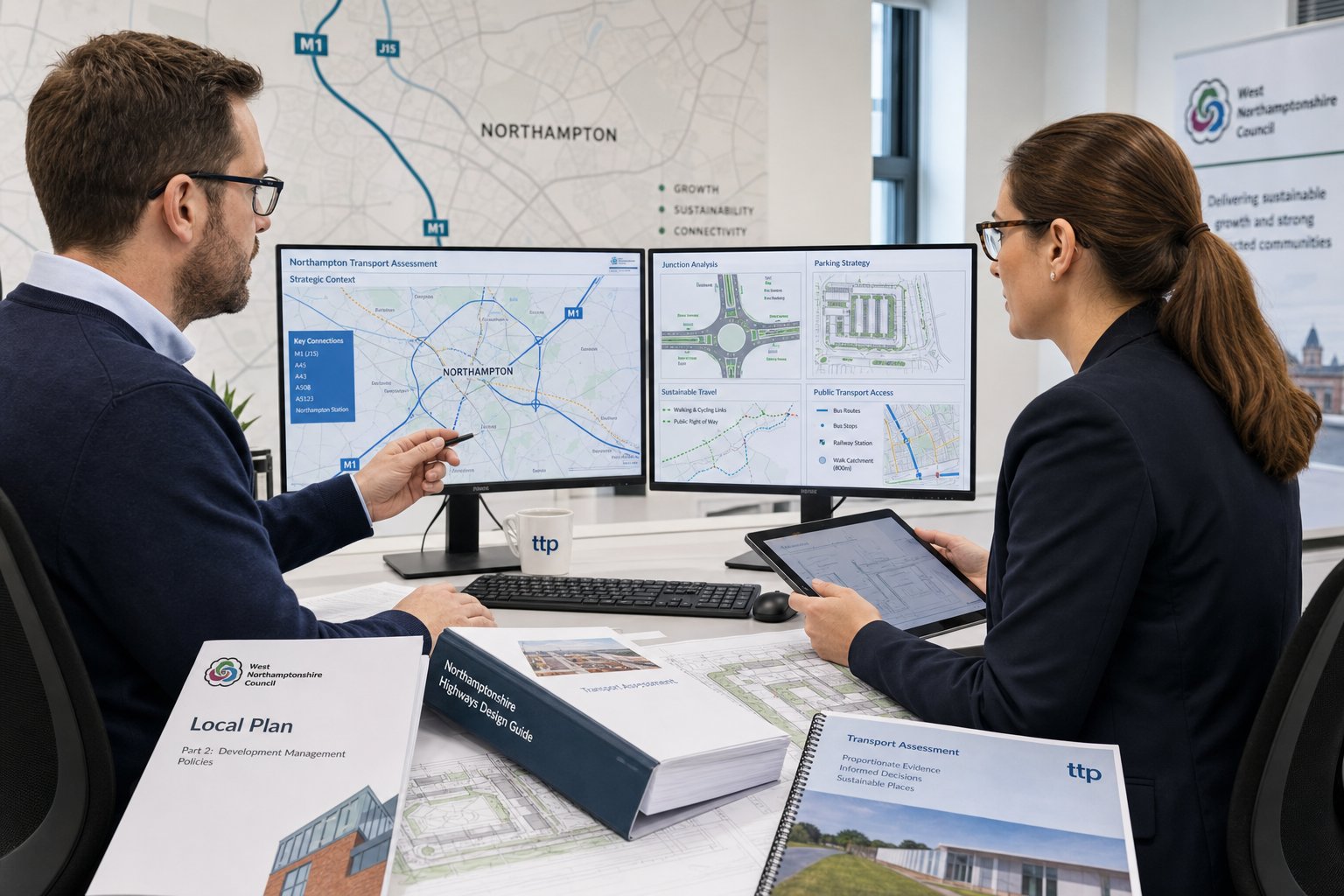
Northampton schemes sit within a planning and highway framework that needs to be understood before any report is drafted. The local highway authority function is now exercised through West Northamptonshire Council, and that matters because local validation expectations, design preferences and officer comments shape what “proportionate” really looks like in practice.
At policy level, we generally work within the National Planning Policy Framework, relevant development plan documents, local parking standards and highways design guidance. The familiar NPPF test remains central: development should only be prevented or refused on transport grounds where the residual cumulative impacts are severe. But severe is not a mathematical threshold: it’s a planning judgement informed by evidence.
That evidence has to reflect Northampton’s network conditions. The town’s movement patterns are heavily influenced by radial and orbital routes, strategic links to the M1, and localised pinch points that can behave quite differently at school peak, commuter peak and inter-peak periods. A scheme near a major corridor may need a wider study area than a site of similar scale in a quieter location.
Parking expectations, active travel links, public transport accessibility and site-specific constraints all feed into that picture. Broader best practice from a Highway And Traffic Engineering perspective is useful, but local application is what usually determines whether an assessment feels credible to officers.
And one small but important point: Northampton applications are rarely helped by copied assumptions from another town. Local road hierarchy, queue behaviour and access constraints aren’t interchangeable.
Key Reports A Traffic Engineer Can Prepare

The right report depends on the scale of development, the sensitivity of the site and what the planning authority is likely to request. Our job is partly technical and partly strategic: deciding what is necessary, what is helpful, and what would simply add cost without improving the planning case.
Typical outputs include Transport Assessments, Transport Statements, Framework or Full Travel Plans, access appraisals, visibility reviews, parking and servicing strategies, junction capacity reports, swept-path analysis notes and responses to technical consultation comments. On some schemes we also coordinate Road Safety Audit processes and prepare designer responses where a highway improvement or access alteration is proposed.
There’s an art to scoping these reports properly. Too little information and the application looks unsupported. Too much, and the submission can become vulnerable because unnecessary technical detail opens up debates that were never material in the first place.
We also find that clients benefit when reporting is integrated with design evolution. A parking strategy written in isolation from the architect’s layout, for example, tends to unravel quickly once bin tracking, cycle parking, EV provision and disabled bays are tested together.
Transport Assessments And Transport Statements
A Transport Assessment is the more detailed route, usually prepared for larger or more traffic-generating schemes. It establishes baseline conditions, reviews sustainable transport options, estimates trip generation, assigns those trips onto the network, tests key junctions where necessary, and considers mitigation. It should end with a clear statement of residual impact, not pages of modelling without planning interpretation.
A Transport Statement is shorter and more proportionate. It suits smaller schemes where impacts are likely to be limited but the planning authority still needs evidence on access, parking, local highway conditions and broad transport effects. In Northampton, the difference between a TS and a TA often comes down to scale, sensitivity and whether there is a realistic capacity question to answer.
The principle in both cases is the same: match the evidence to the proposal. That planning-led approach is consistent across many urban areas, whether the work is being handled by a Traffic Engineer In Birmingham: team or a more locally focused Northampton consultant.
Travel Plans, Technical Notes, And Junction Capacity Reviews
Travel Plans are often misunderstood as box-ticking documents. Done properly, they explain how a development will encourage sustainable travel through practical measures such as cycle storage, pedestrian links, public transport information, car-share initiatives, EV provision, welcome packs, monitoring and coordinator arrangements where relevant.
Technical notes are narrower but often just as valuable. A concise note on visibility splays, parking accumulation, servicing, or swept-path analysis can resolve a consultation issue quickly without requiring a full report rewrite. For many applications, that targeted response is exactly what keeps a programme intact.
Junction capacity reviews come into play where development traffic may materially affect operation. Depending on junction type, that can involve PICADY, ARCADY, LinSig or other recognised methods. The important thing isn’t the software name: it’s whether the assumptions are sensible, the scenarios are transparent, and the outputs are interpreted in planning terms. A marginal increase in queue length may be acceptable on one network and far more problematic on another.
How Traffic Engineers Assess Access, Safety, And Network Impact
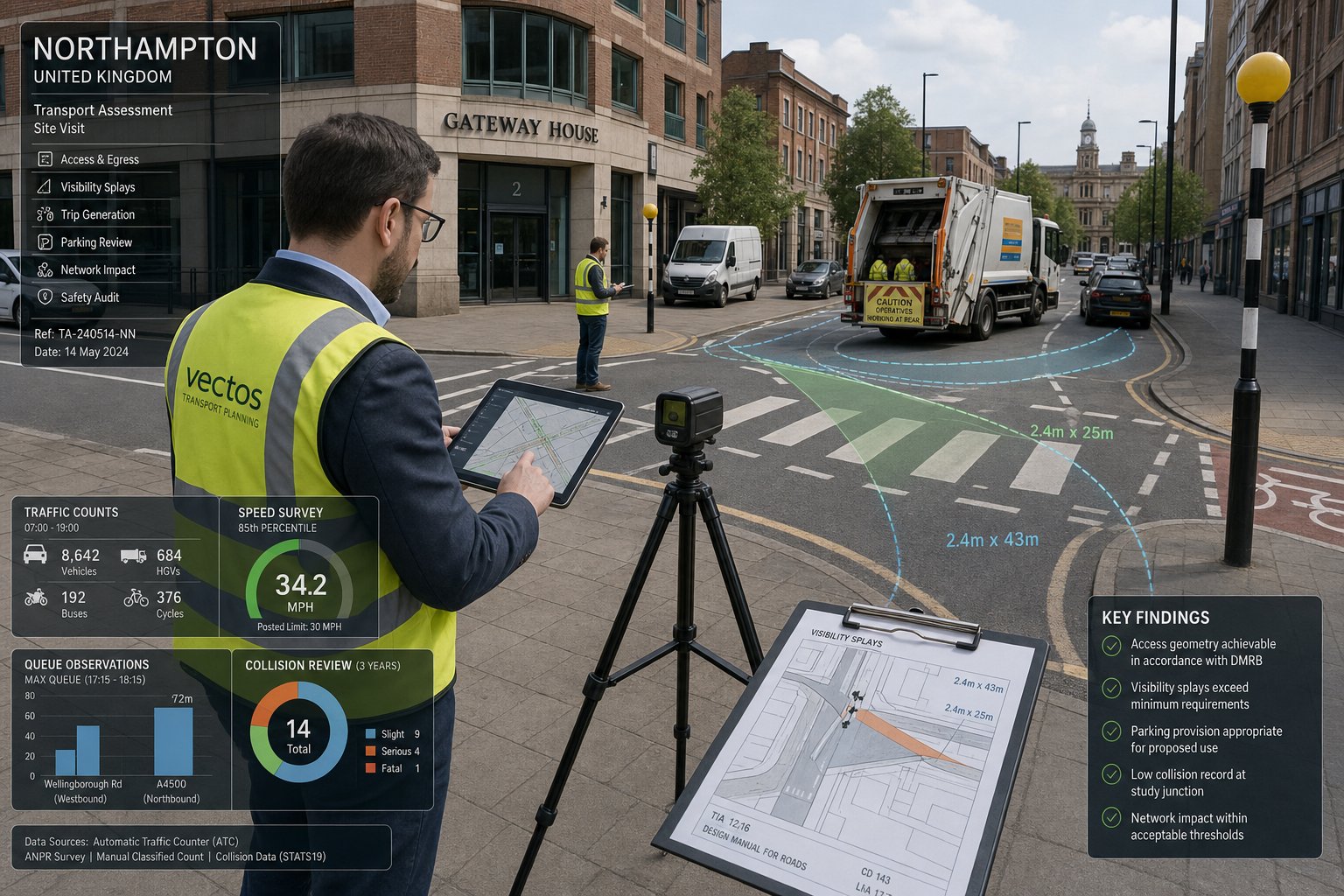
Good transport reporting starts with evidence from the ground, not just desktop assumptions. We usually begin with a site visit to understand frontage conditions, nearby junction form, pedestrian environment, cycle links, crossing points, parking stress, visibility constraints and how the site actually operates at different times of day. Drawings can hide a lot: kerb lines don’t tell you everything.
From there, the assessment may involve traffic counts, speed surveys, queue observations, parking surveys or collision review using available STATS19 data. We compare existing conditions with future baseline conditions and then test the effect of the development. That “with and without development” structure is standard for a reason: it separates background growth from scheme-specific impact.
Access assessment typically considers geometry, visibility splays, vehicle tracking, pedestrian safety and whether the proposed layout can accommodate refuse vehicles, delivery vans and emergency access without conflict. Where trunk roads or strategic links are implicated, standards such as DMRB may become relevant: elsewhere, Manual for Streets principles and local standards often carry more weight.
Safety is never just a matter of counting collisions. We also look at road function, observed driver behaviour, vulnerable users, school activity and whether a proposal could create awkward manoeuvres or unclear priority. Similar methods underpin work in other cities, including schemes led by a Traffic Engineer In Leeds: context, but Northampton decisions still turn on local conditions and officer judgement.
Local Authority Requirements, Thresholds, And Validation Expectations
This is where many planning applications either stay tidy or start to wobble. West Northamptonshire Council may require specific transport documents based on unit numbers, floorspace, access changes or the sensitivity of the surrounding network. In practice, that can mean a Transport Statement for one scheme, a full Transport Assessment and Travel Plan for another, and a focused technical note for a third that appears similar at first glance.
Validation expectations matter because an application can be delayed before substantive review even begins if the transport package is incomplete. We hence recommend confirming likely requirements early, especially for mixed-use sites, education uses, roadside commercial schemes, or proposals with non-standard access arrangements.
Beyond the headline transport report, local authority expectations commonly extend to parking provision, cycle parking, EV charging, disabled spaces, servicing strategy and occasionally a Construction Traffic Management Plan. Where the strategic road network could be affected, National Highways may also become a consultee, adding another layer of review and timescale.
The most useful approach is usually to agree scope before writing. That avoids producing a broad document when the authority really wants one targeted answer. We’ve seen the same lesson play out beyond Northampton too, including work comparable to a Traffic Engineer In Bristol: brief, where validation and proportionality are tightly linked.
Thresholds should never be read mechanically. Officer discretion, site sensitivity and planning history all influence what is considered necessary, so experience with local authority behaviour can be as important as the written checklist.
Working With Architects, Planners, Developers, And Councils
Transport input works best when it is integrated early rather than dropped onto a finished layout. We often start by advising architects on access position, internal tracking, parking arrangement, servicing, gradients and the basic geometry that can save a scheme from later redesign. Small changes at concept stage are cheap: the same changes after submission are not.
With planning consultants and town planners, our role is to align transport evidence with the wider planning narrative. If the planning strategy relies on town-centre sustainability, reduced car dependence or a regeneration argument, the transport case needs to support that logic with credible data and a proportionate level of detail. Lawyers and land teams also benefit from early clarity where access rights, deliverability or planning risk affect site negotiations.
Developers usually want two things at once: technical robustness and speed. That balance is realistic, but only if survey windows, modelling lead times and consultation stages are understood from the outset. Our own approach at ML Traffic is built around concise reporting and quick turnaround, but never by skipping the hard parts that an officer will spot immediately.
Working with councils is equally important. Pre-application engagement can narrow issues, confirm assessment scope and reduce avoidable objections. And when comments do come back, a calm technical response tends to achieve far more than a defensive one. Highway officers are not looking for drama: they are looking for evidence they can trust.
How To Keep Transport Reporting Accurate, Proportionate, And On Programme
Accuracy starts with the right brief. Before surveys are booked or reports are drafted, we need to know what the scheme really is, what stage the design has reached, which uses are fixed, and what planning route is being pursued. Vague instructions create vague reporting. That sounds obvious, yet it’s one of the most common causes of delay.
The next step is proportionality. Not every site needs a sprawling assessment with multiple forecast years and modelled junctions. Equally, not every application can get by with a two-page note and a visibility sketch. We keep reports proportionate by focusing on the issues most likely to influence determination: access safety, parking and servicing, sustainable travel opportunities, and measurable network effects where those are genuinely material.
Programme control matters too. Surveys can be season-sensitive. Peak counts around school holidays may be challenged. Design changes after modelling can require reruns. Council comments can arrive late and still need careful response. Building realistic time into the programme is not pessimism: it’s simply how planning support avoids becoming the critical path.
Where clients operate in several regions, we sometimes benchmark working practices against similar assignments, whether that resembles a Traffic Engineer In Liverpool: instruction or elsewhere. But for Northampton work, the goal remains the same: current data, clear assumptions, disciplined scoping and reports that are detailed enough to persuade without becoming bloated.
Choosing The Right Traffic Engineer In Northampton
If you’re appointing a traffic engineer in Northampton, local knowledge should be near the top of the list. That doesn’t just mean knowing the ring roads and main corridors. It means understanding how West Northamptonshire Council tends to review transport submissions, which issues regularly attract comments, and how to present evidence in a way that answers the real planning question.
Technical range matters as well. A consultant may be comfortable producing a basic Transport Statement but less strong on junction modelling, access design, travel planning or responding to a challenging highways objection. The best appointments usually come from matching the consultant’s actual capability to the scheme’s likely risks rather than buying on headline price alone.
We’d also look at recent project experience, responsiveness, professional standards and whether the team can work constructively with the rest of the consultant group. Professional memberships, chartership and adequate PI insurance are all sensible checks, but they are not the whole story. The practical test is whether the engineer can turn a messy site constraint into a clear, defensible planning position.
A useful question to ask is simple: how would they scope the job and why? If the answer is thoughtful, proportionate and grounded in Northampton context, that’s a good sign. If it sounds generic, it probably is.
Conclusion
In Northampton planning work, transport is rarely an isolated technical appendix. It sits right at the point where design, policy, safety and deliverability meet. A capable traffic engineer helps make that intersection manageable.
Our view is straightforward: the best results come from early input, proportionate scope, current evidence and a clear understanding of what local officers are likely to require. Whether the task is a simple access review, a Transport Statement, a full Transport Assessment, a Travel Plan or junction modelling, the aim is the same, to show that the proposal works in real highway terms and that any impacts are acceptable.
For architects, planners, developers, lawyers, surveyors and councils, that means fewer surprises, cleaner submissions and a better chance of keeping applications moving in 2026.
Frequently Asked Questions about Traffic Engineering in Northampton
What role does a traffic engineer play in Northampton planning projects?
A traffic engineer in Northampton assesses site access, parking, servicing, and traffic impact to create evidence-based transport strategies that meet West Northamptonshire Council’s expectations and align with local and national policies.
When is a traffic engineer needed for a planning application in Northampton?
You typically need a traffic engineer if your development involves new or intensified access on busy or classified roads, is near sensitive junctions or schools, or if West Northamptonshire Council requires transport reports like Transport Statements or Assessments.
What reports can a traffic engineer prepare to support planning applications in Northampton?
They can prepare Transport Assessments, Transport Statements, Travel Plans, access appraisals, parking and servicing strategies, junction capacity reports, and respond to highways consultation comments to demonstrate acceptable transport impacts.
How does a traffic engineer assess safety and network impact for Northampton developments?
Assessment includes site visits, traffic counts, collision data review, vehicle swept-path analysis, and comparison of current and future traffic conditions to ensure proposals comply with standards like Manual for Streets and local highway requirements.
What local planning and highway considerations should be aware of in Northampton?
Transport assessments must consider West Northamptonshire Council’s policies, key routes like the A45 and M1 corridors, local parking and design guidance, and traffic conditions to ensure development impacts are not deemed severe under the National Planning Policy Framework.
How do traffic engineers collaborate with other professionals during Northampton planning?
They provide early advice to architects on access and layout, work closely with planners for aligned transport evidence, engage with developers for technically robust yet efficient reporting, and coordinate with council officers for pre-application discussions and technical responses.