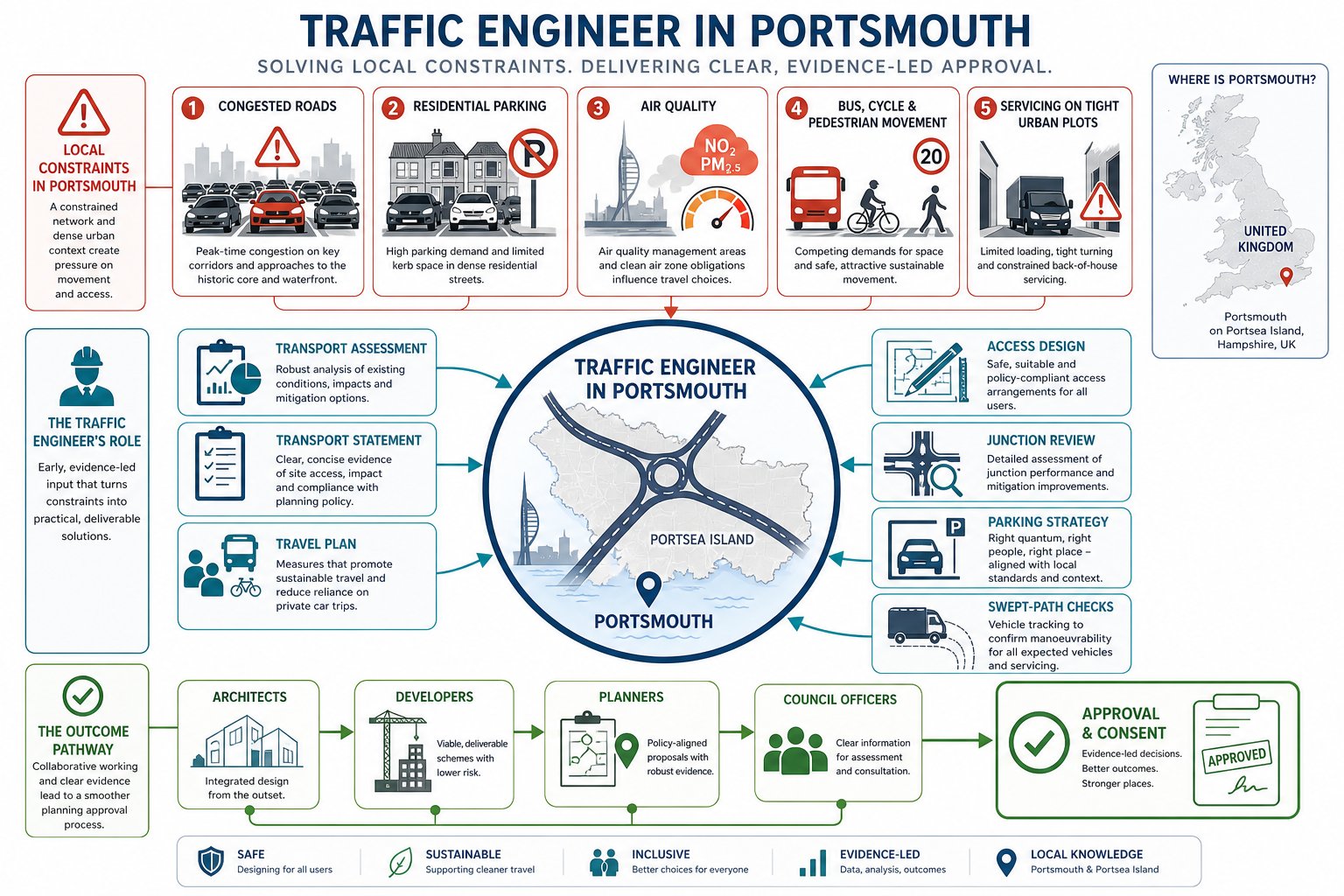
Portsmouth is not an easy place to win planning consent on transport matters. It is a compact island city with a tightly constrained road network, heavy peak-time pressure, sensitive residential streets, strong expectations around walking, cycling and public transport, and a planning context where parking, servicing and air quality can quickly become deciding issues. That means transport evidence cannot be treated as a late-stage add-on.
For architects, planners, developers, surveyors and legal teams, the value of a traffic engineer in Portsmouth is simple: we help turn a proposal into something the planning authority can properly assess and, more importantly, something that stands up to scrutiny. That may involve a Transport Assessment, a Transport Statement, a Travel Plan, access design advice, junction analysis, parking review, servicing checks, or negotiation with highways officers before an application is lodged.
In practice, faster approvals usually come from earlier transport input rather than thicker reports. If the access works, the surveys are current, the trip rates are realistic and the scheme responds to Portsmouth City Council’s policy position, the application is already in a far stronger place. In the sections below, we explain what a traffic engineer does, when formal transport documents are needed, what makes Portsmouth different, and how to choose the right consultant for a smoother planning process in 2026.
Key Takeaways
- A traffic engineer in Portsmouth plays a crucial role in ensuring transport proposals are technically sound, policy-compliant, and feasible within the city’s constrained network.
- Early involvement of a traffic engineer improves chances of planning approval by addressing access, parking, servicing, and sustainable travel concerns before submission.
- Transport Assessments, Statements, or Travel Plans are required based on development scale, land use, and local sensitivity, with proportional evidence tailored to Portsmouth’s specific context.
- Portsmouth’s unique issues like congestion, parking pressure, air quality, and impact on bus and cycle routes demand transport reports grounded in local observation and policy alignment.
- Collaborating with a traffic engineer helps architects, planners, and developers reduce risk, avoid redesign, and speed up the planning process through clear, concise, and credible transport evidence.
- Selecting a traffic engineer familiar with Portsmouth’s policies and urban constraints ensures relevant, accessible communication and timely delivery for smoother project progression.
What A Traffic Engineer In Portsmouth Does For Planning Applications
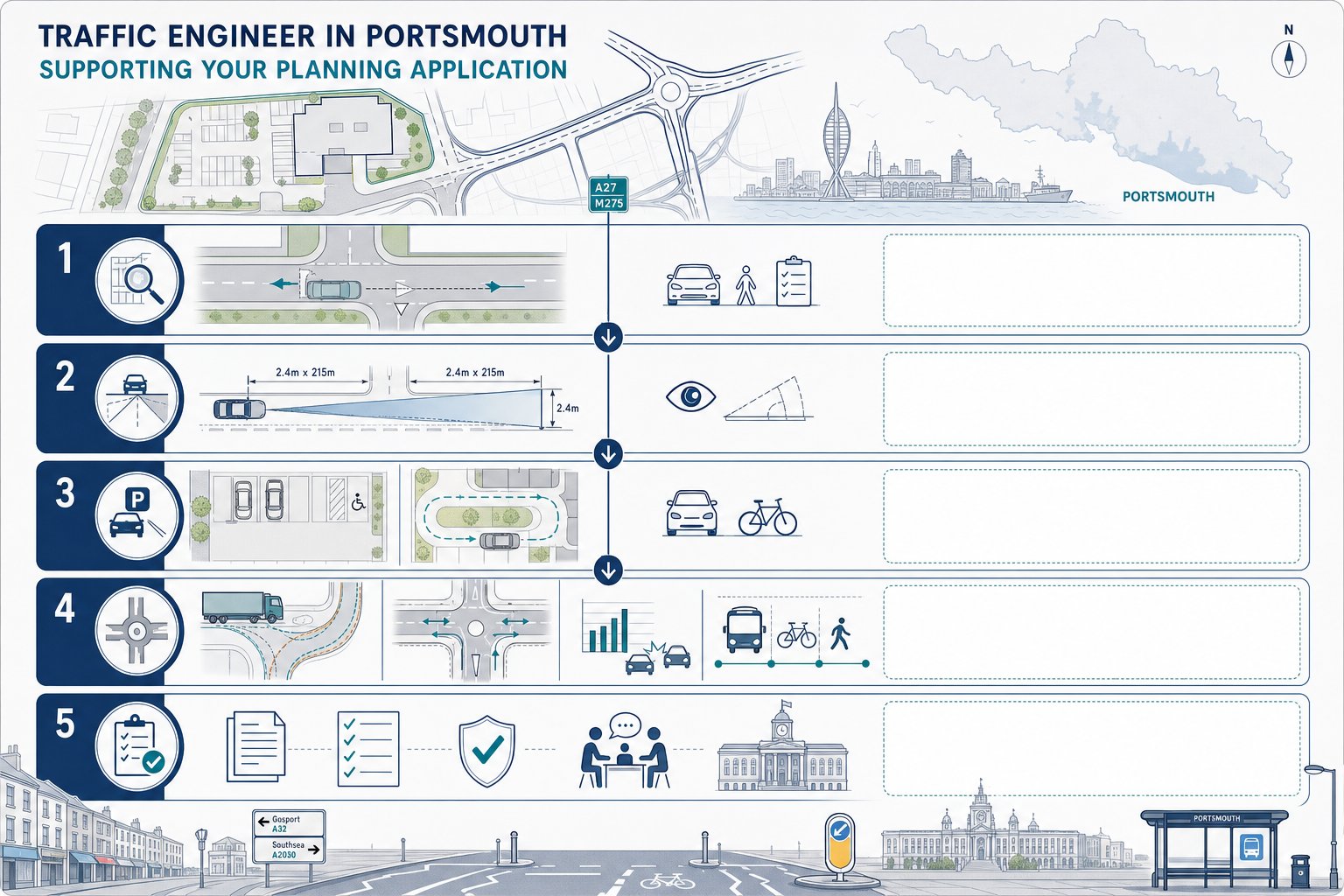
A traffic engineer in Portsmouth provides the technical transport case behind a planning application. At the most basic level, we assess whether a development can be accessed safely and whether the local network can reasonably accommodate the movement it creates. But the role is broader than that.
We prepare Transport Assessments, Transport Statements and Travel Plans, review site access arrangements, advise on visibility splays, parking levels, swept paths, delivery strategy and internal circulation, and check whether a proposal aligns with local and national policy. For many schemes, we also review collision history, sustainable travel opportunities and the effect on nearby junctions, bus operations or cycle routes.
In a city like Portsmouth, this work often starts well before submission. Early feasibility advice can save months. A modest layout change, fewer parking spaces in the wrong place, or an access point too close to a junction can create avoidable objections later. That is why many teams bring in Traffic Engineering Consultants: What at concept stage rather than after drawings are fixed.
We also liaise with Portsmouth City Council planning and highway officers and, where trunk road implications arise, other stakeholders. Good transport advice is not only about calculations. It is about framing evidence clearly, anticipating queries, and presenting a scheme as safe, workable and policy-compliant from the outset.
When A Transport Assessment, Transport Statement, Or Travel Plan Is Needed
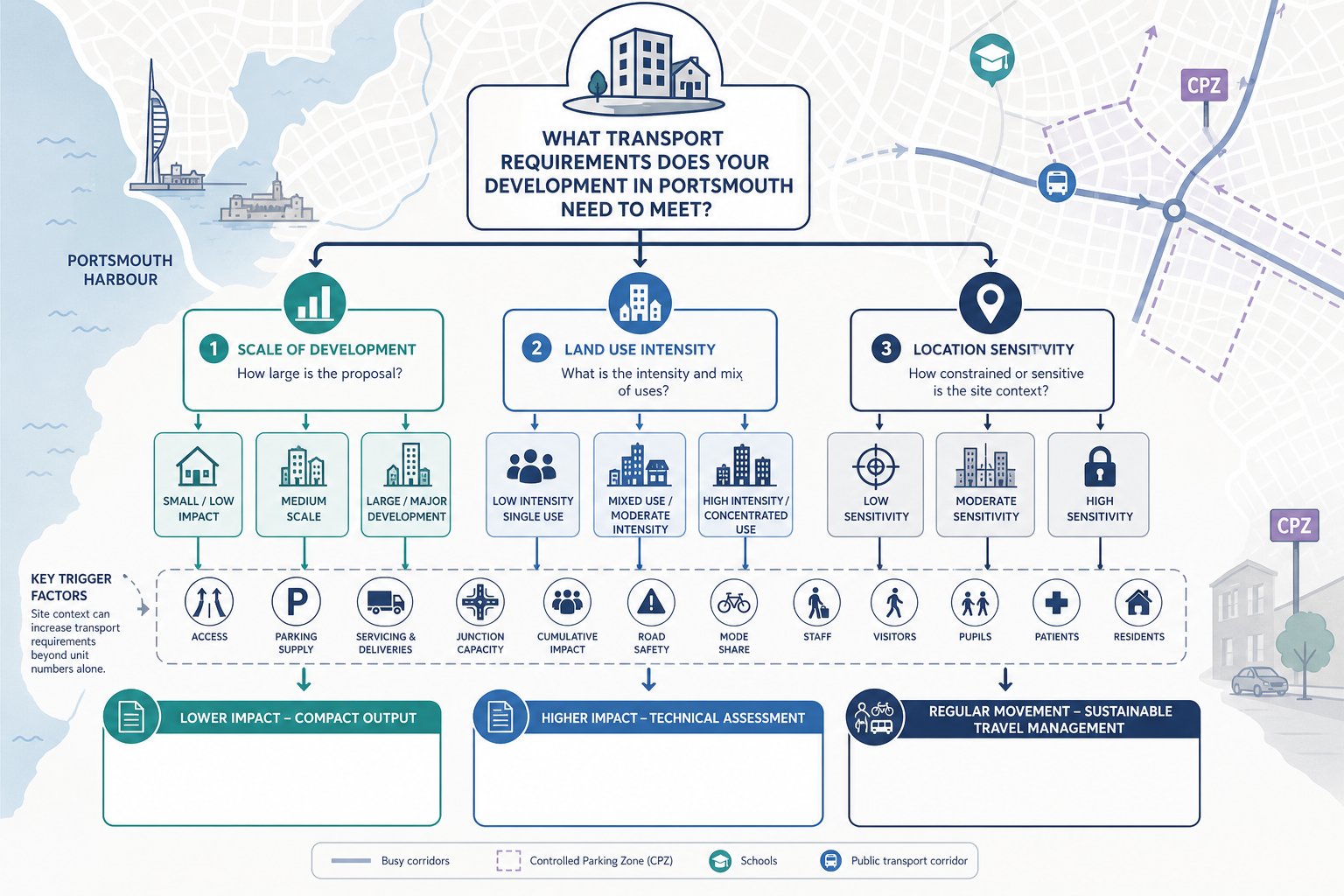
Whether a scheme needs a Transport Assessment (TA), a Transport Statement (TS), or a Travel Plan depends on three things: scale, land use, and location sensitivity. There is no single shortcut threshold that applies to every site in exactly the same way. National policy sets the broad framework, but local validation requirements and site-specific circumstances matter a great deal.
A smaller development with limited traffic impact may only need a TS. That document is usually shorter and more proportionate, but it still needs to address access, parking, servicing and the likely transport effects of the proposal. Larger, more intensive or more sensitive schemes generally require a full TA, especially where junction capacity, cumulative impact, road safety, or mode share are likely to be scrutinised in detail.
A Travel Plan is often required where a development is expected to generate regular staff, visitor, pupil, patient or resident movement that could be influenced by sustainable travel measures. In Portsmouth, where mode shift is a live policy issue, Travel Plans can carry real weight.
The key is proportionality. A good report should be neither thin nor bloated. Teams often benefit from early Highway And Traffic input to agree what level of evidence is sensible before surveys are commissioned.
And one practical point: if the site sits in a constrained urban area, near schools, busy corridors or controlled parking zones, the transport requirement often rises faster than the unit count alone might suggest.
How Portsmouth Planning Context Shapes Transport Requirements
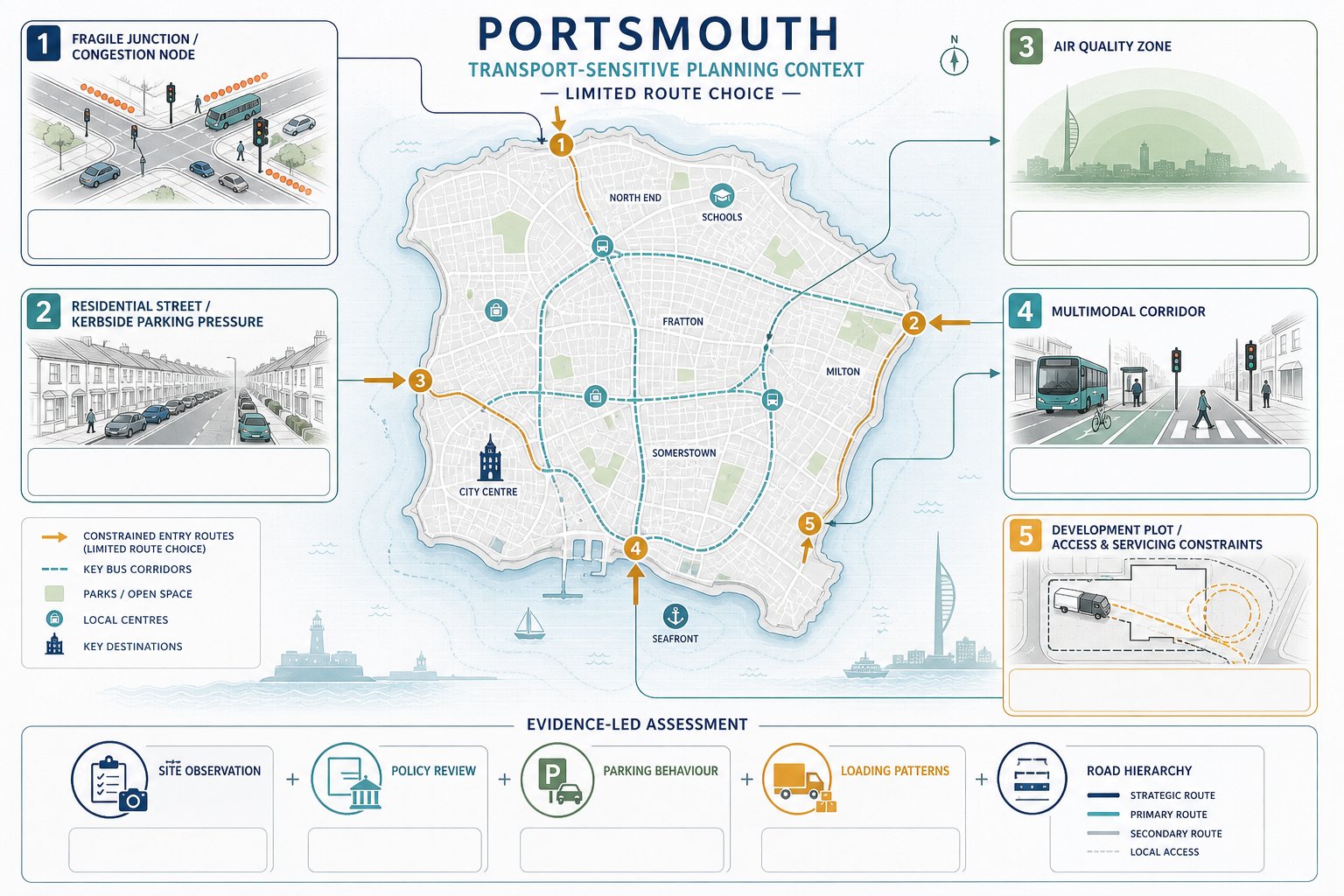
Portsmouth’s planning context is unusually transport-sensitive. The city’s island geography limits route choice, many streets operate under historic constraints, and development often takes place close to existing homes, schools, local centres and bus corridors. That means even relatively modest schemes can trigger detailed questions about parking stress, servicing practicality, highway safety or sustainable travel expectations.
Portsmouth City Council typically looks closely at whether development supports walking, cycling and public transport rather than defaulting to private car use. National planning policy points in the same direction, but local context makes the issue sharper here. A proposal that might appear straightforward on paper can become contentious if it adds turning pressure at a fragile junction, removes kerbside function, or relies on optimistic assumptions about parking displacement.
This is why transport advice in Portsmouth cannot be copied from a generic template. The best work combines policy review with grounded site observation. That includes the local road hierarchy, nearby crossings, cycle provision, bus stop quality, loading patterns and resident parking behaviour. In practice, the discipline overlaps strongly with Traffic Engineering and because planning success depends on how real people move around the site and its surroundings, not just on model outputs.
Key Local Issues That Can Affect A Development Proposal
Several Portsmouth-specific issues tend to influence transport requirements:
- Congestion and junction sensitivity. Small network changes can have outsized effects where links are already close to capacity.
- On-street parking pressure. Residential streets may already experience overspill, especially near centres, stations, schools or seafront areas.
- Air quality concerns. AQMAs and wider emissions considerations can shape both planning strategy and mitigation.
- Bus, cycle and walking impacts. If access design disrupts a bus route, weakens cycle continuity or creates pedestrian conflict, objections become more likely.
- Servicing constraints. Tight urban plots often make refuse collection, delivery turning and emergency access harder than expected.
Those factors do not automatically stop development. But they do mean the transport case needs to be specific, evidence-led and locally credible.
Typical Projects That Need Traffic Engineering Input In Portsmouth
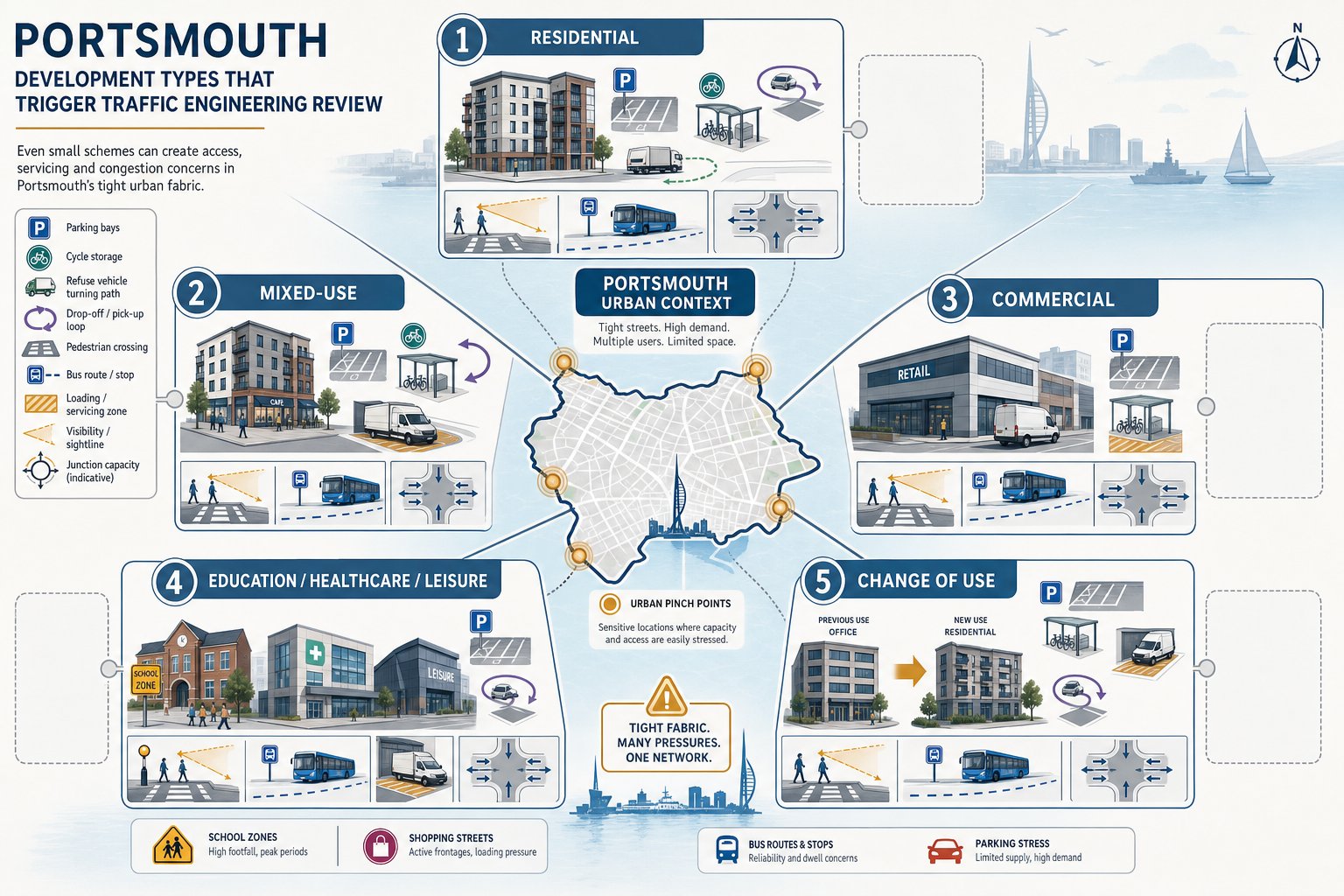
Not every planning application needs a substantial transport submission, but many more schemes benefit from traffic engineering input than applicants first assume. In Portsmouth, that is largely because compact urban conditions create transport pinch points quickly. A project can be small in floor area and still raise difficult questions about access, parking or servicing.
We regularly see traffic engineering needs across residential intensification, mixed-use regeneration, commercial redevelopment, education and healthcare sites, leisure uses, and changes of use that alter trip timing or operational patterns. The earlier those issues are tested, the more options the design team has.
Traffic engineering is also valuable where a site appears straightforward but sits in a politically or technically sensitive location. Near schools, shopping streets, bus routes or existing parking stress, the planning authority will often expect a firmer evidence base. For business-led schemes, Commercial Traffic Engineering advice can help align operations, servicing and customer access with planning expectations before submission.
Residential, Mixed-Use, Commercial, And Change-Of-Use Schemes
For residential projects, common issues include parking demand, cycle storage, refuse access, drop-off behaviour, visibility and whether local junctions can absorb new trips. Even a modest block of flats can draw scrutiny if it displaces parking into controlled or congested streets.
For mixed-use schemes, the challenge is often interaction: servicing, resident amenity, pedestrian movement and varying peak demands across uses.
For commercial sites, delivery patterns, staff travel, customer turnover and loading arrangements are often central.
For change-of-use applications, transport impact can shift significantly without major physical works. Office to HMO, retail to takeaway, or industrial to trade counter proposals can all create different trip rates, parking demand or road safety concerns. That is exactly where a proportionate but well-targeted transport statement can make the difference.
What Is Included In A Traffic Engineering Report
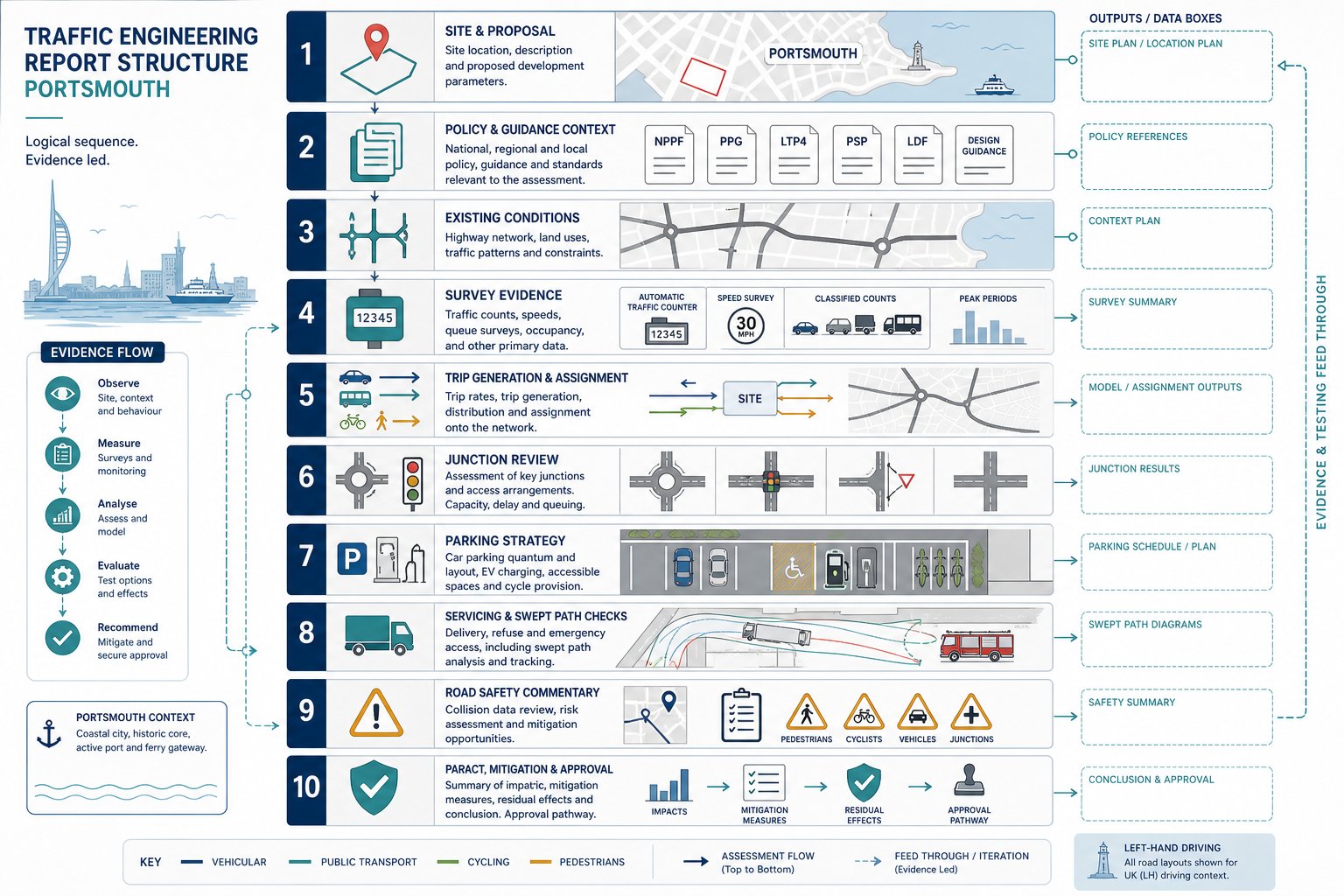
A strong traffic engineering report does two things at once: it explains the proposal in a way planning officers can follow, and it provides enough technical evidence to withstand challenge from highway consultees. The exact content varies by scheme, but most reports combine policy review, site appraisal, survey evidence, trip analysis, operational assessment and design commentary.
Typically, we begin with the site and proposal, then set out the relevant national and local planning and transport policy context. After that come the existing conditions: access arrangement, nearby highway network, sustainable travel opportunities, collision record where relevant, and baseline traffic or parking conditions. The report then moves into the impact of the development and any mitigation or Travel Plan measures needed.
In practice, clarity matters almost as much as technical accuracy. A report can contain the right numbers and still cause delay if the logic is hard to follow or the drawings do not tie back to the narrative. Some planning teams find it helpful to align the transport chapter with wider Traffic Engineering: Your principles so the evidence supports the full planning story rather than sitting beside it awkwardly.
Survey Data, Trip Generation, Junction Review, Parking, And Servicing
The technical core often includes:
- Survey data such as classified traffic counts, turning counts, queue observations, speed surveys, parking beat surveys and site visits at relevant times.
- Trip generation using TRICS or comparable evidence, with assumptions that suit the actual Portsmouth context rather than a generic suburban comparison.
- Trip distribution and assignment showing where vehicles, cycles and pedestrians are likely to travel.
- Junction review or modelling using tools such as PICADY, ARCADY, LINSIG or more detailed software where warranted.
- Parking strategy, including disabled bays, EV provision, cycle parking and management arrangements. A well-judged parking strategy traffic response is often central in Portsmouth.
- Servicing and swept path assessment for refuse vehicles, deliveries and emergency access.
- Road safety commentary including visibility, conflict points and, where appropriate, collision analysis.
Done properly, the report shows not only what the impacts are, but why the authority can be satisfied they are acceptable.
How A Traffic Engineer Supports Architects, Planners, And Developers
The best traffic input is collaborative, not reactive. We do not simply appear at the end to write a report around a finished design. We help shape the scheme so the transport case is easier to justify in the first place.
For architects, that often means advising on access geometry, bin collection strategy, turning space, cycle parking placement, basement ramps, visibility, and whether the layout creates avoidable conflict between pedestrians, servicing and private vehicles. For planners and planning consultants, we provide the technical evidence that supports the planning statement, responds to validation requirements and deals with likely objections before they land. For developers, our role is partly strategic: reducing risk, avoiding redesign, and helping maintain programme certainty.
This support usually starts with site appraisal and concept testing. It may continue through pre-app discussions, design team workshops, formal submission, responses to consultee comments, and discharge of conditions. On more contentious schemes, it can extend to committee support or appeal evidence.
Access design is a recurring pressure point in Portsmouth, especially on constrained plots. Getting that right early, with support informed by access design highway, often saves painful redesign later.
For firms working across several cities, local interpretation matters too. A strategy that suits another authority may not transfer neatly. That is one reason scheme teams comparing regions often notice differences between a Traffic Engineer In another city and one working routinely with Portsmouth’s urban constraints and policy emphasis.
Common Reasons Transport Reports Are Delayed Or Challenged
Most transport objections are not caused by the mere existence of development traffic. They arise because the evidence is incomplete, inconsistent, out of date or insufficiently tuned to local policy. That is frustrating, because many delays are avoidable.
A common issue is weak survey evidence. Post-pandemic travel patterns, school-related peaks, hybrid working and local parking controls have made baseline conditions more nuanced. If counts were taken at the wrong time, on an unrepresentative day, or too long before submission, the authority may question the results.
Another frequent problem is poor alignment between documents. If the architect’s drawings, Design and Access Statement, Delivery and Servicing detail, and transport report describe different parking numbers, vehicle routes or use classes, confidence drops immediately.
We also see schemes challenged because of optimistic assumptions. Understated trip rates, unsupported claims about walking uptake, or casual statements that overspill parking will be “managed” rarely survive scrutiny in Portsmouth.
Then there is policy mismatch. Ignoring local parking standards, air quality concerns, cycle requirements or the practical needs of bus operation can make an otherwise competent report look generic.
Finally, a lack of early engagement often hurts. A brief pre-application conversation can identify whether the authority is likely to expect a TS or TA, additional parking data, a Framework Travel Plan, or access revisions. Without that, teams sometimes submit too little, then spend weeks answering questions that could have been anticipated.
How To Choose The Right Traffic Engineer In Portsmouth
Choosing the right consultant is not just about finding someone who can produce a report. It is about finding a team that understands how Portsmouth schemes are reviewed, what local officers are likely to focus on, and how to give the wider design team clear, practical advice under time pressure.
First, look for relevant local experience. That does not simply mean having worked in Hampshire once or twice. It means familiarity with constrained urban sites, parking-sensitive neighbourhoods, mixed-mode corridors and the way local policy expectations translate into technical requirements.
Second, check for technical range. A good consultant should be comfortable with TRICS analysis, junction modelling, parking studies, access review, swept path assessment, Travel Plans and concise planning-facing writing. Software matters, yes, but judgement matters more. Plenty of weak reports are produced with excellent software.
Third, assess communication quality. Can the engineer explain risks clearly to architects and clients? Can they write in a way officers will actually read without digging for the point? Fast approval often depends on concise reporting and timely responses rather than sheer volume.
Fourth, ask about programme and responsiveness. In live planning work, speed is not a luxury. It affects validation, committee dates, land deals and contractor sequencing.
For many teams, the strongest option is a consultant able to combine early concept input, local policy awareness and efficient report delivery. That is the value proposition firms such as ML Traffic focus on: concise, accurate transport evidence shaped by long experience and tailored to authority expectations rather than padded with unnecessary text.
Conclusion
In Portsmouth, transport is rarely a box-ticking exercise. The city’s constrained network, parking pressure, air quality concerns and strong sustainable travel agenda mean planning applications need transport evidence that is proportionate, local and technically credible.
A capable traffic engineer helps the whole team make better decisions earlier: choosing the right level of reporting, stress-testing access and layout, using robust survey evidence, and addressing the issues Portsmouth City Council is most likely to examine. That reduces planning risk, cuts avoidable delay and improves the chances of a cleaner path to approval.
For architects, developers, planners and legal teams, the practical takeaway is straightforward. Bring transport advice in early, keep the evidence consistent across all submission documents, and use a consultant who understands Portsmouth rather than relying on a generic template. In a city like this, local insight is not a nice extra. It is often what makes a scheme feel deliverable.
Frequently Asked Questions About Traffic Engineering in Portsmouth
What role does a traffic engineer in Portsmouth play in planning applications?
A traffic engineer in Portsmouth provides essential transport assessments, access design advice, and traffic impact analysis to ensure planning applications comply with local policies and road safety requirements, improving chances of approval on the city’s constrained road network.
When is a Transport Assessment or Transport Statement required for Portsmouth developments?
The need for a Transport Assessment or Statement depends on the scale, land use, and location sensitivity of the development, with larger or more traffic-sensitive schemes generally requiring a full Transport Assessment and smaller schemes a Transport Statement.
How does Portsmouth’s unique planning context affect transport requirements?
Portsmouth’s dense island geography and policy focus on sustainable travel mean developments must carefully address parking restraint, air quality, and impacts on bus and cycle routes, making transport evidence more detailed and locally tailored than generic reports.
What key local issues should traffic engineering reports address in Portsmouth?
Reports should cover congestion and junction capacity, on-street parking pressure, air quality management, impacts on bus and cycle routes, and servicing constraints to meet Portsmouth City Council’s scrutiny and ensure safe, compliant developments.
How can a traffic engineer support architects, planners, and developers early in a project?
Early involvement of a traffic engineer helps optimise site access, parking layouts, servicing strategies, and policy compliance, reducing redesign risks and ensuring transport evidence aligns smoothly with planning submissions for faster approvals.
What are common reasons why transport reports might be delayed or challenged in Portsmouth?
Delays often stem from outdated or insufficient survey data, ignoring local policies like parking standards or AQMA rules, underestimating trip generation, inconsistent information across documents, or lack of early engagement with Portsmouth highways officers.