
Getting a scheme through planning in Hereford is rarely just about land use, layout, or design quality. Transport can become the point where an otherwise sensible project starts to wobble. A site may look straightforward on paper, yet questions around access, visibility, parking, congestion, junction pressure, or sustainable travel can quickly decide whether an application moves forward smoothly or attracts costly delay.
That is exactly where a traffic engineer in Hereford adds value. We help translate a development proposal into clear, evidence-based transport advice that planners, highway officers, consultants, and project teams can work with. In a city shaped by historic streets, constrained routes, river crossings, and peak-time pressure on key corridors, generic reporting is rarely enough. What tends to work is advice grounded in local highway realities, proportionate survey evidence, and reports that answer the authority’s concerns before they harden into objections.
For architects, planners, surveyors, lawyers, developers, and councils, the objective is not to produce transport paperwork for its own sake. It is to support a better planning outcome. In practice, that means understanding when a Transport Assessment is needed, when a shorter Transport Statement may be appropriate, how Herefordshire Council is likely to review the evidence, and what technical work can make an application more robust from the outset.
Key Takeaways
- A traffic engineer in Hereford is crucial for delivering transport advice tailored to the city’s unique historic streets, constrained routes, and peak congestion challenges.
- Early involvement of a Hereford traffic engineer improves planning outcomes by ensuring safe access, realistic parking, and sustainable travel measures are integrated from the concept stage.
- Choosing between a Transport Assessment or Transport Statement in Hereford depends on development scale, site context, and local sensitivities rather than size alone.
- Robust traffic surveys and local data are essential in Hereford to provide credible baseline evidence reflecting actual network operations for planning submissions.
- Common transport issues in Hereford include junction capacity, safe access, and active travel connectivity, all requiring practical solutions grounded in local conditions.
- Selecting a traffic engineering consultant with Hereford-specific experience and the ability to tailor reports ensures proportionate, credible advice that meets local authority expectations.
Why A Traffic Engineer Matters For Development Projects In Hereford {#p-DTGmG5l0X1378yTbDYF}
Hereford’s network is not especially forgiving. A relatively modest amount of extra vehicle movement can have a visible effect where routes funnel toward constrained junctions, river crossings, school traffic hotspots, or older streets with limited width and frontage activity. That matters because planning transport work is not judged in the abstract: it is judged against the actual roads, actual queues, and actual safety conditions around a site.
A traffic engineer helps establish whether the development impact is likely to be acceptable and, just as importantly, what can be done if it is not. We assess likely trip generation, distribution, and assignment, review the surrounding network, consider active travel opportunities, and test whether access arrangements are safe and suitable for all users. Where required, we also coordinate with wider project teams so the transport strategy matches the architectural and planning narrative rather than sitting awkwardly beside it.
This early coordination is often the difference between a clean submission and a reactive one. A scheme that has transport input at concept stage usually has better parking logic, more realistic servicing, and fewer late redesigns. That is true in Hereford and elsewhere: the same planning-led approach is reflected in work such as Traffic Engineering Consultants: broader development support and in city-specific advice like Traffic Engineer In Birmingham: where local highway context also drives report strategy.
There is another practical point. Highway officers and planning case officers tend to respond better to concise, proportionate, technically sound evidence than to bloated reports that avoid the real issue. Our role is to identify what matters, test it properly, and present it clearly.
When A Transport Assessment Or Transport Statement Is Typically Needed {#2Su661HvcmqhefqKZ2SMw}
The choice between a Transport Assessment and a Transport Statement usually comes down to scale, trip intensity, and local sensitivity. A Transport Assessment is generally expected for larger schemes or proposals likely to create material transport effects. A Transport Statement is more commonly used for smaller developments where transport issues still need to be addressed, but the likely impacts are more limited.
In Hereford, that distinction is not just about unit numbers or floor area. Context matters. A modest proposal on a constrained rural road, near a busy school route, or close to a stressed junction may need more evidence than a similar-sized scheme in a less sensitive location. National policy and Department for Transport guidance set the framework, but local authority expectations and site conditions decide how far the analysis needs to go.
A sensible first step is screening the proposal against likely trip generation, site access conditions, parking demands, sustainable travel opportunities, and the existing operation of nearby junctions. If trunk roads or the strategic road network could be affected, National Highways may also need to be considered. That early judgement prevents under-scoping, which can trigger objections, and over-scoping, which wastes time and budget.
We usually advise clients to think less in terms of “What is the minimum report we can submit?” and more in terms of “What level of evidence will make this application feel credible?” That tends to be the better commercial decision.
How Hereford Planning Context And Local Highway Constraints Shape Transport Advice
Transport advice in Hereford has to respond to a particular local pattern: historic fabric, limited crossing points, rural approaches, and peak-time congestion that can spread quickly through linked junctions. On paper, a site may appear close to facilities and within a developed area. In practice, the quality of footways, crossing points, visibility, road width, bus connectivity, or queue interaction can change the planning picture.
That means our work is rarely limited to forecasting vehicle trips. We also look closely at whether people can realistically walk to local services, whether cycle connections are practical rather than theoretical, whether servicing can occur without conflict, and whether refuse vehicles or emergency vehicles can enter, turn, and leave safely. Parking standards and layout efficiency matter too, especially on compact sites where over-optimistic design can create operational problems that planning officers immediately spot.
Local nuance is important. A market-town or cathedral-city setting often demands a finer-grained approach than a purely suburban expansion area. In that respect, Hereford has more in common with places requiring tailored local judgement than with one-size-fits-all transport reporting. You can see the same principle in Highway And Traffic Engineering project support and in regional examples like Traffic Engineer In Bristol: where constraints on the surrounding network shape both scope and mitigation.
For that reason, strong Hereford transport advice usually starts with the place, not the template.
Common Development Types That Require Traffic Engineering Input
Many projects need transport input earlier than expected. Not because they are unusually large, but because access, parking, servicing, or local traffic effects become planning issues very quickly.
Residential Schemes
Residential development is the most common example. We are often asked to support anything from a small infill proposal to a substantial edge-of-settlement scheme. The questions sound familiar, but the answers are site-specific: Is the access safe? Are visibility splays achievable? Will parking work in day-to-day use rather than just on a drawing? Are nearby junctions already under pressure at school and commuter peaks? Can pedestrians reach shops, schools, and bus stops without awkward or unsafe movement?
Trip generation is central, but it is not the whole story. Residential schemes also need realistic assumptions on car ownership, visitor parking, refuse collection, emergency access, and internal turning. On constrained sites, a design that technically fits can still perform badly once bins, delivery vans, or parked vehicles are introduced into real life.
Larger housing proposals may need junction capacity testing, Travel Plan measures, and a clearer narrative around sustainable travel. Smaller schemes often benefit from a concise but focused appraisal that deals directly with access and operational concerns before they become reasons for refusal.
Commercial, Employment, And Mixed-Use Projects
Commercial and mixed-use proposals usually bring a broader set of transport questions. A warehouse, trade counter, office, roadside use, foodstore, or town-centre redevelopment can generate very different traffic profiles depending on opening hours, servicing arrangements, staffing levels, customer turnover, and HGV activity.
For these schemes, we look closely at peak patterns, delivery activity, loading space, staff and visitor parking, and whether the surrounding highway can cope with both regular traffic and servicing demands. Mixed-use sites can be especially sensitive because they combine competing movements: residents want quiet and safe circulation, while commercial occupiers need practical access and loading.
Hereford sites of this type often raise questions about routing, local amenity, junction pressure, and whether walking, cycling, and bus access are genuinely attractive. Comparative experience helps here: methods used for Traffic Engineer In Leeds: more complex urban applications and Traffic Engineer In Liverpool: employment-led schemes can be adapted, but always to Hereford’s local conditions rather than copied across.
What A Traffic Engineer In Hereford Can Prepare For A Planning Application
The transport package for a planning application should be proportionate, technically sound, and aligned with the planning strategy. That might be a short note for a straightforward proposal, or a wider evidence set for a more sensitive site.
Transport Assessments, Transport Statements, And Travel Plans
Transport Assessments and Transport Statements are the core planning documents. They explain existing conditions, forecast likely trip generation, set out how traffic will distribute on the network, and assess whether nearby junctions or routes are likely to be materially affected. Where necessary, they include capacity analysis, sustainable travel measures, and mitigation.
Travel Plans often sit alongside these reports. A good Travel Plan is not decorative. It shows that the development has considered how residents, staff, or visitors can travel by modes other than the private car, and it can help make a proposal more acceptable where network sensitivity is a concern. In Hereford, that may include walking links to nearby facilities, cycle parking quality, bus accessibility, welcome packs, monitoring, or on-site measures that make low-car travel more realistic.
The best reporting is concise and specific. We focus on what the authority needs to know, rather than burying the important point under fifty pages of general policy text.
Access Appraisals, Visibility Reviews, And Swept Path Analysis
A planning application often succeeds or fails on practical highway detail. Access appraisals test whether the proposed junction or access point is suitable in principle. Visibility reviews consider whether drivers, cyclists, and pedestrians can see and be seen in line with relevant standards and the speed environment. Swept path analysis demonstrates whether the vehicles that must use the site, from refuse trucks to fire appliances and delivery vehicles, can manoeuvre safely.
These tasks matter because they expose design risks early. A beautiful layout can unravel if a refuse vehicle overruns a footway, if an HGV cannot enter without crossing the centreline, or if boundary treatment blocks required visibility. Identifying those issues before submission is far cheaper than redesigning under planning pressure.
On some projects, temporary construction access or traffic management also needs to be considered, especially where road space is limited or neighbouring uses are sensitive. Comparable work across Traffic Engineer In London: dense urban sites and Traffic Engineer In Manchester: constrained access schemes shows how much value there is in resolving movement details early.
How Traffic Surveys And Local Data Support A Robust Submission {#XSivR2CpKRWCzwpw4HnfL}
Good transport reporting stands on evidence. Without reliable baseline data, even a well-written report can feel speculative. That is why traffic surveys matter so much in Hereford. They show how the network is actually operating, not how we assume it might be operating.
Depending on the site, we may use classified turning counts, automatic traffic counts, speed surveys, queue observations, parking beat surveys, or pedestrian and cycle counts. Collision data is also important, particularly where access safety, visibility, or vulnerable road user movement is likely to be scrutinised. The purpose is simple: to establish a credible baseline and test future conditions against it.
Survey timing needs judgement. School-term conditions, seasonal variation, local events, roadworks, and temporary diversions can all distort results. A robust submission does not just collect data: it explains why the dataset is representative. That sounds obvious, but it is often where weaker applications fall down.
We also use local data to keep modelling proportionate. Not every scheme needs complex software modelling. Sometimes a focused review of observed queues, turning movements, and likely trip impact is enough. Sometimes it is not. The key is matching the method to the planning question, then explaining the answer in a way officers can trust.
Key Transport Issues That Often Affect Hereford Sites
Certain transport issues come up repeatedly in Hereford, and most of them are linked to the city’s constrained movement network and the mix of urban and rural site contexts.
Junction capacity is one of the most common. Even relatively modest trip increases can attract concern if they feed into already stressed intersections at commuter or school peaks. Queuing interaction between nearby junctions can also be more important than a simple standalone capacity review suggests.
Safe access is another recurring issue, especially on rural edges, narrow frontages, or roads with limited forward visibility. A proposal may have enough land for an access in plan form but still struggle once speed environment, verge conditions, drainage features, or boundary constraints are examined properly.
Walking and cycling connectivity often deserves more attention than applicants expect. Planning officers increasingly want to know whether a route is convenient and attractive, not merely technically possible. A site that is “close” to facilities as the crow flies may still have weak active-travel links on the ground.
Parking and servicing also matter. Under-provision can create overspill and neighbour objection: over-provision can undermine sustainability arguments and waste site area. Refuse collection, delivery activity, and turning space are especially important on compact or mixed-use sites. In short, the transport issues that affect Hereford schemes are practical, visible, and hard to argue away if they are not addressed properly.
Choosing The Right Traffic Engineering Support For Your Project
The right consultant is not simply the one who can produce a report fastest. Speed matters, of course, but planning success usually depends on whether the advice is locally aware, proportionate, and strategically useful. In Hereford, that means understanding Herefordshire Council expectations, recognising when a site is likely to trigger detailed scrutiny, and shaping the transport scope around the real planning risks.
We would suggest looking for three things. First, experience with development impact work, access reviews, parking and circulation design, and planning-focused report writing. Second, the ability to tailor outputs to the project rather than recycling a generic template. Third, enough practical judgment to say when a short, well-aimed statement will do and when a fuller technical package is needed.
That is where our approach at ML Traffic tends to help. With more than 30 years of experience, we focus on concise, accurate transport engineering reports produced quickly and aligned to local authority thresholds and planning context. For clients, that usually means fewer surprises, clearer advice, and documents that are easier for the wider consultant team to use.
The strongest support also extends beyond the initial submission. If queries come back from planning or highway officers, or if an appeal requires technical input, continuity matters. A consultant who understands both the site and the reasoning behind the original advice is far more useful than a low-cost report provider who disappears once the PDF has been issued.
Conclusion
For most development projects in Hereford, transport is not a box-ticking exercise. It is a planning issue that can strengthen an application or quietly derail it. Engaging a traffic engineer early gives the project team a clearer view of what evidence is needed, how the local network is likely to be viewed by the authority, and what design changes may improve the scheme before positions harden.
Whether the project needs a Transport Statement, a full Transport Assessment, a Travel Plan, access checks, swept path analysis, or targeted survey work, the aim is the same: technically sound advice that is proportionate, credible, and useful. In a constrained context like Hereford, that kind of planning-focused input often makes the difference between a submission that merely exists and one that is genuinely ready for scrutiny.
Why A Traffic Engineer Matters For Development Projects In Hereford
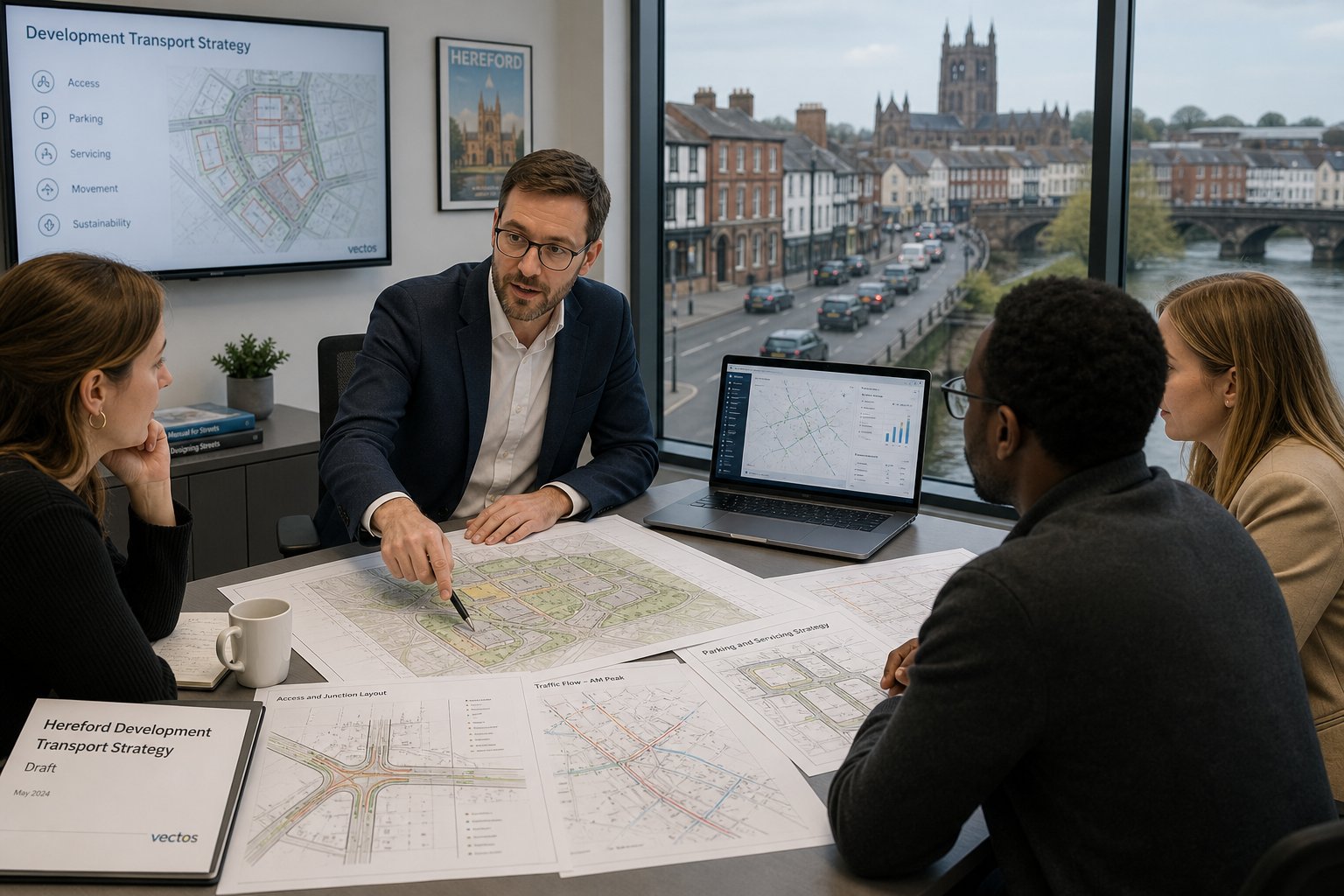
Hereford’s network is not especially forgiving. A relatively modest amount of extra vehicle movement can have a visible effect where routes funnel toward constrained junctions, river crossings, school traffic hotspots, or older streets with limited width and frontage activity. That matters because planning transport work is not judged in the abstract: it is judged against the actual roads, actual queues, and actual safety conditions around a site.
A traffic engineer helps establish whether the development impact is likely to be acceptable and, just as importantly, what can be done if it is not. We assess likely trip generation, distribution, and assignment, review the surrounding network, consider active travel opportunities, and test whether access arrangements are safe and suitable for all users. Where required, we also coordinate with wider project teams so the transport strategy matches the architectural and planning narrative rather than sitting awkwardly beside it.
This early coordination is often the difference between a clean submission and a reactive one. A scheme that has transport input at concept stage usually has better parking logic, more realistic servicing, and fewer late redesigns. That is true in Hereford and elsewhere: the same planning-led approach is reflected in work such as Traffic Engineering Consultants: broader development support and in city-specific advice like Traffic Engineer In Birmingham: where local highway context also drives report strategy.
There is another practical point. Highway officers and planning case officers tend to respond better to concise, proportionate, technically sound evidence than to bloated reports that avoid the real issue. Our role is to identify what matters, test it properly, and present it clearly.
When A Transport Assessment Or Transport Statement Is Typically Needed

The choice between a Transport Assessment and a Transport Statement usually comes down to scale, trip intensity, and local sensitivity. A Transport Assessment is generally expected for larger schemes or proposals likely to create material transport effects. A Transport Statement is more commonly used for smaller developments where transport issues still need to be addressed, but the likely impacts are more limited.
In Hereford, that distinction is not just about unit numbers or floor area. Context matters. A modest proposal on a constrained rural road, near a busy school route, or close to a stressed junction may need more evidence than a similar-sized scheme in a less sensitive location. National policy and Department for Transport guidance set the framework, but local authority expectations and site conditions decide how far the analysis needs to go.
A sensible first step is screening the proposal against likely trip generation, site access conditions, parking demands, sustainable travel opportunities, and the existing operation of nearby junctions. If trunk roads or the strategic road network could be affected, National Highways may also need to be considered. That early judgement prevents under-scoping, which can trigger objections, and over-scoping, which wastes time and budget.
We usually advise clients to think less in terms of “What is the minimum report we can submit?” and more in terms of “What level of evidence will make this application feel credible?” That tends to be the better commercial decision.
How Hereford Planning Context And Local Highway Constraints Shape Transport Advice
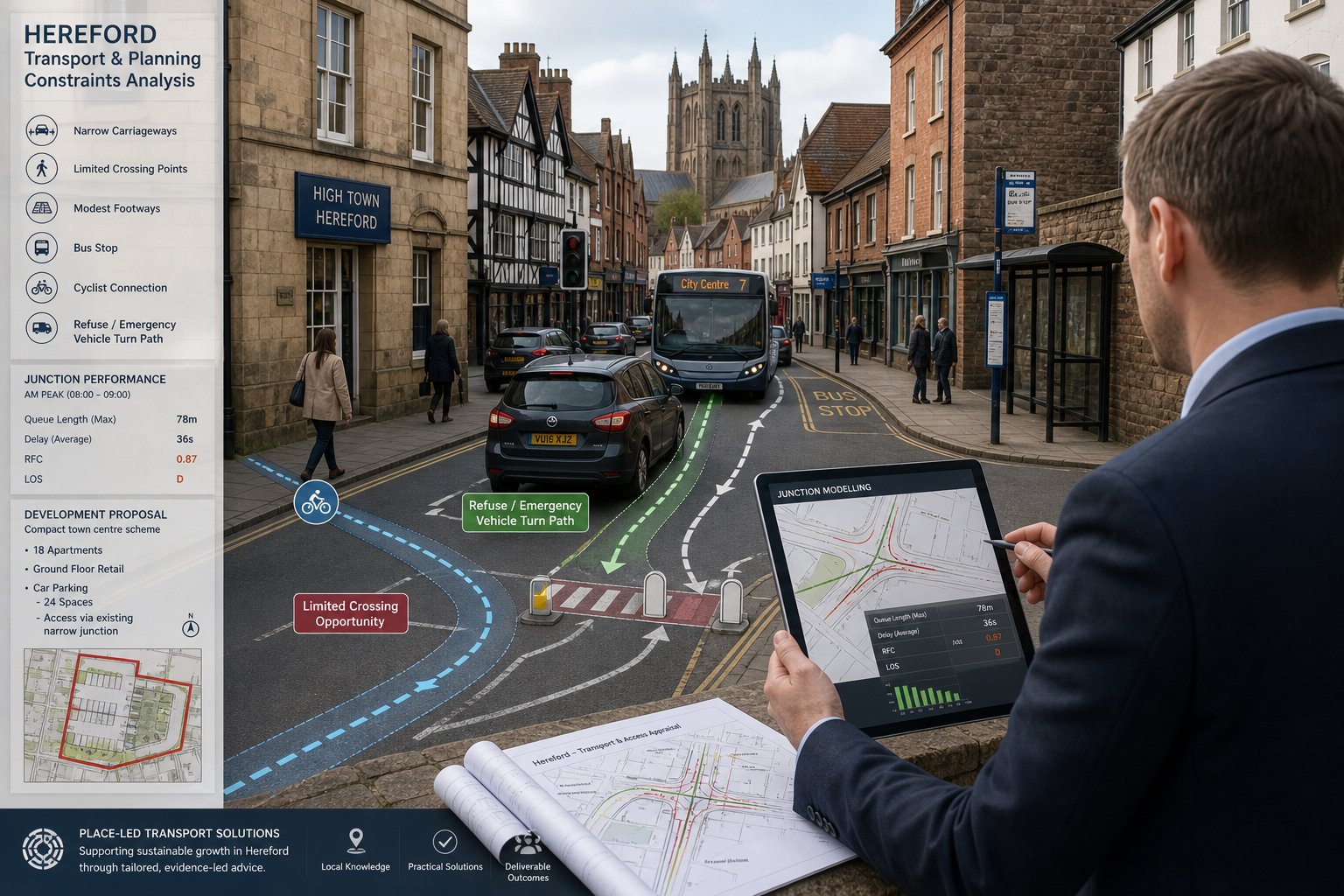
Transport advice in Hereford has to respond to a particular local pattern: historic fabric, limited crossing points, rural approaches, and peak-time congestion that can spread quickly through linked junctions. On paper, a site may appear close to facilities and within a developed area. In practice, the quality of footways, crossing points, visibility, road width, bus connectivity, or queue interaction can change the planning picture.
That means our work is rarely limited to forecasting vehicle trips. We also look closely at whether people can realistically walk to local services, whether cycle connections are practical rather than theoretical, whether servicing can occur without conflict, and whether refuse vehicles or emergency vehicles can enter, turn, and leave safely. Parking standards and layout efficiency matter too, especially on compact sites where over-optimistic design can create operational problems that planning officers immediately spot.
Local nuance is important. A market-town or cathedral-city setting often demands a finer-grained approach than a purely suburban expansion area. In that respect, Hereford has more in common with places requiring tailored local judgement than with one-size-fits-all transport reporting. You can see the same principle in Highway And Traffic Engineering project support and in regional examples like Traffic Engineer In Bristol: where constraints on the surrounding network shape both scope and mitigation.
For that reason, strong Hereford transport advice usually starts with the place, not the template.
Common Development Types That Require Traffic Engineering Input

Many projects need transport input earlier than expected. Not because they are unusually large, but because access, parking, servicing, or local traffic effects become planning issues very quickly.
Residential Schemes
Residential development is the most common example. We are often asked to support anything from a small infill proposal to a substantial edge-of-settlement scheme. The questions sound familiar, but the answers are site-specific: Is the access safe? Are visibility splays achievable? Will parking work in day-to-day use rather than just on a drawing? Are nearby junctions already under pressure at school and commuter peaks? Can pedestrians reach shops, schools, and bus stops without awkward or unsafe movement?
Trip generation is central, but it is not the whole story. Residential schemes also need realistic assumptions on car ownership, visitor parking, refuse collection, emergency access, and internal turning. On constrained sites, a design that technically fits can still perform badly once bins, delivery vans, or parked vehicles are introduced into real life.
Larger housing proposals may need junction capacity testing, Travel Plan measures, and a clearer narrative around sustainable travel. Smaller schemes often benefit from a concise but focused appraisal that deals directly with access and operational concerns before they become reasons for refusal.
Commercial, Employment, And Mixed-Use Projects
Commercial and mixed-use proposals usually bring a broader set of transport questions. A warehouse, trade counter, office, roadside use, foodstore, or town-centre redevelopment can generate very different traffic profiles depending on opening hours, servicing arrangements, staffing levels, customer turnover, and HGV activity.
For these schemes, we look closely at peak patterns, delivery activity, loading space, staff and visitor parking, and whether the surrounding highway can cope with both regular traffic and servicing demands. Mixed-use sites can be especially sensitive because they combine competing movements: residents want quiet and safe circulation, while commercial occupiers need practical access and loading.
Hereford sites of this type often raise questions about routing, local amenity, junction pressure, and whether walking, cycling, and bus access are genuinely attractive. Comparative experience helps here: methods used for Traffic Engineer In Leeds: more complex urban applications and Traffic Engineer In Liverpool: employment-led schemes can be adapted, but always to Hereford’s local conditions rather than copied across.
What A Traffic Engineer In Hereford Can Prepare For A Planning Application
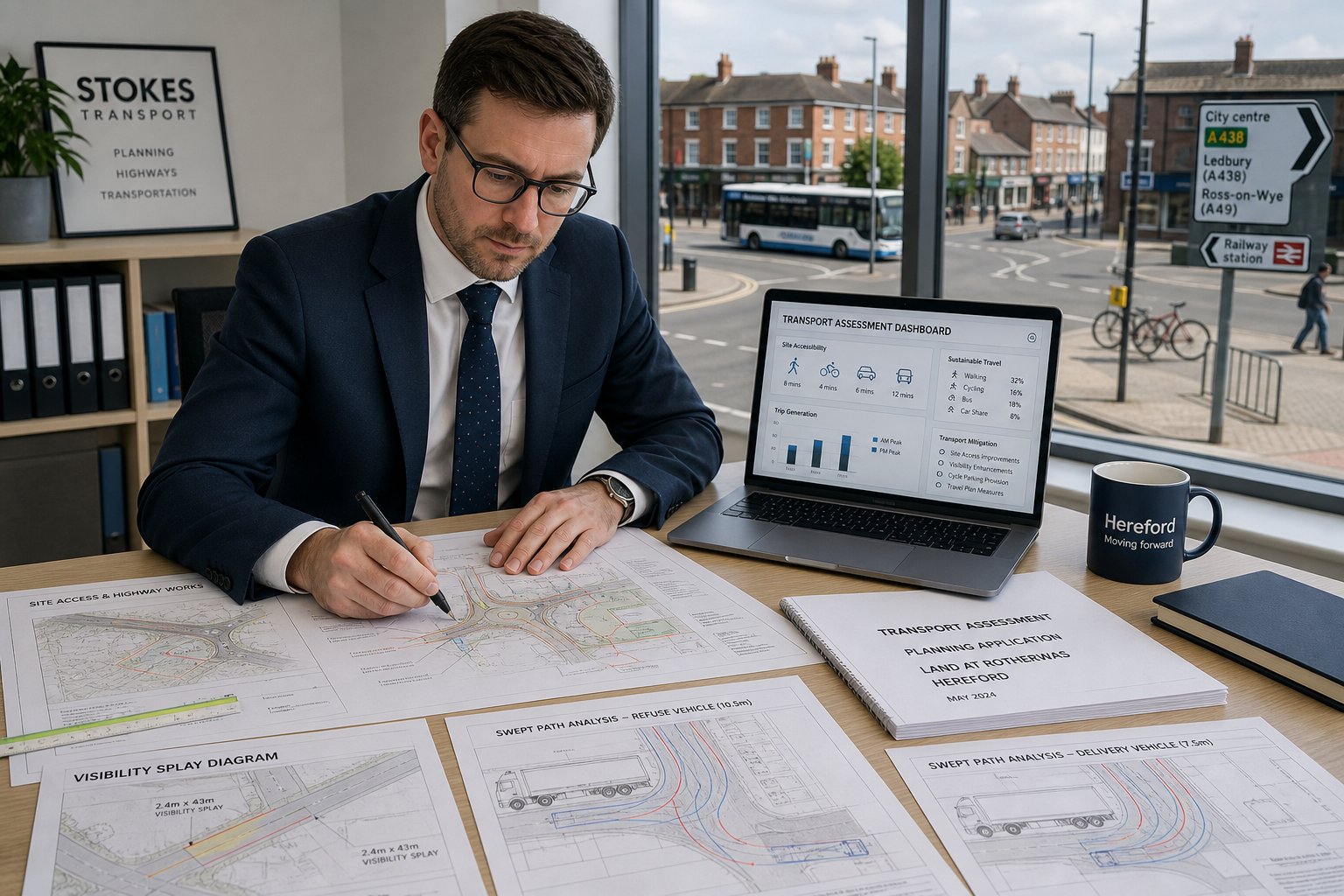
The transport package for a planning application should be proportionate, technically sound, and aligned with the planning strategy. That might be a short note for a straightforward proposal, or a wider evidence set for a more sensitive site.
Transport Assessments, Transport Statements, And Travel Plans
Transport Assessments and Transport Statements are the core planning documents. They explain existing conditions, forecast likely trip generation, set out how traffic will distribute on the network, and assess whether nearby junctions or routes are likely to be materially affected. Where necessary, they include capacity analysis, sustainable travel measures, and mitigation.
Travel Plans often sit alongside these reports. A good Travel Plan is not decorative. It shows that the development has considered how residents, staff, or visitors can travel by modes other than the private car, and it can help make a proposal more acceptable where network sensitivity is a concern. In Hereford, that may include walking links to nearby facilities, cycle parking quality, bus accessibility, welcome packs, monitoring, or on-site measures that make low-car travel more realistic.
The best reporting is concise and specific. We focus on what the authority needs to know, rather than burying the important point under fifty pages of general policy text.
Access Appraisals, Visibility Reviews, And Swept Path Analysis
A planning application often succeeds or fails on practical highway detail. Access appraisals test whether the proposed junction or access point is suitable in principle. Visibility reviews consider whether drivers, cyclists, and pedestrians can see and be seen in line with relevant standards and the speed environment. Swept path analysis demonstrates whether the vehicles that must use the site, from refuse trucks to fire appliances and delivery vehicles, can manoeuvre safely.
These tasks matter because they expose design risks early. A beautiful layout can unravel if a refuse vehicle overruns a footway, if an HGV cannot enter without crossing the centreline, or if boundary treatment blocks required visibility. Identifying those issues before submission is far cheaper than redesigning under planning pressure.
On some projects, temporary construction access or traffic management also needs to be considered, especially where road space is limited or neighbouring uses are sensitive. Comparable work across Traffic Engineer In London: dense urban sites and Traffic Engineer In Manchester: constrained access schemes shows how much value there is in resolving movement details early.
How Traffic Surveys And Local Data Support A Robust Submission
Good transport reporting stands on evidence. Without reliable baseline data, even a well-written report can feel speculative. That is why traffic surveys matter so much in Hereford. They show how the network is actually operating, not how we assume it might be operating.
Depending on the site, we may use classified turning counts, automatic traffic counts, speed surveys, queue observations, parking beat surveys, or pedestrian and cycle counts. Collision data is also important, particularly where access safety, visibility, or vulnerable road user movement is likely to be scrutinised. The purpose is simple: to establish a credible baseline and test future conditions against it.
Survey timing needs judgement. School-term conditions, seasonal variation, local events, roadworks, and temporary diversions can all distort results. A robust submission does not just collect data: it explains why the dataset is representative. That sounds obvious, but it is often where weaker applications fall down.
We also use local data to keep modelling proportionate. Not every scheme needs complex software modelling. Sometimes a focused review of observed queues, turning movements, and likely trip impact is enough. Sometimes it is not. The key is matching the method to the planning question, then explaining the answer in a way officers can trust.
Key Transport Issues That Often Affect Hereford Sites
Certain transport issues come up repeatedly in Hereford, and most of them are linked to the city’s constrained movement network and the mix of urban and rural site contexts.
Junction capacity is one of the most common. Even relatively modest trip increases can attract concern if they feed into already stressed intersections at commuter or school peaks. Queuing interaction between nearby junctions can also be more important than a simple standalone capacity review suggests.
Safe access is another recurring issue, especially on rural edges, narrow frontages, or roads with limited forward visibility. A proposal may have enough land for an access in plan form but still struggle once speed environment, verge conditions, drainage features, or boundary constraints are examined properly.
Walking and cycling connectivity often deserves more attention than applicants expect. Planning officers increasingly want to know whether a route is convenient and attractive, not merely technically possible. A site that is “close” to facilities as the crow flies may still have weak active-travel links on the ground.
Parking and servicing also matter. Under-provision can create overspill and neighbour objection: over-provision can undermine sustainability arguments and waste site area. Refuse collection, delivery activity, and turning space are especially important on compact or mixed-use sites. In short, the transport issues that affect Hereford schemes are practical, visible, and hard to argue away if they are not addressed properly.
Choosing The Right Traffic Engineering Support For Your Project
The right consultant is not simply the one who can produce a report fastest. Speed matters, of course, but planning success usually depends on whether the advice is locally aware, proportionate, and strategically useful. In Hereford, that means understanding Herefordshire Council expectations, recognising when a site is likely to trigger detailed scrutiny, and shaping the transport scope around the real planning risks.
We would suggest looking for three things. First, experience with development impact work, access reviews, parking and circulation design, and planning-focused report writing. Second, the ability to tailor outputs to the project rather than recycling a generic template. Third, enough practical judgment to say when a short, well-aimed statement will do and when a fuller technical package is needed.
That is where our approach at ML Traffic tends to help. With more than 30 years of experience, we focus on concise, accurate transport engineering reports produced quickly and aligned to local authority thresholds and planning context. For clients, that usually means fewer surprises, clearer advice, and documents that are easier for the wider consultant team to use.
The strongest support also extends beyond the initial submission. If queries come back from planning or highway officers, or if an appeal requires technical input, continuity matters. A consultant who understands both the site and the reasoning behind the original advice is far more useful than a low-cost report provider who disappears once the PDF has been issued.
Conclusion
For most development projects in Hereford, transport is not a box-ticking exercise. It is a planning issue that can strengthen an application or quietly derail it. Engaging a traffic engineer early gives the project team a clearer view of what evidence is needed, how the local network is likely to be viewed by the authority, and what design changes may improve the scheme before positions harden.
Whether the project needs a Transport Statement, a full Transport Assessment, a Travel Plan, access checks, swept path analysis, or targeted survey work, the aim is the same: technically sound advice that is proportionate, credible, and useful. In a constrained context like Hereford, that kind of planning-focused input often makes the difference between a submission that merely exists and one that is genuinely ready for scrutiny.
Frequently Asked Questions About Traffic Engineering in Hereford
Why is a traffic engineer important for development projects in Hereford?
A traffic engineer in Hereford assesses how a development impacts the local, constrained highway network, including historic streets and busy junctions, providing evidence and mitigation strategies that ensure proposals are acceptable to Herefordshire Council and National Highways when trunk roads are involved.
When is a Transport Assessment or Transport Statement required in Hereford?
Transport Assessments are usually needed for larger developments or those causing significant traffic effects, while Transport Statements suit smaller schemes. The local context, such as proximity to busy roads or sensitive junctions, influences the need and scope of these reports, following national guidance and council expectations.
What types of development commonly require traffic engineering input in Hereford?
Residential projects, from small infill to major housing estates, and commercial or mixed-use developments involving offices, retail, or warehousing often require traffic engineering support. This includes assessing access safety, parking, servicing, trip generation, and the impact on local junctions and transport modes.
How do Hereford’s local highway constraints affect transport advice for planning applications?
Due to limited river crossings, historic road layouts, and congestion at peak times, transport advice must consider actual road conditions, pedestrian and cycle accessibility, parking efficiency, and safety, tailoring reports to local nuances rather than using generic templates to meet Herefordshire Council’s specific concerns.
What transport documents and analyses can a traffic engineer in Hereford prepare for a planning application?
They can prepare Transport Assessments, Transport Statements, and Travel Plans detailing trip generation and mitigation, as well as access appraisals, visibility reviews, swept path analyses for vehicle manoeuvrability, and temporary traffic management plans, providing technically sound evidence aligned with planning policy.
How do traffic surveys support robust planning submissions in Hereford?
Traffic surveys such as classified turning counts, speed measurements, queue observations, and collision data establish accurate baseline conditions. These data inform credible modelling and demonstrate how the local road network operates, ensuring planning submissions are evidence-based and trusted by highway authorities.