
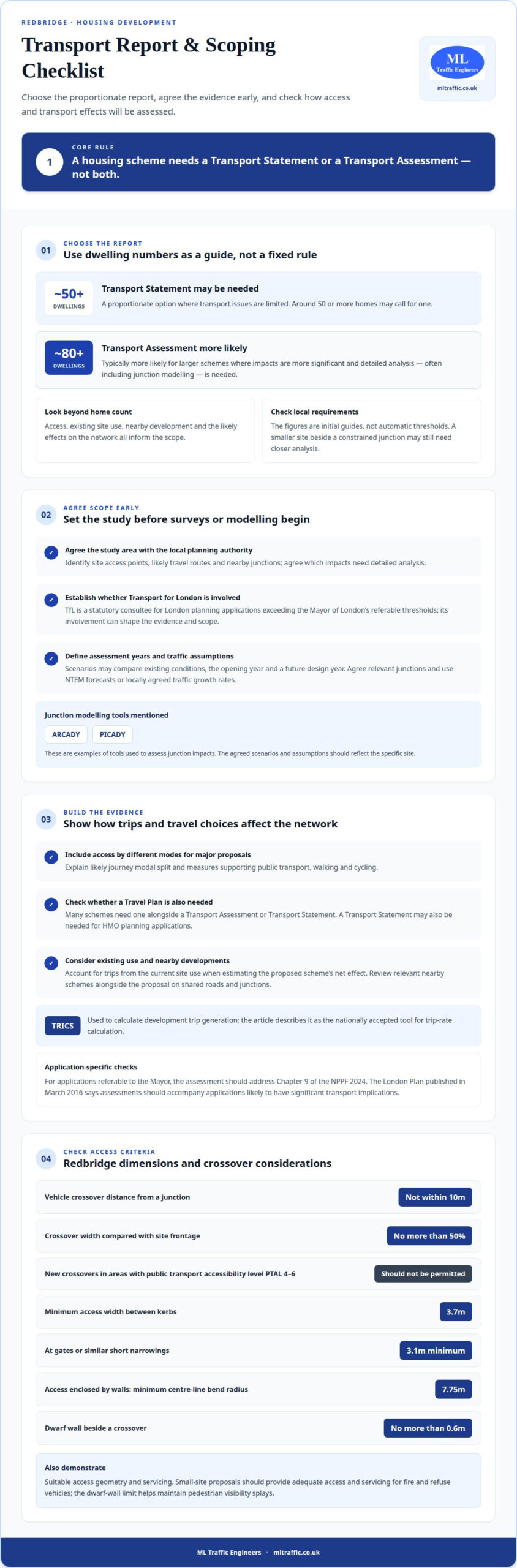
The number of homes matters, but it isn’t the only factor. A transport assessment for a housing development in Redbridge may be needed where transport impacts are significant and detailed analysis is required. Around 50 or more homes may call for a Transport Statement, while developments of typically 80 or more are more likely to need a Transport Assessment; the local authority’s requirements and the proposal’s likely effects also matter.
Before committing time to a planning application, establish which report is appropriate. A Transport Statement covers proposals with limited transport issues, while a Transport Assessment examines more substantial impacts, often including junction modelling. A development needs one or the other, not both.
This guide explains how to identify the right report, what scoping with the local planning authority and Transport for London involves, and how a review considers traffic, access and highway safety. It also covers what affects preparation and what information helps tailor a report to the development and its surroundings.
Key Takeaways
- Scope the transport work early so the study reflects the development, its likely impacts and the planning authorities involved.
- Choose the report based on the scale and nature of transport effects, not dwelling numbers alone.
- Use a review of personal injury accident records to identify existing highway safety issues near the site.
- Account for Redbridge-specific planning considerations, including the transport statement requirement for HMO applications.
- Bring together evidence on access, traffic, parking and sustainable travel to show how the proposal may affect the local network.
Scoping with the local planning authority and Transport for London
Agree the assessment scope early, before surveys or modelling begin. Redbridge’s access conditions and Transport for London’s role can affect the evidence a housing proposal needs.
Planning Authority Scoping
Scoping defines the study area, evidence, assessment years and methods for the application. Identify site access points, likely travel routes and nearby junctions, then agree with the local planning authority which impacts need detailed analysis. Transport for London is a statutory consultee for London planning applications exceeding the Mayor of London’s referable thresholds, so its involvement can shape the scope.
ARCADY and PICADY are examples of tools used to assess junction impacts. Assessments may compare existing conditions, the opening year and a future design year, using NTEM forecasts or locally agreed traffic growth rates. Establish the relevant junctions, scenarios and growth assumptions during scoping, rather than treating them as a standard package for every Redbridge site.
Assessment and Travel Plan Guidance
Redbridge’s planning approach considers the transport effects of the proposed homes and the evidence needed to assess them. The London Plan published in March 2016 says transport assessments should accompany applications likely to have significant transport implications. For major proposals, the assessment should explain access by different modes, likely journey modal split and measures supporting public transport, walking and cycling.
Many schemes need a Travel Plan alongside a Transport Assessment or Transport Statement. A transport statement may be needed for HMO planning applications. Scoping should therefore identify the application type and whether a separate Travel Plan is needed. For applications referable to the Mayor, transport assessments should address Chapter 9 of the NPPF 2024.
Highway and Transport Mitigation
Mitigation should respond to the transport effects identified in the assessment. Redbridge access guidance states that proposed vehicle crossovers should not be within 10m of junctions, and their width should not exceed 50% of the site frontage. New crossovers should not be permitted in areas with a public transport accessibility level of PTAL 4-6. These criteria can influence the layout before submission.
Access design also needs to demonstrate suitable geometry and servicing. Redbridge specifies a minimum width of 3.7m between kerbs, or 3.1m at gates or similar short narrowings; access enclosed by walls needs a minimum centre-line bend radius of 7.75m. Small-site proposals should provide adequate access and servicing for fire and refuse vehicles. A dwarf wall beside a crossover should not exceed 0.6m, helping maintain pedestrian visibility splays.
Requests for changes commonly arise when traffic assumptions are unclear, junction impacts have not been tested, access arrangements conflict with the relevant criteria, or mitigation does not address identified effects. Redbridge’s assessment may also need to explain how walking, cycling and public transport access will improve. Clear scope, transparent assumptions and proportionate mitigation help address these issues directly.
When a housing development needs a Transport Assessment or Transport Statement
The right report depends on the proposal’s likely transport effects, not dwelling numbers alone. In Redbridge, the scale, access, existing site use and nearby development all inform the assessment scope.
Assessment or Statement Requirements
A Transport Statement is proportionate where a proposal has limited transport issues. A Transport Assessment is appropriate where impacts are more significant and detailed analysis, often including junction modelling, is needed. A housing scheme needs one report or the other, not both.
As an initial guide, UK residential developments of around 50 or more dwellings may require a Transport Statement. Larger schemes of typically 80 or more dwellings are more likely to need a Transport Assessment. These are not automatic thresholds: local authority requirements and the proposal’s effects remain relevant.
Consider the whole scheme, not just its home count. A smaller site beside a constrained junction may need closer analysis than its scale suggests. Existing use matters too: the assessment can account for trips generated by the current use and subtract them from proposed trips. This helps show the development’s net effect on the road network.
Cumulative Development Impacts
A transport assessment for a housing development in Redbridge should consider how nearby schemes could combine with the proposal’s traffic. Identify relevant developments in the same network area, then assess their trips alongside those from the proposed housing against shared roads and junctions.
The cumulative review should distinguish existing traffic from trips associated with the current site use, the proposed homes and other developments. This gives decision-makers a clearer picture of combined effects, rather than treating each application in isolation. Scoping can establish which nearby schemes and network locations need consideration.
Trip generation analysis translates a housing layout into estimated vehicle movements. TRICS is used to calculate development trip generation and is described as the nationally accepted tool for trip-rate calculation. The assessment can then consider how those movements affect relevant junctions and the wider local network.
Larger schemes may need more detailed analysis of traffic impacts and potential mitigation. The method should match the issues: a proposal with limited impacts may need a concise statement, while substantial effects can justify a fuller assessment. Relevant factors include access arrangements, existing site activity, nearby schemes and the network’s ability to accommodate combined trips.
These distinctions help define the evidence needed before an application is submitted. For an overview of the report’s role in planning, see this guide to Transport Assessments.
Highway safety and accident record review
A housing proposal can change traffic patterns at site access points, nearby junctions and along approach roads. A Transport Assessment reviews personal injury accident records on the local highway network to identify existing safety issues. This evidence adds context to forecasts: a junction with recorded incidents may need closer consideration than traffic volumes alone suggest.
Define a relevant area around the site, including routes development traffic is likely to use. Consider where recorded incidents occurred and whether locations relate to the proposed access, a nearby junction or a route used by pedestrians and cyclists. For example, an incident close to a site entrance has a different planning context from one elsewhere on the network.
Interpret records alongside the highway layout and development proposal. A pattern linked to a location may point to an existing concern, while a single recorded incident cannot, by itself, explain its cause. Do not treat records as a prediction of future collisions. Instead, use them to understand existing conditions and assess whether additional development traffic could interact with identified issues.
Review findings can guide the rest of the transport analysis. If records highlight a junction, the assessment can examine how proposed trips affect it. If the concern relates to a site access or pedestrian route, the report can consider these features alongside the scheme layout and travel patterns. This links the safety review to the development’s actual effects, rather than presenting accident information as an isolated list.
For a clear planning account, explain the study area, the records reviewed and the relevance of notable locations. Link each finding to a transport question: does the proposal add trips at a location with an identified safety issue, or does the design create a new interaction? The assessment can then describe proportionate responses, such as reviewing access arrangements or considering how people walking and cycling reach the site. Distinguish evidence from interpretation so the planning authority can follow how safety conclusions were reached.
In Redbridge, this review is one part of understanding highway conditions around a housing site. It complements analysis of traffic, junctions, parking and access, helping show whether the proposed development’s effects have been assessed in context. A clearly explained accident record review therefore supports a focused judgement about existing safety concerns and the proposal’s relationship to them.
What is Redbridge Council’s transport assessment and travel plan guidance for planning applications?
Redbridge’s planning evidence base includes technical assessments on transport, which help frame transport considerations for development proposals. The London Plan, published in March 2016, says applications for developments likely to have significant transport implications should include a Transport Assessment. For a housing proposal, the assessment should explain how the scheme relates to existing travel options and the highway network, rather than relying on dwelling numbers alone.
Application type also matters. Redbridge requires a Transport Statement for every HMO planning application, making it part of the transport evidence for an HMO proposal. A Travel Plan may also accompany a Transport Assessment or Transport Statement. These documents have related but distinct roles: the assessment or statement examines transport effects, while the Travel Plan sets out measures to support travel choices associated with the development.
For major proposals, the London Plan expects transport assessments to illustrate accessibility by all modes and the likely journey modal split. The report should also describe measures to improve access by public transport, walking and cycling. In practice, this means relating the site’s location and access arrangements to how residents can reach local destinations. A Travel Plan can support the development’s proposed sustainable travel approach.
Redbridge’s small-site policy provides another relevant planning consideration. Small-site development will be considered favourably in areas with a PTAL rating of 3-6, or within 800m of a station or town centre boundary, subject to other policy requirements. This context can help explain site accessibility in the planning evidence. It does not replace the need to assess the proposal’s transport effects or address other relevant planning considerations.
For London planning applications referable to the Mayor, the transport assessment should address Chapter 9 of the NPPF 2024. This means the report’s scope needs to reflect the application’s planning context as well as its transport effects. Early scoping can establish which evidence is relevant, how the assessment relates to any Travel Plan, and how the application explains access by different modes.
Organise the submission by linking each document to a clear planning purpose. The transport report explains the site’s accessibility and the proposal’s likely transport implications. If a Travel Plan accompanies it, the plan describes measures supporting public transport, walking and cycling. For an HMO, include the required Transport Statement. Together, these documents give Redbridge a coherent account of transport considerations without treating every proposal as identical.
What traffic, public transport, walking, cycling, and road safety data should a Redbridge transport assessment include?
A robust assessment connects the housing proposal to conditions on nearby streets and travel routes. It considers site accessibility, existing highway conditions, and existing and proposed traffic associated with the site. This evidence helps explain how residents may reach the development and how their journeys could affect the local network.
Traffic evidence should show how proposed trips interact with roads and junctions serving the site. Assessments commonly consider weekday morning and evening peak periods, alongside the weekend peak. TRICS is used to calculate development trip generation and is described as the nationally accepted tool for trip-rate calculation. Existing site activity matters too: accounting for current-use trips helps estimate the proposal’s net impact.
Public transport information should explain the site’s access to available services and how those connections support journeys. Walking and cycling data should describe routes connecting the site with nearby destinations, including barriers that affect practical access. For major proposals, the London Plan says assessments should illustrate accessibility by all modes and the likely journey modal split. This helps explain how residents may travel, rather than focusing only on car movements.
Cycle and pedestrian considerations can also be framed through TfL’s Healthy Streets framework, which uses 10 indicators to assess walkability and cycle-friendliness around a development. In practice, the assessment can consider whether routes feel direct and usable, and how the site connects with the surrounding street network. The evidence should relate to actual site access and nearby routes, not simply describe borough-wide transport options.
Traffic surveys provide a picture of movement at relevant locations and times. Their scope should match the proposal and the questions being assessed. For example, counts near a site access can describe existing flows, while junction information can support analysis of traffic effects. A clear report explains which locations and peak periods inform its conclusions and how these relate to the proposed homes and existing site use.
Road safety evidence adds context to traffic and access analysis. Consider whether proposed movements interact with existing highway conditions, pedestrian routes or cycling connections. Present relevant personal injury accident records as part of the wider safety review, linking findings to locations and access arrangements rather than treating them as isolated figures.
Presenting these elements together gives Redbridge a practical picture of movement by car, public transport, walking and cycling. To discuss transport data for a housing proposal, start a project enquiry.
ML Traffic Engineers UK: Transport Assessments
ML Traffic Engineers UK prepares Transport Assessments and Transport Statements for housing developments that need transport evidence for planning applications. Engage the team to establish the appropriate report scope or assess how proposed trips may affect the surrounding network.
Where supporting technical evidence is needed, Swept Path Analysis can assess vehicle movements through access arrangements, while Parking Surveys provide information on existing parking conditions. The relevant work depends on the questions raised by the site layout and proposal.
Share the development details and planning requirements to identify the transport documentation needed for your application. Contact ML Traffic Engineers UK to discuss your Redbridge housing proposal.
Set the next step for your Redbridge proposal
Make transport scope part of the development programme, rather than adding it at the last moment. A transport assessment for a housing development in Redbridge should reflect the proposal’s access, expected travel patterns and the evidence needed for the application. Bringing these decisions together early keeps the assessment connected to the evolving site design.
Before preparing the report, assemble the current plans and key development details. This gives the assessment a defined starting point and helps identify which transport questions need attention. As the scheme develops, keep access and layout information aligned with the evidence being prepared for planning.
ML Traffic Engineers UK can discuss the transport documentation for your proposal and how it fits the planning process. Contact ML Traffic Engineers UK to take the next step with a clear focus on your Redbridge application.
Frequently Asked Questions
What is a transport assessment?
A Transport Assessment is a technical report evaluating how a development could affect transport and access. For housing, it can connect proposed travel demand with the surrounding network and explain planning implications. Its contents are shaped by the site and proposal, rather than a fixed template. For example, a scheme beside a busy junction may need different evidence from housing with straightforward access and limited transport effects.
When do I need one?
A Transport Assessment may be needed when a housing proposal is likely to have substantial transport effects requiring detailed analysis. A smaller proposal with limited transport issues may be addressed through a Transport Statement instead. Key considerations include the development’s scale, access, expected trips and effects on nearby roads and junctions. For an HMO application in Redbridge, include a Transport Statement.
What is a transport assessment for a housing development in England, and when is one required?
In England, a Transport Assessment appraises a housing proposal’s transport impacts to support its planning application. It can examine how new journeys affect roads, junctions, parking and travel choices. The need depends on likely effects, not just the number of homes. For instance, a proposal that concentrates trips at a constrained junction may need more detailed analysis than one with simpler network effects.
What transport assessment requirements apply to housing developments in the London Borough of Redbridge?
Redbridge requirements depend on the proposal and its transport implications. HMO applications should include a Transport Statement, while schemes likely to have significant transport implications should provide transport assessment evidence. A proposal’s location also matters: Redbridge considers small-site development favourably in areas with PTAL 3-6, or within 800m of a station or town centre boundary, subject to other policy requirements.
What development size or trip-generation thresholds trigger a transport assessment in Redbridge?
There is no single dwelling or trip-generation figure that automatically triggers a Transport Assessment in Redbridge. As a UK guide, residential proposals of around 50 or more dwellings may need a Transport Statement, while developments of typically 80 or more are more likely to need an assessment. These are indicators, not fixed Redbridge thresholds. Expected trips, access conditions and network impacts also shape the required level of study.
What are the costs and timescales for preparing a transport assessment for a housing development in Redbridge?
Costs depend on the project and are provided after a quote request; factors include survey requirements, junction modelling and the amount of analysis needed. A straightforward Transport Statement can typically be prepared within 2 to 3 weeks after the necessary information is received. A full Transport Assessment involving traffic surveys and junction modelling will usually take 6 to 10 weeks. Survey scheduling and complete project information affect the programme.
What transport modelling tools and assessment years does Redbridge require for housing proposals?
Redbridge does not require the same package for every proposal, so agree junctions and scenarios during scoping. ARCADY and PICADY are examples of junction-modelling tools. Assessments may compare existing conditions, the opening year and a future design year, using NTEM forecasts or locally agreed traffic growth rates.

Disclaimer
The content on mltraffic.co.uk, including all technical articles, guides, and resources, is provided for general informational and educational purposes only. It is not intended to constitute professional advice in traffic engineering, transportation planning, development approvals, or any other technical or legal field.
While ML Traffic Engineers makes every reasonable effort to ensure the accuracy, completeness, and timeliness of the information published, we do not provide any warranties or representations (express or implied) regarding its reliability, suitability, or availability for any particular purpose. Any reliance you place on the content is strictly at your own risk.
In no event shall ML Traffic Engineers, its directors, employees, authors, or affiliates be liable for any direct, indirect, incidental, special, consequential, or punitive damages (including, without limitation, loss of profits, data, or business opportunities) arising out of or in connection with the use of, or inability to use, any information provided on this website.
The articles and guides on this site are not a substitute for engaging a qualified, professional traffic engineer to assess your specific project requirements. For tailored advice, compliance assessments, or traffic engineering services, please contact a competent professional.
This disclaimer may be updated from time to time without notice. By accessing or using this website, you agree to be bound by the most current version of this disclaimer.