
Planning risk rarely starts with the glossy parts of a scheme. More often, it starts at the site access, the nearby junction, the parking layout, or a local highway officer asking a deceptively simple question: will this development work safely on the ground? That is where traffic engineering consultants come in.
For architects, planners, developers, surveyors, solicitors and local authorities, transport evidence can make the difference between a smooth planning process and months of avoidable delay. A well-prepared report does more than satisfy a validation checklist. It shows how vehicles, cyclists and pedestrians will move, whether junctions can cope, whether visibility is acceptable, and what mitigation is needed to support approval.
In our experience, the best outcomes come when traffic engineering is brought in early rather than treated as a late-stage add-on. At that point, we can help shape site layout, access strategy, parking provision and technical scope before positions harden. That matters even more in 2026, when local planning authorities and highway teams are under pressure to assess schemes quickly but still expect robust, policy-aligned evidence.
Below, we break down what traffic engineering consultants do, when their input is needed, what services they provide, and how to choose the right specialist for a planning application.
What Traffic Engineering Consultants Do And Why Their Input Matters
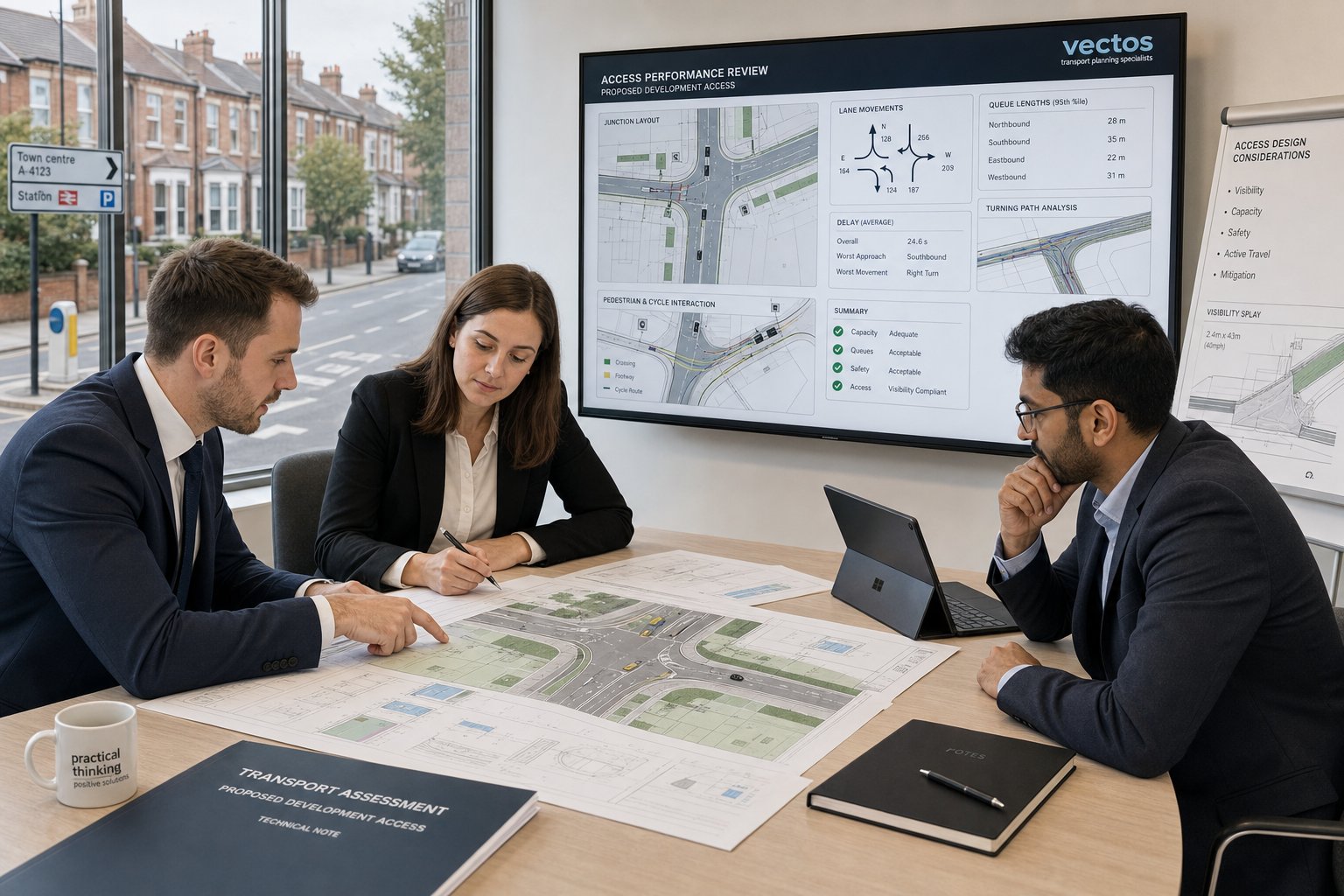
Traffic engineering consultants focus on the way streets and development accesses actually operate. We assess how traffic moves now, how it is likely to move once a scheme is built, and whether the surrounding network can continue to function safely and efficiently. That means looking at flows, queues, delay, lane use, turning movements, conflict points, pedestrian desire lines, servicing movements, cycle interaction and road safety performance.
On a live planning project, that work often turns into practical decisions very quickly. Should the access be priority-controlled or signalised? Is a ghost island right turn lane needed? Can refuse vehicles turn on-site? Will parking overspill create highway stress on nearby residential streets? Does the proposed visibility achieve an acceptable standard? These are not side issues. They are often the issues that determine whether a local authority is comfortable recommending approval.
Strong technical input also helps frame mitigation properly. Instead of vague assurances, a consultant can quantify likely effects and set out targeted responses, whether that is revised access geometry, improved footways, junction upgrades, lining changes, a Travel Plan or a contribution package. Broader context matters too, and good teams understand how traffic evidence fits alongside policy, masterplanning and delivery, as discussed in Transport Planning Consultants.
How Traffic Engineering Differs From Transport Planning And Highway Design
Traffic engineering sits between strategy and construction. Transport planning tends to look at the wider picture: travel demand, trip generation, sustainable mode share, land use patterns and policy compliance. Highway design, by contrast, is more concerned with the physical design and construction of roads, levels, drainage interfaces, pavements, structures and detailed engineering delivery.
Traffic engineering is more operational. We look at how the network performs day to day and how specific design choices affect safety and capacity. Signals, junction geometry, visibility, swept paths, parking layout, lane discipline, queue interaction and network management all sit firmly in this space.
There is overlap, of course. On many projects, one consultant team may contribute to transport planning, traffic engineering and elements of highway design. But the distinction still matters. If a site’s key risk is whether a constrained access can safely serve a mixed-use development, or whether a nearby junction can absorb extra turning traffic, that is traffic engineering territory. Getting the right discipline involved early usually saves redesign later.
When To Appoint A Traffic Engineering Consultant For A Planning Application
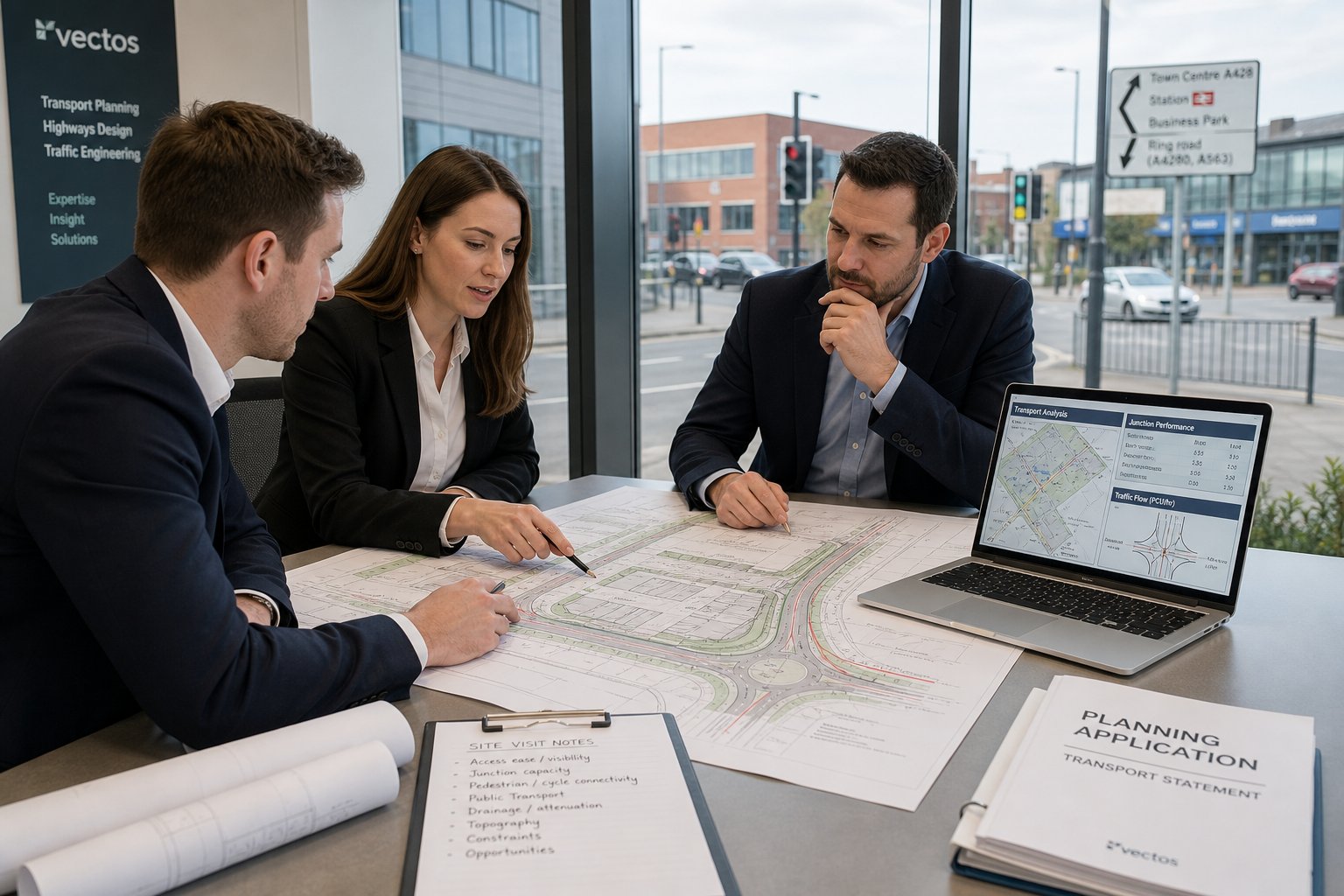
The short answer is earlier than most teams think.
We are often instructed after a layout has been fixed, a red line boundary agreed and a pre-app date booked. That can still work, but it is rarely ideal. If access is marginal, parking is tight, or a sensitive junction sits nearby, early technical review can change the direction of the scheme before money is spent on drawings that later need to be revisited.
At feasibility stage, traffic engineering consultants can test whether a site is likely to be developable in highway terms. That is particularly useful for option appraisals, acquisitions and conditional contracts. We can advise on likely survey needs, local thresholds for a Transport Statement or Transport Assessment, and whether the authority is likely to scrutinise access, capacity, servicing or sustainable travel measures most closely.
Pre-application is another key point. A concise technical note can sharpen discussions with the highway authority and reduce the chance of broad, open-ended information requests later. For developers and planning teams working across multiple regions, local insight also matters: authority expectations in one area are not always mirrored in another, which is why project-specific support such as a Traffic Engineer In Manchester: or other location-led adviser can be valuable.
Once a formal scope is requested, consultant input becomes less optional and more essential.
Typical Triggers For Consultant Input
Some planning applications can proceed with relatively light transport evidence. Others trigger immediate technical scrutiny. Common examples include:
- developments exceeding local thresholds for a Transport Statement or Transport Assessment
- new or altered accesses onto classified roads
- sites close to congested junctions, schools or high street frontages
- constrained urban plots with parking, servicing or turning challenges
- schemes with poor visibility splays or unusual topography
- proposals likely to attract highway objections from neighbours or consultees
- applications where a planning appeal is possible if consent is refused
We would also add one trigger that is easy to miss: uncertainty. If the project team is not sure whether the transport case is straightforward, it usually isn’t. A quick early review often exposes the real risks.
And there is a commercial point here. A modest upfront instruction is usually cheaper than redesigning access geometry, commissioning rushed surveys, or answering several rounds of highway queries under deadline pressure.
Core Services Traffic Engineering Consultants Provide

Most people associate traffic engineering with a Transport Assessment, but the scope is wider than that. Depending on the scheme, we may collect and interpret traffic survey data, review collision records, undertake junction capacity modelling, prepare swept path analysis, advise on parking and servicing, develop access options, assess visibility, support Road Safety Audit processes, and respond to consultation comments during determination or appeal.
The value is not just in producing drawings or calculations. It is in joining the dots. A parking issue may actually be a servicing issue. A junction concern may be solvable through layout changes on site rather than off-site highway works. A local authority objection may stem from poor scoping rather than a fundamentally flawed scheme.
For many development teams, speed matters too. At ML Traffic, the emphasis is on concise and accurate reporting shaped around local authority thresholds, and that reflects what clients usually need: documents that are technically robust without becoming bloated. Practical guidance on the wider discipline appears in Highway and Traffic Engineering Consultants, but in planning terms the core service offer tends to fall into a few recognisable categories.
Transport Statements, Transport Assessments, And Travel Plans
A Transport Statement is generally used for smaller schemes where impacts are expected to be limited. It sets out the development proposals, local transport context, access arrangements, parking provision and a proportionate view of likely traffic effects. The best ones are concise, not flimsy.
A Transport Assessment goes further. It usually includes trip generation, distribution and assignment, baseline network conditions, capacity modelling, sustainable accessibility, servicing review, and mitigation where needed. For larger or more sensitive developments, it becomes one of the central pieces of planning evidence.
Travel Plans sit alongside those reports. Their purpose is demand management: reducing single-occupancy car use, promoting active travel, supporting public transport uptake and embedding monitoring measures that the authority can rely on post-consent. A weak Travel Plan feels generic. A good one is tied to the site, users and local travel opportunities.
Junction Capacity, Access, Parking, And Visibility Reviews
These are often the decisive technical workstreams.
Junction capacity modelling tests how a priority junction, roundabout or signal-controlled junction is expected to operate with and without development traffic. We use recognised tools to understand queues, delay, reserve capacity and practical stress points. Numbers matter, but interpretation matters just as much. A model can show an issue: an experienced engineer explains whether it is material and what can realistically be done about it.
Access reviews focus on geometry, width, radii, vehicle tracking, pedestrian crossing points and conflict with existing movements. Parking and servicing reviews consider quantity, policy compliance, bay dimensions, turning areas, delivery arrangements and usability in the real world. Visibility assessments check whether drivers can see and react in line with accepted standards and local expectations.
Where authorities are especially sensitive to congestion or operational performance, related support from Traffic Flow Management specialists can also feed into the case.
How Traffic Engineering Evidence Supports Planning Decisions
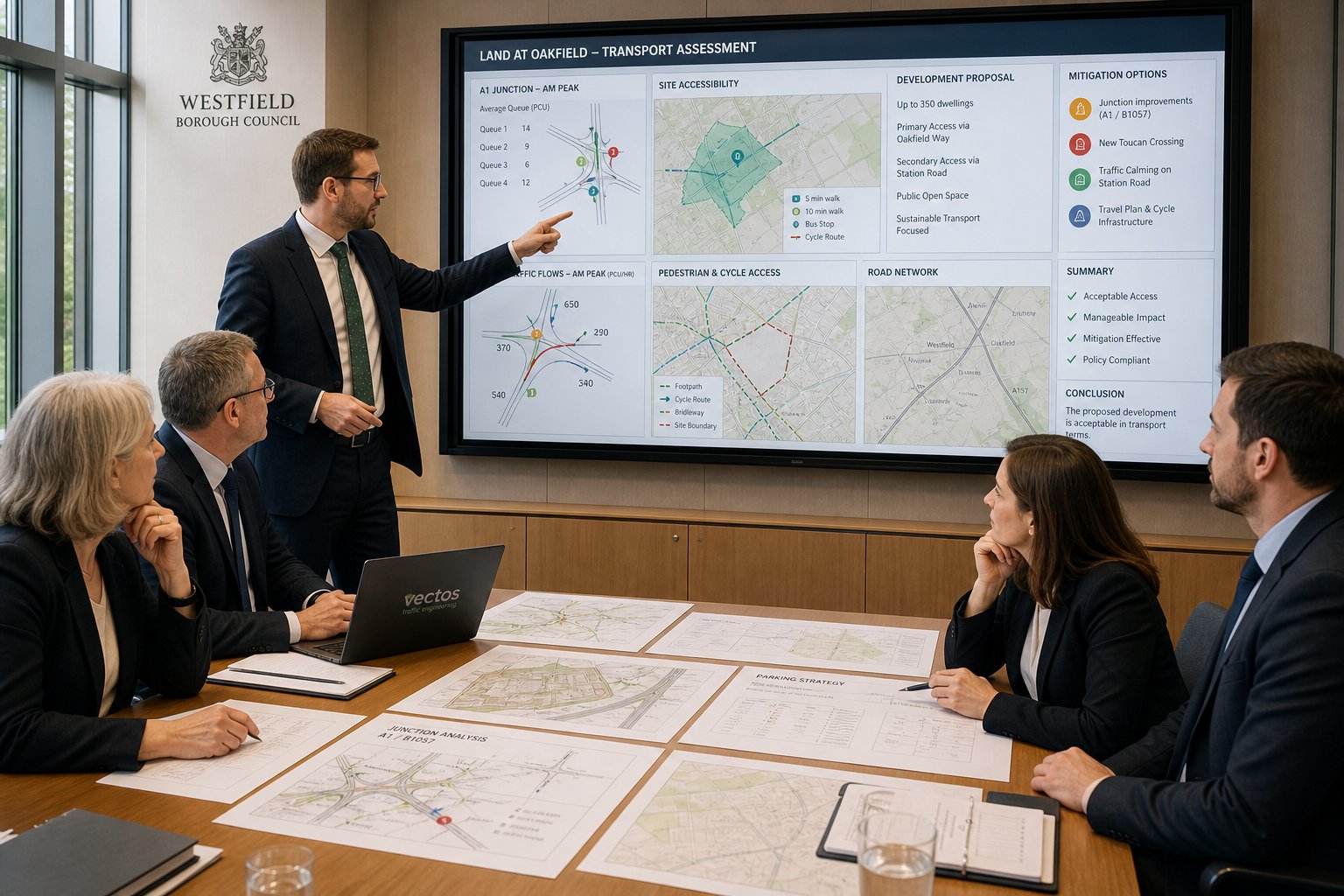
Planning officers and committee members rarely need every technical detail, but they do need confidence that the transport case is sound. Good traffic engineering evidence provides that confidence by translating technical analysis into clear planning conclusions.
In practical terms, the evidence answers a set of recurring questions. Is the site accessible? Can vehicles enter and leave safely? Will nearby junctions operate within an acceptable range? Is parking adequate and usable? Are pedestrians and cyclists properly considered? Is there likely to be severe impact, to use the language that often shapes highway decisions? And if there is an impact, can it be mitigated in a proportionate way?
That evidence also anchors negotiations. Without quantified assessment, discussions become subjective very quickly. One consultee says queues will be intolerable: another says the impact will be negligible. A properly scoped report, supported by survey data and accepted assessment methods, gives everyone a shared technical base.
It is also important at appeal. Inspectors tend to respond well to clear, transparent transport evidence that distinguishes between genuine harm and generalised concern. Loose claims do not travel far. Measured analysis does.
For local authorities, this kind of work helps balance competing objectives: enabling growth, protecting safety, supporting sustainable movement and managing pressure on existing infrastructure. For applicants, it reduces uncertainty. That is why transport evidence is rarely just a supporting note. On many schemes, it is one of the pillars holding the application up.
Working With Architects, Planners, Developers, And Local Authorities

Traffic engineering works best when it is integrated, not bolted on. We spend a large part of any project coordinating with other disciplines because transport issues are almost never isolated from the rest of the design.
With architects, the conversation often starts with layout. A small shift in building line can improve visibility. Moving a bin store can unlock vehicle tracking. Reconfiguring active frontage can create a safer pedestrian route from the public highway. These are design moves, but they are informed by traffic engineering logic.
With planning consultants and town planners, the focus is usually strategy and wording. We help align technical evidence with local policy, committee risk, likely consultee objections and the application narrative. For lawyers and land teams, we may provide input at due diligence stage, particularly where access rights, adoptability or off-site mitigation could affect viability.
Developers want clarity on programme and risk. Local authorities want evidence that is proportionate, policy-compliant and easy to review. The consultant’s job is to bridge those priorities. In major urban areas, that often means understanding how different councils interpret similar standards, whether through a Traffic Engineer In London: perspective on constrained city sites or experience on regional projects such as those led by a Traffic Engineer In Leeds:.
The relationship with highway officers matters as well. The best outcomes usually come from constructive, early dialogue, backed by drawings and evidence that answer the authority’s actual concerns rather than a generic checklist.
What Makes A Good Traffic Engineering Report
A good report is not simply long, heavily modelled or packed with appendices. In fact, some of the least effective transport reports are the ones that bury the key point under fifty pages of technical noise.
A strong traffic engineering report starts with the right scope. That sounds obvious, but many weak submissions begin with assumptions that were never agreed with the authority. Survey extents, assessment years, junction selection, committed development assumptions and modelling scenarios all need to be proportionate and defensible.
From there, quality comes down to transparency. The data source should be clear. The methodology should be recognisable. Any assumptions on trip rates, distribution patterns or growth factors should be explained rather than smuggled in. If modelling has been undertaken, the report should state what software was used, how the network was coded and what the outputs mean in practical terms.
Structure matters too. We generally want to see a clean line from baseline conditions to proposed development, then assessment, mitigation and conclusion. Plans should match the text. Vehicle tracking should reflect the layout actually submitted. Parking counts should be internally consistent. These details sound mundane, but inconsistencies are exactly the sort of thing consultees latch onto.
Most of all, a good report is readable. Technical appendices can do the heavy lifting. The main narrative should explain the findings in plain English, because planning decisions are made by people, not just by models.
Common Issues That Delay Planning Approval
The same transport problems come up again and again, and most are avoidable.
First, poor survey data. If counts are out of date, collected in abnormal conditions, or too limited in geographic scope, the authority may reject the whole evidence base. Since traffic patterns shifted noticeably in the past few years across many towns and city centres, relying on old assumptions is a risky move.
Second, incomplete assessment. A report may mention a junction concern but provide no modelling. Or it may refer to parking compliance without testing whether vehicles can actually manoeuvre. These gaps create easy reasons for objection.
Third, design conflict between disciplines. We have seen planning layouts where landscaping blocks visibility, cycle stores interfere with turning paths, or servicing relies on manoeuvres no operator would accept in real life. None of those issues is fatal on its own, but each can stall determination while revisions are prepared.
Fourth, mitigation arriving too late. Travel Plans, highway works drawings, swept paths or safety responses are sometimes submitted only after objections have been raised. That slows trust as much as it slows programme.
Finally, there is the simple problem of local fit. A technically competent report can still underperform if it does not reflect how the relevant authority reads thresholds and standards. Regional familiarity helps here, whether the scheme sits within the patch of a Traffic Engineer In Liverpool: or a Traffic Engineer In Birmingham: team.
How To Choose The Right Traffic Engineering Consultant
Choosing a consultant is partly about qualifications, but not only that. Technical competence is the baseline. What clients usually need beyond that is judgement.
We would start with relevant experience. Has the consultant worked on similar development types: residential, logistics, roadside, mixed-use, education, care, urban infill? Have they dealt with the local authority involved, or at least authorities with similar highway expectations? Experience shortens the learning curve and reduces avoidable missteps.
Professional standards matter as well. Familiarity with UK guidance such as DMRB, Manual for Streets and TSRGD is essential, as is comfort with survey interpretation, modelling tools, access design and planning-stage reporting. Chartered status can be a useful indicator, though it is not the only one. You also want to know who will actually do the work. A polished proposal means little if the project is then handed to someone inexperienced without oversight.
Ask for examples. Not just glossy covers, but anonymised reports or extracts that show how clearly the consultant writes, how they justify assumptions and how they respond to difficult sites. If appeals, committee support or negotiations are likely, communication skills count every bit as much as technical software skills.
And then there is responsiveness. Planning programmes rarely move in a straight line. You need a team that can turn comments around quickly, advise candidly and keep the transport strategy aligned with the wider application as it evolves.
Conclusion
Traffic engineering consultants sit at a practical but influential point in the planning process. We translate movement, safety and network performance into evidence that planning officers, highway authorities and project teams can act on. When that work is done early and done well, it reduces uncertainty, improves design quality and gives applications a far better chance of progressing without transport-related delay.
For architects, planners, developers, solicitors and councils, the takeaway is fairly simple: do not wait for a highway objection before testing the transport case. Early review of access, junctions, parking, visibility and mitigation is usually cheaper, faster and far less painful than fixing problems late.
In 2026, with planning timescales tight and scrutiny still high, the right consultant does more than write a report. They help make a scheme workable, defensible and ready for decision.
Frequently Asked Questions about Traffic Engineering Consultants
What role do traffic engineering consultants play in the planning process?
Traffic engineering consultants assess how vehicles, cyclists, and pedestrians will move safely and efficiently within a development site and its surroundings. They provide technical evidence on access, junction performance, parking, and safety, which supports smooth planning approvals and reduces delays.
How is traffic engineering different from transport planning and highway design?
Traffic engineering focuses on the day-to-day operation and control of traffic flow, including signals, junction geometry, and safety. In contrast, transport planning addresses broader travel demand and sustainable mode use, while highway design concerns the physical construction and geometry of roads.
When should a traffic engineering consultant be appointed for a planning application?
It is best to involve traffic engineering consultants early, ideally during site feasibility or before pre-application meetings. Early input on access, parking, and local junctions can prevent costly redesigns and ensure compliance with highway authority requirements.
What are the typical services provided by traffic engineering consultants?
Services include traffic surveys and data analysis, junction capacity modelling, swept path and visibility assessments, parking and servicing design, road safety audits, and preparation of Transport Assessments, Transport Statements, and Travel Plans aligned with planning policies.
How does traffic engineering evidence support planning decisions?
It provides quantified data on traffic flows, safety, and junction performance, helping planners assess accessibility, parking adequacy, and road safety. This evidence facilitates informed decision-making, negotiation on mitigation measures, and strengthens appeals by distinguishing genuine impacts from general concerns.
What should be considered when choosing a traffic engineering consultant?
Consider relevant experience with similar development types and local authorities, professional qualifications including chartered status, familiarity with UK standards, quality of previous reports, communication skills, responsiveness, and ability to integrate with planning teams to deliver clear, robust, and compliant evidence.