
Planning applications rarely fail on ambition alone. More often, they run into trouble because access doesn’t work, parking is undercooked, servicing hasn’t been thought through, or the highway authority simply isn’t convinced the impact has been properly tested. That’s where transport planning consultants come in.
We work in the space between design intent and planning reality. For architects, developers, planners, lawyers and local authorities, transport advice is often the difference between a scheme that looks plausible on paper and one that stands up to technical scrutiny. In 2026, that matters more than ever. Validation requirements are tighter, local thresholds vary widely, and expectations around active travel, EV provision, road safety and network resilience are far more detailed than they were even a few years ago.
In practical terms, transport planning consultants assess how people and goods will reach a site, whether the surrounding network can cope, and what evidence is needed to demonstrate that a proposal is safe, suitable and policy-compliant. We also help shape the scheme itself, because the best transport work usually starts before the layout is fixed.
This article explains what transport planning consultants do, when a Transport Assessment or Statement is likely to be needed, which reports matter most, and how early, planning-led advice can reduce delay, avoid rework and improve the odds of consent.
What Transport Planning Consultants Do In The Planning Process

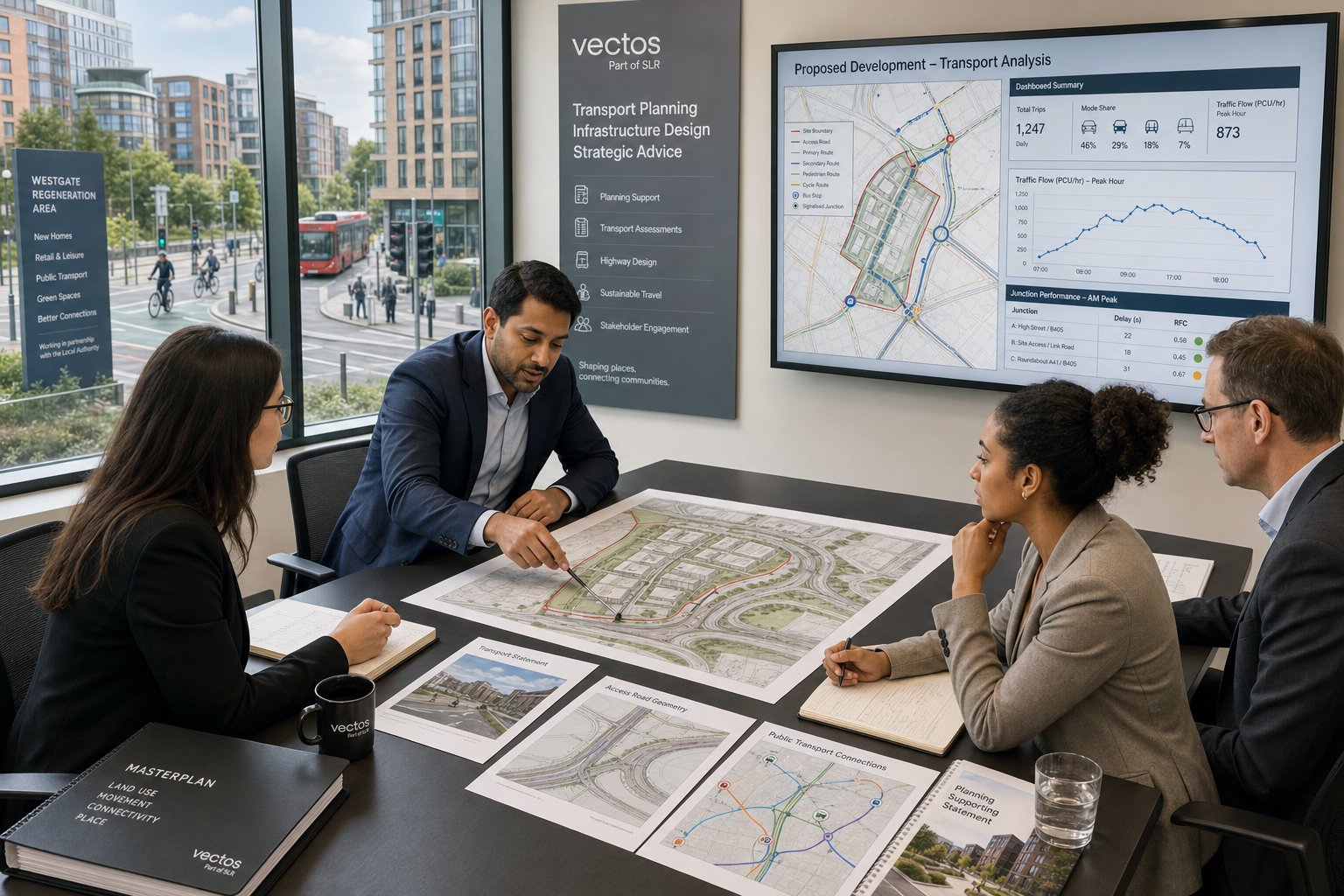
Transport planning consultants assess how a development will function in movement terms and whether it is likely to be acceptable to the local planning authority and highway authority. That sounds simple. In reality, it involves a mix of technical analysis, policy interpretation, design input and negotiation.
At the earliest stage, we review the site and the proposal through a transport lens: existing access arrangements, nearby junctions, public transport availability, walking and cycling links, parking constraints, servicing routes and local collision history. We then test the likely transport effects of the scheme. That usually includes trip generation, trip distribution, parking demand, access design and the operational impact on surrounding roads.
Just as importantly, we advise on what can be improved before an application is submitted. A small change to access geometry, a more credible parking layout, or a better refuse strategy can remove objections before they arise. For larger sites, transport planning can influence the masterplan itself, from street hierarchy to pedestrian permeability.
We also prepare the reports that sit behind the planning application and coordinate with the wider team. In practice, that means working closely with architects, planning consultants, civil engineers and legal advisers so the transport case aligns with the planning strategy. On more location-specific schemes, local knowledge can be decisive, particularly where authority expectations differ: that is often why teams seek support from a Traffic Engineer In Manchester or a Traffic Engineer In London rather than relying on a generic national template.
Done well, transport advice is not just about producing a report. It is about making the scheme easier to approve.
How Transport Advice Supports Different Types Of Planning Applications
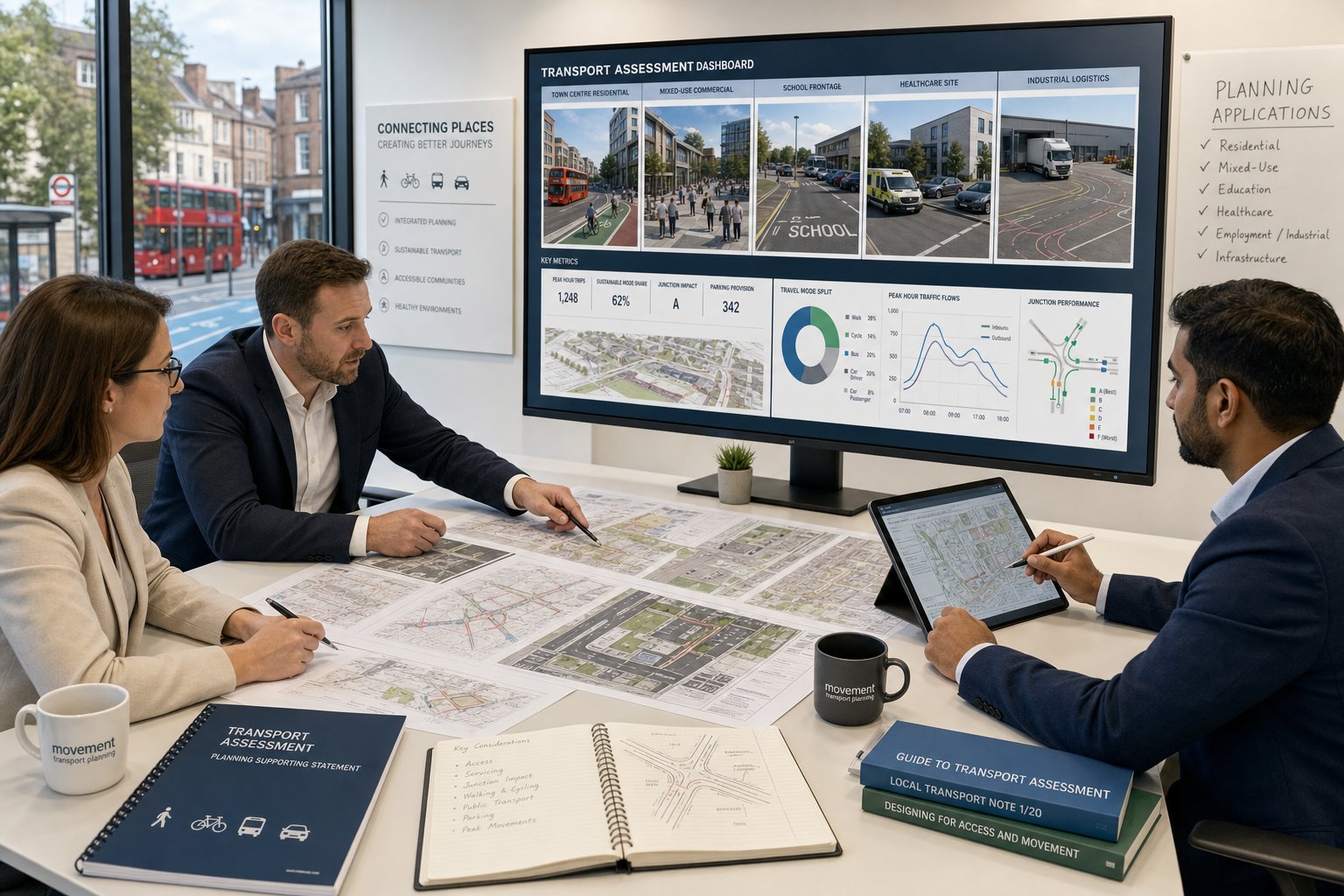

Different land uses create different movement patterns, and that is why transport advice has to be proportionate, site-specific and grounded in how the place will actually operate. A town-centre infill scheme with strong public transport links should not be assessed in the same way as an edge-of-settlement industrial unit or a school on a constrained local road.
Residential, Mixed-Use, And Commercial Development
For residential schemes, the key questions usually centre on access quality, parking provision, trip generation and the effect on nearby junctions. But there is nuance. Flatted town-centre development may justify lower parking ratios and stronger cycle provision: suburban family housing may raise greater pressure around school-run peaks, visitor parking and refuse access.
Mixed-use proposals add another layer because they combine travel purposes across the day. We often assess whether uses complement each other in transport terms, whether linked trips reduce overall impact, and how internal layout can support safe walking and cycling. Commercial development brings its own issues too: delivery activity, staff shift patterns, customer parking turnover and servicing conflicts all need attention.
On larger private-sector projects, early strategy work matters as much as the final report. That is why broader Private Sector Transport Planning and targeted Property Development Transport advice often pay off before the design is locked in.
Schools, Healthcare, Logistics, And Specialist Sites
Schools are notorious for intense but short peak periods. A technically acceptable scheme can still face resistance if drop-off arrangements, staff parking and road safety are not convincingly addressed. We typically examine arrival patterns, informal parking risk, crossing demand and opportunities to shift travel behaviour through a School Travel Plan.
Healthcare schemes can be even more complex. Patients, visitors, staff, community services and ambulances all use the site differently, often at overlapping times. Shift changes can create sharp parking and traffic peaks that standard assumptions miss.
Logistics and industrial sites demand a stronger operational focus. HGV routing, loading arrangements, yard circulation, gatehouse stacking and manoeuvrability are central. A scheme can look generous on a layout drawing and still fail once real vehicles are tested.
Specialist sites such as stadia, leisure destinations or event venues often require crowd and peak-flow thinking rather than ordinary weekday analysis. Public transport capacity, temporary traffic management and pedestrian dispersal can become just as important as car access. In each case, the consultant’s role is to translate a site’s operational reality into evidence the authority can trust.
The Main Transport Reports Used For Planning Applications


The right report depends on the scale of development, the sensitivity of the location and the issues the authority is likely to focus on. One of the most common mistakes in planning is assuming a single generic transport report will do the job. Usually, it will not.
Transport Assessments, Transport Statements, And Travel Plans
A Transport Assessment, or TA, is the more detailed of the main application documents. It is typically prepared for larger or more complex development, or where the surrounding highway network is constrained. A TA examines existing conditions, forecasts trips, assesses impact, and sets out mitigation where required. It should be evidence-led, not merely descriptive.
A Transport Statement, or TS, is shorter and more proportionate. It is generally suitable for smaller schemes where some transport appraisal is needed but the likely impact is limited. The challenge is getting the balance right: too brief, and it invites objections: too long, and it can obscure the key points.
Travel Plans sit alongside either document where sustainable travel promotion is important. They set out measures, targets and monitoring arrangements to encourage walking, cycling, public transport and car sharing. In 2026, authorities increasingly expect these to be practical rather than aspirational, particularly where mode shift is being relied on to justify lower parking or reduced traffic growth.
Junction Modelling, Swept Path Analysis, And Technical Notes
Where capacity is an issue, junction modelling is often needed to test how additional trips will affect delay and queueing. That may involve priority junctions, roundabouts or signalised nodes, depending on local conditions and the authority’s preferred assessment methods.
Swept path analysis is used to demonstrate that vehicles can safely enter, leave and move within a site. It is especially important for refuse vehicles, fire appliances, buses and HGVs. A surprising number of planning delays come from vehicle tracking being left too late.
Technical notes are the unsung workhorses of the planning process. They address focused questions: visibility splays, parking amendments, revised trip rates, delivery arrangements or a response to consultee comments. A concise note can often resolve an issue faster than reopening an entire TA.
For many development teams, transport reporting now sits within a broader package of planning evidence, which is why Developer Transport Consultants are often brought in early rather than only at submission stage.
When A Transport Assessment Or Statement Is Likely To Be Required
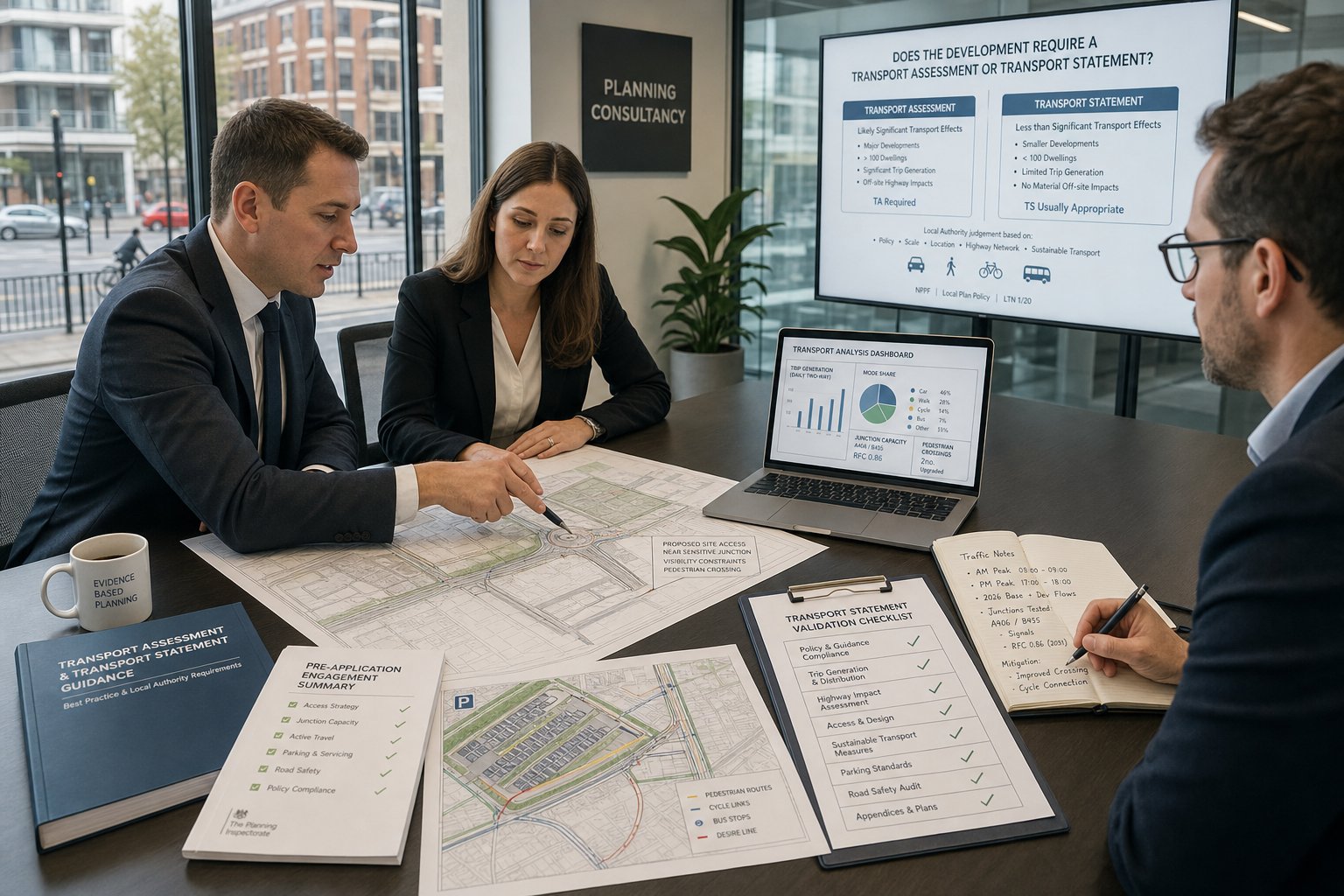
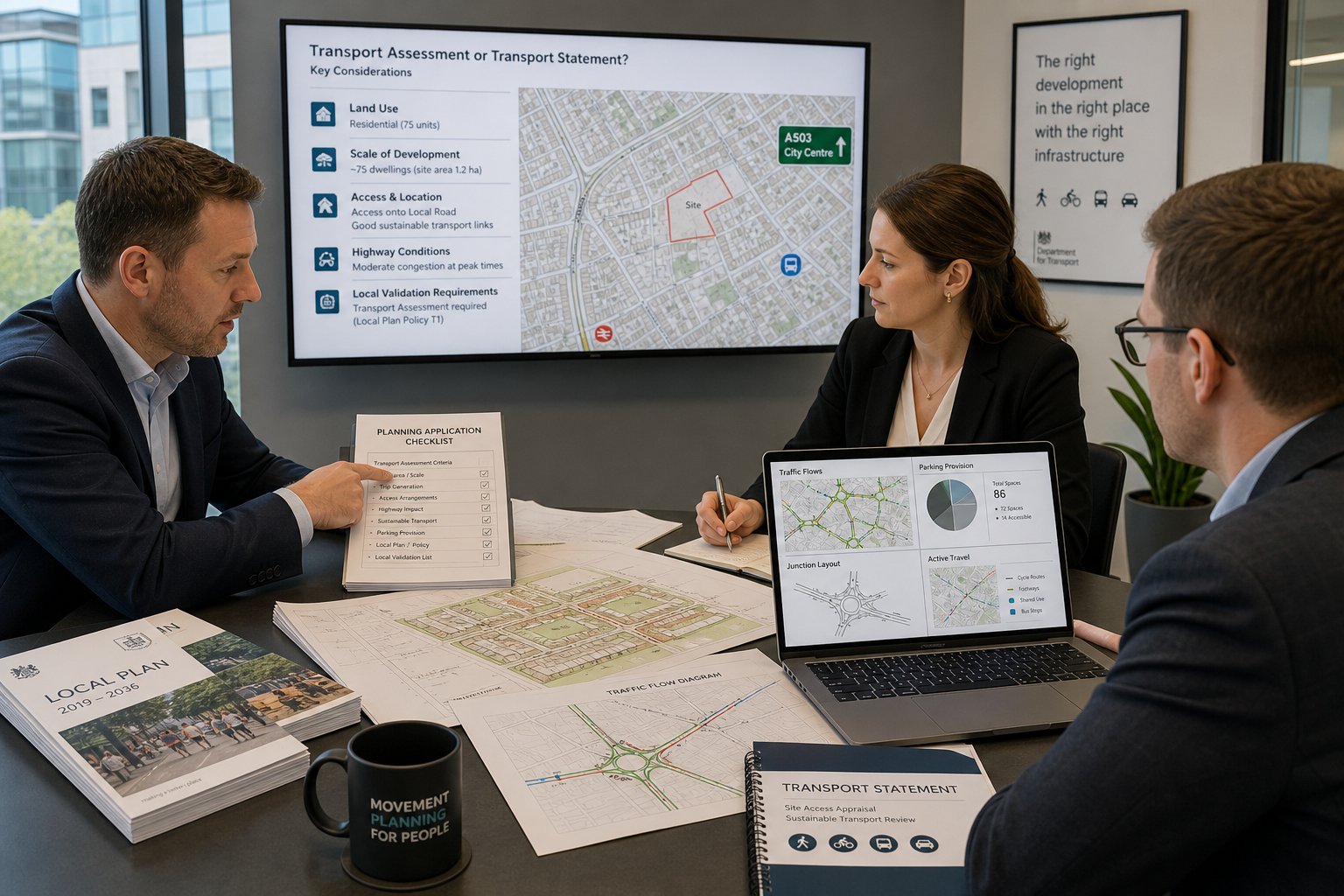
In the UK, the starting point is usually national policy and local validation requirements. The National Planning Policy Framework expects developments that generate significant movement to be supported by a Transport Statement or Transport Assessment. But “significant” is not defined by one fixed national threshold, which is where many applicants get caught out.
In practice, local planning authorities and highway authorities set their own trigger points by land use, scale and location. A modest proposal in one borough may need only a short statement, while the same proposal in a constrained or congested area may require fuller analysis. Dwelling numbers, gross floor area, access changes, parking stress, road safety concerns and proximity to sensitive junctions can all affect the requirement.
Pre-application engagement is often the safest route. We typically review local validation checklists, supplementary guidance and recent decisions, then agree scope with the authority before the application is lodged. That avoids the all-too-common situation where an application is validated late, or worse, challenged after submission because the evidence base is considered inadequate.
The judgement is not only about size. A small scheme with difficult access, poor visibility, high servicing demand or a school nearby can need more transport work than a larger but straightforward site. And in lower-car or sustainability-led schemes, authorities may expect clearer evidence on active travel and emissions. That is one reason why Net Zero Transport Planning is becoming more closely tied to mainstream planning submissions, rather than treated as a separate conversation.
How Consultants Assess Access, Parking, Servicing, And Highway Impact


This is the technical core of the work. Authorities want to know four things: can the site be reached safely, can it operate efficiently, is the parking and servicing credible, and will the surrounding network continue to function acceptably.
Access assessment usually starts with geometry and visibility. We review whether the access arrangement is suitable for the likely vehicle types, whether gradients are manageable, whether pedestrian and cycle routes are coherent, and whether the proposal connects sensibly to nearby streets and public transport. Sometimes the answer is straightforward. Sometimes a scheme hinges on a few metres of kerb alignment.
Parking assessment is more than counting spaces against a standards table. We test likely demand by land use and context, consider disabled parking, cycle storage, EV charging, visitor provision and operational realities such as turnover or overspill. In town centres, the key issue may be whether reduced parking is justified. In suburban locations, the issue may be whether under-provision will simply push vehicles onto nearby roads.
Servicing analysis focuses on how deliveries, refuse collection and occasional larger vehicles will work in practice. If a refuse vehicle has to reverse excessively, or a loading bay blocks circulation, the authority will notice. This is where an Access Strategy Transport approach can sharpen the scheme before objections arise.
Highway impact assessment then pulls the threads together through trip generation, distribution, assignment, junction modelling and road safety review. Where needed, we identify mitigation, whether that is a crossing upgrade, revised access control, parking management or off-site highway works.
Working With Local Planning Authorities And Highway Authorities
A strong technical report helps, but planning outcomes are rarely determined by paperwork alone. The process also depends on how effectively consultants engage with local planning officers and highway engineers.
We usually start with pre-application discussions where the scale of assessment, likely concerns and technical methodology can be agreed in principle. That might cover traffic survey extents, junctions to model, parking assumptions, accident study areas, or whether a Travel Plan is expected. Reaching that shared understanding early can save weeks later.
From there, the role becomes part technical author, part interpreter. Authorities often ask for clarifications rather than wholesale redesigns: extra sensitivity tests, revised drawings, clearer servicing arrangements, updated parking schedules. If the consultant understands both policy and local practice, those questions can often be answered quickly and proportionately.
Local familiarity matters more than many teams expect. Even where policy is published, the way authorities apply standards can differ considerably. A consultant with regional experience, whether through a Traffic Engineer In Leeds appointment or work across multiple northern and southern authorities, will usually anticipate the points that trigger concern.
On contentious schemes, consultants may also support planning committees, Section 106 discussions or appeals. At that stage, credibility matters. Authorities do not need glossy language: they need evidence, consistency and a clear explanation of why the proposal is acceptable in transport terms.
How To Choose The Right Transport Planning Consultant
Not all transport consultants do the same job in the same way. Some are strongest on strategic planning support, some on detailed modelling, some on highway design, and some mainly on report production. The right choice depends on the project, the authority and the risks in play.
First, look for relevant sector experience. A consultant who routinely advises on urban residential schemes may not be the best fit for a logistics yard, and vice versa. Ask what comparable projects they have handled and, more importantly, what issues they resolved on those schemes.
Second, test local authority knowledge. Familiarity with national guidance is expected: understanding local thresholds, parking standards, committee sensitivities and validation quirks is where real value appears. A consultant who knows how a particular highway authority interprets a standard can save substantial time.
Third, check capability beyond the written report. Can they handle junction modelling, swept path analysis, Travel Plans and access design input? If issues emerge mid-application, you want a team that can solve them, not just document them.
Fourth, consider responsiveness. Planning timetables are rarely neat. A good consultant should be able to turn around concise, accurate advice at speed, especially when comments arrive late in the process.
For many clients, that means choosing a team with practical planning experience, engineering depth and a track record of concise reporting. With more than 30 years in the field, we know that the best outcomes usually come from advice that is technically robust but also realistic about programme pressure and local authority expectations.
Common Planning Delays And How Early Transport Input Helps Avoid Them
Most transport-related planning delays are predictable. That is the frustrating part. They tend to stem from evidence gaps, design conflicts or scope disagreements that could have been picked up weeks earlier.
A classic example is the missing or underpowered TA or TS. The application goes in, the authority reviews it, and suddenly the team is being asked for traffic surveys, junction analysis or a Travel Plan that should have been discussed before submission. Another common issue is layout-led design that ignores access geometry, servicing needs or parking standards until late stage. By then, changing the site plan is painful and expensive.
Mitigation can also arrive too late. If off-site highway works, visibility improvements or parking controls are needed, those requirements can affect cost, land take, legal agreements and programme. Discovering them after the application has been lodged is nobody’s idea of fun.
Early transport input helps because it changes the sequence. We can test feasibility before the design hardens, agree scope with the authority before validation, and identify likely objections while there is still room to respond sensibly. That often results in cleaner submissions, fewer consultee surprises and a stronger negotiating position.
In simple terms, the earlier transport planning is integrated, the less likely it is to become a late-stage obstacle. And for consultants, planners and developers juggling budgets and timetables, that is often the difference between a smooth determination and months of avoidable drift.
Conclusion
Transport planning consultants do far more than produce technical appendices. We help development teams prove that a scheme can be accessed safely, serviced properly, parked realistically and integrated into the surrounding network without unacceptable impact. Just as importantly, we help identify problems early enough to fix them.
For architects, planners, lawyers, surveyors, builders, developers and councils, the value is not only in compliance. It is in reducing uncertainty. A well-scoped Transport Statement, a credible Transport Assessment, a robust Travel Plan or a timely piece of junction analysis can move an application from vulnerable to defensible.
In 2026, with tighter validation standards and sharper scrutiny from highway authorities, transport advice works best when it is brought in early and tied closely to the design process. The strongest planning applications are rarely the ones with the most paperwork. They are the ones where the transport story makes sense from the outset.
Frequently Asked Questions about Transport Planning Consultants
What roles do transport planning consultants play in the planning application process?
Transport planning consultants assess access, parking, servicing, and traffic impacts of proposed developments. They provide technical analysis, advise on site layout improvements, and prepare necessary transport reports to support planning applications, ensuring proposals comply with policy and meet local authority requirements.
When is a Transport Assessment or Transport Statement required for a development?
A Transport Assessment is generally needed for larger or more complex developments generating significant trips or located in sensitive areas. Smaller proposals with limited impacts usually require a Transport Statement. Local authorities set specific thresholds based on land use and scale, so early consultation is essential to determine the right report.
How do transport planning consultants help with different types of developments like residential or healthcare?
They tailor advice according to the land use; for residential schemes, they focus on access, parking, and trip impacts. For healthcare, they consider patient, staff, and ambulance movements including shift peaks. Mixed-use and specialist sites like logistics or stadia require detailed operational and crowd movement analysis to ensure safe, efficient access and servicing.
What technical analyses do transport planning consultants conduct regarding access and parking?
Consultants assess access geometry, visibility, gradients, and connections to walking, cycling, and public transport. Parking evaluations include demand forecasts, local standards compliance, disabled and EV spaces, visitor parking, and turnover. This ensures safe, effective vehicle and pedestrian movement and compliance with evolving regulations.
How can early involvement of transport planning consultants prevent planning delays?
Early input allows transport consultants to shape site layouts, agree assessment scope with authorities, and identify mitigation needs before submission. This reduces evidence gaps, scope disputes, and costly redesigns later, facilitating smoother validation and quicker planning consent by addressing transport concerns proactively.
What factors should be considered when choosing a transport planning consultant?
Select consultants with sector-specific expertise relevant to your development type, strong local authority knowledge, and the capability to provide comprehensive transport modelling, design input, and travel planning. Responsiveness and practical experience with local planning and highway teams are also crucial to navigating complex applications efficiently.