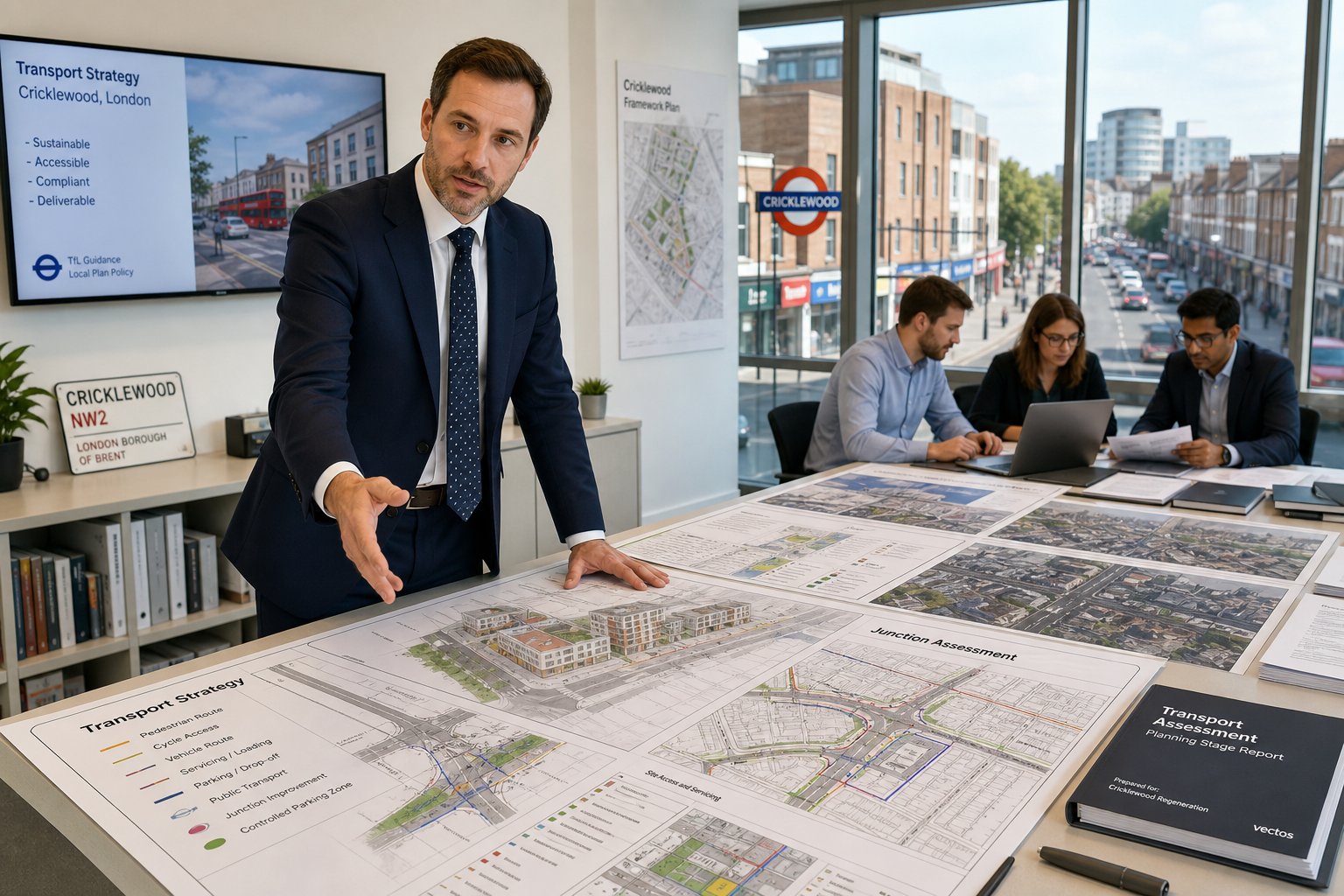
Cricklewood is one of those parts of north-west London where transport planning is never a side issue. It sits at the meeting point of strategic roads, busy high streets, rail connections, dense neighbourhoods and ongoing development pressure. That means even modest schemes can raise real questions about access, parking stress, servicing, pedestrian safety and the wider effect on already constrained streets.
For architects, planners, developers and legal teams, that creates a familiar risk: a project that looks straightforward on paper can become difficult once highways comments arrive. In our experience, that’s exactly where a traffic engineer in Cricklewood adds value. We help teams show that proposals are workable, policy-aligned and proportionate to their likely impact, rather than leaving transport matters to be picked apart late in the planning process.
In 2026, that job is shaped by more than just vehicle numbers. Barnet, Brent and Camden expectations, TfL guidance, the London Plan, Healthy Streets principles, Vision Zero, cycle provision, car-free housing policies and servicing strategy all influence whether an application feels credible. The practical task is to translate those requirements into clear evidence: how people will arrive, how deliveries will happen, whether access is safe, and what mitigation is reasonable.
Below, we set out where transport engineering fits into Cricklewood projects, which schemes typically need support, what reports are usually required, and how to choose the right adviser before submission pressures start to bite.
Key Takeaways
- Engaging a traffic engineer in Cricklewood early helps ensure development proposals are safe, workable, and aligned with local transport policies.
- Transport engineering in Cricklewood must address complex local factors like parking stress, pedestrian safety, and servicing constraints due to busy roads and neighbourhoods.
- Cricklewood developments must comply with diverse regulations including Barnet, Brent, Camden borough policies, TfL guidance, and London Plan requirements for sustainable transport.
- Traffic engineers provide tailored transport evidence such as Transport Statements, junction modelling, and Travel Plans appropriate to a scheme’s scale and impact.
- Addressing common issues like parking pressure, congested junctions, and servicing logistics strengthens planning applications and mitigates local concerns.
- Selecting a traffic engineer knowledgeable about Cricklewood’s local context and London planning culture ensures clearer communication and more effective planning support.
Why Transport Engineering Matters For Development In Cricklewood
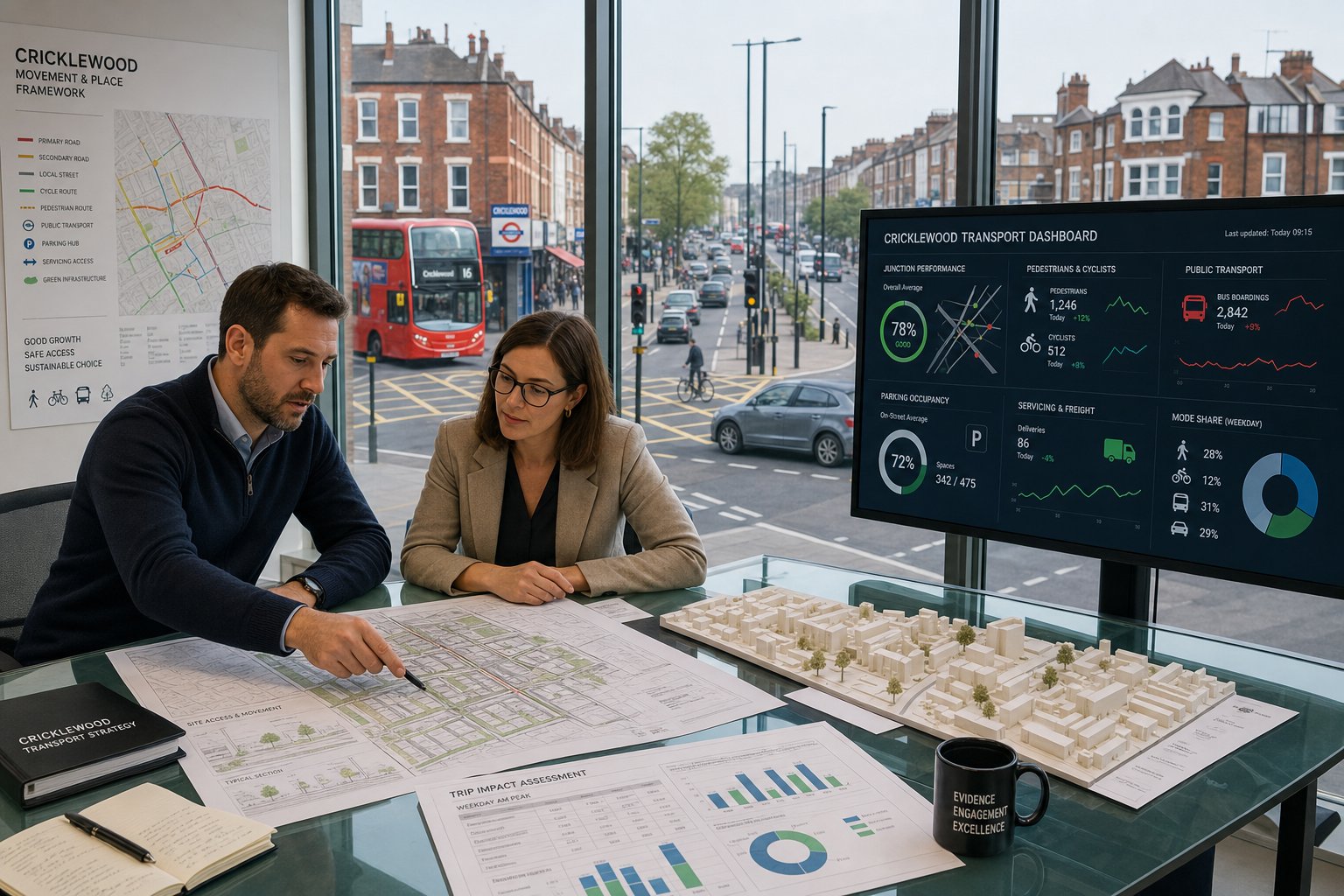
Cricklewood is not a place where transport impacts can be waved through with a few generic statements. Between Cricklewood Broadway, the A5, nearby links to the A407, bus-heavy corridors, local schools and constrained residential streets, movement patterns are busy, layered and sensitive to change. A scheme may be acceptable in principle, yet still run into objections if it cannot clearly demonstrate safe access, manageable trip impact, suitable servicing and a defensible parking approach.
That is why transport engineering matters so much at planning stage. We are not only counting trips. We are helping frame a planning argument that a development will function in the real world. For smaller sites, that might mean proving a modest residential proposal will not create severe parking overspill or dangerous reversing onto a busy road. For larger schemes, it often means assessing junction effects, sustainable mode opportunities, walking routes, cycle storage expectations and delivery patterns in a way that local officers and highway consultees can trust.
In Cricklewood, transport evidence also plays a broader role in supporting growth without simply shifting problems onto surrounding streets. Intensification around station areas, town centre plots and brownfield land can be policy-supportive, but only when the transport case is thought through. Good reporting helps balance development ambition with local realities such as congestion, kerbside competition and air quality concerns.
That wider discipline is part of modern Traffic Engineering: Your: not just road layout, but the interaction between planning policy, place-making and movement. And for teams working across the capital, the principles we apply in a Traffic Engineer In London: context become especially relevant in locations like Cricklewood, where strategic and local issues overlap almost block by block.
Local Planning And Highway Considerations That Shape Projects In Cricklewood
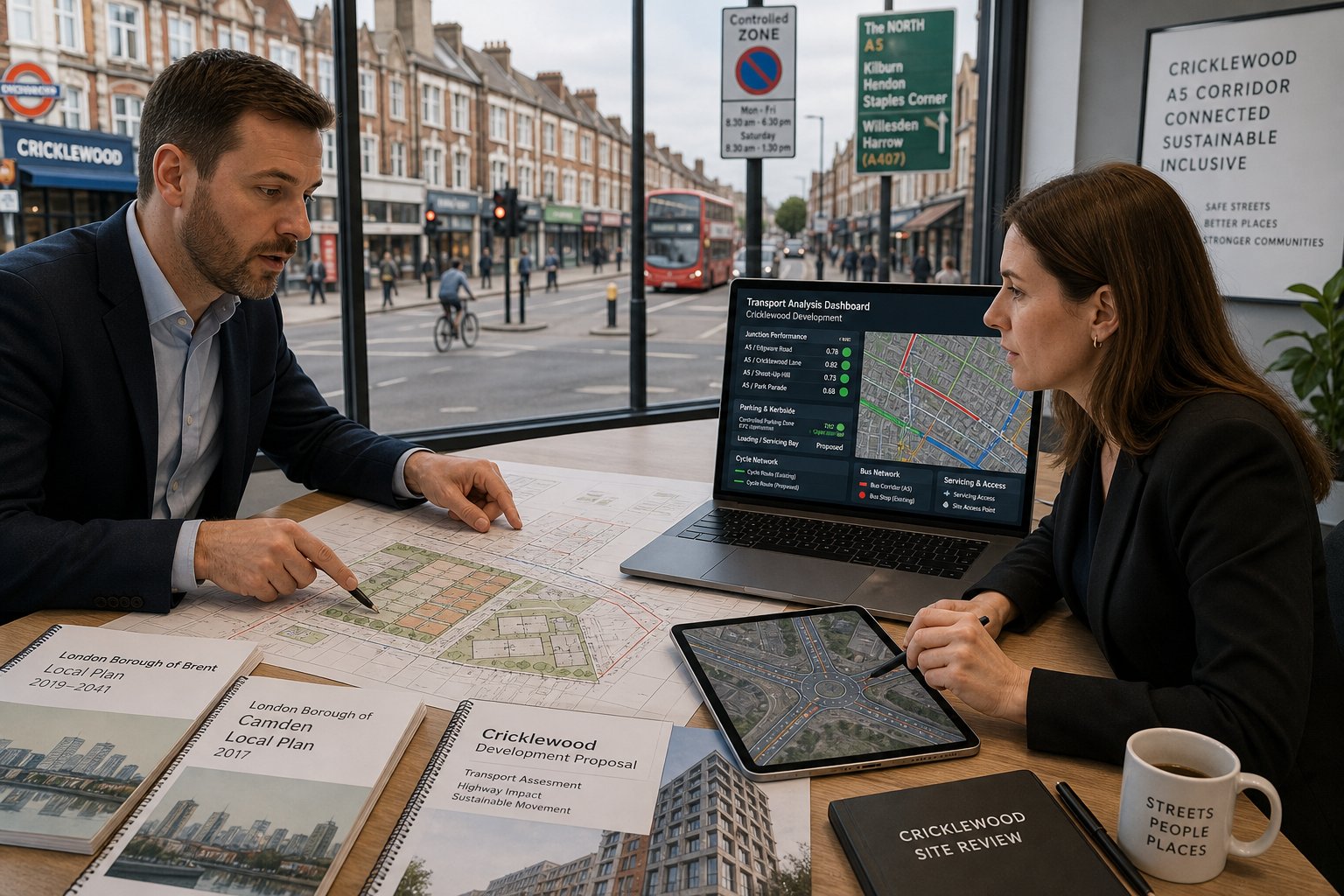
A Cricklewood project can fall within different borough contexts depending on the exact site location, so one of the first jobs is getting the policy and highway picture right. Barnet, Brent and Camden do not approach every transport matter in exactly the same way, even where they are all working within the London Plan framework. Parking restraint, cycle provision, car-free expectations, servicing standards and local street management can vary enough to affect design decisions early.
The road hierarchy is another major factor. Sites fronting or connecting to the A5 carry a very different set of access and servicing sensitivities from those on quieter residential roads. Add in bus routes, junction pressure, Controlled Parking Zones, loading restrictions, existing waiting controls and nearby schools, and it becomes obvious why a “standard” transport response rarely works. A proposal that seems minor in floorspace terms may still face close scrutiny because of turning movements, kerbside demand or pedestrian conflict.
Then there is London’s policy direction. Healthy Streets, Vision Zero, 20 mph environments, walking and cycling priority, LTNs in surrounding areas and the general shift away from car-led design all influence what is likely to be supported. For many schemes, success depends on showing not only that traffic effects are acceptable, but that the development contributes to a safer and more sustainable movement pattern.
That is where experienced Traffic Engineering Consultants: tend to earn their keep. We review the planning history, local constraints, council validation expectations and likely consultee concerns before the application is locked down. On complex sites, especially those with active frontages or servicing needs, the discipline overlaps heavily with Commercial Traffic Engineering, because traffic impact and operational practicality are often the same conversation from two different angles.
Typical Schemes That Need A Traffic Engineer
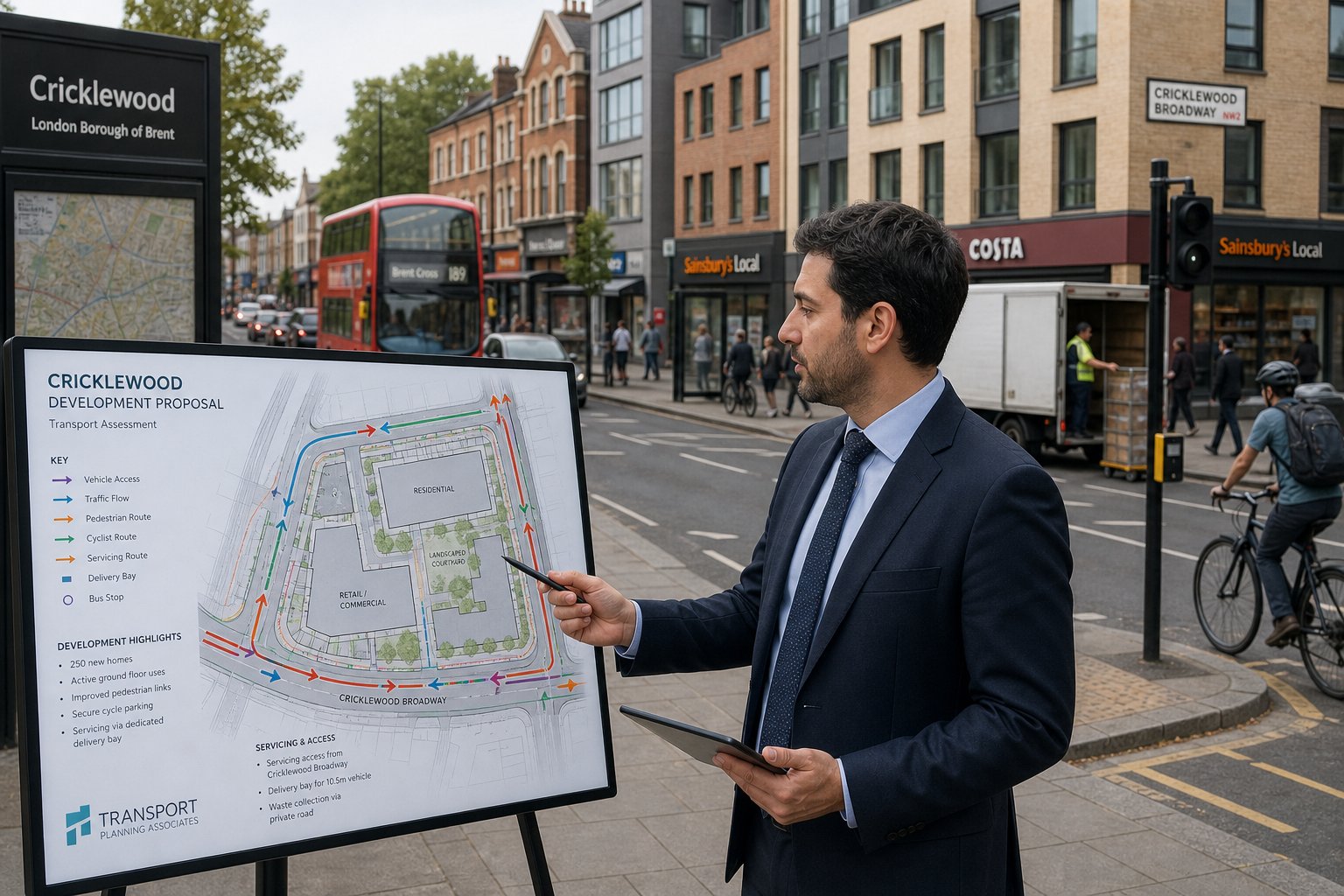
Not every proposal needs a full-scale transport package, but many more schemes benefit from traffic input than applicants first assume. In Cricklewood, where streets are busy and policy expectations are relatively high, transport questions often appear even on mid-sized or seemingly simple developments.
The common thread is this: if a proposal changes how people, vehicles, deliveries or servicing interact with the site, transport evidence may be necessary. Sometimes the requirement is formal, triggered by validation thresholds or officer requests. Sometimes it is strategic, because an early note from a traffic engineer can prevent a planning statement from making assumptions the highways team later rejects.
Below are the project types where we most often see that support become important.
Core Traffic Engineering Services For Planning Applications
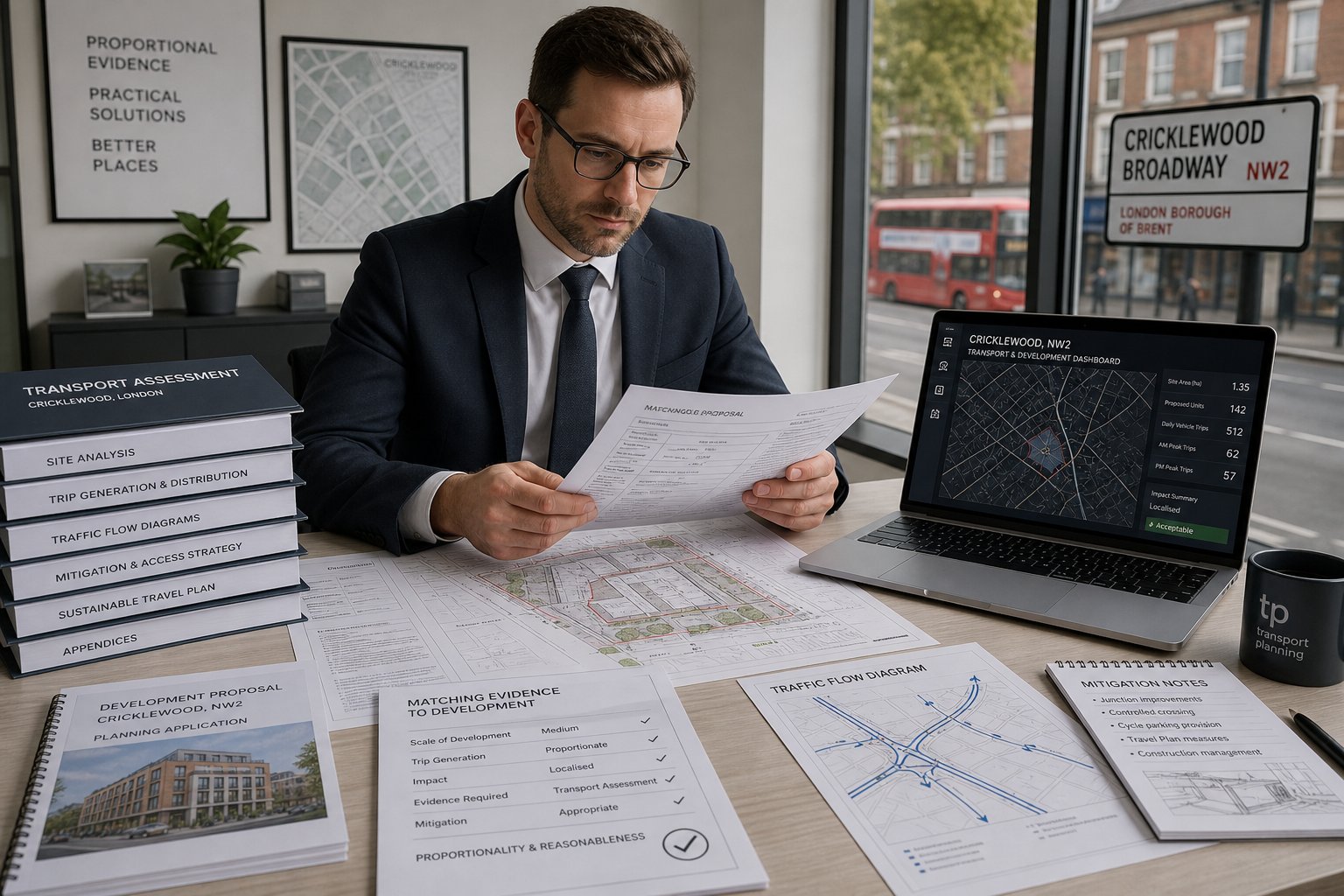
Most Cricklewood schemes do not need every possible transport document. What they do need is the right level of evidence. The art, really, is proportion. A small infill scheme should not carry the burden of a major-application assessment: equally, a more intensive development should not rely on a thin statement that leaves obvious questions unanswered.
Our role is to match the reporting package to the scale, land use and local sensitivity of the proposal. That usually means some combination of technical assessment, design review and mitigation planning, all prepared in a form that planning officers and highways consultees can work with. The key services below turn up most often in Cricklewood applications.
How A Traffic Engineer Supports The Planning Process From Start To Decision
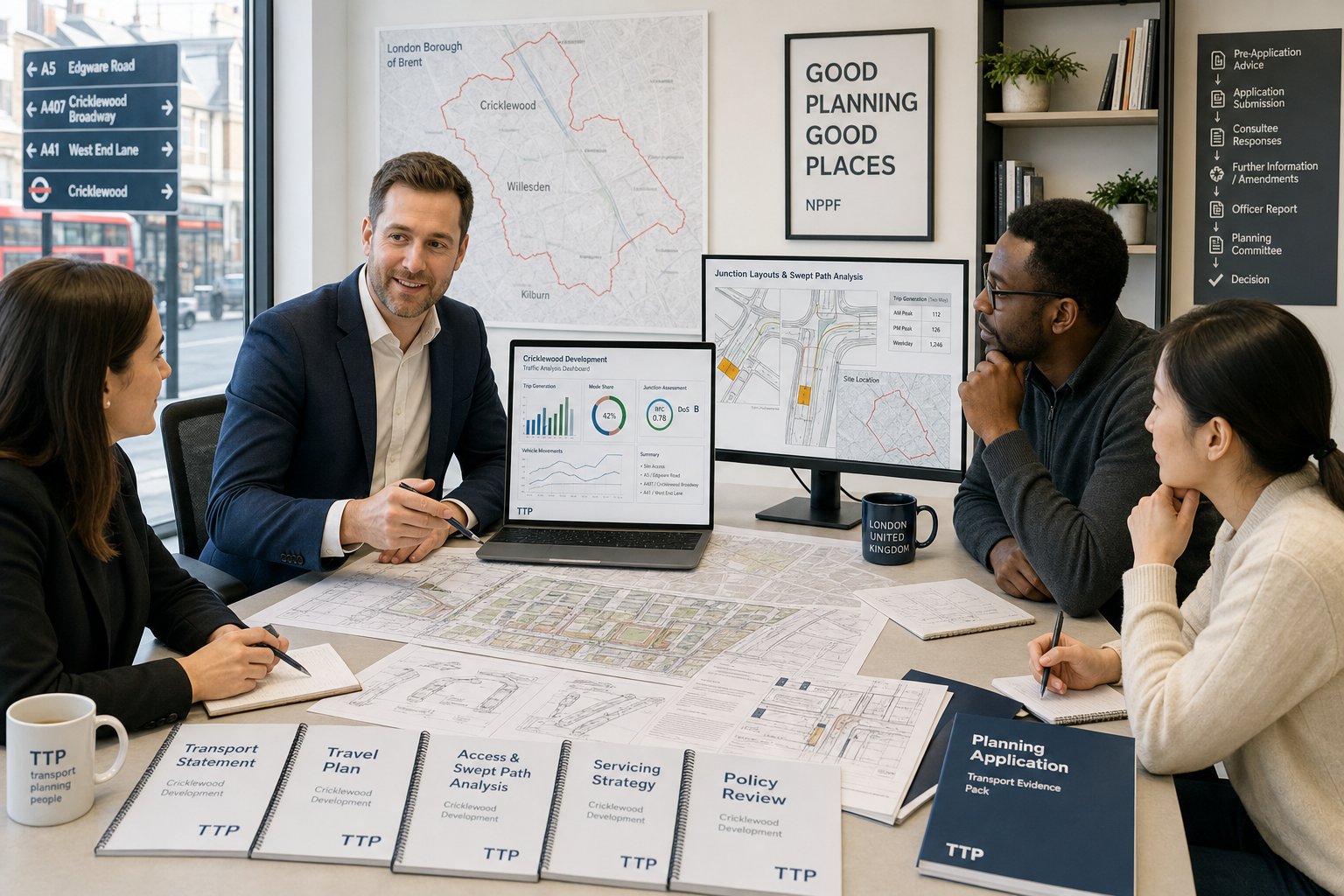
The strongest transport submissions usually start well before the planning application is uploaded. Early in the process, we review the site, development quantum, planning background and likely transport triggers. That allows us to scope what is actually needed: perhaps a concise Transport Statement and swept-path review, perhaps a fuller Transport Assessment with junction modelling, Travel Plan measures and servicing strategy.
Pre-application engagement can be particularly useful in Cricklewood, especially on sites touching strategic roads, sensitive junctions or borough boundaries. Where TfL or a borough highways team is likely to take a close interest, agreeing the broad approach early can save a lot of churn later. We then coordinate surveys, policy review, TRICS-based trip analysis where appropriate, access testing and drawing input so the technical story aligns with the architectural one.
Once the application is live, the job is not over. Highways comments often raise points on parking restraint, cycle standards, servicing arrangements, visibility, refuse tracking or local traffic impact. Responding well matters. We prepare clarifications, revise layouts, expand evidence where needed and help the wider team answer consultee queries without drifting into contradiction.
That support can continue through committee and, if necessary, appeal. The same disciplined approach used by a Traffic Engineer In Manchester: or a Traffic Engineer In Bristol: project applies here too: define the issue, evidence the impact, propose proportionate mitigation, and keep the planning case coherent from first sketch to final decision.
Common Transport Issues In Cricklewood And How They Are Addressed
Certain issues appear again and again in Cricklewood applications, and they are rarely abstract. They are the practical concerns local authorities worry about because residents, bus operators, schools and town centre users experience them daily.
One of the biggest is on-street parking pressure. Where streets are already heavily parked, officers are understandably sceptical of any scheme that appears to rely on spare kerbside capacity that does not really exist. The answer is often a low-car or car-free strategy backed by credible evidence: PTAL context, Controlled Parking Zone restrictions, strong cycle parking, car-club membership support and Travel Plan measures that are more than box-ticking.
Congested junctions are another recurring theme, especially around the A5 corridor and other busy local links. Here, a basic trip estimate may not be enough. Junction modelling, turning analysis or a robust qualitative capacity review may be needed to show whether development traffic is material and, if so, what mitigation is sensible. Sometimes that means layout refinement: sometimes signal optimisation, pedestrian crossing changes or operational restrictions.
Servicing is often where schemes become unstuck. Narrow streets, limited frontage and competing kerbside demand can make a delivery strategy look fine on a drawing yet unworkable on the ground. We commonly address this through on-site loading provision, timed servicing windows, smaller vehicle assumptions where justified and Delivery and Servicing Plans that match actual occupier needs.
Safety near schools, bus stops and active high-street frontages also needs careful treatment. Crossings, visibility, vehicle speeds, cycle access and pedestrian desire lines all matter. A proposal that responds to those realities tends to feel far more credible to decision-makers.
What To Prepare Before Instructing A Traffic Engineer
A traffic engineer can move quickly when the project team provides the basics up front. Without them, time gets lost on chasing assumptions, and transport advice becomes more tentative than it needs to be.
The starting point is a clear red-line boundary and the latest drawings: site plan, proposed layout, access points, floorspace schedules, unit numbers and any basement or servicing arrangements. We also need to understand the proposed land use in practical terms, not just planning labels. For example, a nursery application turns on staff numbers, pick-up patterns and opening hours: a mixed-use scheme needs expected occupiers, servicing assumptions and parking philosophy.
Any pre-application feedback from the council, highway authority or TfL is valuable, even if it is informal. So are known constraints such as trees, utilities, existing crossovers, refuse collection limitations or title restrictions affecting access. If the architect has already considered cycle parking, blue-badge provision, loading or refuse movement, that early thinking helps us spot gaps before they become officer objections.
Programme matters too. We always ask for the target submission date, any committee ambition and whether the team is already in design freeze territory. Some transport tasks are fast: others depend on surveys, modelling inputs or design revisions. The earlier that reality is acknowledged, the better.
For teams managing multiple live projects, the working method described in a broader Traffic Engineer In framework is relevant here as well: good inputs, a clear scope and realistic deadlines usually produce better transport evidence than last-minute firefighting.
Choosing The Right Traffic Engineer For A Cricklewood Project
Not all traffic support is interchangeable. A consultant may be technically competent but still be the wrong fit for a Cricklewood scheme if they do not understand London planning culture, borough-specific expectations or how TfL-related issues can shape an application.
We would look first for local relevance. Has the engineer worked on projects in north London? Do they understand the practical differences between Barnet, Brent and Camden approaches? Can they advise on parking restraint, Healthy Streets expectations, cycle standards and car-free policy without needing to be led by the planning consultant every step of the way?
Then there is capability. Depending on the project, you may need Transport Statements, Transport Assessments, Travel Plans, swept-path analysis, access design, junction modelling and responses to detailed highways comments. Familiarity with TRICS, PICADY, ARCADY, LINSIG and AutoTURN is not the whole story, but it is a useful sign that the team can handle both strategic reporting and technical detail.
Style matters more than people admit. The best traffic engineer for a planning-led project is usually the one who can explain transport issues clearly to architects, planners, solicitors and clients, not just to other engineers. Concise reporting, realistic advice and willingness to coordinate with the wider design team count for a lot.
Finally, look at scope and availability. A low fee can be expensive if it excludes responses to consultee comments or arrives too late to influence design. In our view, the right appointment is one that de-risks the planning process, not one that simply produces a PDF.
Conclusion
In Cricklewood, transport is rarely a background technicality. It is often one of the factors that determines whether a scheme feels robust, policy-aligned and deliverable. For residential, commercial and mixed-use projects alike, a well-judged transport strategy helps answer the questions councils and highway authorities are most likely to ask: is access safe, are impacts proportionate, can servicing work, and does the proposal support more sustainable travel?
That is why appointing an experienced traffic engineer early usually pays back. We can help shape the scheme before avoidable problems harden into objections, prepare evidence at the right level for the application, and support the team through consultee review to decision. In a place as transport-sensitive as Cricklewood, that is not just useful support. It is often a core part of planning risk management.
Frequently Asked Questions about Traffic Engineering in Cricklewood
Why is a traffic engineer important for development projects in Cricklewood?
A traffic engineer ensures developments in Cricklewood are safe, accessible, and policy-compliant by addressing highway safety, parking, access, and trip impacts amidst busy local conditions and London-wide transport policies.
What local planning and highway factors influence transport engineering in Cricklewood?
Cricklewood projects must consider borough-specific policies in Barnet, Brent, and Camden, road hierarchy like the A5 and A407, bus routes, parking controls, and London initiatives such as Healthy Streets and Vision Zero to shape transport proposals effectively.
Which types of developments in Cricklewood typically require traffic engineering input?
Residential infills, blocks of flats, HMOs, mixed-use schemes, retail-to-restaurant conversions, nurseries, and medical centres often need transport statements or assessments to demonstrate manageable impacts and sustainable access in Cricklewood.
How does a traffic engineer support the planning process from start to finish?
They conduct early site reviews, scoping, traffic surveys, prepare Transport Statements or Assessments, respond to highway consultee comments, and help refine designs to ensure applications meet council and TfL standards for approval.
What common transport issues arise in Cricklewood and how are they addressed?
On-street parking pressure is managed through car-free designs and travel plans; congested junctions may require junction modelling or signal improvements; servicing is planned with loading bays and timing; safety near schools is enhanced with crossings and traffic calming.
How should developers prepare before engaging a traffic engineer in Cricklewood?
Provide clear site boundaries, up-to-date drawings, land use details, any pre-application feedback, parking strategies, known constraints, and project timelines to enable accurate, tailored transport advice and efficient planning support.