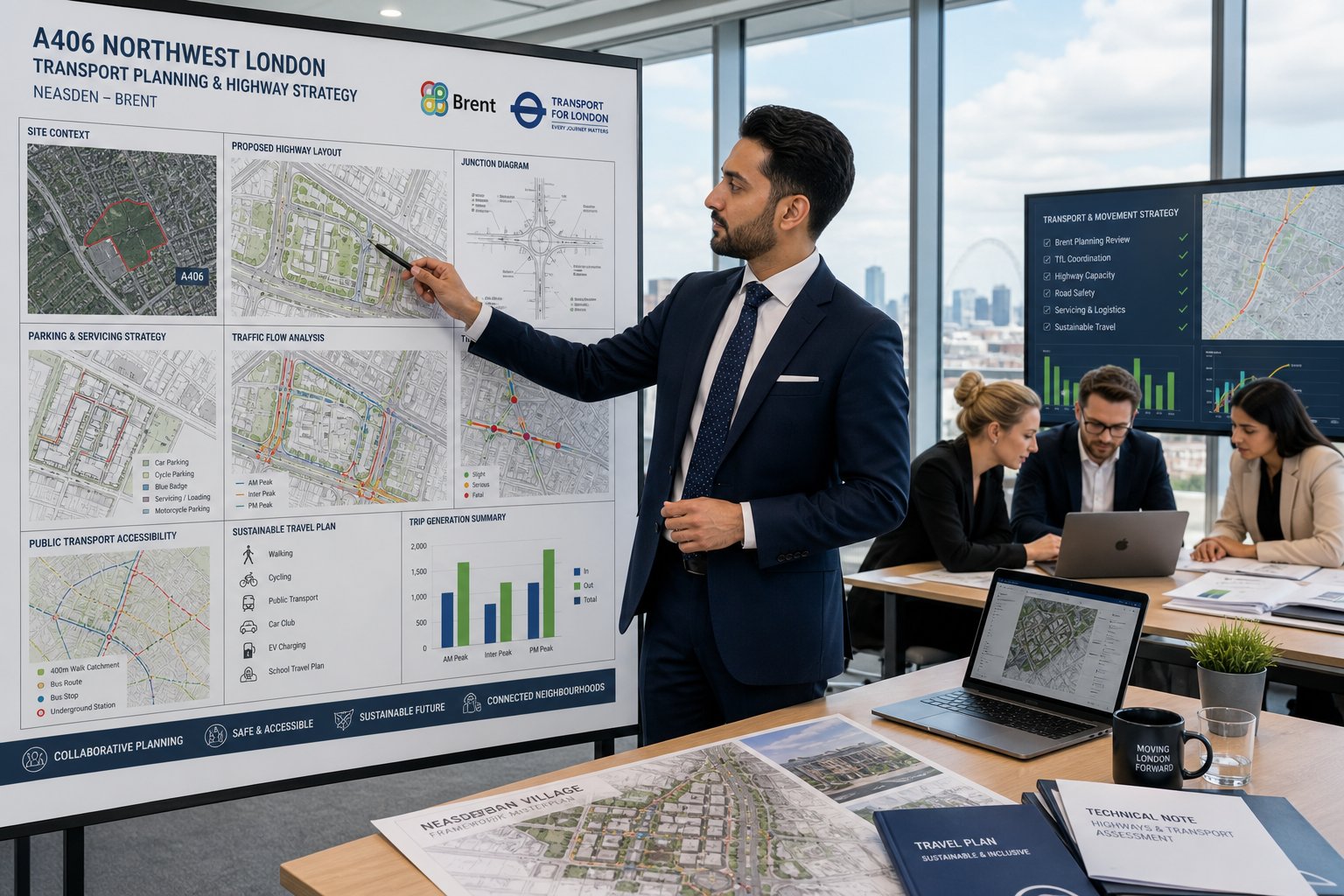
In Neasden, transport issues can make or break a planning application surprisingly early. A scheme may look sound in architectural and land-use terms, yet still run into trouble over access geometry, parking stress, servicing, or concerns about knock-on traffic at already busy junctions near the A406 and surrounding local roads. That is exactly where a traffic engineer in Neasden becomes essential.
We work with architects, planners, developers, surveyors, legal teams, and councils to turn transport from a planning risk into a properly evidenced part of the application. In practice, that means producing clear, proportionate reports, testing assumptions, and anticipating the questions Brent highways officers or TfL are likely to ask before those questions become objections.
The local context matters. Neasden is not a blank map. It sits within a constrained London network shaped by bus movements, parking restraint, Healthy Streets expectations, and very real sensitivity around road safety and capacity. A generic report rarely goes far enough. What tends to help is transport evidence grounded in policy, traffic data, and a practical understanding of how urban sites actually operate once occupied.
In this guide, we set out what a traffic engineer in Neasden does, which schemes usually need input, when a Transport Statement may be enough, and how robust technical work can smooth the path to consent in 2026.
Key Takeaways
- A traffic engineer in Neasden provides essential transport evidence tailored to local road conditions, policies, and planning context to support successful planning applications.
- Transport assessments, statements, or technical notes must be proportionate and address key issues like access safety, parking, servicing, and junction capacity to reduce planning risks.
- Local knowledge of Neasden’s constrained transport network, including bus routes and parking restrictions, is vital to anticipate and satisfy Brent and TfL requirements.
- Early traffic engineering input helps identify and manage access, servicing, and sustainable travel challenges, preventing late-stage objections or costly redesigns.
- Robust transport evidence strengthens planning submissions by aligning with Healthy Streets principles and promoting realistic, safe non-car travel options.
- Small schemes with minor impacts may only require a Transport Statement, but complex or sensitive developments often need detailed Transport Assessments for smoother consent.
What A Traffic Engineer In Neasden Does For Planning Applications

A traffic engineer in Neasden supports planning applications by providing transport evidence that is technical enough for highways review but practical enough to help a project move forward. At the simplest level, we assess how people, vehicles, deliveries, cyclists, and refuse vehicles will access and use a site. At a more detailed level, we quantify trip generation, test junction effects, review safety, and align proposals with Brent policy, London Plan expectations, and TfL requirements where strategic roads or bus routes are involved.
That usually starts with establishing the right reporting route: a full Transport Assessment, a lighter-touch Transport Statement, or a targeted technical note. We then look at existing site conditions, surrounding highway constraints, parking conditions, public transport accessibility, and whether the development creates any material change in movement patterns. Comparable work delivered through Traffic Engineering Consultants: often turns on exactly this judgement: not over-reporting, but not underestimating risk either.
For many teams, the value is partly strategic. A well-prepared transport submission helps frame pre-application discussions, respond to consultee comments, and support negotiation over conditions, s106 obligations, or s278 works. At ML Traffic, our approach is built around concise and accurate reporting, shaped by more than 30 years of experience and tailored to the thresholds and planning context that local authorities actually use.
Why Neasden Schemes Need A Local Transport And Highways Perspective

Neasden is one of those locations where local understanding is not a “nice to have”. It directly affects what is likely to be accepted. The area is influenced by the North Circular, busy distributor roads, local residential streets, bus operations, and a planning environment where parking restraint and sustainable travel are taken seriously. A proposal that looks modest on paper can still trigger concern if it adds turning movements at a sensitive access, disrupts kerbside activity, or worsens conditions at a known pinch point.
We hence assess Neasden schemes in their real operating context rather than as abstract trip numbers. That includes nearby junction performance, pedestrian desire lines, school-run pressure, servicing activity, and the relationship between site access and bus movement. The same principle underpins broader urban work such as Traffic Engineer In London: planning support, where local authority expectations often shape the difference between a smooth determination and repeated revisions.
There is also a policy layer. Brent and TfL do not just ask whether a site can physically function. They want to know whether it supports Healthy Streets, manages road danger, and avoids unnecessary car dependence. Local knowledge helps us judge when a car-free or car-lite position is realistic, how much weight to place on PTAL and bus accessibility, and whether mitigation should focus on access design, servicing controls, or travel planning rather than simply adding parking.
Common Development Types That Require Traffic Engineering Input

Not every project needs a major transport package, but a surprising range of developments in Neasden benefit from traffic engineering input. Infill sites, upward extensions, estate renewal plots, changes of use, small retail reconfigurations, community facilities, and mixed-use schemes can all raise transport questions that planning teams need answered clearly.
The common thread is not just scale. It is whether the proposal changes how the site interacts with the street. A relatively small scheme can still be sensitive if access is tight, kerbside demand is high, or local residents already experience parking stress. Likewise, a larger site may be acceptable if impacts are managed early and demonstrated properly.
We are often brought in to identify what the authority is likely to focus on: access safety, visibility, servicing hours, cycle provision, public transport links, cumulative traffic, or the practicality of refuse collection. In more specialist urban cases, the logic overlaps with Commercial Traffic Engineering work, where operational detail matters as much as headline trip forecasts.
Residential Developments And Change Of Use Projects
Residential schemes generate some of the most frequent transport instructions in Neasden. That includes apartment blocks, small infill housing, HMOs, purpose-built student accommodation where relevant, and conversions from other uses to residential. The key questions are usually straightforward to state but technical to prove: how many trips will the development create, where will those trips go, can local streets absorb them, and what happens to parking demand?
For change of use projects, one of the most useful pieces of evidence is the comparison between the lawful existing use and the proposed one. A scheme may appear to intensify activity, yet the technical case can show a net reduction in peak vehicle demand or a lower servicing burden. That sort of analysis often helps cut through assumptions.
We also review internal operation: entry and exit design, disabled parking, cycle storage access, turning for emergency and refuse vehicles, and whether the layout works on a constrained urban footprint. Sometimes the transport issue is not traffic volume at all: it is that a vehicle cannot safely manoeuvre without reversing onto the highway or conflicting with pedestrians.
Commercial, Mixed-Use, And Community-Led Schemes
Commercial and mixed-use projects tend to create more varied movement patterns. Offices may peak in the morning and evening, food and drink uses can create shorter but sharper turnover, and local logistics or trade counters may place disproportionate pressure on servicing space. Community-led schemes such as schools, health centres, places of worship, and community halls bring their own quirks, especially where arrivals are concentrated into very narrow time windows.
In these cases, we often test not just trip generation but how the site operates minute by minute. Can a delivery vehicle enter, unload, and leave without blocking the carriageway? Are taxis likely to queue informally? Does school pick-up risk obstructing buses or private accesses nearby? If the answer is “possibly”, the report needs to show how that risk is managed.
Where strategic routes or signalised junctions may be affected, we may use modelling and scenario testing to understand queueing and delay. Similar issues arise in city-centre and edge-of-centre schemes discussed in Traffic Engineering: Your Complete overview material, but in Neasden the local road hierarchy and A406 influence make the practical stakes especially clear.
Transport Assessments, Statements, And Technical Notes Explained

These documents are often mentioned together, but they do different jobs.
A Transport Assessment is the fuller option. It is used where a scheme is larger, more sensitive, or potentially material in transport terms. It typically covers site context, policy, existing conditions, trip generation, distribution and assignment, junction impact, access arrangements, parking, servicing, road safety, walking and cycling links, public transport, and mitigation. For Neasden schemes near constrained corridors, that breadth can be essential because a narrow report may leave obvious gaps for officers or TfL to challenge.
A Transport Statement is more proportionate. It still needs to be robust, but it is usually suitable where impacts are limited and can be explained without a full modelling exercise. The best ones are concise and focused rather than thin. In our experience, planning teams appreciate a document that answers the right questions directly instead of burying them under unnecessary appendices.
A technical note is more targeted again. We often use one to address a single matter during pre-app or post-submission discussions: updated trip generation, revised tracking, a parking amendment, a visibility check, or a response to consultee comments. This can save a team from reopening an entire report when only one issue has changed. That pragmatic style is common in efficient multi-authority work, including examples akin to Traffic Engineer In Manchester: support where timing and clarity matter.
When A Delivery Can Rely On A Transport Statement Instead Of A Full Assessment
A scheme can often rely on a Transport Statement when predicted trips are low, access changes are modest, and there is no credible evidence of a material effect on local junctions, parking, or road safety. Small infill residential sites, minor changes of use, and compact commercial or community proposals may fall into that category, provided they are not tied into a particularly sensitive frontage or strategic road issue.
But “small” does not automatically mean “simple”. A minor scheme with a poor access arrangement or awkward servicing requirement may still need more detailed work. Equally, a development with low trip generation may trigger scrutiny because of local parking pressure or the interaction with bus stops, crossings, or restricted visibility.
Our rule of thumb is that the document should match the planning risk. If a clear, evidence-led statement can show the site will function safely and without material impact, that is usually the better planning tool. If not, trying to underplay the issue often backfires and leads to further information requests anyway.
Highway Access, Visibility, And Junction Capacity Considerations

Access is one of the first things officers and reviewers examine, and for good reason. If vehicles cannot enter and leave safely, or if a proposed access conflicts with pedestrians, cyclists, buses, or nearby junction operation, the entire application becomes vulnerable.
We usually begin with geometry and visibility. That means checking whether the proposed access width, radii, gradient, and splays are appropriate in the context of surrounding speeds, frontage activity, and whether Manual for Streets or DMRB principles are the right benchmark. In built-up areas like Neasden, that judgement is rarely mechanical. The “correct” design often depends on street character, vehicle type, and whether the site is expected to function as a low-frequency access or a more active servicing point.
Then comes capacity. For priority junctions and signalised nodes, we test whether development traffic would materially worsen queues, delays, reserve capacity, or blocking back. Where needed, we use recognised modelling tools and compare future baseline conditions with development scenarios. The point is not to produce a flashy model for its own sake. It is to answer practical planning questions: does the junction still work, and if not, what mitigation is realistic?
Sometimes mitigation is modest, line marking changes, access tightening, signal optimisation, or refined turning controls. Sometimes the answer is operational, such as servicing restrictions at peak times. Similar decision-making features in regional casework like Traffic Engineer In Bristol: planning reports, but local constraints in Neasden make early testing especially valuable.
Parking, Servicing, And Refuse Collection Strategy In Urban Sites
Urban planning disputes often look like traffic disputes from a distance, but once you get into the detail they are really about parking and servicing. Neasden is a good example. Even where a proposal generates relatively few vehicle trips, questions around parking stress, loading, and waste collection can dominate consultee comments and neighbour objections.
We hence prepare parking and servicing strategies that reflect how the site will operate in day-to-day conditions. For parking, that means reviewing London Plan and Brent standards, PTAL, disabled provision, visitor demand, EV charging, and cycle parking. The aim is not simply to hit a number. It is to justify why the number and arrangement are workable in that location.
Servicing requires even more care. Delivery vehicles, refuse trucks, and occasional larger vehicles need a route, a turning strategy, and a space to stop without compromising safety. Swept-path analysis is often the crucial evidence here, especially on tight sites where one awkward manoeuvre can become the authority’s main concern. For busy uses, we may also prepare a Delivery and Servicing Plan or support a waste management strategy.
This is one area where applicants often gain time by dealing with the operational detail early rather than waiting for highways comments. And yes, it is usually cheaper to redraw a forecourt before submission than to redesign the whole access later.
Walking, Cycling, Public Transport, And Sustainable Travel Requirements
Modern transport evidence is not only about cars. In Brent and across London, officers want to know whether a development supports safe and realistic non-car travel from day one. That means the surrounding pedestrian and cycle environment matters just as much as the site boundary.
We assess footway width, crossing opportunities, lighting, natural surveillance, step-free access where relevant, and the quality of routes to nearby bus stops, stations, schools, shops, and local services. If there is a missing dropped kerb, a poor crossing point, or a weak connection between the entrance and the wider network, that can be worth addressing in the planning package because it changes the credibility of the sustainable travel argument.
Cycle strategy has become more detailed too. Secure and convenient parking, access gradients, door widths, turning space, and the relationship between cycle storage and the public realm all matter. A token cycle room hidden behind multiple doors tends not to impress anyone.
Public transport assessment then ties the picture together. We look at accessibility, route choice, likely mode share, and whether a Travel Plan is needed to formalise measures such as cycle incentives, resident information packs, car-club membership, or parking controls. In broader comparative work, from Traffic Engineer In Leeds: to other urban authorities, the pattern is consistent: sustainable transport evidence is no longer a side note: it is central to planning acceptability.
How Traffic Evidence Supports A Smoother Planning Process
Good transport evidence does more than satisfy a validation checklist. It helps a planning team control risk. When reports are proportionate, locally informed, and clearly argued, they reduce the chance of highways objections, repeated requests for clarification, and late-stage redesign.
That matters because transport comments often have a knock-on effect on everything else. If access moves, site layout may change. If servicing does not work, landscaping, bin stores, or active frontage proposals may need revision. If parking is challenged, viability and unit mix sometimes come back into the conversation. Early traffic input prevents those issues from surfacing too late.
We find the smoothest applications usually share three features. First, the likely transport concerns are identified at pre-app stage. Second, the evidence is proportionate to the scale and sensitivity of the proposal. Third, the report is written in a way that planners, lawyers, and highways officers can all use. Dense technical material has its place, but planning decisions are easier when the transport logic is transparent.
For that reason, we focus on concise, accurate outputs that answer the authority’s real questions rather than producing volume for the sake of it. That approach is consistent with the wider planning support discussed in Traffic Engineer In Liverpool: contexts too: better evidence early usually means fewer surprises later.
Conclusion
A local traffic engineer in Neasden brings more than technical modelling to a planning application. We bring context: how Brent is likely to view access, what TfL may query, where parking and servicing pressure will land, and how sustainable travel expectations should be evidenced in a credible way.
For architects, planners, developers, surveyors, and legal teams, that can make a tangible difference. The right transport input helps match the report to the scheme, anticipate objections before they harden, and keep design changes proportionate rather than reactive. In a constrained urban setting, that is often what separates a clean submission from a difficult one.
In 2026, robust transport evidence remains one of the most practical ways to improve planning certainty. And in Neasden, where local road conditions, policy expectations, and operational detail all matter, getting that evidence right from the outset is rarely wasted effort.
Frequently Asked Questions about Traffic Engineering in Neasden
What role does a traffic engineer in Neasden play in planning applications?
A traffic engineer in Neasden provides essential transport evidence for planning applications, assessing access, trip generation, parking, and safety. They ensure compliance with Brent and TfL standards and help anticipate and address potential objections from highways officers or TfL.
When is a Transport Statement sufficient for a Neasden development instead of a full Transport Assessment?
A Transport Statement is suitable for smaller schemes with low predicted trip generation, modest access changes, and no significant impact on local junctions or parking. It offers a focused assessment for less sensitive proposals, saving time without underestimating risks.
Why is local knowledge critical for traffic engineering in Neasden?
Neasden’s transport context is shaped by constraints like the A406, bus routes, parking restraint, and Healthy Streets policies. Understanding local junction pinch points, road safety history, and bus priority enables traffic engineers to produce evidence that aligns with Brent and TfL expectations, reducing refusal risks.
What types of developments typically need traffic engineering input in Neasden?
Developments such as residential blocks, infill housing, HMOs, small retail changes, mixed-use schemes, and community facilities often require traffic engineering. The key focus is on how changes affect site access, parking stress, servicing, and local street interactions.
How do traffic engineers in Neasden address parking, servicing, and refuse collection challenges?
They prepare parking and servicing strategies aligned with London Plan and Brent standards, including swept-path analyses to prove safe manoeuvrability for delivery and refuse vehicles. This early operational detail reduces planning objections and supports effective site functioning.
How does traffic engineering support sustainable travel in Neasden developments?
Traffic engineers assess pedestrian and cycle access, footway quality, public transport links, and propose Travel Plans encouraging non-car modes. They ensure developments comply with Healthy Streets and Vision Zero policies, improving safety and accessibility for sustainable users.