
Planning risk on a development scheme rarely announces itself early. It usually shows up later: a highway objection, a refused access, a parking shortfall, or a transport condition that forces a redesign when the team thought the drawings were already settled. That is exactly where a traffic engineer in Addington earns their place.
For architects, planners, developers, surveyors, solicitors and local authorities, transport input is not just a box to tick before submission. It shapes whether a site can operate safely, whether junctions can cope, whether servicing actually works on paper and on street, and whether a proposal aligns with local and national policy. In practice, those issues affect programme, cost, land value and planning confidence.
We approach this work with a planning-led mindset. With more than 30 years of experience behind our reporting at ML Traffic, we know that concise evidence usually carries more weight than bloated documents, provided the analysis is robust and tuned to local authority expectations. In Addington, that means combining technical transport assessment with a realistic understanding of local roads, constraints, travel patterns and consultee concerns.
Below, we set out what a traffic engineer in Addington actually does, which schemes typically need support, what reports are commonly required, and how early advice can keep an otherwise good planning application moving.
Key Takeaways
- A traffic engineer in Addington plays a crucial role by assessing and mitigating transport risks early in the planning process to prevent costly delays and redesigns.
- Local context and detailed knowledge of Addington’s road conditions, parking, and pedestrian activity are essential for effective traffic engineering input and ensuring scheme acceptability.
- Common projects requiring traffic engineering include residential developments, change of use applications, schools, healthcare facilities, and mixed-use schemes, where transport impacts vary significantly.
- Key transport reports such as Transport Statements, Assessments, and Travel Plans must be proportionate, technically sound, and tailored to local planning authority expectations in Addington.
- Early and collaborative involvement of a traffic engineer helps shape designs that comply with policy, optimise site layout, and address highway safety, parking, and access concerns.
- Selecting a traffic engineer with local experience and planning strategy awareness improves submission quality and increases chances of smooth, timely planning consent in Addington.
What A Traffic Engineer In Addington Does For Planning And Development

A traffic engineer in Addington supports planning and development by turning transport risk into something measurable, explainable and, where necessary, fixable. That usually starts with one basic question: will the proposal create an unacceptable impact on the highway network or on highway safety?
To answer it, we review the scale and type of development, the likely trip demand, the access arrangement, servicing needs, parking layout, walking and cycling connections, and the relationship with nearby junctions. We then test whether the scheme fits accepted standards and policy expectations rather than relying on broad assumptions.
In practical terms, that might involve assessing visibility splays, reviewing collision records, checking refuse and delivery movements, forecasting peak-hour trips, or advising whether a small scheme needs a concise statement or a fuller assessment. It can also mean identifying mitigation early: altered access geometry, better internal circulation, revised parking provision, a delivery strategy, or sustainable travel measures that make the application more robust.
For development teams, that transport input has value well before submission. A transport review can influence the red-line boundary, unit mix, layout efficiency and viability. We often find that seemingly minor design choices have major transport implications.
For broader context on the role itself, our guidance on traffic engineering consultants and transportation planning explains how technical evidence and planning strategy work together.
Why Addington Schemes Need A Local Transport And Highways Perspective
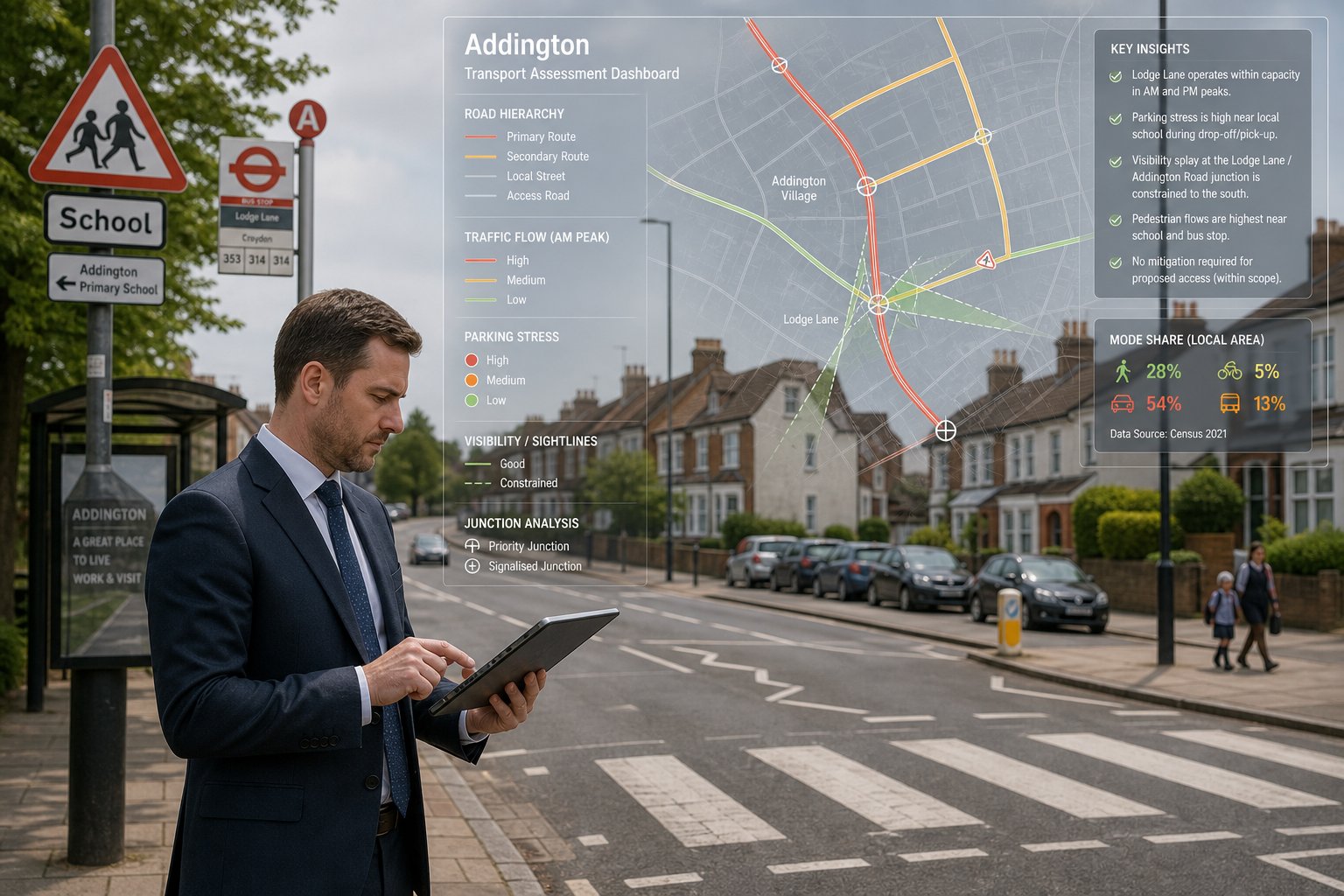
Local context matters more than many applicants expect. Two schemes with similar floorspace can receive very different transport responses depending on the surrounding road hierarchy, nearby junction pressure, parking controls, bus accessibility, school activity, collision history and pedestrian conditions.
In Addington, that local perspective is essential because acceptability is rarely judged on trip numbers alone. Highway authorities and planning officers want to know how a proposal interacts with the real street environment. Is there existing on-street parking stress? Do school pick-up periods already create friction? Is the access close to a junction, bend or crossing point? Are there visibility constraints, gradients or frontage activities that change the safety picture?
A generic report prepared without local sensitivity tends to miss what consultees notice immediately. And once those concerns are raised late in the process, projects slow down.
We hence start with the site in its actual setting, not just as a drawing. That means reviewing the immediate street network, observing traffic behaviour where needed, understanding local authority thresholds, and framing recommendations in the language decision-makers are used to seeing. The same planning-led method applies across other locations too, whether the scheme team needs insight from a Traffic Engineer In London: or a Traffic Engineer In Birmingham:.
That local reading of risk is often the difference between a transport document that merely exists and one that genuinely helps secure consent.
Common Projects That Require Traffic Engineering Input In Addington

Not every proposal needs a lengthy transport package, but many more schemes benefit from traffic engineering input than applicants first assume. In Addington, support is commonly needed where a development introduces new trips, intensifies site use, changes the character of access movements, or creates pressure around parking, servicing or pedestrian safety.
Typical triggers include new residential development, redevelopment of constrained urban plots, subdivision of existing buildings, change of use applications, schools and care settings, health facilities, retail units with delivery activity, and mixed-use schemes where different demand patterns overlap. Some projects need only a concise evidence base: others require detailed modelling and negotiation.
The key point is that scale is not the only issue. A relatively modest site can attract scrutiny if access is awkward, servicing is tight, or local streets are already sensitive. Equally, a larger proposal may be acceptable if trips are well distributed, sustainable access is good, and mitigation is designed in early.
What matters is understanding where the transport questions are likely to arise before the planning authority asks them. That lets the design team respond with evidence rather than explanation after the fact.
Residential Developments And Change Of Use Applications
Residential schemes are among the most common projects requiring transport review in Addington. Even small infill developments can raise issues around parking demand, refuse access, visibility, turning, and peak-hour traffic at nearby junctions. For larger housing proposals, the focus widens to trip generation, internal layout, pedestrian connectivity, cycle provision and the suitability of the surrounding network.
Change of use applications are another frequent pressure point. An office becoming flats, a shop becoming food takeaway, or a house becoming an HMO may appear straightforward in planning terms, but the transport consequences can shift materially. Parking accumulation, servicing frequency, delivery patterns, short-stay stopping behaviour and night-time activity can all alter.
We assess those changes using realistic assumptions and local evidence. That may involve comparing lawful and proposed use classes, estimating likely trip movements by time period, and testing whether the access and frontage can safely accommodate the new pattern of activity. In many cases, good transport advice helps avoid overdesign just as much as it helps avoid underassessment.
Commercial, Education, Healthcare, And Mixed-Use Schemes
Commercial and institutional projects tend to require a broader operational review. Offices, trade counters, schools, clinics, care facilities and mixed-use sites can generate very different demand peaks from standard residential development. A school, for example, may create intense but short-lived pressure at drop-off and pick-up. A healthcare use may generate staff, visitor and servicing traffic through the day. A mixed-use scheme may balance uses well overall but still fail at one awkward access point.
For these projects, we typically examine delivery and servicing arrangements, emergency access, staff and visitor parking, blue-badge provision, cycle parking, coach or minibus activity where relevant, and interactions with adjacent streets. We also look closely at management arrangements, because operational controls can materially influence planning acceptability.
Where uses are combined on one site, the detail matters. Shared access points, conflicting peak periods, and internal circulation often determine whether a layout works smoothly or stores up objections. That is why transport engineering input is often most valuable before the design is fixed.
Core Transport Reports Needed For Addington Planning Applications
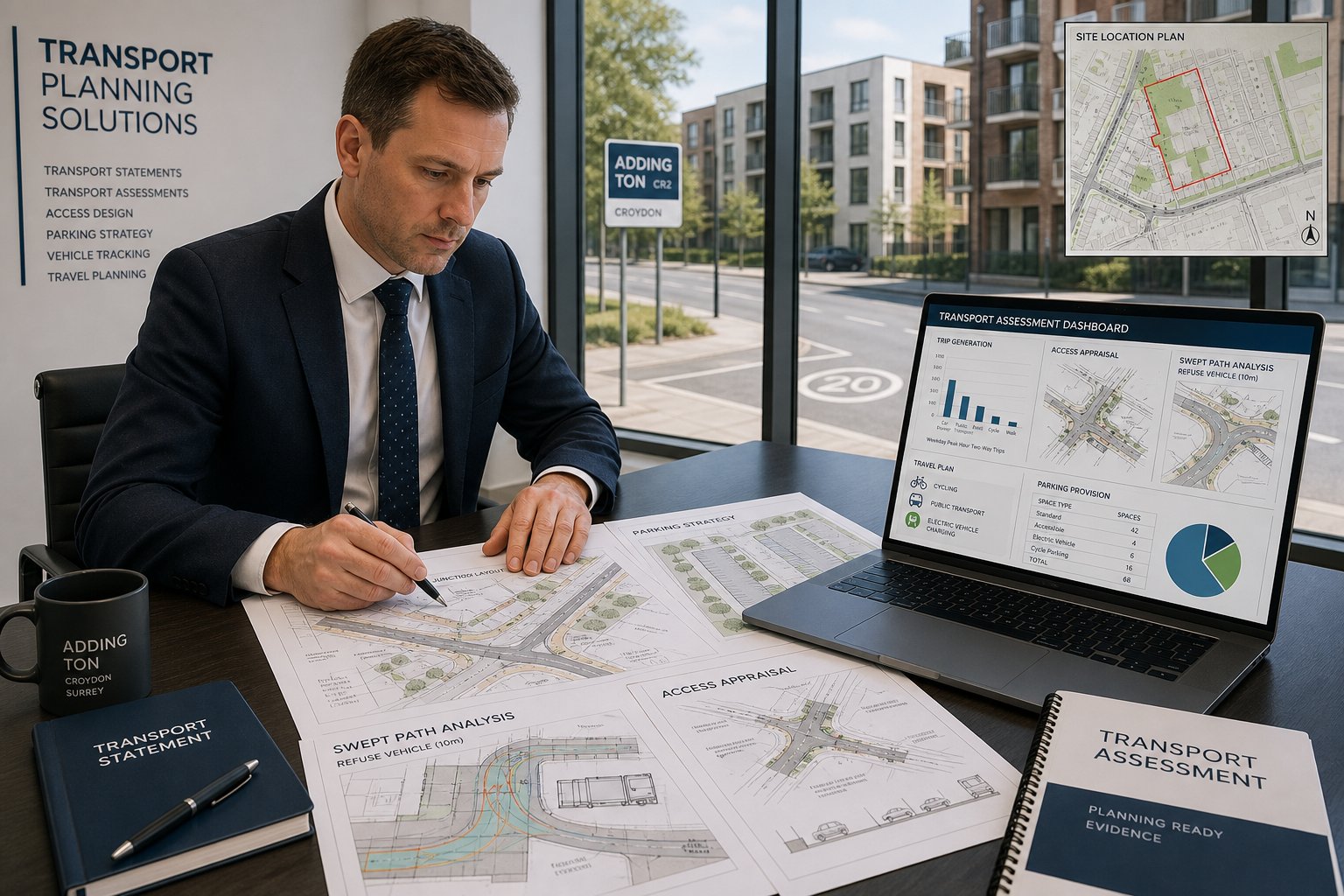
The right report depends on the development’s scale, context and likely impact. In Addington, local authorities and highway consultees generally expect the transport evidence to be proportionate but technically sound. Submitting too little can trigger objections: submitting the wrong form of report can create confusion and delay.
Most applications fall into a familiar set of transport documents. The challenge is choosing the one that matches the proposal and then scoping it properly. A concise, accurate statement can be more effective than a sprawling report if the impact is genuinely limited. But where the effects are material, a fuller evidence base is necessary.
We focus on producing planning-ready reports that address thresholds, highway concerns and site specifics directly, rather than relying on generic text. That approach is central to the work we do at ML Traffic and reflects the wider planning support expected from a Traffic Engineer In Leeds: or a Traffic Engineer In Liverpool:.
Transport Statements, Transport Assessments, And Travel Plans
A Transport Statement is normally used for smaller schemes where transport impacts are limited and can be explained without extensive modelling. It usually describes the site context, existing transport conditions, likely trip generation, parking and access arrangements, and why the development would not have a severe residual impact.
A Transport Assessment is more detailed and is generally required for larger or more sensitive proposals. It may include multi-modal trip generation, distribution and assignment, junction capacity testing, baseline surveys, committed development review, road safety analysis and mitigation proposals. The document needs to show not only what impact occurs, but whether that impact is acceptable in policy and operational terms.
A Travel Plan sits alongside either report where sustainable travel measures are needed. This can include cycle facilities, public transport information, car-sharing measures, electric vehicle support, monitoring and review mechanisms, and targets for reducing single-occupancy car use. A good Travel Plan is practical rather than aspirational. Authorities notice the difference.
Access Appraisals, Swept Path Analysis, And Parking Strategy
Access appraisals test whether a site can be safely and efficiently reached by the vehicles expected to use it. That means checking visibility splays, access width, gradients, proximity to junctions, pedestrian crossing desire lines and likely interaction with existing traffic. On constrained sites, small geometric issues can become central planning issues.
Swept path analysis is often essential where larger vehicles must enter, exit or turn within a site. Refuse vehicles, fire appliances, delivery vans and HGVs each have different tracking requirements. Using recognised software, we demonstrate whether manoeuvres can be completed without overrunning kerbs, mounting footways or conflicting with parked vehicles. If they cannot, the layout needs to change before submission, not after.
Parking strategy is another recurring focus. Authorities increasingly expect a reasoned position on car parking numbers, disabled bays, electric vehicle charging, cycle storage, servicing bays and sometimes motorcycle parking. The right answer is not always “more spaces”. It is the amount and arrangement that reflects local standards, likely demand and the site’s accessibility.
How Trip Generation, Junction Capacity, And Site Access Are Assessed

Transport assessment is often misunderstood as a single traffic count followed by a conclusion. In reality, it is a layered process. We begin by understanding the proposed land use, likely occupancy or visitor profile, servicing pattern and catchment. From there, we estimate how many trips the site is likely to generate, when they will occur, what mode they will use and which routes they are likely to follow.
Trip generation is usually informed by surveyed databases, local census and accessibility data, observed conditions and professional judgement. The point is not to produce an impressive spreadsheet. It is to forecast movement demand credibly enough that the authority can trust the result.
Once trips are established, we assess junction capacity and operational impact. Depending on the site, that may involve priority junction modelling, signal junction assessment or broader network review using industry-standard tools such as Junctions 9, LinSig, SIDRA, Synchro or, for more complex scenarios, microsimulation platforms. Queueing, delay, reserve capacity and practical performance all matter.
Site access is then checked for safety and function. Can vehicles enter and leave without conflict? Are pedestrian routes protected? Does the access align with standards and local guidance? If visibility is compromised, if delivery vehicles block movement, or if turning relies on unrealistic behaviour, the proposal is vulnerable.
Good assessment is hence both numerical and spatial. The modelling has to agree with what the layout can physically achieve on the ground.
Working With Local Planning Authorities, Highway Authorities, And Design Teams
Transport work rarely succeeds in isolation. A strong planning application depends on coordination between the traffic engineer, architect, planning consultant, civil engineer, drainage designer, landscape team and, in many cases, legal advisers dealing with obligations or access rights.
We typically feed into projects at several points: site feasibility, pre-application strategy, design review, planning submission, and post-submission responses. At each stage, the aim is slightly different. Early on, we identify constraints and likely requirements. Closer to submission, we make sure the evidence aligns with the drawings and planning narrative. After submission, we help respond to consultee comments quickly and precisely.
That relationship with authorities is particularly important. Highway officers generally want clear answers to predictable questions: how many trips, what impact, is the access safe, can vehicles manoeuvre, is parking adequate, and what mitigation is proposed? If a report is vague, inconsistent with the drawings, or evasive about weak points, objections become much more likely.
We hence prefer a straightforward approach: scope issues early, present the evidence cleanly, and engage constructively with comments. Similar coordination principles apply across wider project locations, whether a client is working with a Traffic Engineer In Manchester: or a Traffic Engineer In Bristol:.
Done well, transport advice does not sit at the edge of the scheme. It helps shape a design that can actually get consent.
Common Planning Risks And How Early Traffic Advice Helps Avoid Delays
Most transport-related planning delays come from issues that were visible earlier but not addressed early enough. The recurring examples are familiar: a substandard access, parking that does not meet likely demand, no workable refuse strategy, underestimated trip generation, or a layout that fails a swept path test once the authority asks for one.
These problems do not just threaten refusal. They also trigger rounds of revisions, updated drawings, additional surveys and extended determination periods. For developers and professional teams, that means more fee spend, more programme pressure and often a weaker negotiating position.
Early traffic advice reduces that risk because it allows proper options testing before the scheme is locked in. We can compare access positions, stress-test parking assumptions, advise whether a Transport Statement is enough or a fuller Assessment is wiser, and identify where pre-application discussion with the authority is worth the effort. Sometimes the best result is confirming that the proposal is broadly sound. Other times it is making one or two targeted changes that prevent a much larger problem later.
The commercial value of that early input is easy to underestimate. A timely transport review can protect layout efficiency, avoid redesign, and support cleaner submissions. In planning terms, it often means fewer surprises. And on live projects, fewer surprises are worth quite a lot.
How To Choose The Right Traffic Engineer In Addington
Choosing the right traffic engineer in Addington is not simply a question of who can produce a report fastest, although turnaround matters. What you need is a consultant who understands planning strategy, highway authority expectations, technical modelling, and the reality of how design decisions affect transport acceptability.
Start with relevant UK experience. The engineer should be comfortable preparing Transport Statements, Transport Assessments, Travel Plans, access appraisals and swept path drawings, and should know when each is required. Registration or chartership can be a useful indicator, but practical planning experience on similar schemes is just as important.
Then look at local and procedural awareness. Do they understand how local thresholds and policy context affect scoping? Can they identify likely consultee objections before they appear? Can they communicate clearly with architects, planners and clients who are not transport specialists?
Finally, test their judgement. A good consultant does not inflate scope unnecessarily, but they also do not underplay genuine risks to win an instruction. They explain where a scheme is straightforward, where it is vulnerable, and what can be done about it.
That balance matters to us. At ML Traffic, we focus on concise, accurate reporting built around local planning context and practical decision-making. For clients, that usually translates into clearer advice, faster submissions and stronger responses when transport issues do arise.
Conclusion
For planning applications in Addington, transport evidence can quietly determine whether a scheme progresses smoothly or gets pulled into delay, redesign and objection. A capable traffic engineer brings structure to that risk: testing trip impact, checking access safety, reviewing parking and servicing, and presenting the findings in a form local authorities can rely on.
The real advantage, though, is not just technical compliance. It is timing. When transport input comes in early, teams make better layout decisions, scope reports properly, and deal with authority concerns before they harden into formal objections.
Whether the project is residential, commercial, educational, healthcare-led or mixed use, the goal stays the same: demonstrate that the proposal is safe, workable, policy-compliant and proportionate. In Addington, that local, planning-aware approach is often what gives an application the best chance of moving forward without unnecessary transport-related friction.
Frequently Asked Questions About Traffic Engineering in Addington
What does a traffic engineer in Addington do for development planning?
A traffic engineer in Addington analyses how a proposed development impacts local traffic flow, safety, parking, and access, recommending solutions like junction changes or parking controls. They ensure layouts meet UK design standards and local policy to support planning applications effectively.
Why is local knowledge important for traffic engineering in Addington?
Local context such as road hierarchy, congestion points, accident history, and parking controls heavily influence planning acceptability. Traffic engineers in Addington tailor their assessments to reflect these local factors, ensuring transport reports address real street conditions and authority concerns.
Which types of projects in Addington typically require traffic engineering input?
Projects needing support usually include new residential developments, change of use applications (e.g. office to flats), commercial, educational, healthcare, and mixed-use schemes that change access or trip patterns. Even smaller sites may need review if access is constrained or parking issues exist.
What transport reports are commonly required for Addington planning applications?
Smaller schemes often require a Transport Statement outlining limited impacts, while larger developments need a detailed Transport Assessment with trip generation, junction modelling, and mitigation. Travel Plans accompany these to promote sustainable travel and manage car use effectively.
How do traffic engineers assess trip generation and junction capacity in Addington?
They estimate site trip numbers using observed data and industry trip rates, then model junction capacity and traffic flow with specialist software like SIDRA or Synchro. Safety and operational efficiency of access points are checked against standards to ensure proposals are viable and safe.
How can early advice from a traffic engineer prevent planning delays in Addington?
Early traffic advice identifies transport risks before submission, allowing design adjustments to access, parking, and servicing. This reduces the chance of authority objections, costly redesigns, and extended determination periods, supporting smoother, faster planning approvals for developments.