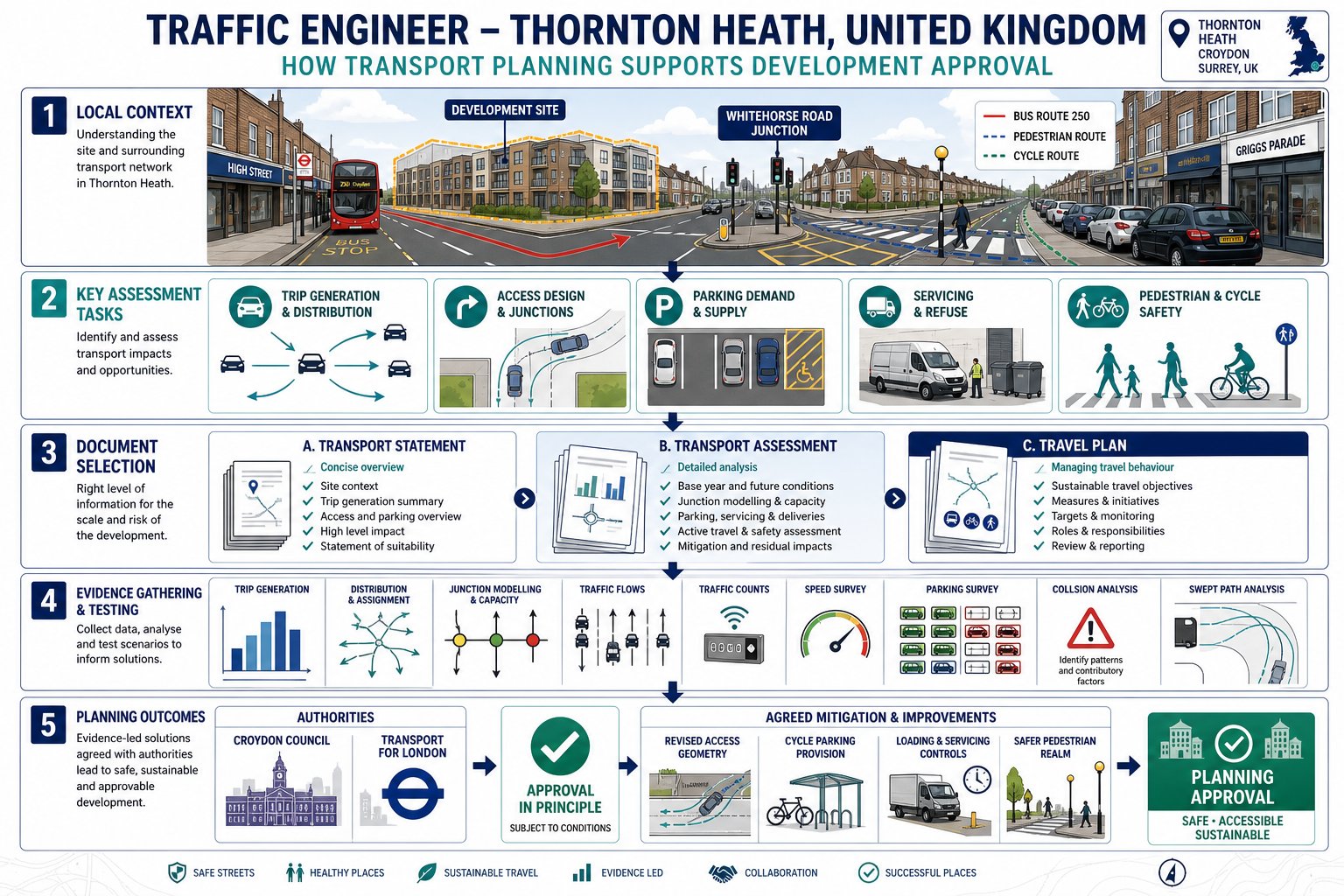
Planning in Thornton Heath can look straightforward on paper, then become complicated the moment highways, servicing, parking pressure, or TfL comments enter the conversation. A modest infill scheme may raise questions about refuse access. A change of use can trigger concerns about delivery activity, pedestrian safety, or overspill parking. And a larger residential or mixed-use proposal can quickly move into formal transport assessment territory.
That’s where a Traffic Engineer in Thornton Heath becomes valuable. We use traffic and transport planning evidence to show how a development will function in the real world: how people arrive, where vehicles turn, whether a junction can cope, whether visibility is acceptable, and what mitigation may be needed to satisfy Croydon Council or Transport for London.
For architects, planning consultants, developers, solicitors, surveyors and local authorities, the challenge is rarely just producing a report. It’s producing the right report, at the right time, with local policy awareness and technical judgement behind it. Good transport input can prevent avoidable objections, shape site layout early, and keep a planning submission moving instead of stalling in post-validation questions.
In this guide, we explain what traffic engineers actually do for schemes in Thornton Heath, when planning applications usually need transport input, which surveys and reports matter, and how local highway considerations can affect design decisions long before determination.
Key Takeaways
- A Traffic Engineer in Thornton Heath provides essential local transport expertise to ensure developments comply with Croydon Council and TfL policies.
- Early traffic engineering input can prevent planning delays by addressing access, parking, and servicing concerns before submission.
- Transport Statements and Transport Assessments vary by scheme size and impact, guiding suitable evidence for planning applications.
- Local road conditions, including parking stress and junction capacity, significantly influence the design and acceptance of development proposals.
- Effective parking, servicing, and refuse collection strategies are crucial to avoid objections and support daily site operations.
- Responding to transport-related objections with credible, evidence-based reports keeps planning applications progressing smoothly.
What A Traffic Engineer Does For Developments In Thornton Heath
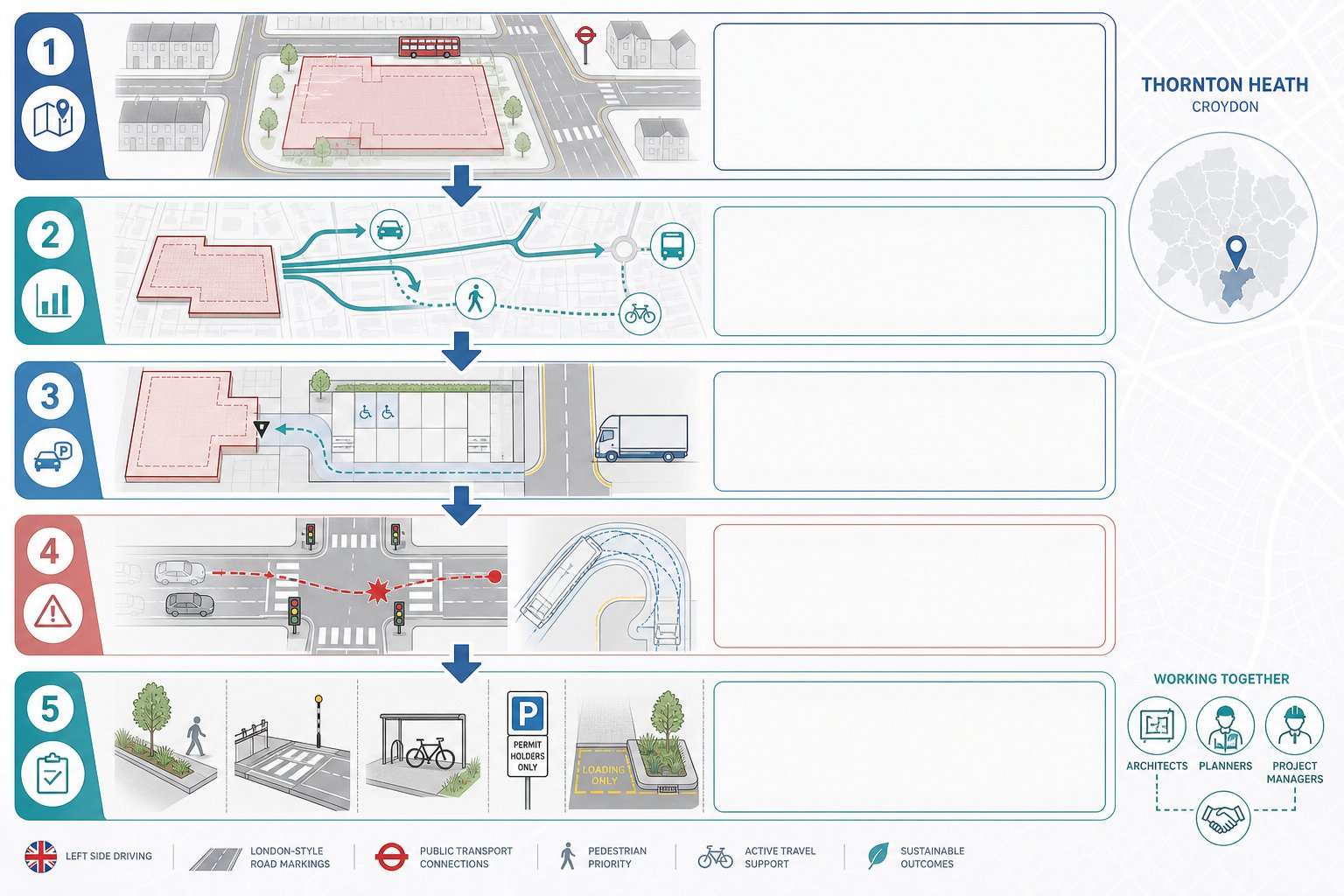
A traffic engineer supports development by translating transport impacts into planning evidence that officers, highway authorities and design teams can use. In practical terms, that means we assess trip generation, likely vehicle movements, site access arrangements, parking demand, servicing activity, pedestrian and cycle conditions, and highway safety risks associated with a proposal.
For a small scheme, that may involve a concise review of whether the existing road network can accommodate the development without material harm. For a more complex application, it can mean forecasting peak-hour trips, testing nearby junctions, reviewing collision records, preparing swept path drawings, and recommending mitigation that makes a scheme acceptable.
In Thornton Heath, local context matters a lot. Roads can be constrained, bus movement is important, and many developments sit within established residential streets where neighbour concerns about parking and traffic are immediate and predictable. We hence don’t just write a generic report. We align the scope with Croydon’s planning expectations, London-wide policy, and the actual operating characteristics of the surrounding highway network.
Our role also includes coordination. We often work alongside architects, town planners and project managers so transport issues are addressed before they become objections. That can mean adjusting access geometry, refining unit mix, reviewing cycle parking numbers, or advising whether a scheme is likely to need a Transport Statement, a full Assessment, or supporting notes only. Broader Traffic Engineering and Transportation principles often shape these early decisions, but the value comes from applying them to the street outside the site, not just to policy wording.
When You May Need Traffic Engineering Input For A Planning Application
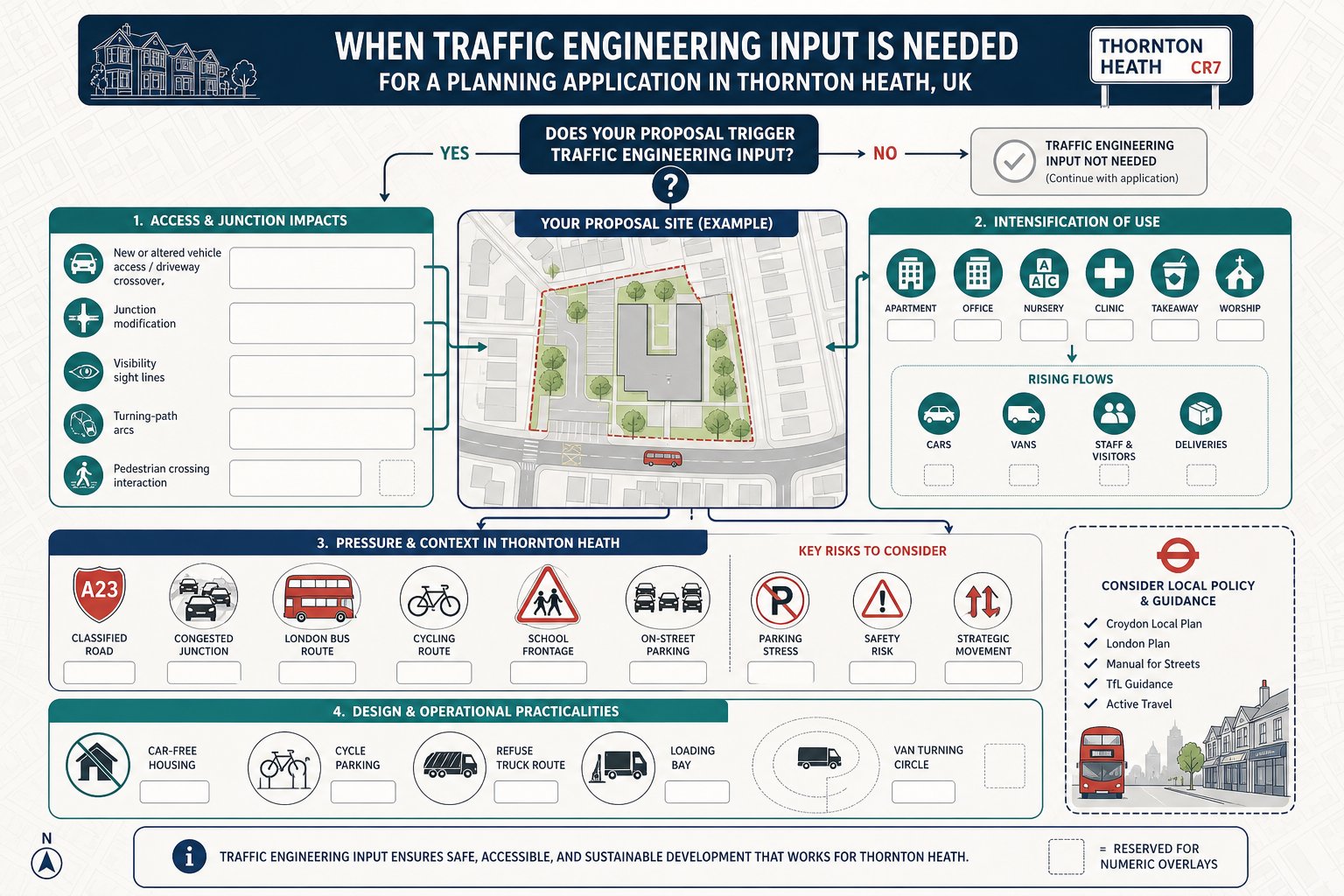
Not every planning application in Thornton Heath needs a lengthy transport document. But many need some level of traffic engineering input earlier than applicants expect.
A common trigger is a new or altered access. If a proposal introduces a crossover, modifies a junction, or changes how vehicles enter and leave a site, highway officers will usually want to understand visibility, turning movements, pedestrian interaction and safety implications. Even a relatively small change can become contentious if it sits on a busy road, near a bus route, or close to a school.
Another trigger is intensification of use. More flats, more staff, more visitors, longer opening hours, or more deliveries can all increase transport impact. Change-of-use applications are especially prone to underestimating this. A former office becoming a nursery, clinic, takeaway or place of worship may alter arrival patterns far more than the floor area suggests.
We also tend to advise early involvement where sites affect classified roads, junctions already under pressure, or streets with clear parking stress. Croydon and TfL may ask for formal evidence if a scheme could influence strategic movement, bus reliability, active travel provision or local road safety.
And then there’s the practical reality: if the design team is already debating car-free status, cycle parking, refuse collection routes, loading space, or whether a van can actually turn on site, traffic input is probably needed. Experienced Traffic Engineering Consultants: What problems solve more than they document. Getting us involved before submission is usually cheaper than trying to rescue a weak transport position after objections land.
Transport Statements, Transport Assessments, And Travel Plans Explained
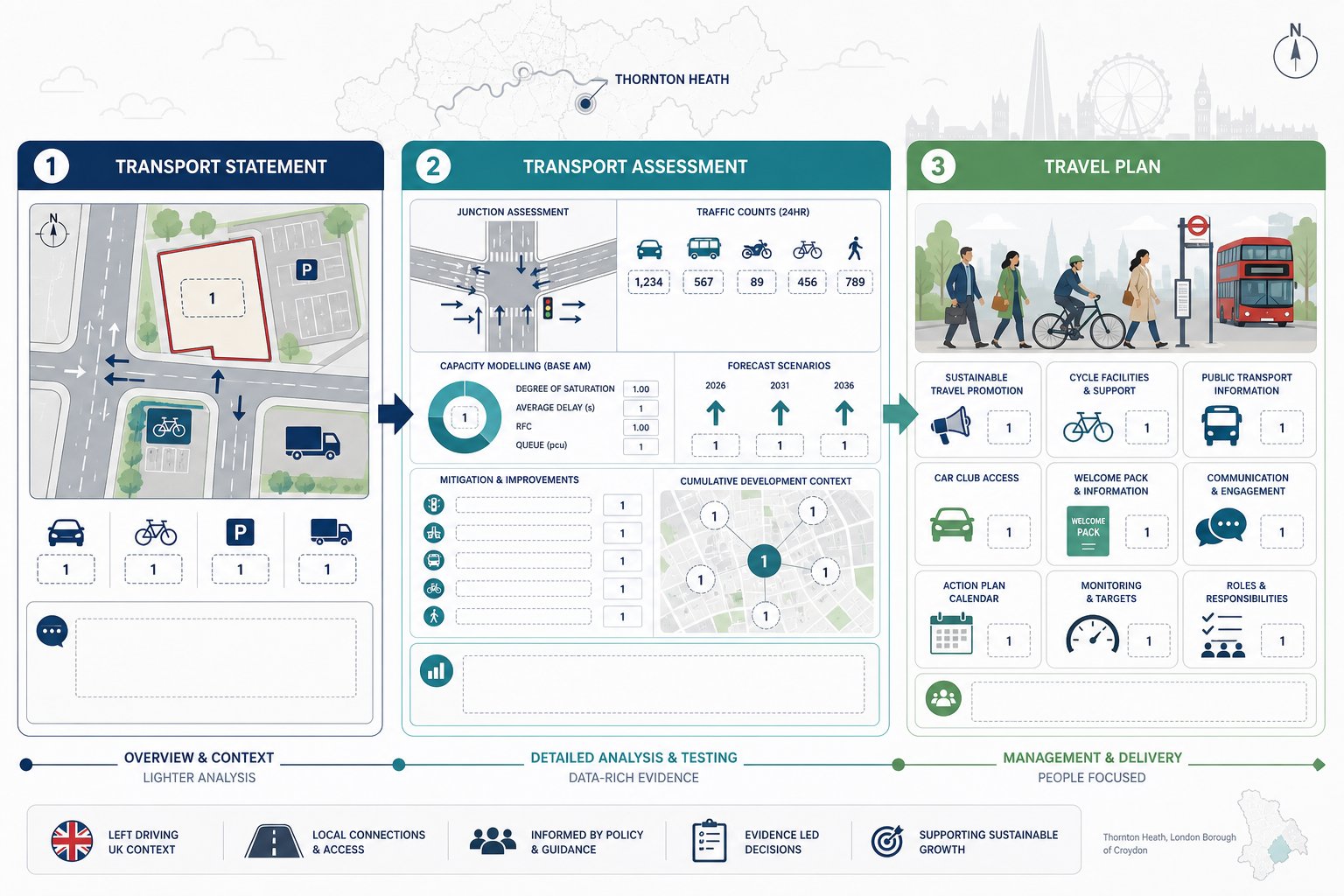
These three documents are related, but they do different jobs.
A Transport Statement (TS) is typically used for smaller schemes with limited but still relevant transport effects. It sets out the site context, existing highway conditions, likely trip generation, access proposals, parking and cycle provision, and servicing arrangements. It may also include a modest review of road safety or local junction operation. The point is to show that transport matters have been considered proportionately and that the proposal will work acceptably.
A Transport Assessment (TA) is more detailed. This is usually required where the scale, type, or location of development creates a greater potential impact. A TA may include multi-modal baseline analysis, surveyed traffic flows, junction capacity modelling, future year forecasting, committed development review, mitigation testing and cumulative impact commentary. If officers are likely to ask, “What happens at the junction in the weekday peak in five years’ time?”, you are generally in TA territory.
A Travel Plan (TP) is different again. It is a management strategy designed to influence how people travel to and from a site. It may include cycle facilities, public transport information, car club membership, monitoring targets, welcome packs, appointment scheduling, delivery management, and named responsibility for implementation.
In practice, the lines can blur. A moderate scheme may require a TS plus a framework Travel Plan. A larger development may need a TA with a full Travel Plan and supporting technical appendices. The wider discipline covered by Highway And Traffic Engineering often overlaps here, because the report type must match both the planning threshold and the real impact of the proposal.
How Local Highway And Planning Considerations Shape Schemes In Thornton Heath
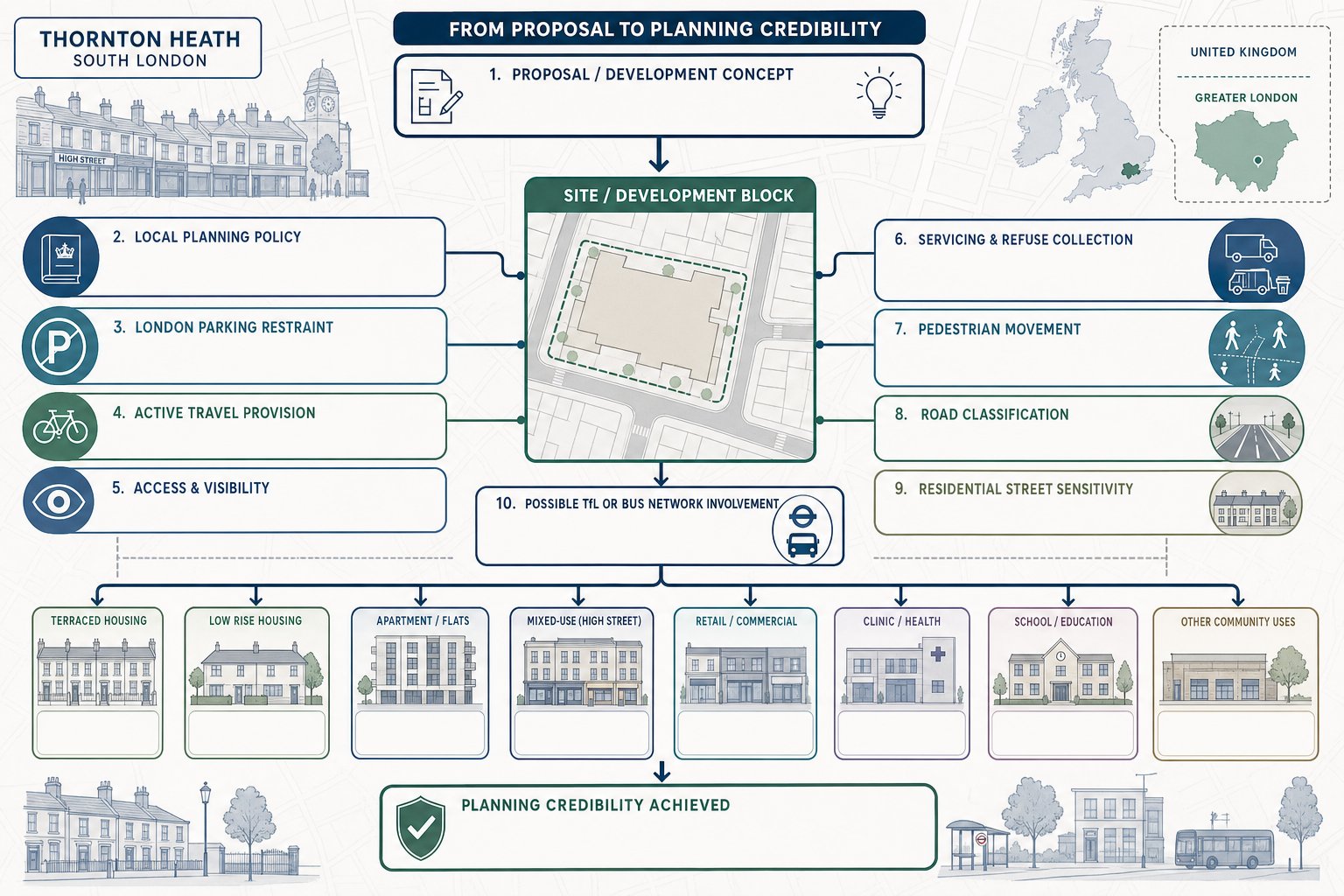
Thornton Heath schemes don’t sit in a vacuum. They are shaped by the London Plan, Croydon’s local planning framework, parking standards, active travel expectations, and the operational priorities of the surrounding road network. A proposal that appears efficient from a site-layout perspective can still struggle if it creates poor servicing arrangements, substandard visibility, inconvenient pedestrian movement, or parking assumptions that don’t fit local policy.
In London boroughs, parking restraint is often a central issue. That affects whether a scheme is designed as car-free or car-lite, how disabled parking is justified, and whether cycle storage can genuinely support a lower-car model. On more constrained sites in Thornton Heath, the biggest transport challenge is often not trip generation itself, but the interaction between access, servicing, refuse collection and the public realm.
Road classification matters too. If a site fronts a busier route, or if its traffic will pass through sensitive residential streets, the authority is likely to scrutinise turning, waiting, loading and conflict with vulnerable road users more carefully. TfL may also become relevant where the proposal touches the strategic network or bus operations.
That is why local understanding matters. General Traffic Engineer In London: considerations apply, but Thornton Heath still has its own street patterns, frontage conditions and planning sensitivities that shape whether a scheme feels credible to decision-makers.
Typical Development Types That Require Traffic Engineering Advice
The need for transport input usually follows impact, sensitivity and scrutiny rather than just size. A compact proposal on a difficult frontage may need more detailed assessment than a larger one on a forgiving site. We commonly support infill housing, flatted developments, HMOs, commercial refurbishments, health uses, education-related schemes, mixed-use projects, and operational changes affecting deliveries or pick-up activity.
Any scheme that changes traffic patterns, introduces a new access, increases occupier numbers, or depends on careful parking and servicing management can benefit from advice. Sometimes the transport work is straightforward. Sometimes it becomes the hinge point for the whole planning strategy.
Residential Developments
Residential schemes are a staple of planning work in Thornton Heath, but they vary hugely in transport complexity. A pair of new houses on a side street may require a relatively focused review of visibility, crossover design, parking and refuse collection. A flatted scheme, estate infill project or higher-density redevelopment can require a much broader analysis covering trip rates, cycle parking, blue badge provision, servicing, emergency access, and how future residents will travel without causing unacceptable local pressure.
Residential proposals also attract neighbour concern quickly. Residents tend to focus on overspill parking, unsafe reversing, congestion at school-run times, and whether delivery vans will stop in the carriageway. Those concerns are not always fatal, but they do need a technical response grounded in evidence, not reassurance alone.
Commercial, Mixed-Use, And Change-Of-Use Schemes
Commercial and mixed-use schemes often generate more operational scrutiny than applicants first expect. A café, convenience retail unit, nursery, gym, clinic or last-mile logistics use can create sharp peaks, repeat short-stay parking demand, courier activity and servicing patterns that differ significantly from previous lawful use.
That is why change-of-use proposals often need careful transport review even when no major building works are proposed. We assess likely arrivals, departures, loading frequency, delivery vehicle types, and kerbside implications, then test whether those patterns can be managed safely and in policy terms. For developer teams dealing with employment or town-centre sites, the issues discussed in Commercial Traffic Engineering are often directly relevant to Thornton Heath applications as well.
Key Traffic Surveys And Data Used To Support Planning Submissions
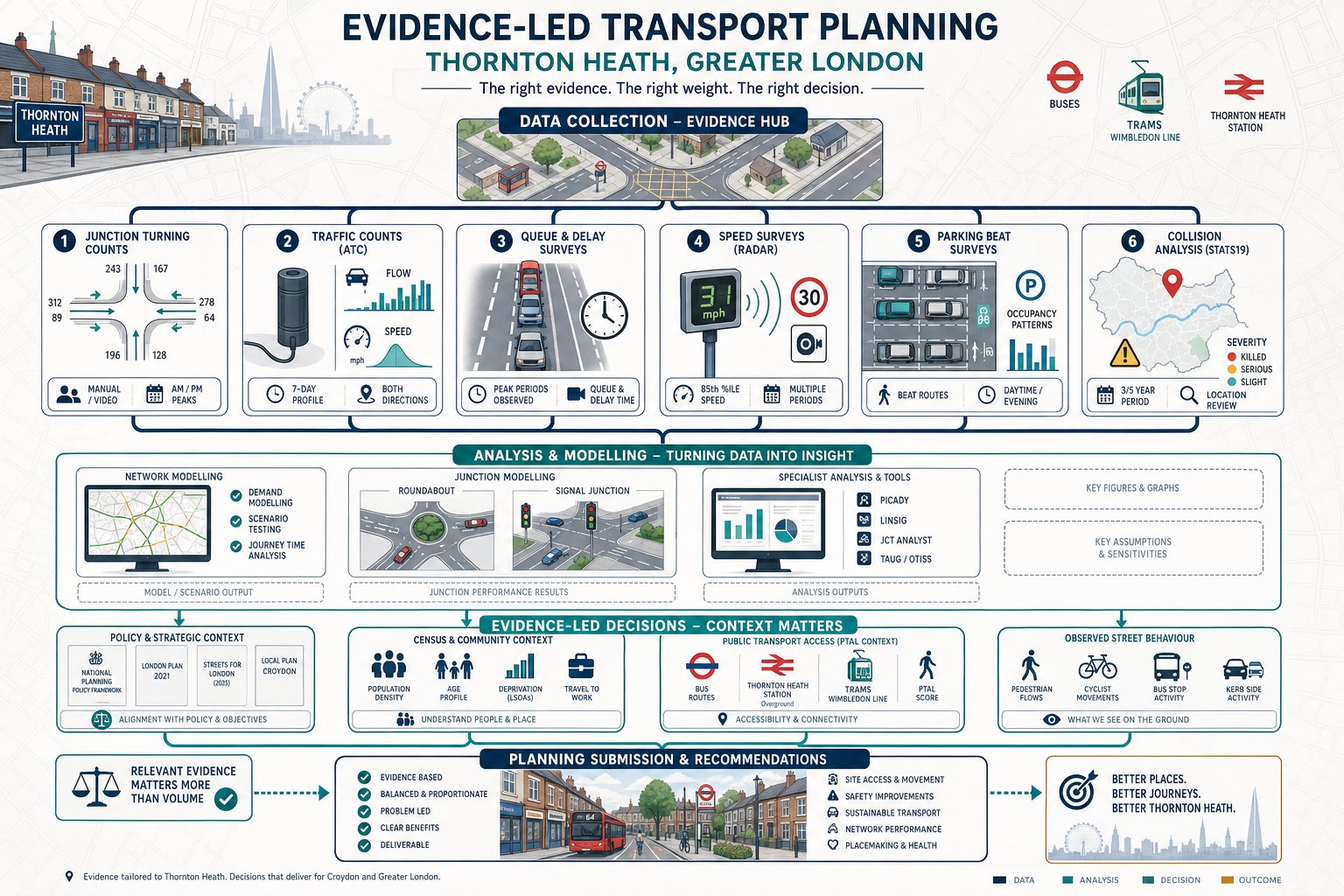
Strong planning submissions are built on evidence, and in transport that usually means surveys plus judgement. The exact package depends on the site and proposal, but common inputs include manual turning counts, automatic traffic counts (ATCs), queue and delay surveys, speed surveys, parking beat surveys, and personal injury collision data analysis.
Manual turning counts help us understand how nearby junctions currently operate in the weekday or Saturday peak. ATCs provide directional flows and speed data over longer periods. Parking surveys are particularly valuable in Thornton Heath where local concerns about parking stress can dominate consultation responses: done properly, they show occupancy patterns rather than anecdotal impressions.
Collision analysis is another important piece. If there is an existing safety record near the site, we review the pattern, severity and likely contributory factors before deciding whether mitigation is needed. Context matters here: a handful of incidents over several years does not automatically mean a proposal is unsafe, but ignoring the record is a mistake.
For larger schemes, surveys feed into modelling software such as PICADY, ARCADY, LinSig, VISSIM or Synchro/HCS. These tools are useful, but only when the assumptions behind them are sensible. A model can look technically polished and still answer the wrong question.
We also draw on wider Traffic Engineering: Your methodology, local census and PTAL context, publicly available policy standards, and observed site behaviour. Good transport evidence isn’t about assembling the biggest appendix bundle. It’s about choosing data that directly addresses the planning risk in front of the scheme.
Junction Capacity, Access Design, And Highway Safety Considerations
Three issues sit at the centre of many transport reviews: can nearby junctions cope, can vehicles access the site safely, and does the proposal create or worsen a highway safety problem?
Junction capacity work looks at how priority junctions, signalised junctions and roundabouts currently perform and how they are expected to operate with development traffic added. We review queues, delays, reserve capacity and, where necessary, future year scenarios. The goal is not to prove there will never be a queue, that would be unrealistic in urban London, but to show whether the development would cause a severe or unacceptable impact in planning terms.
Access design focuses on geometry and function. We consider visibility splays, carriageway width, radii, gradients, pedestrian crossing desire lines, interaction with parked vehicles, and whether the access arrangement suits the vehicles expected to use it. If a refuse truck or delivery van cannot manoeuvre without repeated reversing into a busy road, the layout probably needs rethinking.
Highway safety goes beyond standards tables. We review local collision records, frontage activity, school movement, cycling conditions and likely driver behaviour. Sometimes a technically compliant layout still feels uncomfortable because of its context. And planning officers notice that.
This is where practical engineering judgement matters as much as software output. Many issues can be resolved by modest design changes: moving a gate line, widening a throat, adjusting parking layout, relocating bins, or managing servicing times. In more complex cases, the structured approach used by a Traffic Engineer In other urban authority is similar, but the Thornton Heath street environment will always dictate the final answer.
Parking, Servicing, Refuse Collection, And Delivery Strategy
A planning application can survive a modest traffic impact more easily than it survives unresolved parking and servicing questions. In Thornton Heath, these issues often drive the authority’s practical response to a scheme.
Parking assessment starts with policy, but it shouldn’t end there. We review London and Croydon standards, PTAL, site accessibility, likely occupier or user profile, disabled parking needs, cycle parking provision and local kerbside conditions. For residential schemes, the question is often whether the level of on-site parking is justified and whether the design supports a genuinely lower-car lifestyle. For commercial uses, it may be whether short-stay demand, staff parking or pick-up activity can be managed without harming the street.
Servicing can be even more critical. We identify likely vehicle types, delivery frequency, loading duration and whether on-site loading is feasible. If it isn’t, we assess whether kerbside activity is realistic and acceptable. Refuse collection is frequently overlooked until late in the design process, yet waste teams and highway officers will want confidence that bins can be moved safely and collection vehicles can operate without awkward reversing or obstruction.
Swept path analysis is often central here. It demonstrates whether cars, vans and refuse vehicles can enter, turn and leave the site in a safe, workable manner. Where necessary, we also prepare Delivery and Servicing Plans setting out time restrictions, booking systems, management responsibilities and operational controls.
In short, transport planning is not just about moving traffic: it is about making daily site operation believable. And if daily operation looks shaky, planning risk climbs fast.
How A Traffic Engineer Helps Respond To Planning Objections And Highway Comments
Even well-prepared applications can attract objections. In Thornton Heath, the most common transport-related concerns are increased traffic, overspill parking, highway danger, congestion at nearby junctions, poor visibility, and disruption from servicing or refuse collection. The difference between a delayed scheme and an approved one often lies in how those points are answered.
We start by separating perception from evidence. Some objections raise real design flaws. Others reflect understandable local anxiety but are not supported by survey data, policy thresholds or highway safety records. Our job is not to dismiss concerns: it is to test them properly and respond in a way officers can rely on.
That may involve a technical note, revised drawings, additional parking surveys, updated tracking, junction modelling, or a rebuttal letter responding point by point to Croydon or TfL comments. If the authority says a proposed access is too tight, we can demonstrate a redesign. If neighbours argue the street is already full, occupancy surveys can show the actual pattern. If deliveries are the issue, a servicing management plan may solve it.
This responsive stage is where experience really shows. Planning transport is rarely linear. Questions evolve, officers change emphasis, and comments arrive late. Teams familiar with Traffic Engineer In Bristol: or other authority-specific processes know that local nuance affects the tone and content of every reply, even when the technical principles are consistent.
For us, the aim is simple: reduce uncertainty, answer the authority’s actual concern, and keep the application moving with concise, credible evidence rather than unnecessary bulk.
Conclusion
For many schemes in Thornton Heath, transport is not a side issue to be dealt with at the end. It shapes access, layout, parking strategy, servicing, policy compliance and eventually the prospects of planning success.
A good Traffic Engineer in Thornton Heath helps teams spot risks early, define the right scope of evidence, and present a proposal in a form Croydon Council and TfL can assess with confidence. That might mean a short, well-judged Transport Statement for a modest development, or a fuller package of surveys, modelling and mitigation for a more demanding site.
The common thread is clarity. When transport reporting is proportionate, locally informed and technically robust, schemes tend to move forward with fewer surprises. And in a planning environment where delay is expensive, that matters.
For architects, planners, developers, solicitors and surveyors, early traffic engineering input is often the difference between a transport issue that grows into an objection and one that is solved quietly, on the drawing board, before submission.
Frequently Asked Questions about Traffic Engineering in Thornton Heath
What does a traffic engineer do for developments in Thornton Heath?
A traffic engineer in Thornton Heath assesses trip generation, junction performance, access design, parking, and highway safety to prepare technical reports and mitigation proposals that support planning submissions and satisfy Croydon Council and TfL requirements.
When is traffic engineering input needed for a planning application in Thornton Heath?
Traffic engineering is typically needed when a proposal introduces new or altered access, intensifies use with more residents or deliveries, affects classified roads or bus routes, or when Croydon or TfL request a Transport Statement, Transport Assessment, or Travel Plan.
What are the differences between Transport Statements, Transport Assessments, and Travel Plans?
A Transport Statement is a concise report for small schemes outlining baseline conditions and access; a Transport Assessment provides detailed analysis including junction modelling for larger impacts; a Travel Plan manages how people travel to a site with measures like cycle facilities and monitoring.
How do local highway and planning considerations shape developments in Thornton Heath?
Developments are influenced by the London Plan, Croydon Local Plan, parking standards, and TfL design guidance, which affect access geometry, visibility, pedestrian and cycle provision, and road safety to ensure schemes comply with local policy and operate efficiently.
What types of developments in Thornton Heath usually require traffic engineering advice?
Typical schemes include residential infill housing, flatted developments, HMOs, commercial refurbishments, health and education uses, mixed-use projects, and any changes that affect traffic patterns, access, parking, or servicing arrangements.
How can traffic engineers help address planning objections related to traffic and parking?
Traffic engineers review objections, separate perceptions from evidence, and provide technical notes, revised designs, surveys, or mitigation measures to respond effectively to Croydon Council and TfL concerns, helping keep planning applications progressing smoothly.