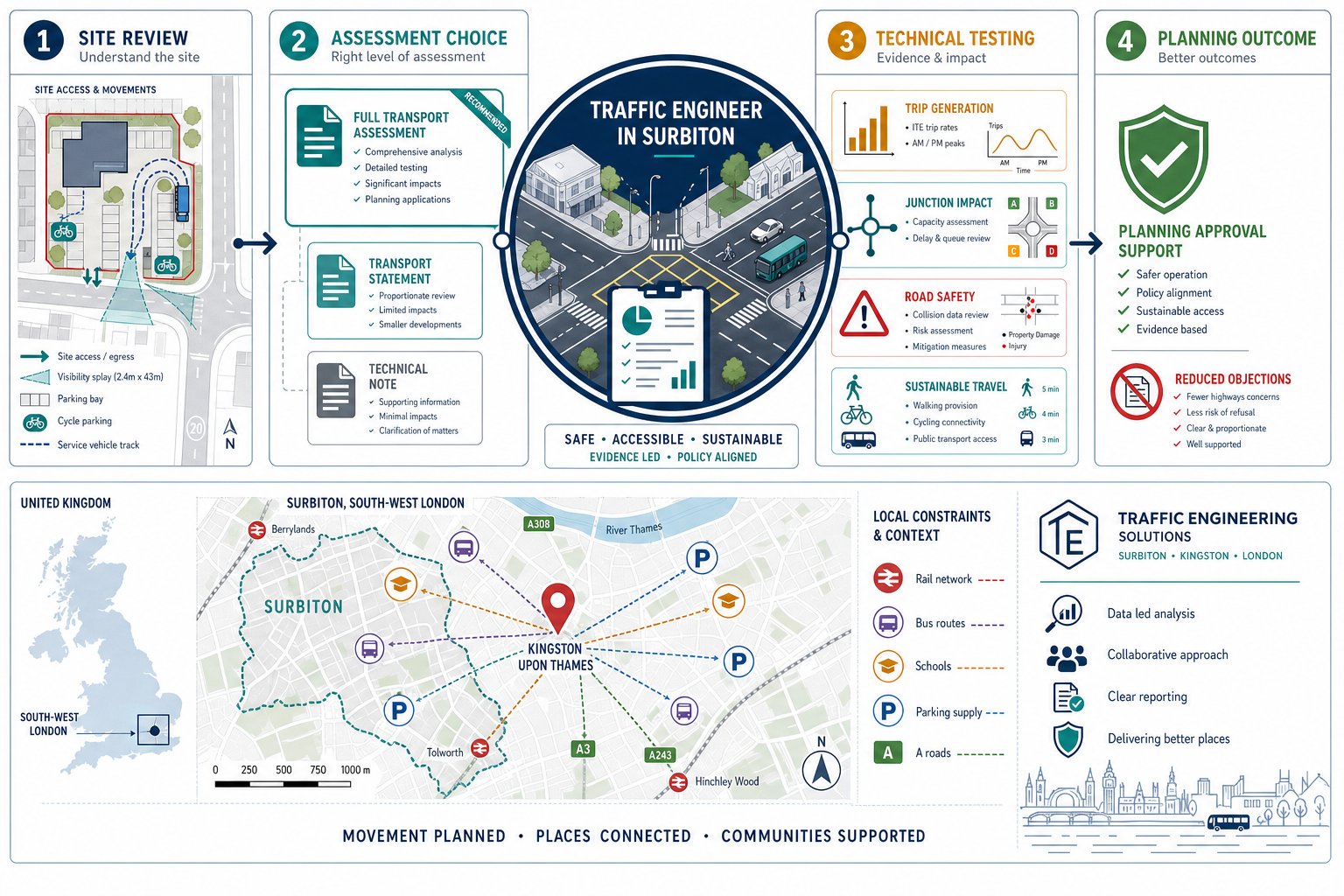
Planning in Surbiton rarely turns on design alone. A scheme can look sensible on paper, fit the site, and still stall if the transport case is thin, too generic, or disconnected from how Kingston’s streets actually work. That is usually where a traffic engineer in Surbiton earns their keep.
We work with architects, planners, developers, solicitors and project teams who need transport input that is practical rather than theatrical. In this part of south-west London, transport evidence has to do more than tick a box. It needs to explain how a proposal will function on streets shaped by rail accessibility, busy bus routes, school traffic, controlled parking, constrained junctions and the wider pull of Kingston town centre and the A3.
In 2026, local planning decisions are still being made on a familiar principle: can the development operate safely, efficiently and in policy terms without causing unacceptable impact? To answer that properly, highway officers and planning case officers need credible analysis on access, parking, servicing, trip generation, road safety and sustainable travel.
This article sets out what a traffic engineer in Surbiton actually does for planning applications, when a Transport Assessment, Transport Statement or Technical Note is likely to be needed, and how local constraints can shape strategy long before submission. The point is straightforward. Better transport evidence usually means fewer surprises, cleaner consultation, and a much stronger chance of avoiding highways-based objections.
Key Takeaways
- A traffic engineer in Surbiton provides practical transport evidence crucial for successful planning applications, ensuring developments operate safely and efficiently within local street conditions.
- Local knowledge of Surbiton’s unique transport environment—including rail accessibility, bus routes, controlled parking zones, and school traffic—is essential for credible transport assessments.
- Choosing the correct report type—Transport Assessment, Transport Statement or Technical Note—based on project scale and impact avoids delays and objections in the planning process.
- Key transport considerations include access design, visibility, parking provision (including EV and cycle spaces), servicing arrangements, trip generation, and sustainable travel support.
- Early involvement of a traffic engineer helps align development proposals with Kingston Borough’s transport policies and local authority expectations, reducing highway-based objections and speeding up approvals.
What A Traffic Engineer In Surbiton Does For Planning Applications
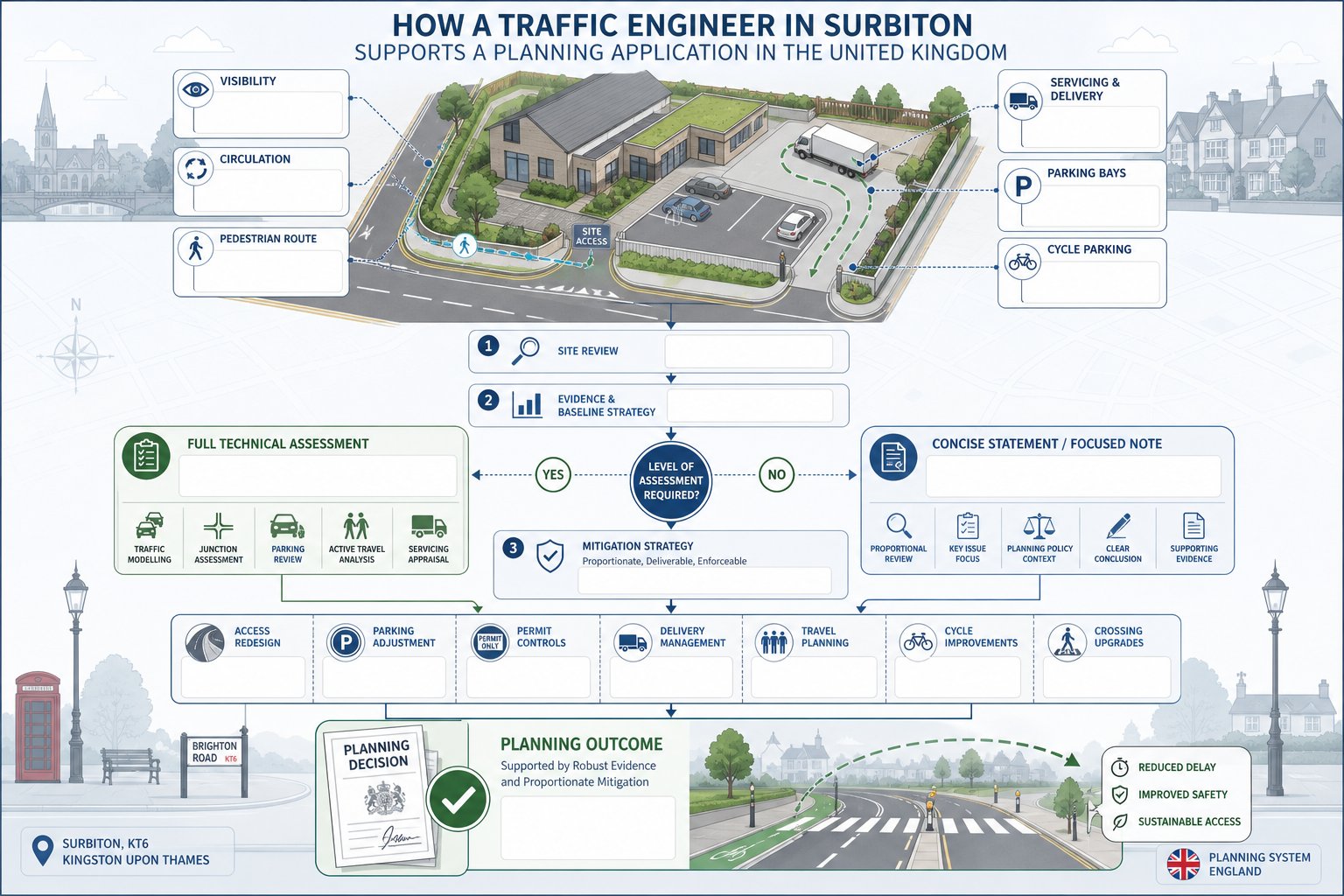
A traffic engineer in Surbiton translates a development proposal into transport evidence that a planning authority can test. That sounds simple. In practice, it involves a mix of technical review, local judgement and plain-English explanation.
At the outset, we assess the site layout and the likely pressure points: access geometry, visibility splays, internal circulation, swept paths, parking provision, cycle storage, servicing arrangements and interaction with pedestrians. On a constrained urban site, small details matter. A bin lorry turning head that works in CAD but not in reality can quickly become a planning problem.
We then advise on the right reporting route. Some schemes need a full TA with junction capacity testing and a wider study area. Others are better served by a concise TS or a focused note responding to one issue. That distinction matters because over-reporting wastes time, but under-reporting can invite avoidable objections.
The job also includes mitigation. We may recommend amended access design, revised parking ratios, permit-free measures, delivery management, travel planning, improved cycle provision or crossing upgrades. Our role is not just to describe impact: it is to reduce it where sensible.
For project teams that need broader context, our work sits within the same practical approach used by Traffic Engineering Consultants: and more specialist Highway And Traffic Engineering support. The aim is consistent: clear evidence, proportionate scope and fewer transport-related delays.
Why Local Transport Evidence Matters In Surbiton And The Wider Kingston Area
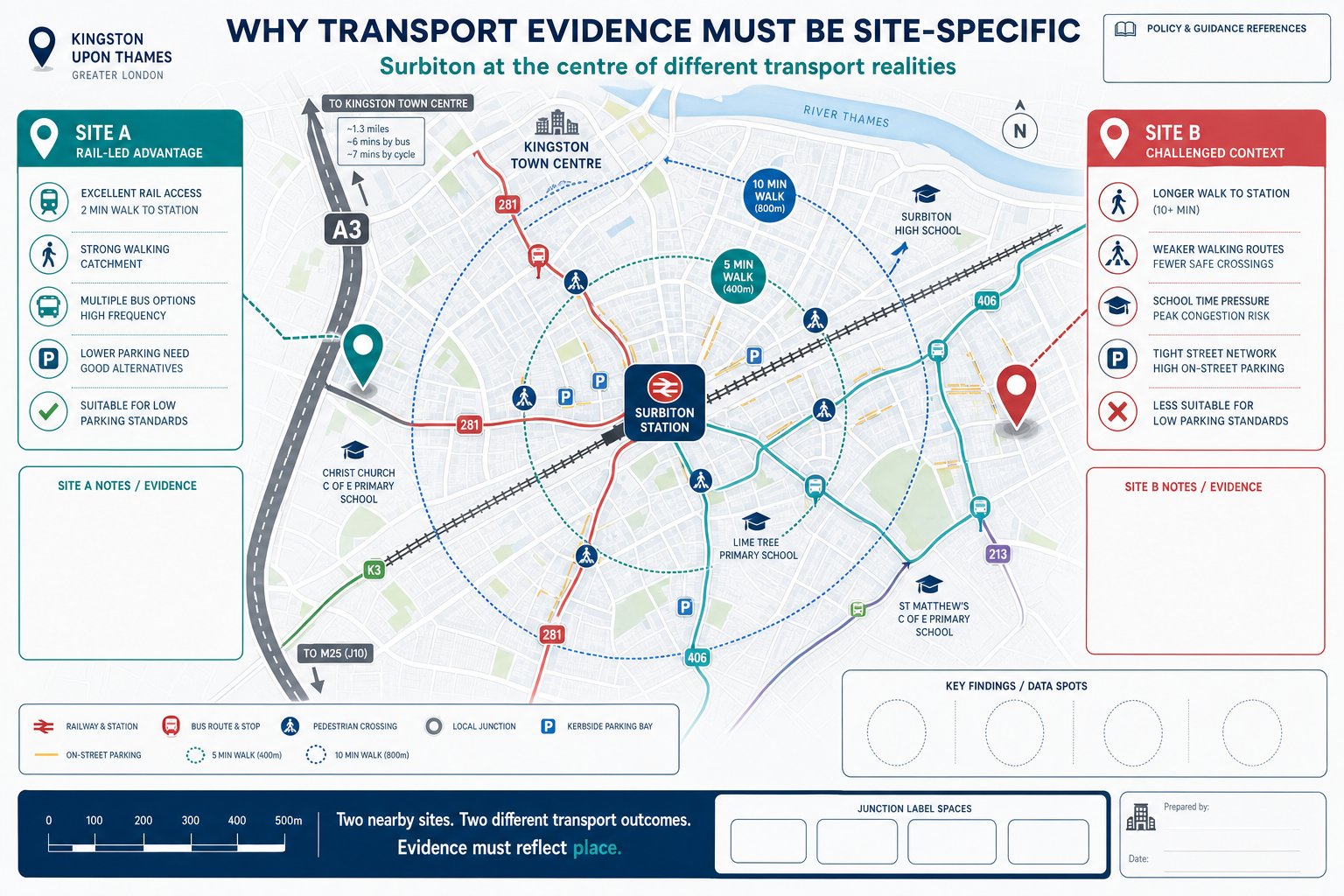
Local transport evidence matters because Surbiton is not a generic suburban location. It has strong rail accessibility, regular bus connections, residential streets that can be narrow and sensitive, and travel patterns heavily influenced by Kingston town centre, school movements and strategic links such as the A3.
That means a report based on broad assumptions or recycled wording tends to show its seams very quickly. Kingston officers usually want to know how the site interacts with the actual network around it: whether there is realistic spare kerb space, whether a proposed access sits near a bus route or crossing point, whether local junctions are already peaking hard, and whether reduced parking can genuinely be supported by public transport and active travel options.
In Surbiton, a ten-minute walk radius can change the transport story substantially. One site may be comfortably rail-led and suitable for restrained parking. Another, only a short distance away, may have more fragile on-street conditions, weaker pedestrian routes or school-time conflict that needs careful handling.
That is why we lean on site-specific surveys, policy review and local authority expectations rather than generic templates. A good example of this wider context can also be seen in Traffic Engineer In London: where borough-by-borough variation shapes strategy. In Surbiton, local knowledge is not a nice extra: it is often the difference between a persuasive submission and one that feels copy-and-pasted.
When A Transport Assessment, Transport Statement, Or Technical Note Is Needed
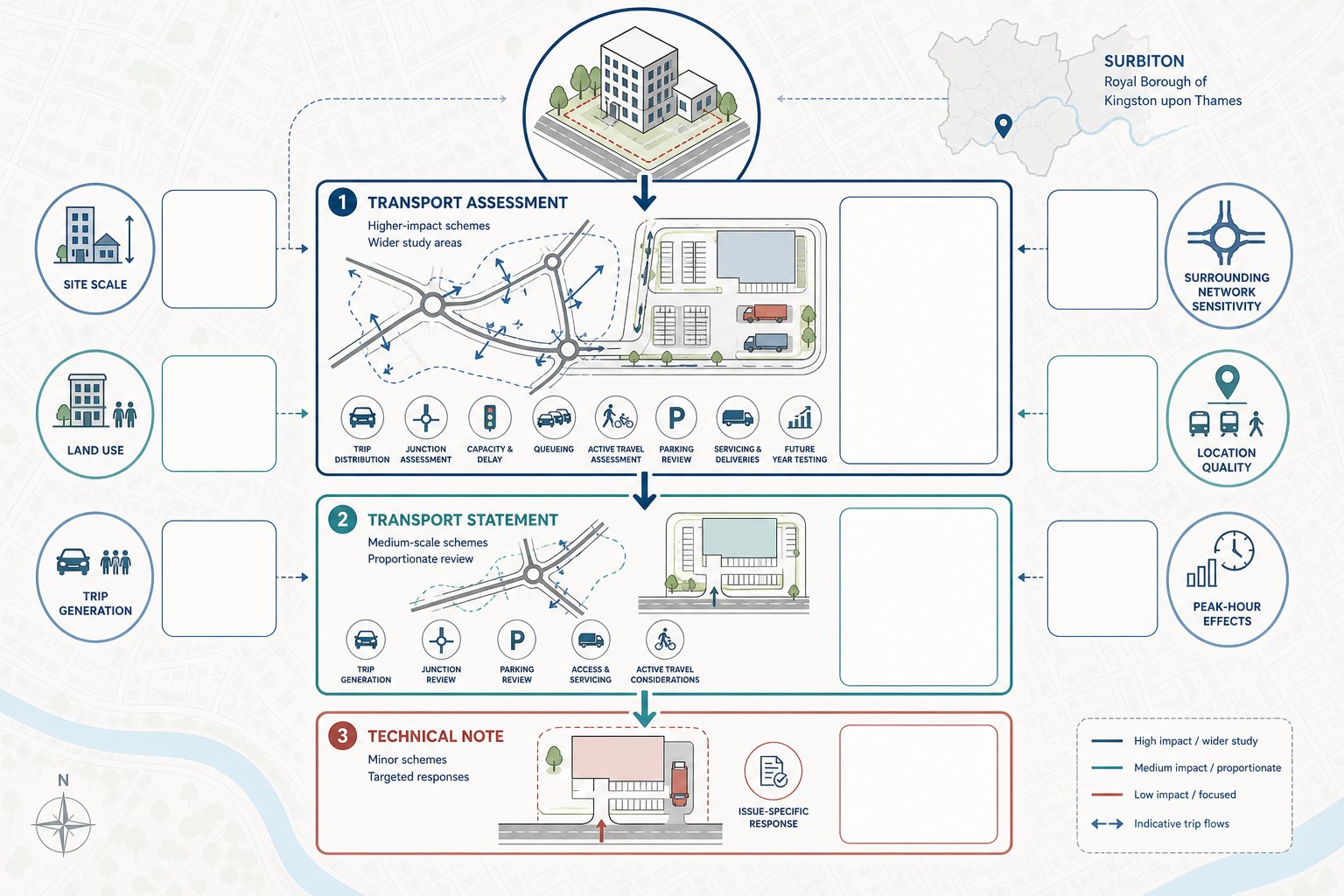
The right document depends on scale, use, likely trip generation and the sensitivity of the surrounding network.
A Transport Assessment is usually needed for larger or higher-impact proposals. Think substantial residential schemes, food retail, schools, healthcare uses with high turnover, or mixed-use sites where peak-hour effects are likely to extend beyond the frontage. A TA typically considers existing conditions, accessibility, policy context, forecast trip generation, modal split, junction impact, parking demand, servicing and mitigation. It may include junction modelling and a broader study area agreed through scoping.
A Transport Statement is generally more proportionate for medium-sized development where transport effects are material but not expected to be severe. It still needs to be evidence-led, but the analysis is usually narrower and lighter than a TA.
A Technical Note is often the right answer for smaller schemes, minor amendments, condition discharge, or focused responses to highways comments. If the issue is limited to one access point, parking arrangement, delivery bay, or a challenge to trip rates, a short technical note can be more effective than an oversized report.
The trick is judgement. We advise clients not to assume that project size alone settles the matter. Context can elevate a modest scheme into a more complex exercise. Equally, a well-located proposal with low trip impact may justify a leaner response, especially where Traffic Engineering and Transportation principles support a proportionate assessment.
Common Development Types That Require Traffic Engineering Input
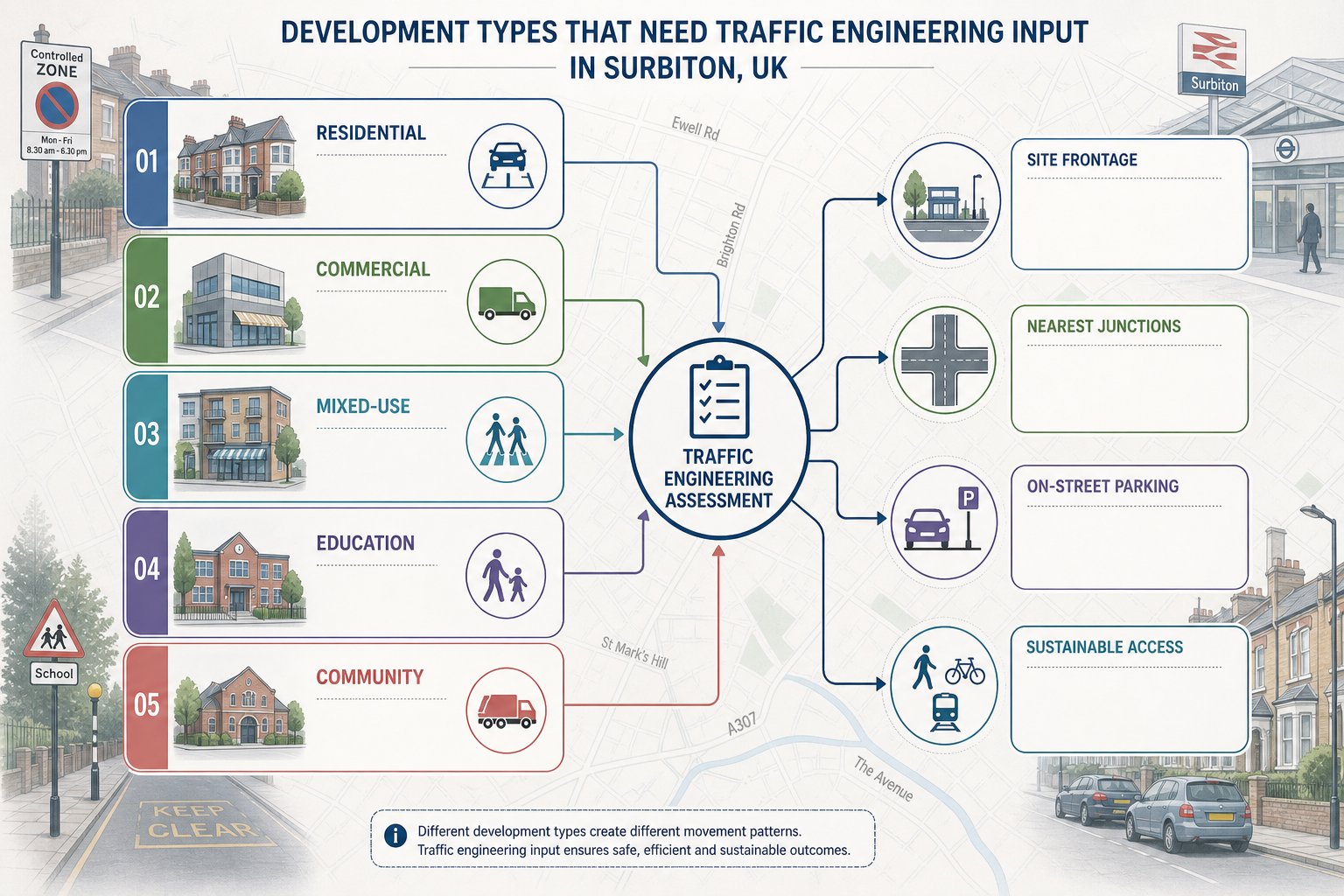
Traffic engineering input is most valuable where planning success depends on showing that movement, access and servicing have been thought through early rather than patched up later. In Surbiton, that covers more schemes than many clients first expect.
Developments often trigger transport questions not because they are enormous, but because they sit on constrained plots, near schools, within controlled parking zones, or close to roads where a small increase in friction can become contentious. Even a change of use with limited floorspace can prompt requests for evidence if servicing, pick-up activity or parking stress are likely to shift.
At application stage, our role is usually to identify whether transport concerns are likely to focus on the site frontage, the nearest junctions, on-street parking conditions, sustainable access, or all four. That early filter helps the wider consultant team avoid spending money in the wrong place.
The most common project categories are residential, commercial and mixed-use, plus education and community uses. Each behaves differently. A flat scheme near the station may justify one parking strategy: a nursery on a residential street may require a very different response because short-duration drop-off activity can dominate officer concern.
Below, we break out the patterns we see most often in Surbiton planning work.
Residential Schemes
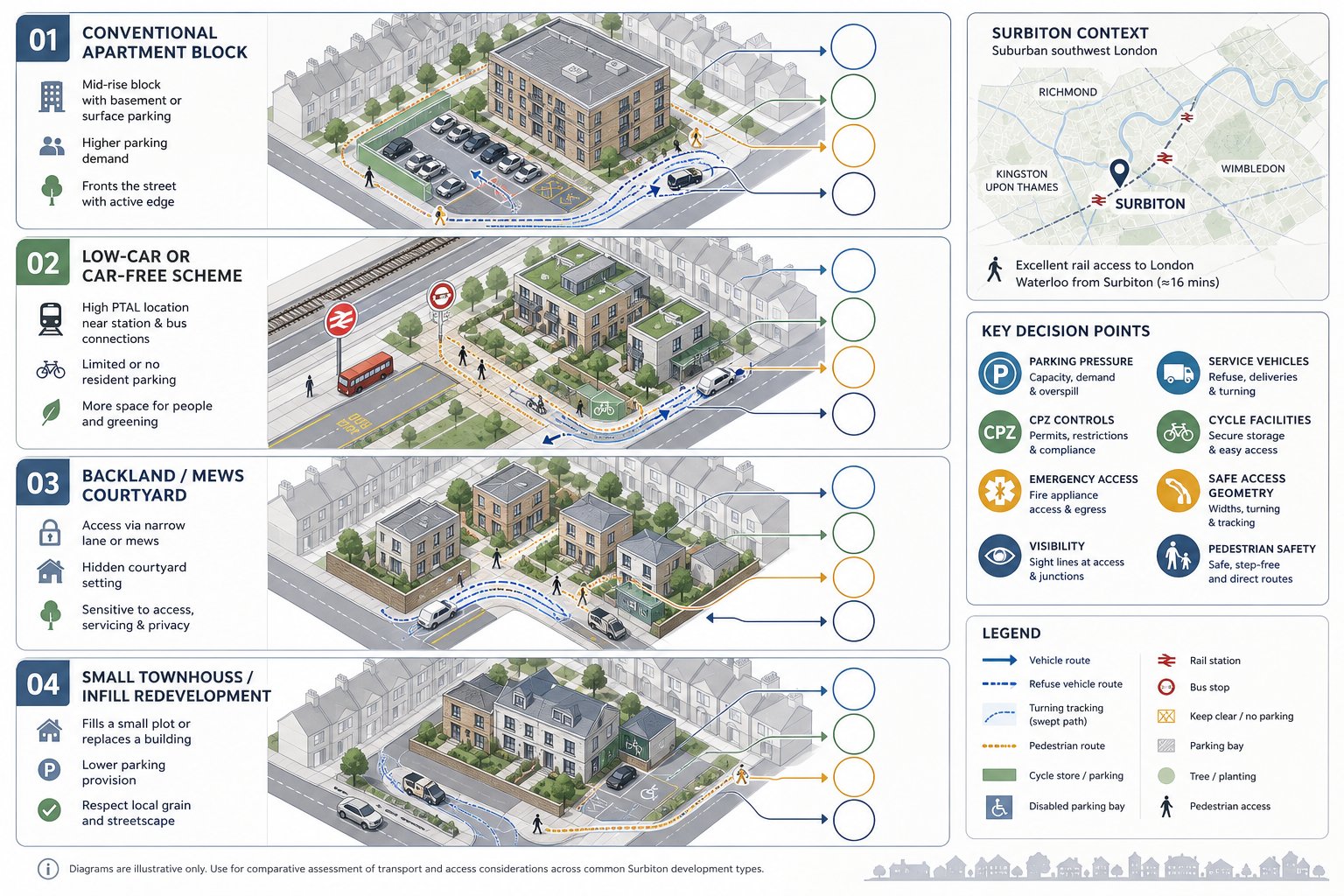
Residential schemes are the most frequent source of transport instructions in Surbiton, but they are not all alike. A small infill block of flats, a townhouse redevelopment, a backland scheme, a low-car apartment proposal or student-style accommodation can each trigger different highways concerns.
For conventional apartments, the recurring issues are parking provision, visitor parking, disabled bays, cycle parking, refuse collection and whether access geometry is safe and workable. On tighter sites, tracking drawings matter because one awkward reversing movement can dominate consultation responses.
Low-car or car-free schemes need a more nuanced case. In the right location, particularly near strong rail and bus accessibility, reduced parking can be entirely defensible. But the evidence has to be credible. Officers will often want reassurance that the proposal will not simply displace demand onto already pressured streets, especially where CPZ controls exist or may be tightened later.
Backland and mews-style schemes raise another set of questions: narrow access drives, intervisibility with pedestrians, emergency access, and how service vehicles operate without creating conflict. These are the jobs where a short, sharp technical note can sometimes be more persuasive than pages of generic narrative.
Where the project expands beyond a straightforward housing layout, the same logic seen in Traffic Engineering: Your wider planning work applies: show how the scheme actually functions day to day, not just how it looks on a drawing.
Commercial, Mixed-Use, And Education Projects
Commercial and mixed-use schemes tend to attract more operational scrutiny because their traffic effects are often less predictable than standard housing. Offices may have modest peak parking demand but higher delivery activity. Retail and food uses can generate short-stay churn, informal stopping and servicing tension. Leisure uses sometimes shift demand into evenings and weekends, which changes the assessment picture entirely.
Mixed-use blocks add another layer. A proposal with ground-floor commercial space and upper-floor residential accommodation might not produce heavy peak-hour traffic overall, yet servicing, refuse, courier activity and kerbside management can still become critical. These are often the submissions where we advise clients to test the practical operation of the frontage before finalising architecture.
Education uses are particularly sensitive in Surbiton and Kingston because school streets, crossing demand, bus activity and parent drop-off patterns can be more contentious than raw traffic volume. A nursery, tuition centre or school extension may need careful analysis of arrival windows, pedestrian desire lines and local road safety, even where formal trip generation appears modest.
For developers and planning teams handling broader non-residential portfolios, the discipline overlaps closely with Commercial Traffic Engineering. The central issue is operational realism: how people, deliveries and vehicles will actually arrive, stop, move and leave once the building is occupied.
Key Traffic And Transport Issues Reviewed During A Planning Submission
Most planning submissions in Surbiton turn on a familiar set of transport questions, but the weighting changes from site to site. Officers may focus on access safety for one proposal, parking stress for another, and strategic junction impact for a larger redevelopment.
Our job is to identify which issues are likely to carry the most planning weight and then evidence them properly. That means not just describing standards, but tying them back to how the street network behaves in real conditions. The same headline topic can be straightforward on one road and controversial on another.
In practice, the review usually covers four broad layers: whether the site can be safely accessed, whether vehicles can manoeuvre and service the development, whether predicted trips are reasonable, and whether the location supports a policy-compliant shift toward walking, cycling and public transport.
The two sub-areas below capture the issues that most often drive comments from highways officers in Kingston. They are also the points where early transport input tends to save the most time, because layout changes are much easier before an application is locked.
Access, Visibility, Parking, And Servicing
Access design is often the first thing a highway officer studies, and for good reason. If vehicles cannot enter and leave safely, or if pedestrians are exposed to poor visibility, the rest of the transport case becomes secondary.
In Surbiton, visibility splays need to be tested against actual frontage conditions, not just idealised standards. Street trees, parked vehicles, boundary walls, gradients and nearby crossings can all affect what is genuinely achievable. We review whether the access width works, whether vehicles can pass, and whether turning can occur within the site where required.
Parking is rarely just about bay numbers. Officers will look at disabled provision, EV charging, visitor spaces, cycle parking quality, and the likelihood of overspill. A restrained parking approach can work well in accessible locations, but only if the evidence and the management strategy are aligned.
Servicing is another frequent weak spot in planning submissions. Refuse collection, deliveries and occasional larger vehicles need to be tracked realistically. If a service vehicle would block the highway, reverse excessively, or rely on informal manoeuvres, that will likely draw comment.
This is where concise technical support is valuable. Across Traffic Engineer In different local authority contexts, we see the same pattern: access and servicing objections are rarely about theory: they arise when drawings do not match likely real-world operation.
Trip Generation, Junction Impact, And Sustainable Travel
Trip generation is the bridge between a site and the wider network. We estimate how many person trips and vehicle trips a development is likely to produce, usually using recognised databases such as TRICS alongside local judgement. Then we test where those trips are likely to go, when they will occur, and whether nearby junctions can accommodate them.
For larger schemes, this may require junction modelling. For smaller applications, a robust comparative assessment may be enough. The key is proportionality. A minor infill scheme does not need the same modelling effort as a school expansion beside an already stressed corridor.
But numbers alone do not settle the planning case. In Surbiton, sustainable travel is a serious part of the assessment, not an afterthought. We examine walking routes, cycle access, public transport accessibility, local services, station proximity and whether a travel plan is needed to support mode shift. In many cases, stronger active travel measures help justify lower parking and reduce highway concerns.
Recent planning practice has made this even more important. Officers increasingly expect developments to support policy goals around decarbonisation, healthier streets and reduced car dependency where the location allows it. That broader framing is consistent with the practical approach set out in Traffic Engineer In Liverpool: local-insight work: forecast the impacts, yes, but also show the route to a more sustainable pattern of movement.
How The Traffic Engineering Process Works From Enquiry To Submission
A good transport submission is usually the product of a fairly disciplined process, even when the final report looks neat and compact.
First, we review the proposal, planning status, site location and likely transport triggers. At this stage we are asking basic but important questions: what use class is involved, how many units or square metres are proposed, what are the surrounding street conditions, and is there any obvious issue with access, parking or servicing?
Second comes scoping. For many projects, the smartest move is to agree the broad approach with the local authority and, where relevant, TfL. That can include the study area, survey requirements, whether a TA or TS is expected, and what specific issues officers are likely to focus on.
Third is data collection and technical testing. Depending on the scheme, that may mean traffic counts, parking beat surveys, personal injury collision review, accessibility mapping, swept path analysis or junction modelling. Then we draft the report and supporting plans.
Finally, there is negotiation. This part is often underestimated. Highways comments may request clarification, revised trip rates, stronger travel plan measures, or a tweak to access design. Responding quickly and coherently can make a real difference to programme. With more than 30 years of experience behind our reporting approach, we focus on concise evidence that answers the actual planning questions rather than burying them under unnecessary volume.
How Surbiton Planning Constraints Can Influence Transport Strategy
Surbiton’s constraints do not just affect the content of a report: they often shape the development strategy itself.
High public transport accessibility near the station and along bus corridors can support lower parking levels, permit-free arrangements and stronger emphasis on cycle storage and travel planning. But that is only persuasive if the site genuinely benefits from those connections and the pedestrian route quality is credible. A nominally close station is less helpful if the walking route is awkward, severed or feels unsafe.
Street form matters too. Narrow residential roads, historic frontage conditions, school gate activity and existing parking stress can all push a scheme toward a different transport solution. We sometimes recommend a redesign of the access, fewer car spaces with tighter management, relocated servicing, or a more explicit car-free position to avoid conflicts that would otherwise sit at the heart of the application.
Controlled Parking Zones can be particularly influential. They may support a lower-parking strategy, but they also sharpen officer attention on overspill risk and permit eligibility. Likewise, sites near local centres often benefit from walkability yet face more loading pressure and kerbside friction.
The wider point is that transport strategy in Surbiton is rarely generic. It has to respond to rail accessibility, street constraints and local policy in combination. When that happens early, the planning story becomes cleaner, and the report reads less like damage control and more like joined-up design.
Conclusion
A well-prepared planning application does not treat transport as a late-stage appendix. In Surbiton, it is often one of the threads that holds the whole submission together.
When we are brought in early, we can usually help teams decide what level of reporting is proportionate, where the genuine transport risks sit, and how local constraints in Kingston are likely to shape officer response. That might mean a full Transport Assessment, a leaner statement, or simply a tightly argued technical note backed by the right drawings and survey evidence.
The practical value of a traffic engineer in Surbiton is straightforward: we help show that development can function safely, align with Kingston and TfL expectations, and avoid preventable highways objections. For architects, planners, developers, lawyers and councils alike, that tends to mean faster decisions, fewer surprises and a stronger planning case overall.
Frequently Asked Questions about Traffic Engineering in Surbiton
What role does a traffic engineer in Surbiton play in planning applications?
A traffic engineer in Surbiton assesses site layouts for access, parking, servicing, and visibility, prepares transport assessments or statements, and advises on mitigation measures to ensure developments operate safely and meet Kingston Council and TfL policies.
When is a Transport Assessment required for a development in Surbiton?
A Transport Assessment is typically needed for larger or high-impact developments such as substantial residential schemes, schools, or retail, where junction capacity and wider network effects must be analysed comprehensively.
How do local constraints in Surbiton influence traffic engineering strategies?
Surbiton’s narrow streets, controlled parking zones, rail and bus accessibility, and nearby schools shape strategies by often requiring reduced parking, permit-free arrangements, access redesign, and strong sustainable travel measures to address local transport challenges.
What types of developments commonly require traffic engineering input in Surbiton?
Common developments include residential schemes (flats, car-free housing), commercial or mixed-use projects, and education facilities, each requiring tailored transport evidence focused on access, parking, servicing, and travel patterns.
How does a traffic engineer estimate trip generation and assess junction impacts?
They use recognised databases like TRICS alongside local knowledge to forecast person and vehicle trips, then apply junction modelling or comparative assessments to evaluate capacity and network safety, ensuring proportional analysis based on scheme size and sensitivity.
Why is local transport evidence critical for Surbiton planning submissions?
Kingston Council expects evidence that reflects Surbiton’s unique transport environment, including rail hubs, bus routes, parking controls, and road safety, ensuring proposals align with real-world conditions rather than generic assumptions.