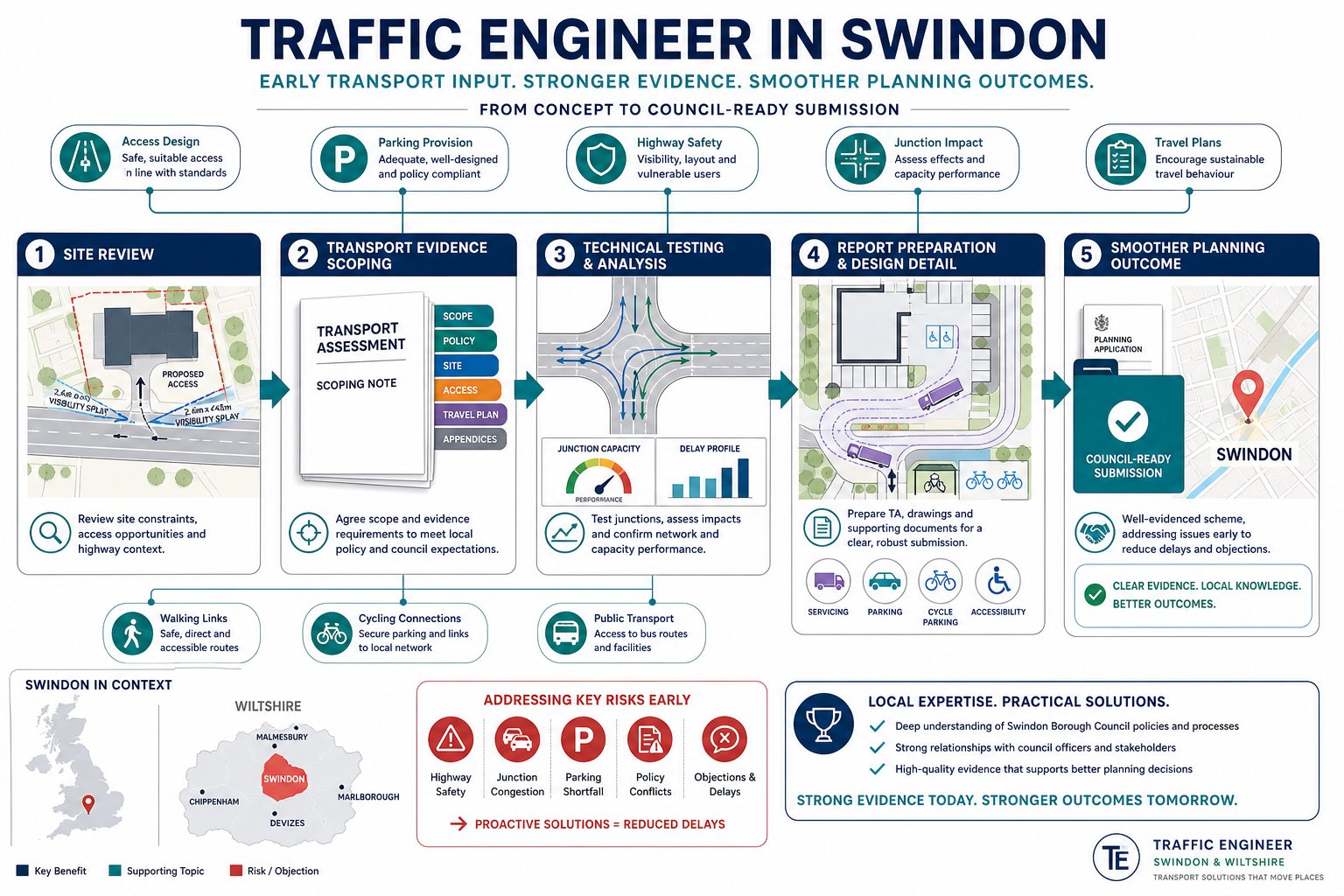
A planning application can look well judged on paper and still run into trouble once highways comments arrive. We’ve seen it happen with schemes that seemed straightforward at concept stage: an access that just misses visibility standards, a parking layout that doesn’t quite work for servicing, or a report scope that was too light for the likely impact. In Swindon, those issues can slow validation, trigger extra technical queries, and push decisions further down the line than anyone wants.
That’s where a traffic engineer in Swindon becomes more than a technical add-on. We help turn transport and highway matters into a planning-led strategy that matches the site, the scale of development, and the expectations of Swindon Borough Council. For architects, planners, surveyors, developers, and legal teams, the value is usually simple: fewer surprises, clearer evidence, and reports that are ready for scrutiny.
In this guide, we break down what a traffic engineer in Swindon actually does, when a Transport Assessment or Transport Statement is likely to be needed, how local highway standards shape reporting, and why early advice often saves weeks later. The point isn’t to drown a scheme in analysis. It’s to produce the right level of evidence, at the right time, so an application stands up technically and moves forward with less friction.
Key Takeaways
- A traffic engineer in Swindon is essential for producing precise, council-ready transport reports that reduce planning delays and highway objections.
- Early traffic engineering advice helps identify and resolve access, visibility, and parking issues before application submission, saving time and costs.
- Transport Assessments or Statements should be proportionate to the development’s size and impact to provide the right level of evidence effectively.
- Local knowledge of Swindon Borough Council’s policies allows tailoring of reports to address specific highway safety, parking, and sustainability standards.
- Transport reports must incorporate sustainable travel considerations and practical Travel Plans to meet modern planning expectations.
- Choosing a traffic engineer with relevant local project experience ensures accurate, clear, and defensible transport evidence aligned with planning strategy.
What A Traffic Engineer In Swindon Does For Planning Applications
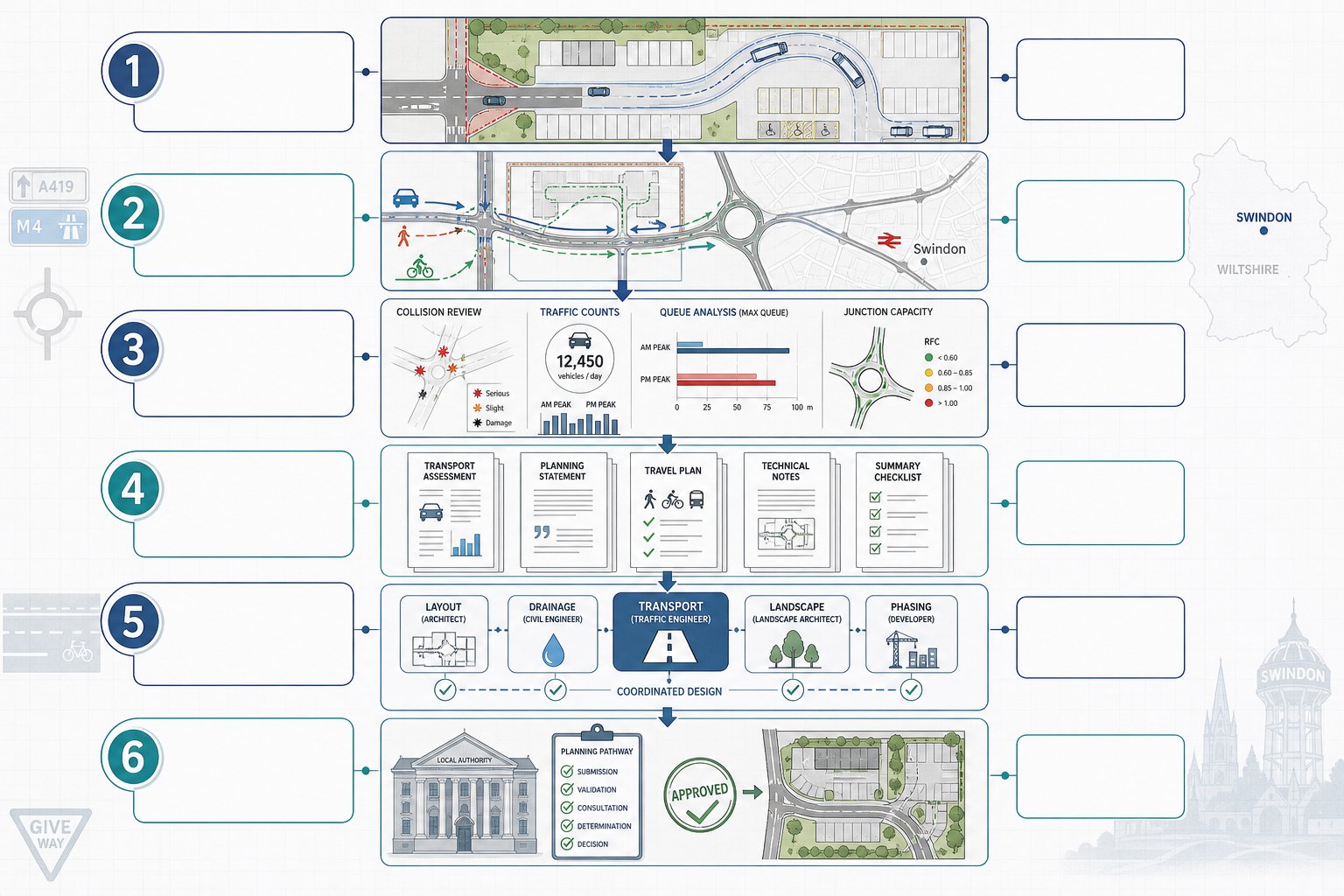
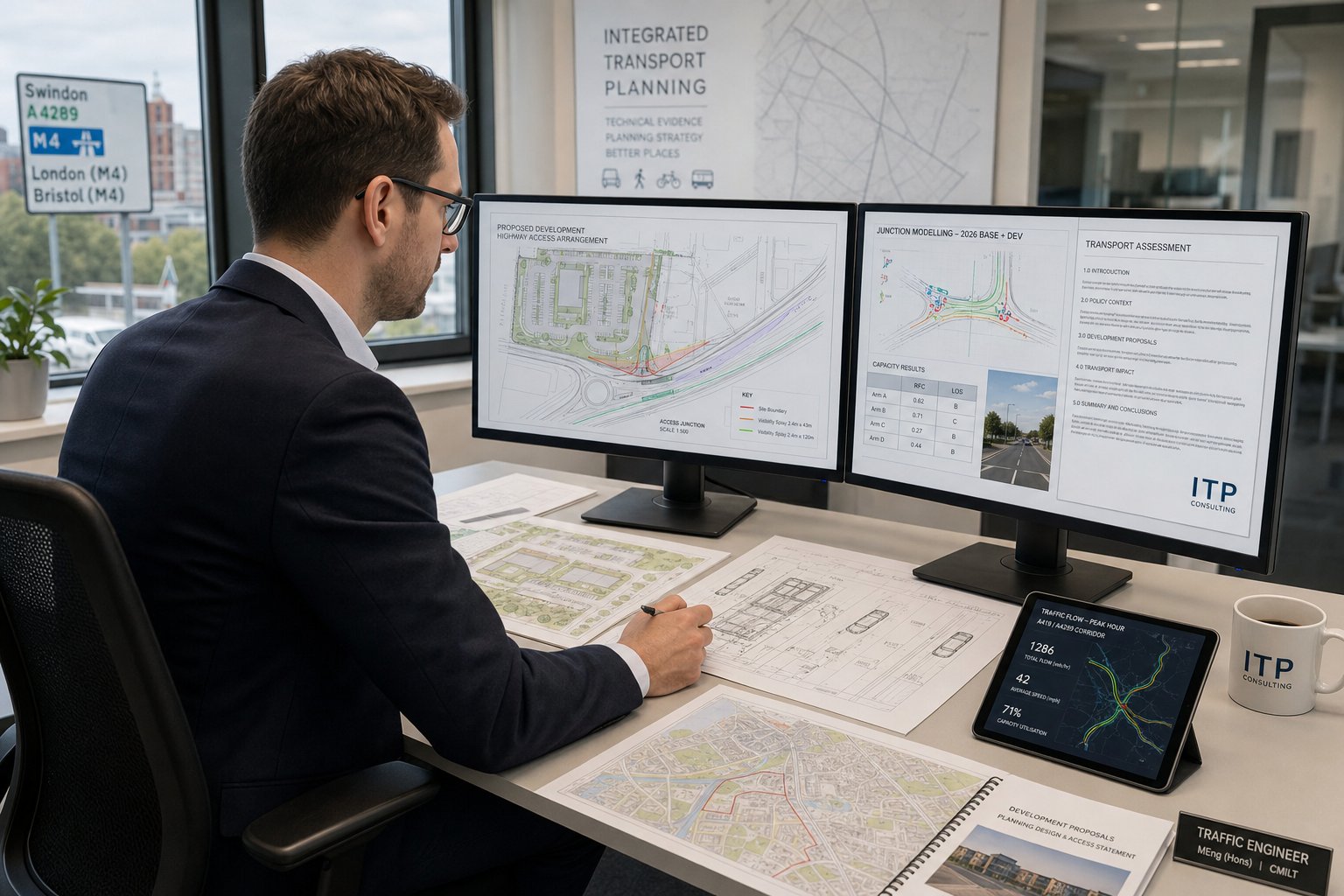
A traffic engineer in Swindon provides the technical transport evidence that sits behind a robust planning submission. In practice, that means reviewing how a proposed development will connect to the highway network, how people and vehicles will move through and around the site, and whether the scheme is likely to create any highway safety or capacity concerns.
Our role often starts earlier than many teams expect. We review draft layouts, access points, swept paths, parking arrangements, and likely trip impacts before the planning package is fixed. That early review matters because once an architect has coordinated a layout around units, floor space, drainage, and landscape, changing an access geometry or visibility splay can be awkward and expensive.
We also prepare the documents that local planning authorities and highway officers rely on: Transport Assessments, Transport Statements, Travel Plans, junction assessments, and focused technical notes. Where comments come back from officers, we respond with evidence rather than guesswork. That may involve collision analysis, traffic surveys, capacity modelling, or design revisions that improve the application’s chances.
On more complex sites, we coordinate closely with the wider consultant team. A useful overview of that broader role sits within Highway And Traffic, but the key point is this: transport input is rarely separate from planning strategy. It shapes viability, layout, phasing, and often the tone of the authority’s response.
When A Transport Assessment, Transport Statement, Or Technical Note Is Needed
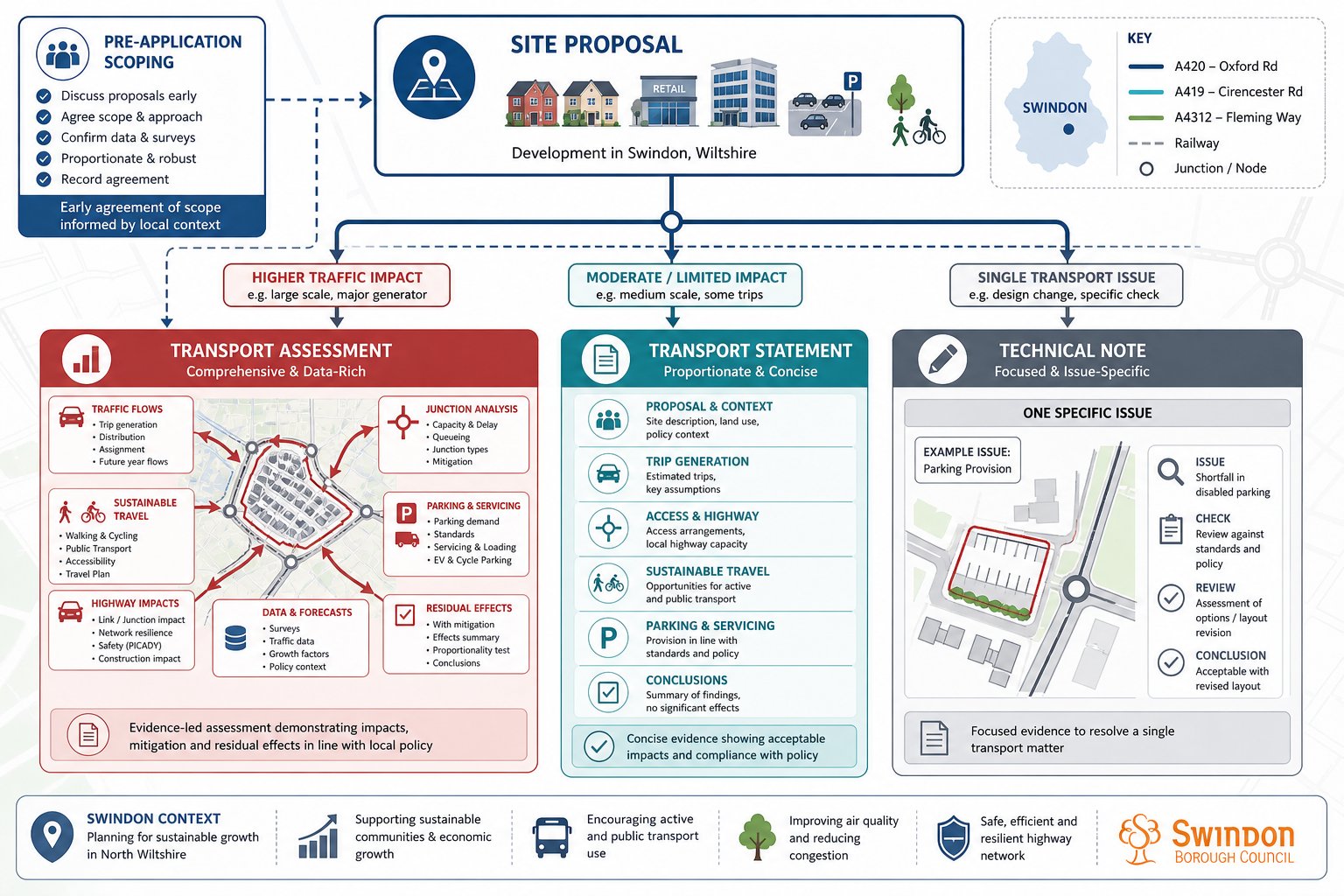
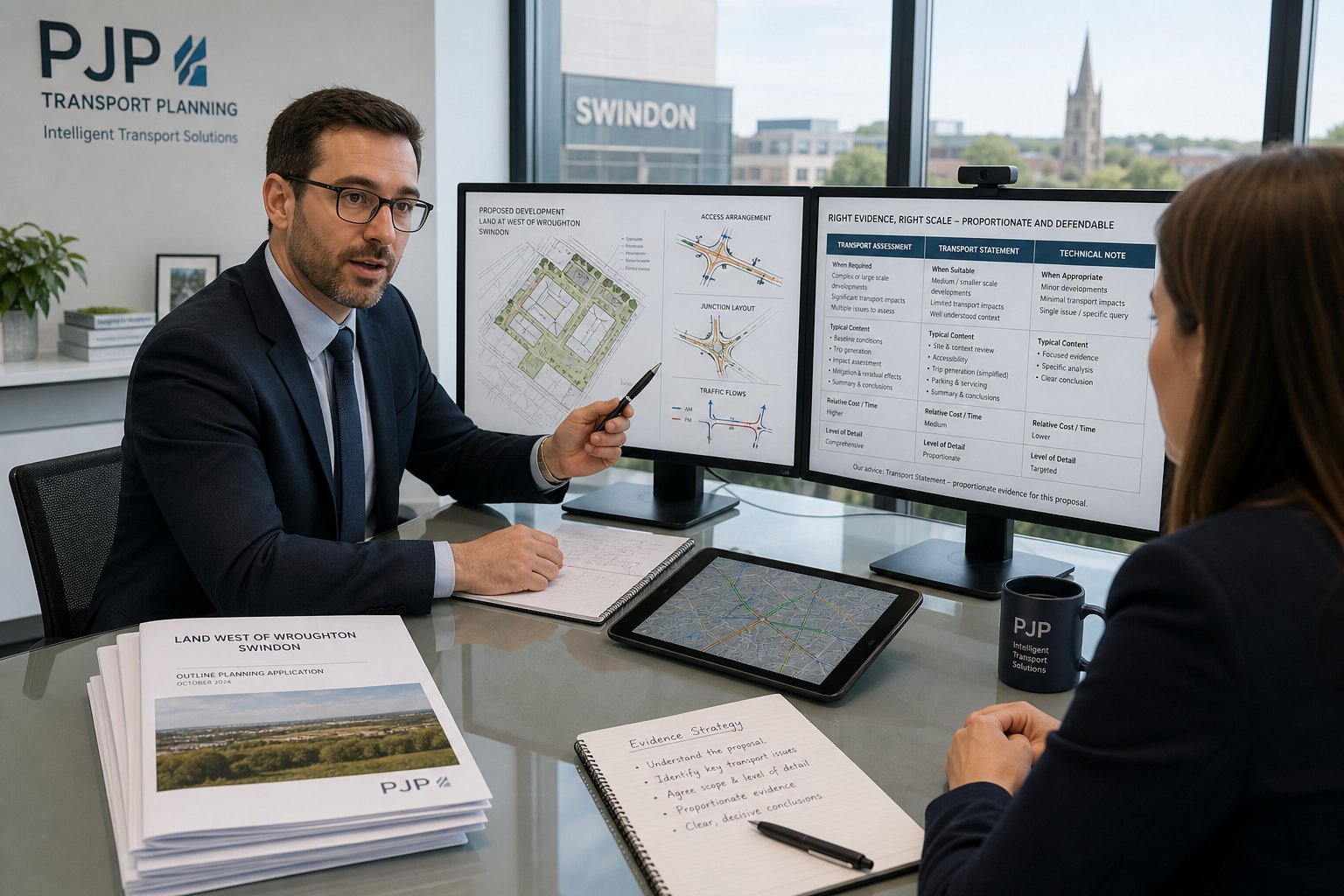
Not every site in Swindon needs a full Transport Assessment. But every scheme needs the right level of transport evidence. Getting that balance wrong is common. Some applicants over-prepare and spend money where a concise statement would do. Others under-scope the work and then have to retrofit surveys, modelling, and mitigation after highways objections land.
A Transport Assessment is usually required where a proposal is likely to generate material traffic effects. That typically includes larger residential schemes, retail development, employment sites, roadside uses, and proposals with sensitive access arrangements or constrained nearby junctions. A TA tends to cover baseline conditions, trip generation, trip distribution, junction capacity, sustainable travel options, and the residual impact of the development.
A Transport Statement is more proportionate for smaller or medium-sized schemes where transport effects are more limited. It still needs to be evidence-based, but it is lighter in scope and more focused on demonstrating that impacts are acceptable.
A Technical Note is narrower. We often prepare one to address a specific issue raised during determination, such as revised parking numbers, an amended access, or a single junction modelling exercise. In some cases, a focused note is exactly what is needed to keep an application moving.
Scope should ideally be agreed at pre-app stage. That approach mirrors the more general advice set out in Traffic Engineering Consultants: What: define the transport questions early, and the reporting becomes faster, leaner, and more defensible.
How Swindon Planning Context And Local Highway Requirements Shape Transport Reports
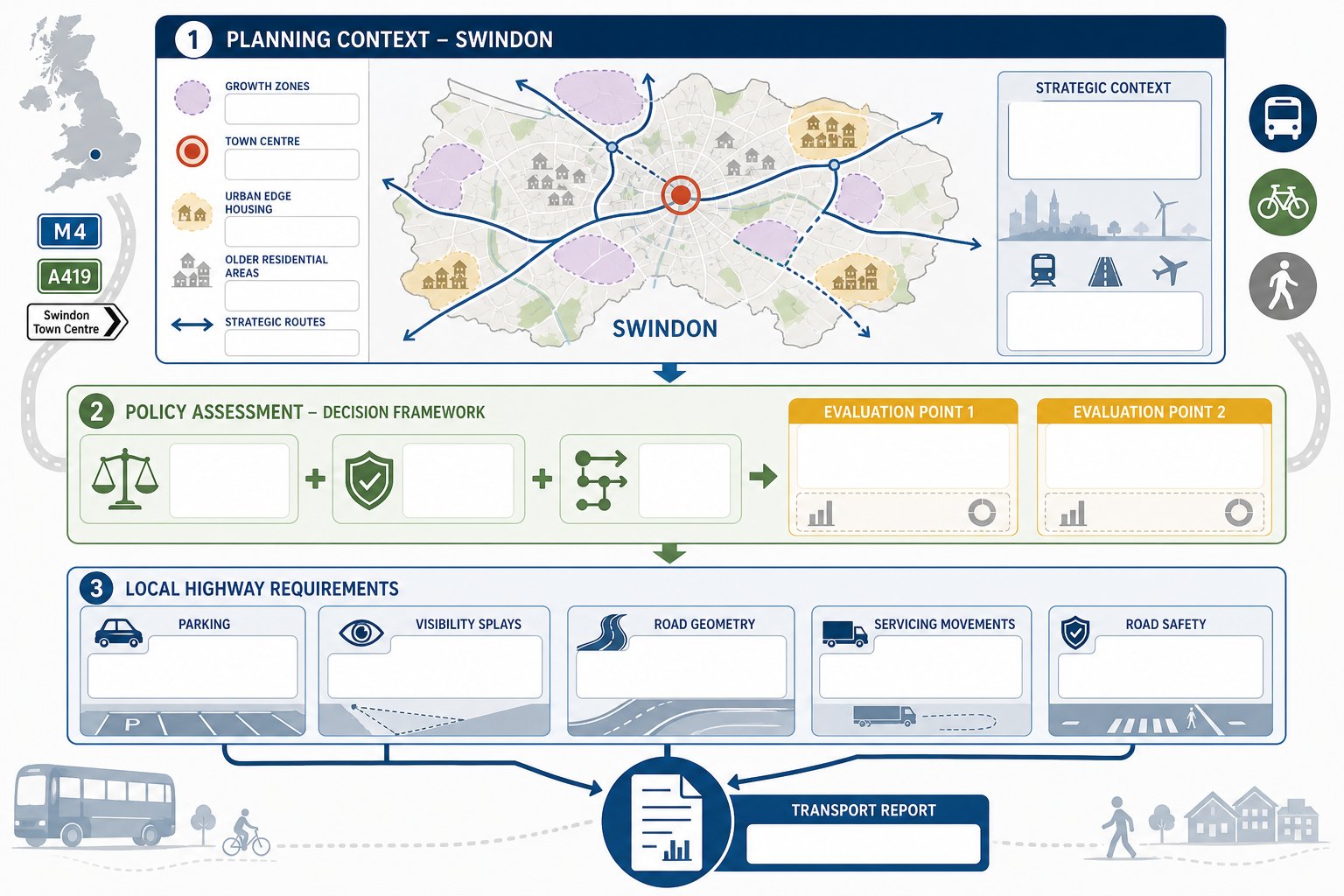
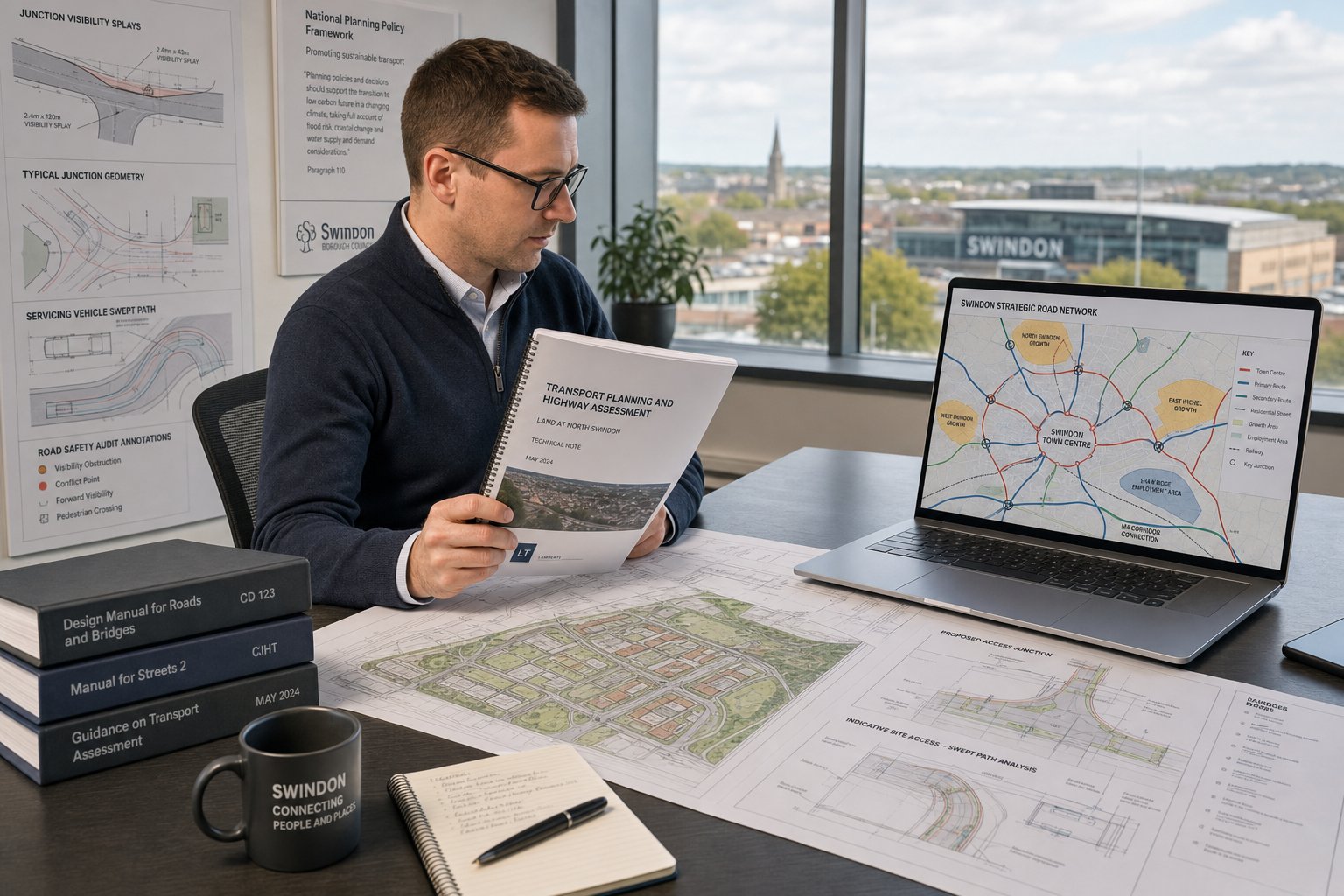
Transport reports are never written in a vacuum. In Swindon, they need to reflect the local planning context, the highway authority’s expectations, and national policy tests. That sounds obvious, yet many weak submissions fail because they rely on generic reporting that could have been written for almost anywhere.
We tailor reports to the realities of the borough: local growth areas, town centre change, strategic routes, established residential streets, and the relationship between newer expansion areas and older highway infrastructure. A site near the urban edge, for example, raises different questions from an infill scheme close to public transport and established walking links.
The policy framework matters too. National planning policy is clear that development should only be prevented or refused on highways grounds where there would be an unacceptable impact on highway safety, or where the residual cumulative impacts on the road network would be severe. Those are high bars, but they still demand properly structured evidence.
Local parking standards, visibility requirements, road geometry, servicing expectations, and road safety considerations then shape the detail. We hence build reports around the standards and concerns most likely to arise in Swindon rather than relying on boilerplate assumptions. The same principle applies in other authorities, whether in Traffic Engineer In Birmingham: work or elsewhere: local knowledge changes the quality of the advice, and often the outcome.
Common Development Types That Need Traffic Engineering Input
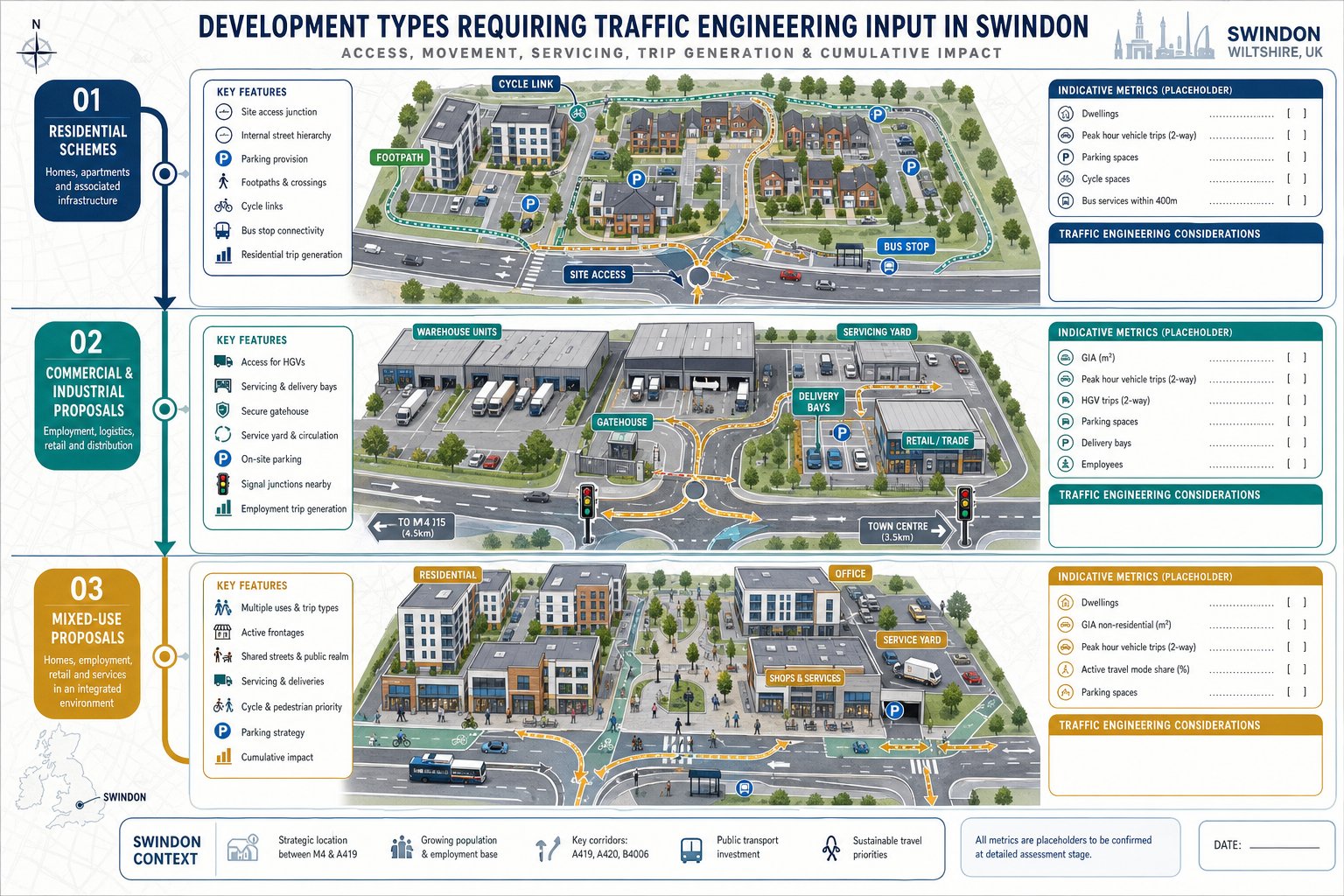
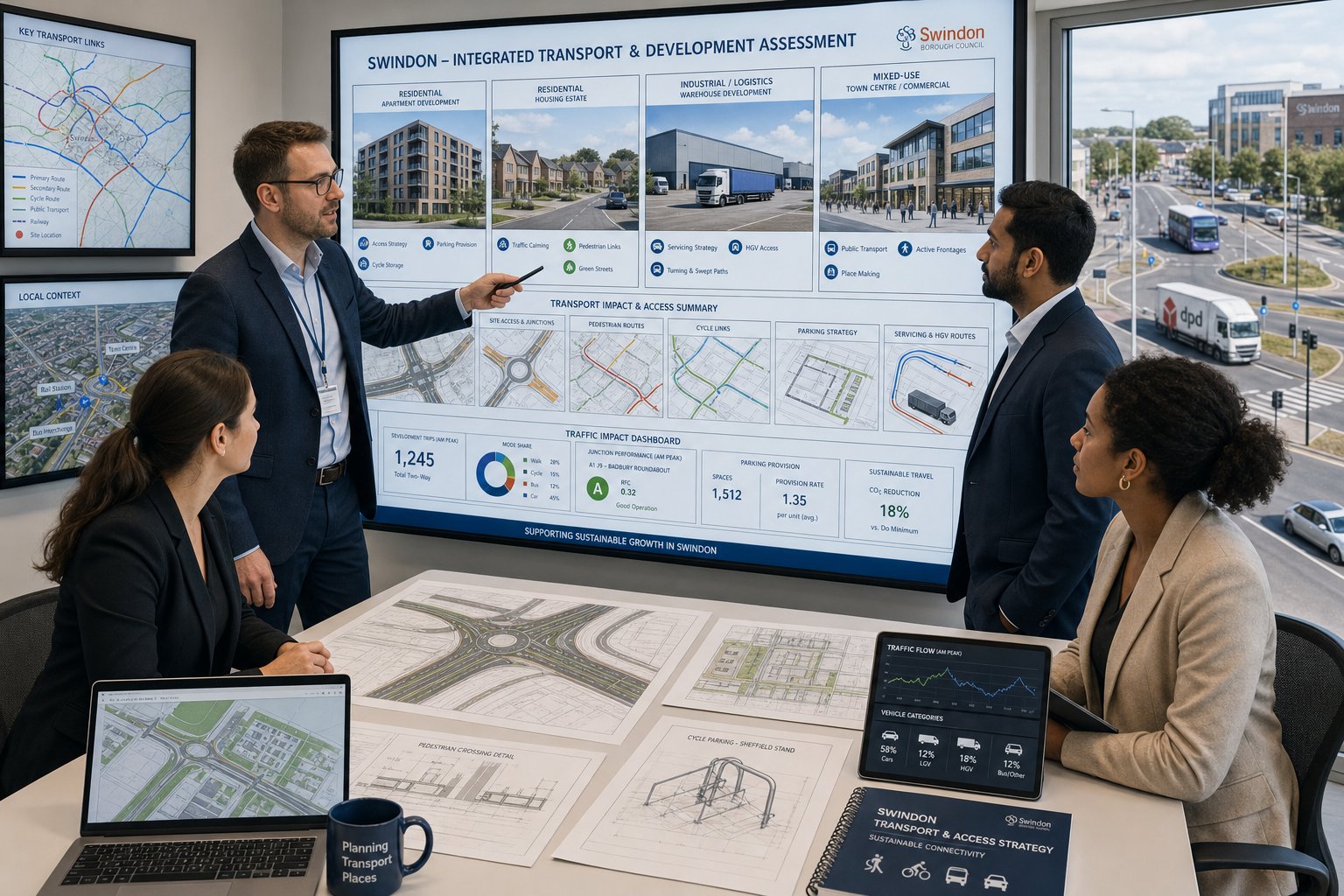
Some schemes clearly need transport input from day one. Others look modest at first glance, then reveal access, servicing, or cumulative impact issues once the detail is tested. In Swindon, the range is broad, but a few development categories come up again and again.
Residential Schemes
Residential development is probably the most frequent trigger for transport reporting. That includes single access apartment blocks, backland housing, roadside infill plots, medium-sized estates, and strategic urban extensions. The transport issues vary by scale. A small site might focus on access width, turning, parking, and visibility. A larger scheme will usually need trip generation, junction impact testing, internal street hierarchy, pedestrian links, and travel planning.
Residential schemes also tend to attract detailed scrutiny on whether the site is genuinely sustainable. Officers will want to understand how future residents can walk to local facilities, access bus services, and cycle safely. Parking pressure on surrounding streets is another recurring concern, especially where on-site provision is tight.
Commercial, Industrial, And Mixed-Use Proposals
Commercial and industrial proposals often create more specialised transport questions. Warehousing and logistics schemes may hinge on HGV routing, servicing space, gatehouse operation, or peak hour interactions with nearby junctions. Office and retail schemes raise different issues: arrival profiles, linked trips, public transport accessibility, and town centre parking dynamics.
Mixed-use proposals are often the most interesting technically because they combine several movement patterns in one place. Internal circulation, servicing conflicts, pedestrian priority, and phasing all need careful thought. On these schemes, our job is not just to prove acceptability but to show that the transport strategy supports the placemaking ambition as well.
What A Traffic Engineer Will Review Before Preparing A Report
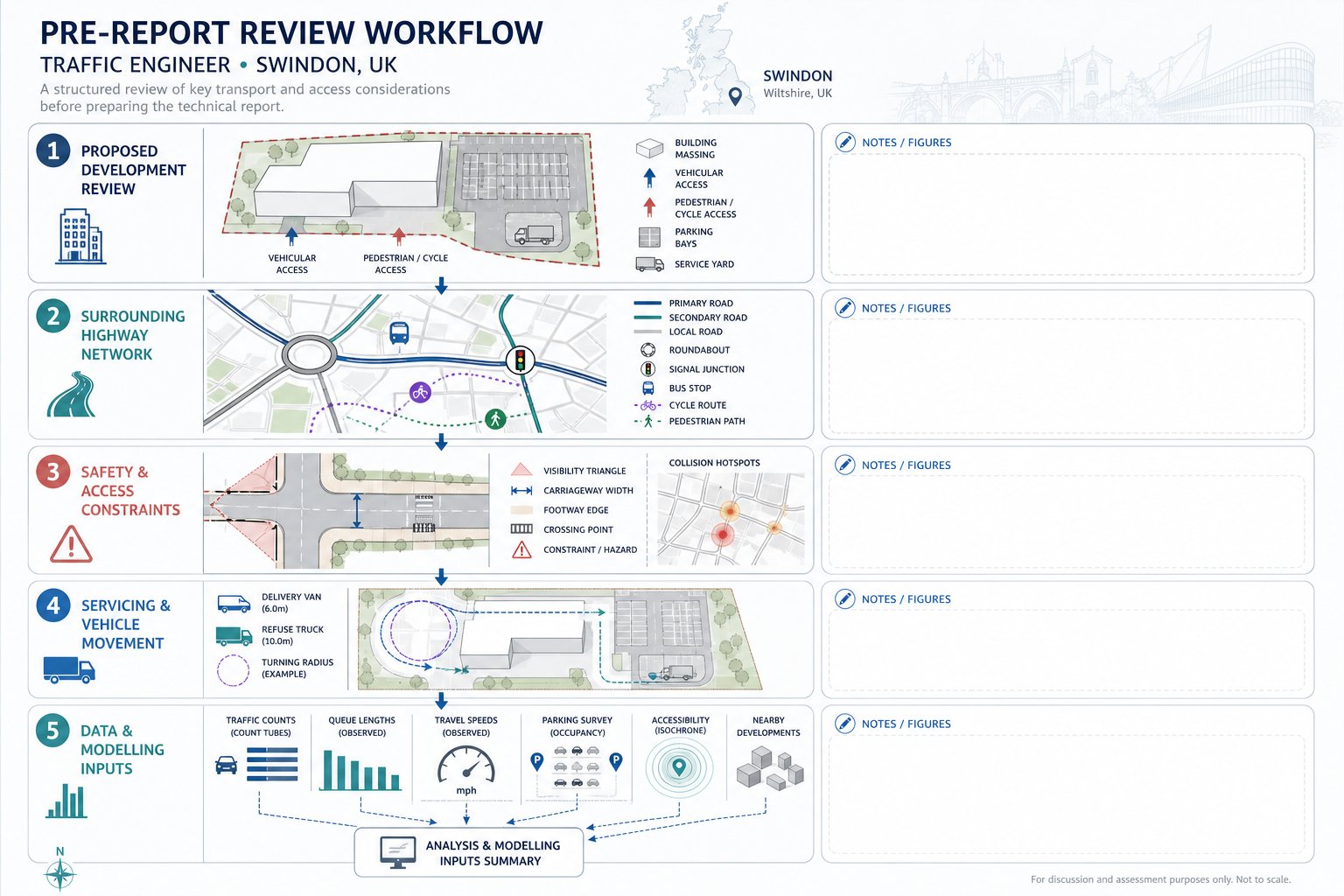
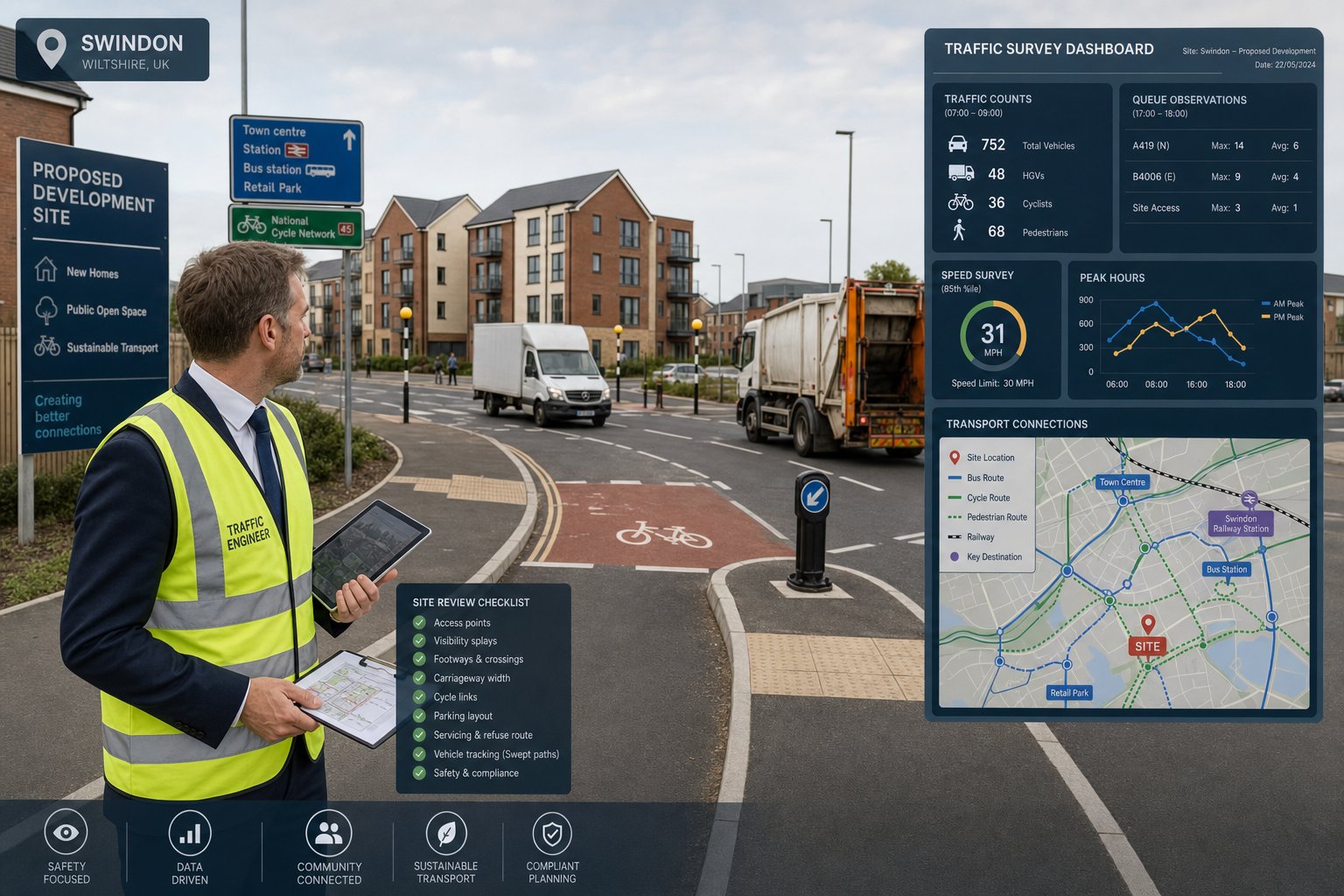
Before we write a report, we need to understand both the site and the network around it. That groundwork is where good transport advice starts. If the baseline review is shallow, the final report usually is too.
We typically begin with the proposed development itself: land use, scale, access points, parking numbers, servicing demands, internal layout, and likely build-out assumptions. Then we review the surrounding highway network, including road hierarchy, traffic conditions, nearby junction forms, speed environment, public transport links, and walking and cycling connections.
A proper site review also looks closely at visibility splays, carriageway width, footway provision, crossing opportunities, collision history, and any features that could constrain safe access. Servicing can be a hidden issue. Plenty of layouts work well for cars but fail once delivery vehicles, refuse collection, or larger vans are tracked properly.
Data collection may include traffic counts, queue observations, speed surveys, parking beat surveys, and accessibility mapping. On more technical schemes, we review committed development nearby and any background growth assumptions that should feed into modelling.
This front-end work is one reason concise specialist input can outperform generic reporting. Across projects, whether in Swindon or in Traffic Engineer In Leeds:, the strongest submissions are usually the ones where the report writer has properly interrogated the site rather than simply described it.
Access Design, Visibility, Parking, And Highway Safety Considerations
Access is often where planning transport issues become very tangible. A drawing may look neat in plan form, but the highway authority will want to know whether vehicles can enter and leave safely, whether emerging drivers can see adequately, and whether the design works in the real street environment rather than just in CAD.
Visibility is a common flashpoint. Required splays depend on traffic speed, road geometry, frontage conditions, and local standards. Achieving them can be awkward on constrained plots, especially where boundary walls, vegetation, parked vehicles, or vertical alignment interfere. We test these issues early because if visibility is fundamentally compromised, it is better to know before the application goes in.
Parking is more nuanced than simply counting spaces. We review allocation, visitor demand, disabled provision, cycle parking, EV charging expectations, manoeuvring quality, and the risk of overspill onto nearby roads. Some sites benefit from reduced parking if they are in sustainable locations: others need stronger justification if provision sits below local expectations.
Highway safety goes beyond geometry. We assess collision patterns, likely conflict points, pedestrian routes, servicing interactions, and whether the proposal introduces unusual or avoidable risk. Sometimes the right answer is a modest design amendment. Sometimes it is a clearer technical explanation. And sometimes, bluntly, the layout needs reworking.
Junction Capacity, Trip Generation, And Traffic Impact Analysis
When a scheme is likely to affect nearby junctions, transport reporting moves from descriptive to analytical. This is the point where decision-makers want to know not just what the proposal is, but what it does to the network.
Trip generation is usually the starting point. We estimate how many vehicle, pedestrian, cycle, and public transport trips the development is likely to create, often using recognised database sources and local comparators where appropriate. The quality of professional judgement matters here. A suburban employment site in Swindon won’t necessarily behave like a city-centre scheme in another authority, even if the land use class is similar.
From there, we consider trip distribution and assignment: where those trips are likely to come from and go to. That informs which junctions need testing and at what peak periods.
For capacity analysis, we may use tools such as PICADY, ARCADY, LINSIG, SIDRA, or microsimulation on larger or more sensitive schemes. The right software depends on the junction form and the planning question being asked. What matters is not using complicated modelling for its own sake, but using proportionate analysis to show whether the residual impact is acceptable and whether mitigation is needed.
This kind of evidence-led approach is a consistent feature in Traffic Engineer In Manchester: work as well: robust assumptions, transparent reporting, and conclusions that an officer can actually rely on.
Travel Plans, Sustainable Transport, And Active Travel Expectations
Modern transport reporting in Swindon is not only about vehicle impact. It is also about how a development supports sustainable movement from the outset. For many applications, especially residential, office, education, healthcare, and larger mixed-use proposals, the authority will expect a credible account of how walking, cycling, and public transport have been considered.
That means reviewing footway continuity, crossing quality, local bus services, distance to everyday facilities, cycle parking, end-of-trip facilities, and the permeability of routes through and beyond the site. If a scheme relies on active travel claims that don’t survive a site walk, officers tend to spot it quickly.
A Travel Plan can help convert broad sustainability aims into practical commitments. Depending on the development, that might include welcome packs, cycle facilities, travel information, public transport incentives, monitoring arrangements, or the appointment of a coordinator. The best Travel Plans are realistic. They reflect who will use the site and how people actually make travel choices, rather than reading like a policy template.
We also look at whether the scheme can improve existing conditions. A new or widened footway, a cleaner crossing arrangement, better cycle access, or clearer wayfinding can make a material difference. In planning terms, those details often help a proposal feel aligned with current transport policy rather than merely compliant.
How Early Traffic Engineering Advice Can Reduce Planning Delays
The cheapest time to solve a transport problem is usually before the design hardens. Once an application is submitted, every highway concern becomes slower and more expensive to answer. Revised drawings need coordination, further surveys may require fresh commissioning, and determination timetables start to slip.
Early traffic engineering advice reduces that risk in a few very practical ways. First, it identifies fatal or near-fatal issues at concept stage: substandard visibility, awkward refuse tracking, inadequate parking, unsuitable access gradients, or likely pressure on a nearby junction. Second, it helps define the correct reporting scope, so the application is supported by enough evidence from the beginning. Third, it gives the project team a basis for pre-application discussions with the authority.
In our experience, pre-app transport engagement is often worth it for anything beyond the simplest site. It narrows the likely debates and helps avoid the classic mid-process request for “further clarification” that quietly adds a month.
There’s also a softer benefit. When a submission reads as though transport has been properly thought through, officers tend to spend less time probing basic omissions. That does not guarantee approval, of course, but it improves the quality of the conversation. Similar lessons come through in Traffic Engineer In London: work, even if the local detail differs sharply.
Choosing A Traffic Engineer In Swindon For Accurate, Council-Ready Reporting
If you are appointing a traffic engineer in Swindon, technical competence is only part of the picture. The real test is whether the consultant can produce reporting that is proportionate, locally informed, and genuinely useful to the planning strategy.
We would look for three things. First, local authority understanding. A consultant should know how Swindon Borough Council and its highway officers typically approach access, parking, sustainability, and impact thresholds. That local feel saves time because the report is framed around the questions the authority is most likely to ask.
Second, modelling and report-writing ability. Plenty of people can run software: fewer can explain assumptions clearly, justify professional judgement, and produce a document that reads well under scrutiny from planners, highways officers, and occasionally planning counsel. That matters.
Third, relevant project experience. Residential infill, commercial access strategies, and strategic allocations all carry different transport risks. A consultant who has handled similar schemes before will usually spot issues faster and propose cleaner solutions.
At ML Traffic, that’s the space we work in: concise, accurate transport reports delivered quickly, shaped by more than 30 years of experience and tailored to local thresholds and planning contexts. If you need a broader sense of how specialist input supports approval pathways, Traffic Engineer In Liverpool: examples show the same principle in another local authority setting.
Conclusion
A strong planning submission is not just about good design or the right planning statement. It also depends on whether the transport case is proportionate, credible, and aligned with local expectations. That is exactly where a traffic engineer in Swindon adds value.
When transport advice is brought in early, access issues are easier to fix, report scope is easier to agree, and the final application is far less likely to be weakened by avoidable highway objections. For architects, planners, developers, surveyors, and councils, the benefit is practical rather than theoretical: clearer evidence, smoother determination, and a better chance of securing a policy-compliant outcome.
In 2026, with planning scrutiny still tight and transport policy still moving toward safer, more sustainable development, council-ready reporting is not a luxury. It is part of how stronger applications get over the line.
Frequently Asked Questions about Traffic Engineering in Swindon
What does a traffic engineer in Swindon do for planning applications?
A traffic engineer in Swindon reviews development proposals, designs access and internal roads, prepares Transport Assessments and Statements, and addresses highway comments to ensure the scheme meets local standards and reduces planning delays.
When is a Transport Assessment required for developments in Swindon?
Transport Assessments are usually required for larger schemes with significant traffic impacts, such as major residential, retail, or employment sites, to evaluate trip generation, junction capacity, and potential highway effects.
How do local planning policies in Swindon affect transport reports?
Transport reports must reflect Swindon’s Local Plan allocations, highway design and parking standards, and comply with national policy like the NPPF, focusing on highway safety and avoiding severe residual impacts.
What are common traffic engineering concerns for residential developments in Swindon?
Key concerns include safe access, adequate visibility splays, parking allocation, sustainable travel options, and managing parking pressures on surrounding streets to meet Swindon Borough Council requirements.
How does early traffic engineering advice help reduce planning delays?
Early advice identifies potential access or safety issues before finalising designs, agrees the scope of Transport Assessments with highways, and minimises late requests for additional surveys or revisions, streamlining planning approval.
What should I look for when choosing a traffic engineer in Swindon?
Choose a traffic engineer with strong knowledge of Swindon Borough Council’s local standards, excellent modelling and report-writing skills, and experience handling similar residential or commercial schemes to ensure council-ready reports.